Explore papers
Filter by research area, year and venue. Every filter is in the address bar, so you can share a view as a link.
 Spread & networksPlatforms, policy & society
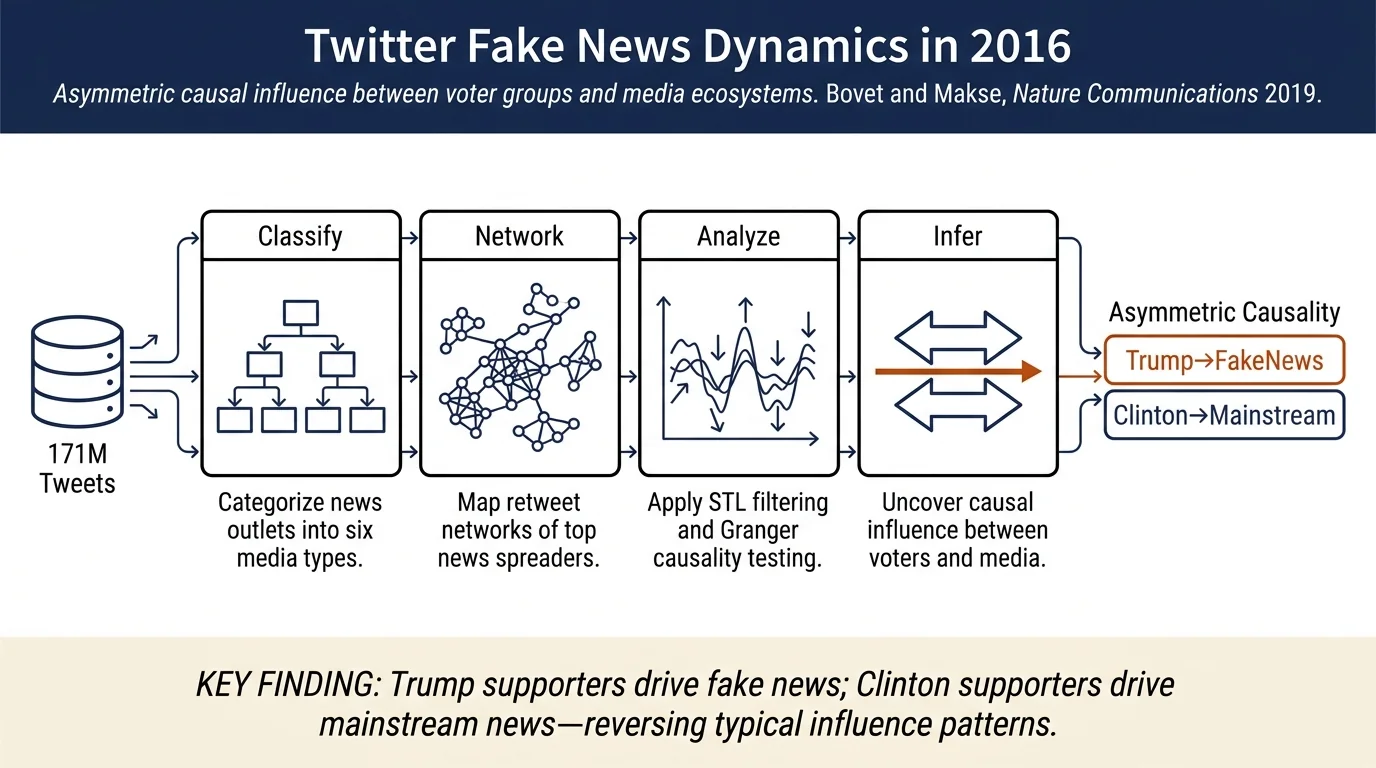
Influence of fake news in Twitter during the 2016 US presidential electionUsing 171 million tweets from the five months preceding the 2016 U.S. election, this study found that 25% of news-sharing tweets contained fake or extremely biased content. Network analysis revealed distinct clusters of fake, biased, and mainstream news spreaders.
 Spread & networksPlatforms, policy & society
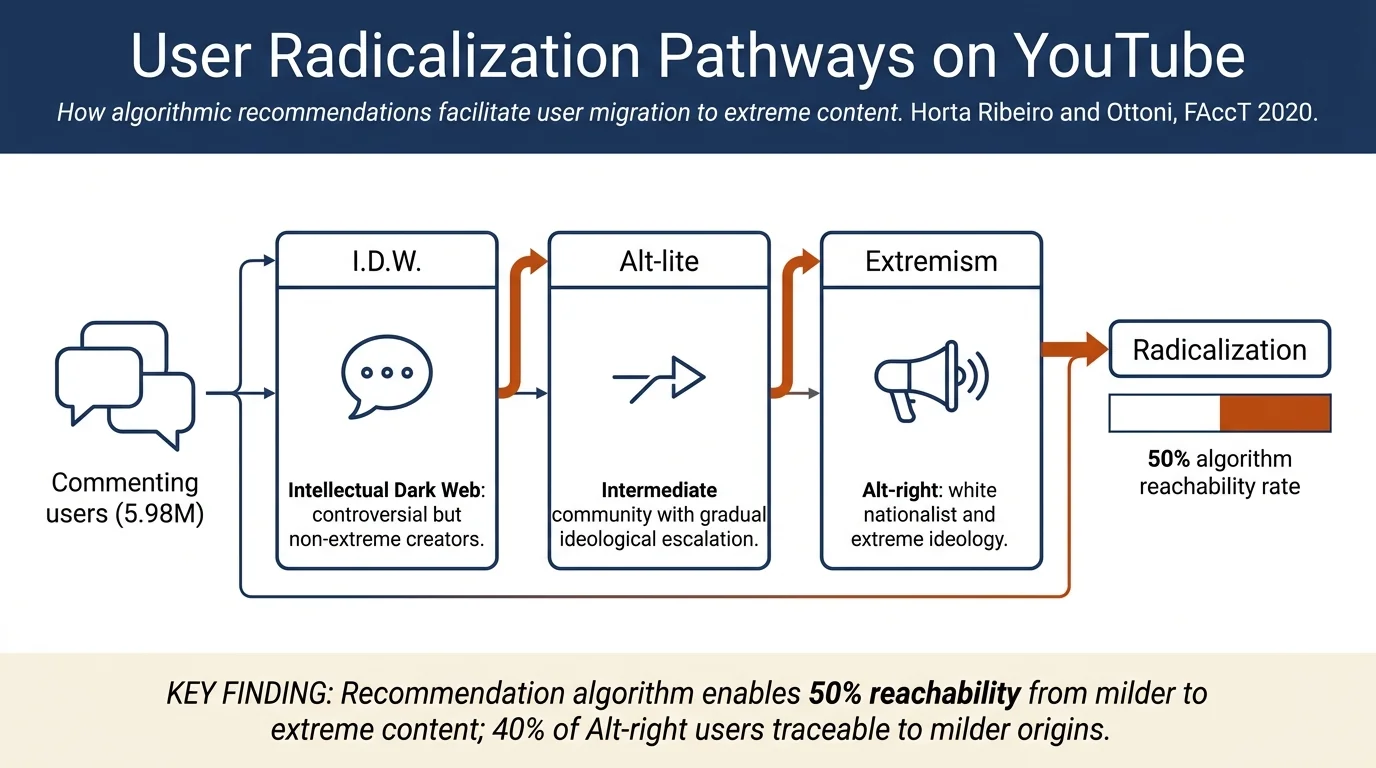
Auditing Radicalization Pathways on YouTubeFirst large-scale quantitative audit of user radicalization on YouTube. The authors tracked 349 channels across three ideological communities (Intellectual Dark Web, Alt-lite, Alt-right) and found strong evidence that users systematically migrate toward more extreme content.
 Datasets & evaluationSpread & networks
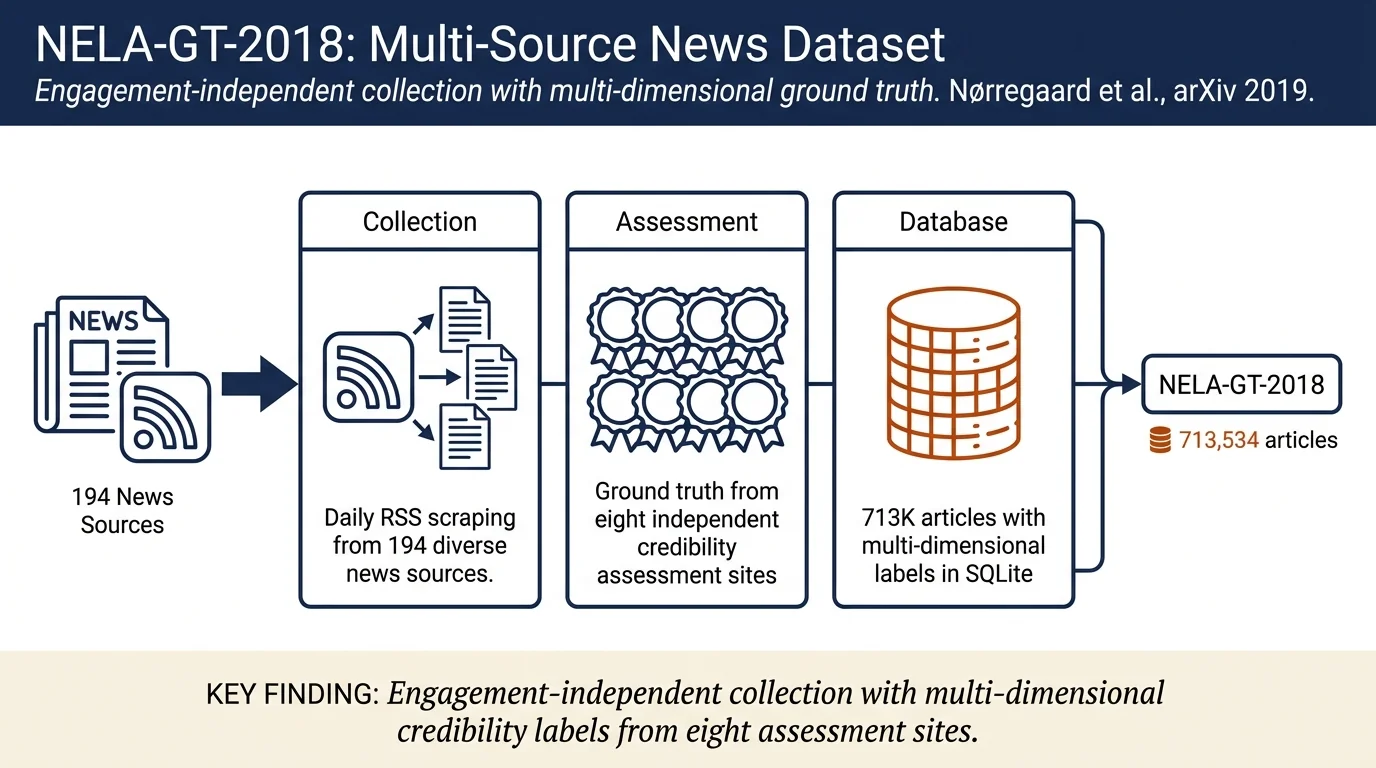
NELA-GT-2018: A Large Multi-Labelled News Dataset for The Study of Misinformation in News ArticlesNELA-GT-2018 is a large, engagement-independent collection of 713,534 news articles from 194 sources across 10 months (Feb–Nov 2018). It combines multi-source-level ground truth labels from eight independent assessment sites (NewsGuard, Pew Research, Wikipedia, OpenSources, Media Bias/Fact Check, AllSides, BuzzFeed News, PolitiFact)…
 Detection methodsSpread & networks
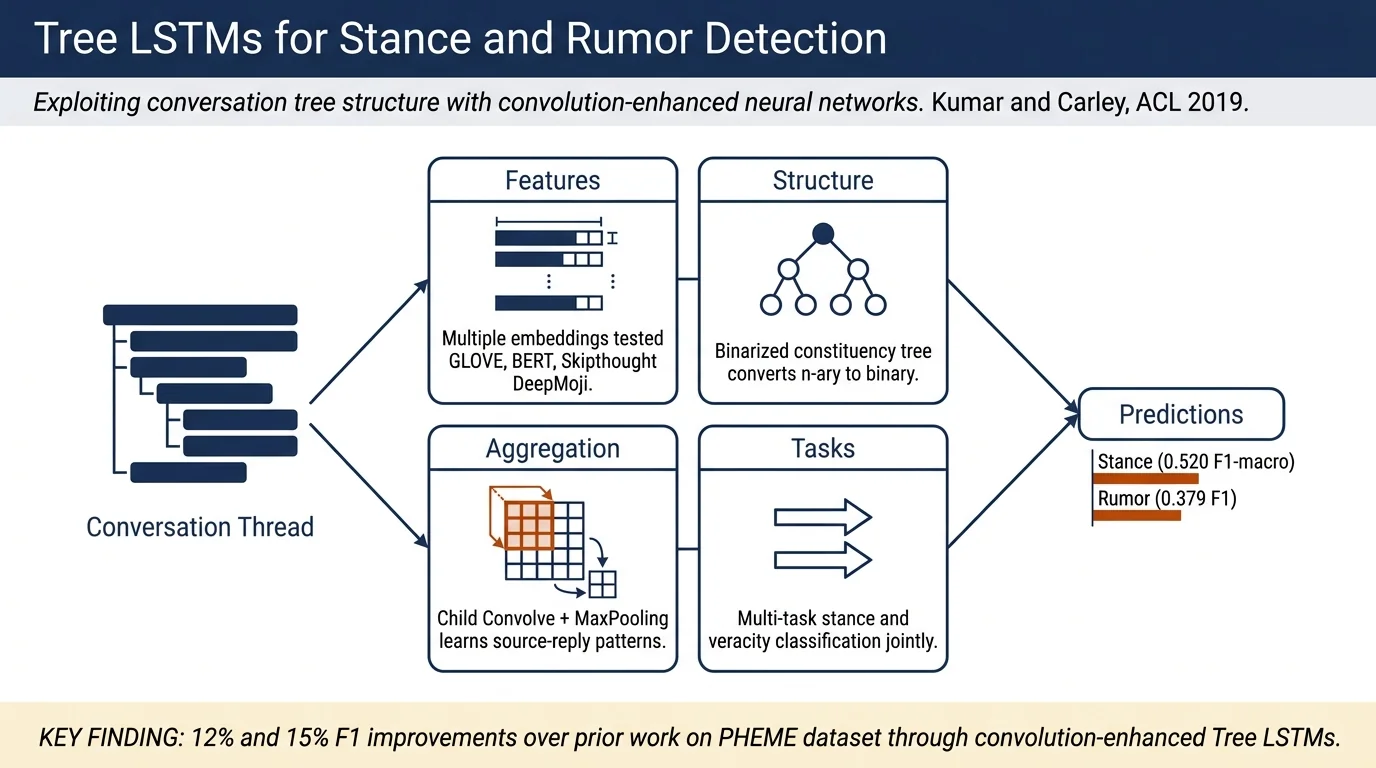
Tree LSTMs with Convolution Units to Predict Stance and Rumor Veracity in Social Media ConversationsProposes Tree LSTM and Binarized Constituency Tree (BCTree) LSTM architectures enhanced with convolution units to classify stance and predict rumor veracity in social media conversation threads. The approach exploits the tree structure inherent in threaded conversations (source post with nested replies) and combines it with convolutional…
 Spread & networksDatasets & evaluation
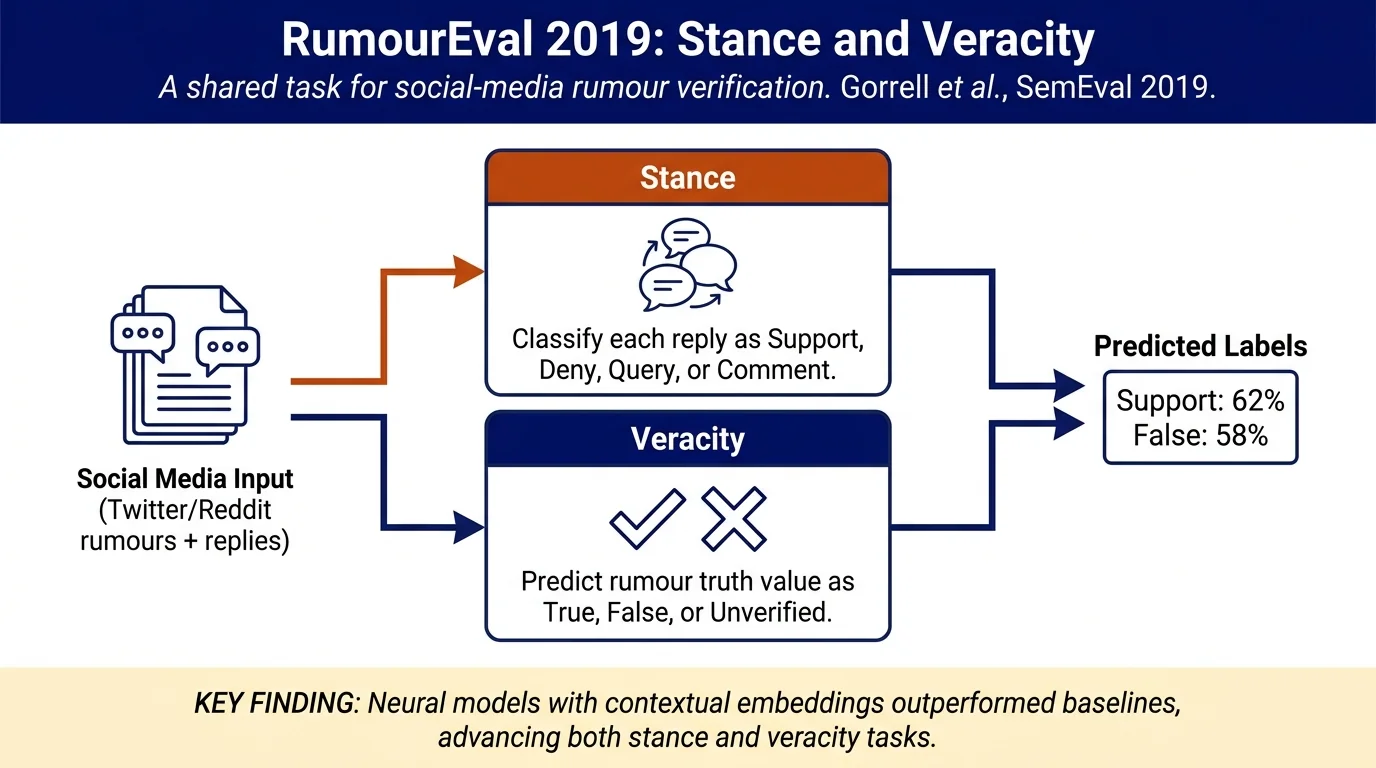
RumourEval 2019: Determining Rumour Veracity and Support for RumoursRumourEval 2019 is a shared task for rumour stance detection and veracity prediction on social media. Extending the 2017 edition, it introduces Reddit data alongside Twitter, provides datasets annotated for SDQC stance (Support/Deny/Query/Comment) and three-way veracity labels, and received 22 system submissions showing that modern…
 Spread & networksDetection methods
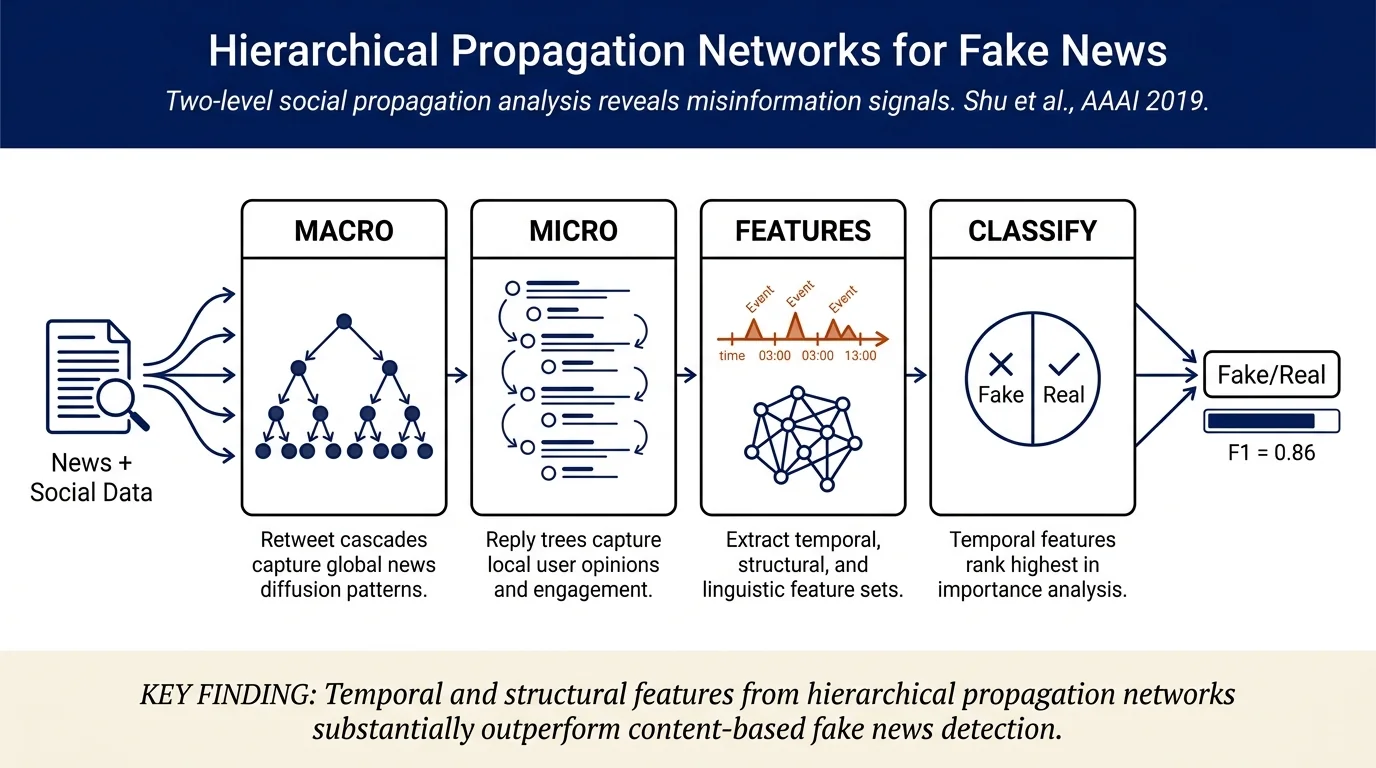
Hierarchical Propagation Networks for Fake News Detection: Investigation and ExploitationContent-only fake news detection has limited performance because fake news is deliberately crafted to mimic real news. This paper constructs hierarchical propagation networks from both macro-level (tweet/retweet cascade) and micro-level (reply conversation) granularity, extracts structural, temporal, and linguistic features from both…
 Spread & networksDetection methods
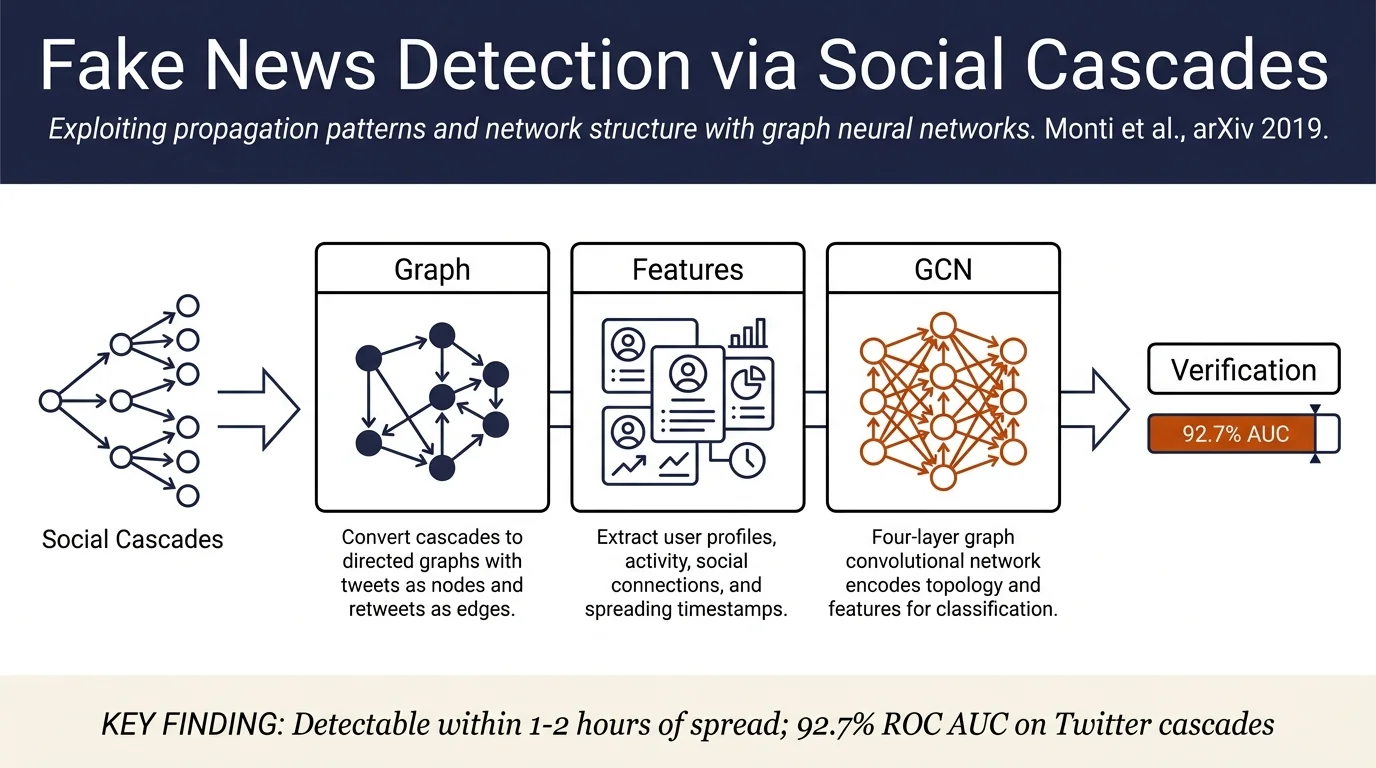
Fake News Detection on Social Media using Geometric Deep LearningA graph neural network approach for fake news detection that exploits social network structure and news propagation patterns rather than content alone. The method integrates user profiles, social connections, and cascade dynamics to achieve 92.7% ROC AUC on Twitter data and can detect fake news within hours of propagation.
 Spread & networksDetection methods
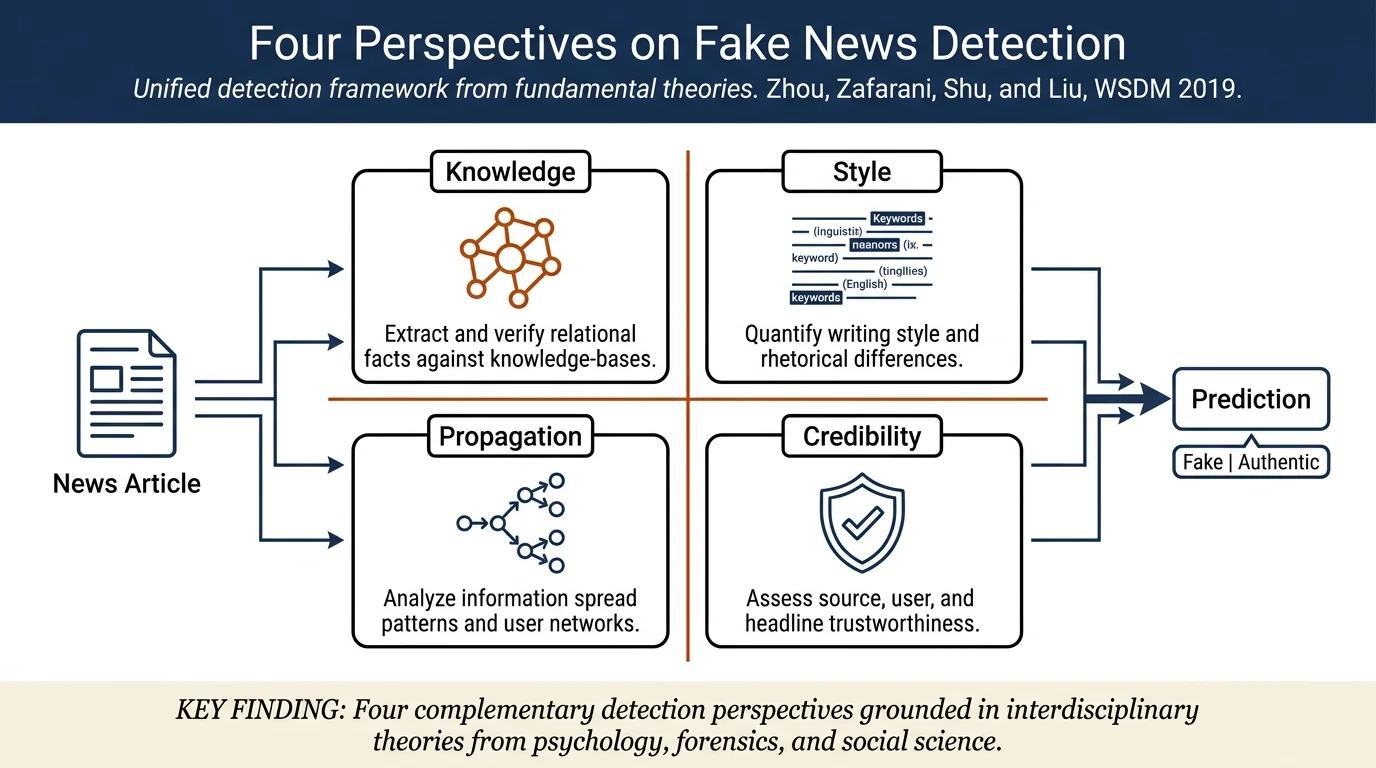
Fake News: Fundamental Theories, Detection Strategies and ChallengesA comprehensive tutorial framework addressing fake news research across three dimensions: (1) fundamental theories from psychology, social science, economics, and forensics explaining human vulnerability to misinformation and why individuals participate in fake news activities; (2) detection strategies unified across four perspectives…
 Detection methodsSpread & networks
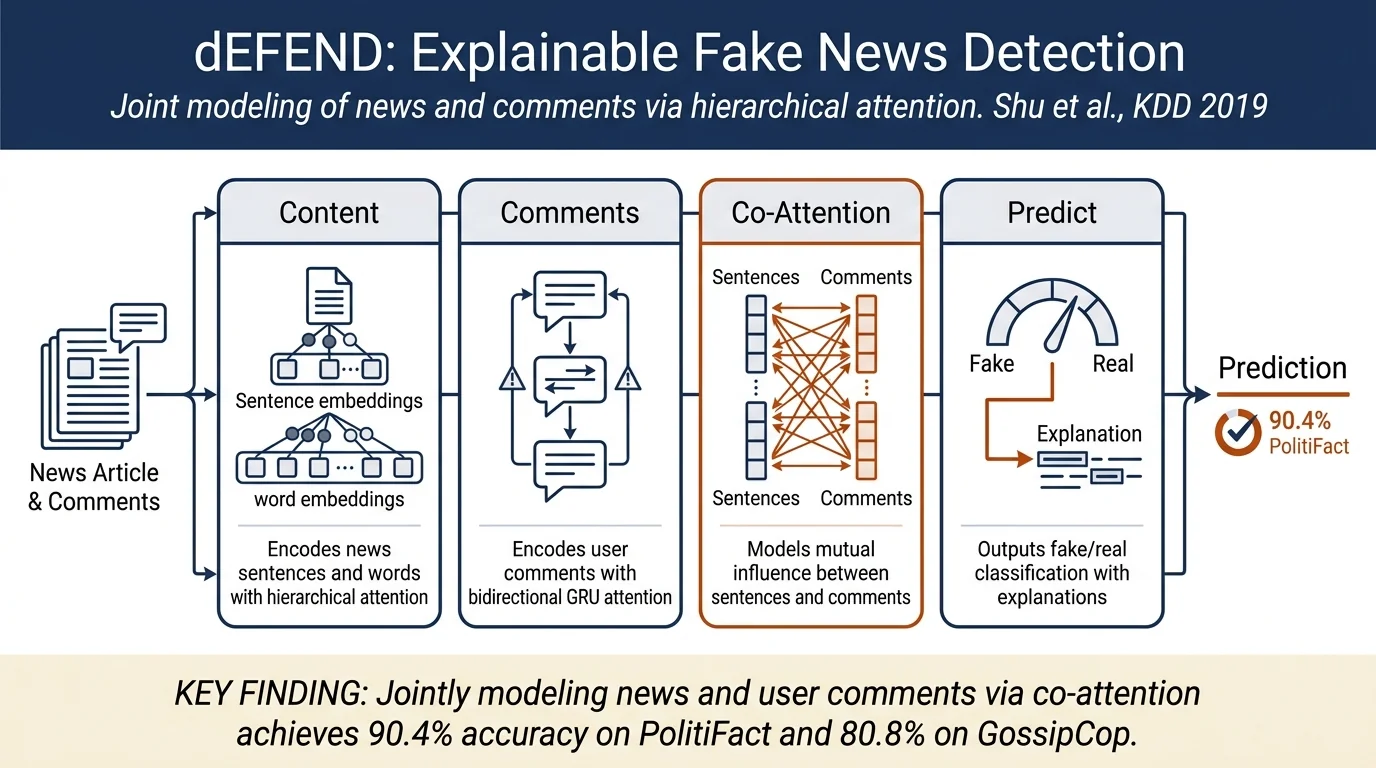
dEFEND: Explainable Fake News DetectionFake news detection on social media typically focuses on content alone, but user comments and reactions provide complementary signals. This paper proposes dEFEND, a hierarchical attention neural network that jointly encodes news sentences and user comments to both detect fake news and explain why a piece of news is detected as fake by…
 Spread & networksPlatforms, policy & society
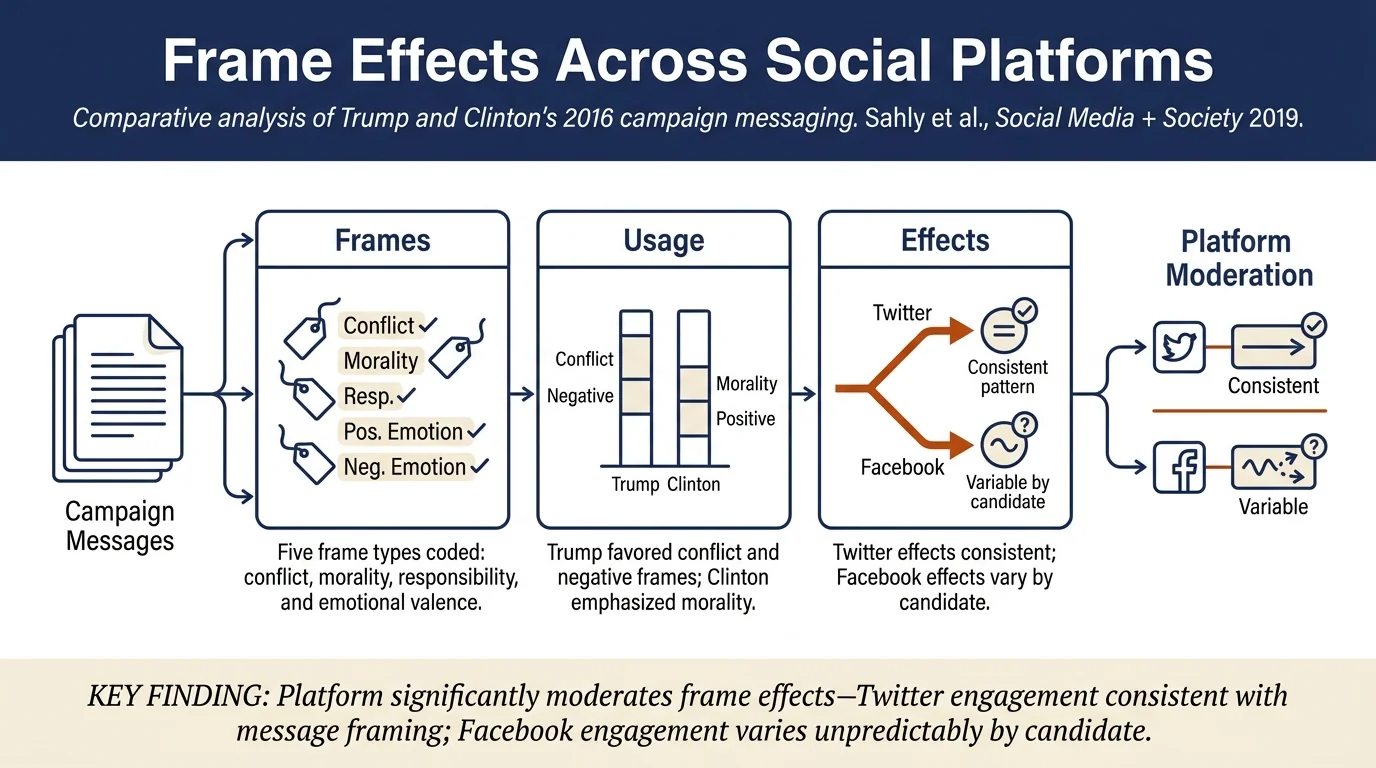
Social Media for Political Campaigns: An Examination of Trump's and Clinton's Frame Building and Its Effect on Audience EngagementThis study analyzes how Trump and Clinton's 2016 campaigns framed messages on Twitter and Facebook, and how frame type affected audience engagement. Trump relied on conflict and negative emotional frames, while Clinton used morality and positive emotional frames.
 Spread & networksBots & coordinated campaigns
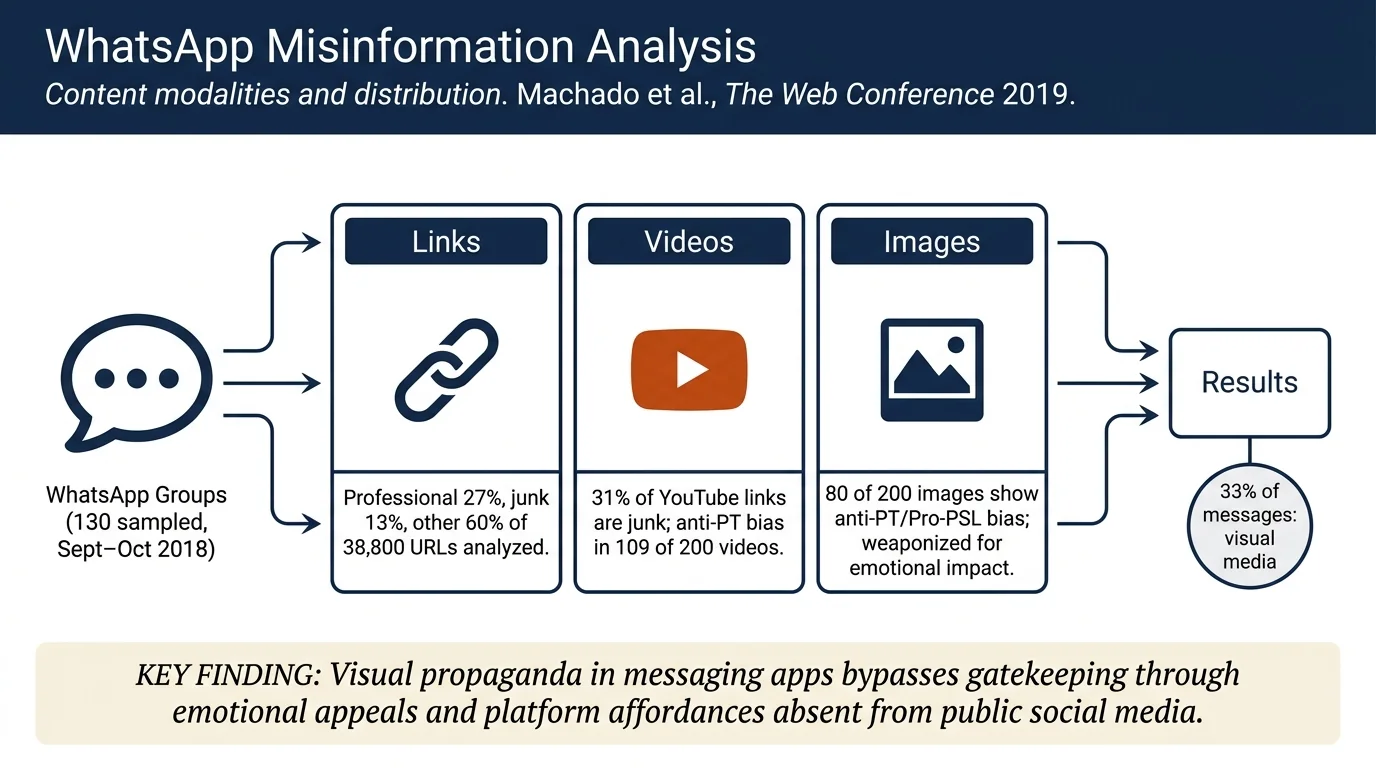
A Study of Misinformation in WhatsApp groups with a focus on the Brazilian Presidential ElectionsStudy of 130 public WhatsApp groups during the 2018 Brazilian presidential election found that 13.1% of shared links pointed to junk news sources, with 40% of links directing to YouTube—a platform used strategically to bypass platform moderation. Videos and images dominated message content (33% of all messages) and were heavily…
 Bots & coordinated campaignsPlatforms, policy & society
Coordinating a Multi-Platform Disinformation Campaign: Internet Research Agency Activity on Three U.S. Social Media Platforms, 2015 to 2017This paper analyzes Russian Internet Research Agency activity across Facebook, Twitter, and Reddit from 2015–2017 using vector autoregression models on 3,126 Facebook ads, 1.9M tweets, and 12,603 Reddit posts. Key finding: Reddit activity influenced subsequent Twitter activity (a "trial balloon" effect), but the IRA's Twitter engagement…
 Spread & networksPsychology & interventions
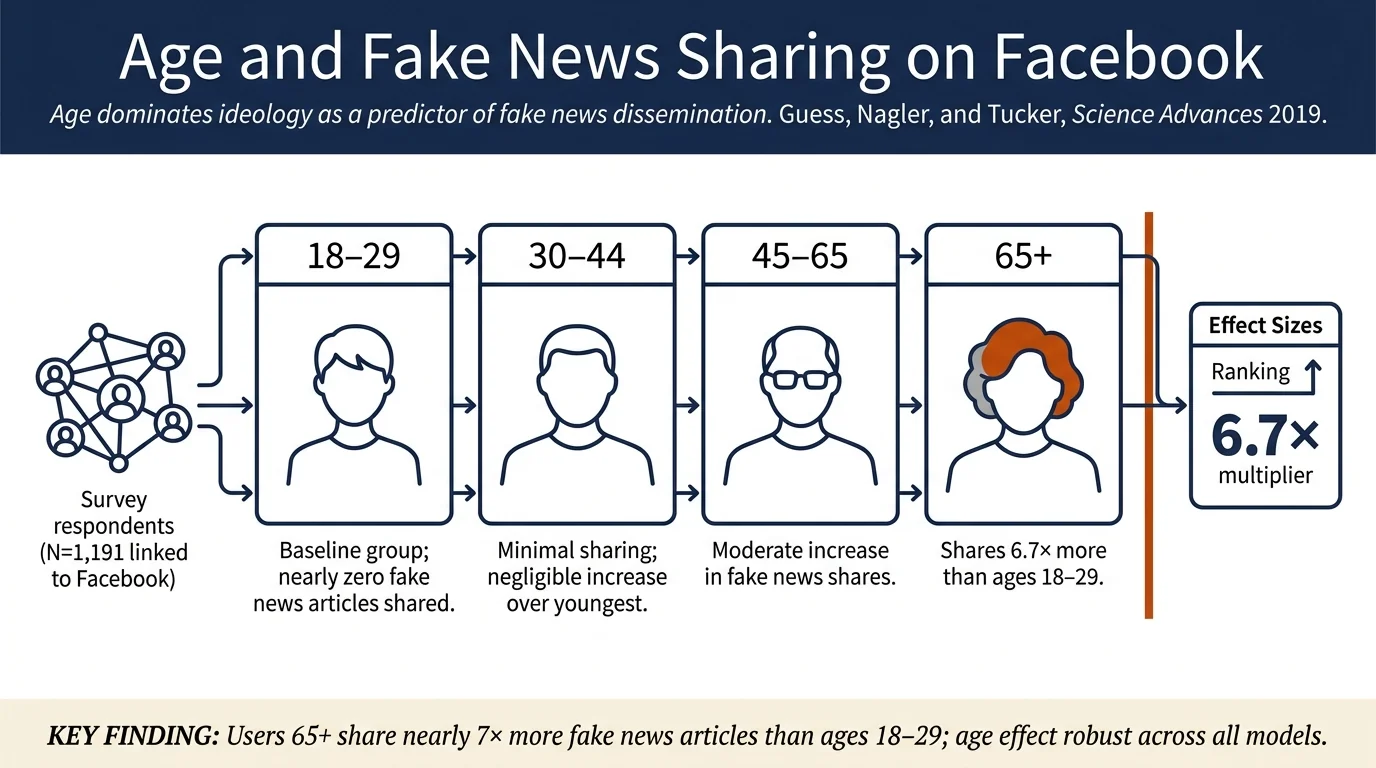
Less than you think: Prevalence and predictors of fake news dissemination on FacebookFake news dissemination on Facebook during the 2016 election was a rare behavior (8.5% of users shared at least one article), with clear demographic stratification: conservatives shared more articles from fake news domains (pro-Trump), but the strongest and most robust predictor was age—users over 65 shared nearly seven times as many…
 Spread & networksPlatforms, policy & society
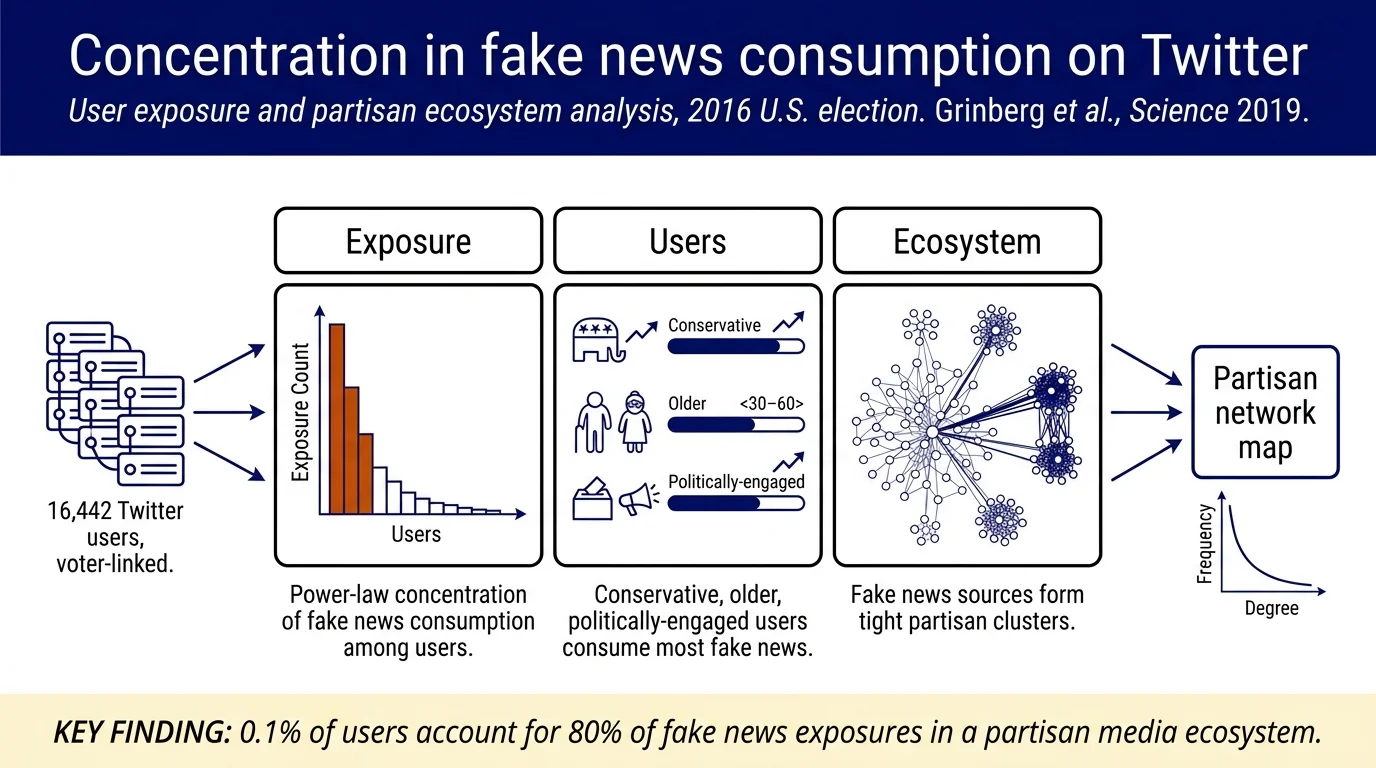
Fake news on Twitter during the 2016 U.S. presidential electionFake news consumption on Twitter during the 2016 election was extremely concentrated: only 1% of users saw 80% of exposures, and 0.1% shared 80% of fake news. Conservative-leaning, older, highly politically engaged users drove most consumption.
 Spread & networksPlatforms, policy & society
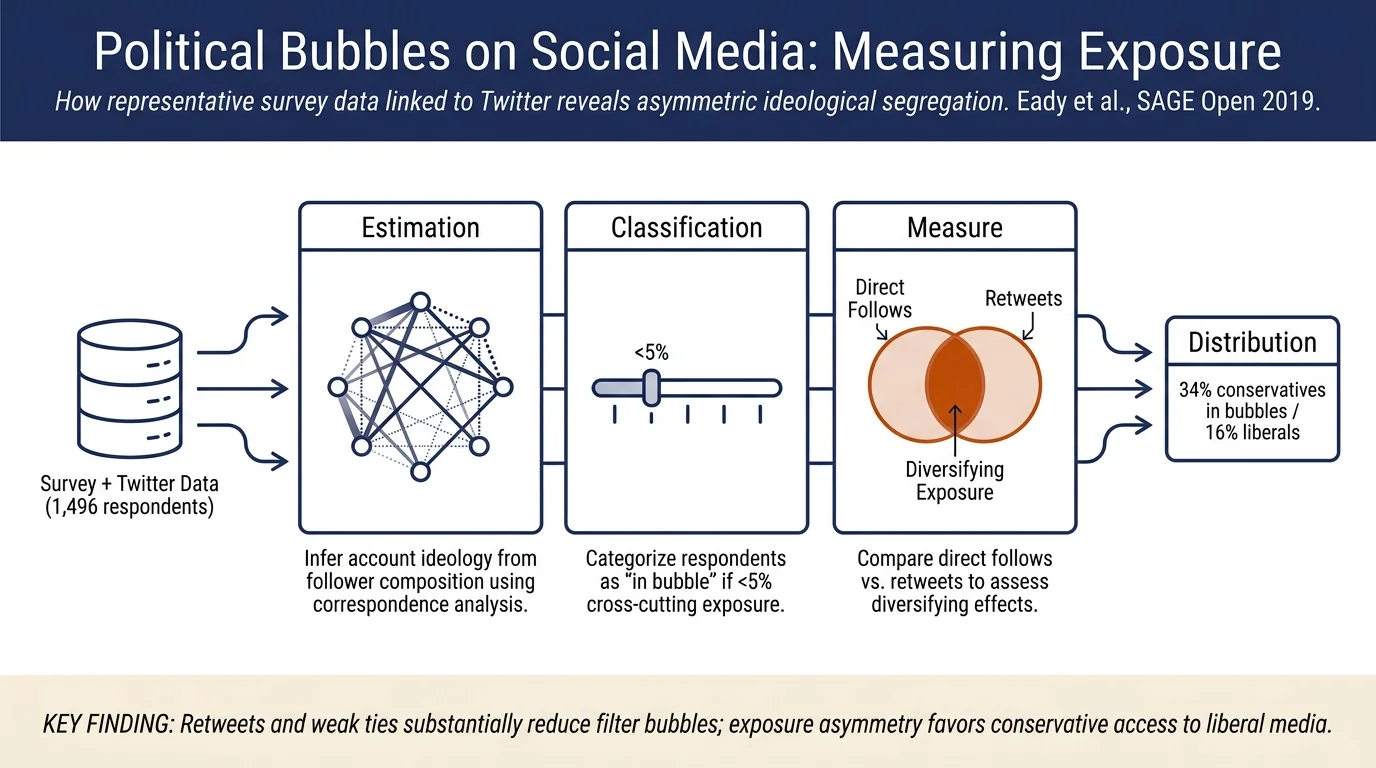
How Many People Live in Political Bubbles on Social Media? Evidence From Linked Survey and Twitter DataEady et al. link survey data from 1,496 Americans to Twitter data from 642,345 accounts and ~1.2 billion tweets to measure political polarization in media consumption. Rather than finding evidence of extreme "filter bubbles" where most people consume ideologically homogeneous content, they find substantial overlap in the accounts…
 Psychology & interventionsSpread & networks
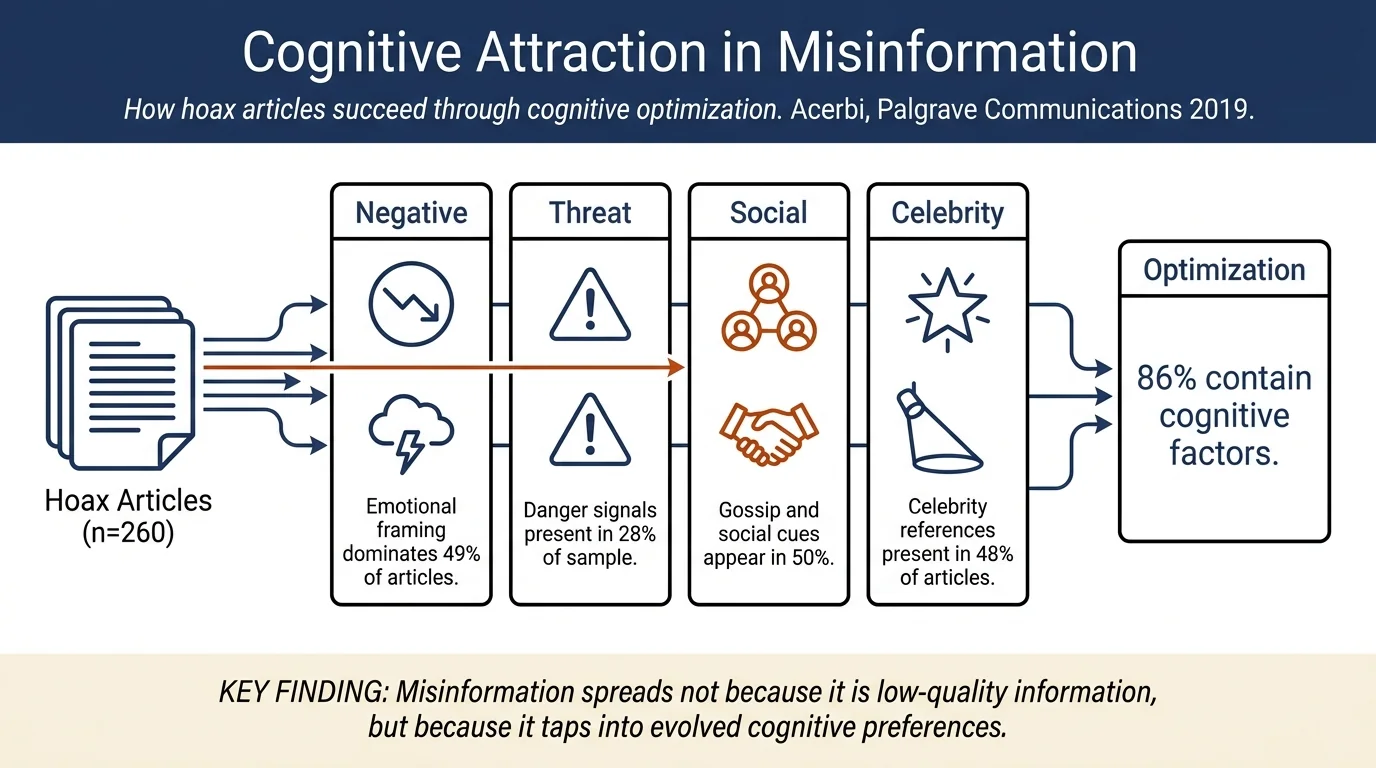
Cognitive attraction and online misinformationMisinformation spreads not because it is low-quality information constrained by digital media inefficiencies, but because it taps into general evolved cognitive preferences. A content analysis of 260 articles from 26 hoax websites shows that 86% contain at least one cognitive-appeal feature: negative framing (49%), threat descriptions…
 Spread & networksDetection methods
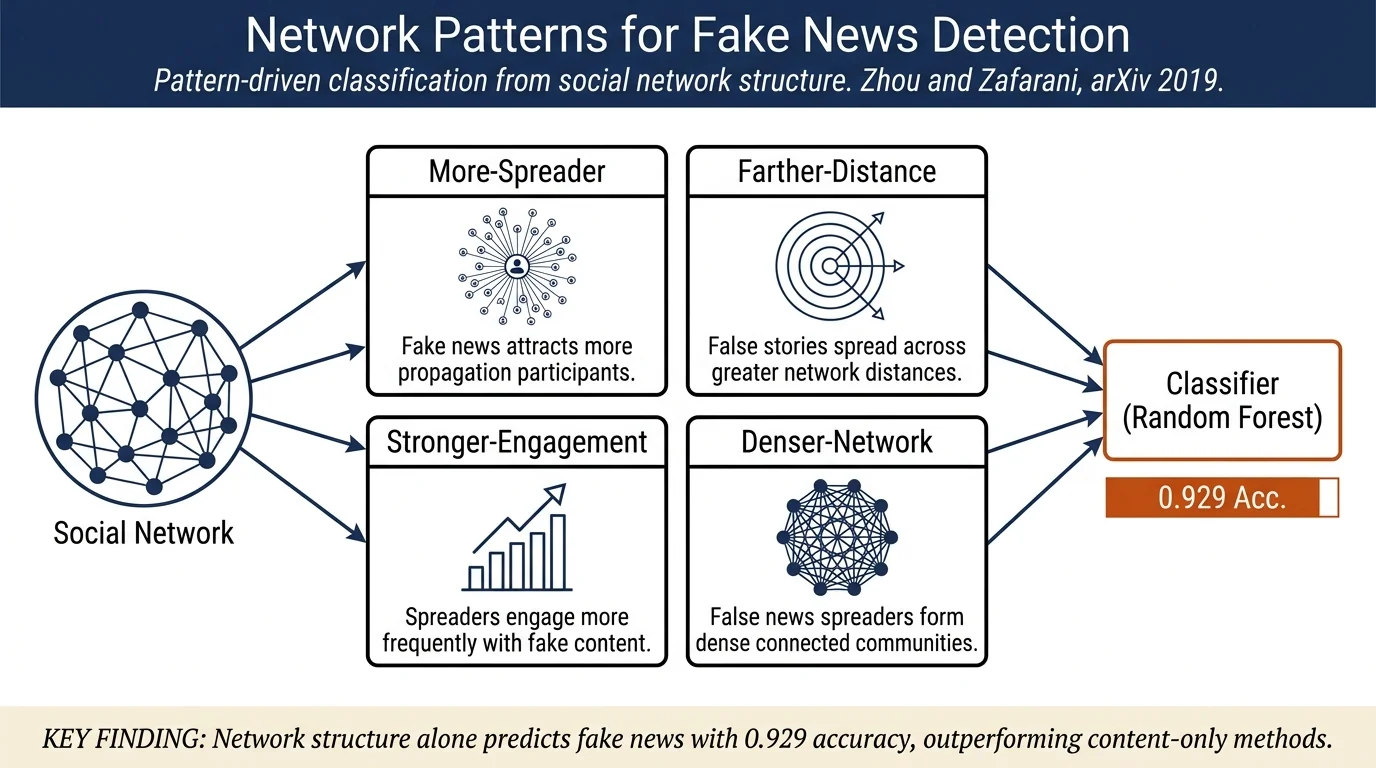
Network-based Fake News Detection: A Pattern-driven ApproachThis paper proposes a pattern-driven, network-based fake news detection model that identifies and quantifies four empirically grounded behavioral patterns in social networks: fake news attracts more spreaders, spreads farther, elicits stronger engagement, and is spread by denser networks than true news. These patterns are operationalized…
 Spread & networksDatasets & evaluation
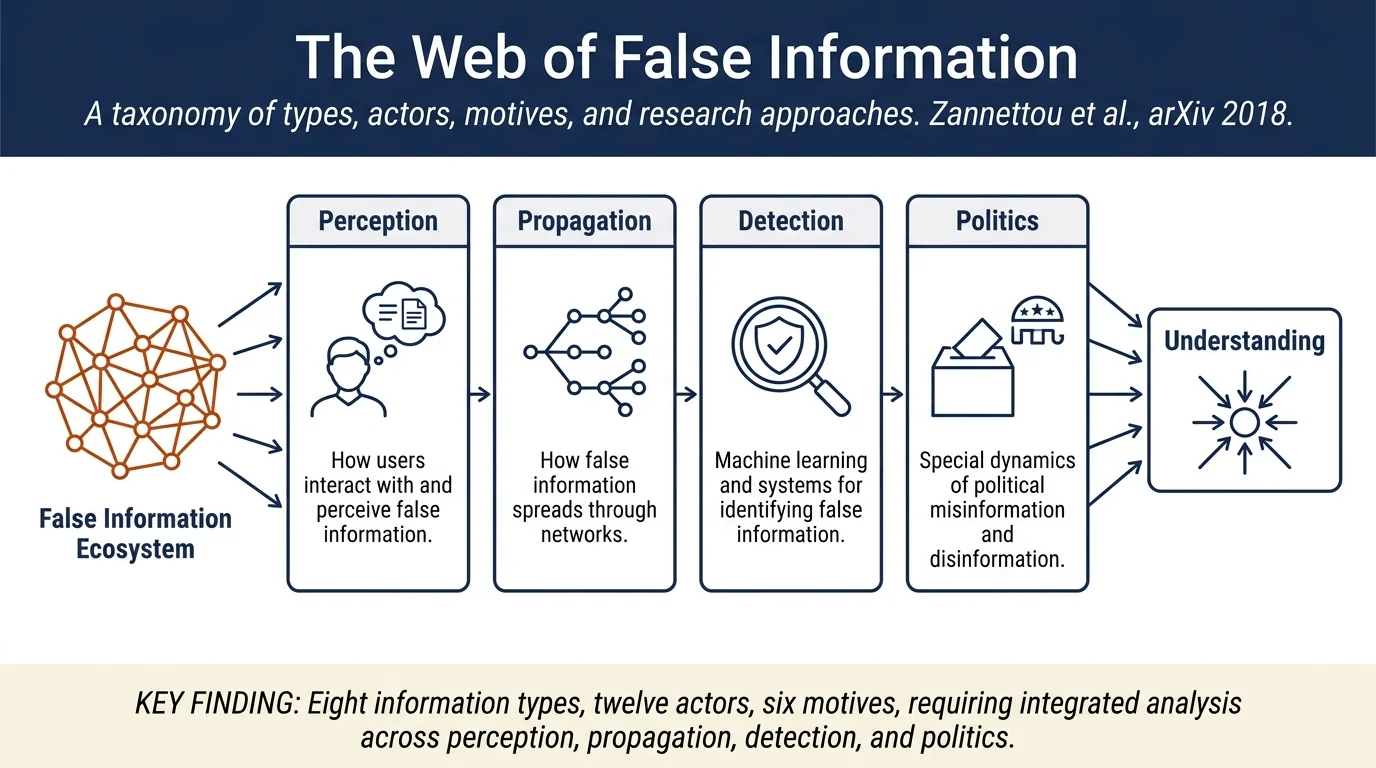
The Web of False Information: Rumors, Fake News, Hoaxes, Clickbait, and Various Other ShenanigansComprehensive typology of the false information ecosystem on the Web, identifying eight types of false information (fabricated stories, propaganda, conspiracy theories, hoaxes, biased news, rumors, clickbait, satire), twelve actor categories (bots, criminal organizations, activists, governments, paid posters, journalists, useful idiots,…
 Bots & coordinated campaignsSpread & networks
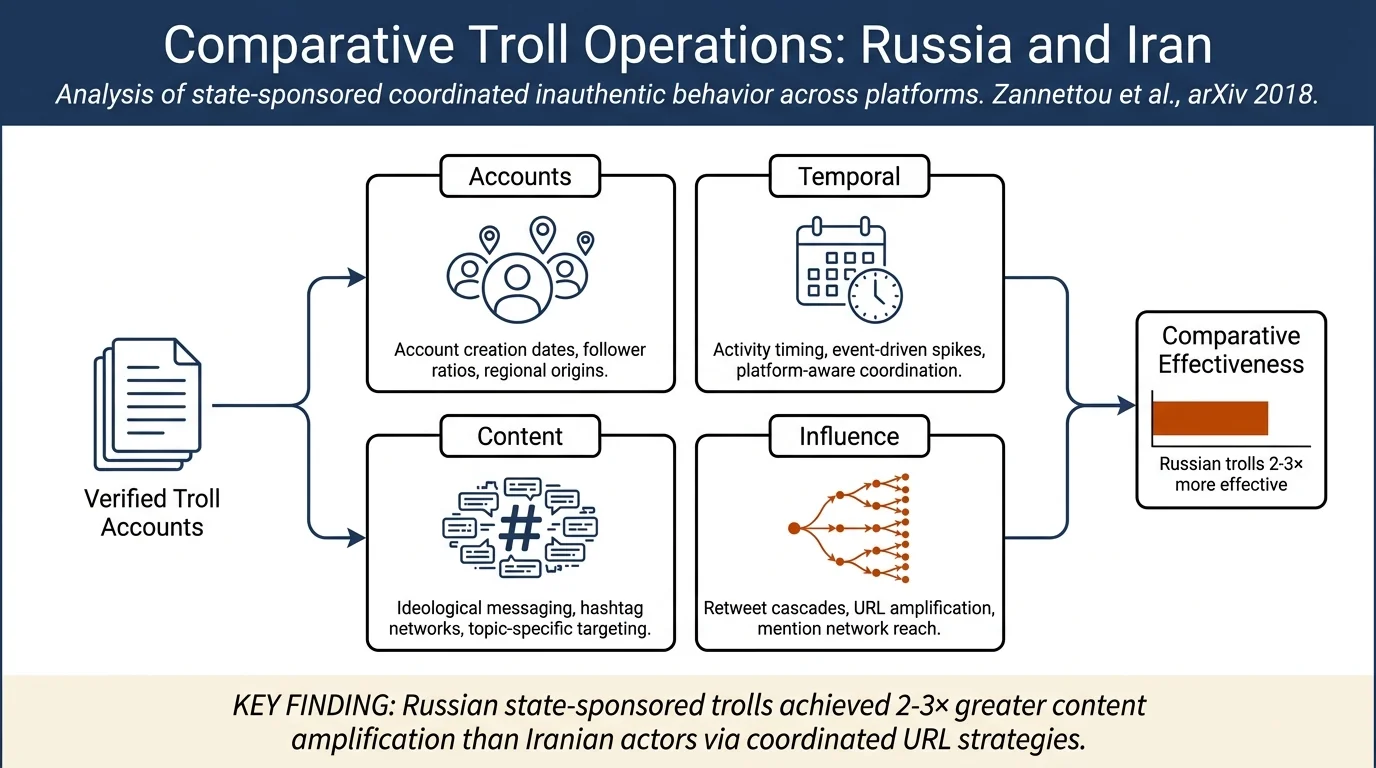
Who Let The Trolls Out? Towards Understanding State-Sponsored TrollsComparative analysis of 934 Russian and 770 Iranian state-sponsored trolls across Twitter and Reddit (10M posts) reveals distinct operational patterns: Russian trolls prioritized URL amplification (retweets, mentions) and pro-Trump messaging; Iranian trolls pursued regional and anti-Trump narratives motivated by real-world events. Both…
 Spread & networksBots & coordinated campaigns
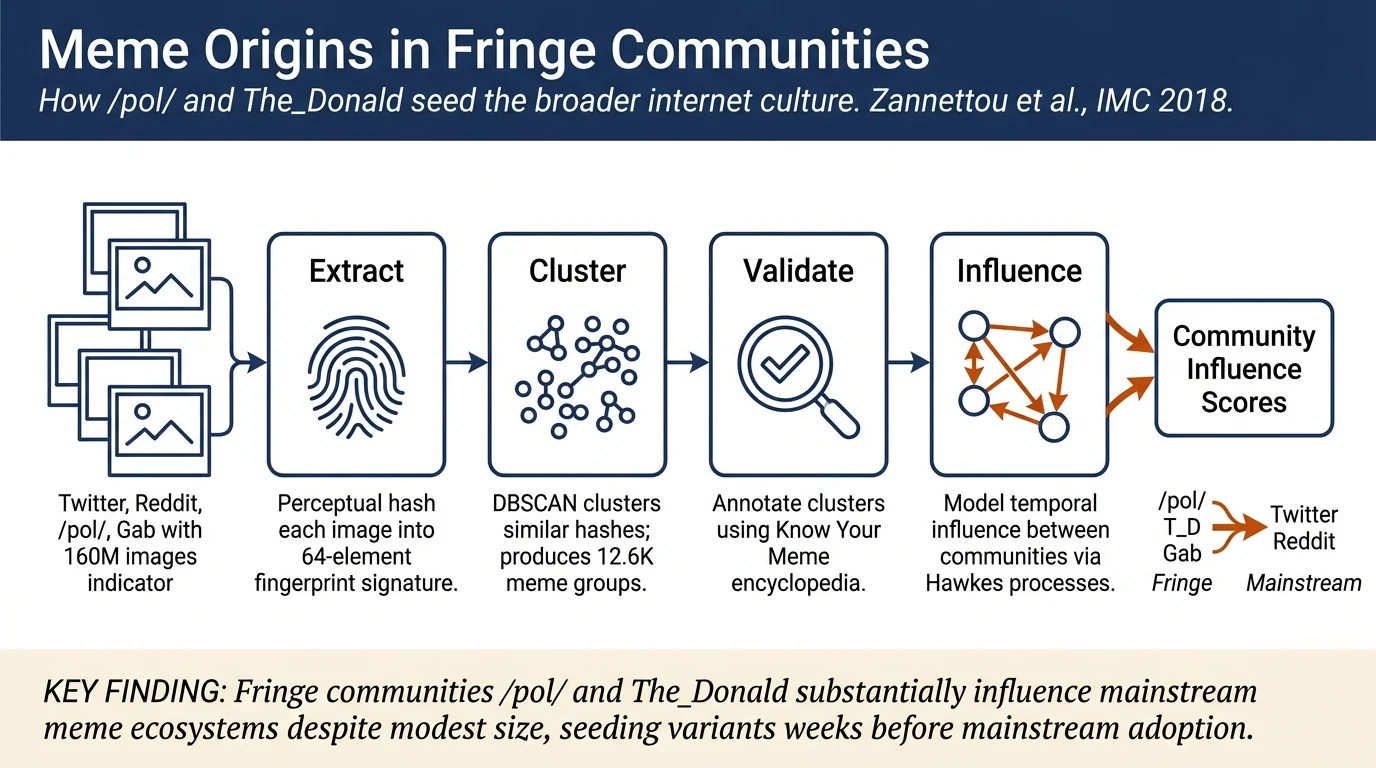
On the Origins of Memes by Means of Fringe Web CommunitiesLarge-scale empirical study of how image memes originate and propagate across fringe and mainstream Web communities. Analyzes 160M images posted to Twitter, Reddit, /pol/, and Gab (2016–2017) using perceptual hashing, clustering, and custom distance metrics.
 Bots & coordinated campaignsPlatforms, policy & society
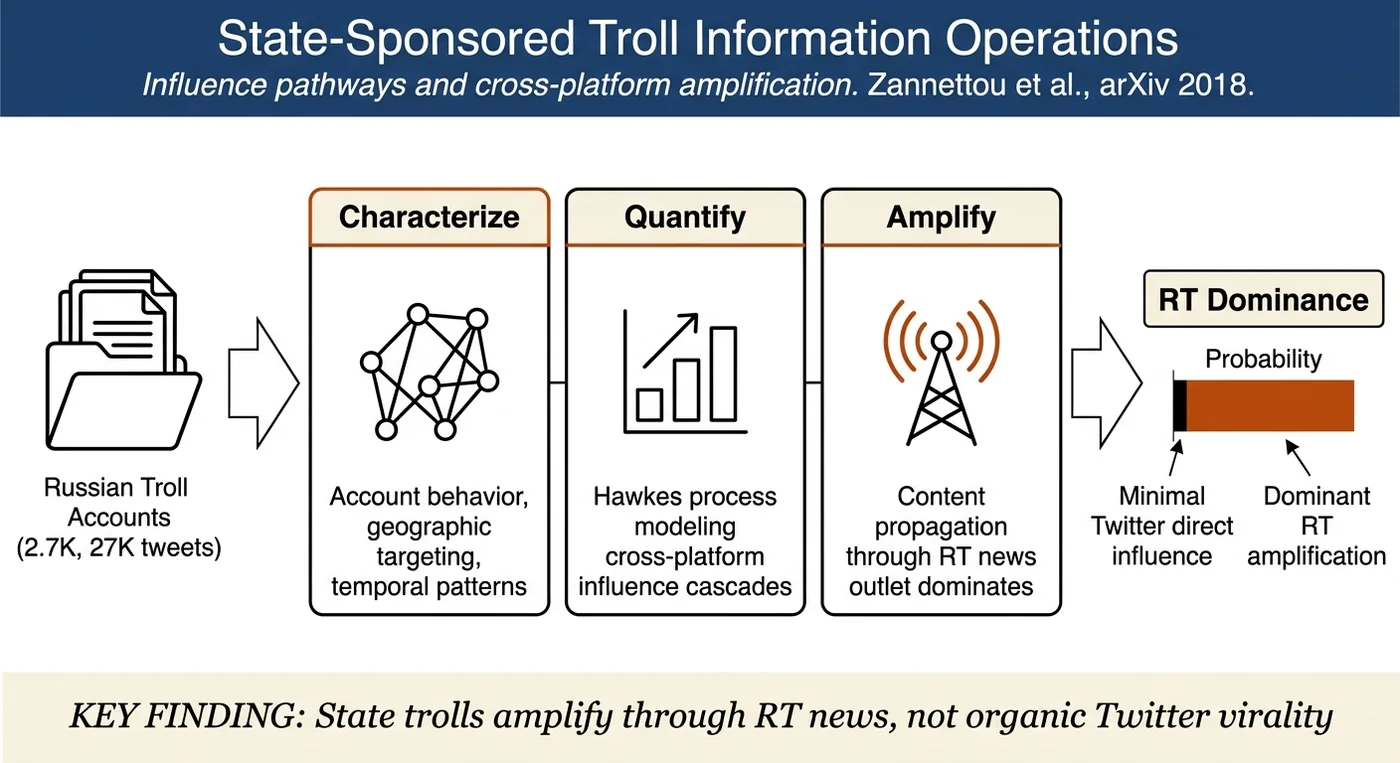
Disinformation Warfare: Understanding State-Sponsored Trolls on Twitter and Their Influence on the WebLarge-scale empirical study of 2.7K Russian state-sponsored troll accounts and 27K tweets (Jan 2016–Sep 2017) reveals minimal direct Twitter influence but significant content amplification through RT news outlet. Trolls actively target political events, adopt multiple identities, concentrate geographically in USA/Germany/Eastern Europe,…
 Spread & networksDetection methods
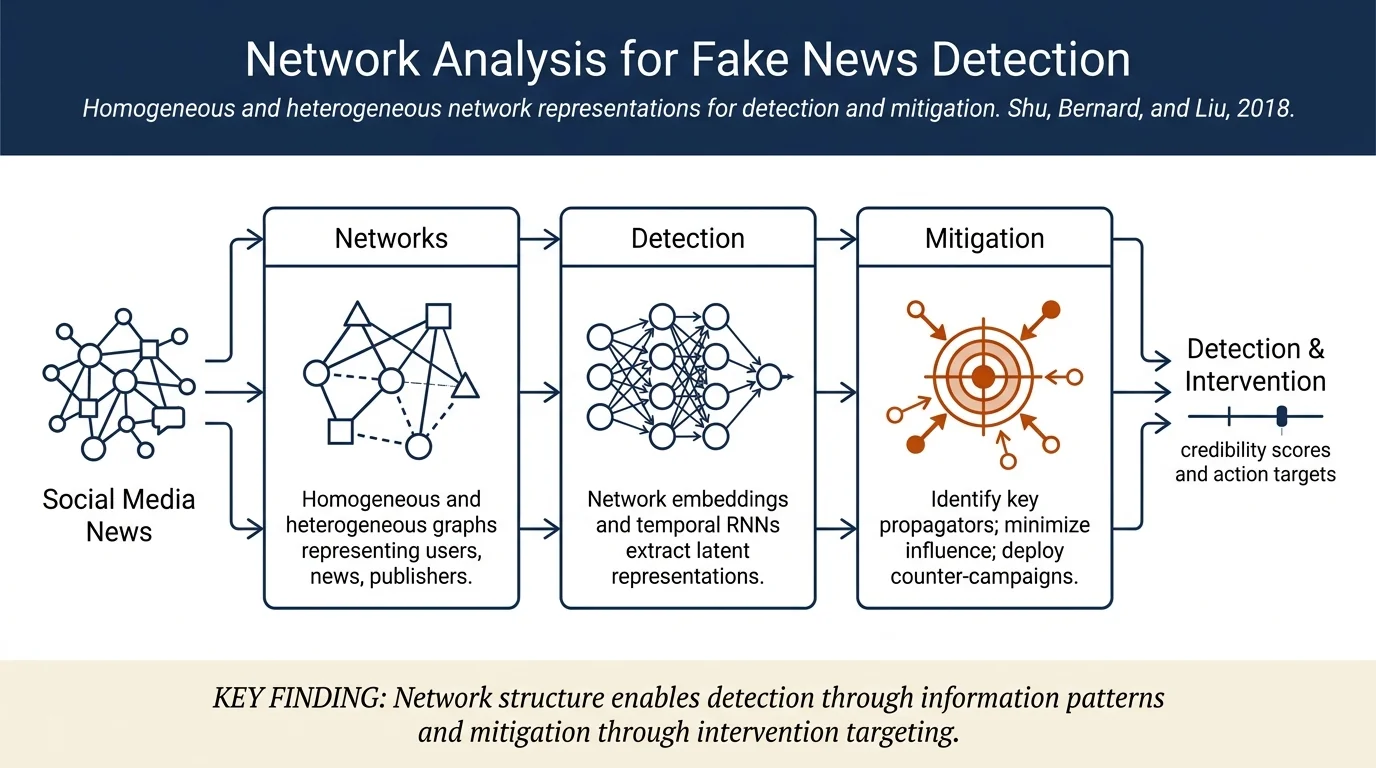
Studying Fake News via Network Analysis: Detection and MitigationThis chapter surveys network-based approaches to fake news detection and mitigation on social media, organizing fake news dissemination along three dimensions (content, social, temporal) and introduces methods exploiting network structure: homogeneous networks (friendship, diffusion, credibility) and heterogeneous networks (knowledge,…
 Spread & networksPlatforms, policy & society
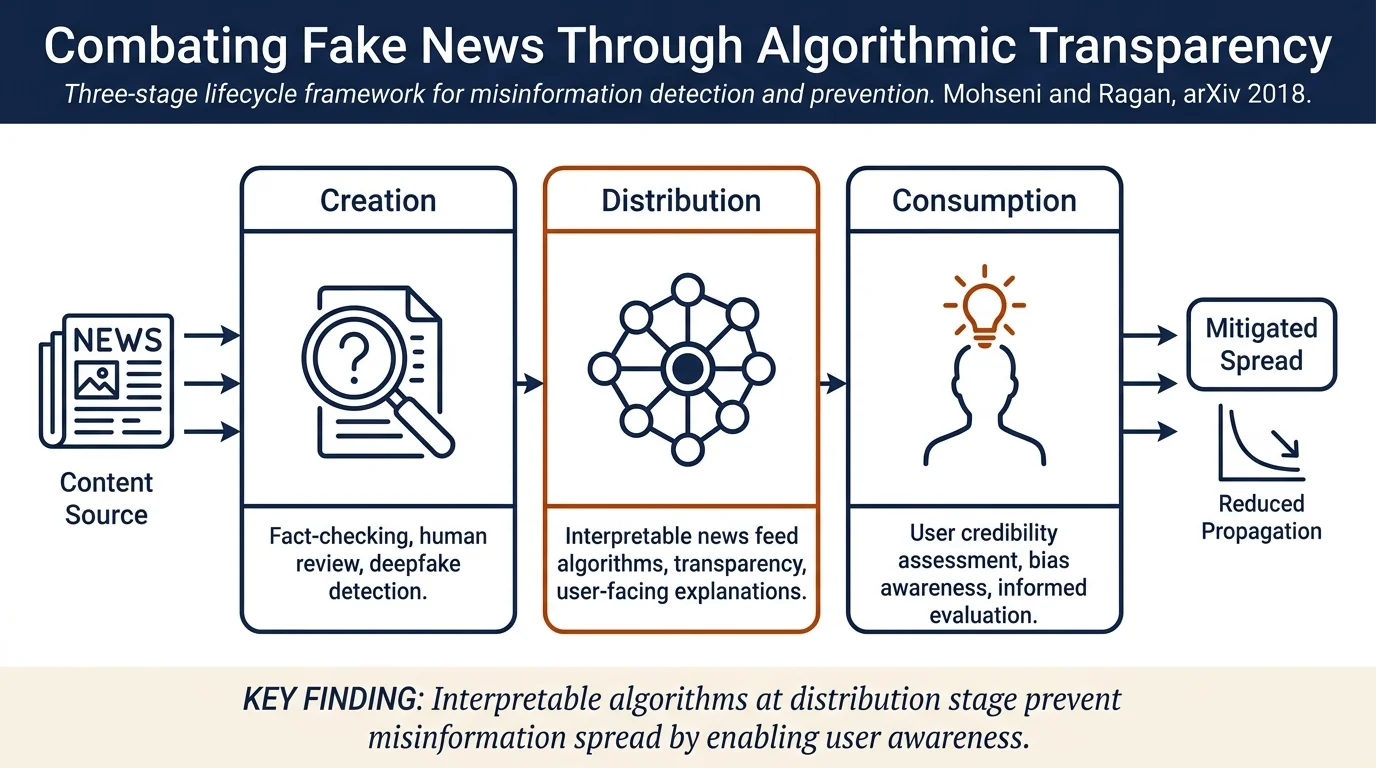
Combating Fake News with Interpretable News Feed AlgorithmsThis position paper reviews fake news detection methods and argues that news feed algorithms are insufficiently transparent, enabling echo chambers and filter bubbles that amplify misinformation. The authors propose interpretable and explainable news feed algorithms as a solution, positioning transparency and user awareness as critical…
 Datasets & evaluationSpread & networks
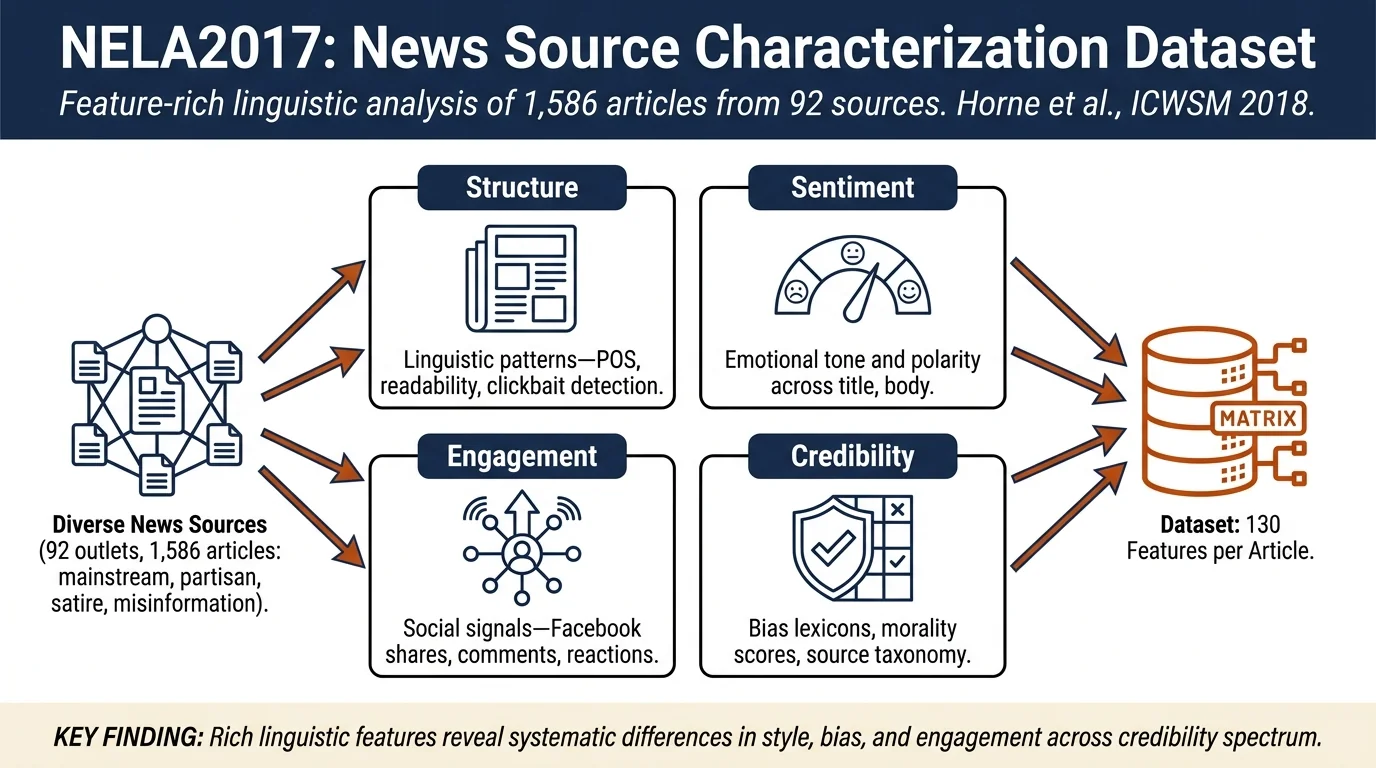
Sampling the News Producers: A Large News and Feature Data Set for the Study of the Complex Media LandscapeIntroduces NELA2017, a dataset of 1,586 news articles from 92 diverse news sources over 7 months (April–October 2017), including mainstream outlets, hyper-partisan sources, satire, and deliberately false news sites. Computes 130 content-based linguistic and engagement features on each article, enabling large-scale comparative analysis of…