Explore papers
Filter by research area, year and venue. Every filter is in the address bar, so you can share a view as a link.
 Spread & networksPlatforms, policy & society
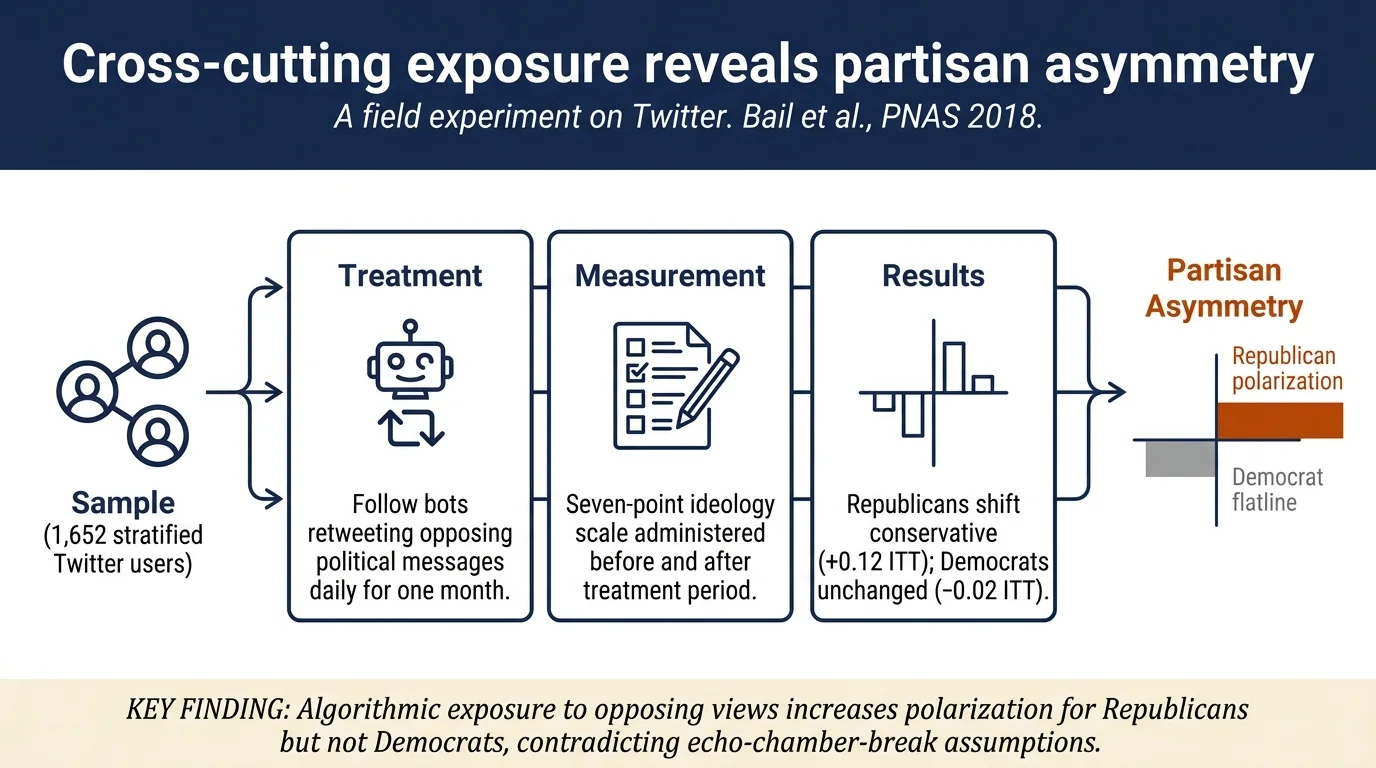
Exposure to opposing views on social media can increase political polarizationThis field experiment tested whether exposure to opposing political views on social media reduces polarization. Twitter users (Republicans and Democrats) were randomly offered money to follow bots retweeting messages from opposing politicians and opinion leaders for one month.
 Detection methodsSpread & networks
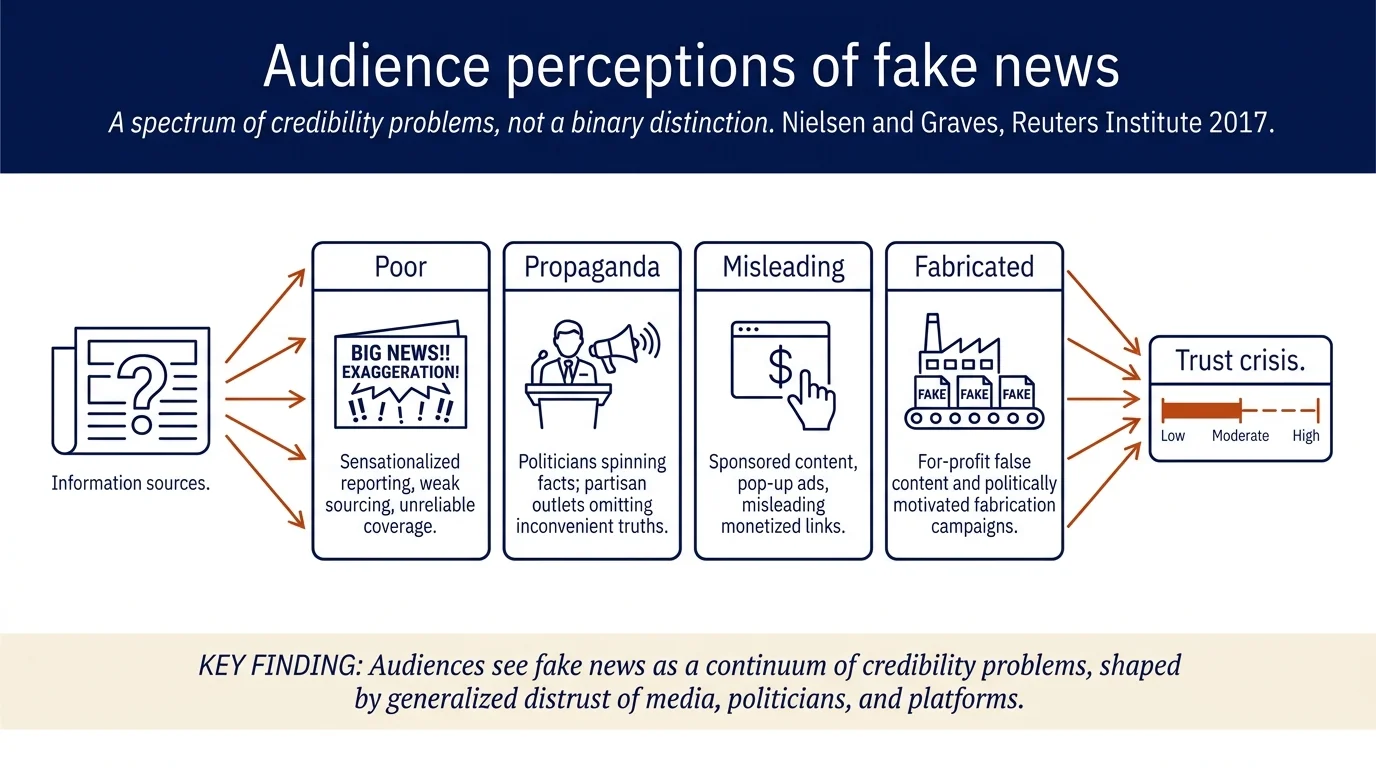
"News you don't believe": Audience perspectives on fake newsUsing focus groups and surveys across the US, UK, Spain, and Finland, Nielsen and Graves find that ordinary people see fake news as a spectrum rather than a binary distinction—encompassing poor journalism, political propaganda, misleading advertising, and fabricated content. Audiences experience the "fake news" problem as one of degree,…
 Spread & networksDetection methods
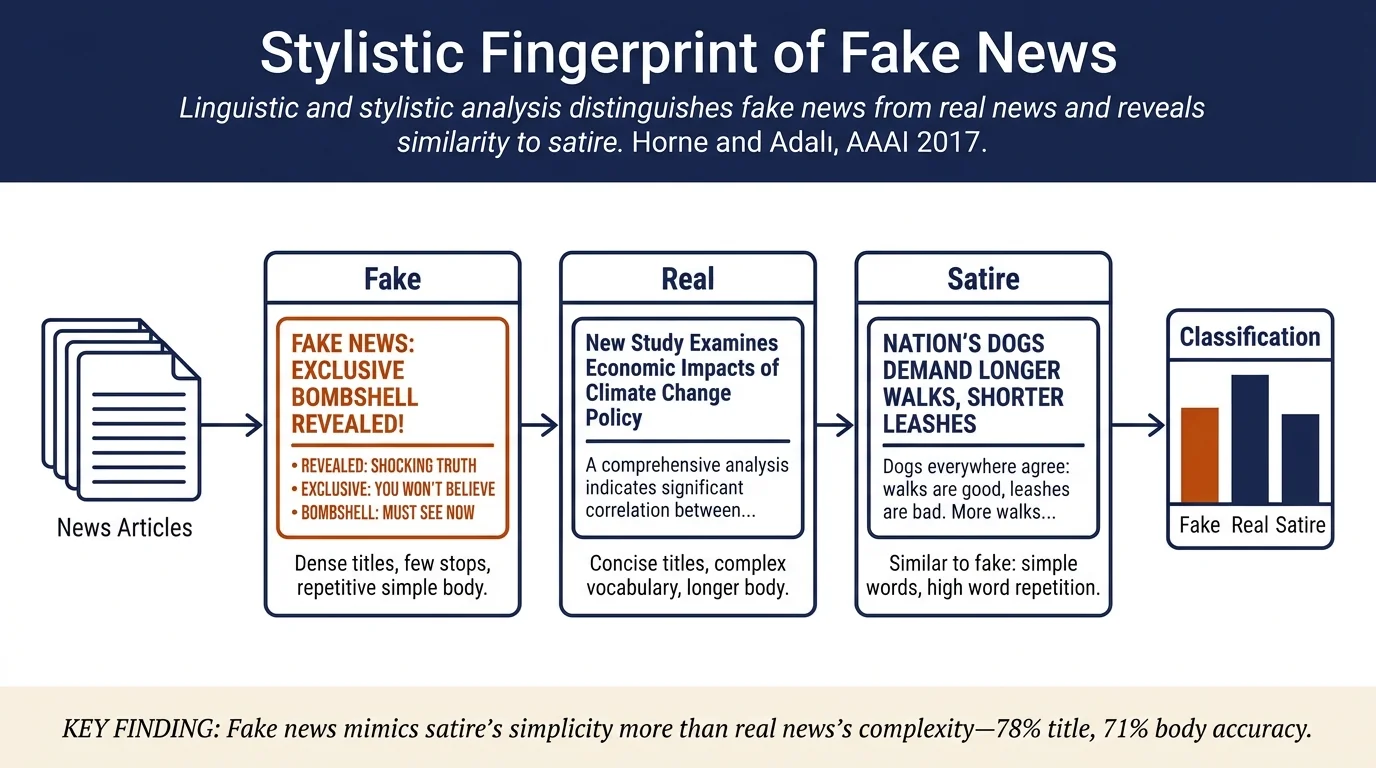
This Just In: Fake News Packs a Lot in Title, Uses Simpler, Repetitive Content in Text Body, More Similar to Satire than Real NewsFake news differs systematically from real news in stylistic features, especially titles. Contrary to the assumption that fake news mimics real news, it is actually more similar to satire: packed titles with fewer stop words and more proper nouns, combined with shorter, repetitive body text with simpler language.
 Spread & networksFact-checking & verification
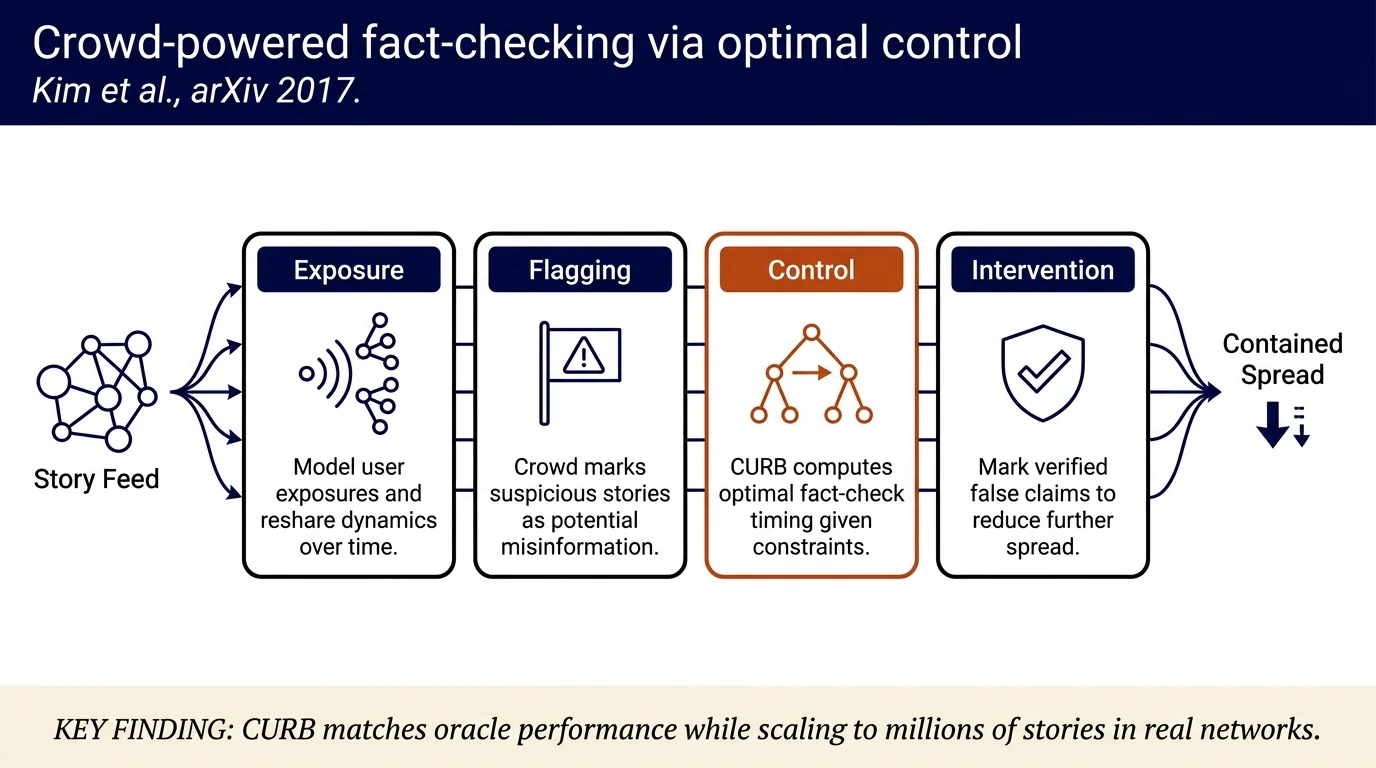
Leveraging the Crowd to Detect and Reduce the Spread of Fake News and MisinformationOnline social networks use crowd-powered flagging to identify misinformation: when users flag a story, enough flags trigger fact-checking, which disputes false claims. This paper formulates the problem of deciding which stories to fact-check and when, subject to limited fact-checking resources, as a stochastic optimal control problem.
 Spread & networksDetection methods
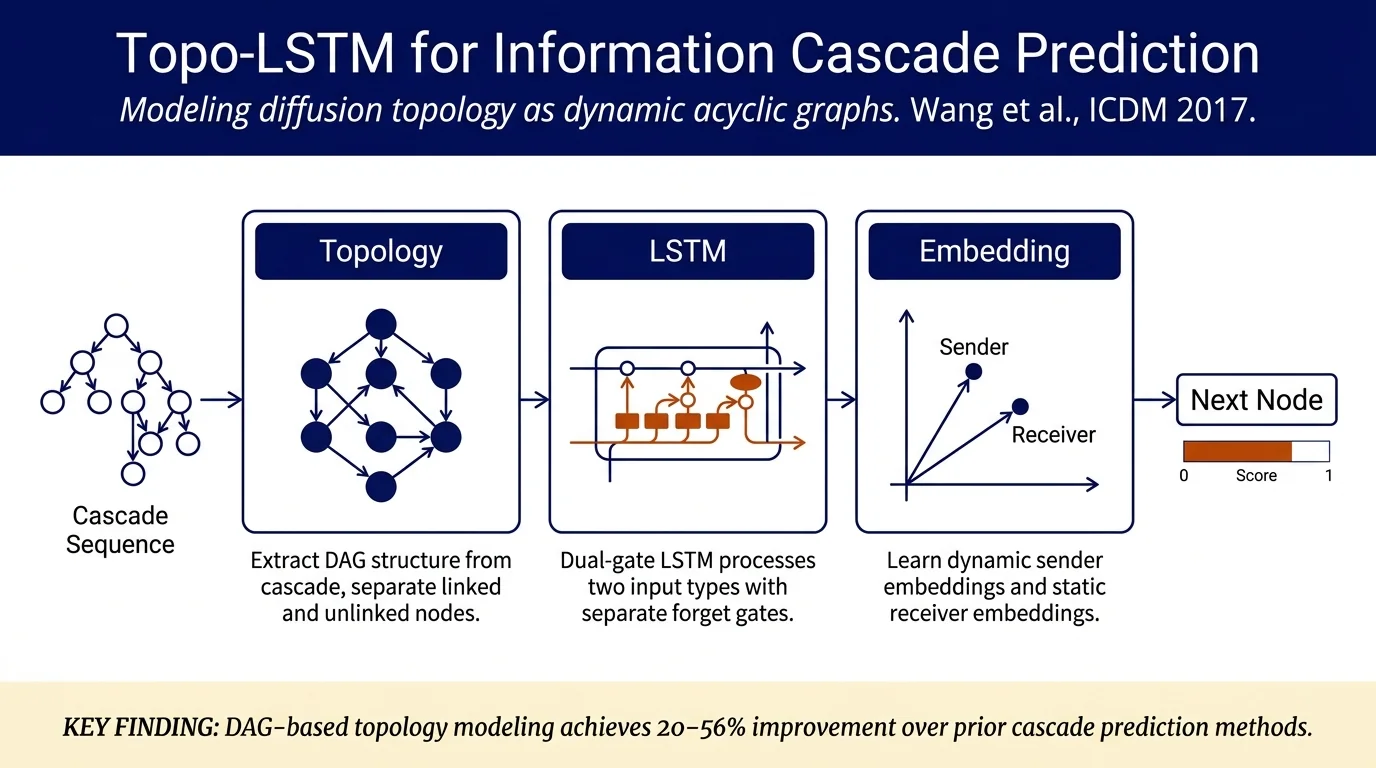
Topological Recurrent Neural Network for Diffusion PredictionWang et al. propose Topo-LSTM, a novel LSTM architecture for modeling dynamic directed acyclic graphs (DAGs) to predict which node will be activated next in information cascades. The key insight is that information diffusion on networks should be modeled explicitly as diffusion topologies—graphs showing how information spreads from…
 Detection methodsSpread & networks
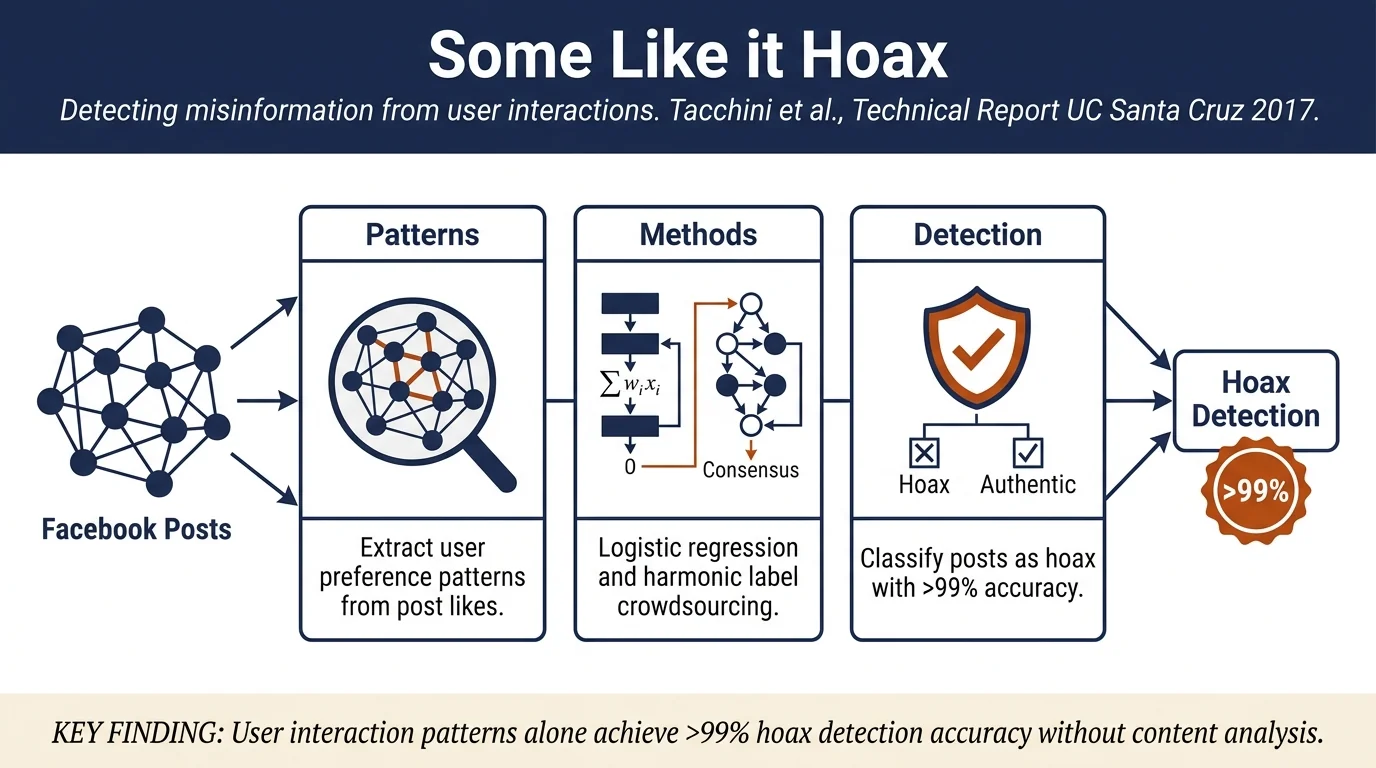
Some Like it Hoax: Automated Fake News Detection in Social NetworksHoaxes on Facebook can be detected with 99% accuracy using user interaction patterns (who "liked" posts) rather than content analysis. Two algorithms—logistic regression and harmonic boolean crowdsourcing—achieve high accuracy even with minimal labeled training data, and knowledge transfers across different Facebook communities.
 Spread & networksDetection methods
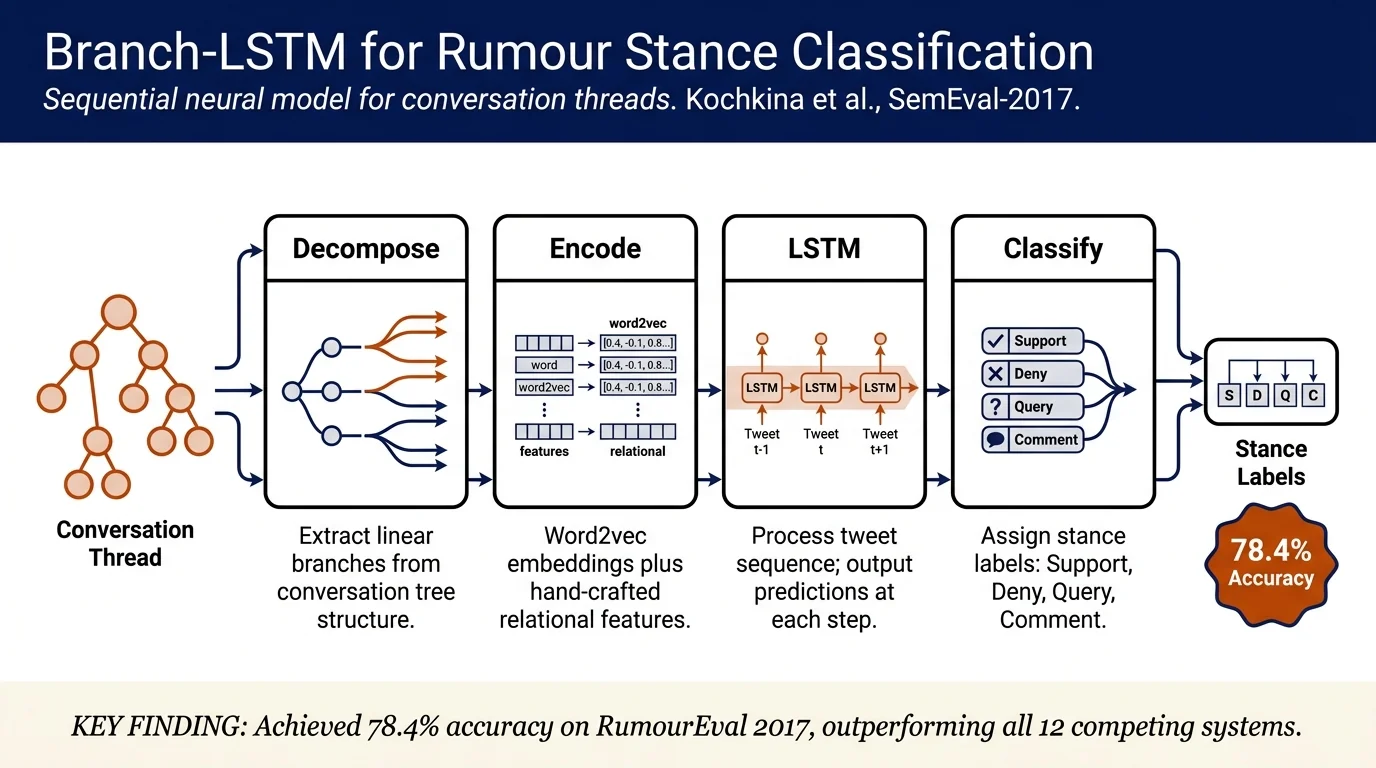
Turing at SemEval-2017 Task 8: Sequential Approach to Rumour Stance Classification with Branch-LSTMThis paper proposes Branch-LSTM, a sequential neural model for rumour stance classification in Twitter conversations. By decomposing conversation threads into linear branches and modeling them with LSTM layers, the approach captures conversational context while assigning stance labels (Support/Deny/Query/Comment) to each tweet.
 Detection methodsDatasets & evaluation
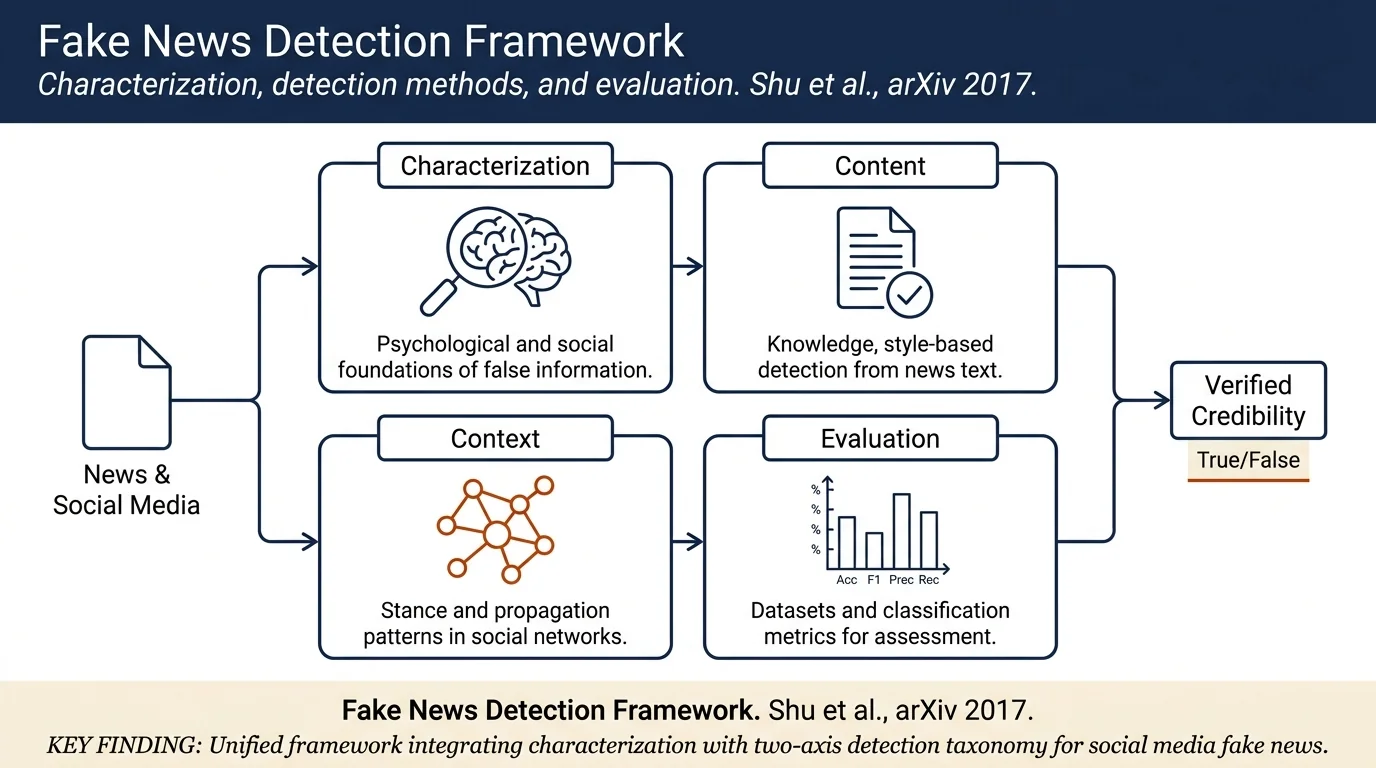
Fake News Detection on Social Media: A Data Mining PerspectiveThis comprehensive survey reviews fake news detection on social media through a data mining lens. It frames the problem around two key aspects—characterization (understanding the psychological and social foundations of fake news) and detection (building computational methods using news content and social context features).
 Spread & networksBots & coordinated campaigns
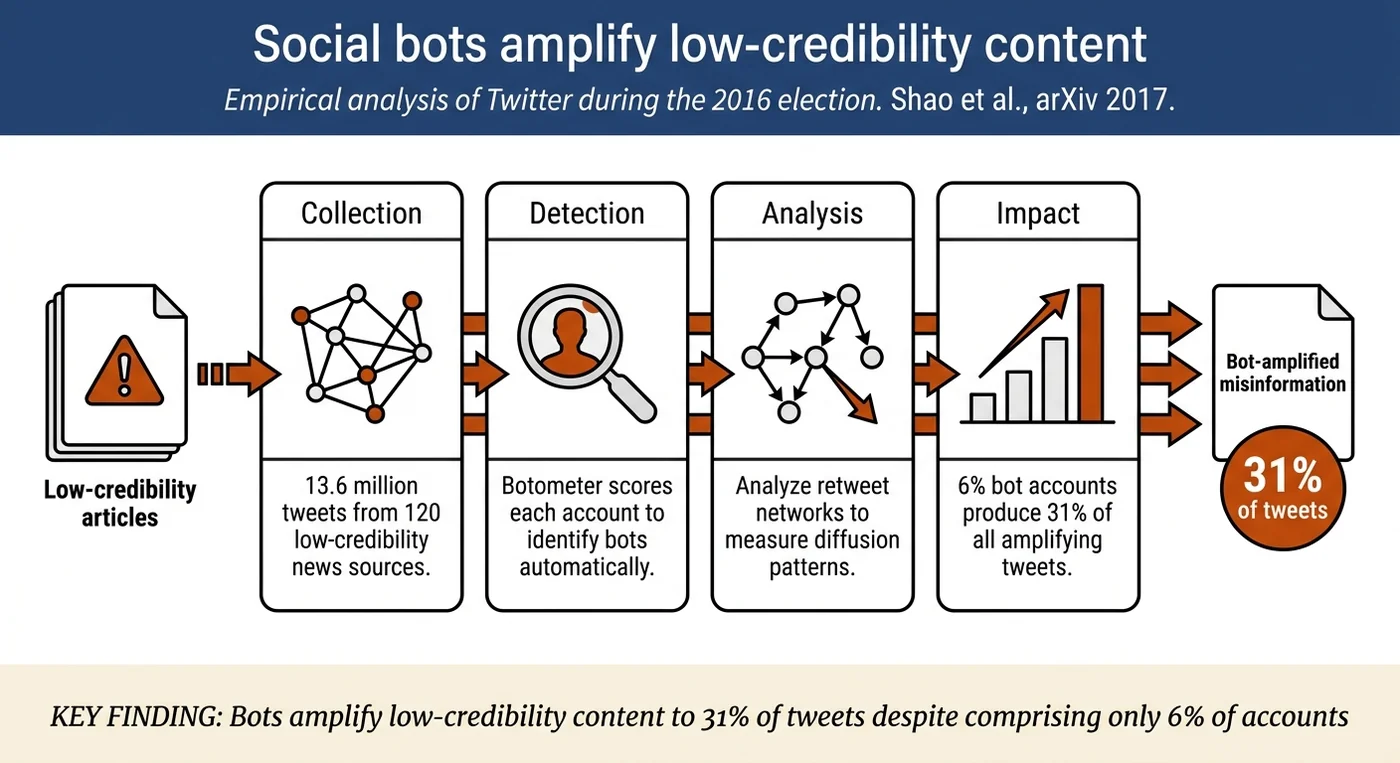
The spread of low-credibility content by social botsEmpirical analysis of 14 million Twitter messages during the 2016 U.S. election finds social bots disproportionately amplify low-credibility content: though bots comprise only 6% of accounts sharing such content, they account for 31% of tweets. Bots employ two strategies—rapid early amplification and targeting of influential users—making…
 Detection methodsSpread & networks
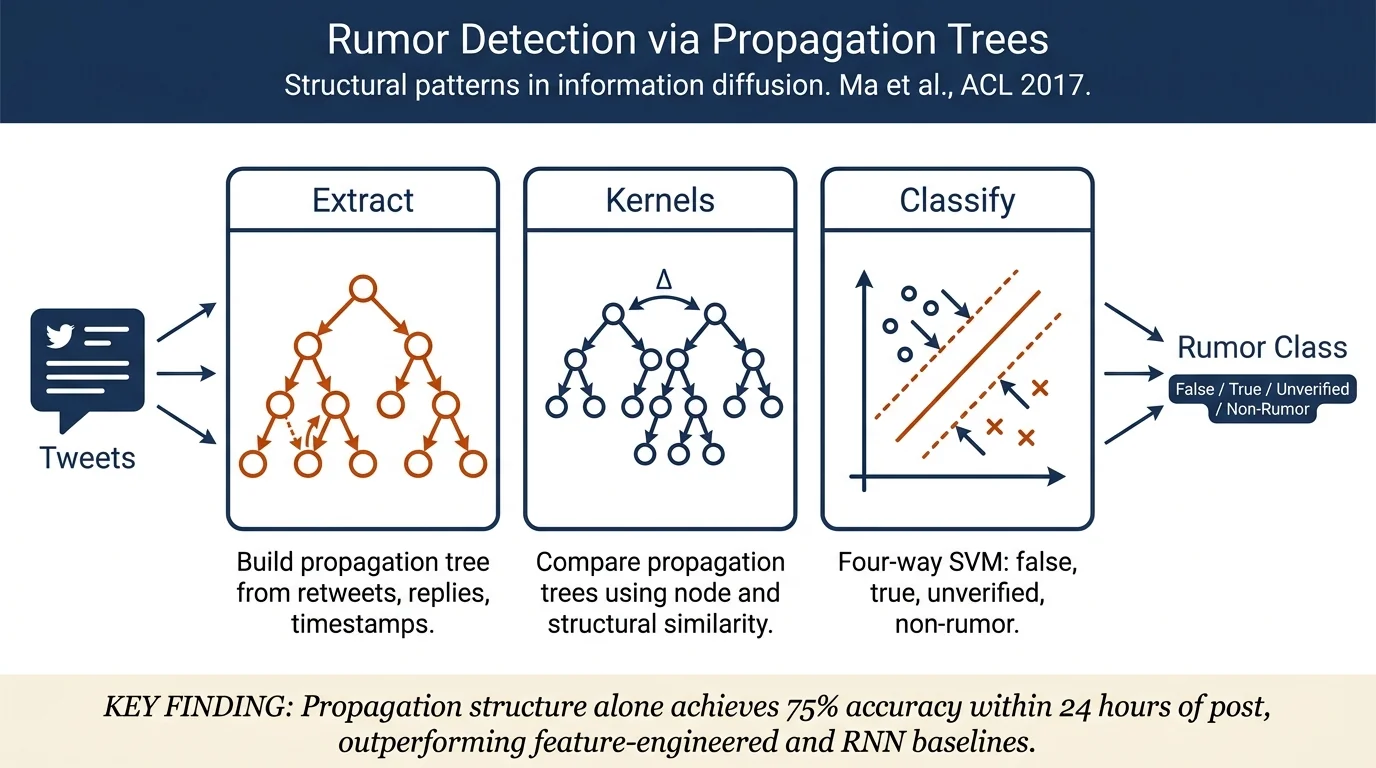
Detect Rumors in Microblog Posts Using Propagation Structure via Kernel LearningThis paper addresses rumor detection in microblog posts by modeling information diffusion as propagation trees and proposing a kernel-based method (PTK) that captures high-order structural patterns differentiating rumors from non-rumors. The approach extends to context-sensitive variants (cPTK) and achieves superior early detection…
 Spread & networksDatasets & evaluation
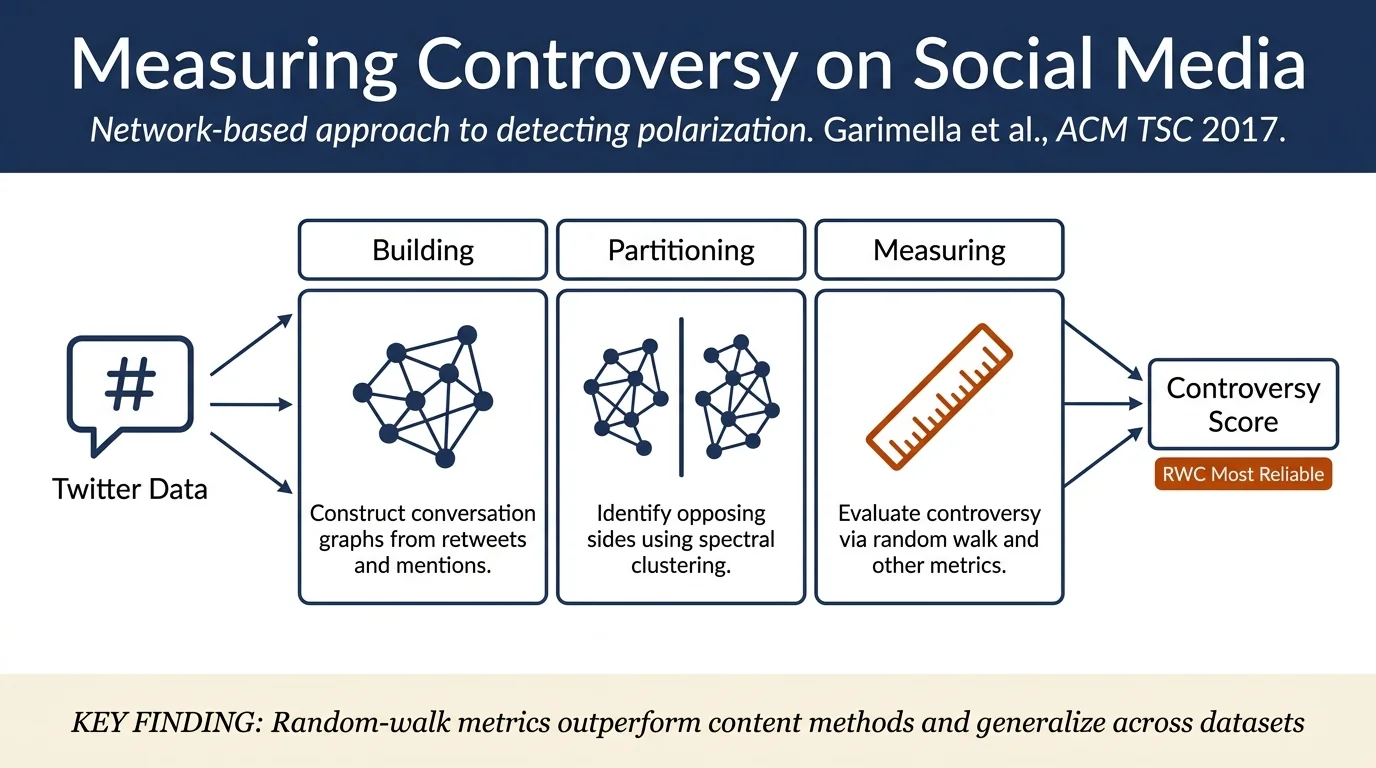
Quantifying Controversy on Social MediaThis work presents a graph-based pipeline to measure controversy in social media discussions. The authors build conversation graphs from Twitter interactions (retweets, follows, mentions), partition them to identify opposing sides, and apply multiple controversy measures—with a random-walk-based metric (RWC) emerging as the most reliable…
 Spread & networksDatasets & evaluation
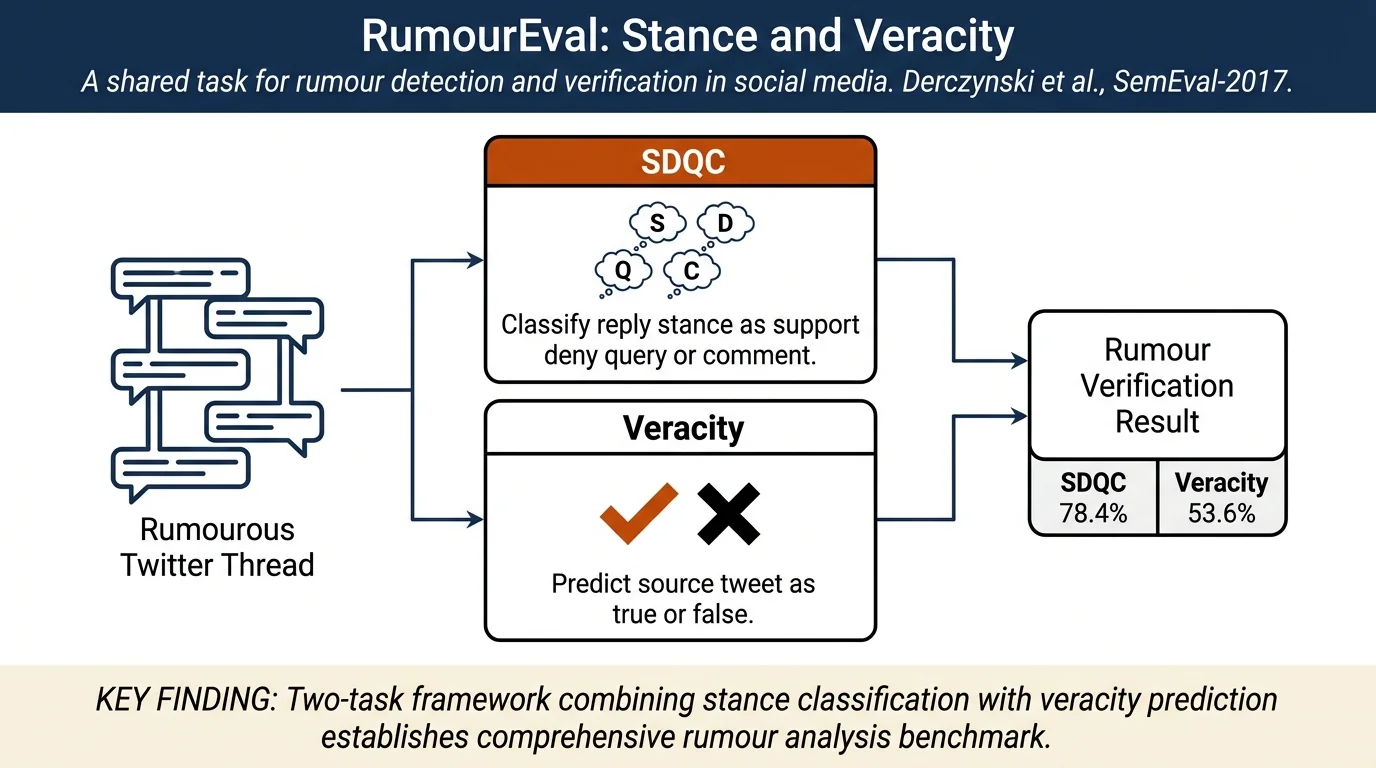
SemEval-2017 Task 8: RumourEval: Determining rumour veracity and support for rumoursRumourEval is a shared task benchmark for detecting and verifying rumours in social media. It introduces two subtasks: (a) stance classification (SDQC: Support/Deny/Query/Comment) of replies to rumourous claims, and (b) veracity prediction (true/false) of source tweets.
 Spread & networksPsychology & interventions
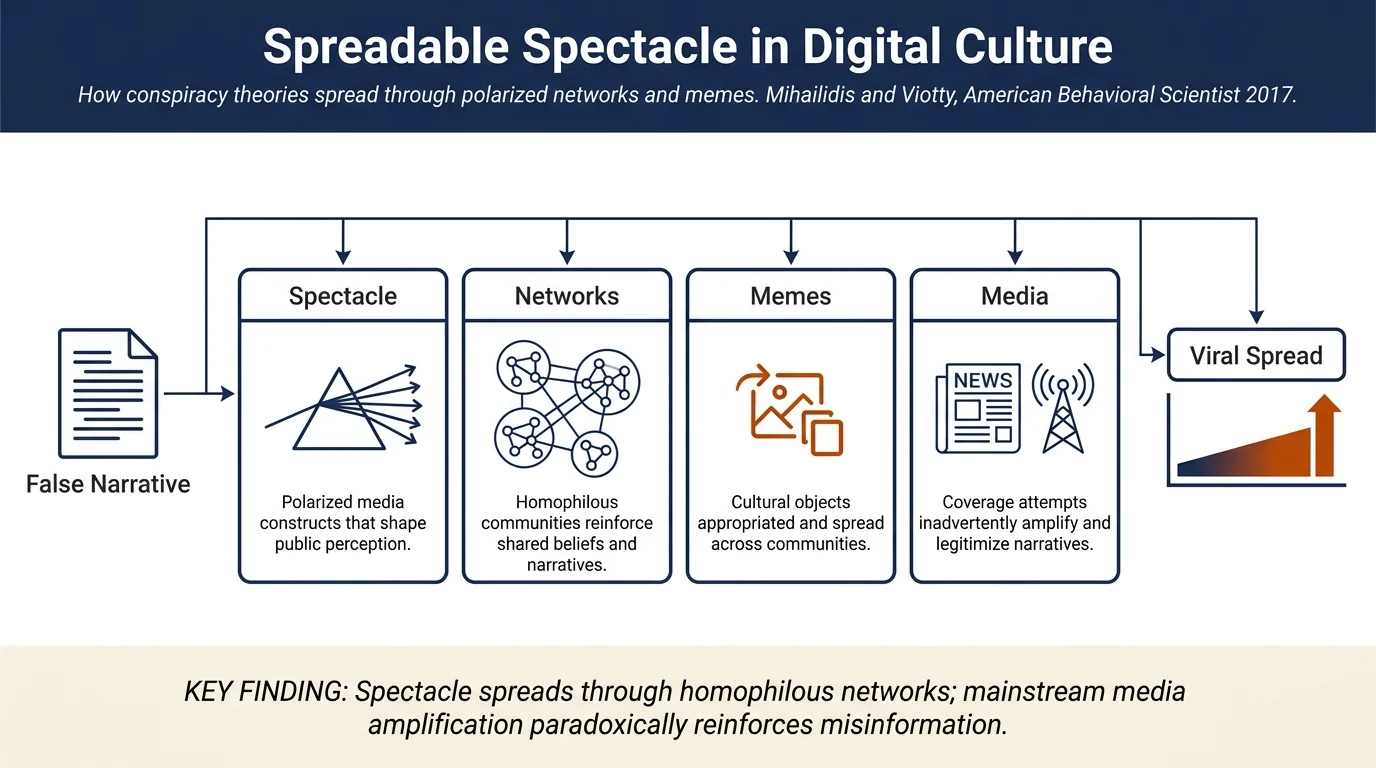
Spreadable Spectacle in Digital Culture: Civic Expression, Fake News, and the Role of Media Literacies in "Post-Fact" SocietyThis paper explores how spectacle—media constructs outside ordinary routine that capitalize on polarization—spreads through digital culture during the 2016 U.S. election. Using the Pizzagate conspiracy theory as a case study, the authors argue that citizen-driven spectacle leverages homophilous networks, memes, and appropriated cultural…
 Spread & networksPsychology & interventions
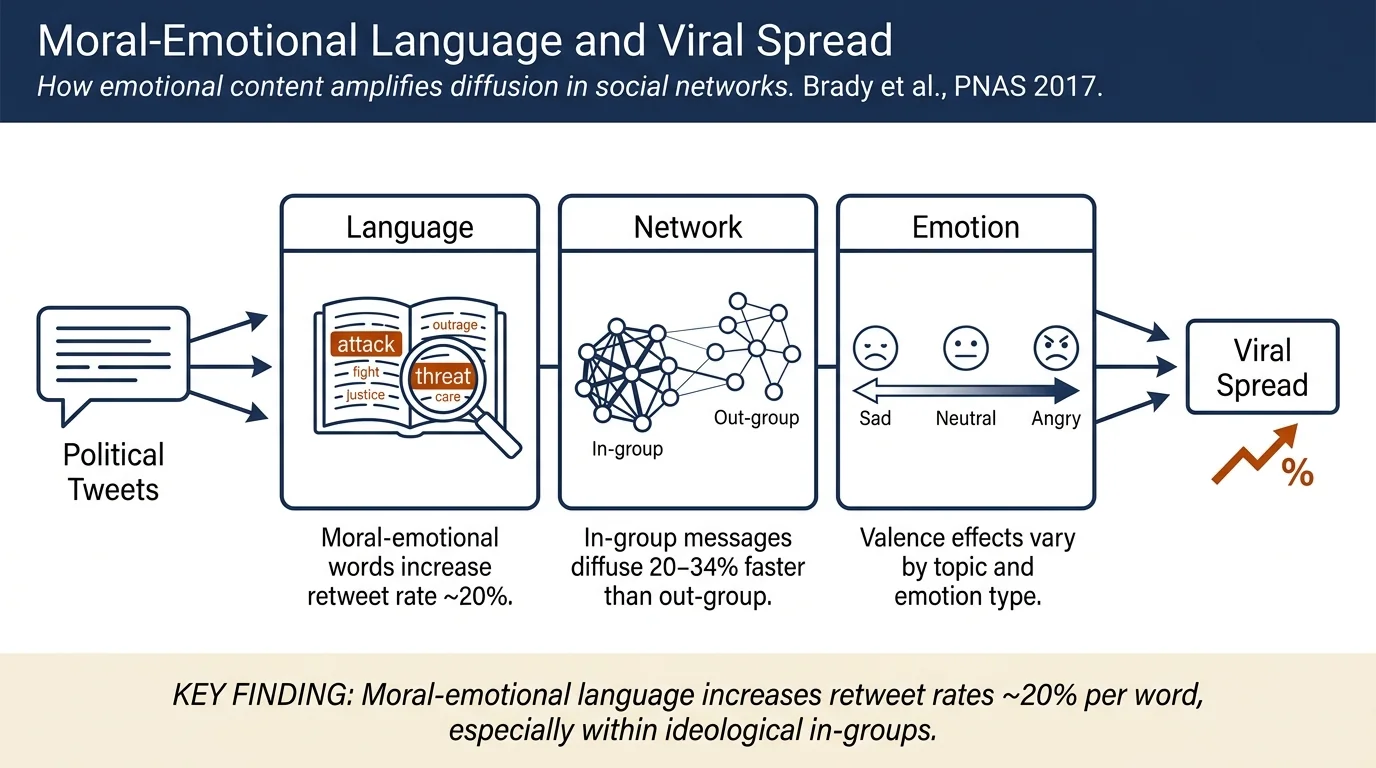
Emotion shapes the diffusion of moralized content in social networksMoral-emotional language (words combining moral and emotional content) increases message diffusion in social networks by ~20% per word. This effect is stronger within political in-groups than out-groups, explaining how moral and political ideas spread within polarized "echo chambers" on platforms like Twitter.
 Spread & networksPlatforms, policy & society
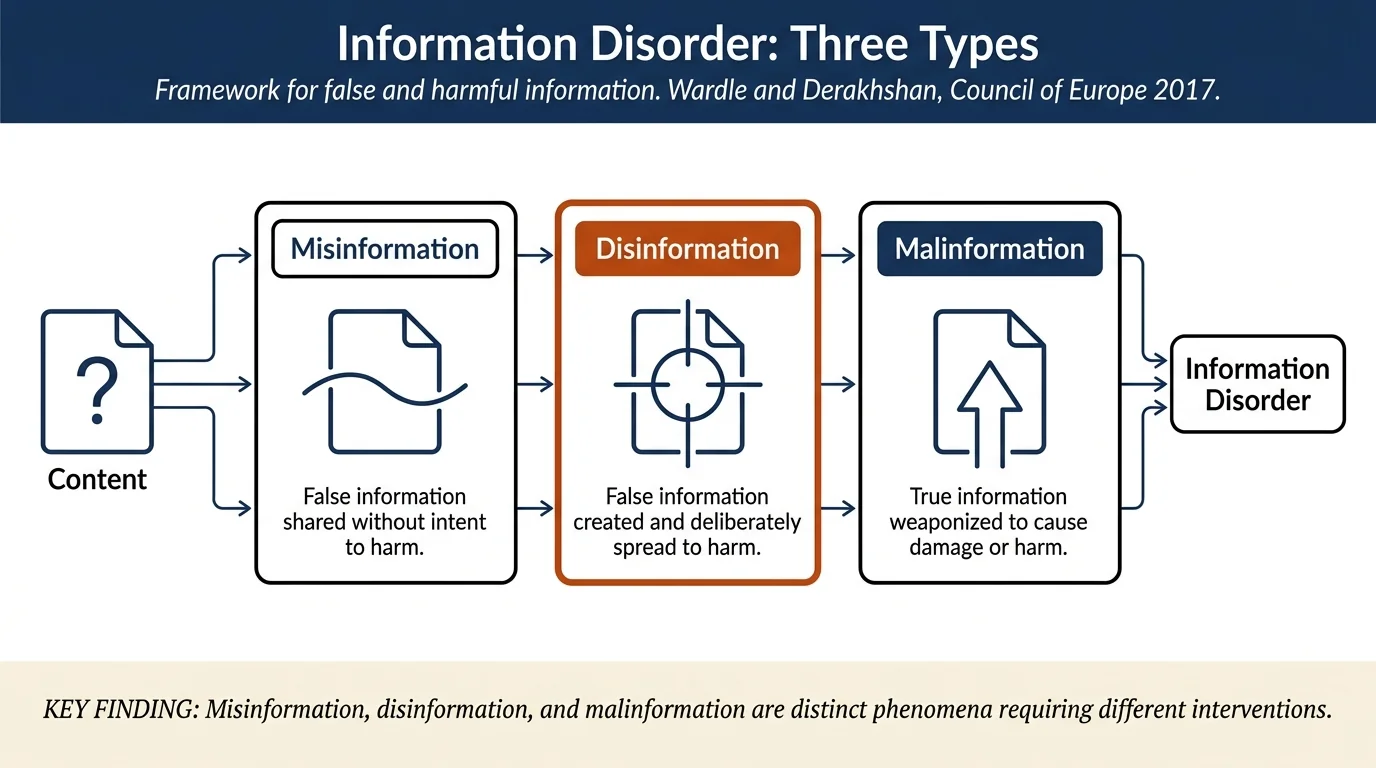
Information Disorder: Toward an Interdisciplinary Framework for Research and Policy MakingThis Council of Europe report introduces a comprehensive framework for understanding "information disorder" via three types (mis-, dis-, mal-information) defined by falseness and intent-to-harm. It examines the agents, messages, and interpreters involved, the creation-production-distribution lifecycle, and proposes 34 recommendations…
 Spread & networksBots & coordinated campaigns
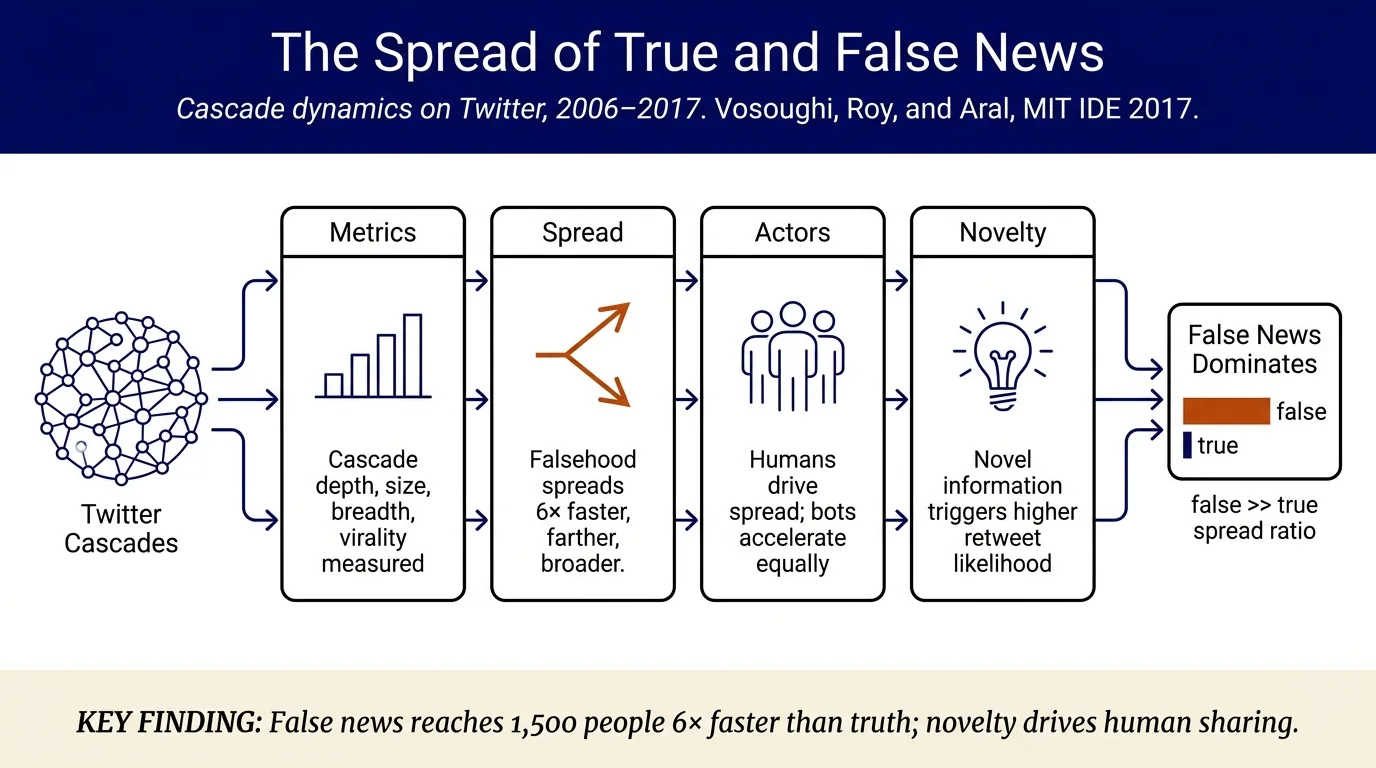
The Spread of True and False News OnlineAnalyzes 126,000 verified true and false news cascades from Twitter (2006–2017) covering 3 million users and 4.5 million shares. False news diffuses significantly farther, faster, deeper, and more broadly than truth across all categories, with false political news spreading fastest.
 Spread & networksPlatforms, policy & society
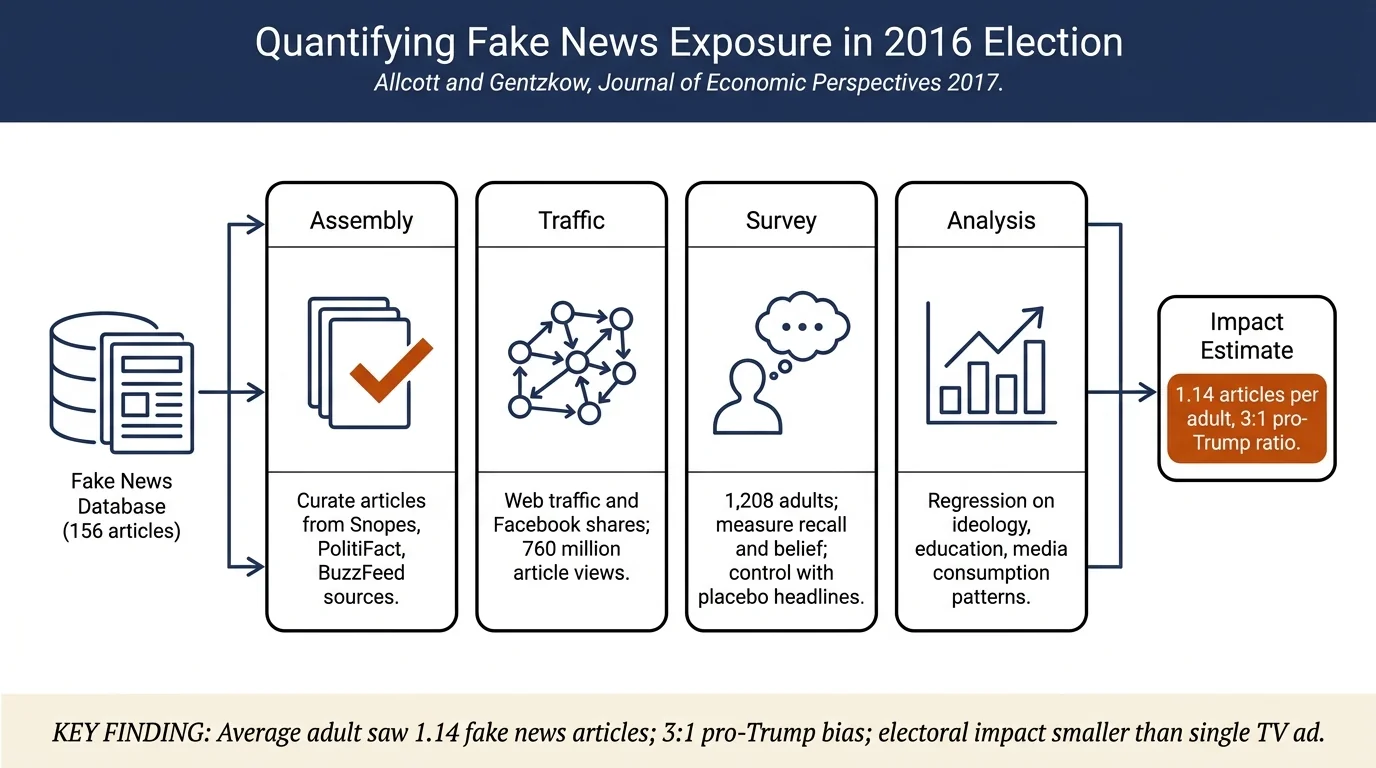
Social Media and Fake News in the 2016 ElectionAllcott and Gentzkov provide the first comprehensive empirical evidence on fake news exposure during the 2016 US election. Drawing on a curated database of 156 fake news articles, web traffic data, and a post-election survey of 1,200 adults, they estimate the average American saw and remembered 1.14 fake news articles during the election…
 Spread & networksPsychology & interventions
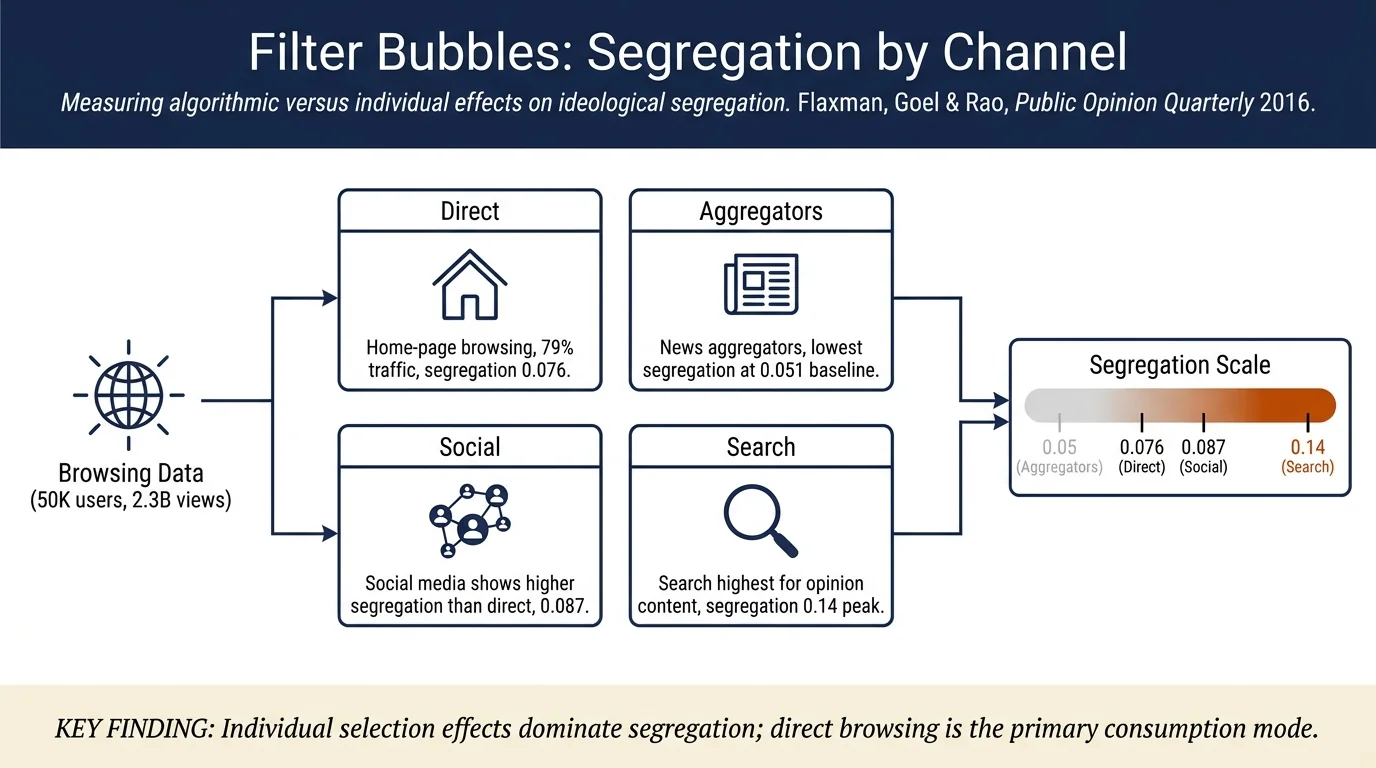
Filter Bubbles, Echo Chambers, and Online News ConsumptionThis paper examines whether technological changes (social media, search engines) increase ideological segregation in online news consumption by analyzing web-browsing data from 50,000 active news readers. They find that while social media and search are associated with higher segregation than direct browsing, the overall effects are…
 Spread & networksDetection methods
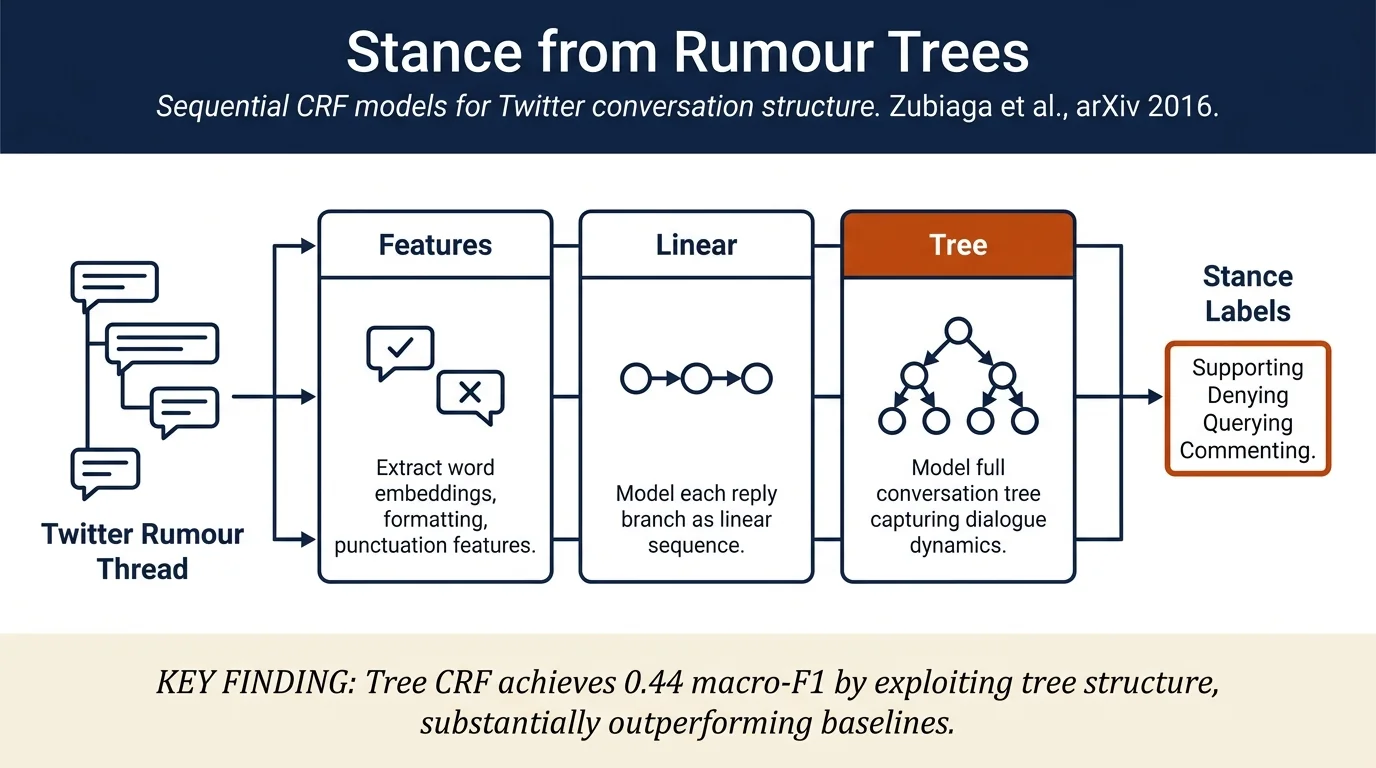
Stance Classification in Rumours as a Sequential Task Exploiting the Tree Structure of Social Media ConversationsProposes that modelling Twitter conversations as tree-structured sequences improves rumour stance classification. Introduces Linear and Tree Conditional Random Fields (CRF) to exploit the sequential structure of replies within rumour threads, showing that Tree CRF significantly outperforms non-sequential baselines on 4,519 annotated…
 Spread & networksDetection methods
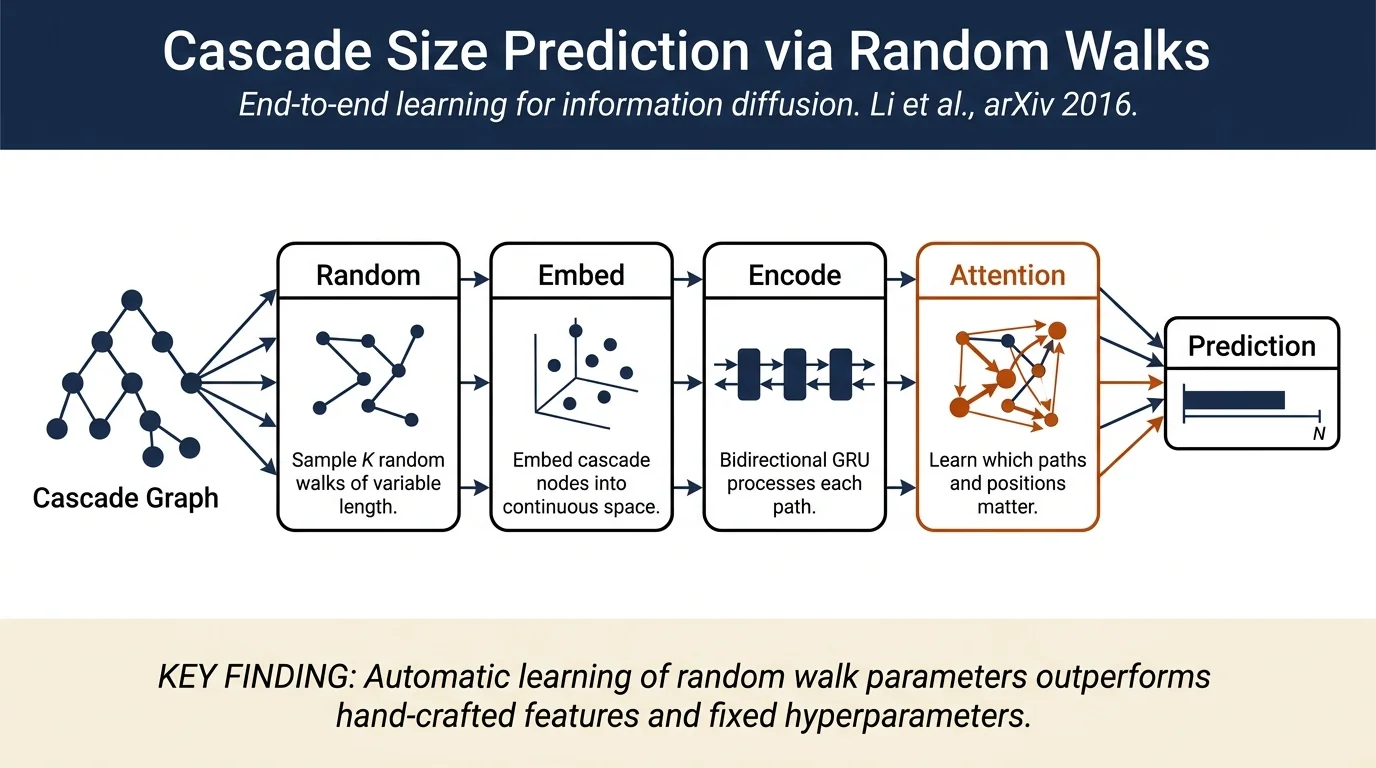
DeepCas: an End-to-end Predictor of Information CascadesDeepCas predicts the future size of information cascades (e.g., how many people will eventually retweet a post or cite a paper) using an end-to-end deep learning model that represents cascade graphs as sets of random walk paths. Instead of relying on hand-crafted network features, the model learns cascade representations automatically…
 Spread & networksPlatforms, policy & society
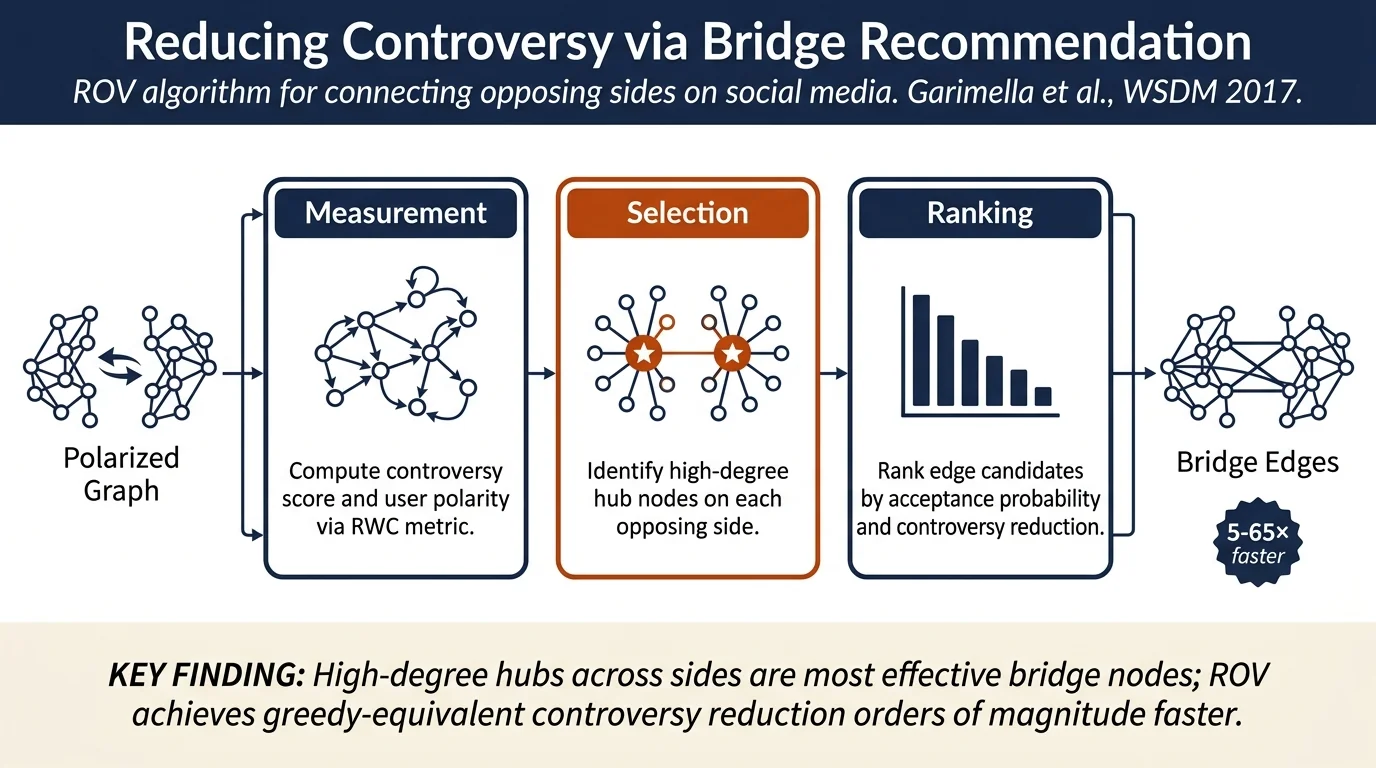
Reducing Controversy by Connecting Opposing ViewsThis paper proposes an algorithmic approach to reduce polarization on social media by recommending social connections (edges) between opposing sides. Using an endorsement graph representation and the random-walk-based controversy metric, the authors formulate the problem as k-edge-addition and develop an efficient algorithm (ROV) that…
 Spread & networksPlatforms, policy & society
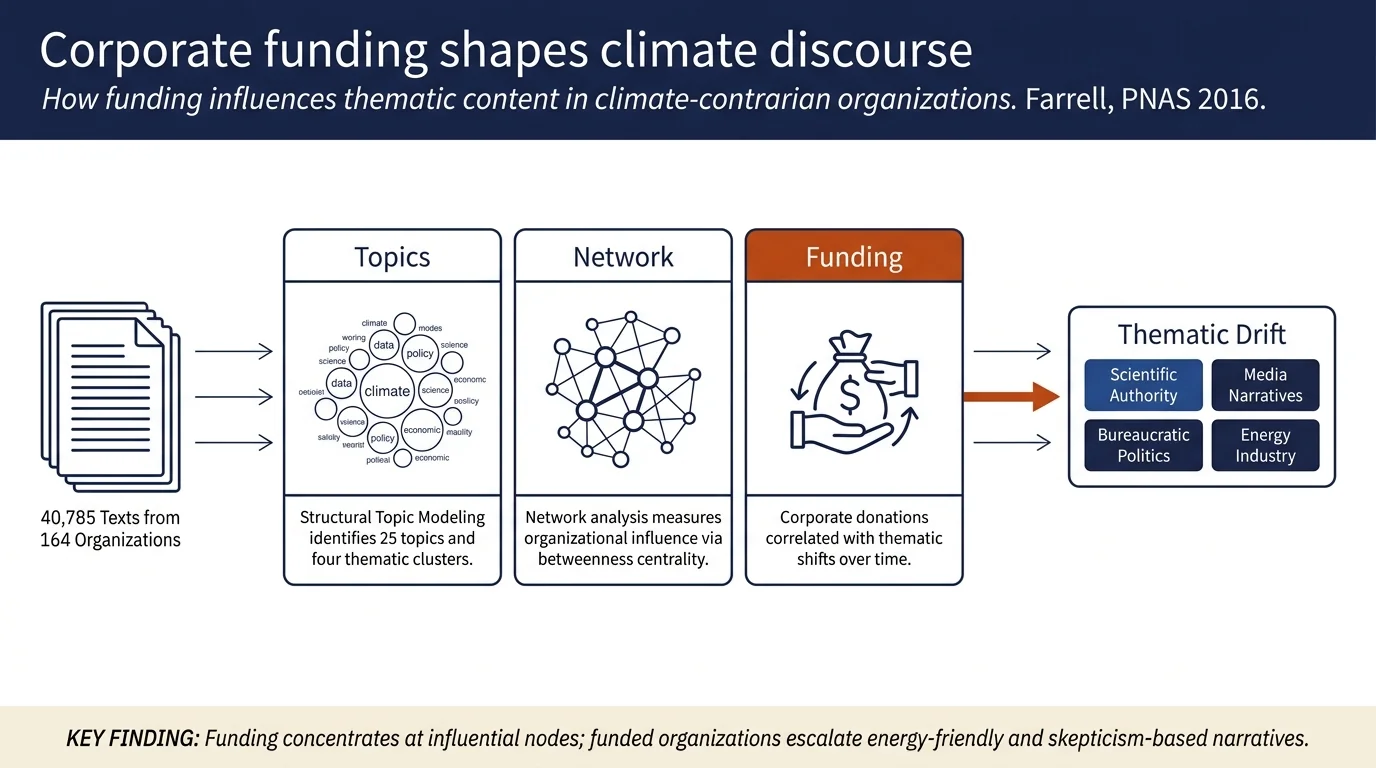
Corporate funding and ideological polarization about climate changeFarrell analyzes 40,785 texts (39+ million words) from 164 climate contrarian organizations between 1993–2013, employing Structural Topic Modeling and social network analysis to demonstrate that corporate funding from entities like ExxonMobil and Koch family foundations directly influences which polarization themes are created and…
 Spread & networksDatasets & evaluation
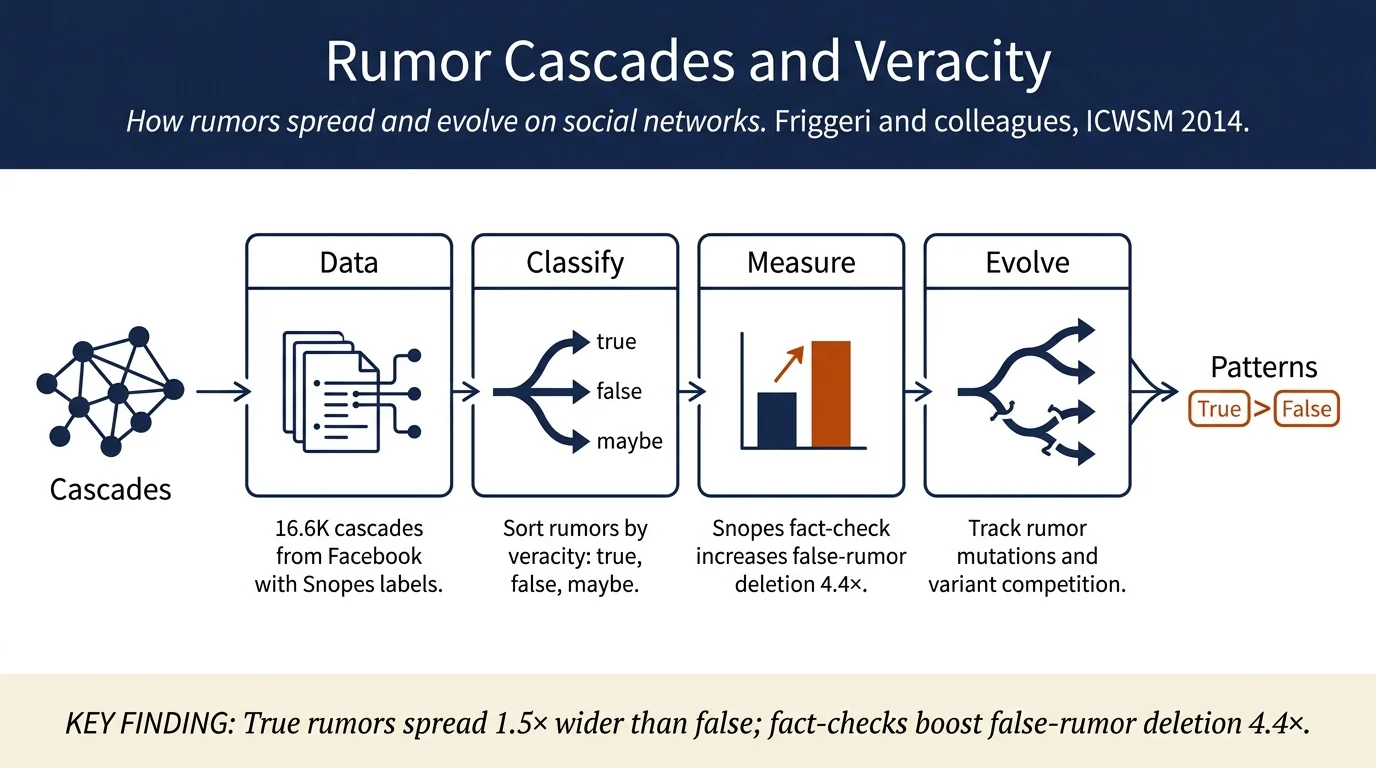
Rumor CascadesFriggeri et al. tracked thousands of rumors on Facebook using Snopes.com as ground truth, finding that rumor cascades run deeper in the social network than typical content. True rumors spread more virally than false ones despite false rumors being more frequently uploaded; Snopes fact-checks increase deletion likelihood for false rumors…
 Spread & networksDetection methods
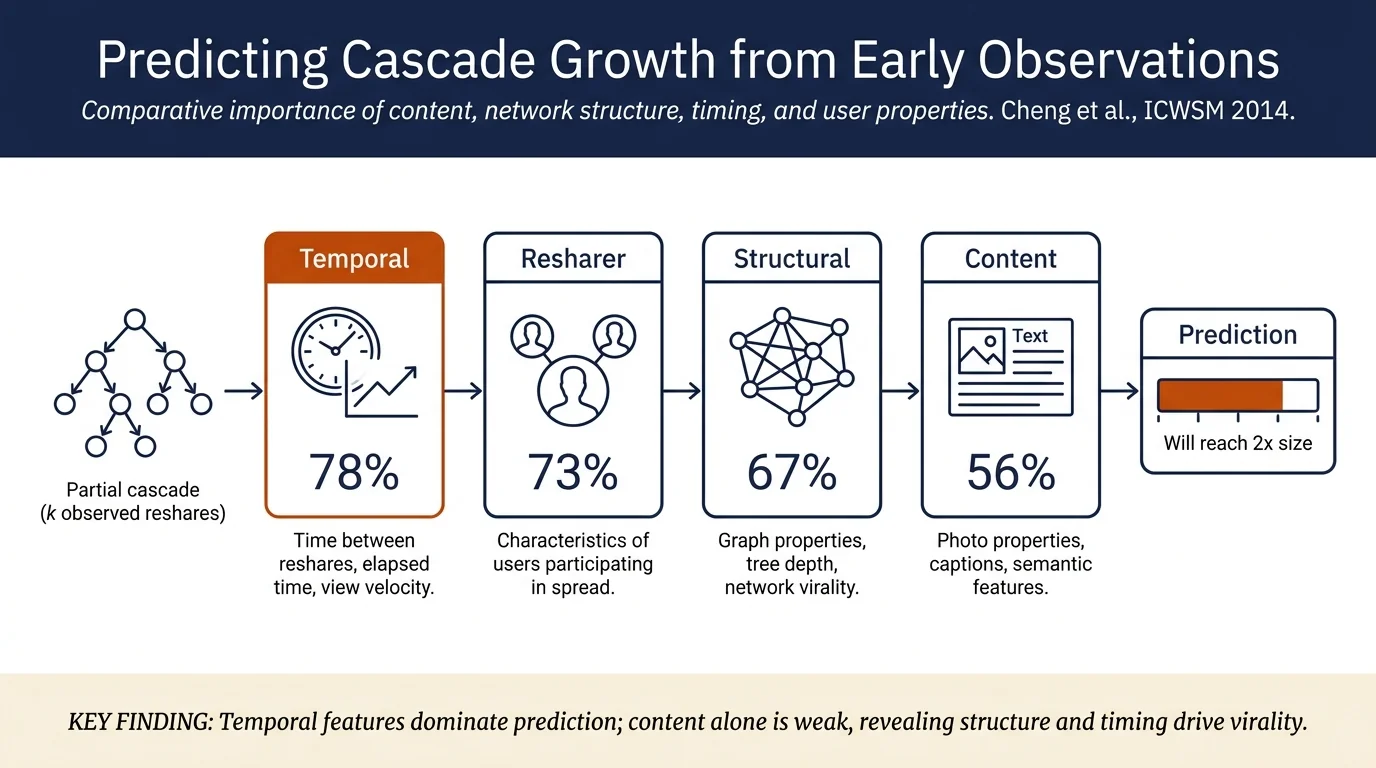
Can Cascades be Predicted?Information cascades on social networks can be predicted with reasonable accuracy (~80%) using temporal and structural features extracted from early observations. Performance improves substantially as more cascade stages are observed.