Corporate funding and ideological polarization about climate change
Author: Justin Farrell
Venue: Proceedings of the National Academy of Sciences (PNAS), January 5, 2016, Vol. 113, No. 1
DOI: 10.1073/pnas.1509433112
TL;DR
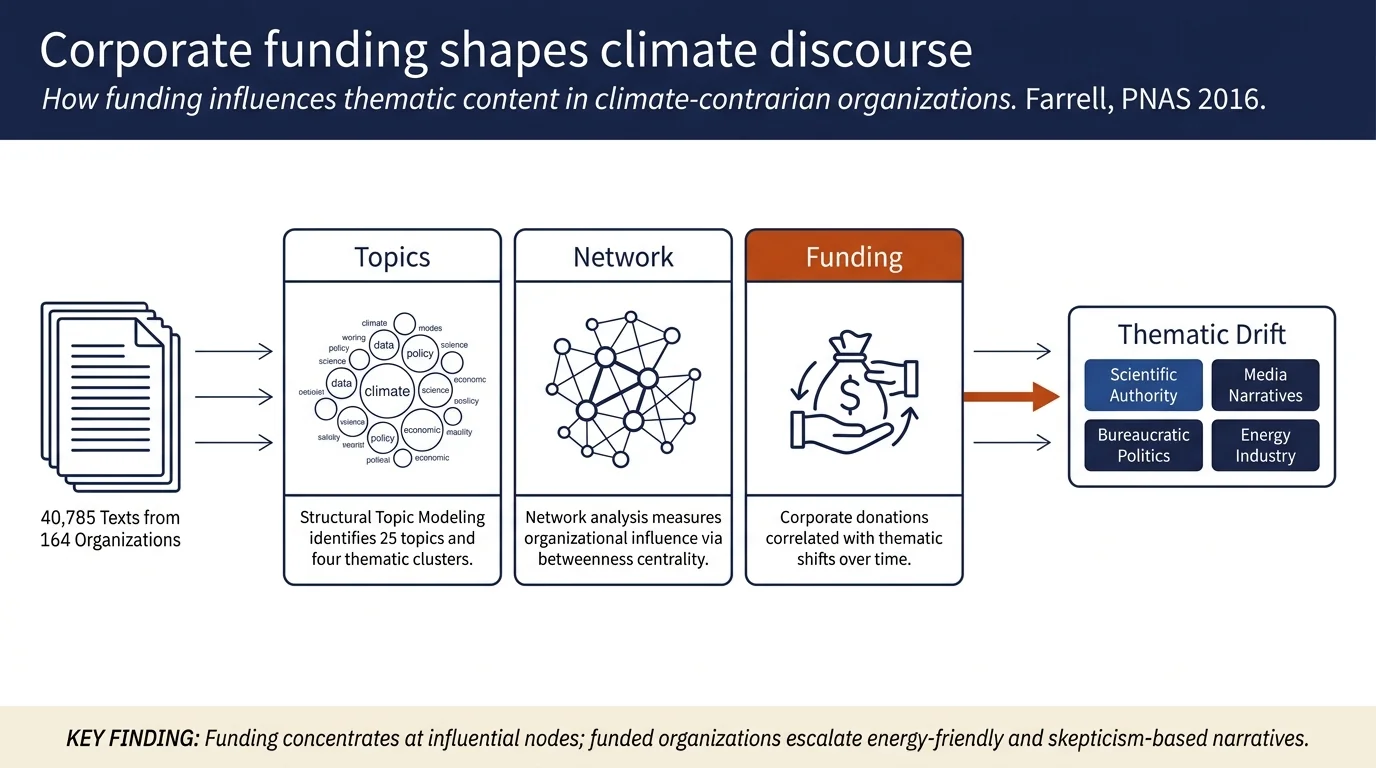
Farrell analyzes 40,785 texts (39+ million words) from 164 climate contrarian organizations between 1993–2013, employing Structural Topic Modeling and social network analysis to demonstrate that corporate funding from entities like ExxonMobil and Koch family foundations directly influences which polarization themes are created and amplified. Organizations with corporate ties were more likely to produce discourse and concentrated themes around temperature trends, energy production benefits of CO₂, and long-term climate cycles—distinct from unfunded organizations' messaging.
Contributions
- Comprehensive empirical demonstration that corporate funding influences actual thematic content of polarizing discourse (not just its production).
- Novel computational methodology combining Structural Topic Modeling on massive text corpora with organizational metadata and social networks.
- Longitudinal evidence (1993–2013) of how funding-driven thematic shifts occurred in real time across the contrarian movement.
- Four distinct thematic clusters within climate contrarian discourse: (1) scientific evidence disputes, (2) public knowledge/media narratives, (3) bureaucratic politics, (4) energy industry concerns.
Method
The study integrates two datasets: (1) a social network of 4,556 individuals with ties to 164 contrarian organizations, and (2) 40,785 texts produced by those organizations. Contrarian organizations were identified from peer-reviewed literature as overtly promoting skepticism about climate consensus. Corporate funding was operationalized as documented donations from ExxonMobil or Koch family foundations (1993–2013) via IRS records.
Text analysis employed Structural Topic Modeling (STM), an extension of Latent Dirichlet Allocation that incorporates document-level metadata (year published, organizational funding status) to identify topics and their prevalence conditional on covariates. The approach avoids hand-coding by inductively discovering 25 thematic topics via machine learning on word co-occurrence patterns.
Network analysis computed betweenness centrality to measure organizational influence and tested whether text-producing organizations differed in centrality or corporate funding.
Results
Network findings: Text-producing organizations had significantly higher betweenness centrality (p < 0.006), indicating discursive influence. Organizations that produced texts and received corporate funding had even higher centrality (p < 0.002), suggesting funding concentrated at the movement's most influential nodes.
Thematic landscape: The corpus segregated into four interpretable clusters: 1. Scientific authority disputes (bottom left, green): topics around CO₂ benefits, long-term cycles, temperature trends, skepticism of IPCC science, and melting Arctic. 2. Media/public narratives (bottom middle, yellow): Al Gore, media coverage, human health framing. 3. Bureaucratic politics (top middle, blue): federal/state regulation, EPA rules, cap-and-trade bills, presidential politics. 4. Energy industry concerns (top, black): oil/gas, energy production, fuel usage, government spending, economic development.
Corporate funding effects: Plotting topic prevalence over time (1993–2013) conditional on funding status revealed distinct trajectories for four key topics: - Temperature Trends: Funded organizations showed increasing emphasis from 2007–2013 (rising red line), while unfunded organizations peaked mid-2000s and declined (falling black line). - Energy Production: Funded organizations showed sharp increase after 2005; unfunded remained stable. - CO₂ is Good: Funded organizations escalated dramatically after 2005; unfunded flat. - Climate is Long-term Cycle: Funded organizations surged after 2008; unfunded declined.
These divergences suggest corporate funding did not merely enable existing contrarian discourse but actively steered its thematic focus toward energy-production-friendly and skeptical-of-scientific-attribution narratives over the period.
Connections
- Related to van der Linden et al. (2017) via shared focus on climate misinformation and polarization mechanisms.
- Exemplifies Disinformation via documented organizational and financial networks orchestrating alternative discourse.
- Methodologically aligned with computational social science approaches combining large-scale text and network data.
- Complements corporate influence on public knowledge and policy formation.
- Links to political polarization mechanisms driven by organized funding rather than spontaneous societal division.
Notes
Strengths: This is a rare large-scale, quantitative treatment of a phenomenon long documented qualitatively (e.g., "Merchants of Doubt"). The comprehensive corpus of 40,785 texts avoids selection bias in media coverage analysis. STM with metadata-conditioning elegantly isolates thematic shifts attributable to funding while avoiding deterministic causal claims. Longitudinal design reveals temporal dynamics missed by snapshot analyses. The four-cluster visualization of topic correlations provides intuitive sense of contrarian discourse architecture.
Limitations: The study cannot definitively disentangle causation (does funding cause message shift, or do organizations creating those messages attract funding?). The authors address this via supplementary analysis showing few differences between "front groups" (funded first) and "established think tanks" (funded later), but acknowledge micro-level causal mechanisms remain unknown. Funding is binary (did-vs-did-not receive from EM/KFF), not measuring amounts or other funders. The furtive nature of modern PAC funding means comprehensive funding data is unattainable.
Broader implications: Beyond climate, this demonstrates how private funding shapes scientific discourse at scale. The paper's analytical framework—combining machine learning text analysis with organizational networks and metadata—is transferable to other polarized domains (vaccines, election integrity, pandemic response) where funding and messaging may be coordinated.