Information Disorder: Toward an Interdisciplinary Framework for Research and Policy Making
Authors: Claire Wardle, Hossein Derakhshan Venue: Council of Europe, October 2017 — URL
TL;DR
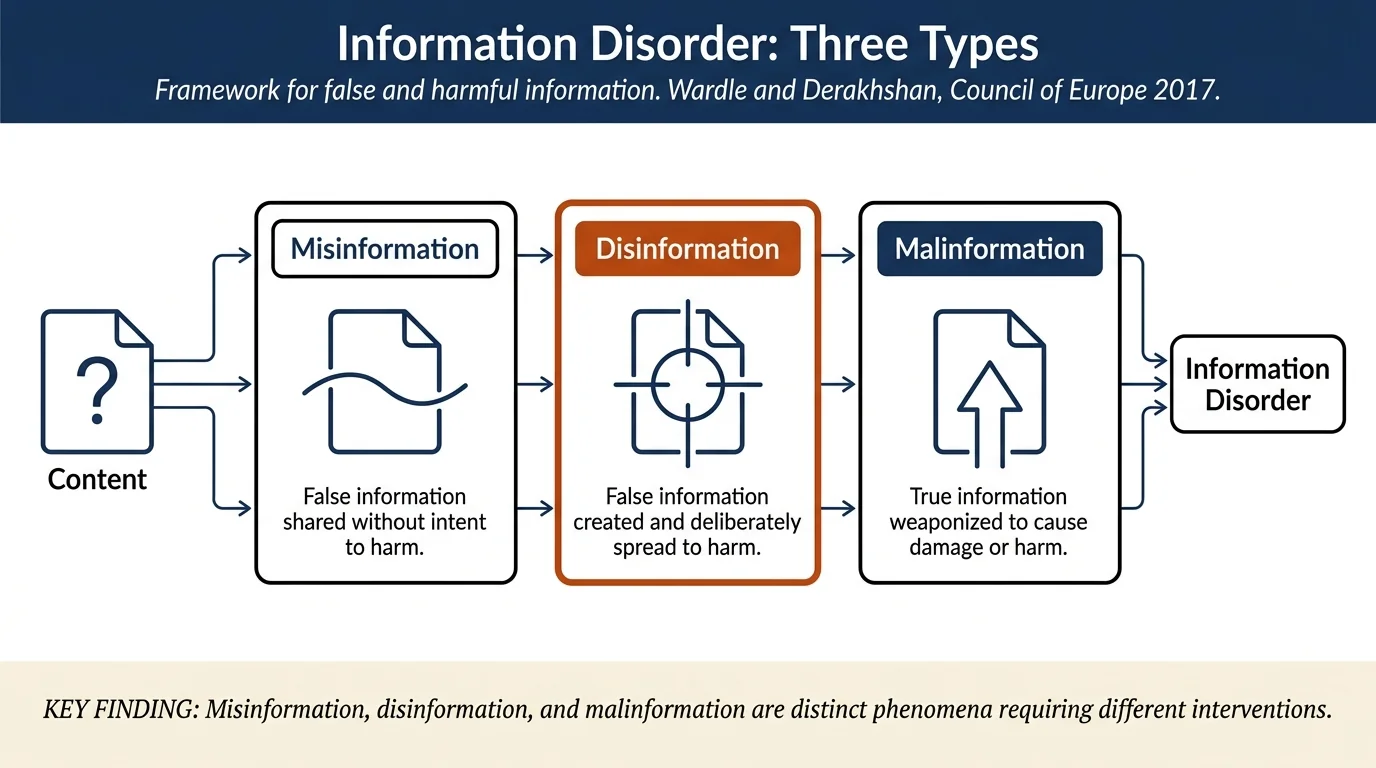
This Council of Europe report introduces a comprehensive framework for understanding "information disorder" via three types (mis-, dis-, mal-information) defined by falseness and intent-to-harm. It examines the agents, messages, and interpreters involved, the creation-production-distribution lifecycle, and proposes 34 recommendations across technology, government, media, civil society, and education. The framework has become canonical in the field.
Contributions
- Introduces the terminological distinction between mis-information (false, unintentional), dis-information (false, intentional), and mal-information (true, malicious use)
- Proposes an agent-message-interpreter analytical model to decompose information disorder episodes
- Maps three phases of information disorder: creation, production/reproduction, and distribution
- Catalogs the role of social networks, algorithmic amplification, and mainstream media in propagating falsehoods
- Identifies seven subtypes of problematic content: satire, misleading, imposter, fabricated, false connection, false context, manipulated
- Provides 34 specific recommendations targeting technology platforms, governments, media, civil society, educators, and funders
Method
The report grounds its framework in communication theory (James Carey's distinction between transmission and ritual models), psychological research on information consumption, and case-study analysis of the 2017 French Presidential election and the 2016 US election. Rather than proposing a detection algorithm, it offers a conceptual taxonomy and structured questions for analyzing how false or harmful information is created, amplified, and interpreted by audiences.
Results
The report identifies information pollution as a systemic problem driven by: (1) accessible publishing technology, (2) social-media-driven private-to-public information flow, (3) accelerated news cycles, (4) trusted-peer communication bypassing gatekeepers, (5) algorithmic curation favoring emotional content, and (6) visual misinformation (underexplored compared to text). It emphasizes that disproportionate focus on text-based "fake news" obscures the role of visuals, mainstream media amplification, and state-sponsored campaigns in dis-information.
Connections
- Related to Zhou & Zafarani's survey via shared definition of misinformation types and detection-method taxonomy
- Contemporary with Vosoughi et al. on spread dynamics of false news
- Contemporaneous with Allcott & Gentzkov on the scale and economic incentives of fake news
- Extends earlier media-literacy and propaganda work (McLuhan, Carey) to the networked age
Notes
Strengths: - The mis/dis/mal trichotomy has become standard terminology in the field, replacing the vaguer "fake news" - The agent-message-interpreter framework is elegant and forces decomposition of complex information phenomena - Practical: provides actionable questions for researchers and policymakers, not just theory - Acknowledges mainstream media's role in amplification, resisting oversimplified narratives about text-only fabrications
Limitations: - The framework is descriptive rather than predictive; it does not propose mechanisms for scale or virality - Limited empirical validation of the recommended interventions - Recommendations are sometimes aspirational ("technology companies should do X") without addressing incentive structures or implementation feasibility - The report predates deepfakes and large-scale synthetic media (though it flags this as a concern); the framework holds but detection challenges are higher
Follow-ups: - Empirical work on which types (mis vs. dis) dominate by platform and domain (health, politics, etc.) - Studies of the effectiveness of the recommended media-literacy and source-checking approaches - Extensions to synthetic media (audio/video deepfakes) using this framework