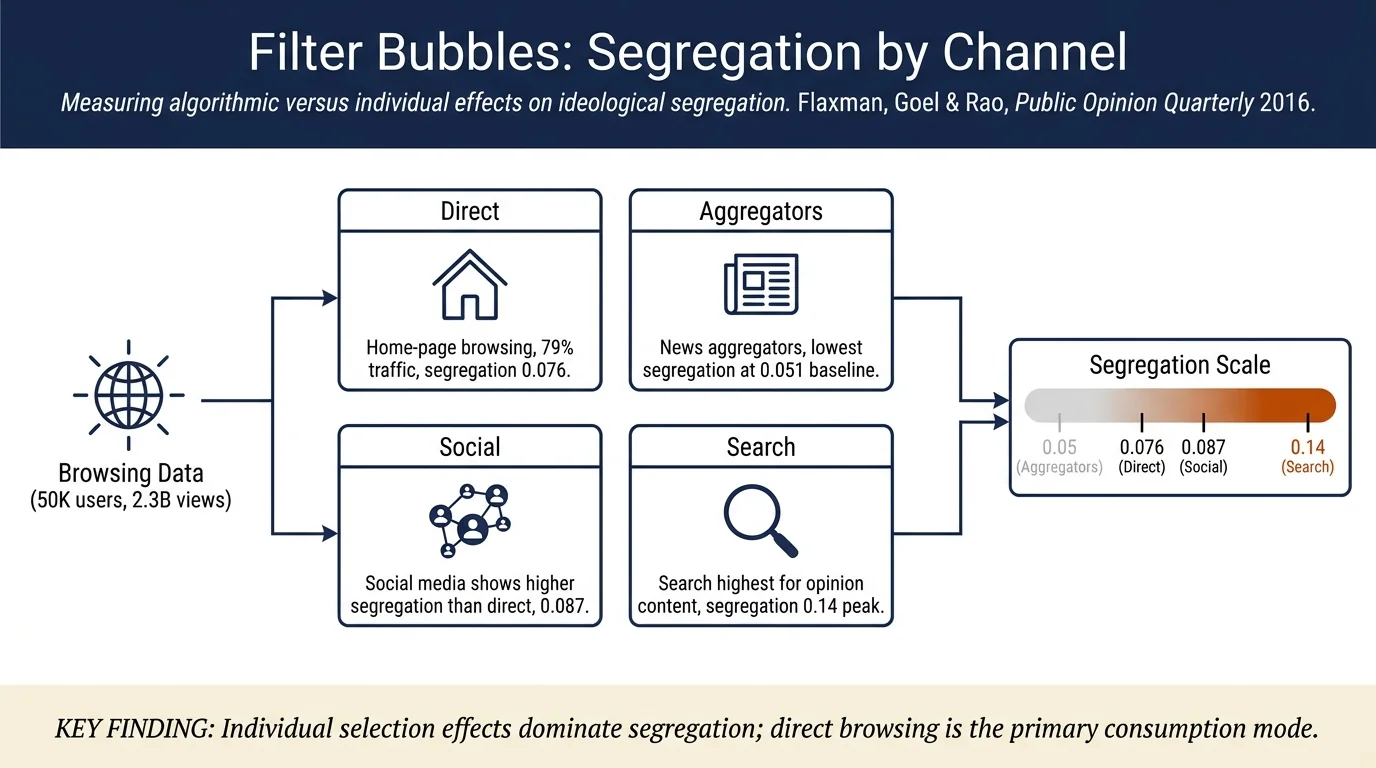
Filter Bubbles, Echo Chambers, and Online News Consumption
Authors: Seth Flaxman, Sharad Goel, Justin M. Rao Venue: Public Opinion Quarterly, Vol. 80, Special Issue, 2016 — DOI
TL;DR
This paper examines whether technological changes (social media, search engines) increase ideological segregation in online news consumption by analyzing web-browsing data from 50,000 active news readers. They find that while social media and search are associated with higher segregation than direct browsing, the overall effects are modest—most variation in news consumption is driven by individuals choosing to visit the home pages of their ideologically preferred outlets, not by algorithmic filtering.
Contributions
- Introduces a large-scale dataset of web-browsing behavior from 50,000 US-based active news readers with 2.3 billion distinct page views (March–May 2013).
- Develops an audience-based measure of news outlet political slant by inferring outlet readership ideology from IP address geolocation.
- Quantifies ideological segregation across four consumption channels: direct navigation, web search, social media, and news aggregators.
- Distinguishes segregation effects across article types (descriptive news vs. opinion).
- Demonstrates that individual selection effects dominate segregation; direct browsing is the primary consumption mode (79% of news traffic).
Method
The authors collected anonymized web-browsing data via the Bing Toolbar, a browser extension allowing users to voluntarily share their surfing activity. They restricted analysis to 50,000 users with at least ten substantive news articles and two opinion pieces in a three-month window—a filter that identifies active news consumers.
Measuring outlet ideology: Since human editorial ratings were infeasible, they estimated the fraction of each news outlet's readership that voted Republican in the previous presidential election using: - Audience-based inference: users' geographic locations (inferred from IP addresses) correlated with local political composition to estimate outlet-level conservative share - Validation: correlations between their measure and prior survey-based estimates (Pew 2014) were 0.81 for top outlets
Identifying consumption channels: The authors inferred how users discovered stories via a referrer classification: - Direct: top-level domain (short URL) such as nytimes.com or foxnews.com - Aggregator: referrals from Google News and other news aggregators - Social: Facebook, Twitter, e-mail services - Search: Google, Bing, Yahoo web search
Modeling segregation: They developed a hierarchical Bayesian model to estimate individual-level ideology (latent polarity score) based on the ideological composition of news outlets each user visited. Segregation is defined as the expected squared distance between individuals' polarity scores: \(\sqrt{E[(μ_i - μ_j)^2]}\). They also modeled segregation separately by consumption channel and article subjectivity (descriptive vs. opinion).
Results
Overall segregation: Individual polarity scores range from 0 (entirely liberal) to 1 (entirely conservative), with most users clustered near the center (median ~0.5). Estimated segregation is 0.11 when measuring across all users, indicating moderate ideological distance but substantial overlap.
Segregation by channel: - Aggregators show lowest segregation (0.051 for descriptive news) - Direct browsing: 0.076 - Social media: 0.087 - Search: highest at 0.087 for descriptive news, 0.14 for opinion
Social media and search are associated with ~1.4× higher segregation than direct browsing for opinion content, though absolute effects remain modest.
Consumption patterns:
- Direct navigation dominates: 79% of news consumption, 67% of opinion
- Search: 13% of news, 23% of opinion
- Social media: 6% of news, 10% of opinion
- Aggregators: <1% across both
Opposing partisan exposure: Even extreme right-leaning readers encounter some liberal content when searching (3% of search results vs. virtually none on their preferred outlets directly). This suggests search and social media do expose users to ideological diversity, though effects are small.
Key insight: Within-user ideological variation (variance in the outlets a single user visits) exceeds between-user variation. Most individuals read a variety of sources but cluster them around their ideological preference; extreme segregation is rare.
Connections
- Related to filter bubble theory via critique: shows limited evidence that algorithms alone drive segregation
- Contrasts with echo chamber mechanisms; provides empirical measurement
- Cited by Eady et al. 2019 on real-world partisan news exposure
- Methodologically related to Bakshy et al. (2015) on social media exposure to ideological diversity; both measure actual exposure patterns rather than algorithmic potential
- Complements Sunstein (2009) discussion of technological sorting and polarization; provides empirical grounding
Notes
Strengths: - Large-scale behavioral data with fine-grained outlet classifications - Careful causal reasoning: attributes segregation to individual selection, not just algorithms - Tests implications across multiple channels and article types - Honest about sparsity in data and modeling uncertainty
Limitations: - Sample is self-selected (Bing Toolbar users; ~14% of active news readers per Pew estimates) and skewed toward desktop/higher-income users - Outlet-level ideology estimated from audiences, not editorial analysis; misclassifies outlets with ideologically mixed readerships - Three-month observation window may not capture seasonal variation in consumption patterns - Correlation between predicted and survey-based measures is ~0.8, not perfect
Implications for misinformation: Filter bubble and echo chamber concerns often invoke algorithmic amplification of extremism. This paper's finding that direct browsing drives most news consumption suggests individual agency dominates over algorithmic curation in aggregate. However, this does not rule out algorithmic effects on specific subgroups (e.g., marginal users who do rely on search/social) or on downstream amplification of fringe content.