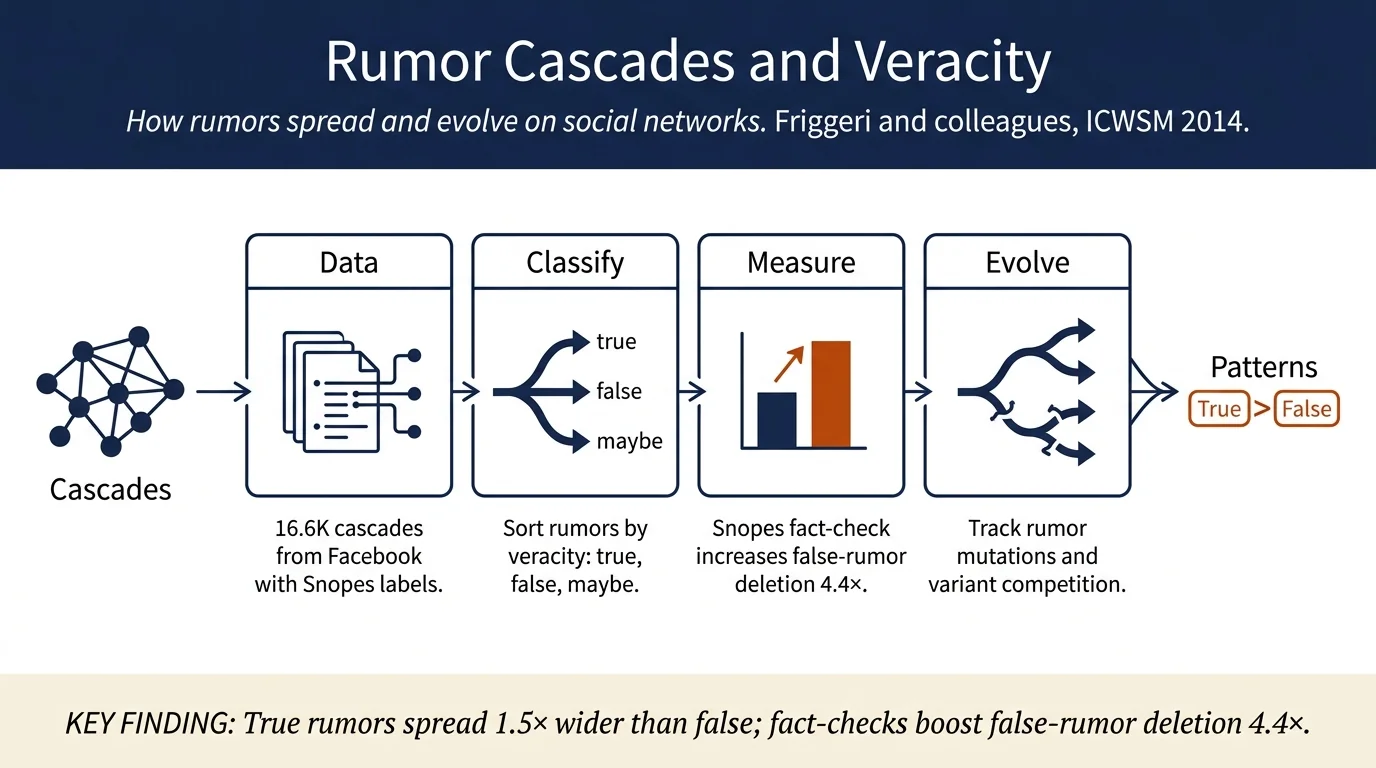
Rumor Cascades
Authors: Adrien Friggeri, Lada A. Adamic, Dean Eckles, Justin Cheng Venue: ICWSM 2014
TL;DR
Friggeri et al. tracked thousands of rumors on Facebook using Snopes.com as ground truth, finding that rumor cascades run deeper in the social network than typical content. True rumors spread more virally than false ones despite false rumors being more frequently uploaded; Snopes fact-checks increase deletion likelihood for false rumors (4.4×) but have minimal long-term propagation effects. The paper also demonstrates that rumors evolve and mutate over time, with different variants competing for dominance.
Contributions
- Large-scale empirical dataset of 16,672 rumor cascades (62.5M shares) from Facebook, using Snopes.com linkage as ground truth for rumor verification.
- Cascade depth analysis showing rumors propagate deeper in the social network than non-rumor photos of comparable size, suggesting contagious rumor content rather than seed account influence.
- Veracity asymmetry findings: True rumors achieve higher virality (163 avg. shares/upload) than false ones (108), despite false rumors being 62% of cascades vs. 45% on Snopes.
- Fact-checking effect measurement: Snopes comments increase reshare deletion probability 4.4× for false rumors; effects vary heterogeneously across specific rumors.
- Rumor evolution analysis: Using copy-paste meme data (April 2009 – October 2011), showed rumors mutate and exhibit burstiness with recurrence; demonstrates that community "voting" via propagation selects correct variants over time.
- Counter-rumor dynamics: Documented how humorous parodies can outcompete serious debunking, achieving 8.6M posts vs. 12.7M original rumor.
Method
Data collection: 249,035 comments on photos/reshares posted July–August 2013 containing valid Snopes.com links; filtered to 16,672 single-rumor cascades (>95% links pointing to same article) with 62.5M total shares. Sampled using Snopes mention probability (0.1%–0.3% of comments) to estimate total rumor distribution.
Veracity classification: Three-way coding of Snopes labels: false (45% of corpus), true (26%), maybe/mixed/undetermined (29%).
Cascade depth: Reconstructed reshare trees using click, impression, and connection data; compared rumor cascades to reference sample of non-rumor photos matched by cascade size decile.
Snopes effect analysis: Conditional on Snopes URL, compared deletion rates and child-reshare rates for snoped vs. non-snoped reshares using online bootstrap for confidence intervals.
Rumor evolution: Clustered copy-paste textual memes using 4-grams and cosine similarity; analyzed variant popularity and cross-variant dynamics for "money bags" and "Facebook charging" memes.
Results
- Virality by veracity: True rumors (163 shares/upload) significantly exceed false rumors (108) despite false rumors dominating uploads (62% vs. 45% on Snopes); category-level analysis shows virality independent of cascade frequency.
- Cascade depth: Rumor cascades exhibit deeper median (depth ∝ 1/log(size)) than reference photo cascades, consistent with rumor contagiousness rather than seed-driven spread (94.2% of large cascades initiated by pages).
- Snopes deletion effect: For false rumors, snoped reshares 4.4× more likely to be deleted (95% CI [3.7, 5.2]); effect smaller but significant for maybe (p < 0.001) and true rumors (p = 0.079); heterogeneous across rumors (0–22% deletion probability swing).
- Long-term snoping impact: While reshares snoped shortly after posting show immediate deletion spike, 45.2% of true-rumor child reshares occur after snoping (vs. 51.9% for false, 59.4% for maybe)—suggesting comment-reading deficiency or active ignoring.
- Rumor evolution: "Money bags" meme (Jul 2013 start) reached 1.1M shares by September despite false 823-year claim; three parody variants achieved 8.6M posts, outcompeting serious debunking (~5K posts); network selected correct calendar variant each year.
Connections
- Related to A Survey of Information Cascade Analysis: Models, Predictions, and Recent via comprehensive survey of cascade prediction and dynamics.
- Cited by Detection and Resolution of Rumours in Social Media: A Survey as empirical foundation for rumor-specific cascade properties.
- Complements Fake News: Fundamental Theories, Detection Strategies and Challenges on propagation-based detection via contagion patterns.
- Extends information diffusion to rumor-specific setting; foundational for understanding Cascade dynamics and prediction.
Notes
Strengths: - Unprecedented scale (16K cascades) with ground-truth veracity labels; methodological innovation in estimating total rumor distribution from biased sample. - Heterogeneous treatment effects (Figure 11) reveal context-dependent snoping impact; handles confounding by conditioning on URL. - Evolutionary analysis of meme mutations shows creative, dynamic nature of social information; demonstrates network-level selection mechanism (variant voting).
Limitations: - Sample heavily biased toward cascades that receive Snopes mentions; cannot estimate absolute popularity of un-snoped rumors. - Analysis of snoping effects purely observational; residual confounding between snoping tendency and deletion propensity remains plausible. - Depth reconstruction requires internal Facebook data; non-reproducible. - Limited to English-language Facebook; cross-platform and multilingual generalization unclear. - No causal identification of why rumors mutate; intent vs. typographical error distinction not examined.
Open questions: - Do subpopulations exist with differential snope-susceptibility or rumor-vulnerability? - How does platform shift from copy-paste (text) to reshare (photo) mechanics affect rumor evolution and correction? - Can rumor evolution patterns (burstiness, mutation) be predicted?