Explore papers
Filter by research area, year and venue. Every filter is in the address bar, so you can share a view as a link.
 Spread & networksPlatforms, policy & society
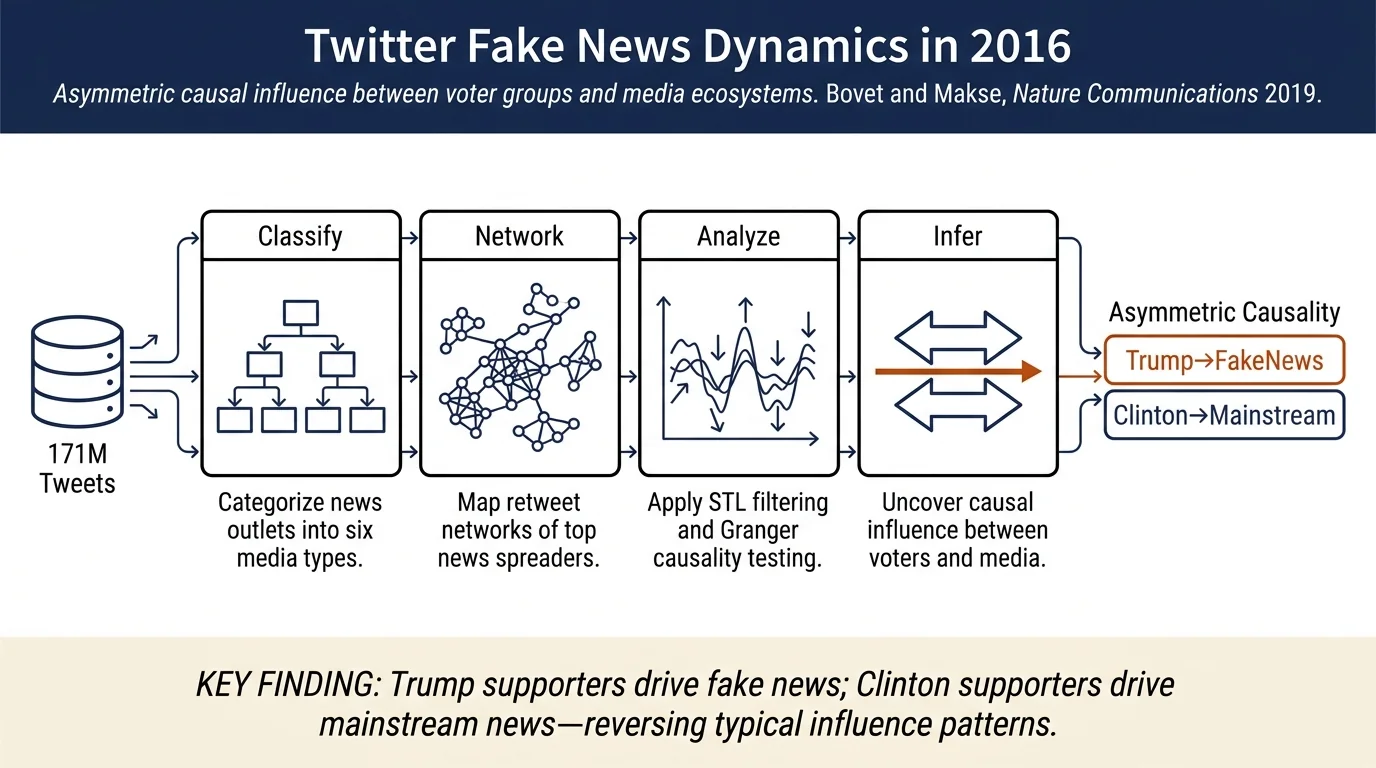
Influence of fake news in Twitter during the 2016 US presidential electionUsing 171 million tweets from the five months preceding the 2016 U.S. election, this study found that 25% of news-sharing tweets contained fake or extremely biased content. Network analysis revealed distinct clusters of fake, biased, and mainstream news spreaders.
 Fact-checking & verificationDatasets & evaluation
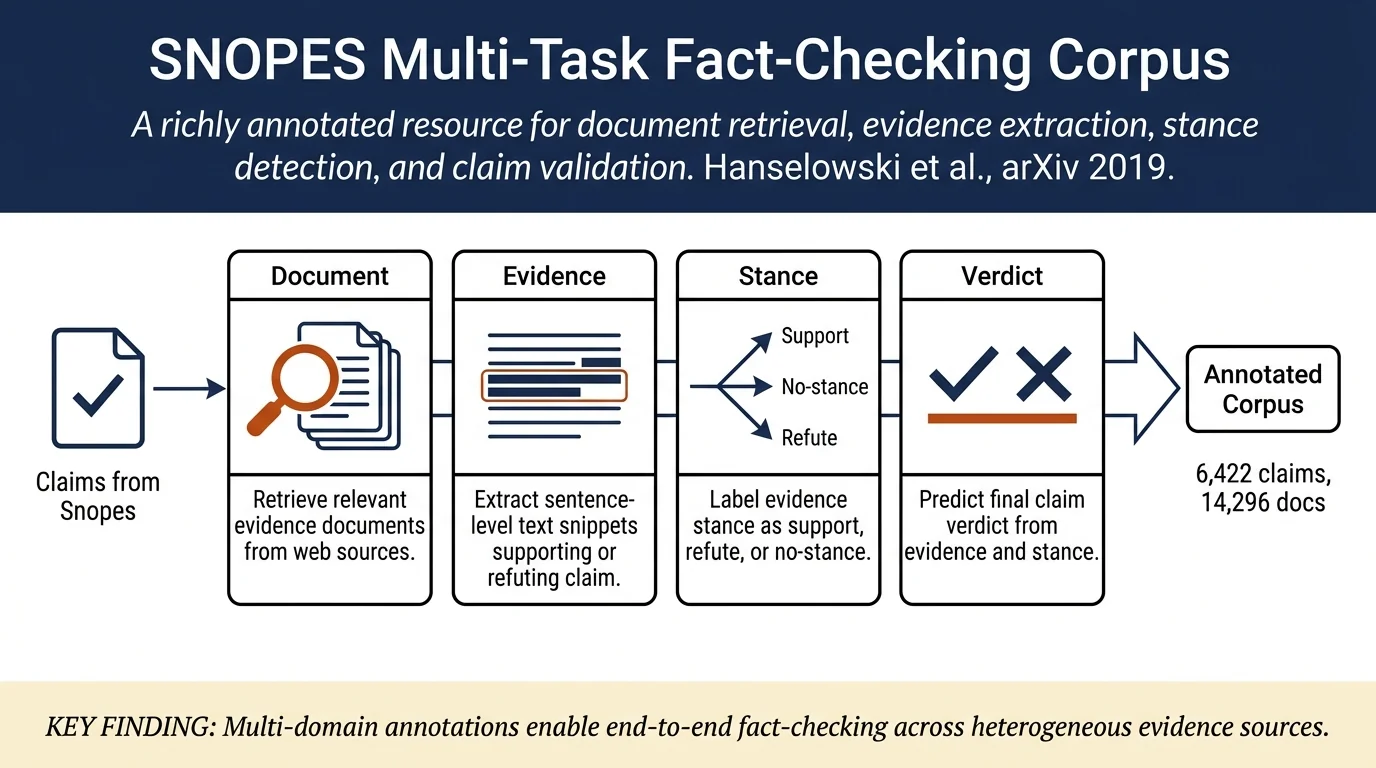
A Richly Annotated Corpus for Different Tasks in Automated Fact-CheckingThe paper introduces SNOPES, a large-scale fact-checking corpus with 6,422 validated claims and 14,296 documents covering multiple domains (news, social media, blogs). Each claim is annotated with evidence text snippets, evidence stance (support/refute/no stance), and verdicts, enabling training of models for four core fact-checking…
 Fact-checking & verificationDatasets & evaluation
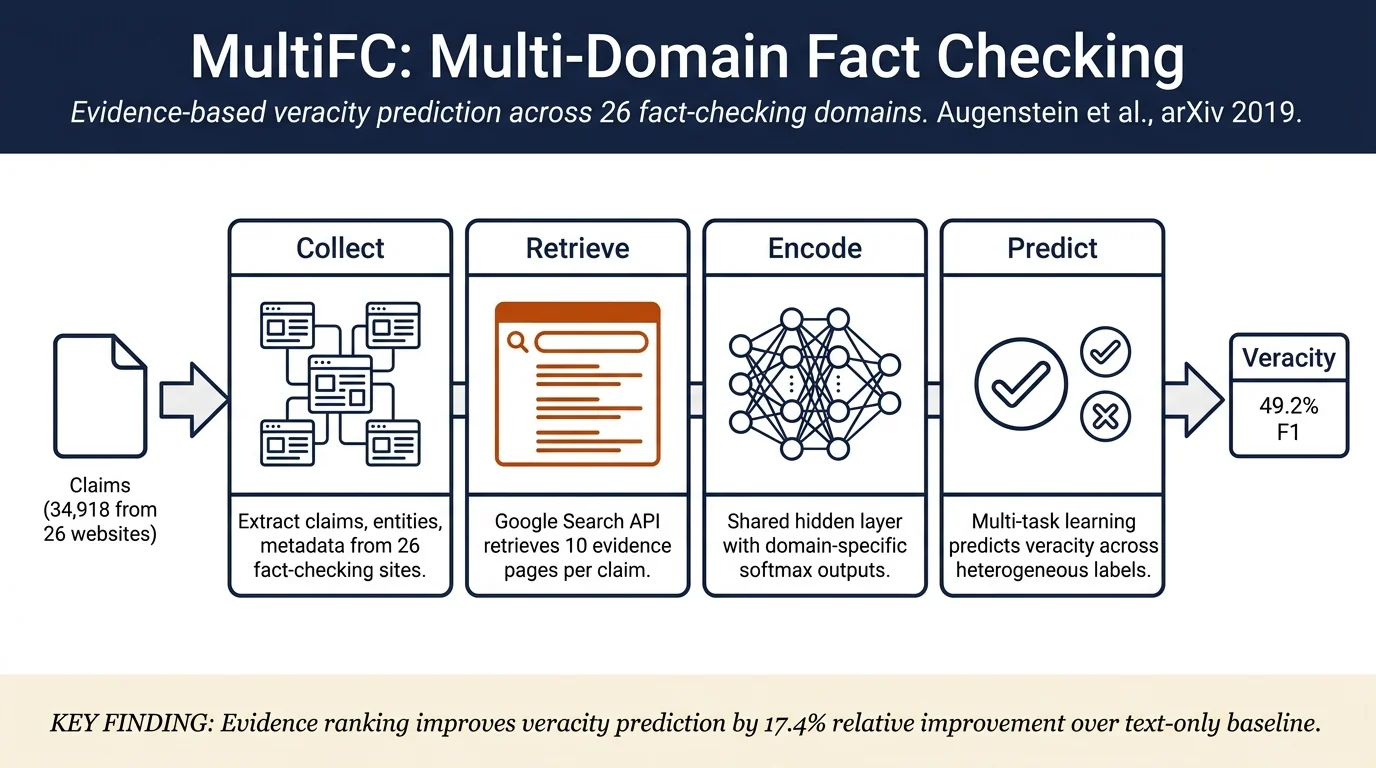
MultiFC: A Real-World Multi-Domain Dataset for Evidence-Based Fact Checking of ClaimsMultiFC is the largest publicly available real-world dataset of naturally occurring factual claims (34,918 claims) collected from 26 fact-checking websites, with rich metadata, evidence pages retrieved via Google Search, and entity linking to Wikipedia. The paper demonstrates that evidence ranking combined with veracity prediction…
 Datasets & evaluationSpread & networks
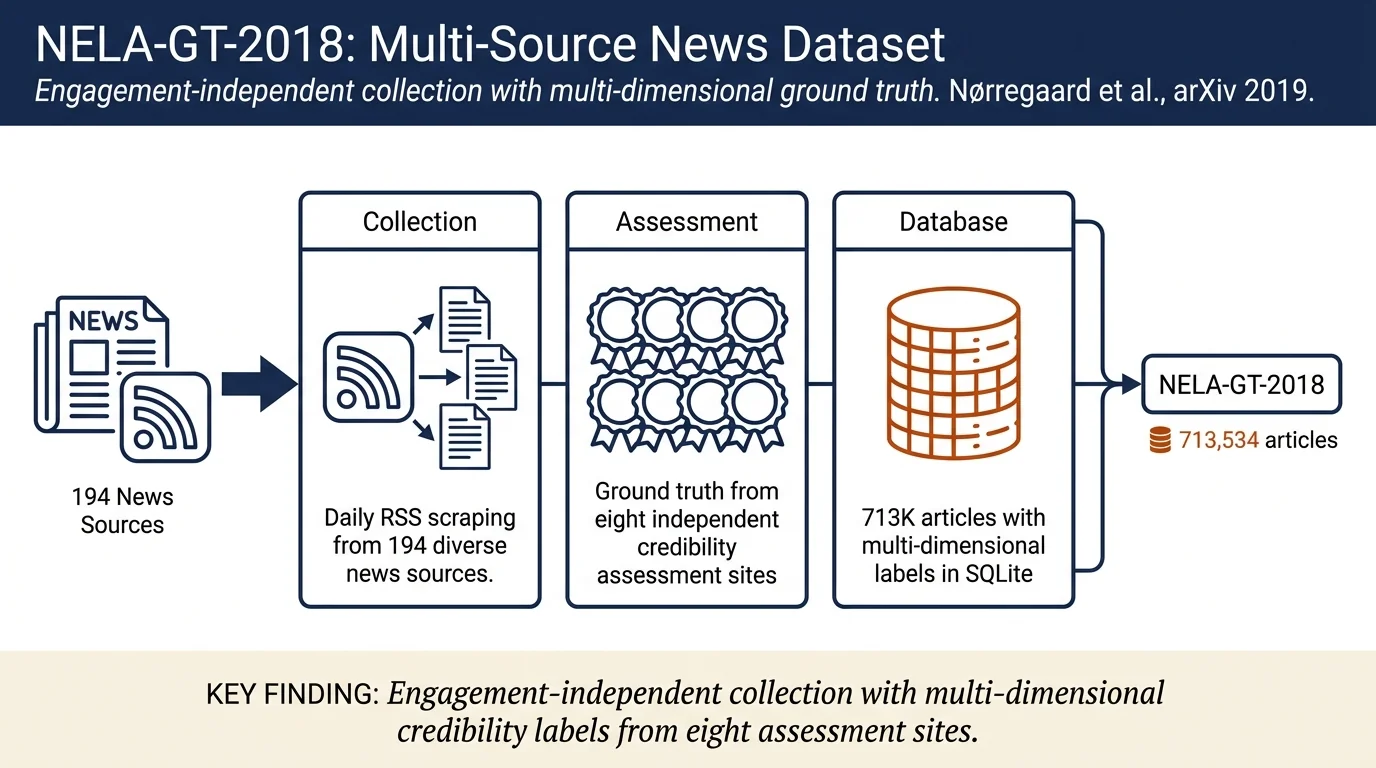
NELA-GT-2018: A Large Multi-Labelled News Dataset for The Study of Misinformation in News ArticlesNELA-GT-2018 is a large, engagement-independent collection of 713,534 news articles from 194 sources across 10 months (Feb–Nov 2018). It combines multi-source-level ground truth labels from eight independent assessment sites (NewsGuard, Pew Research, Wikipedia, OpenSources, Media Bias/Fact Check, AllSides, BuzzFeed News, PolitiFact)…
 Spread & networksDatasets & evaluation
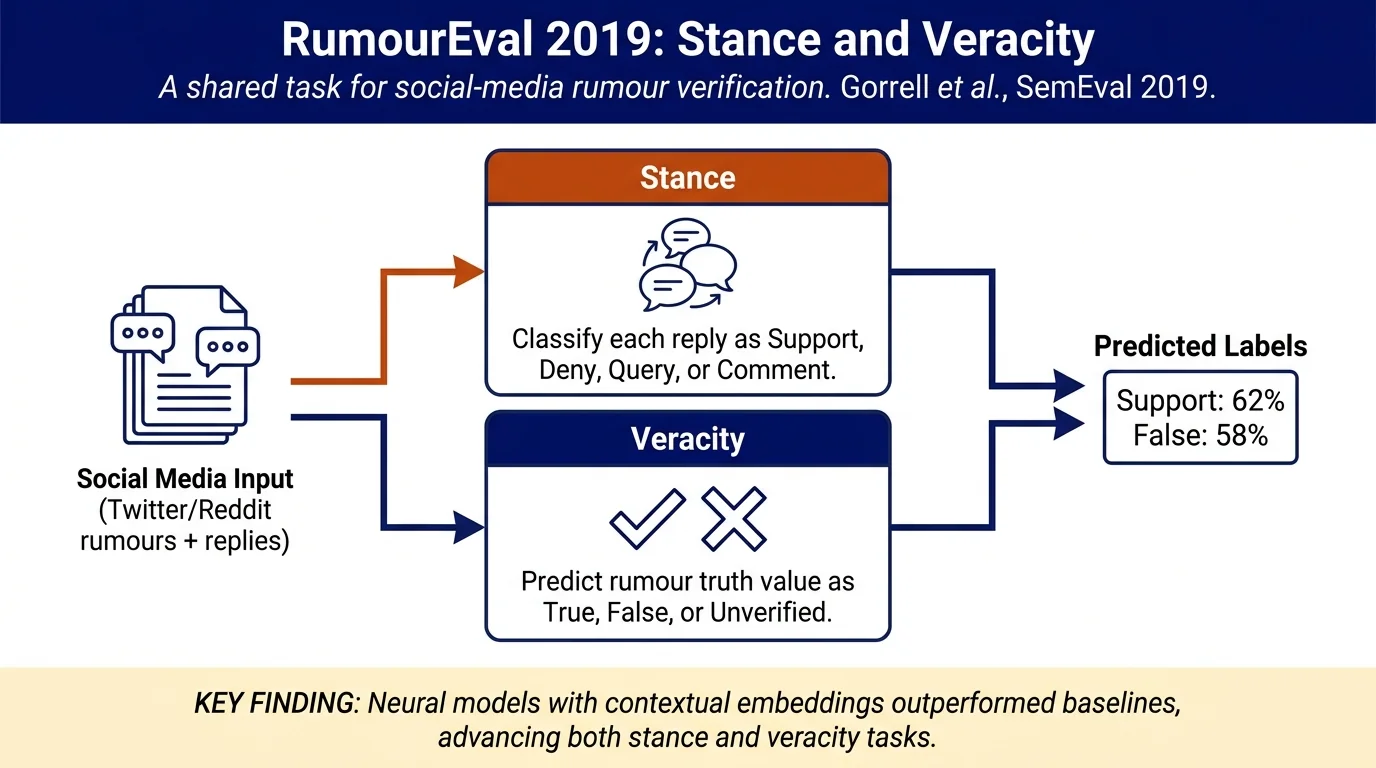
RumourEval 2019: Determining Rumour Veracity and Support for RumoursRumourEval 2019 is a shared task for rumour stance detection and veracity prediction on social media. Extending the 2017 edition, it introduces Reddit data alongside Twitter, provides datasets annotated for SDQC stance (Support/Deny/Query/Comment) and three-way veracity labels, and received 22 system submissions showing that modern…
 Fact-checking & verificationPlatforms, policy & society
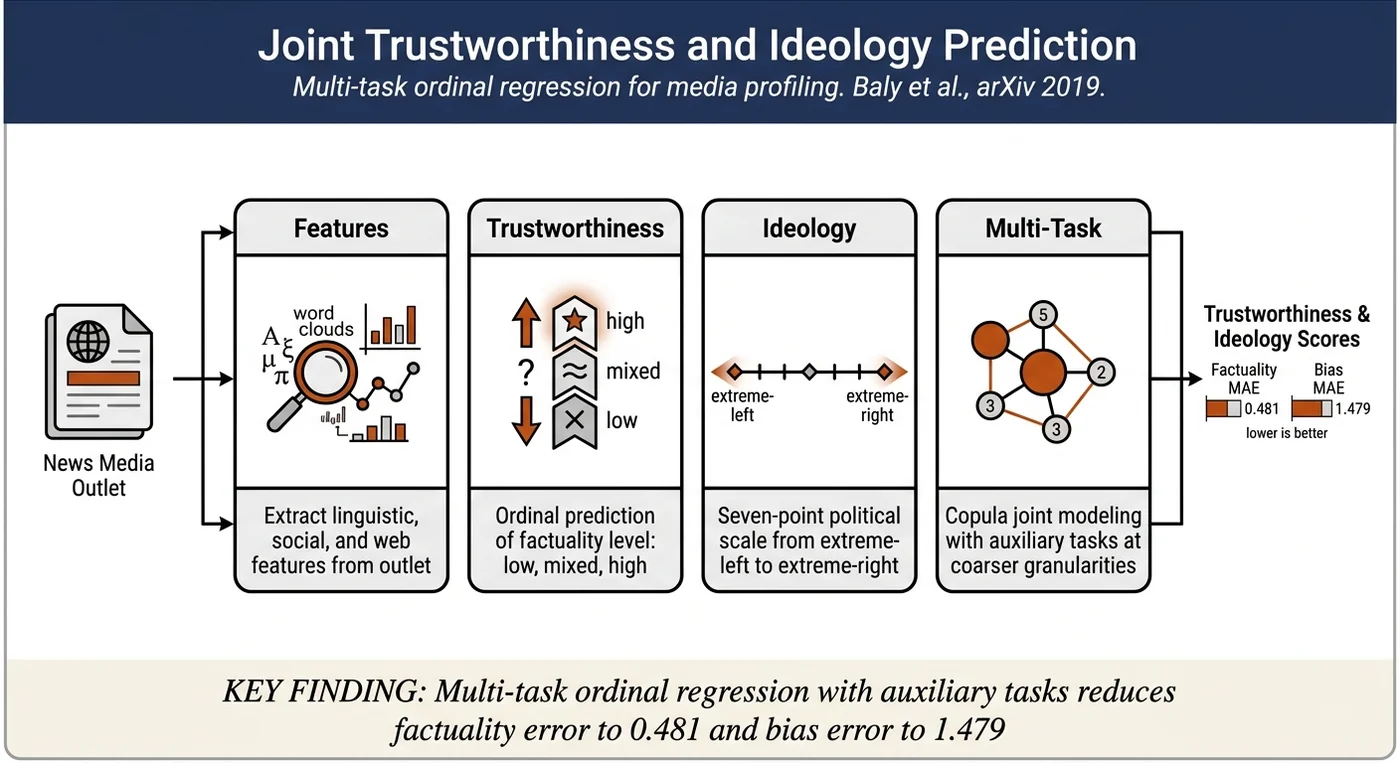
Multi-Task Ordinal Regression for Jointly Predicting the Trustworthiness and the Leading Political Ideology of News MediaRather than predicting media bias and trustworthiness separately, this paper jointly models both as ordinal regression tasks using Copula Ordinal Regression. The intuition is that hyper-partisan outlets tend to be less trustworthy, while centrist outlets are more factual.
 Fact-checking & verificationPlatforms, policy & society
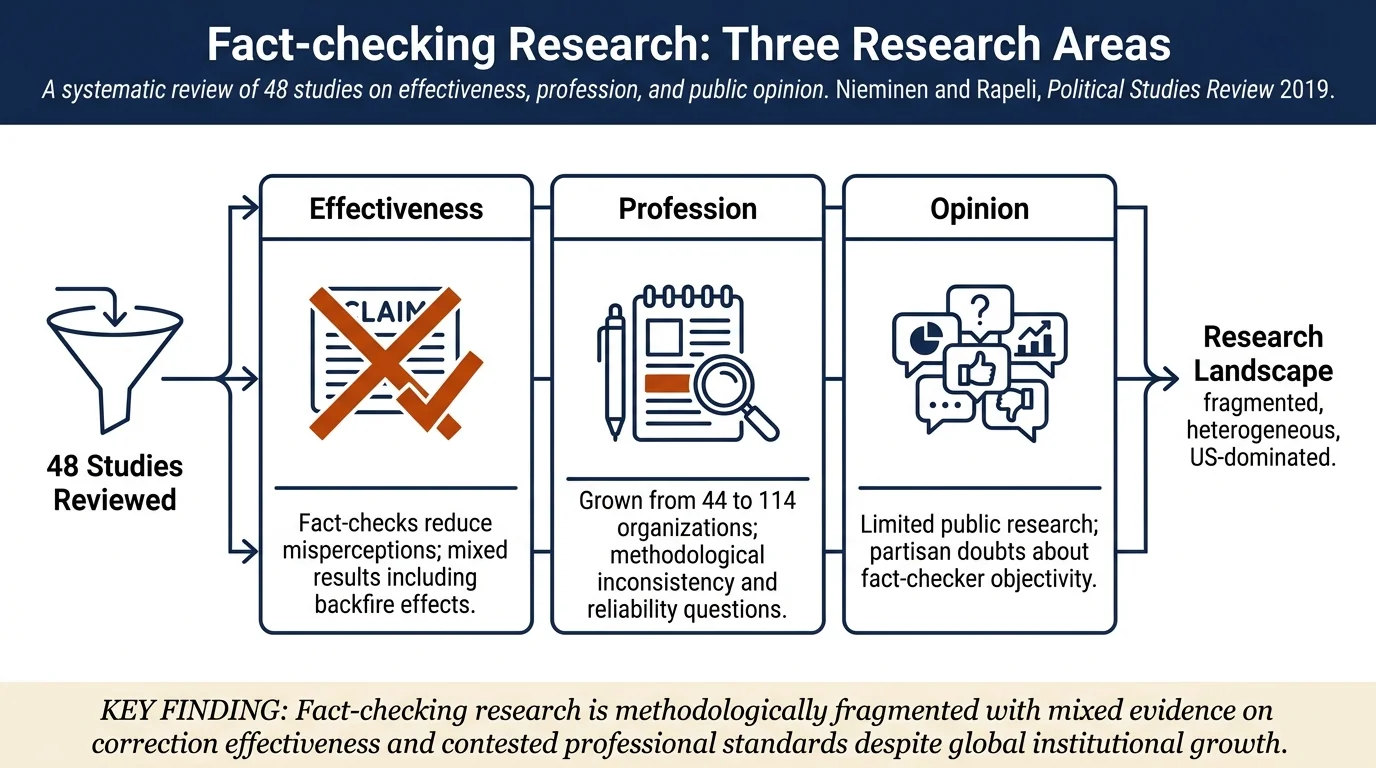
Fighting Misperceptions and Doubting Journalists' Objectivity: A Review of Fact-checking LiteratureComprehensive literature review of 48 studies on political fact-checking, organized into three research areas: (1) fact-checking effectiveness for correcting misperceptions (mixed results, including backfire effects); (2) fact-checking as a profession (contested methods and reliability); (3) public opinion about fact-checking (mostly…
 Psychology & interventionsSpread & networks
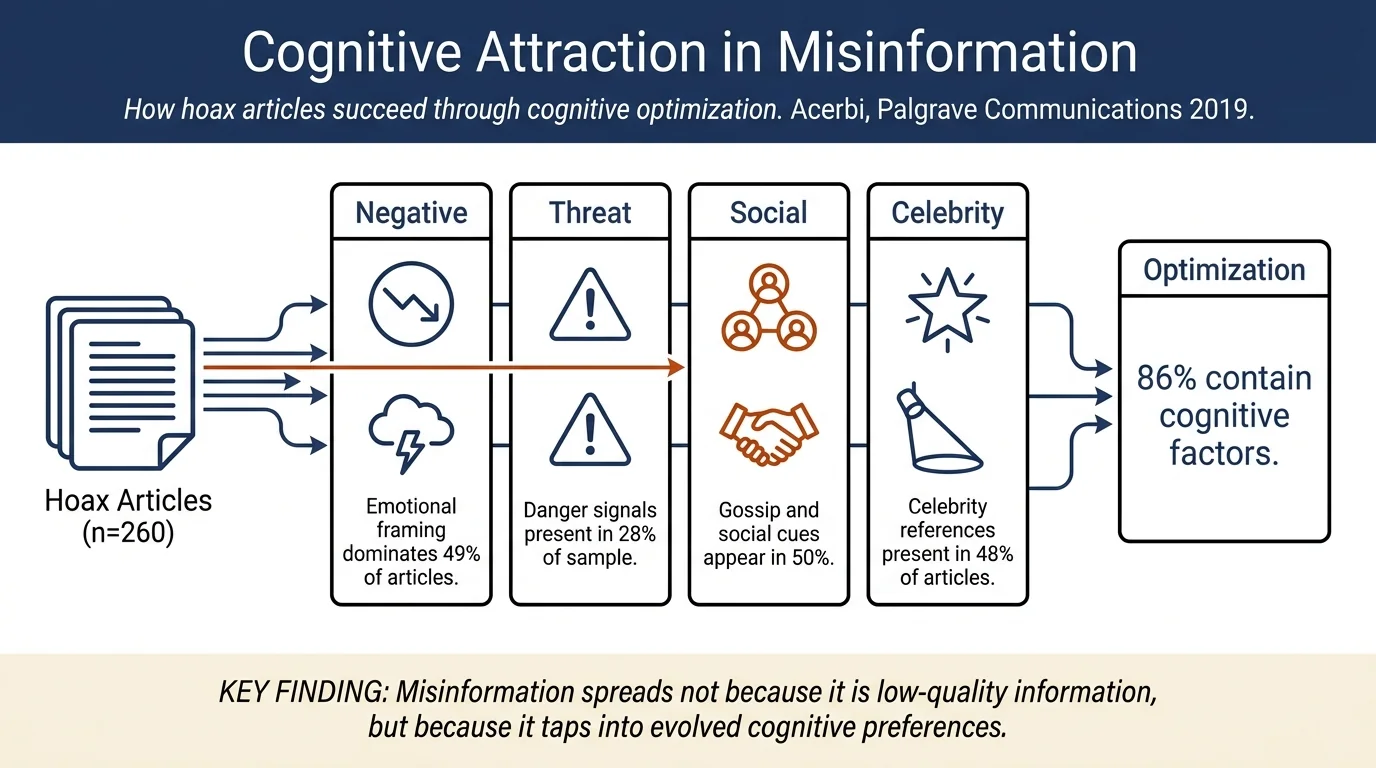
Cognitive attraction and online misinformationMisinformation spreads not because it is low-quality information constrained by digital media inefficiencies, but because it taps into general evolved cognitive preferences. A content analysis of 260 articles from 26 hoax websites shows that 86% contain at least one cognitive-appeal feature: negative framing (49%), threat descriptions…
 Detection methodsDatasets & evaluation
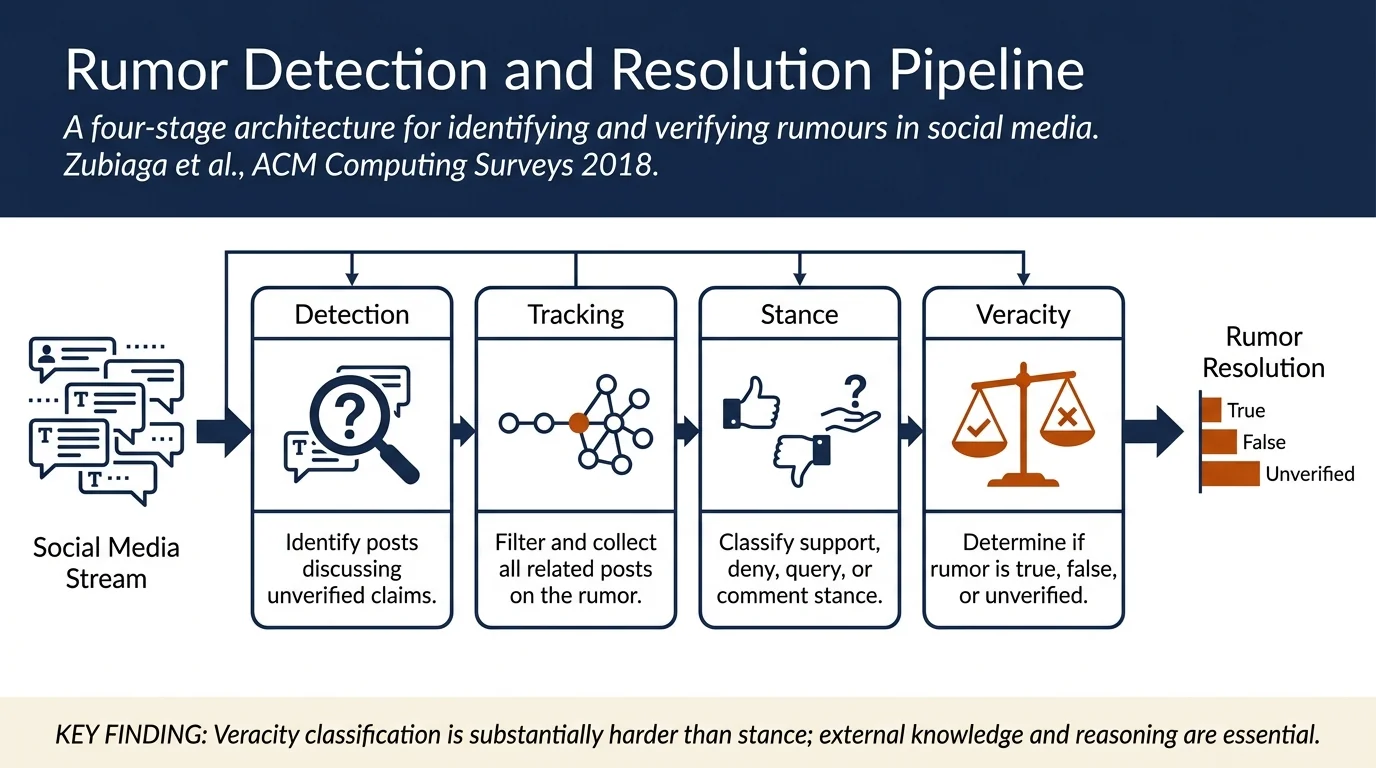
Detection and Resolution of Rumours in Social Media: A SurveyComprehensive survey of rumour detection and resolution in social media covering the entire pipeline: rumour definition and characterization, data collection strategies, annotation schemes, detection approaches for both emerging and long-standing rumours, tracking of rumour propagation, stance classification (support/deny/query/comment),…
 Fact-checking & verificationDatasets & evaluation
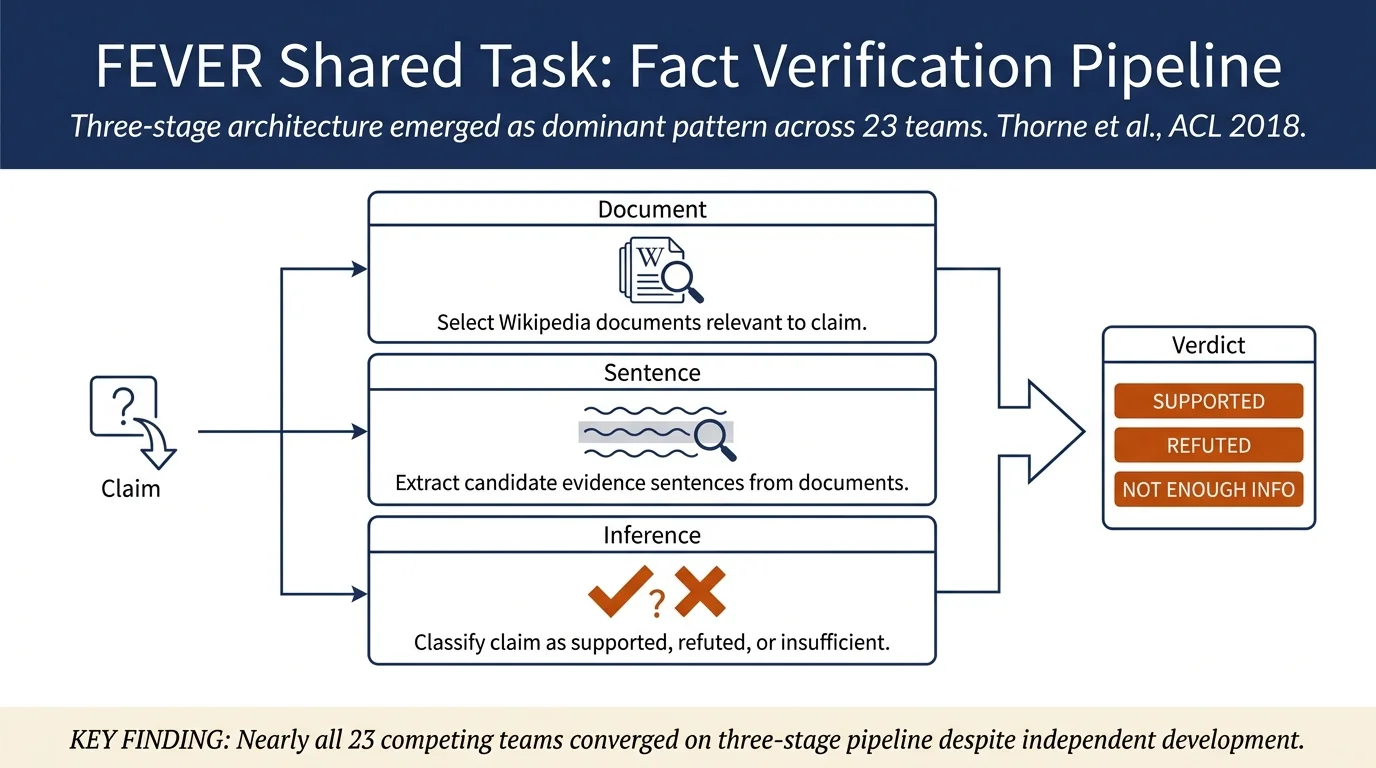
The Fact Extraction and VERification (FEVER) Shared TaskThis paper presents results of the first FEVER shared task competition, which challenged 23 teams to classify whether human-written factoid claims could be SUPPORTED or REFUTED using evidence retrieved from Wikipedia. The best system achieved 64.21% FEVER score, demonstrating the difficulty of joint evidence retrieval and natural…
 Fact-checking & verificationDatasets & evaluation
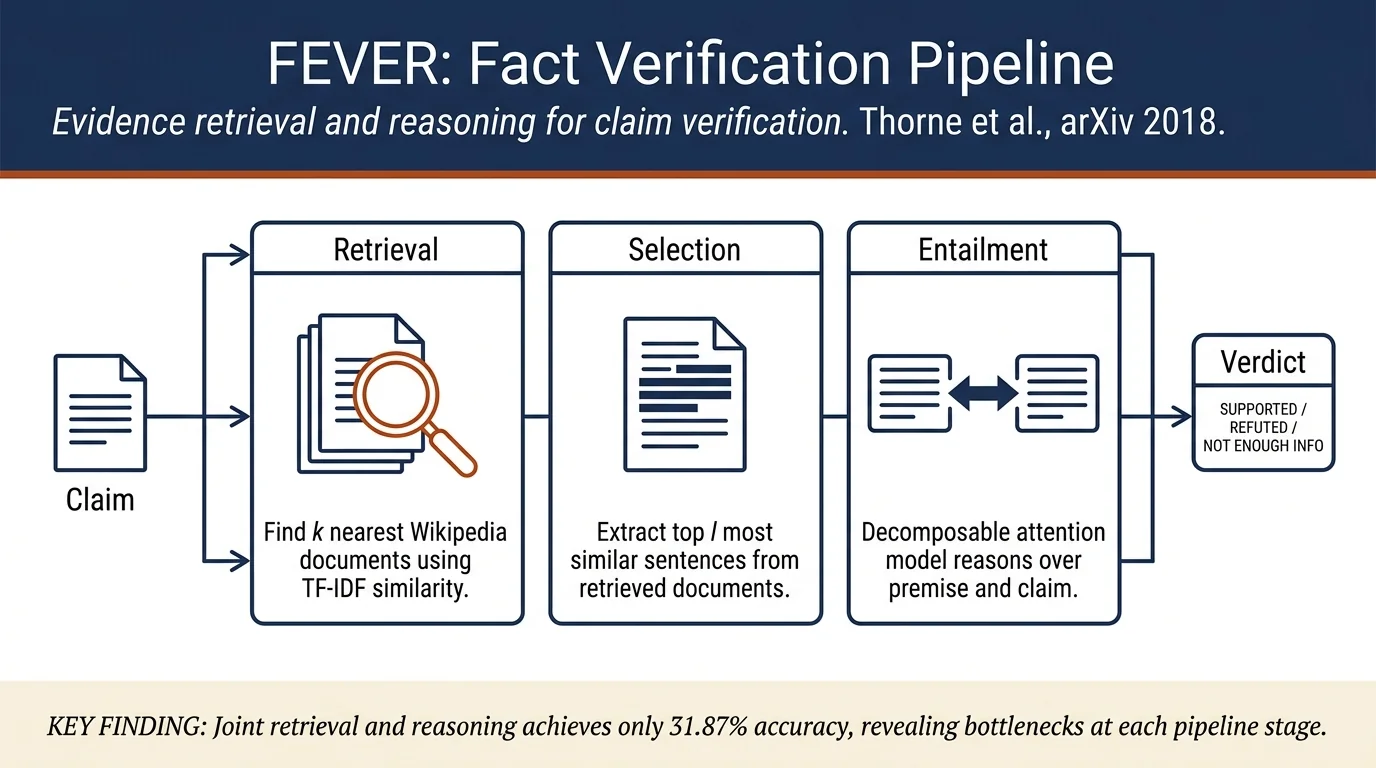
FEVER: A Large-Scale Dataset for Fact Extraction and VERificationThis paper introduces FEVER, a large-scale dataset of 185,445 human-verified claims with Wikipedia evidence for training fact verification systems. Claims are generated from Wikipedia and labeled as SUPPORTED, REFUTED, or NOT ENOUGH INFO; the paper presents a three-stage baseline pipeline (document retrieval, sentence selection, textual…
 Fact-checking & verificationDetection methods
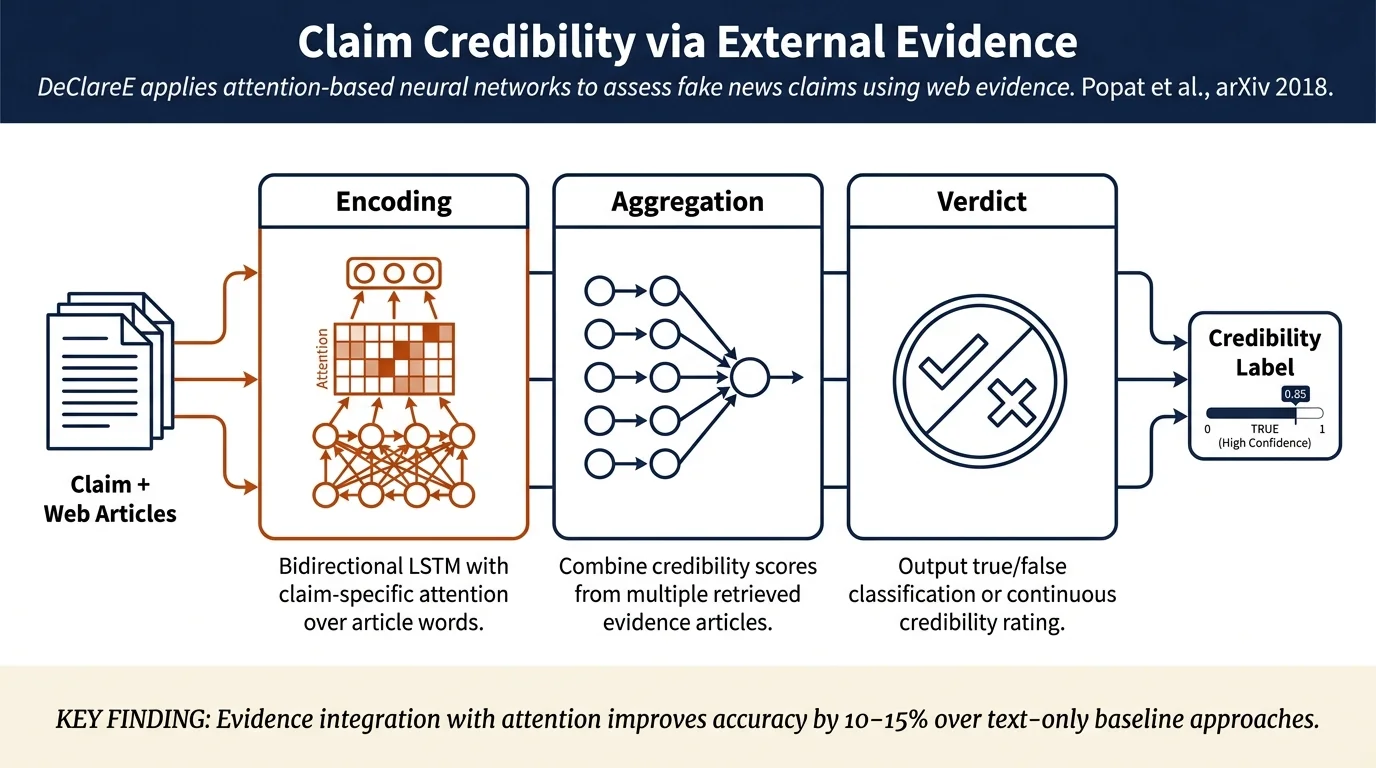
DeClareE: Debunking Fake News and False Claims using Evidence-Aware Deep LearningDeClareE is an end-to-end neural network for evidence-aware credibility assessment of arbitrary natural-language claims. The model combines claim and evidence article representations using bidirectional LSTMs with claim-specific attention, automatically discovering which web articles support or refute a claim without hand-crafted…
 Detection methodsFact-checking & verification
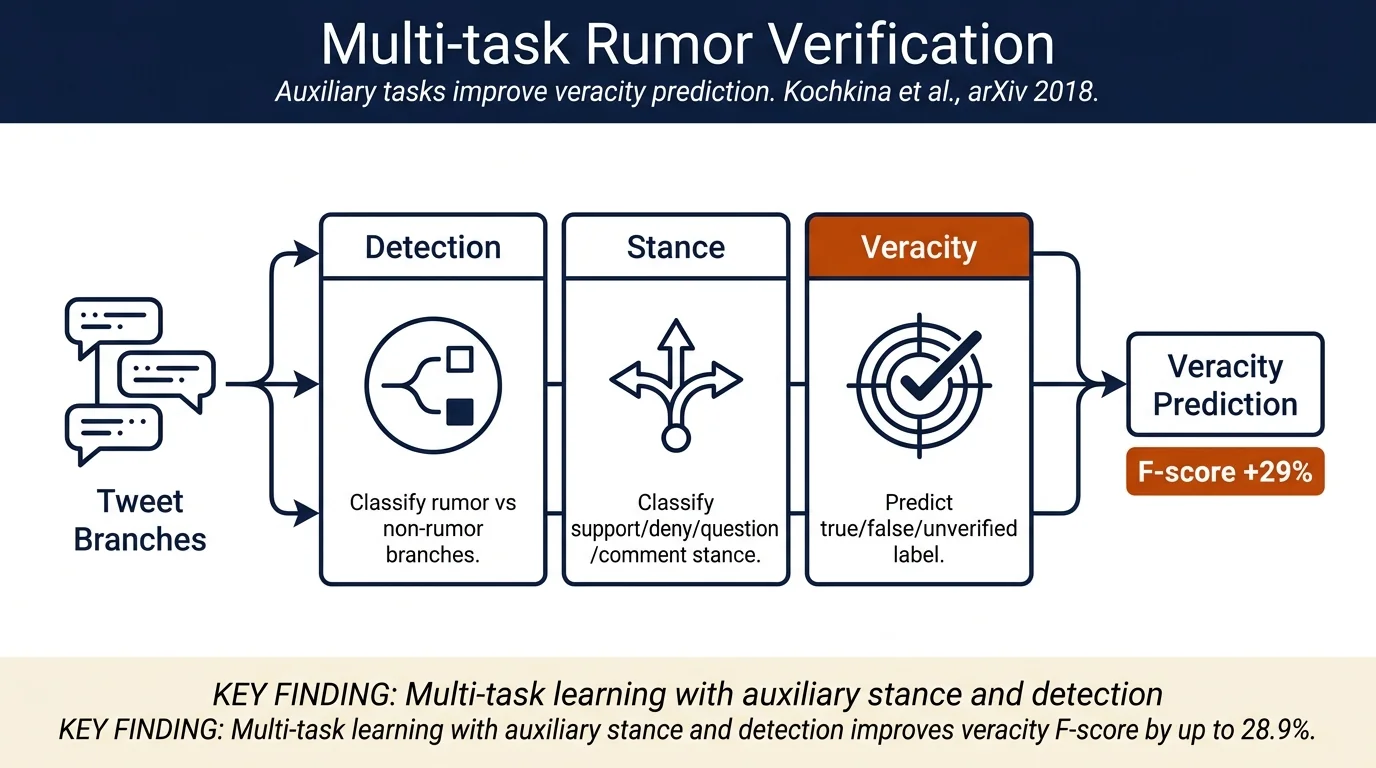
All-in-one: Multi-task Learning for Rumour VerificationThis paper proposes a multi-task learning framework for rumor verification that jointly trains veracity classification (the main task) with auxiliary tasks—rumor detection and stance classification. The approach outperforms single-task baselines on both RumourEval and PHEME datasets, demonstrating that sharing representations across…
 Datasets & evaluationSpread & networks
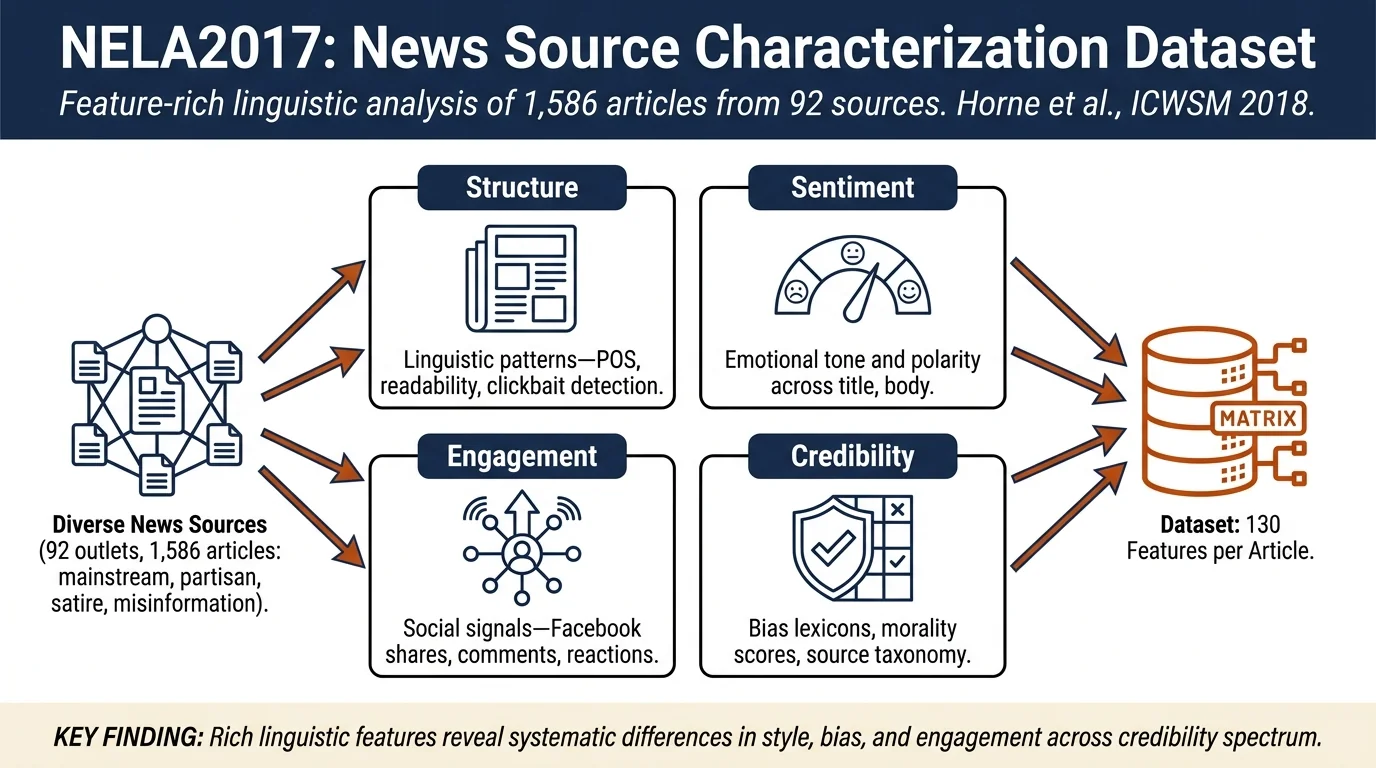
Sampling the News Producers: A Large News and Feature Data Set for the Study of the Complex Media LandscapeIntroduces NELA2017, a dataset of 1,586 news articles from 92 diverse news sources over 7 months (April–October 2017), including mainstream outlets, hyper-partisan sources, satire, and deliberately false news sites. Computes 130 content-based linguistic and engagement features on each article, enabling large-scale comparative analysis of…
 Fact-checking & verificationDatasets & evaluation
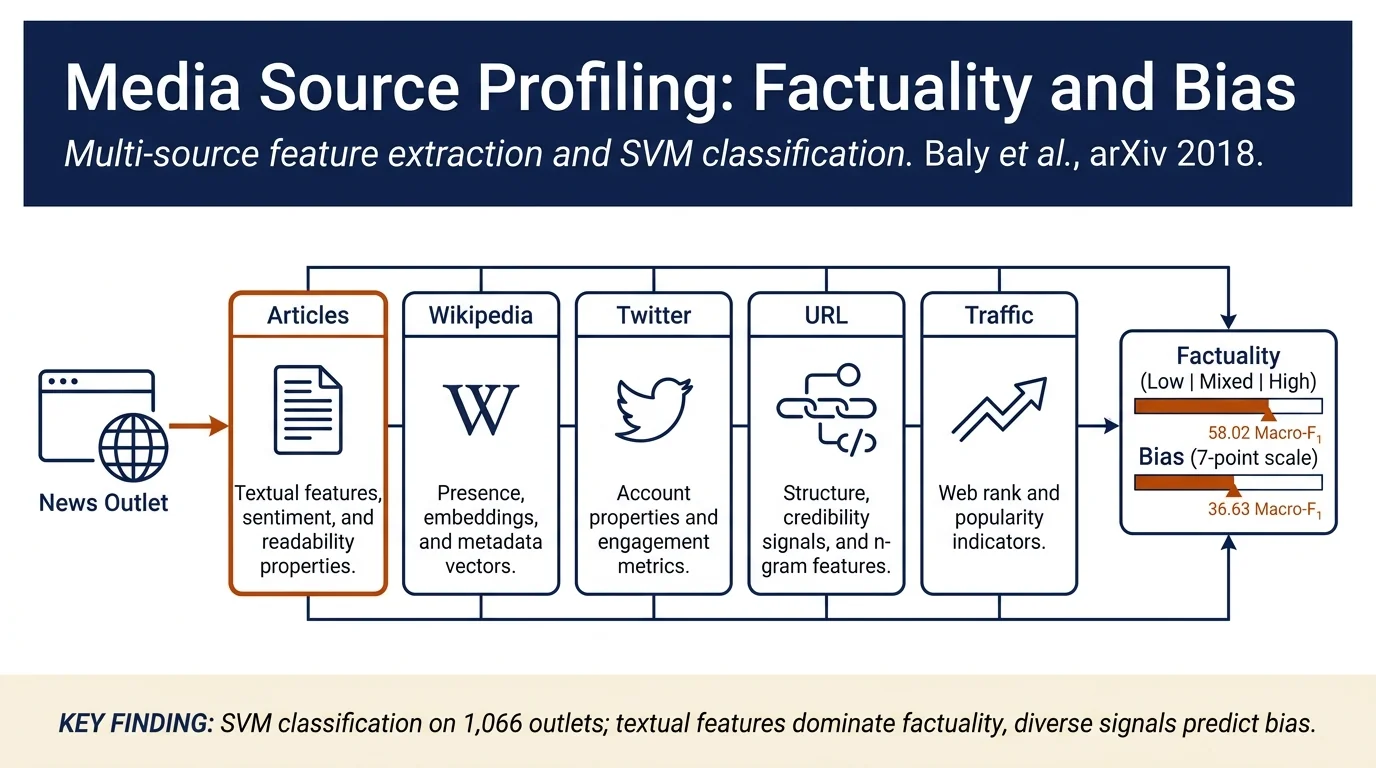
Predicting Factuality of Reporting and Bias of News Media SourcesThis paper frames predicting news media factuality and bias as classification tasks at the news outlet level rather than at the claim or article level. The authors extract 141 features from multiple sources (articles, Wikipedia, Twitter, URL structure, web traffic) and train SVM classifiers, creating a dataset of 1,066 websites manually…
 Platforms, policy & societyFact-checking & verification
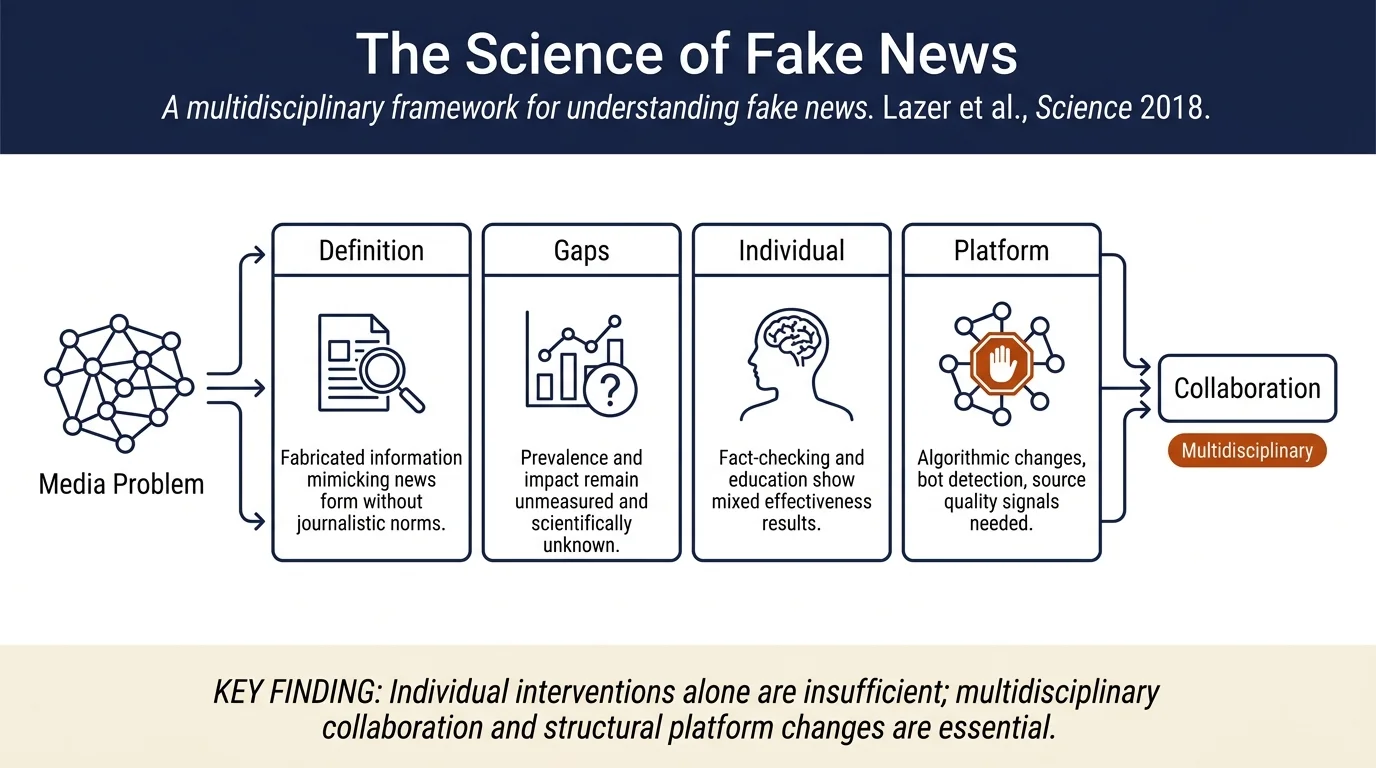
The Science of Fake NewsThis multidisciplinary review establishes a scientific framework for studying fake news, defining it as fabricated information that mimics news media form but lacks editorial norms. The paper identifies two mitigation strategies—empowering individuals through fact-checking and education, and structural platform interventions—while…
Fact-checking & verificationDatasets & evaluation
ClaimBuster: The first end-to-end fact-checking systemFoundational work introducing ClaimBuster, an end-to-end automated fact-checking system. Introduces a dataset of 23,533 human-annotated U.S. debate statements with check-worthiness labels, establishing baselines for automated claim check-worthiness detection and ranking.
 Fact-checking & verificationPsychology & interventions
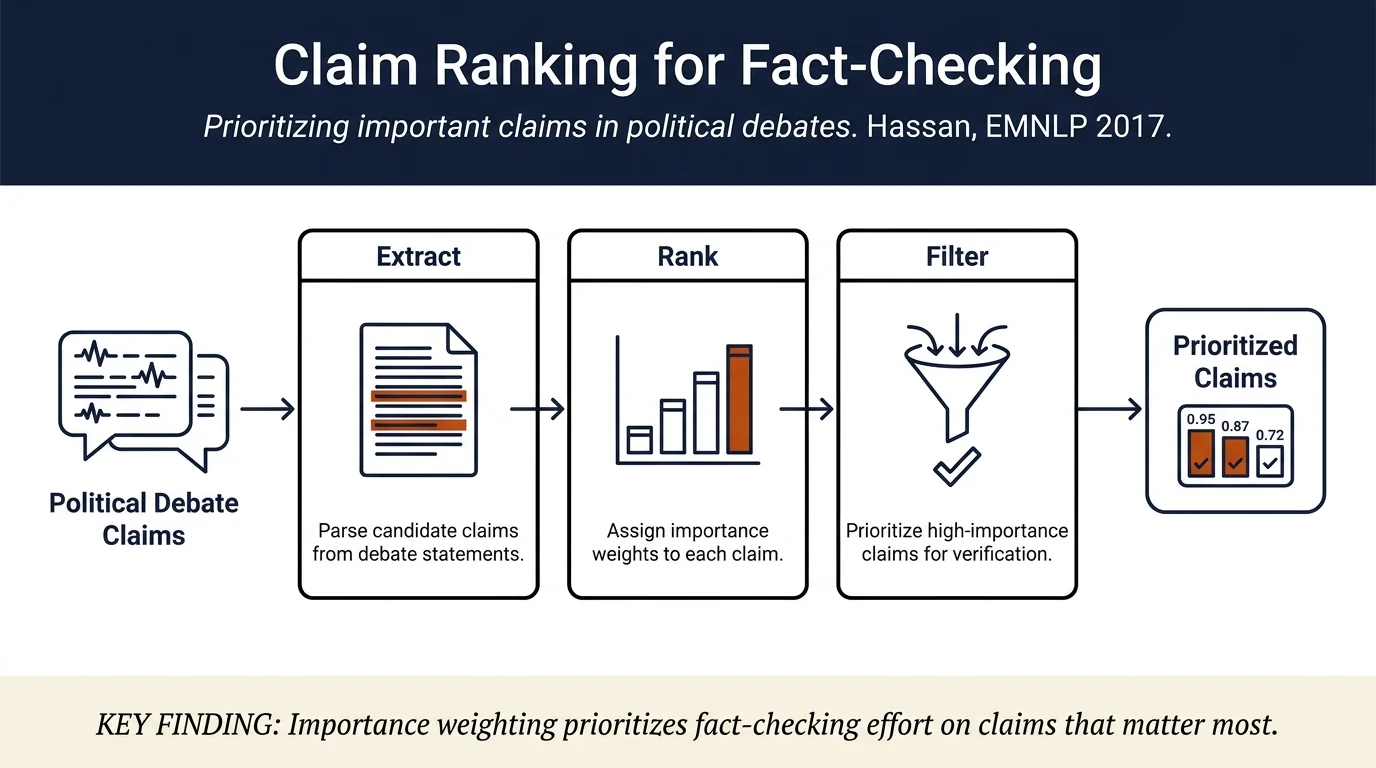
Claim Ranking in Political DebatesEarly work framing check-worthiness as claim ranking; introduces the notion of "importance weighting" for prioritizing claims for fact-checking in political debates. Foundational for understanding which claims warrant verification effort.
 Spread & networksFact-checking & verification
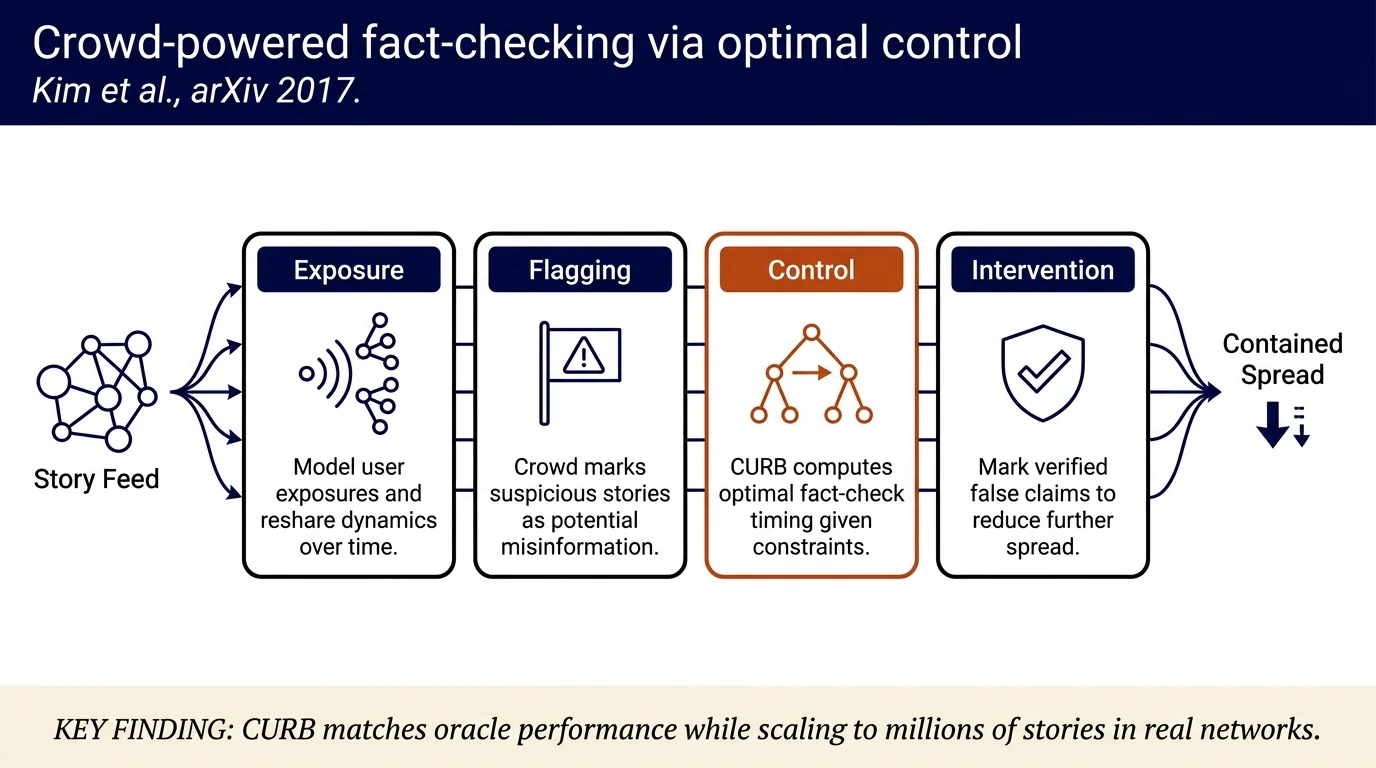
Leveraging the Crowd to Detect and Reduce the Spread of Fake News and MisinformationOnline social networks use crowd-powered flagging to identify misinformation: when users flag a story, enough flags trigger fact-checking, which disputes false claims. This paper formulates the problem of deciding which stories to fact-check and when, subject to limited fact-checking resources, as a stochastic optimal control problem.
 Datasets & evaluationFact-checking & verification
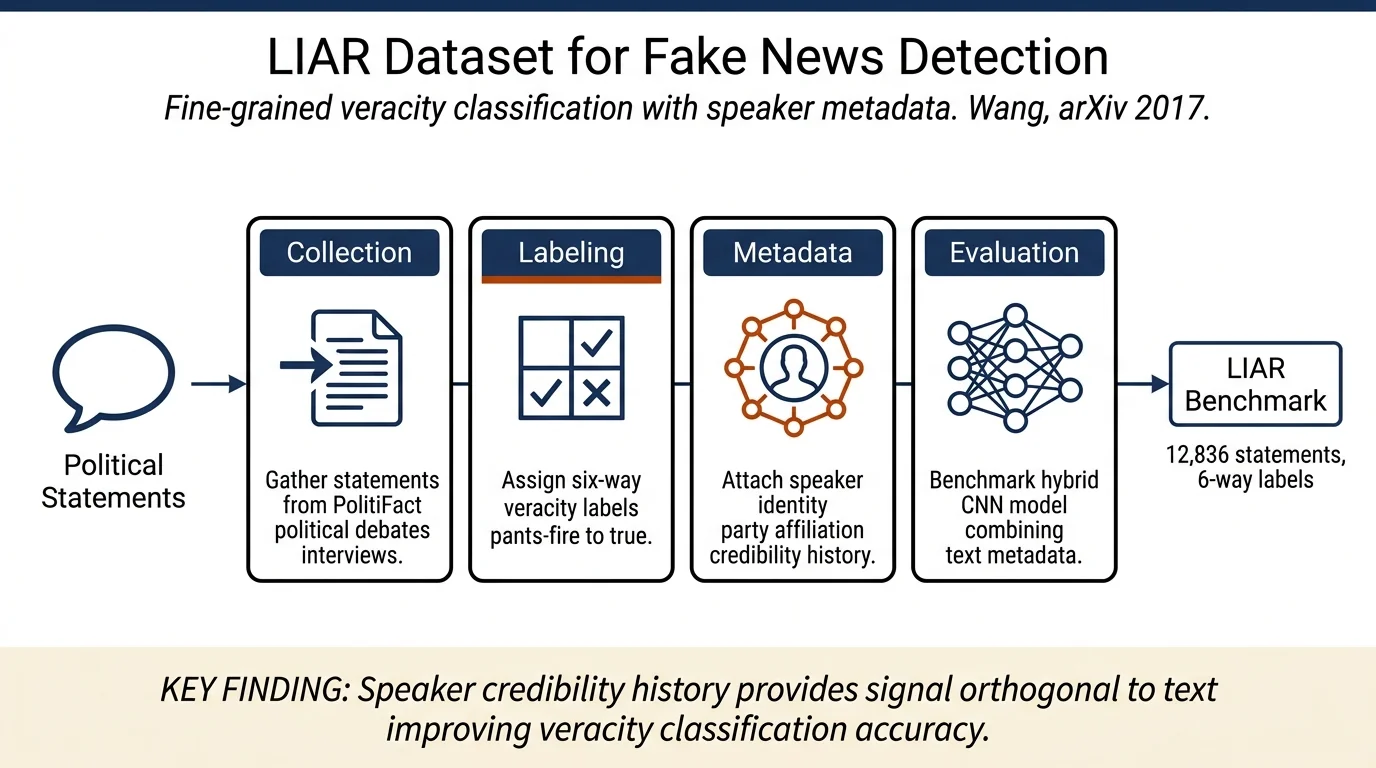
Liar, Liar Pants on Fire: A New Benchmark Dataset for Fake News DetectionThis paper introduces LIAR, a benchmark dataset of 12,836 manually labeled short statements from POLITIFACT.COM spanning 2007–2016, addressing the critical lack of labeled data for fake news detection. Each statement is annotated with fine-grained veracity labels (pants-fire, false, barely-true, half-true, mostly-true, true) and rich…
 Fact-checking & verificationDatasets & evaluation
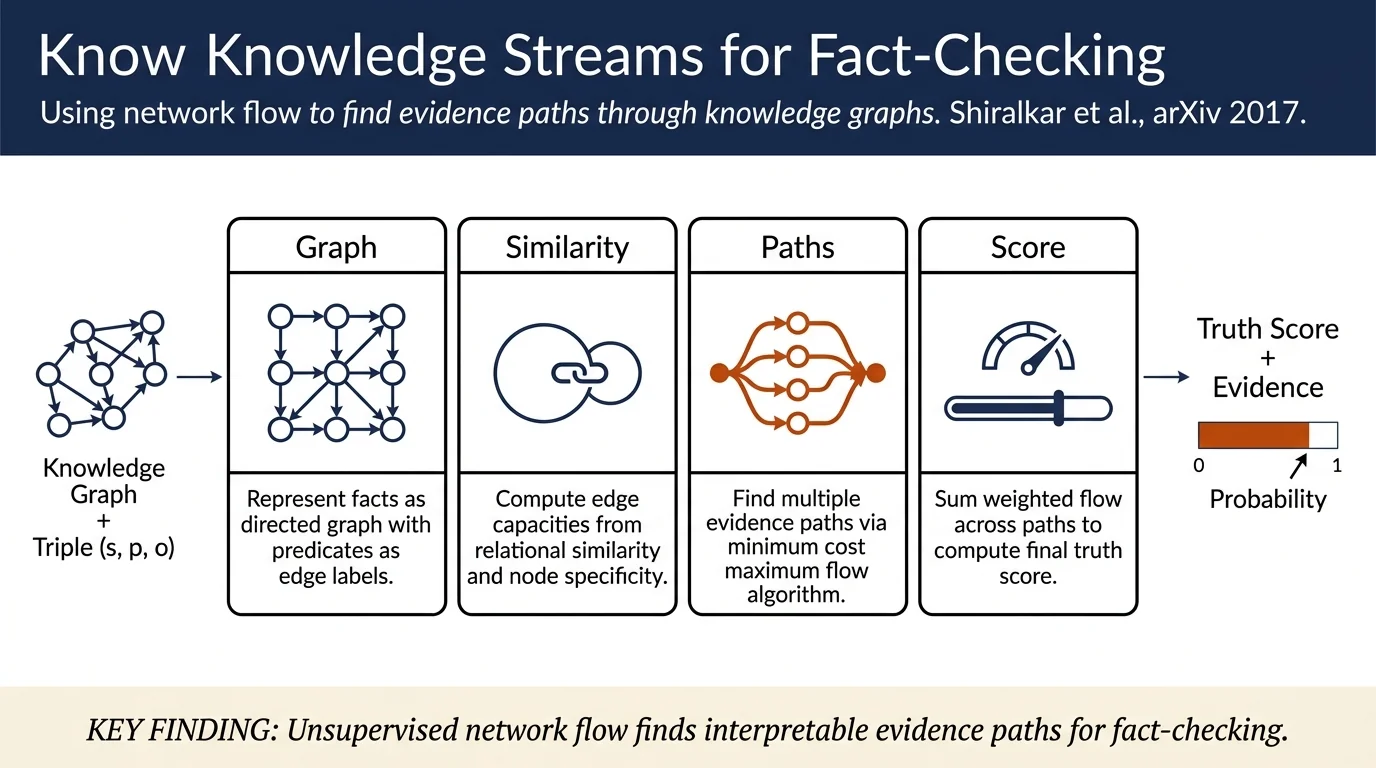
Finding Streams in Knowledge Graphs to Support Fact CheckingKnowledge Stream (KS) is an unsupervised network-flow approach for computational fact-checking that treats a knowledge graph as a flow network. For a triple (subject, predicate, object), KS finds multiple paths connecting subject to object and uses edge capacities (based on relational similarity and node specificity) to compute a truth…
 Detection methodsFact-checking & verification
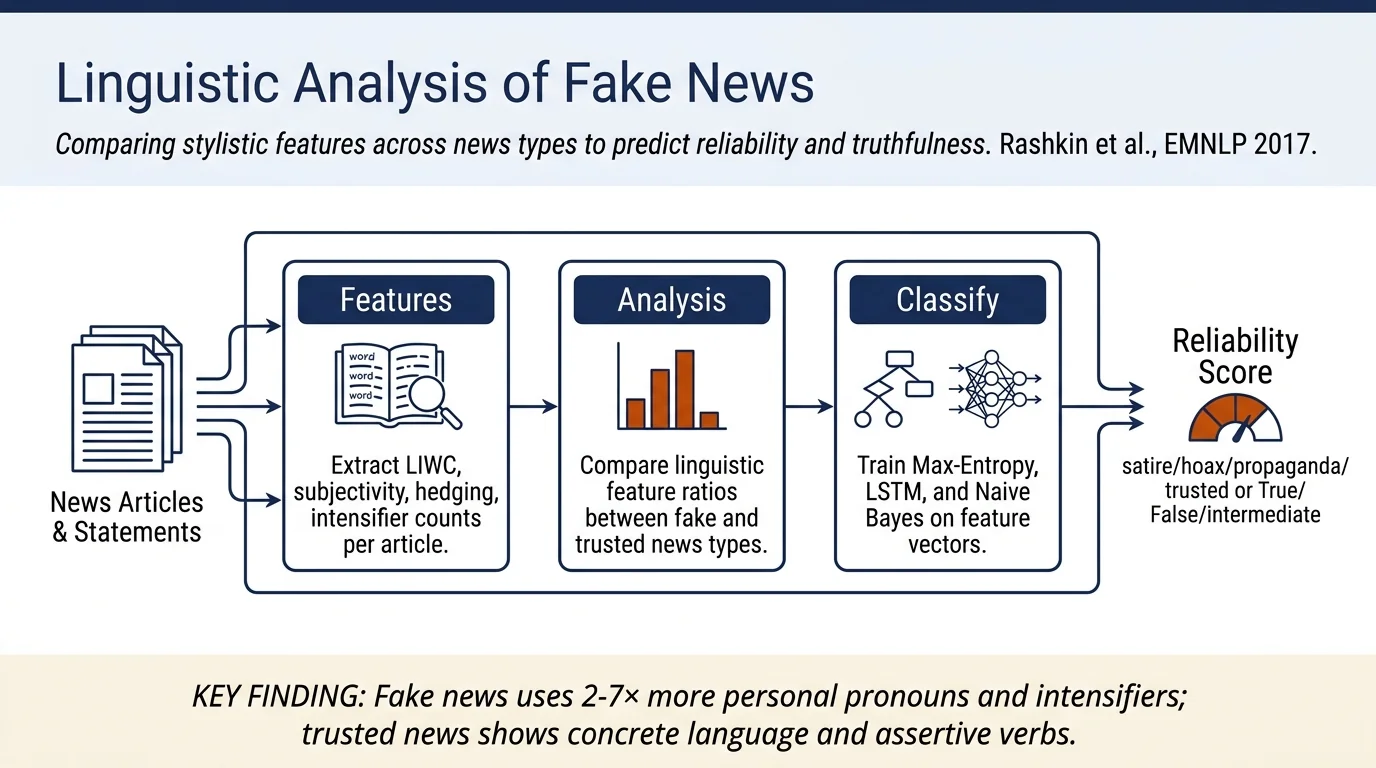
Truth of Varying Shades: Analyzing Language in Fake News and Political Fact-CheckingThis paper performs a linguistic analysis of fake news across four categories—satire, hoaxes, propaganda, and trusted news—using lexical features (LIWC, subjectivity, hedging, intensifiers). Experiments show that fake news articles use more first-person pronouns, exaggerative language (superlatives, modal adverbs), and hedging, while…
 Spread & networksDatasets & evaluation
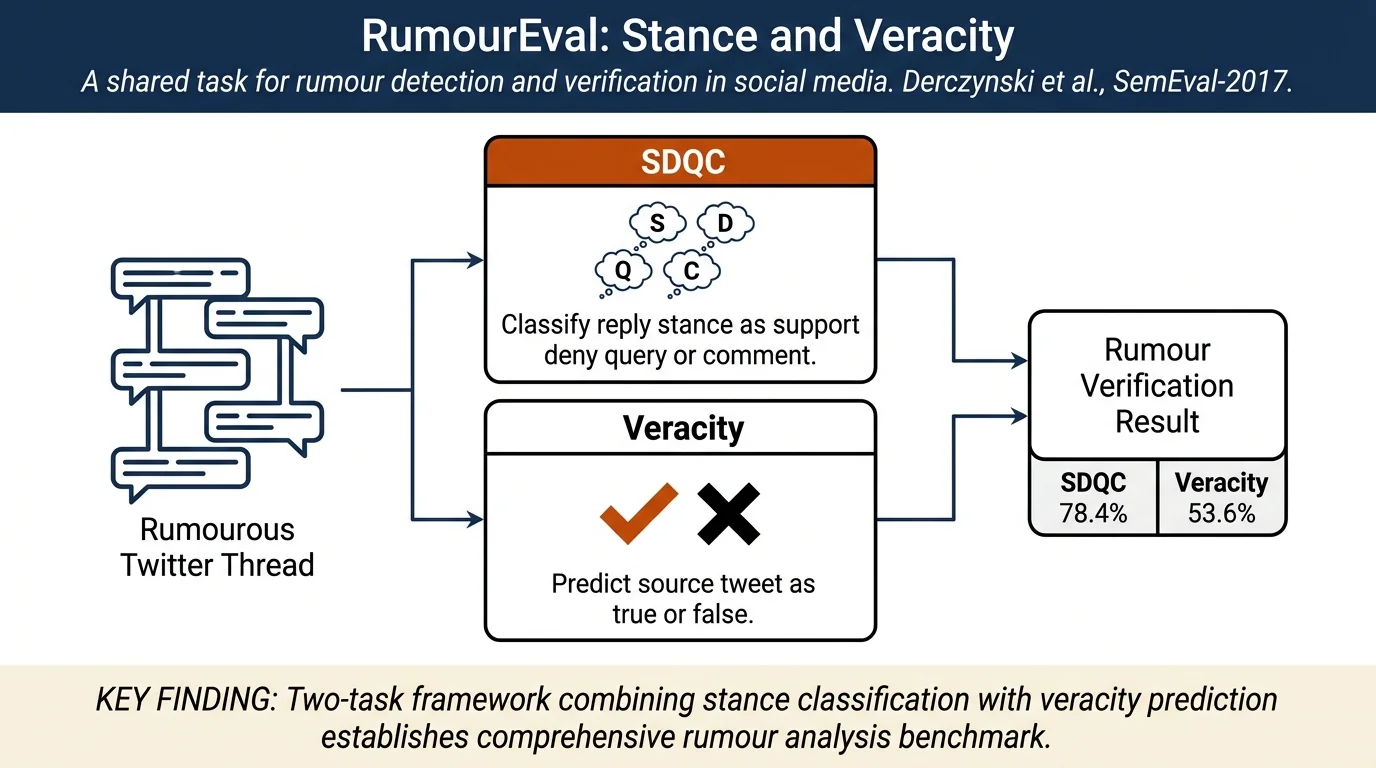
SemEval-2017 Task 8: RumourEval: Determining rumour veracity and support for rumoursRumourEval is a shared task benchmark for detecting and verifying rumours in social media. It introduces two subtasks: (a) stance classification (SDQC: Support/Deny/Query/Comment) of replies to rumourous claims, and (b) veracity prediction (true/false) of source tweets.
 Psychology & interventionsPlatforms, policy & society
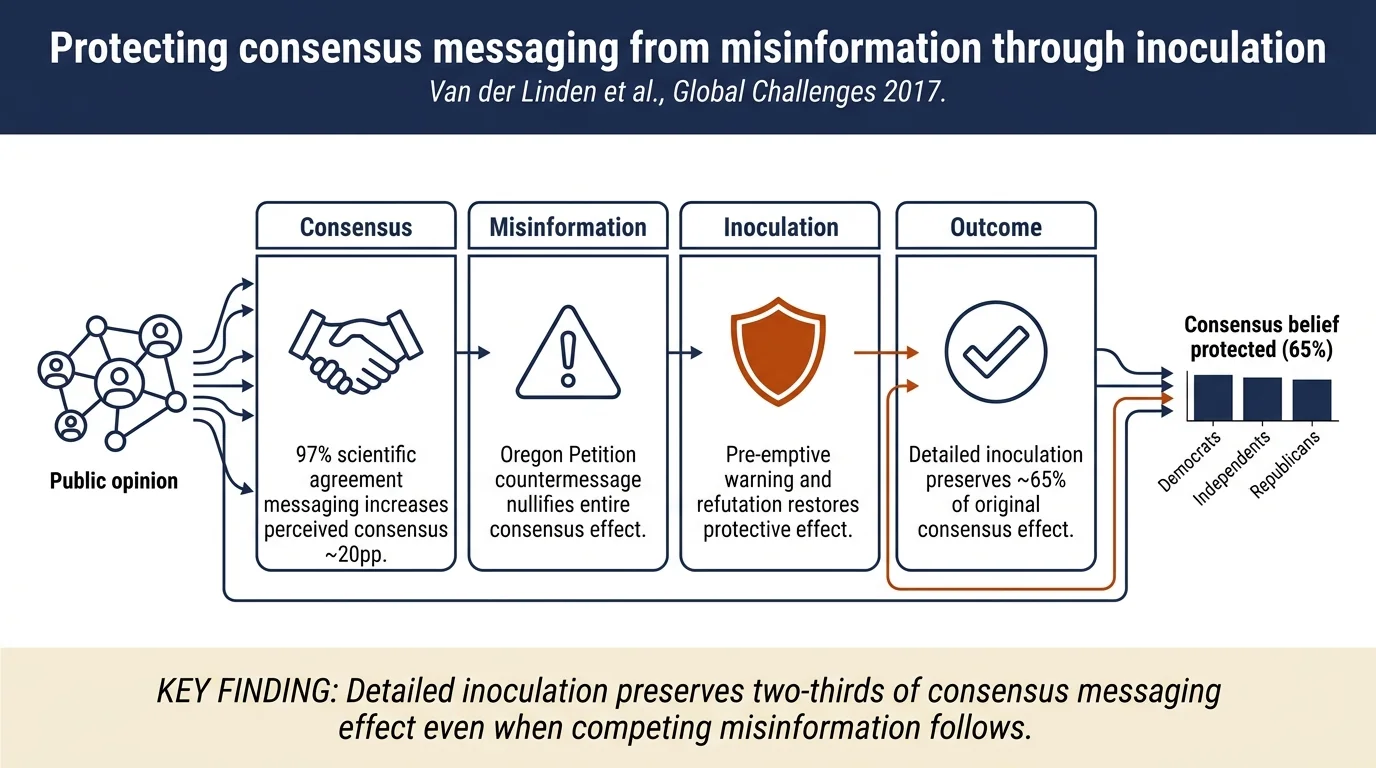
Inoculating the Public against Misinformation about Climate ChangeLarge-scale experiments (N=2,167) demonstrate that misinformation about scientific consensus on climate change nullifies the effect of consensus messaging. Pre-emptive inoculation—warning people about misleading tactics and providing refutations—preserves two-thirds of the consensus effect.