Explore papers
Filter by research area, year and venue. Every filter is in the address bar, so you can share a view as a link.
 Deepfakes & multimodalDetection methods
The Emergence of Deepfake Technology: A ReviewThis review analyzes 84 news articles about deepfakes to synthesize understanding of synthetic video technology, its applications, threats, and countermeasures. Deepfakes—hyper-realistic videos created using AI (primarily GANs)—lower the barrier to video forgery and represent a significant threat to trust, elections, and security.
 Detection methodsDatasets & evaluation
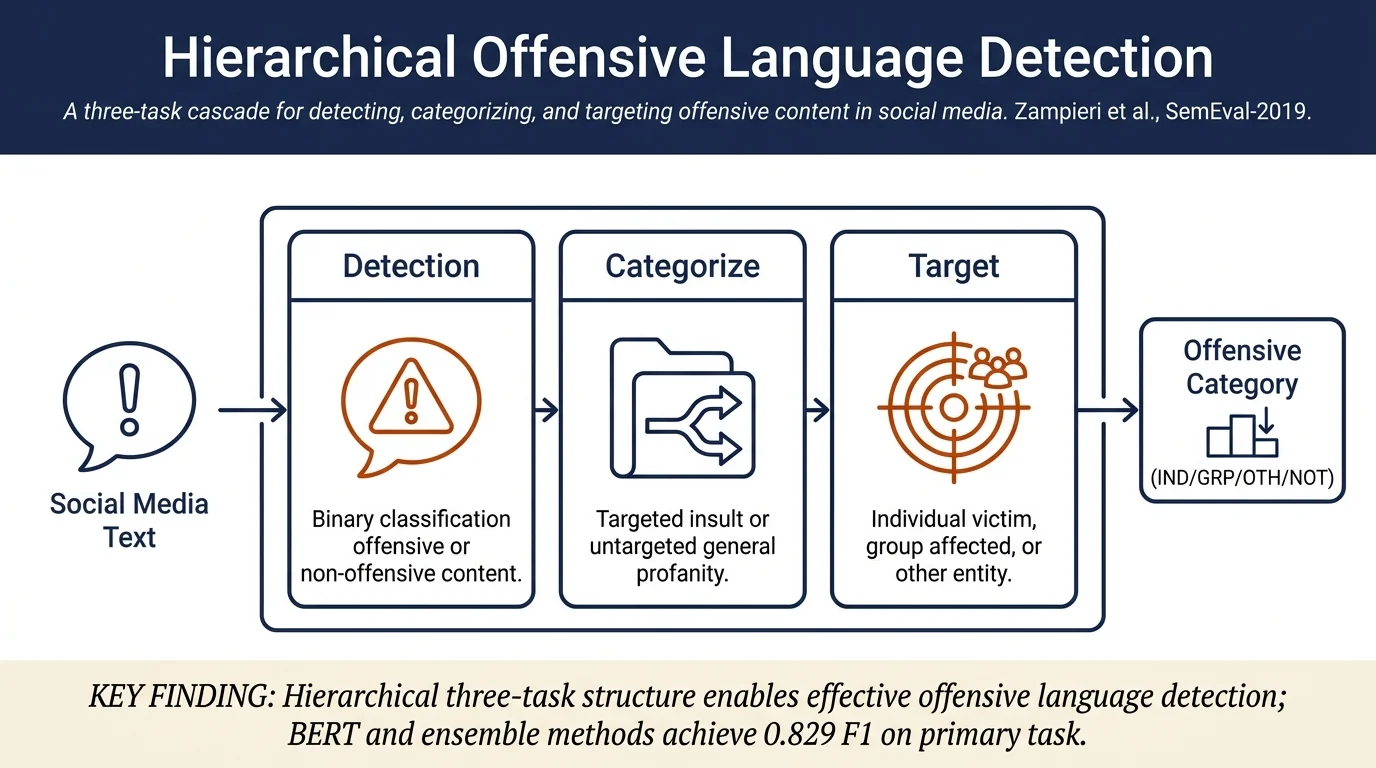
SemEval-2019 Task 6: Identifying and Categorizing Offensive Language in Social MediaSemEval-2019 Task 6 reports on a shared task competition for identifying and categorizing offensive language in social media using the OLID dataset. Approximately 800 teams registered and 115 submitted results across three sub-tasks: offensive language detection (104 teams), offense type categorization (71 teams), and offense target…
 Datasets & evaluationDetection methods
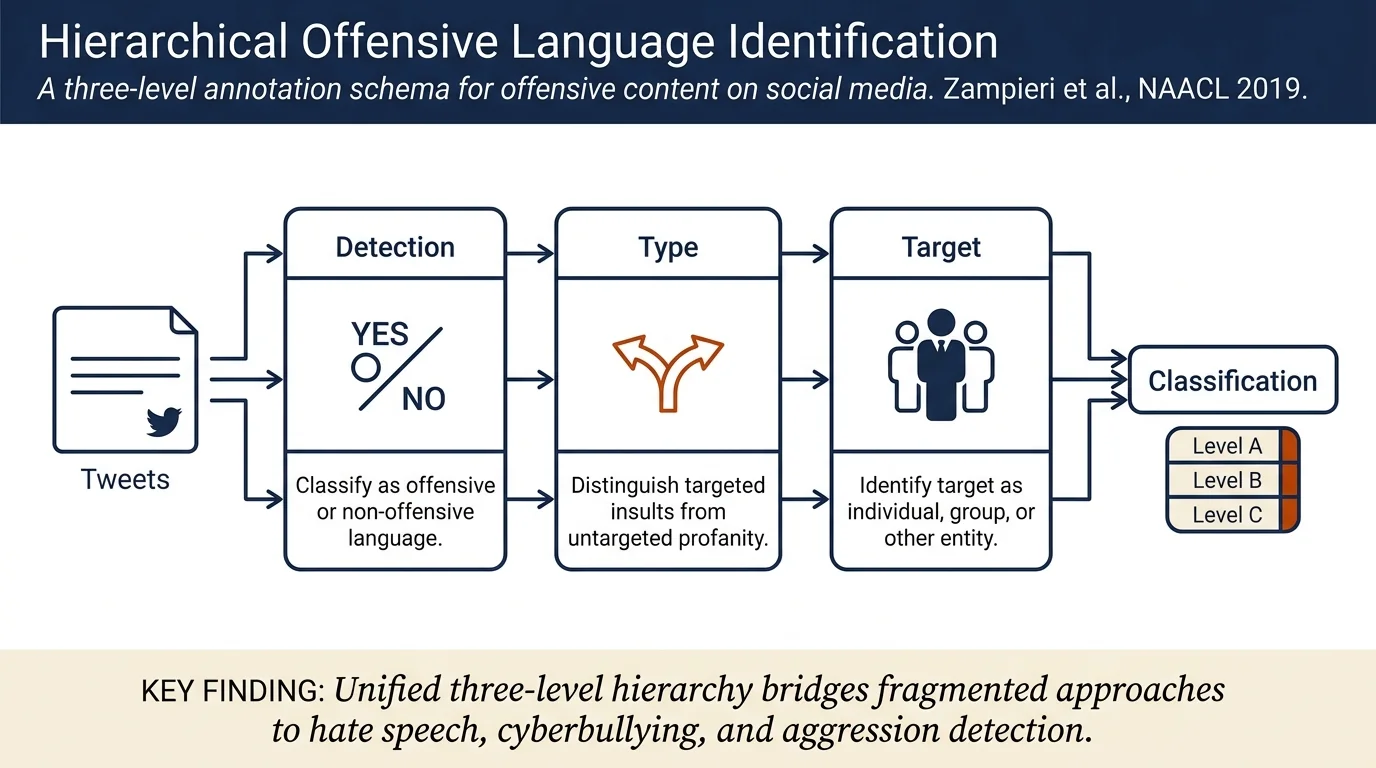
Predicting the Type and Target of Offensive Posts in Social MediaThis paper introduces OLID (Offensive Language Identification Dataset), a large-scale dataset of 14,100 English tweets annotated with a three-level hierarchical schema for detecting offensive content. The hierarchy distinguishes offensive from non-offensive posts (Level A), categorizes offense type as targeted insults or untargeted…
 Detection methodsDatasets & evaluation
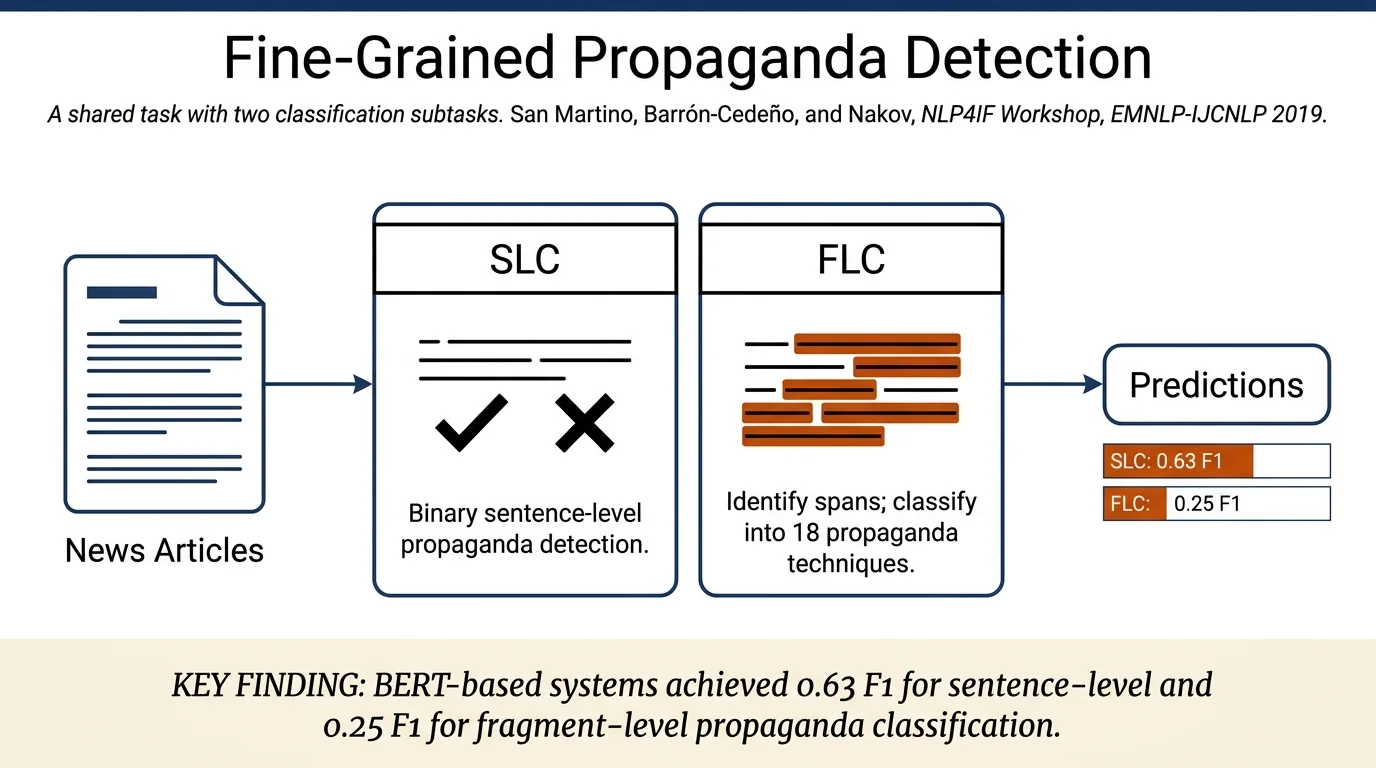
Findings of the NLP4IF-2019 Shared Task on Fine-Grained Propaganda DetectionThis paper reports findings from a shared task on fine-grained propaganda detection in news articles, featuring two subtasks: fragment-level identification and classification into 18 propaganda techniques, and sentence-level binary propaganda detection. The task attracted 90 registered teams with 39 making submissions; winning systems…
 Detection methodsSpread & networks
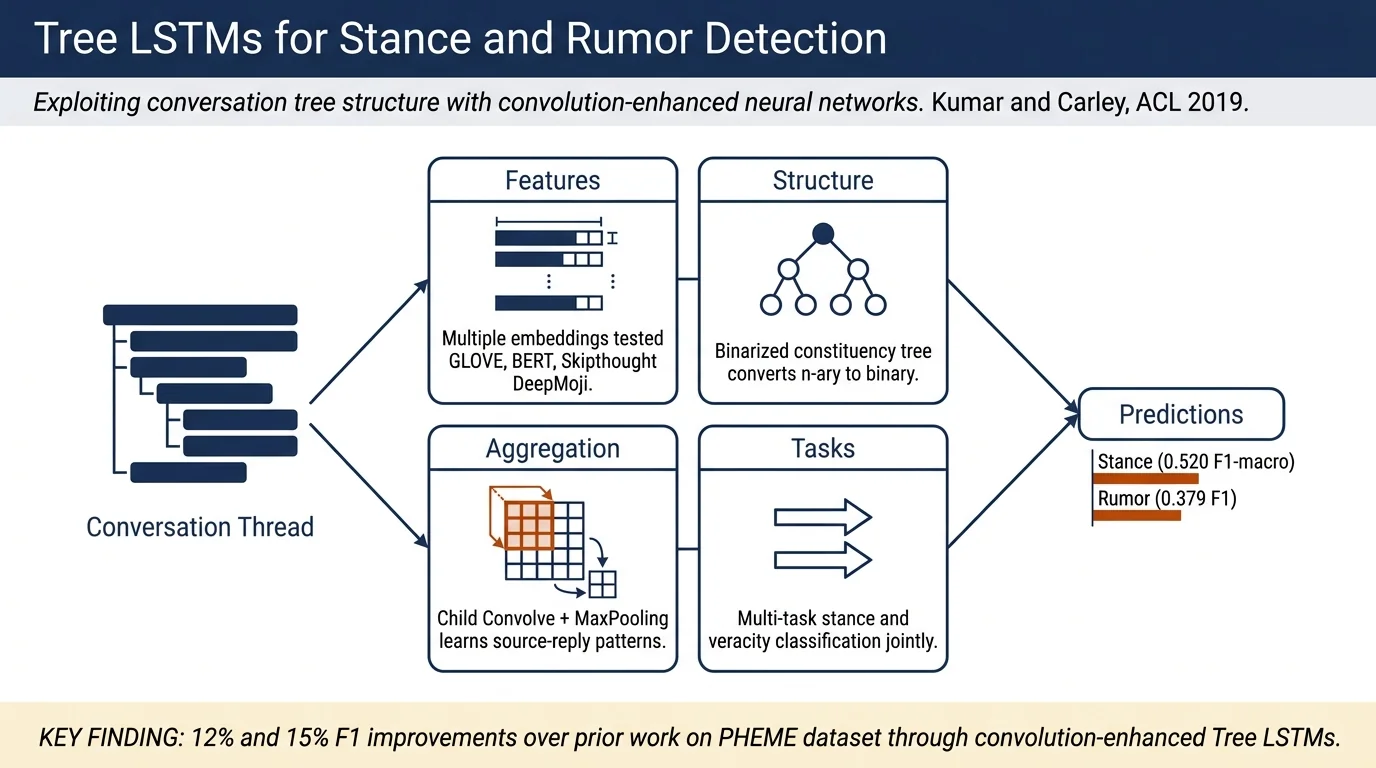
Tree LSTMs with Convolution Units to Predict Stance and Rumor Veracity in Social Media ConversationsProposes Tree LSTM and Binarized Constituency Tree (BCTree) LSTM architectures enhanced with convolution units to classify stance and predict rumor veracity in social media conversation threads. The approach exploits the tree structure inherent in threaded conversations (source post with nested replies) and combines it with convolutional…
 Bots & coordinated campaignsDetection methods
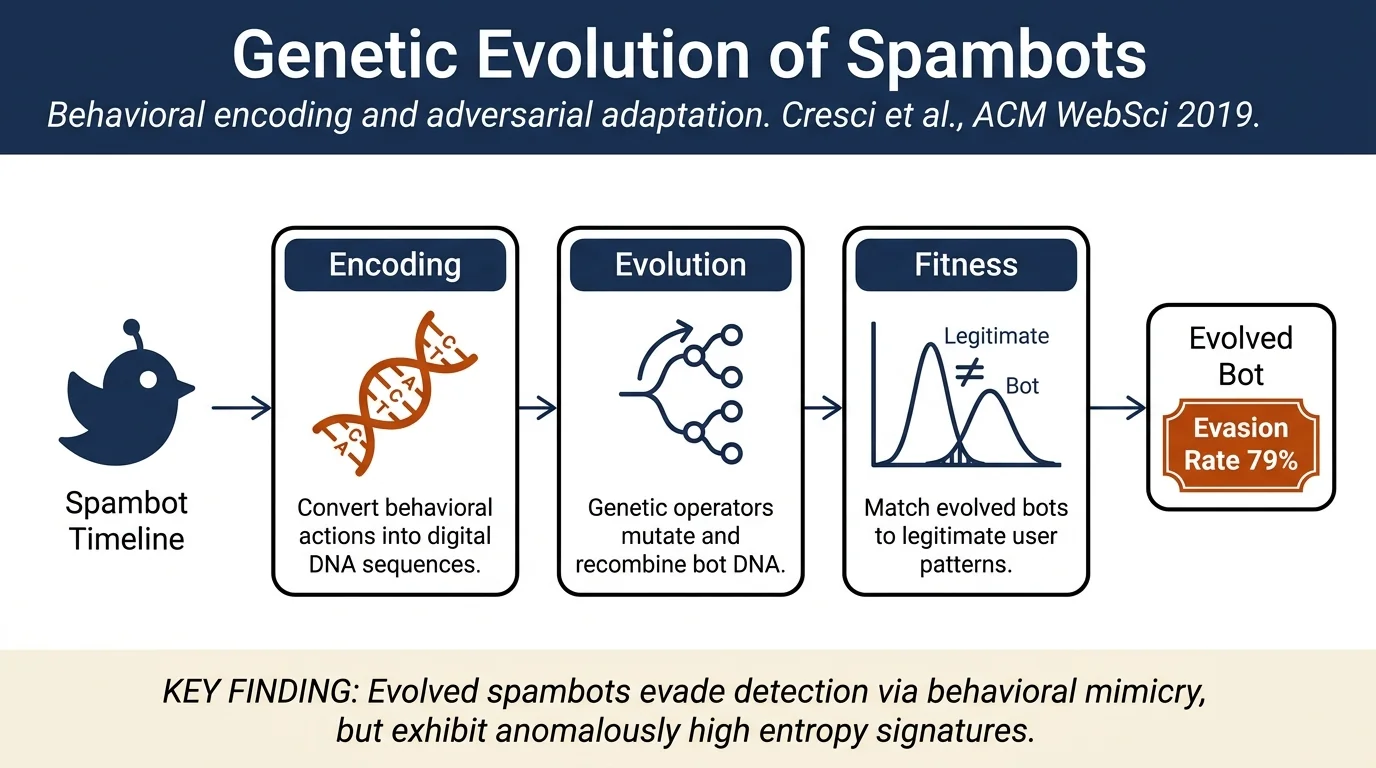
Better Safe Than Sorry: an Adversarial Approach to improve Social Bot DetectionProposes GenBot, a novel genetic algorithm that synthesizes evolved versions of existing spambots by encoding behavioral timelines as "digital DNA" sequences and iteratively evolving them to resemble legitimate user behavior. Tests the evolved bots against three state-of-the-art detection systems and finds they largely evade detection…
 Deepfakes & multimodalDetection methods
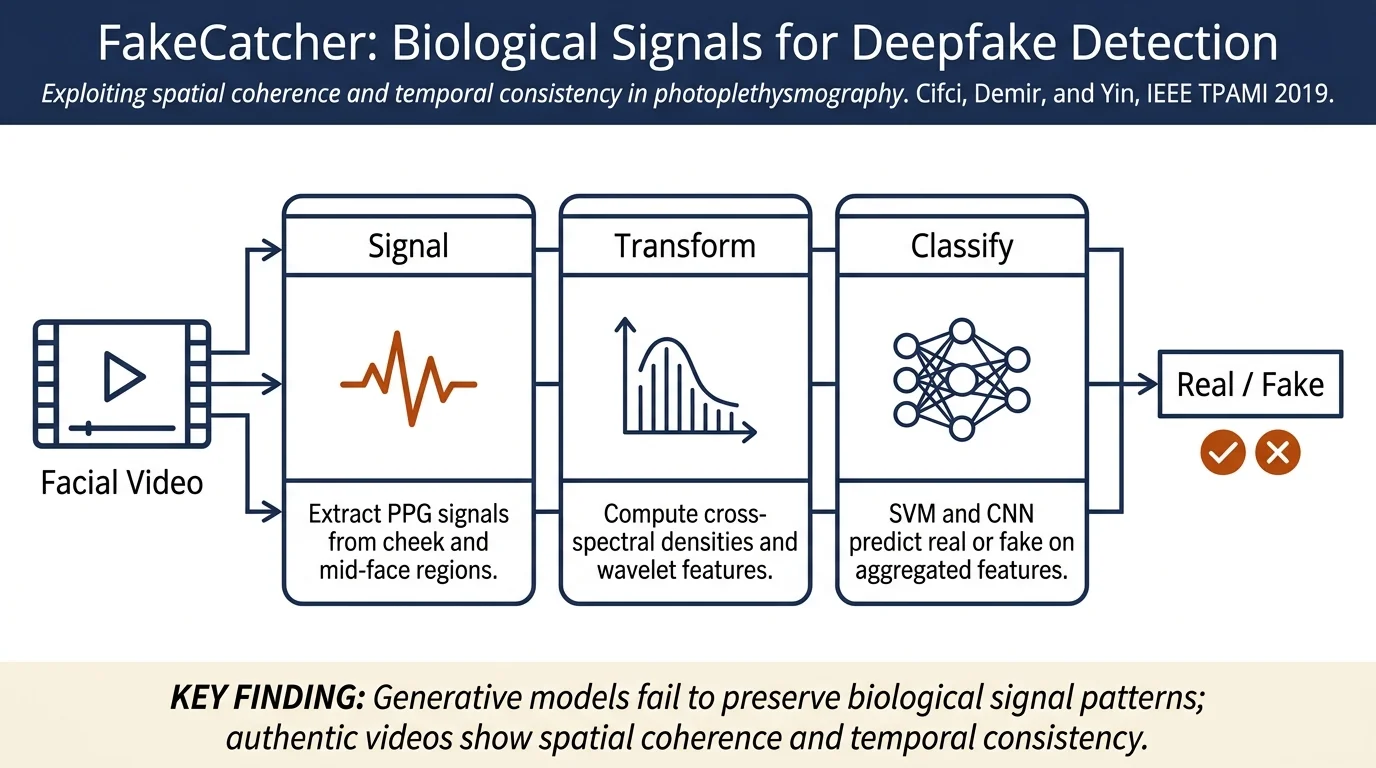
FakeCatcher: Detection of Synthetic Portrait Videos using Biological SignalsFakeCatcher detects deepfakes by analyzing biological signals (photoplethysmography—blood flow patterns) extracted from facial regions. The key insight is that generative models fail to preserve spatial coherence and temporal consistency of these signals in authentic videos, making biological signal analysis a powerful forensic tool…
 LLMs & generative AIDetection methods
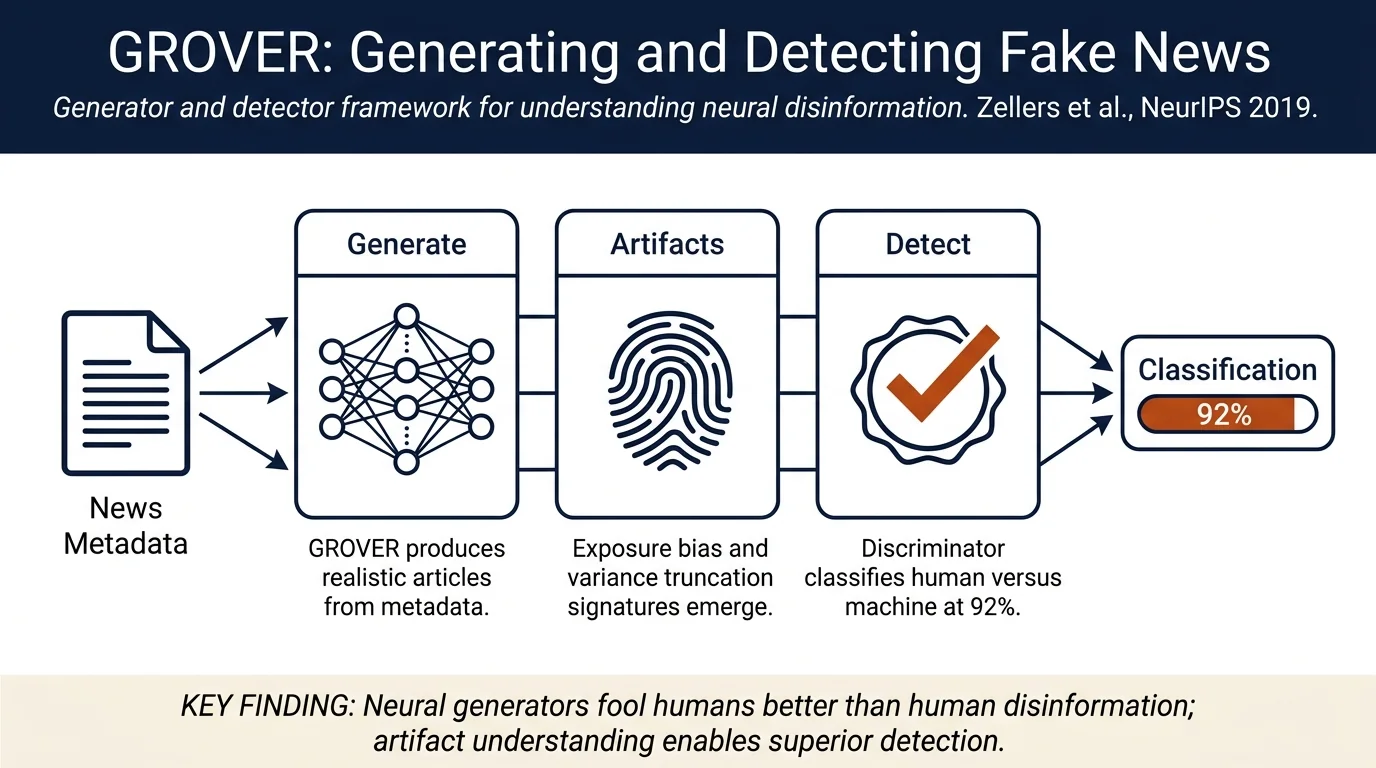
Defending Against Neural Fake NewsZellers et al. introduce GROVER, a conditional neural text generation model that can both generate and detect neural fake news. The paper shows that humans cannot reliably distinguish GROVER-generated propaganda from real human-written disinformation, rating machine-generated propaganda as more trustworthy (2.42/3 vs 2.19/3 for human…
 Detection methodsDatasets & evaluation
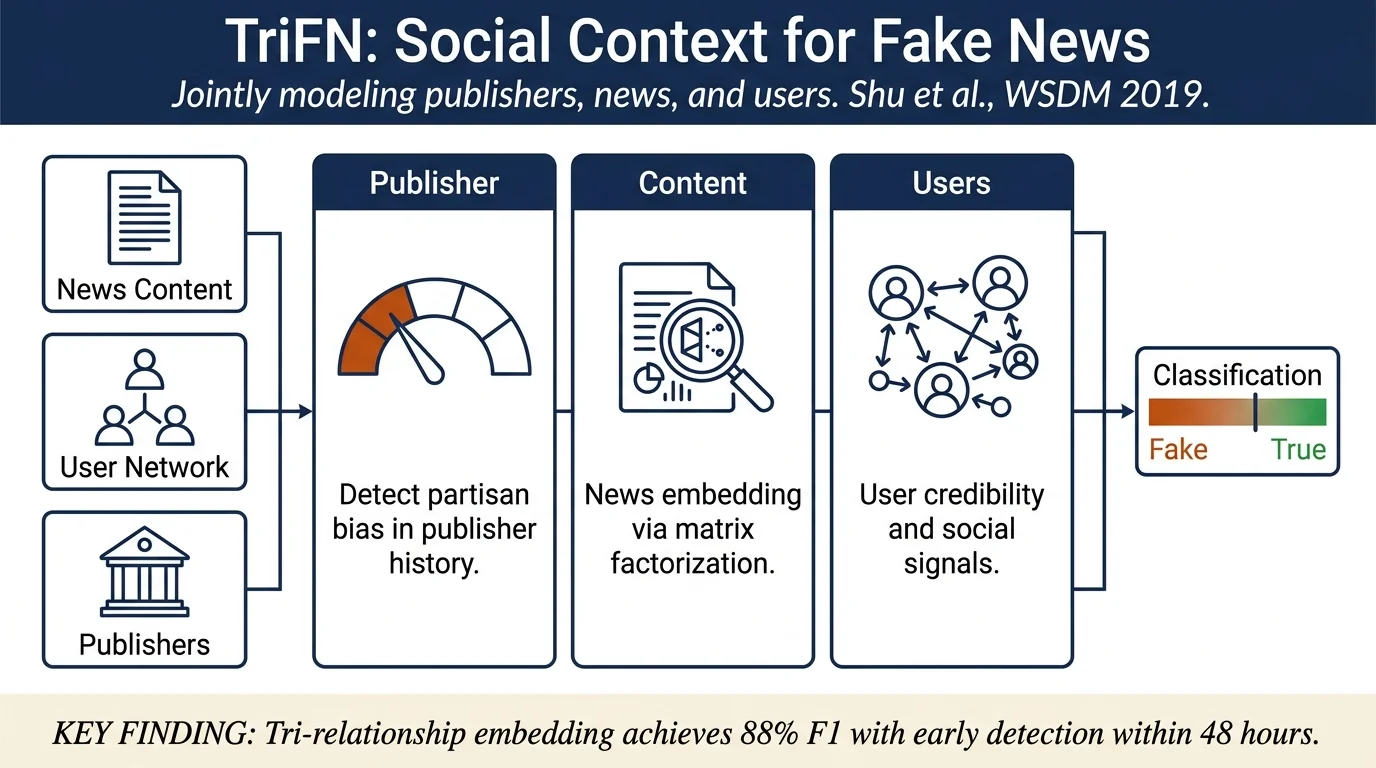
Beyond News Contents: The Role of Social Context for Fake News DetectionContent-only detection is insufficient because fake news is crafted to mimic real news. This paper argues that the tri-relationship among publishers, news pieces, and users forms rich social context for detection: partisan-biased publishers more likely publish fake news, and low-credibility users more likely share it.
 Spread & networksDetection methods
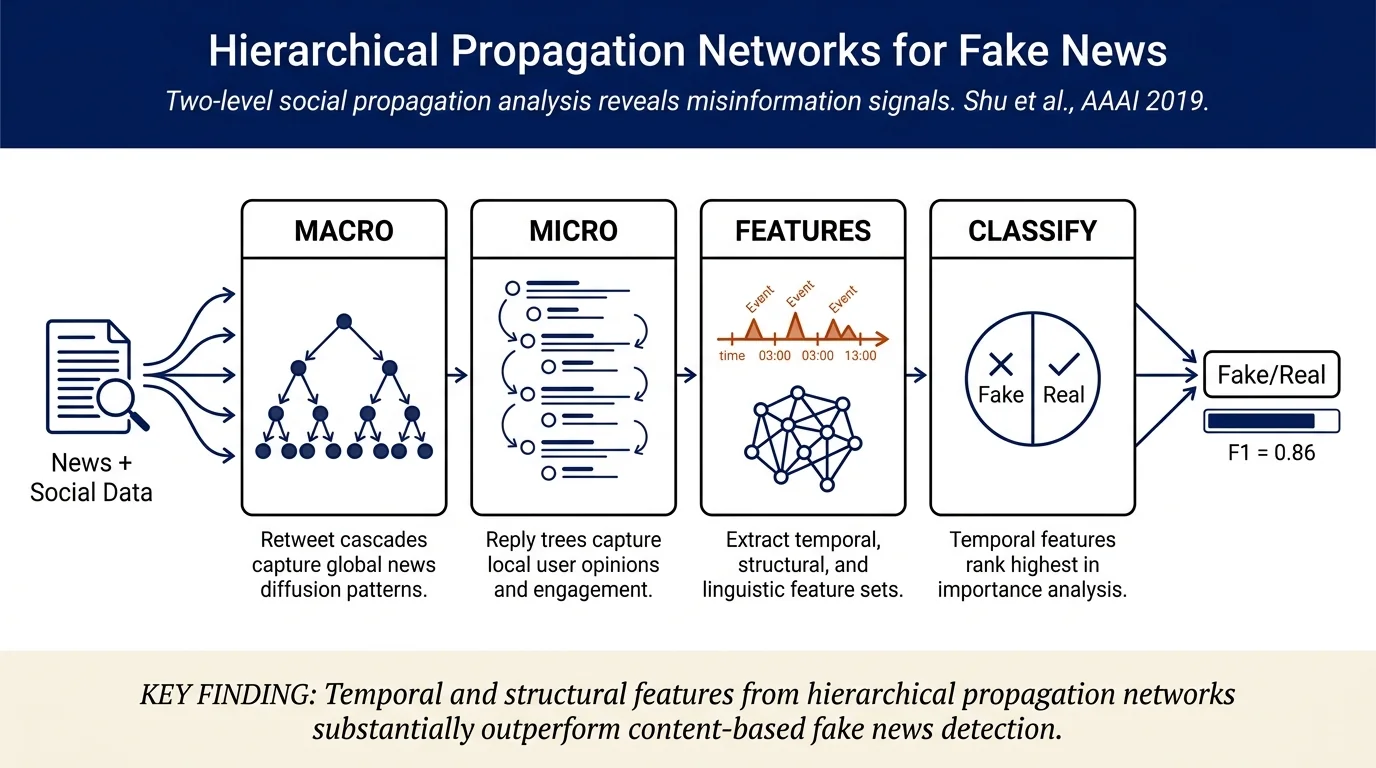
Hierarchical Propagation Networks for Fake News Detection: Investigation and ExploitationContent-only fake news detection has limited performance because fake news is deliberately crafted to mimic real news. This paper constructs hierarchical propagation networks from both macro-level (tweet/retweet cascade) and micro-level (reply conversation) granularity, extracts structural, temporal, and linguistic features from both…
 Spread & networksDetection methods
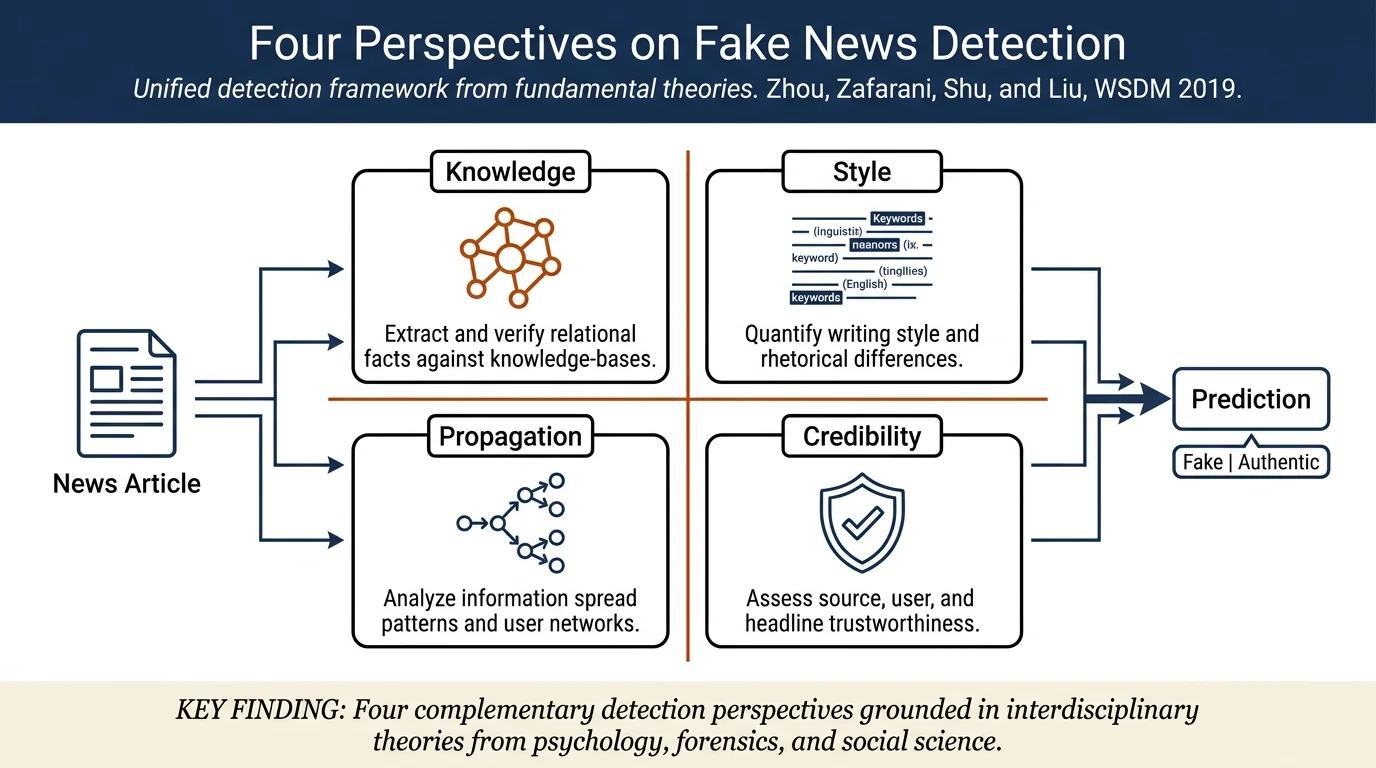
Fake News: Fundamental Theories, Detection Strategies and ChallengesA comprehensive tutorial framework addressing fake news research across three dimensions: (1) fundamental theories from psychology, social science, economics, and forensics explaining human vulnerability to misinformation and why individuals participate in fake news activities; (2) detection strategies unified across four perspectives…
 Detection methodsSpread & networks
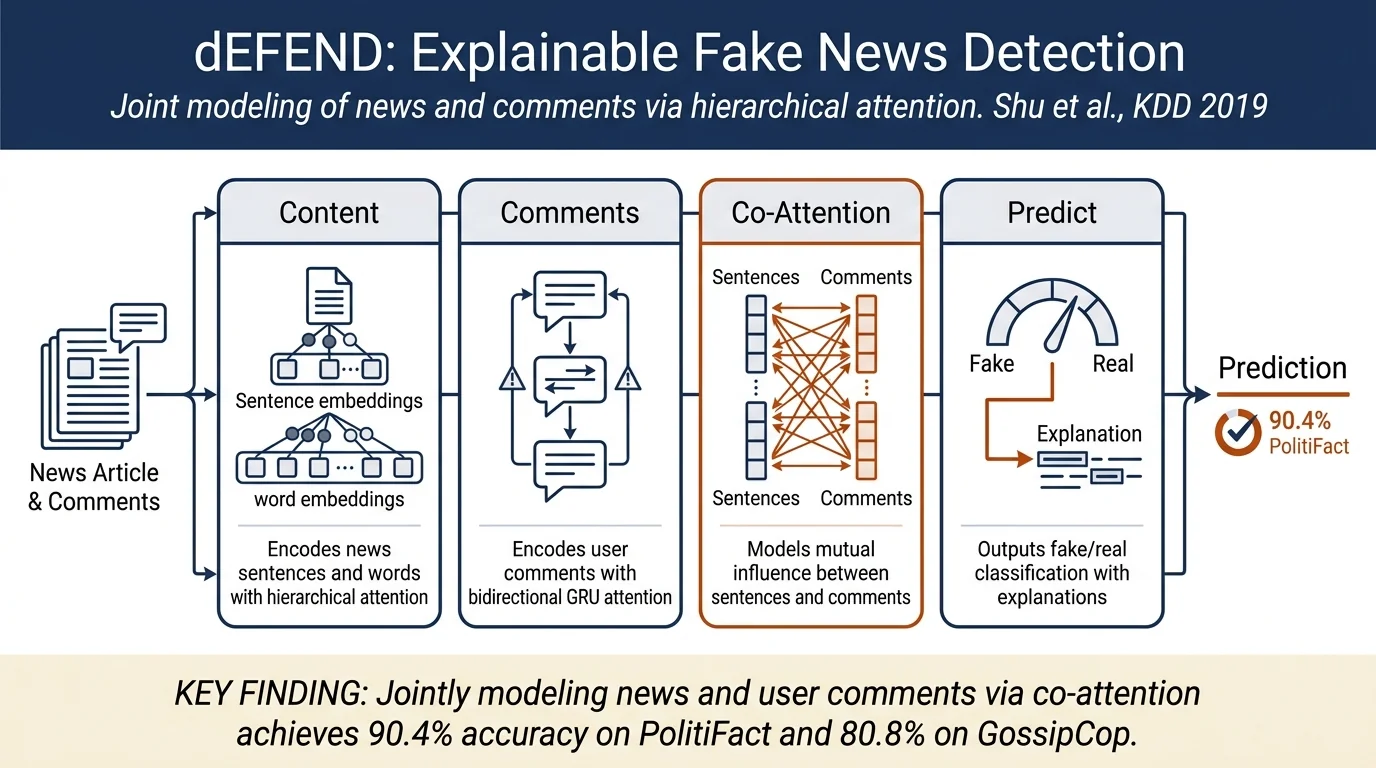
dEFEND: Explainable Fake News DetectionFake news detection on social media typically focuses on content alone, but user comments and reactions provide complementary signals. This paper proposes dEFEND, a hierarchical attention neural network that jointly encodes news sentences and user comments to both detect fake news and explain why a piece of news is detected as fake by…
 Deepfakes & multimodalDetection methods
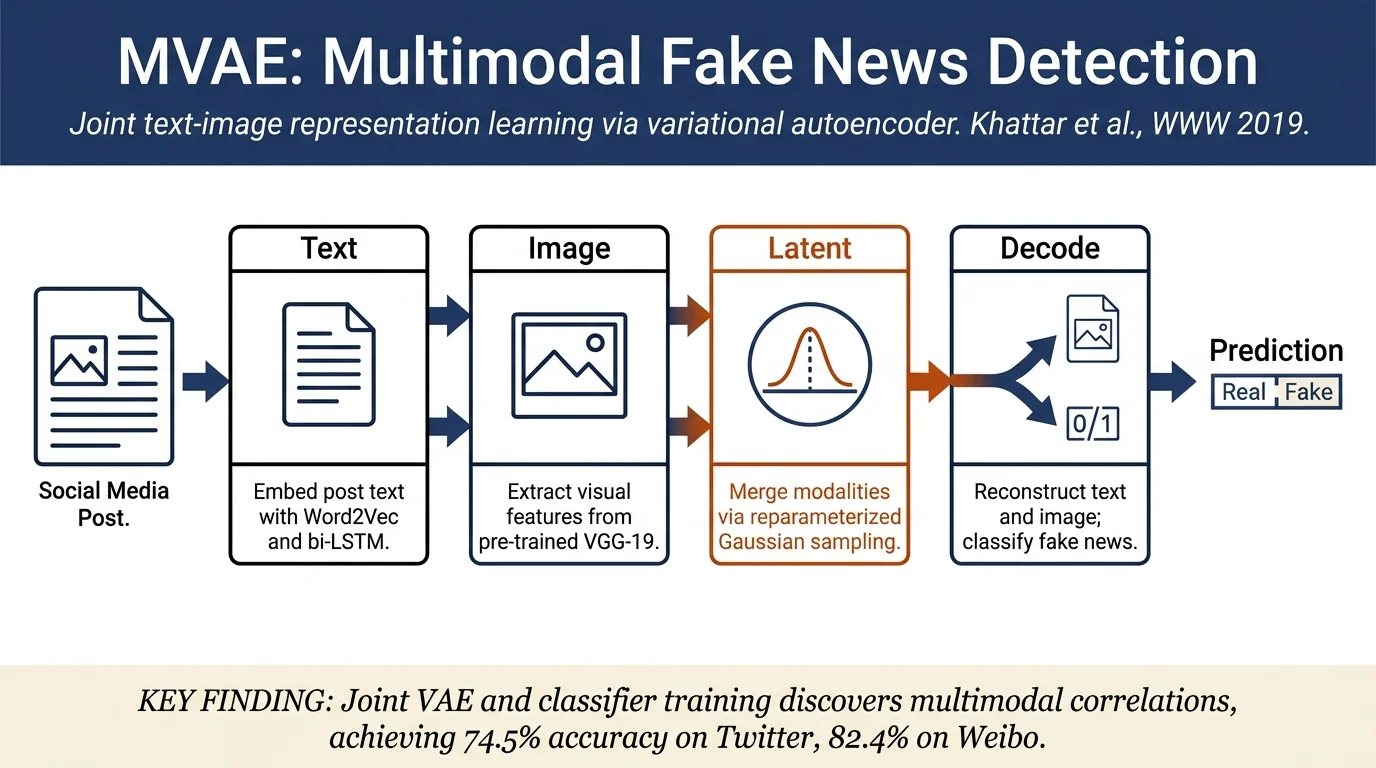
MVAE: Multimodal Variational Autoencoder for Fake News DetectionThe paper proposes MVAE, a variational autoencoder that learns shared representations of text and images in social media posts to detect fake news. The model jointly trains an encoder-decoder (to discover correlations across modalities) with a binary classifier.
 Detection methodsDatasets & evaluation
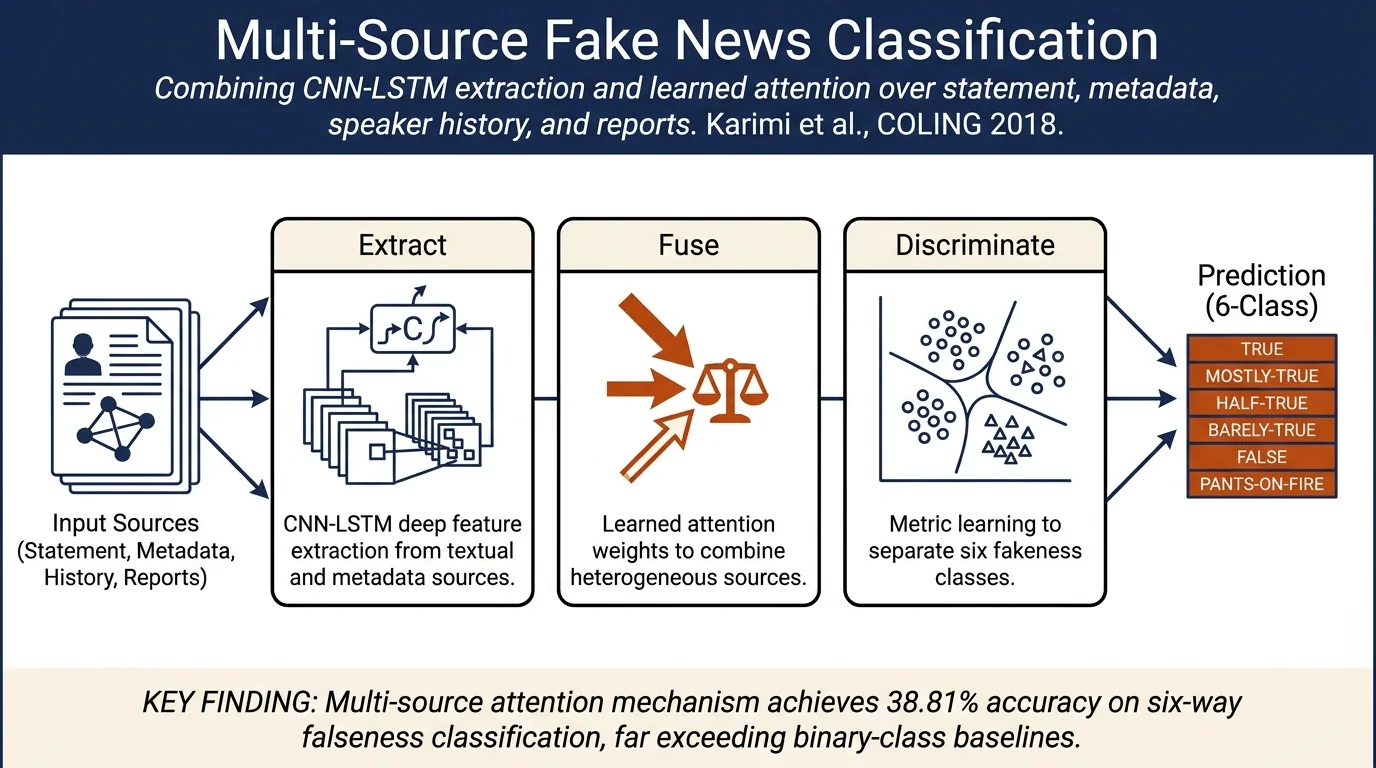
Multi-Source Multi-Class Fake News DetectionProposes MMFD, a multi-source multi-class fake news detection framework combining automated feature extraction (CNN-LSTM), interpretable multi-source fusion (attention mechanism), and fakeness discrimination. Achieves 38.81% accuracy on LIAR dataset across six classes of fakeness (true, mostly-true, half-true, barely-true, false,…
 Detection methodsLLMs & generative AI
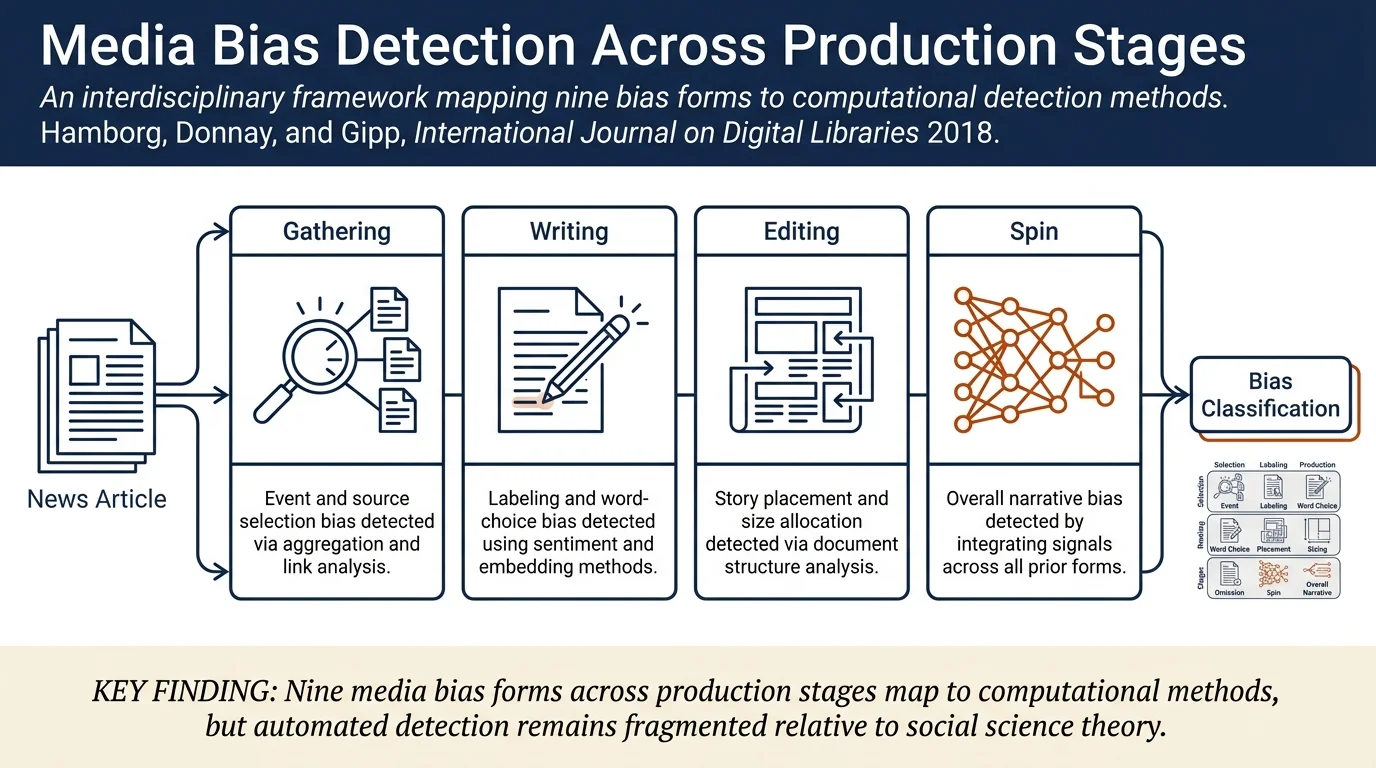
Automated identification of media bias in news articles: an interdisciplinary literature reviewThis paper surveys automated and manual methods for identifying media bias in news articles, bridging social science and computer science approaches. It defines nine distinct forms of media bias and maps social science research onto computational techniques, finding that NLP-based methods are promising for automated detection but remain…
 Detection methodsDatasets & evaluation
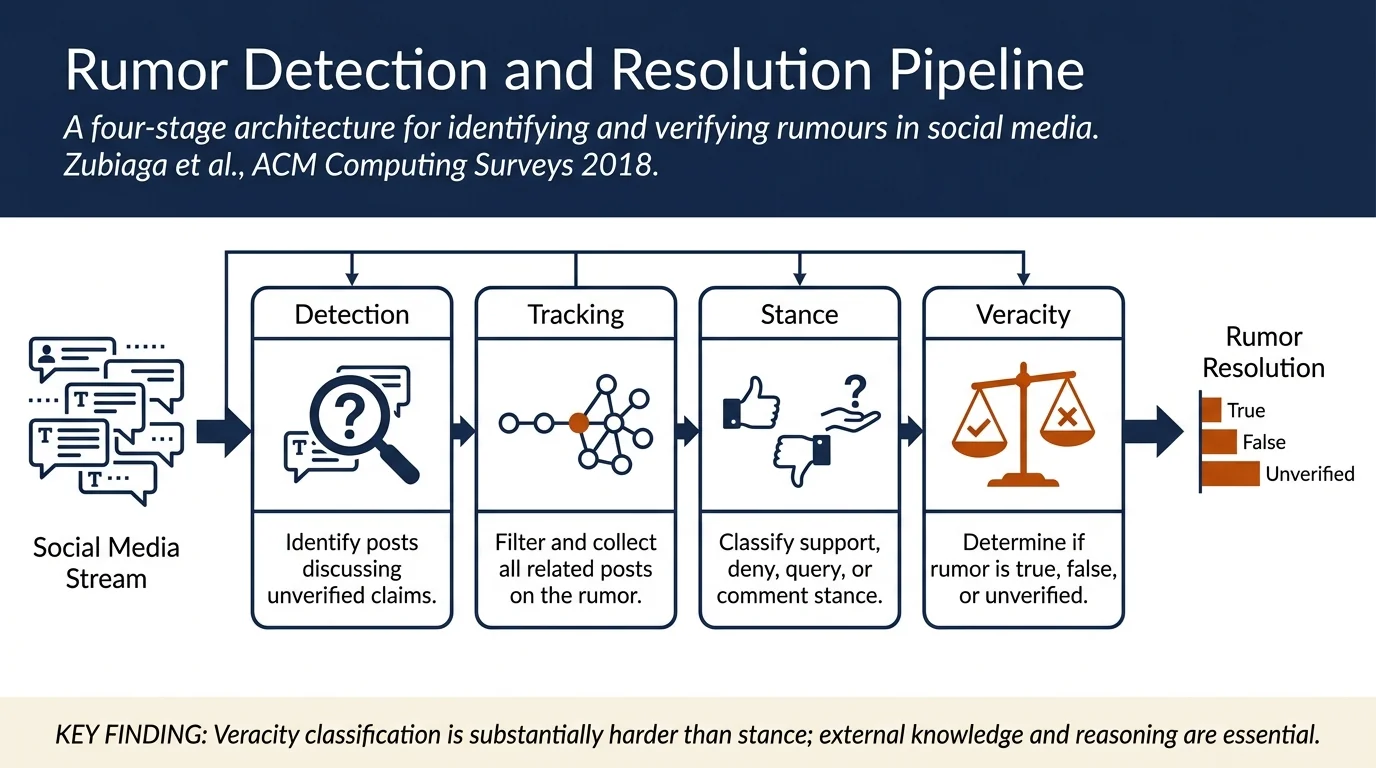
Detection and Resolution of Rumours in Social Media: A SurveyComprehensive survey of rumour detection and resolution in social media covering the entire pipeline: rumour definition and characterization, data collection strategies, annotation schemes, detection approaches for both emerging and long-standing rumours, tracking of rumour propagation, stance classification (support/deny/query/comment),…
 Spread & networksDetection methods
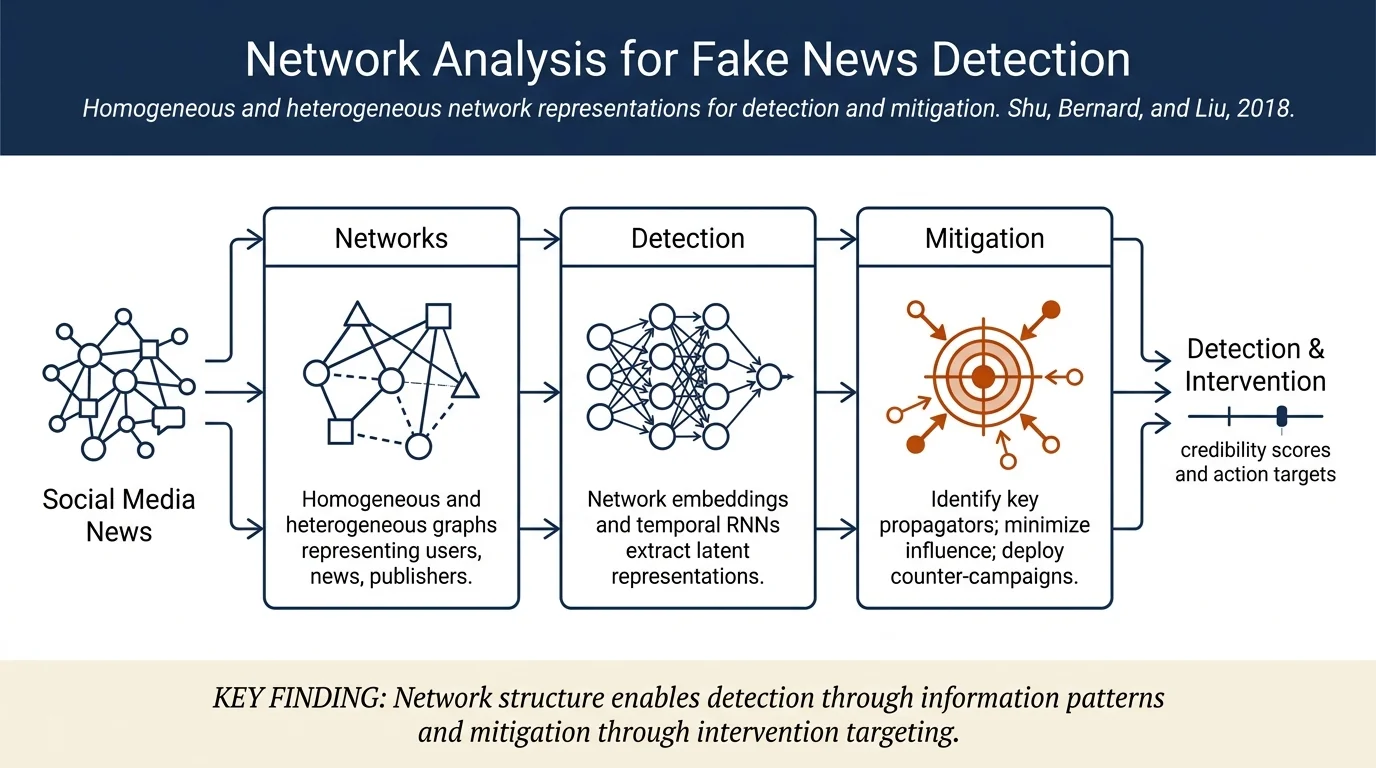
Studying Fake News via Network Analysis: Detection and MitigationThis chapter surveys network-based approaches to fake news detection and mitigation on social media, organizing fake news dissemination along three dimensions (content, social, temporal) and introduces methods exploiting network structure: homogeneous networks (friendship, diffusion, credibility) and heterogeneous networks (knowledge,…
 Detection methodsDatasets & evaluation
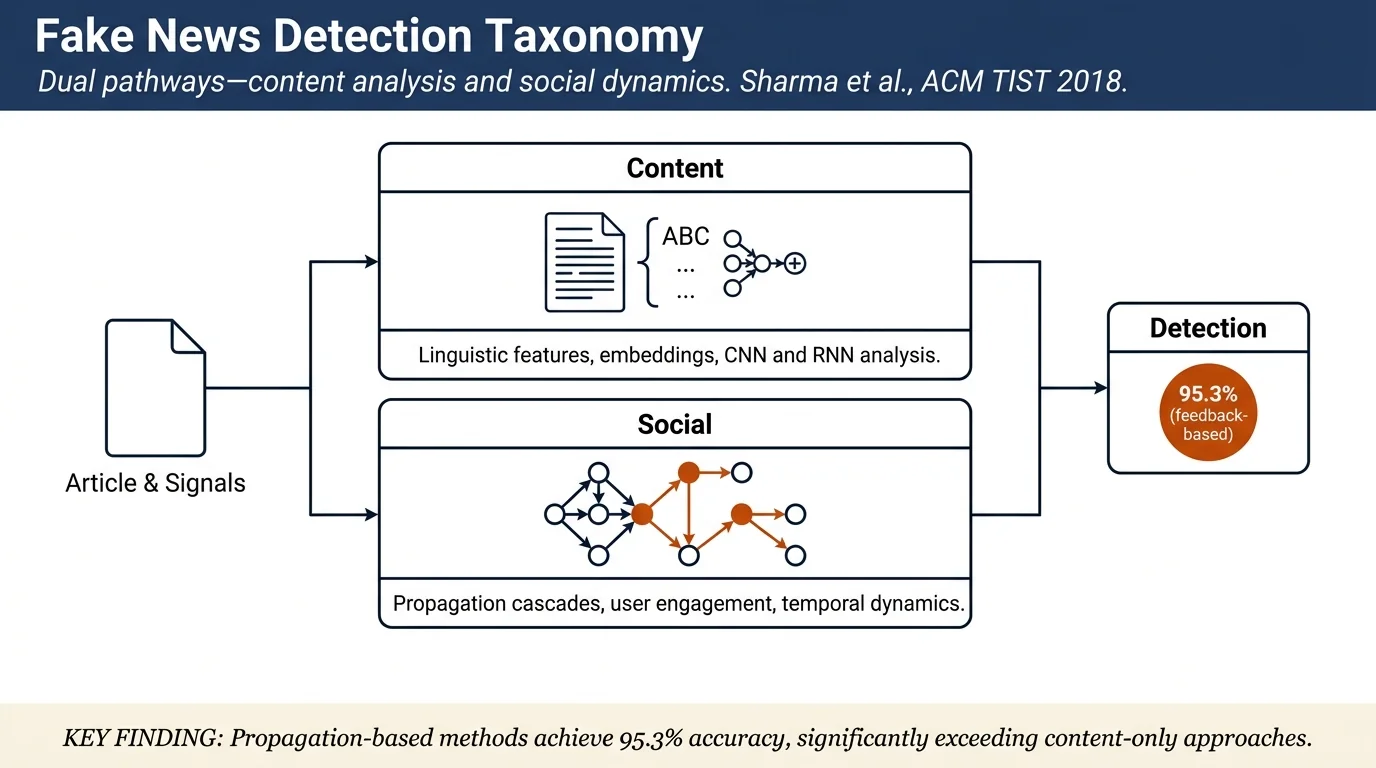
Combating Fake News: A Survey on Identification and Mitigation TechniquesThis comprehensive survey of fake news detection and mitigation organizes existing methods into two broad categories: content-based approaches (linguistic and deep learning methods) and feedback-based approaches (exploiting propagation patterns, user responses, and temporal dynamics). The authors consolidate 23+ publicly available…
 Spread & networksDetection methods
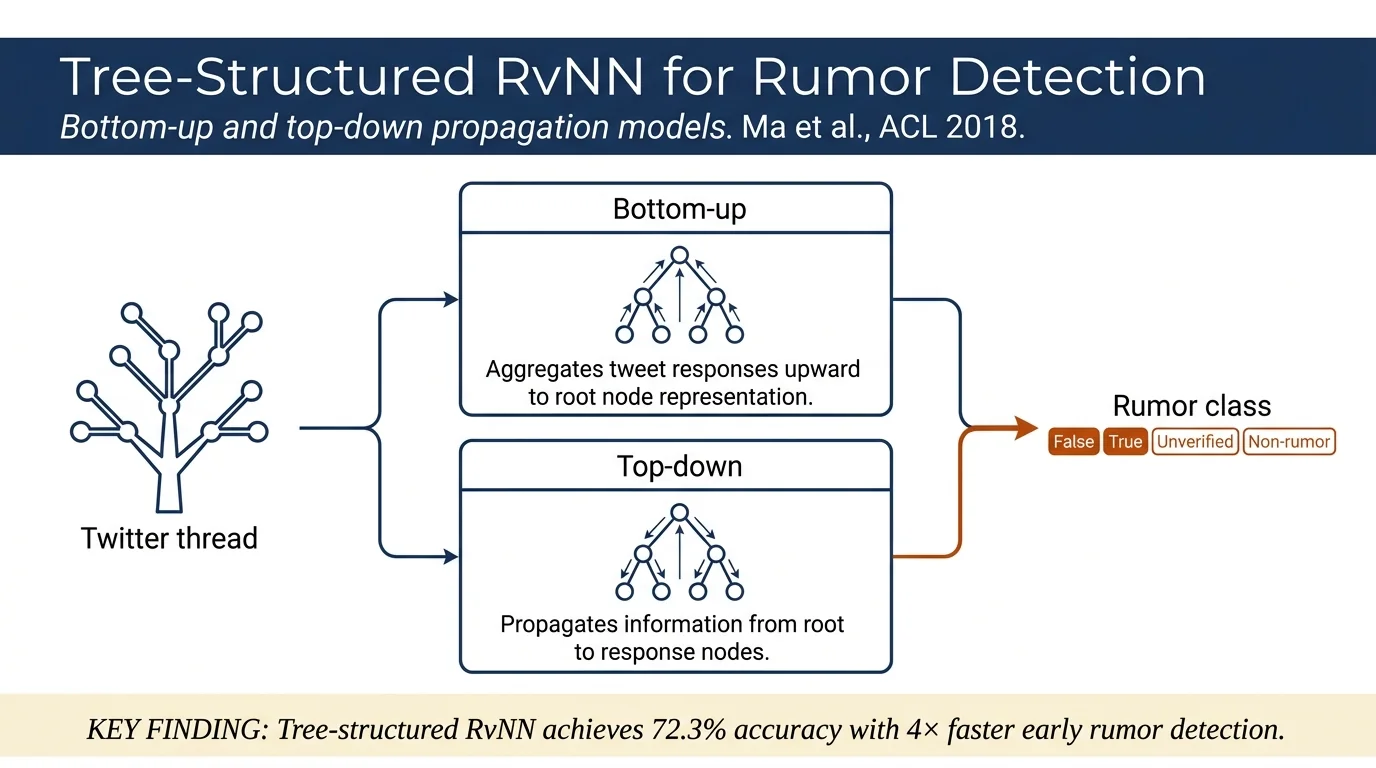
Rumor Detection on Twitter with Tree-structured Recursive Neural NetworksProposes two variants of recursive neural networks (RvNN)—bottom-up and top-down—that operate on propagation tree structures of tweets to detect rumors. Rather than treating tweets sequentially, the model learns representations that respect how tweets actually propagate in response threads.
 Deepfakes & multimodalDetection methods
EANN: Event Adversarial Neural Networks for Multi-Modal Fake News DetectionThe paper proposes EANN, an adversarial neural network that detects fake news on newly emerged events by learning event-invariant features. An event discriminator forces the multi-modal feature extractor to remove event-specific features while preserving shared patterns across events.
 Detection methodsLLMs & generative AI
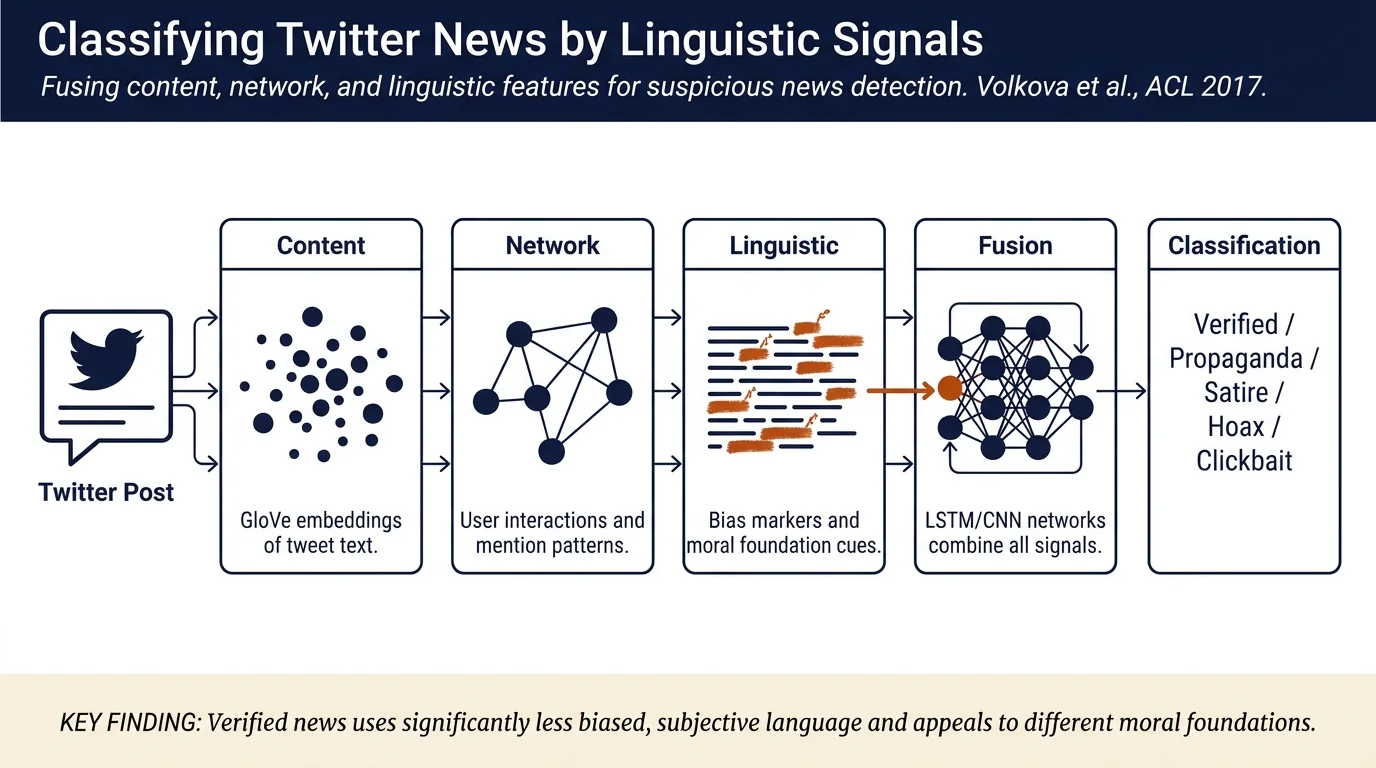
Separating Facts from Fiction: Linguistic Models to Classify Suspicious and Trusted News Posts on TwitterThis paper presents neural network models combining tweet content, social network interactions, and linguistic features (bias markers, subjectivity cues, moral foundations) to classify Twitter news posts as suspicious (propaganda, hoaxes, clickbait, satire) or verified. The models achieve 95% accuracy on binary classification and 0.7…
 Detection methodsSpread & networks
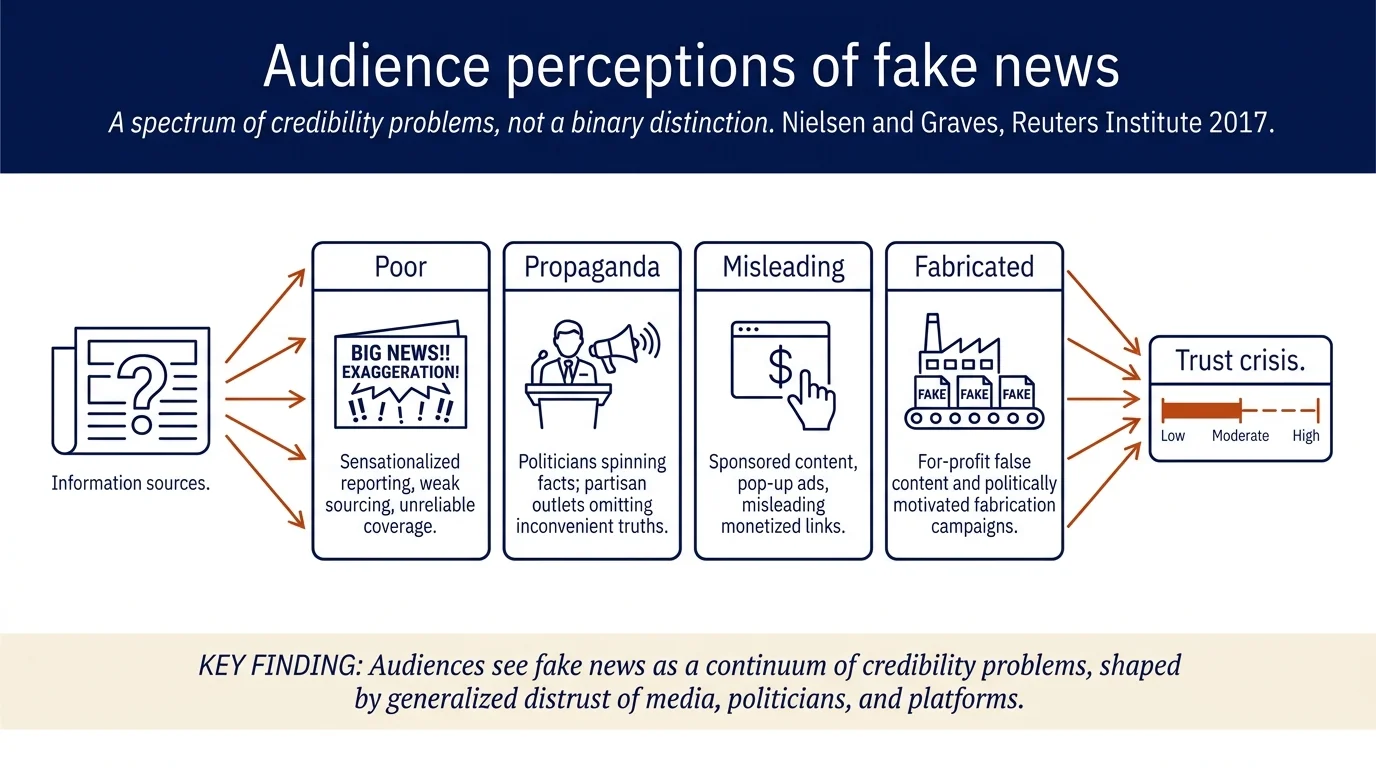
"News you don't believe": Audience perspectives on fake newsUsing focus groups and surveys across the US, UK, Spain, and Finland, Nielsen and Graves find that ordinary people see fake news as a spectrum rather than a binary distinction—encompassing poor journalism, political propaganda, misleading advertising, and fabricated content. Audiences experience the "fake news" problem as one of degree,…
 Spread & networksDetection methods
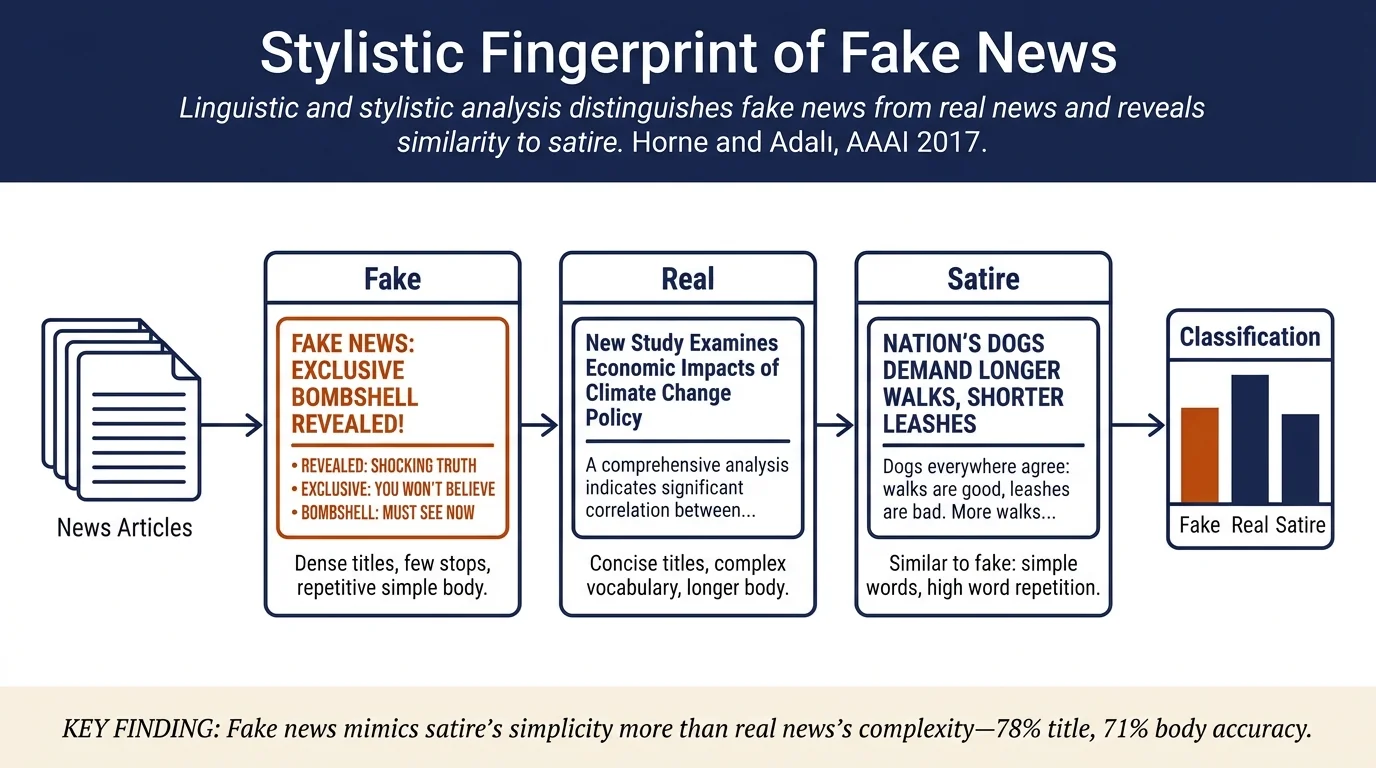
This Just In: Fake News Packs a Lot in Title, Uses Simpler, Repetitive Content in Text Body, More Similar to Satire than Real NewsFake news differs systematically from real news in stylistic features, especially titles. Contrary to the assumption that fake news mimics real news, it is actually more similar to satire: packed titles with fewer stop words and more proper nouns, combined with shorter, repetitive body text with simpler language.
 Detection methodsDatasets & evaluation
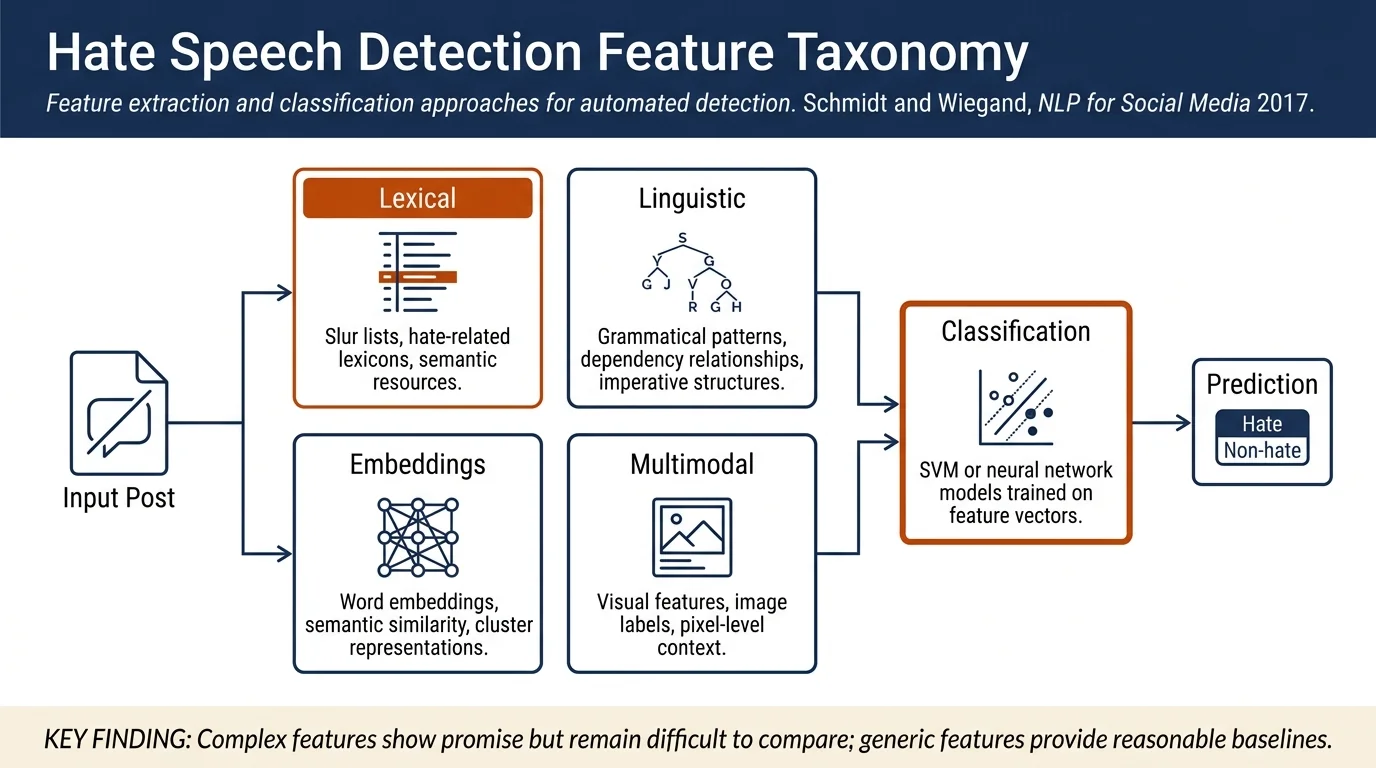
A Survey on Hate Speech Detection using Natural Language ProcessingThis survey systematically reviews automatic hate speech detection methods, covering feature extraction techniques (surface features, embeddings, sentiment analysis, lexical resources, linguistic features, knowledge bases), classification approaches (mostly supervised learning with SVMs and neural networks), annotation practices, and key…