Better Safe Than Sorry: an Adversarial Approach to improve Social Bot Detection
Authors: Stefano Cresci, Marinella Petrocchi, Angelo Spognardi, Stefano Tognazzi
Venue: ACM Web Science Conference (WebSci), June 30–July 3, 2019, Boston, MA — arXiv:1904.05132
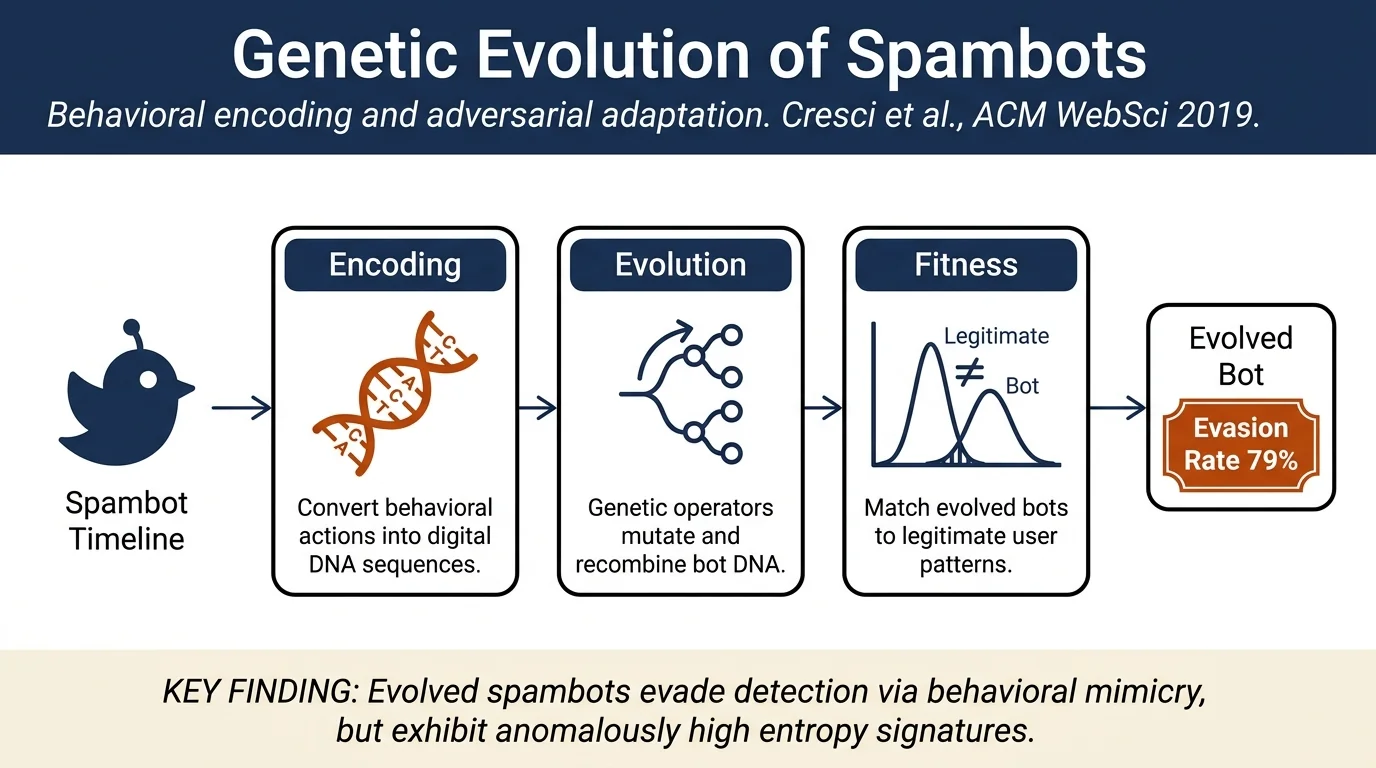
TL;DR
Proposes GenBot, a novel genetic algorithm that synthesizes evolved versions of existing spambots by encoding behavioral timelines as "digital DNA" sequences and iteratively evolving them to resemble legitimate user behavior. Tests the evolved bots against three state-of-the-art detection systems and finds they largely evade detection (F₁ ≈ 0.26), while analysis reveals evolved bots exhibit suspiciously high Shannon entropy—a feature that could strengthen future detection systems. Demonstrates a proactive approach to bot detection rather than the traditional reactive cycle.
Contributions
- GenBot algorithm: Proposes the first genetic algorithm designed specifically for simulating spambot behavioral evolutions, using digital DNA sequences as the genetic encoding and multi-level crossover operators (group-level and user-level)
- Proactive detection framework: Introduces a paradigm shift from reactive detection (designing systems after bots evolve) to proactive detection (simulating likely future bot evolutions to preemptively strengthen defenses)
- Demonstration of detection vulnerability: Shows that evolved spambots evade multiple state-of-the-art techniques: 79% evasion rate against Cresci et al. 2017, ~64% against Miller et al. 2014, and ~51% against Ahmed & Abulaish 2013
- Actionable detection improvements: Identifies that evolved spambots exhibit significantly higher normalized Shannon entropy (mean H_norm ≈ 1.0) than legitimate accounts (mean H_norm ≈ 0.8), suggesting entropy-based features could improve detection robustness
Method
Digital DNA Encoding
User behavior is encoded as sequences using the digital DNA technique: each action (tweet, reply, retweet) maps to a character (A, C, T respectively). A user's timeline becomes a string encoding the chronological sequence of action types, enabling bioinformatic analysis tools.
GenBot Algorithm
GenBot extends the (1+1)-evolutionary algorithm scheme with three mutation and crossover operators:
Mutation: Biased toward increasing tweet frequency (A base); mutations from C (reply) or T (retweet) to A are favored (reflecting legitimate user skew), while mutations from A to C/T are less probable.
Crossover operators (multi-level): - Group-level (GCO): one-point crossover at user-group level, mixing users between parent groups - User-level (UCO): one-point crossover at DNA sequence level within individual users - User reverse (URCO): one-point crossover where the second parent's DNA is reversed before recombination, increasing variability
Fitness Function
Uses Kullback-Leibler divergence (D_KL) between LCS (longest common substring) curves of evolved bots and legitimate accounts. The algorithm minimizes this distance, converging toward evolved bots whose group-level behavioral signature matches legitimate users.
Experimental Setup
- Legitimate account dataset: 3,474 human-operated Twitter accounts, verified via direct contact (used in prior DNA-Inspired Online Behavioral Modeling and Its Application to Spambot Detection work)
- Genetic algorithm parameters: Population size = 30, maximum generations = 20,000, mutation probability = 0.0002, DNA sequence length = 2,000 (matching legitimate accounts)
- Evaluation: LCS curves compared visually and quantitatively via AUC and D_KL; evolved bots tested against 3 state-of-the-art detectors
Results
Behavioral Similarity to Legitimate Users
Evolved bots achieve LCS AUC of 4,079 vs. legitimate benchmark of 3,961 (2.98% error), substantially better than prior resampling techniques which achieved ~50% error. When evolved bots are mixed with legitimate accounts, the combined group behaves indistinguishably from pure legitimate accounts (21.98% AUC change).
Detection Evasion
Evolved spambots largely evade state-of-the-art detection:
| Detection Technique | Non-evolved Bots | Evolved Bots |
|---|---|---|
| The Paradigm-Shift of Social Spambots: Evidence, Theories, and Tools for the | F₁ = 0.923 | F₁ = 0.298 |
| Miller et al. (2014) | F₁ = 0.435 | F₁ = 0.480 |
| Ahmed & Abulaish (2013) | Accuracy = 0.495, MCC = −0.071 | (similar failure) |
Generalizability
Evolved bots transfer across different sets of legitimate accounts. When GenBot is retrained on disjunct subgroups (Group A and B) of the legitimate accounts, the evolved bots still closely match the new target groups (12.72% and 7.28% AUC error respectively), indicating the algorithm learns generalizable legitimate patterns rather than overfitting to a specific group.
Actionable Detection Improvement
Despite evading group-level detection, evolved bots exhibit anomalously high Shannon entropy in their DNA sequences (mean H_norm ≈ 1.0 vs. legitimate mean ≈ 0.8). This indicates very erratic, non-repetitive behavior that lacks the regularities legitimate users exhibit. Extending detection systems to incorporate entropy-based features could detect these evolved bots.
Connections
- Extends the digital DNA framework introduced in Cresci et al. 2016, applying it to attack generation rather than detection
- Directly related to Cresci et al. 2017 which documents spambot evolution; this paper operationalizes that evolution framework
- Part of the shift toward proactive security approaches in online social networks
- Demonstrates adversarial machine learning applied to social bot detection, generating adversarial samples to test and strengthen defenses
- Methodologically related to work on adversarial classifier evasion and genetic algorithm applications in security
Notes
Strengths: - First study to quantitatively simulate spambot evolution and test detection robustness against likely future bot variants - Novel application of multi-level genetic operators (group and user levels) to a security domain - Strong empirical validation: evolved bots successfully evade multiple independent detectors, raising genuine concern about detection system vulnerabilities - Actionable insight (entropy-based features) emerges directly from analysis of failure modes - Reproducible: code and data publicly available; results stable across 5 runs (low variance in D_KL) - Proactive framing is ethically sound—designed to strengthen defenses, not aid attackers
Limitations: - Evaluation focuses on behavioral detection techniques; graph-based and content-based methods not thoroughly tested (Ahmed & Abulaish partially tested; network structure not evaluated) - Evolved bots tested only on Twitter; generalizability to other platforms unclear - Genetic algorithm parameters (20,000 generations) computationally expensive; scalability to real-time or online detection not addressed - LCS-based behavioral similarity is somewhat coarse-grained; fine-grained temporal patterns (e.g., inter-tweet intervals) not explicitly modeled - Entropy insight is post-hoc; it's unclear whether entropy is a fundamental weakness of evolved bots or an artifact of this particular GA design
Future directions: - Extend to graph-based and content-based detection techniques; test GenBot's success against broader detector families - Incorporate entropy-based fitness constraints to produce genuinely harder adversarial bots - Apply to other bot types (follower inflation, coordinated campaigns, political manipulation) and platforms - Develop online/streaming variants for real-time detection of evolving bot populations - Study the interaction between evolved bot strategies and potential defenses (e.g., can detectors adapt faster than GA simulations?)