Explore everything
Filter by research area, year and venue. Every filter is in the address bar, so you can share a view as a link.
 Spread & networksPsychology & interventions
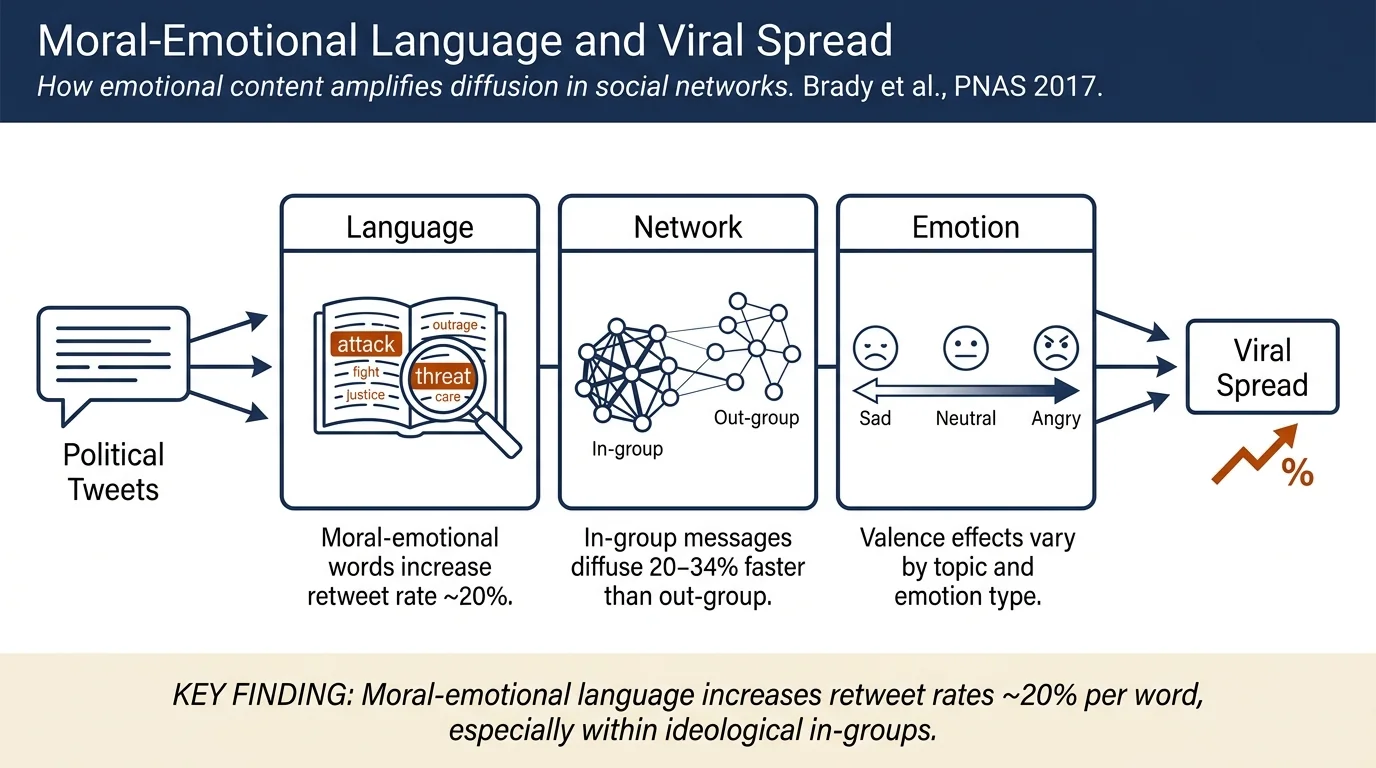
Emotion shapes the diffusion of moralized content in social networksMoral-emotional language (words combining moral and emotional content) increases message diffusion in social networks by ~20% per word. This effect is stronger within political in-groups than out-groups, explaining how moral and political ideas spread within polarized "echo chambers" on platforms like Twitter.
 Spread & networksPsychology & interventions
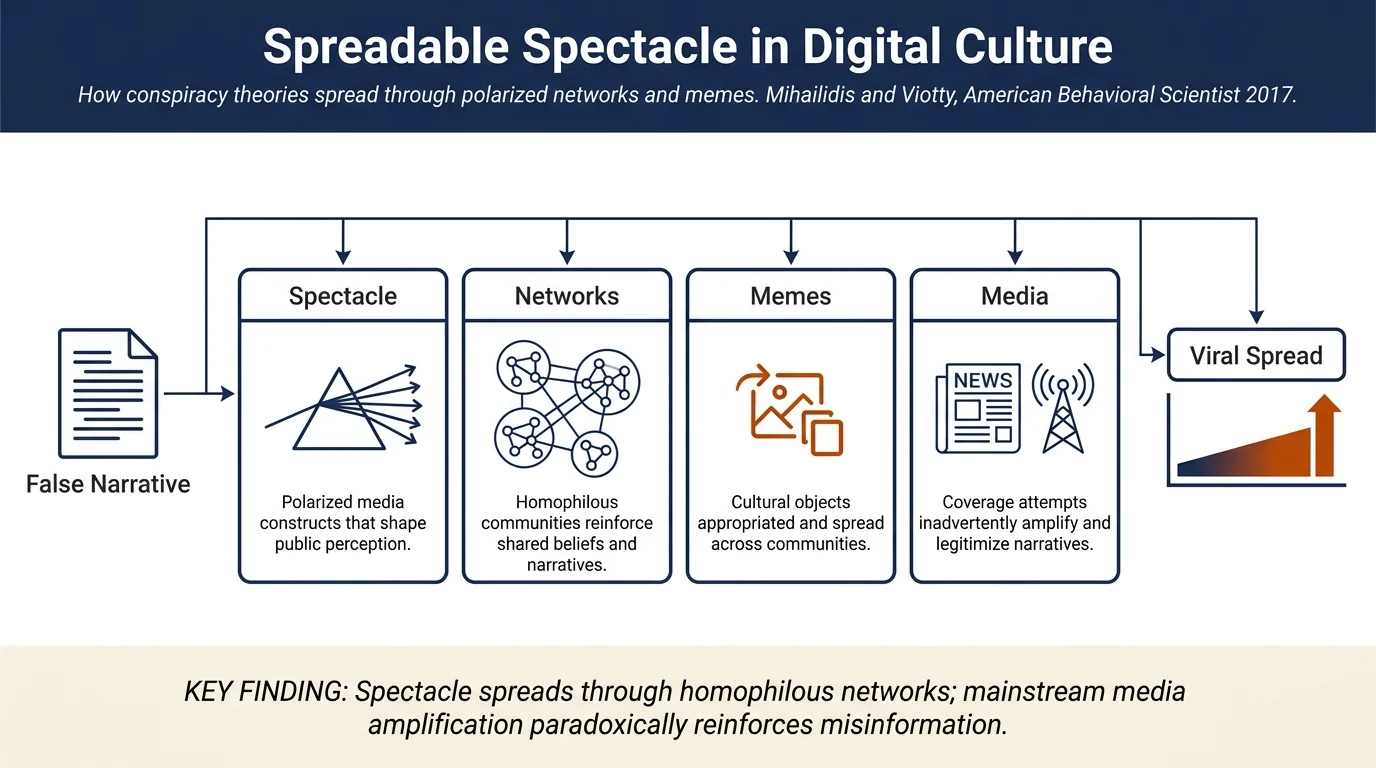
Spreadable Spectacle in Digital Culture: Civic Expression, Fake News, and the Role of Media Literacies in "Post-Fact" SocietyThis paper explores how spectacle—media constructs outside ordinary routine that capitalize on polarization—spreads through digital culture during the 2016 U.S. election. Using the Pizzagate conspiracy theory as a case study, the authors argue that citizen-driven spectacle leverages homophilous networks, memes, and appropriated cultural…
 Spread & networksPlatforms, policy & society
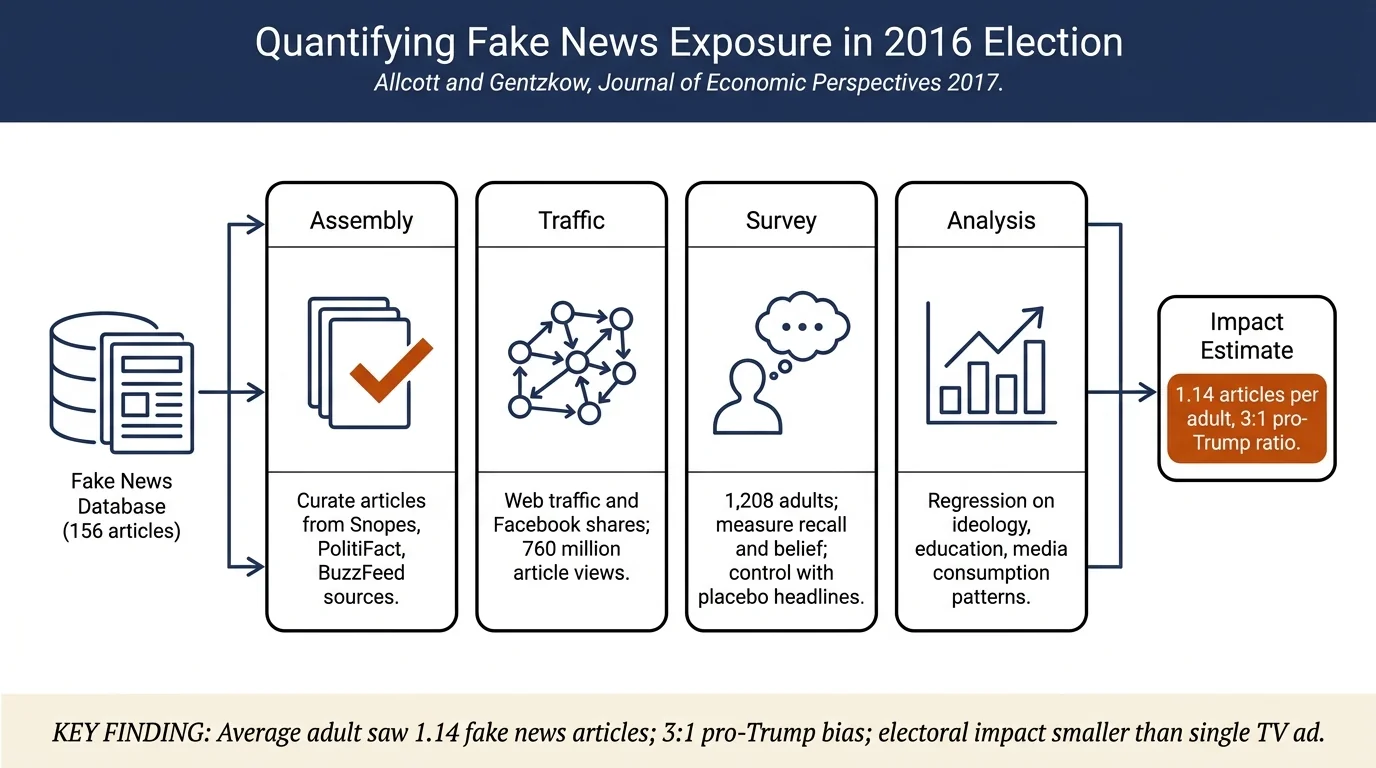
Social Media and Fake News in the 2016 ElectionAllcott and Gentzkov provide the first comprehensive empirical evidence on fake news exposure during the 2016 US election. Drawing on a curated database of 156 fake news articles, web traffic data, and a post-election survey of 1,200 adults, they estimate the average American saw and remembered 1.14 fake news articles during the election…
 Spread & networksBots & coordinated campaigns
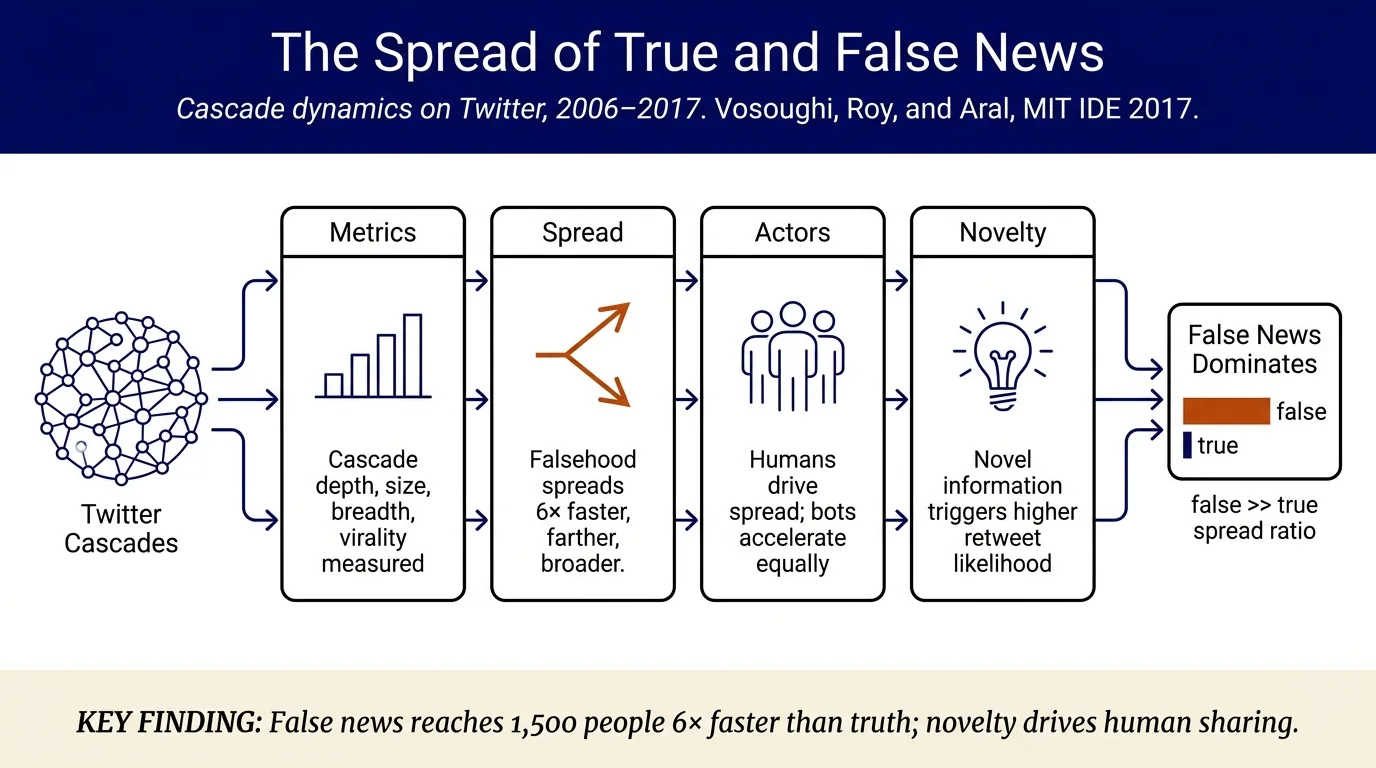
The Spread of True and False News OnlineAnalyzes 126,000 verified true and false news cascades from Twitter (2006–2017) covering 3 million users and 4.5 million shares. False news diffuses significantly farther, faster, deeper, and more broadly than truth across all categories, with false political news spreading fastest.
 Spread & networksPlatforms, policy & society
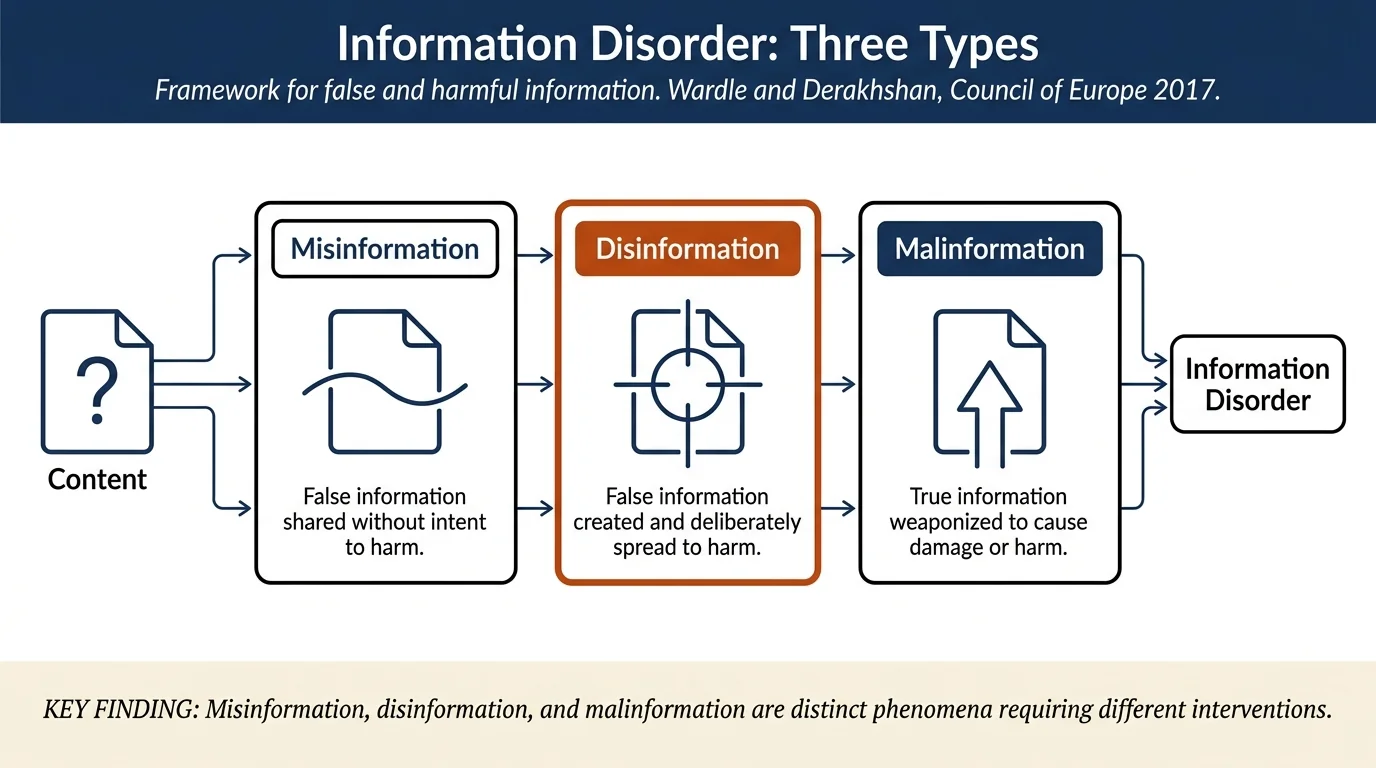
Information Disorder: Toward an Interdisciplinary Framework for Research and Policy MakingThis Council of Europe report introduces a comprehensive framework for understanding "information disorder" via three types (mis-, dis-, mal-information) defined by falseness and intent-to-harm. It examines the agents, messages, and interpreters involved, the creation-production-distribution lifecycle, and proposes 34 recommendations…
 Spread & networksPsychology & interventions
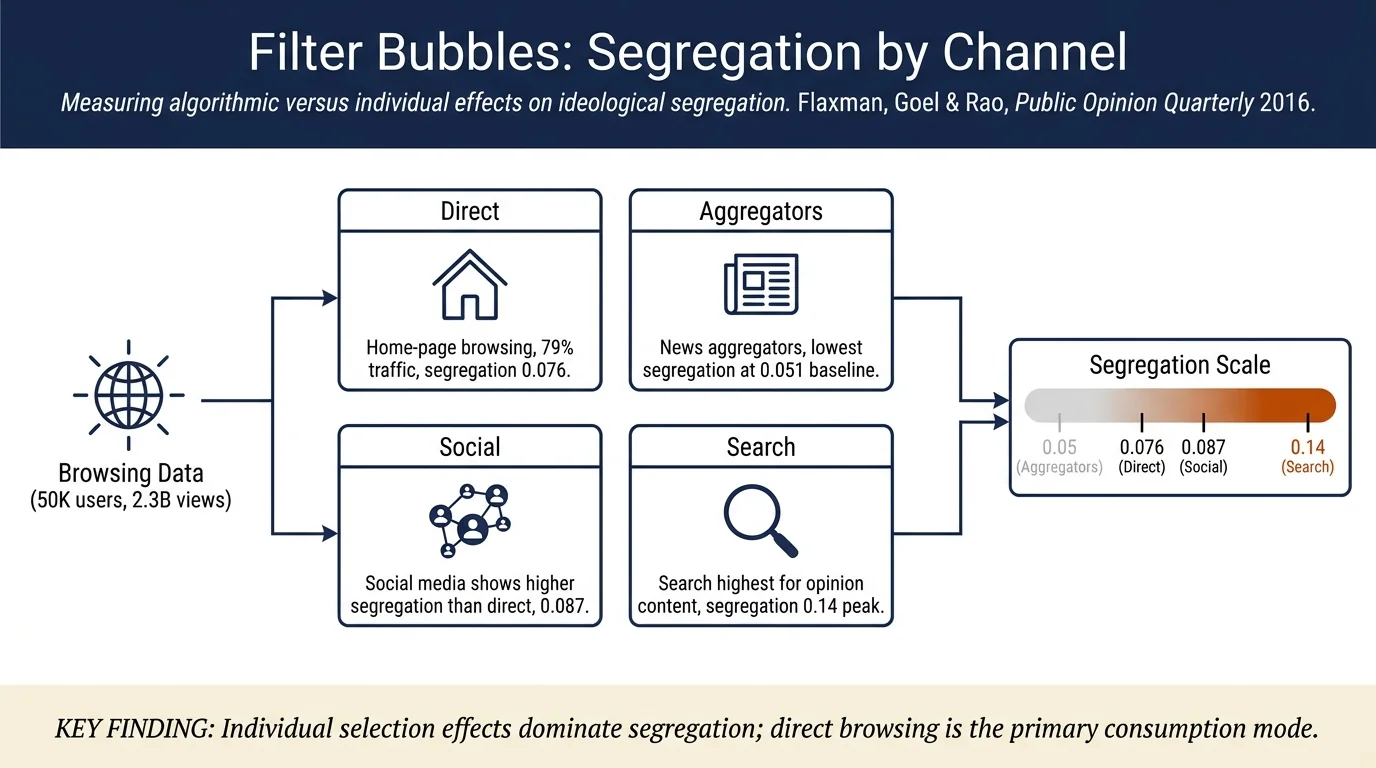
Filter Bubbles, Echo Chambers, and Online News ConsumptionThis paper examines whether technological changes (social media, search engines) increase ideological segregation in online news consumption by analyzing web-browsing data from 50,000 active news readers. They find that while social media and search are associated with higher segregation than direct browsing, the overall effects are…
 Spread & networksDetection methods
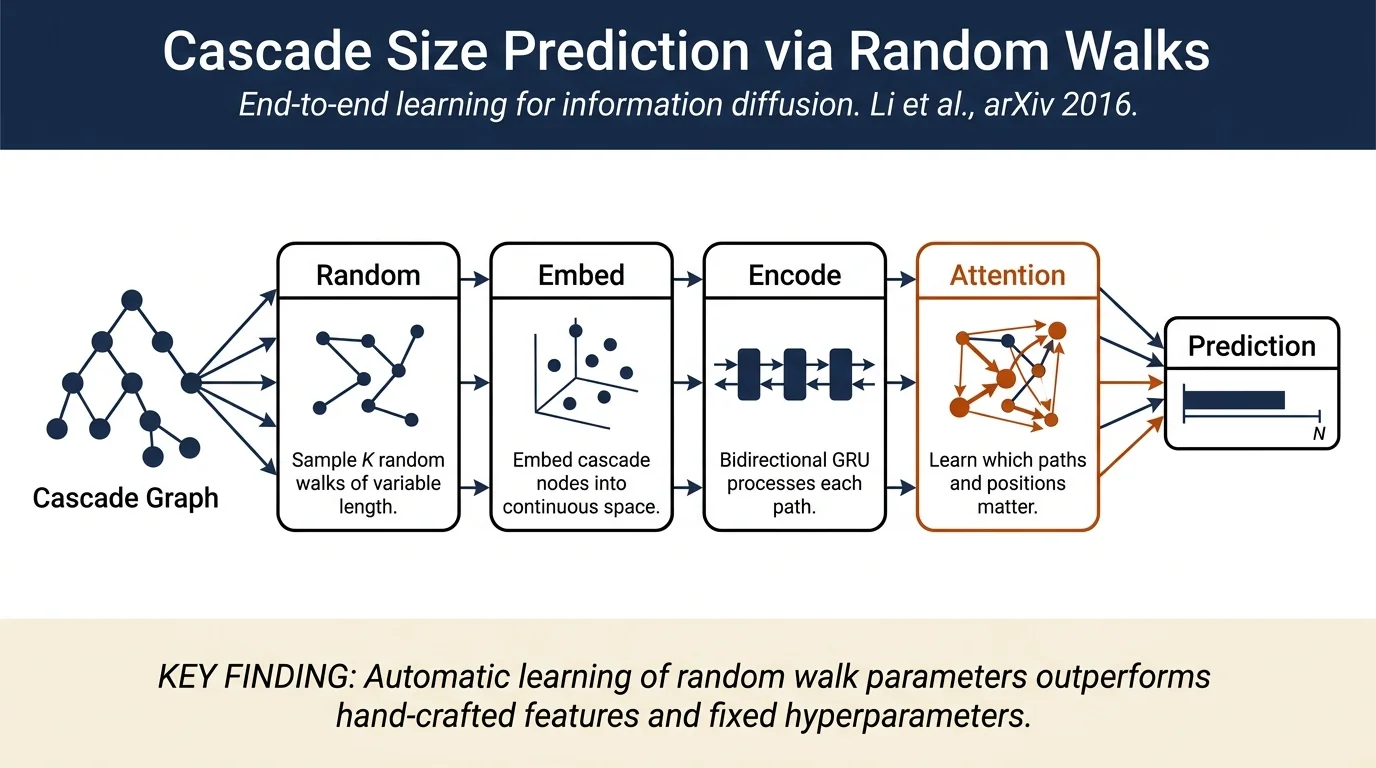
DeepCas: an End-to-end Predictor of Information CascadesDeepCas predicts the future size of information cascades (e.g., how many people will eventually retweet a post or cite a paper) using an end-to-end deep learning model that represents cascade graphs as sets of random walk paths. Instead of relying on hand-crafted network features, the model learns cascade representations automatically…
 Spread & networksDetection methods
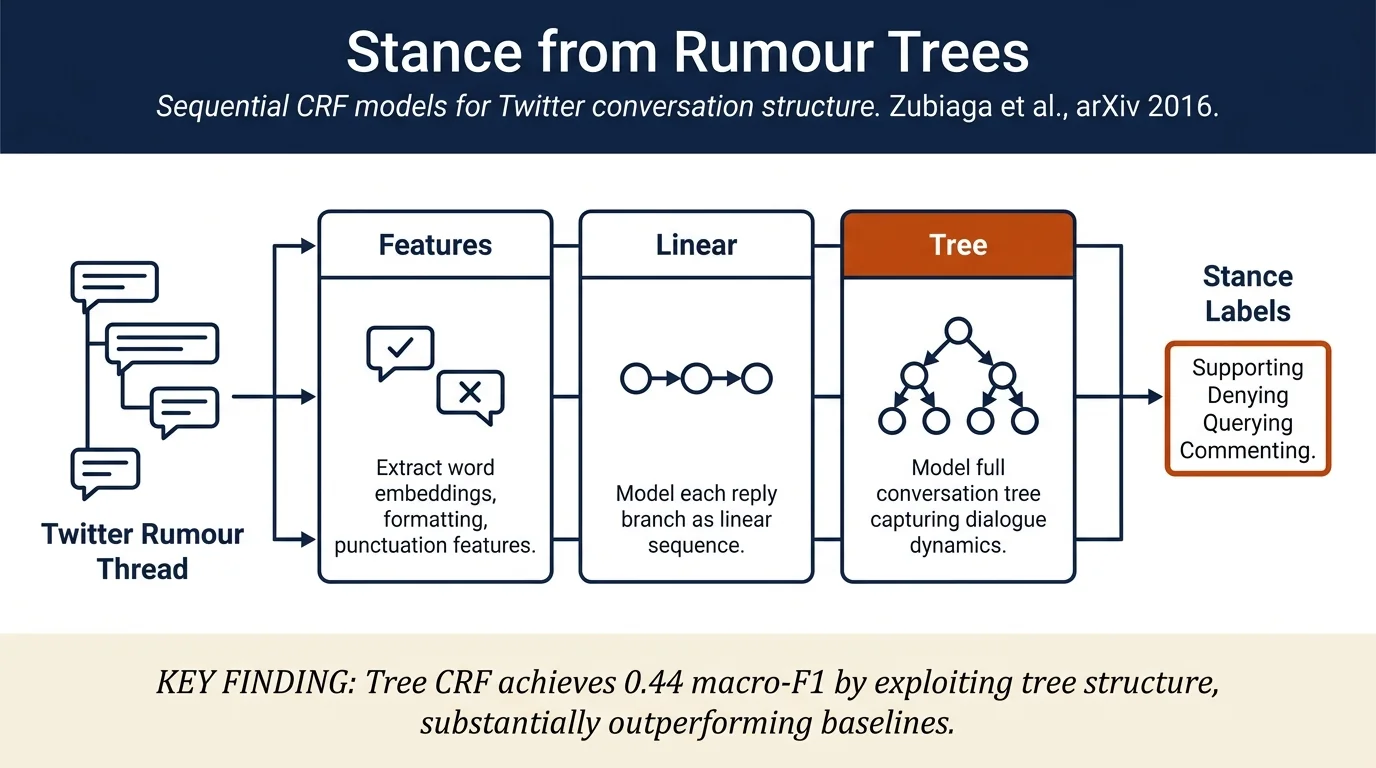
Stance Classification in Rumours as a Sequential Task Exploiting the Tree Structure of Social Media ConversationsProposes that modelling Twitter conversations as tree-structured sequences improves rumour stance classification. Introduces Linear and Tree Conditional Random Fields (CRF) to exploit the sequential structure of replies within rumour threads, showing that Tree CRF significantly outperforms non-sequential baselines on 4,519 annotated…
 Spread & networksPlatforms, policy & society
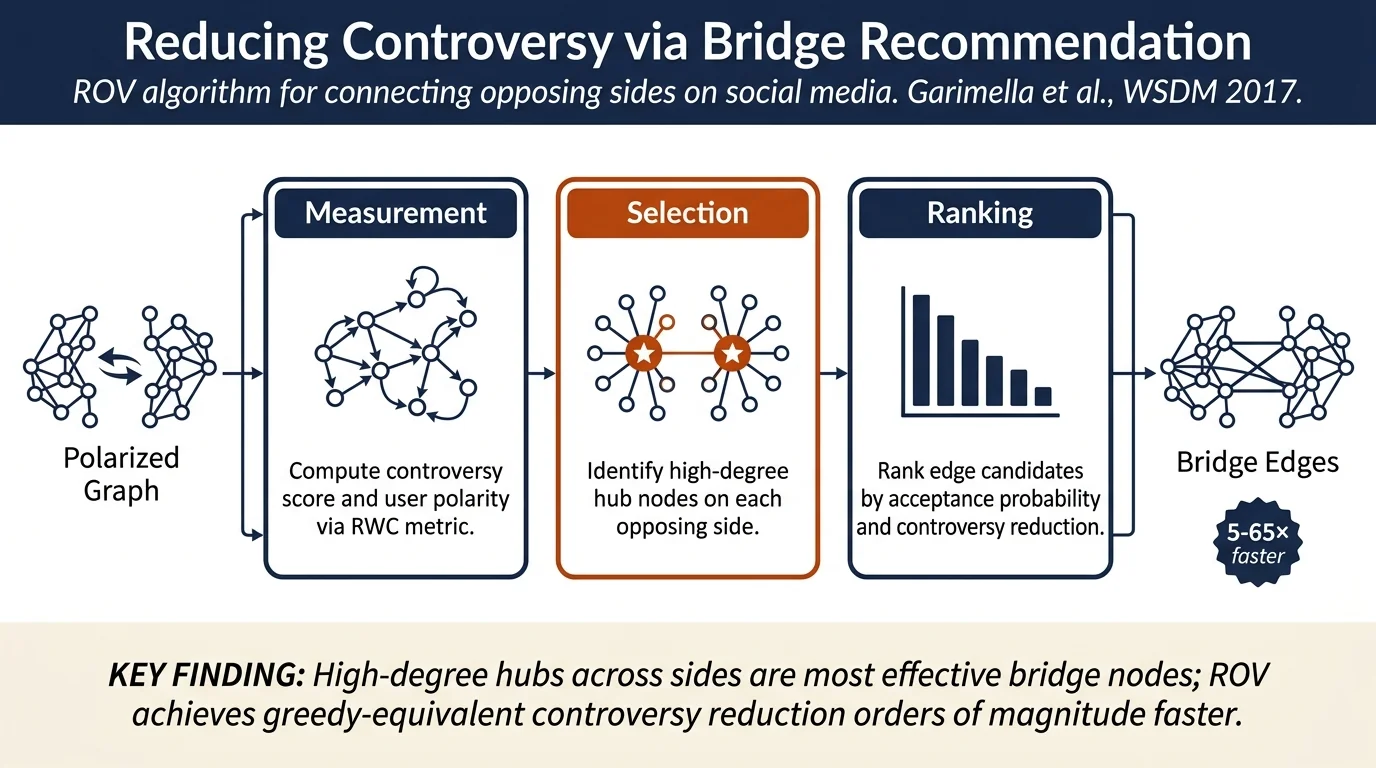
Reducing Controversy by Connecting Opposing ViewsThis paper proposes an algorithmic approach to reduce polarization on social media by recommending social connections (edges) between opposing sides. Using an endorsement graph representation and the random-walk-based controversy metric, the authors formulate the problem as k-edge-addition and develop an efficient algorithm (ROV) that…
 Spread & networksPlatforms, policy & society
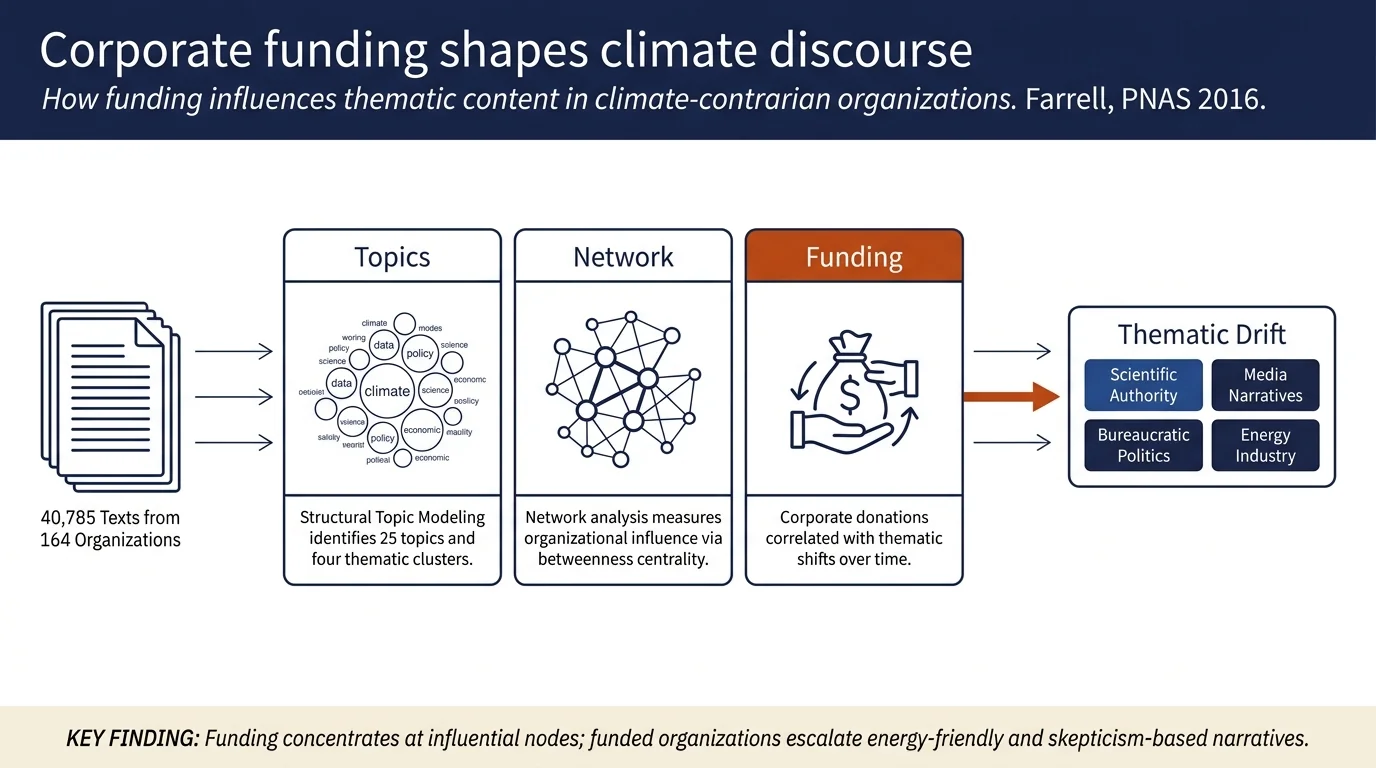
Corporate funding and ideological polarization about climate changeFarrell analyzes 40,785 texts (39+ million words) from 164 climate contrarian organizations between 1993–2013, employing Structural Topic Modeling and social network analysis to demonstrate that corporate funding from entities like ExxonMobil and Koch family foundations directly influences which polarization themes are created and…
 Spread & networksDatasets & evaluation
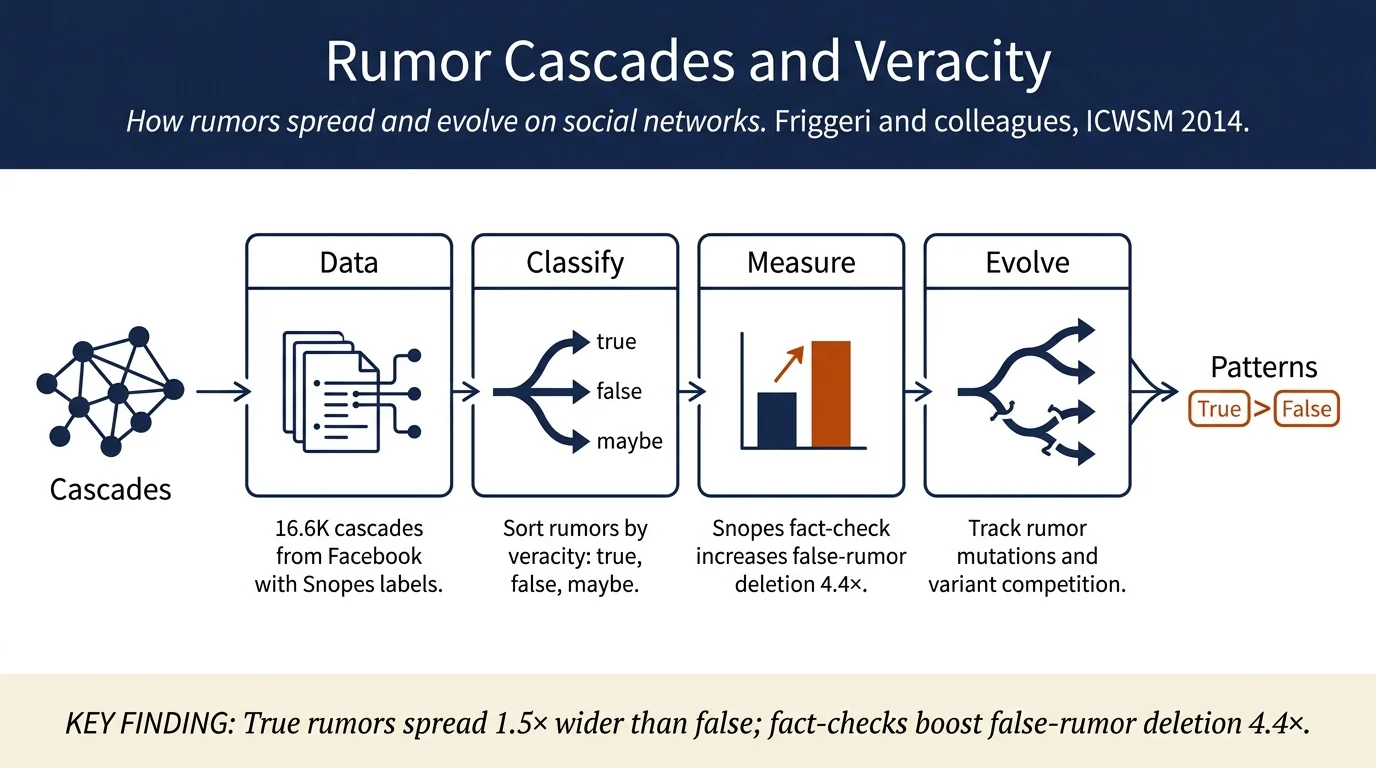
Rumor CascadesFriggeri et al. tracked thousands of rumors on Facebook using Snopes.com as ground truth, finding that rumor cascades run deeper in the social network than typical content. True rumors spread more virally than false ones despite false rumors being more frequently uploaded; Snopes fact-checks increase deletion likelihood for false rumors…
 Spread & networksDetection methods
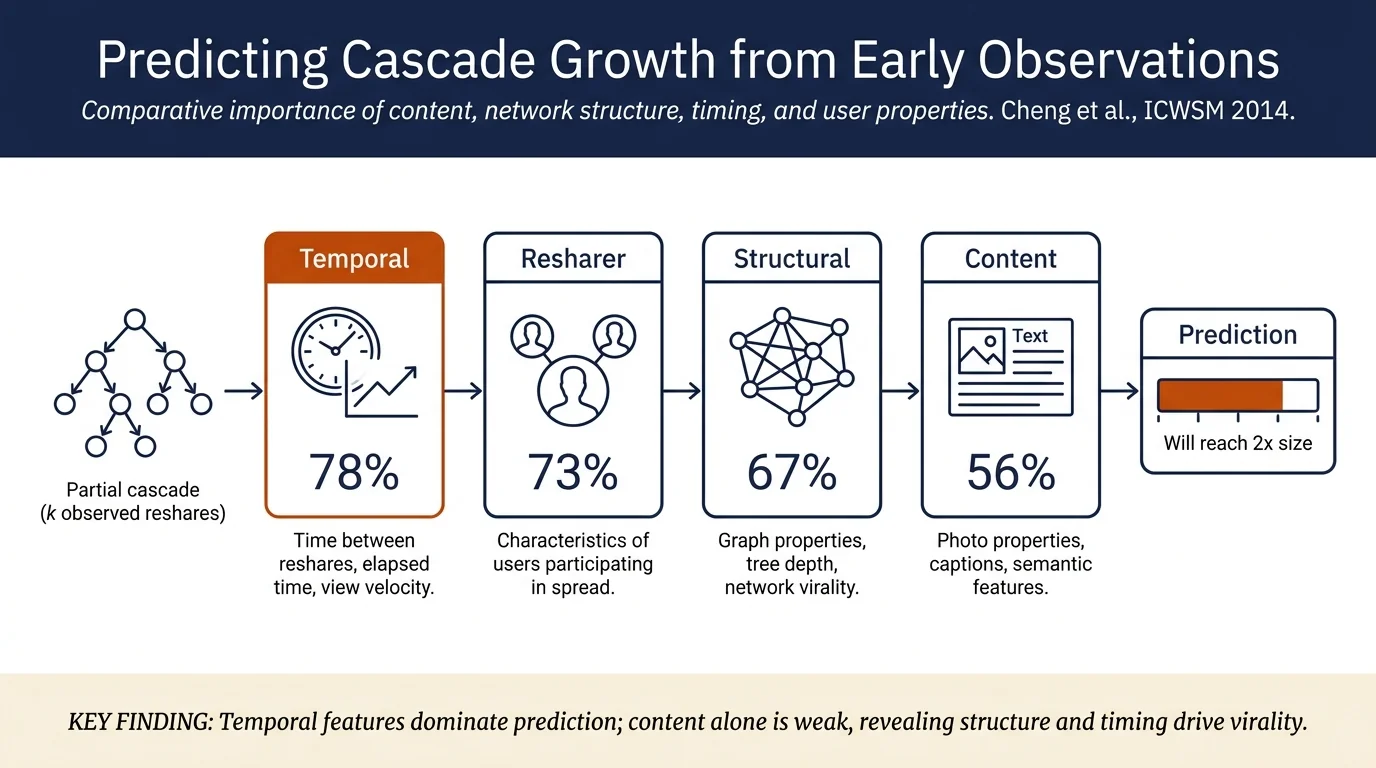
Can Cascades be Predicted?Information cascades on social networks can be predicted with reasonable accuracy (~80%) using temporal and structural features extracted from early observations. Performance improves substantially as more cascade stages are observed.
 Spread & networksPlatforms, policy & society
Beware online filter bubblesAlgorithmic personalization on major platforms like Facebook and Google has created "filter bubbles" — personalized information universes that show us what we're predicted to like rather than what we need to see. This invisible algorithmic gatekeeping threatens democracy and information diversity by isolating us in narrow perspectives,…
 Detection methodsSpread & networks
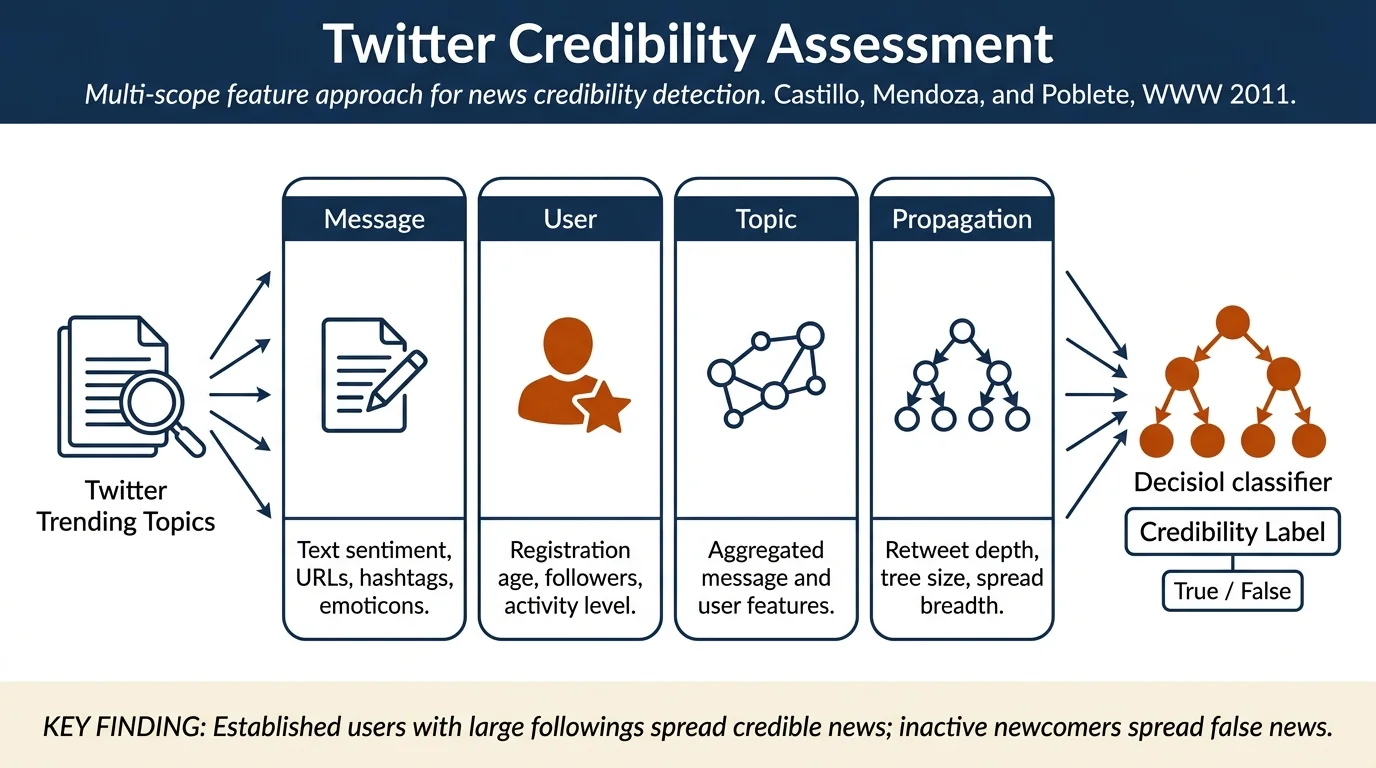
Information Credibility on TwitterThis paper proposes supervised learning classifiers to automatically assess the credibility of news discussed on Twitter. Using human-labeled topics from trending discussions, the authors extract message-level, user-level, topic-level, and propagation-level features to build classifiers that distinguish newsworthy from conversational…
 Spread & networksBots & coordinated campaigns
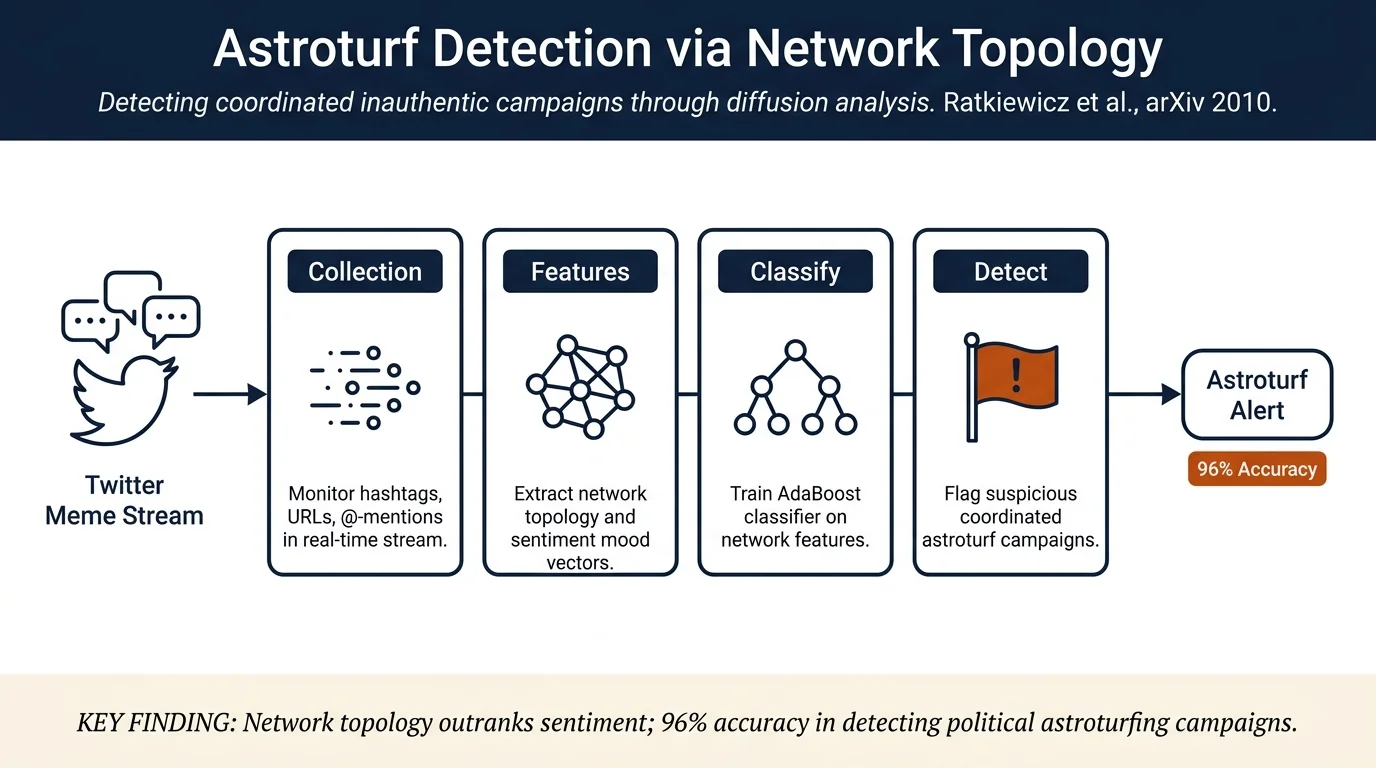
Detecting and Tracking the Spread of Astroturf Memes in Microblog StreamsPolitical campaigns increasingly use social media to amplify deceptive memes that mimic organic grassroots behavior—termed "astroturfing." This paper introduces the Truthy system, which analyzes meme diffusion networks on Twitter to detect orchestrated campaigns through network topology and sentiment analysis, achieving ~90%…
 Spread & networksDatasets & evaluation
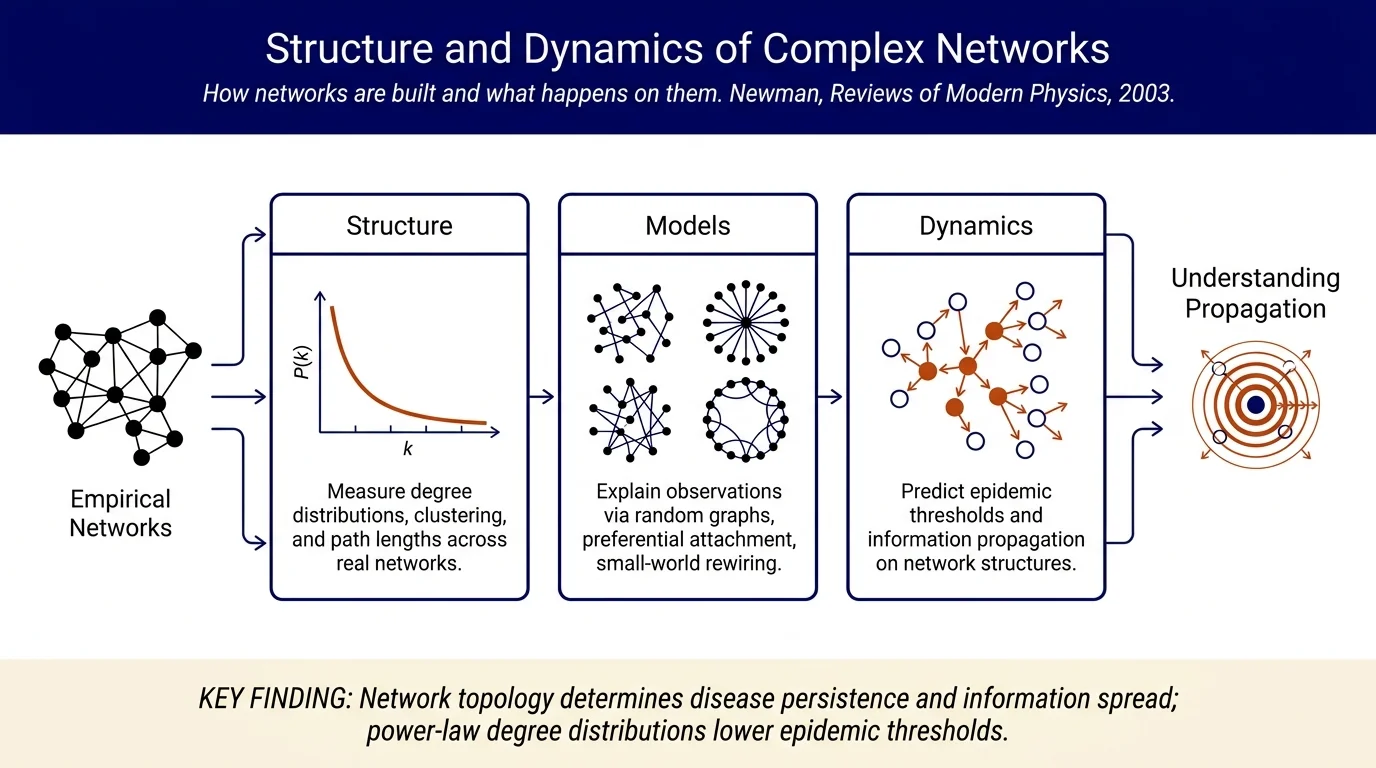
The structure and function of complex networksThis comprehensive review surveys the properties and mathematical models of complex networks across diverse domains: social networks, the Internet, biological networks, and collaboration networks. Newman covers observed structural properties (degree distributions, clustering, small-world effects), foundational models (random graphs,…
Spread & networksPsychology & interventions
A Theory of Fads, Fashion, Custom, and Cultural Change as Informational CascadesFoundational theoretical framework explaining how fads, fashions, and beliefs spread through sequential information cascades: when individuals use others' actions to infer information while ignoring their own private signals, widespread adoption of incorrect beliefs and practices can occur.
Platforms, policy & societyBots & coordinated campaigns
Partisanship, Propaganda, and Disinformation: Online Media and the 2016 U.S. Presidential ElectionThis large-scale analysis of mainstream and social media coverage during the 2016 U.S. presidential election documents asymmetric partisan structures: conservative media formed an insulated, hyperpartisan ecosystem centered on far-right outlets like Breitbart, while liberal media remained anchored in traditional journalistic practices.…
Spread & networksPsychology & interventions
Avoiding the Echo Chamber About Echo Chambers: Why selective exposure to like-minded political news is less prevalent than you thinkThis Knight Foundation white paper reviews the academic literature on echo chambers and filter bubbles and argues that the narrative of pervasive ideological self-segregation in media consumption is significantly overstated. While people do prefer congenial political information, most Americans consume diverse media diets; most partisan…
Spread & networksPlatforms, policy & society
Social Media, Political Polarization, and Political Disinformation: A Review of the Scientific LiteratureThis comprehensive literature review examines the relationships among social media usage, political polarization, and political disinformation, synthesizing research across six topic areas: online political conversations, consequences of disinformation exposure, producers of disinformation, spreading strategies, content and polarization…
Bots & coordinated campaignsPlatforms, policy & society
The Global Disinformation Order: 2019 Global Inventory of Organised Social Media ManipulationA comprehensive inventory of government and political-party organized social media manipulation campaigns (cyber troops) across 70 countries. The report catalogs organizational structures, strategies, platforms, and resources deployed for computational propaganda; finds organized manipulation in 70 countries (up from 28 in 2017), with…
Spread & networksPlatforms, policy & society
WhatsApp vigilantes: an exploration of citizen reception and circulation of WhatsApp misinformation linked to mob violence in IndiaThis LSE report examines how WhatsApp misinformation circulation in India relates to lynchings and mob violence since 2015. The study investigates citizen reception, technological affordances, motivations for sharing, and the broader socio-political context shaping how false information spreads through messaging platforms and triggers…
 Spread & networksDetection methods
Climate Change Misinformation: Supply, Demand, and the Challenges to ScienceLewandowsky examines climate denial through supply and demand lenses: well-funded disinformation campaigns (billions annually from fossil fuel interests and conservative think tanks) deploy cherry-picked data to infiltrate mainstream media and political rhetoric, while political ideology (conservatism, libertarianism) predisposes people…
 Spread & networksBots & coordinated campaigns
The Spread of Misinformation in Social MediaMenczer presents a framework for understanding misinformation spread through social networks as an inevitable consequence of network structure and human cognitive limitations rather than platform design failures. He discusses how structural properties—scale-free topology, finite attention, information overload—create vulnerabilities…