The structure and function of complex networks
Author: M. E. J. Newman Venue: Reviews of Modern Physics, vol. 74, no. 1, pp. 47–97, 2003 — DOI ArXiv: cond-mat/0303516
TL;DR
This comprehensive review surveys the properties and mathematical models of complex networks across diverse domains: social networks, the Internet, biological networks, and collaboration networks. Newman covers observed structural properties (degree distributions, clustering, small-world effects), foundational models (random graphs, scale-free networks, preferential attachment), and processes that occur on networks (epidemic spreading, search, network resilience). The work unifies network science across disciplines and provides theoretical foundations for understanding how information and processes propagate through connected systems.
Contributions
- Systematic exposition of real-world network properties and statistical characterization (degree distributions, clustering coefficients, path lengths, assortative mixing)
- Unified presentation of network models: random graphs, Barabási–Albert preferential attachment, small-world networks, and their generalizations
- Detailed treatment of epidemiological processes on networks (SIR, SIS models) with application to disease and information spread
- Analysis of search and navigation algorithms on networks with different topologies
- Discussion of network resilience, robustness to vertex/edge removal, and cascading failures
Method
The review synthesizes empirical studies of real-world networks and develops mathematical models to explain their structure and behavior:
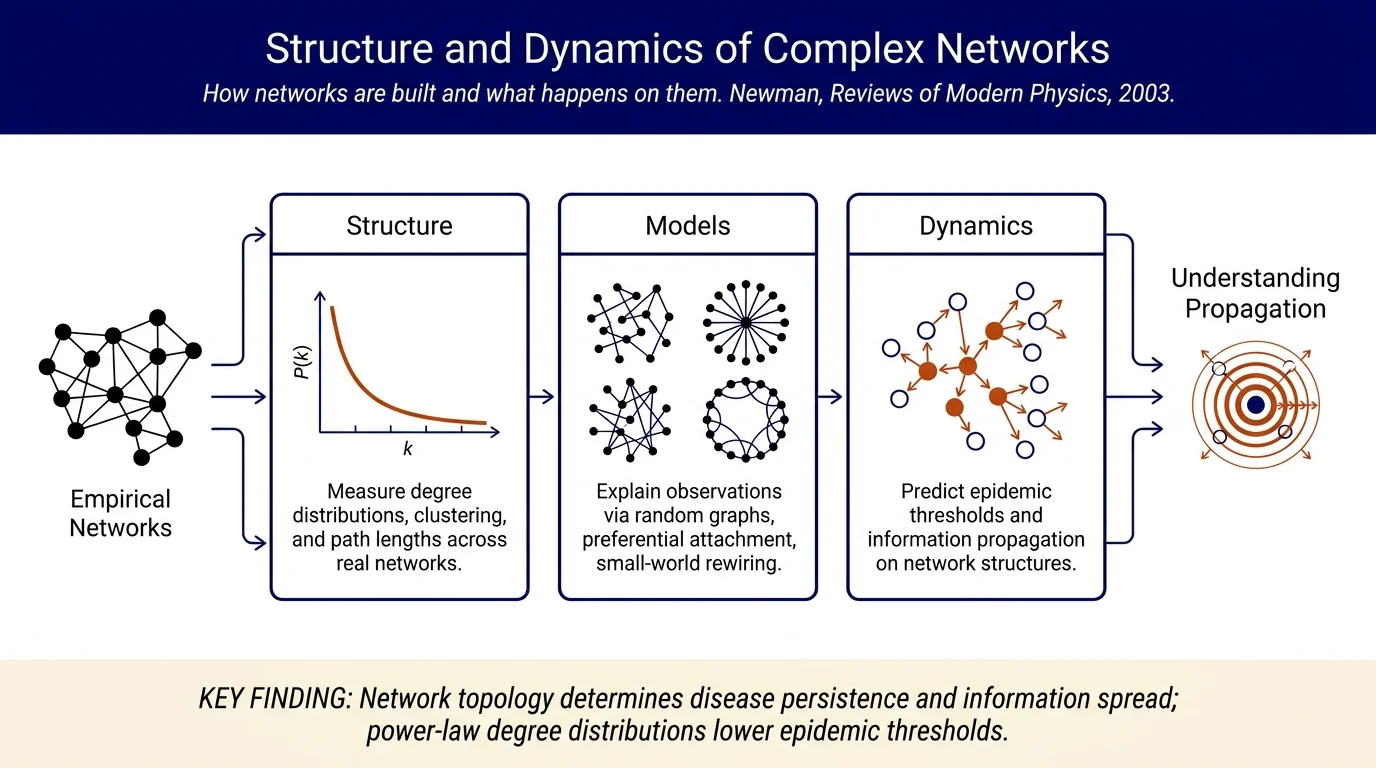
Structural analysis. Newman documents distributions of network properties: degree distributions (often power-law in real networks), clustering coefficients (high in social networks), average path lengths, degree correlations, and other metrics. He shows that real networks differ markedly from random graph predictions.
Network models. The paper presents random graph theory as a baseline, then develops more realistic models. Scale-free networks and preferential attachment (where new nodes attach to high-degree nodes with higher probability) reproduce observed power-law degree distributions. Small-world models interpolate between regular lattices and random graphs, producing simultaneously high clustering and short path lengths.
Dynamical processes. For epidemiological spreading, Newman develops the SIR (susceptible–infected–recovered) and SIS (susceptible–infected–susceptible) compartmental models on networks. Key result: disease spread depends on the basic reproduction number and network structure; power-law degree distributions lower the epidemic threshold, enabling disease persistence even with low per-contact transmission rates.
Search and navigation. Newman discusses both exhaustive network search (crawling to index the network) and guided search strategies that exploit network structure (high-degree vertices, hierarchical organization).
Results
Key empirical and theoretical findings:
- Degree distributions. Real networks often exhibit power-law degree distributions P(k) ∝ k^−γ with 2 < γ < 3, in stark contrast to Poisson distributions in random graphs.
- Clustering. Social networks show high clustering (many triangles); biological networks show moderate clustering; collaboration networks (e.g., scientific coauthorship) show strong clustering that decays hierarchically.
- Small-world phenomenon. Many networks exhibit simultaneously high clustering and short characteristic path lengths. Watts–Strogatz model shows how rewiring a regular lattice produces small-world behavior.
- Preferential attachment. Growing networks in which new vertices preferentially attach to high-degree vertices naturally generate scale-free degree distributions. This model explains power-law emergence in many growing systems.
- Epidemic thresholds. On scale-free networks, the epidemic threshold vanishes (for power-law exponent γ < 3), meaning diseases persist at arbitrarily low transmission rates. On networks with degree correlations or clustering, thresholds are nonzero and can be computed.
- Resilience. Scale-free networks are robust to random vertex removal but vulnerable to targeted removal of high-degree hubs. Small-world networks show intermediate resilience.
Connections
- Directly relevant to Misinformation spread and diffusion, Information diffusion in social networks, and Cascade Models — epidemic processes provide a foundation for modeling how misinformation propagates
- Related to Network Based Detection through understanding of network topology and its influence on information flow
- Foundational for Graph Neural Networks and GNN-based fake news detection (GNNs exploit network structure for node/subgraph classification)
- Connected to Social networks and online communities research, particularly on how network structure influences information visibility and adoption
- Related to Bot detection and coordinated inauthentic behavior — network clustering and modularity can reveal coordinated accounts
Notes
Strengths: - Authoritative, comprehensive treatment of network science up to 2003. Brings disparate fields (physics, biology, sociology, computer science) into a unified framework. - Clear mathematical development of models with both theory and empirical validation. - The epidemic process framework is directly applicable to understanding information and misinformation spread over social networks. - Extensive references (400+) provide entry points into specialized topics.
Limitations and context: - Published in 2003; subsequent developments in network neuroscience, multilayer networks, temporal/dynamic networks, and algorithmic developments are not covered. - The work is primarily structural and equilibrium-focused; later work (e.g., temporal point processes, reinforcement learning on networks) provides dynamics at finer timescales. - Application to fake news requires extensions: real-world misinformation dynamics are faster and driven by algorithmic amplification, not just network topology; sentiment and linguistic features matter alongside structure.
Research relevance: This is foundational material. Most network-based fake news detection papers build on concepts here: they study how misinformation spreads as a cascade or epidemic on social graphs, exploit network properties (homophily, clustering, assortativity) to detect falsified content, or use GNNs that operate on the graph structure described in this work. Understanding Newman's treatment of scale-free networks and epidemic processes is essential context for those approaches.