Detecting and Tracking the Spread of Astroturf Memes in Microblog Streams
Authors: Jacob Ratkiewicz, Michael Conover, Mark Meiss, Bruno Gonçalves, Snehal Patil, Alessandro Flammini, Filippo Menczer
Institution: Center for Complex Networks and Systems Research, School of Informatics and Computing, Indiana University, Bloomington
Year: 2010 — arXiv:1011.3768
TL;DR
Political campaigns increasingly use social media to amplify deceptive memes that mimic organic grassroots behavior—termed "astroturfing." This paper introduces the Truthy system, which analyzes meme diffusion networks on Twitter to detect orchestrated campaigns through network topology and sentiment analysis, achieving ~90% classification accuracy. The work identifies concrete examples of coordinated bot accounts and fake user networks engaged in political manipulation during the 2010 U.S. elections.
Contributions
- Klatsch framework: A unified, extensible architecture for real-time mining, visualization, and analysis of meme diffusion in social media streams. Models social media as timestamped events linking actors (users) and memes (hashtags, URLs, phrases, mentions).
- Truthy detection system: A web service that tracks political memes on Twitter, detects suspicious diffusion patterns, and allows crowdsourced annotation of astroturfed content. Combines network statistics, sentiment analysis, and user labels for classification.
- Case studies of astroturfing: Detailed analysis of real coordinated campaigns uncovered during the 2010 midterm elections, including fake accounts, coordinated bot behavior, and Twitter-bomb techniques.
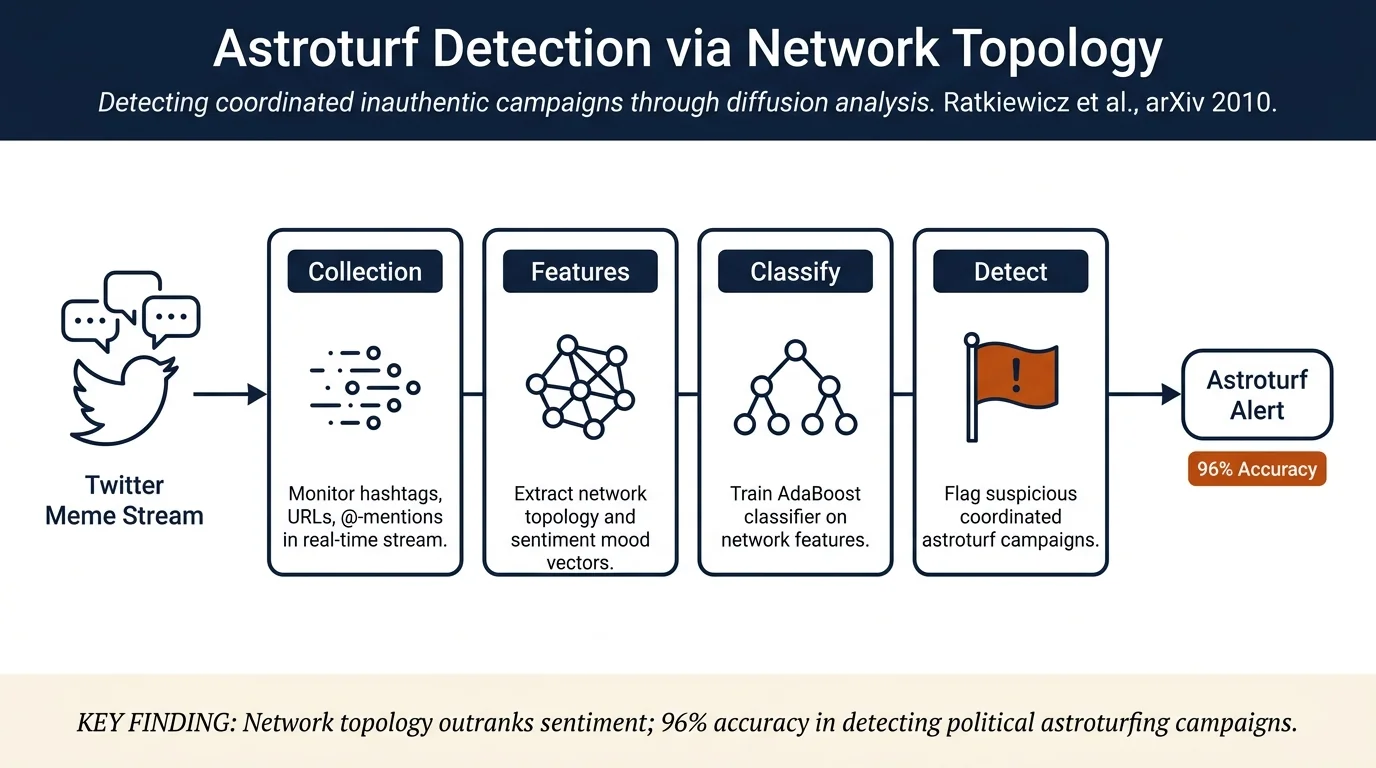
- Network-based classifier: Demonstrates that topological features of diffusion networks (not just message content) are highly predictive of astroturfing, with supervised learning achieving 96% accuracy on balanced datasets.
Method
Klatsch Framework
The system models social media as a series of timestamped events, where each event involves actors (users) and memes (information units: hashtags, @-mentions, URLs, or text phrases). A directed graph captures diffusion: edges represent retweets or mentions between users, weighted by frequency. This abstraction applies across diverse platforms (Twitter, Yahoo Meme, Google Buzz).
Truthy System Architecture
Data Collection: - Monitored Twitter gardenhose (4–8 million tweets/day) during September–October 2010 - Filtered to ~305 million tweets; ~1.2 million matched ~2,500 political keywords (candidate names, hashtags #tcot, #p2) - Second-stage meme filter identified topics with 5+ mentions per hour, reducing to 600,000 tweets for database
Feature Extraction: - Network statistics: Node/edge counts, mean degree, strength, clustering coefficient, in/out-degree skew, entry points (injection points), largest connected component size - Sentiment analysis: Google-based Profile of Mood States (GPOMS) expanded to 964 tokens; six-dimensional mood vectors (Calm, Alert, Sure, Vital, Kind, Happy) per meme - Crowdsourced labels: Users could annotate memes via web interface as "truthy," "legitimate," or "remove"
Classification
Labeled dataset: 366 memes (61 truthy, 305 legitimate). Resampled to balance classes due to class imbalance. Trained two classifiers using WEKA: - AdaBoost with DecisionStump: 96.4% accuracy, AUC 0.99 (best overall) - SVM: 95.6% accuracy, AUC 0.95
Top discriminative features: mean edge weight, mean strength, edge count, in/out-degree skew, in-strength standard deviation. Network topology features outranked sentiment scores.
Results
Classification Performance
- AdaBoost with resampling: 96.4% accuracy, 0.99 AUC, 5% false-negative rate (least desirable error)
- Confusion matrix (AdaBoost): 165 true positives (45% of positives), 188 true negatives (51% of all memes), 7 false positives (2%), 6 false negatives (1%)
Identified Astroturf Campaigns
- #ampat: Conservative hashtag boosted by two accounts (@CStevenTucker, @CSteven) controlled by same person; 41,000+ coordinated tweets
- @PeaceKaren_25 + @HopeMarie_25: Retweeted Republican candidates in lockstep; created a "Twitter bomb" for "gopleader"
- Chris Coons smear campaign: Network of ~10 bot accounts injecting thousands of tweets from freedomist.com; manipulated hashtags and URL parameters to evade detection
- gopleader.gov: URL promotion via the suspicious accounts above
Twitter subsequently suspended these accounts after Truthy detection.
Legitimate Memes (Controls)
- #Truthy: Injected by NPR Science Friday as experimental probe
- @senjohnmccain: Natural diffusion with two communities (retweets from @ladygaga, direct mentions)
- News URLs: Organic spreading patterns with diverse injection points
Key Insights
-
Astroturf signatures: Successful political astroturfing exhibits pathological network structures—high numbers of unique injection points with few connections, high average degree (star-like), or large edge weights between dyads (clique-like). Differ sharply from organic meme cascades.
-
Early detection is critical: Most astroturf attempts fail to gain viral traction and show small networks with isolated injection points. These are easiest to identify and intercept before they deceive organic users.
-
Sentiment is weaker than topology: While sentiment (mood vectors) contributed, network structure features were far more discriminative for classification.
-
Bot coordination tactics: Observed techniques include text reuse with hashtag/URL obfuscation, coordinated mentions of popular users to increase retweet probability, and account impersonation/sock puppets.
Connections
- Extends Misinformation and fake news detection and Coordinated inauthentic behavior literature by focusing on diffusion patterns rather than message content
- Related to Social Bot Detection — bots are key actors in astroturfing but not the only mechanism; legitimate users can be unwittingly complicit
- Employs Network analysis of misinformation and Sentiment Analysis as detection features; influenced by Information diffusion in social networks theory
- Precursor work to later systems for detecting coordinated behavior and inauthentic networks on social media
- Filippo Menczer's group later extended this to broader coordinated manipulation and platform accountability
Notes
Strengths: - Clear problem formulation: astroturfing is distinct from spam and requires network-aware detection - Concrete case studies with real Twitter accounts and documented suspensions - Generalizable framework (Klatsch) applicable beyond Twitter - Strong classification results (96%) with interpretable features - Practical impact: cases were verified and removed by Twitter
Limitations: - Training data relatively small (366 memes) and skewed toward false negatives; the resampling workaround suggests inherent class imbalance - Evaluation restricted to 2010 U.S. elections context; generalization to other domains/years unclear - Sentiment analysis (GPOMS) is somewhat dated; modern NLP might improve features - Sampling bias: gardenhose is biased sample of Twitter; full firehose could reveal different patterns - No account-age or reputation features (mentioned as future work)
Impact and Reception: This paper is foundational in coordinated inauthentic behavior detection and influenced later work on bot and astroturf detection. The Truthy system gained media attention during the 2010 elections and was referenced in policy discussions on platform manipulation. Later work extends the network-topology approach to detect broader coordinated campaigns beyond politics.
Paper read and ingested 2026-05-16 by reza