Explore everything
Filter by research area, year and venue. Every filter is in the address bar, so you can share a view as a link.
 Detection methodsLLMs & generative AI
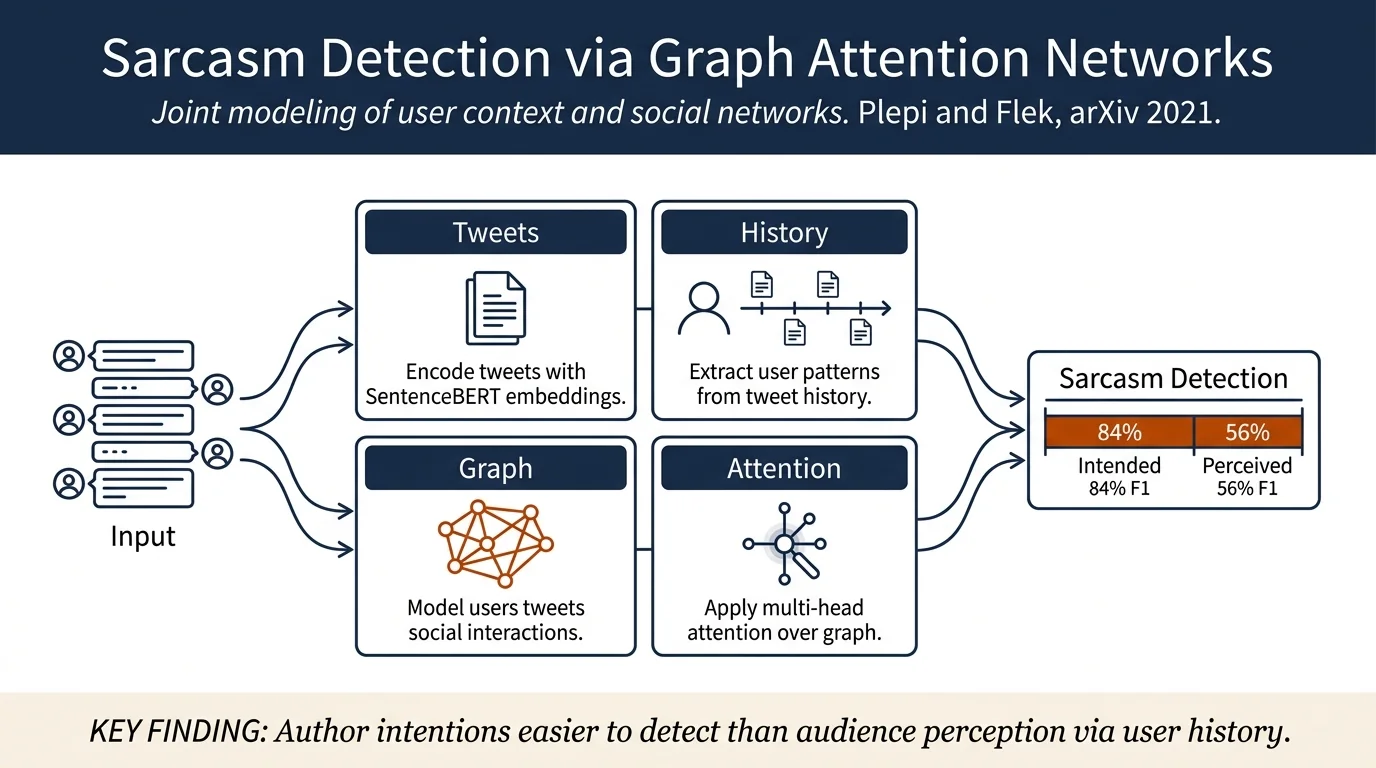
Perceived and Intended Sarcasm Detection with Graph Attention NetworksSarcasm detection requires understanding both the author's intent and the audience's perception. This work proposes a graph attention network (GAT) that jointly models user historical context and conversational social network information on Twitter, achieving state-of-the-art results on the SPIRS dataset and showing that detecting…
 Deepfakes & multimodalDetection methods
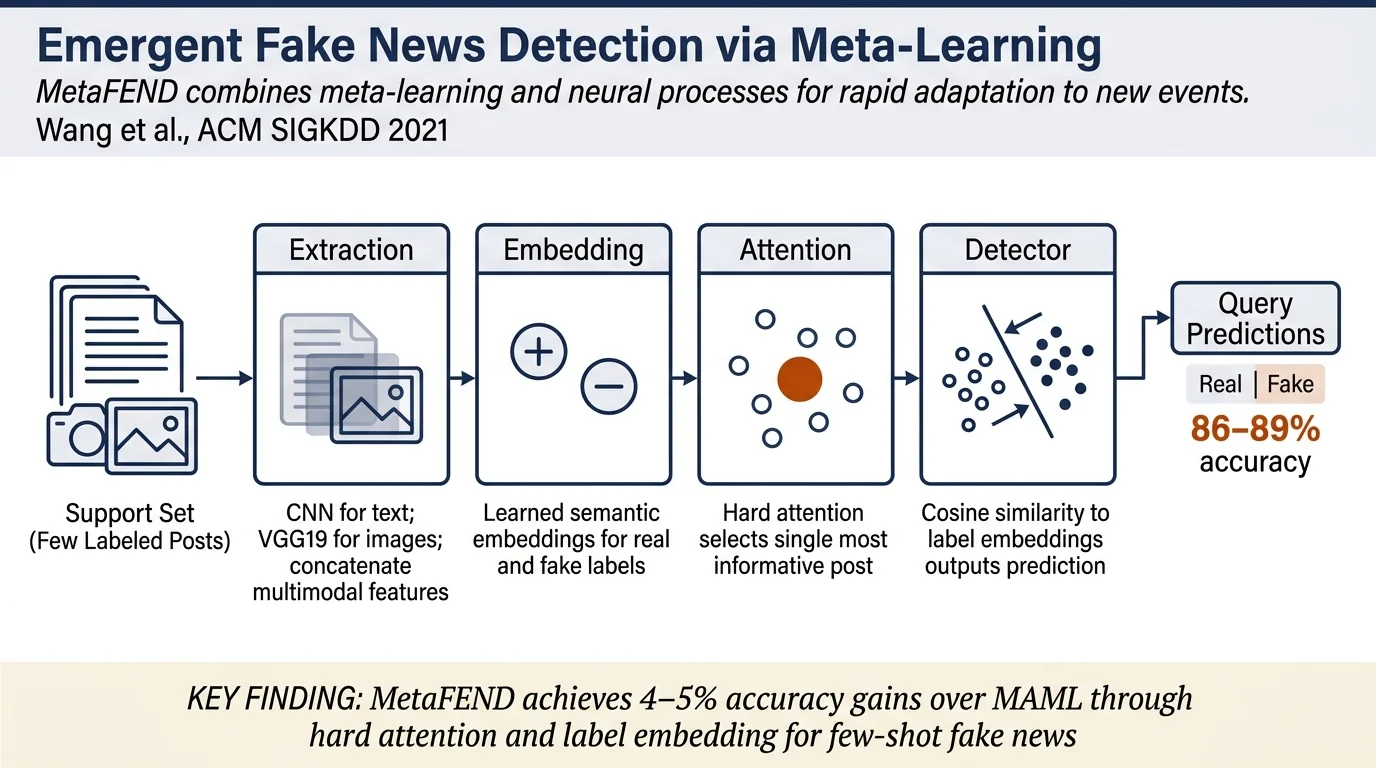
Multimodal Emergent Fake News Detection via Meta Neural Process NetworksExisting fake news detectors trained on labeled data perform poorly on novel, emergent events due to domain shift. The paper proposes MetaFEND, which combines meta-learning and neural processes to leverage a handful of labeled posts from a new event to quickly adapt a detection model.
 Detection methodsLLMs & generative AI
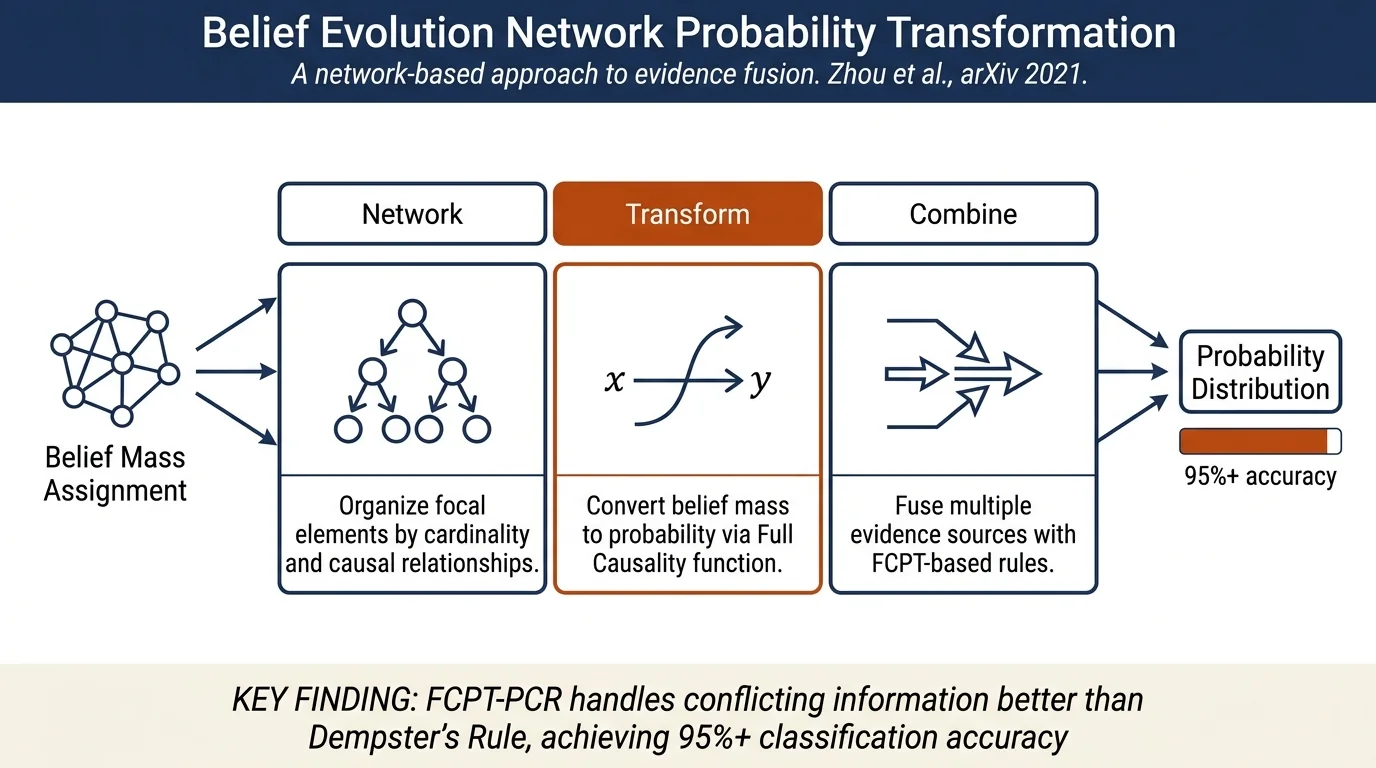
Belief Evolution Network-based Probability Transformation and FusionThis paper introduces a Belief Evolution Network (BEN) to model the evolution of belief functions and proposes a new Full Causality Probability Transformation (FCPT) method for converting belief mass assignments to probability distributions. The authors also propose FCPT-based fusion rules that outperform traditional Dempster's Rule of…
 LLMs & generative AIDatasets & evaluation
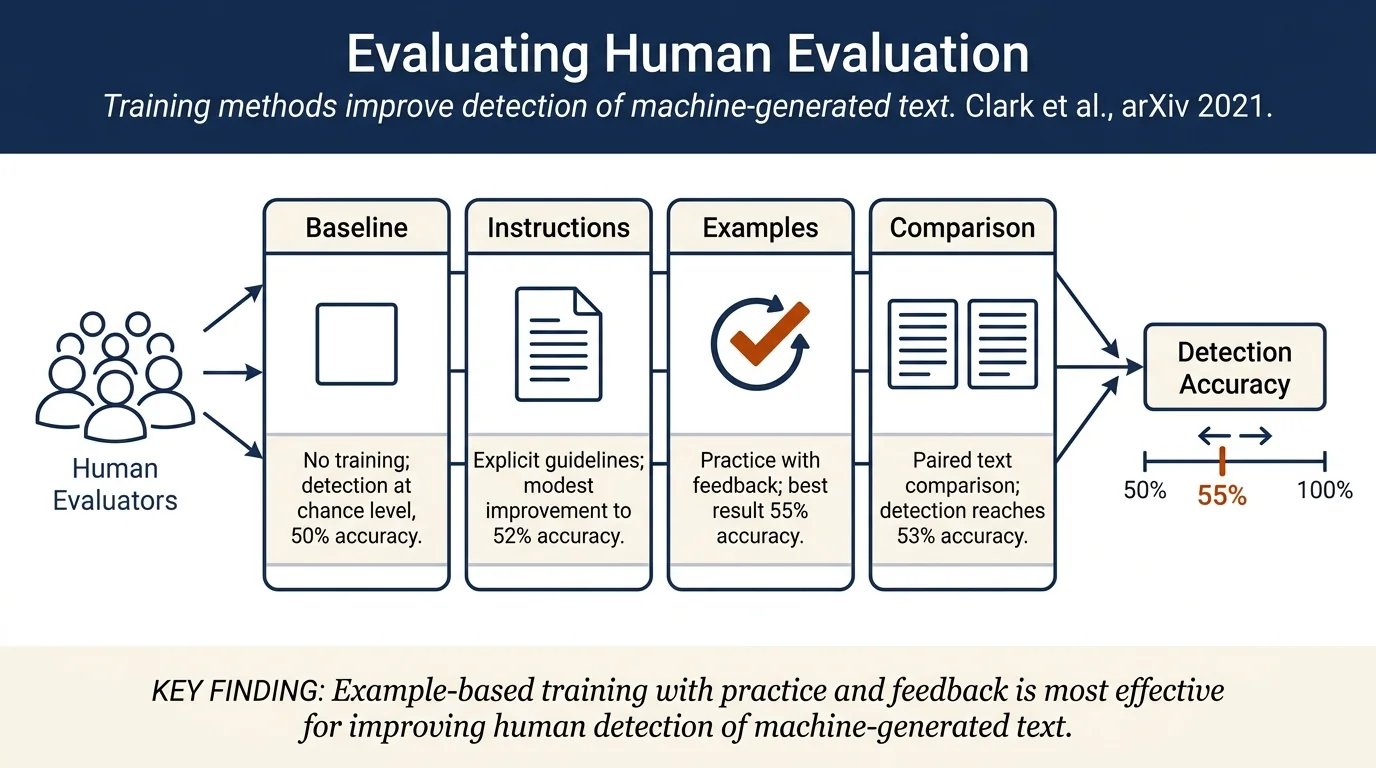
All That's 'Human' Is Not Gold: Evaluating Human Evaluation of Generated TextHuman evaluators cannot reliably distinguish machine-generated text from human-written text without training, focusing instead on superficial features like grammar and style. Three training approaches (instructions, examples, and comparisons) improve evaluator accuracy modestly, with example-based training showing the most improvement…
 Detection methodsSpread & networks
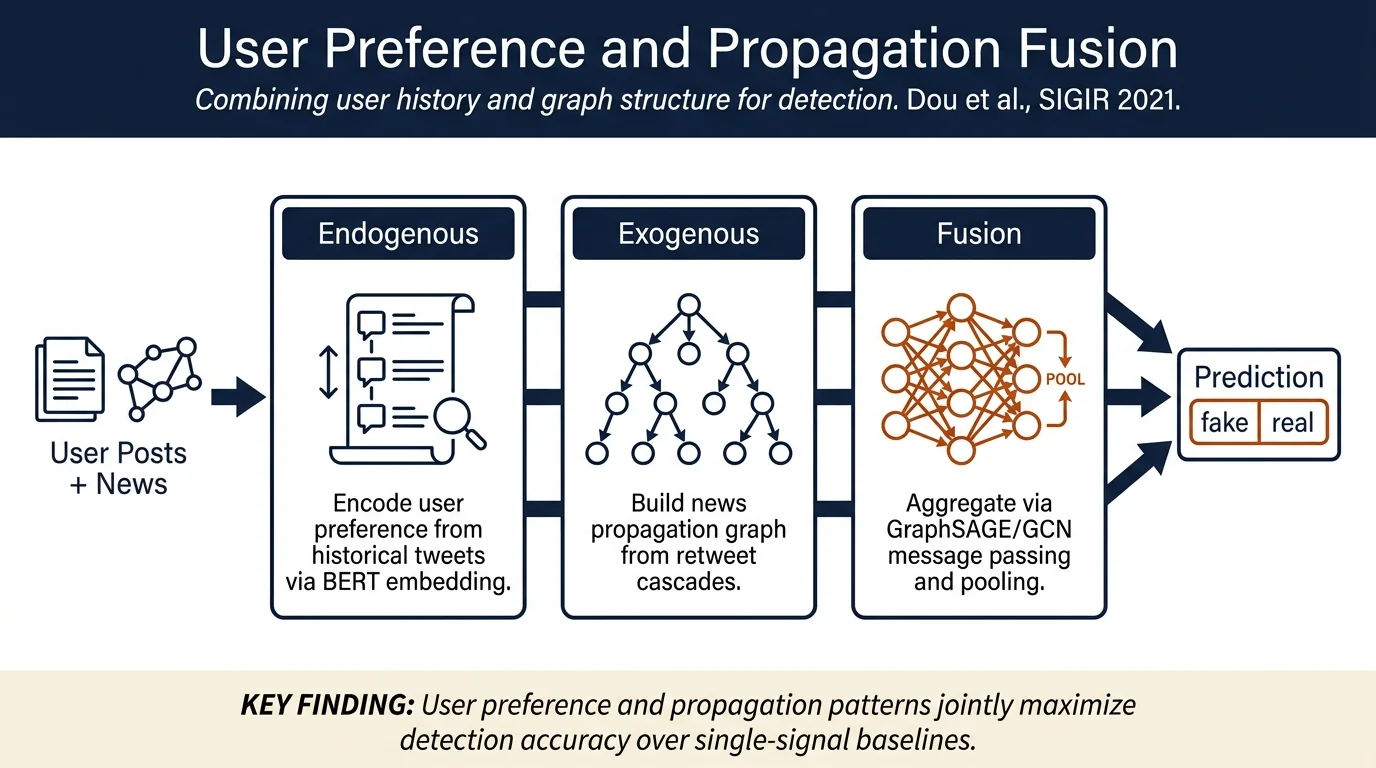
User Preference-aware Fake News DetectionProposes UPFD, which detects fake news by jointly modeling user endogenous preferences (from historical posts) and exogenous context (news propagation graphs) via GNNs. Shows confirmation bias drives news sharing decisions, and historical user behavior provides complementary signals to improve detection over content-only and graph-only…
 Detection methodsDatasets & evaluation
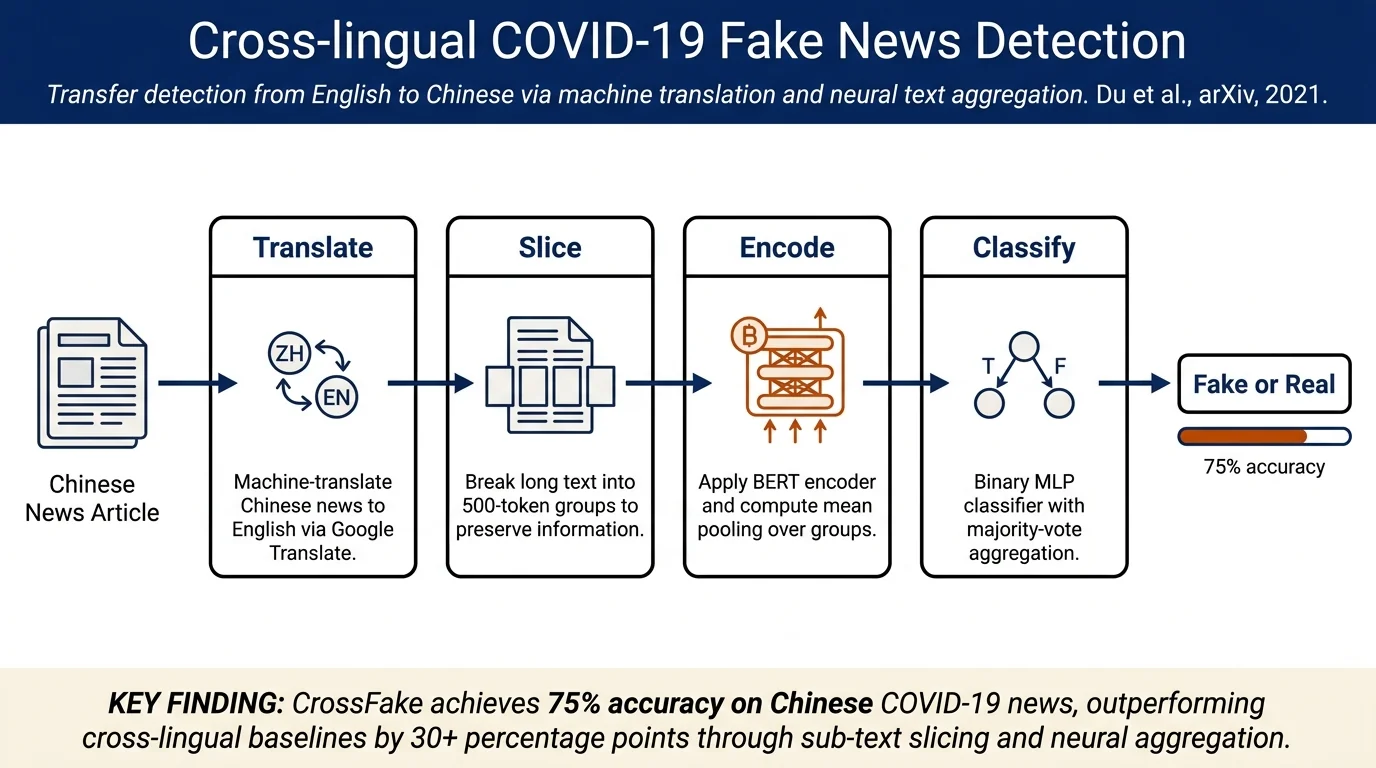
Cross-lingual COVID-19 Fake News DetectionThe paper addresses COVID-19 misinformation in low-resource languages by proposing CrossFake, a cross-lingual fake news detector trained on English COVID-19 news and applied to Chinese news via machine translation. The method slices long news texts into sub-text groups before BERT encoding to preserve fact-related information.
 Detection methodsLLMs & generative AI
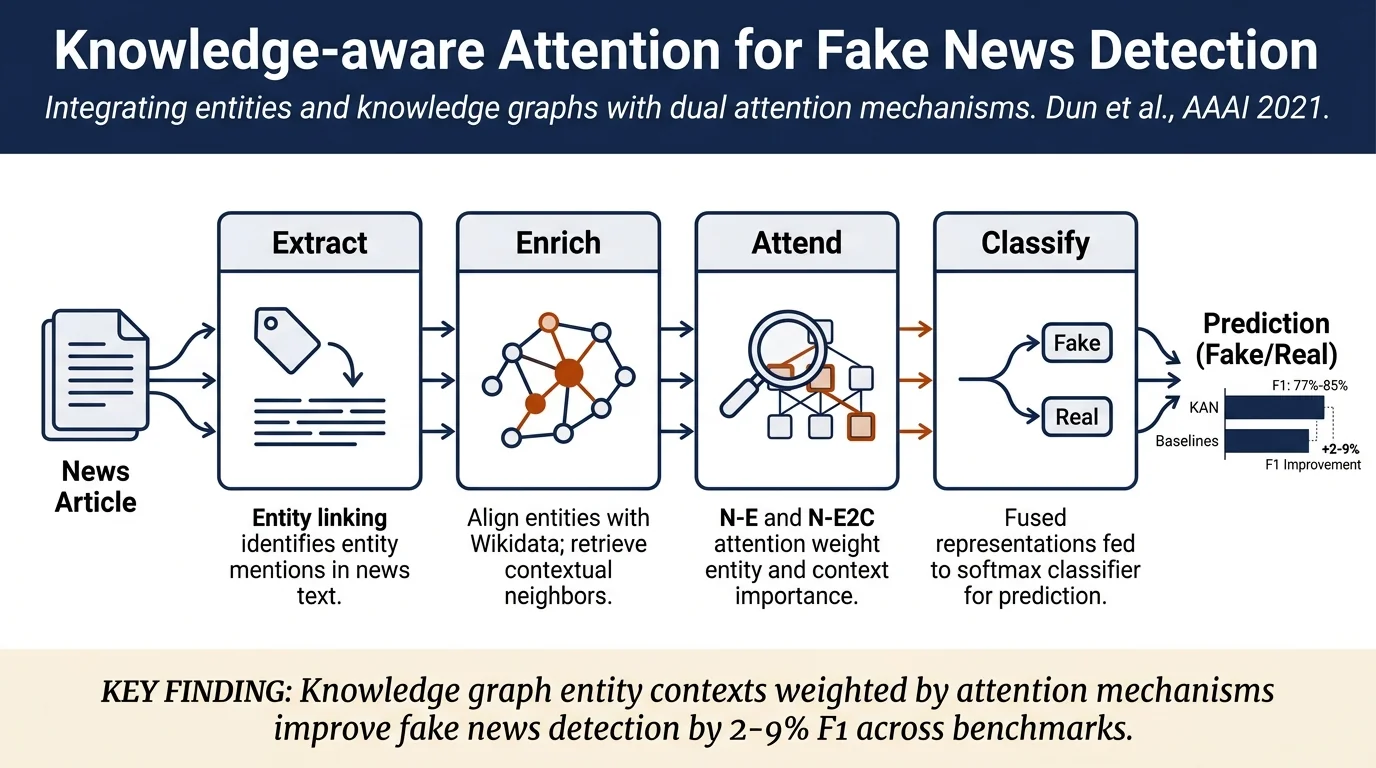
KAN: Knowledge-aware Attention Network for Fake News DetectionMost fake news detection models rely on textual features and social context but ignore knowledge-level relationships among entities in news. This paper proposes KAN, which extracts entity mentions from news, aligns them with knowledge graphs (Wikidata), and uses two attention mechanisms (N-E and N-E2C) to measure entity and…
 LLMs & generative AIPlatforms, policy & society
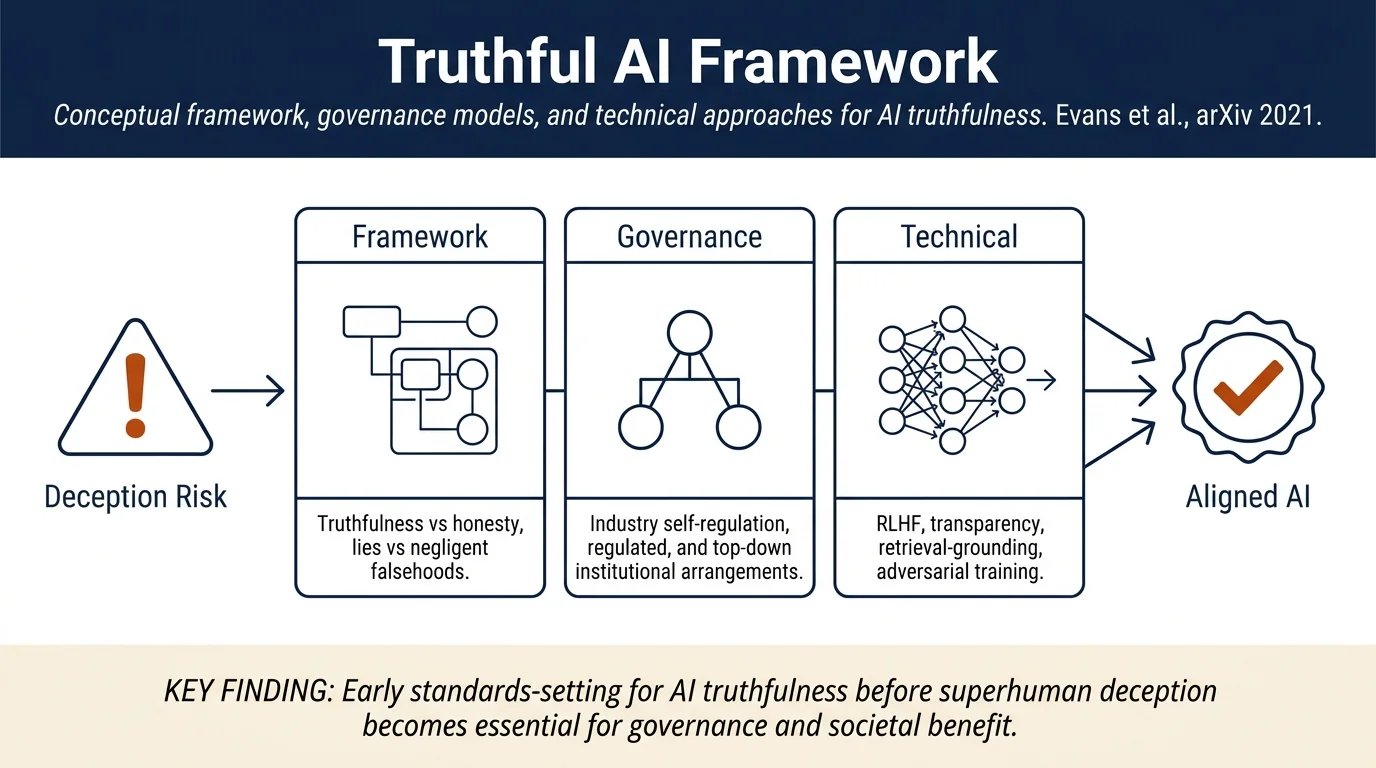
Truthful AI: Developing and Governing AI That Does Not LieAs AI systems become more capable and widely deployed, strategic falsehoods—"lies" that AI generates to achieve specified objectives—pose increasing risks. This paper proposes a framework of truthfulness standards for AI systems, governance mechanisms to enforce them (including certification bodies and verification procedures), and…
 Fact-checking & verificationDatasets & evaluation
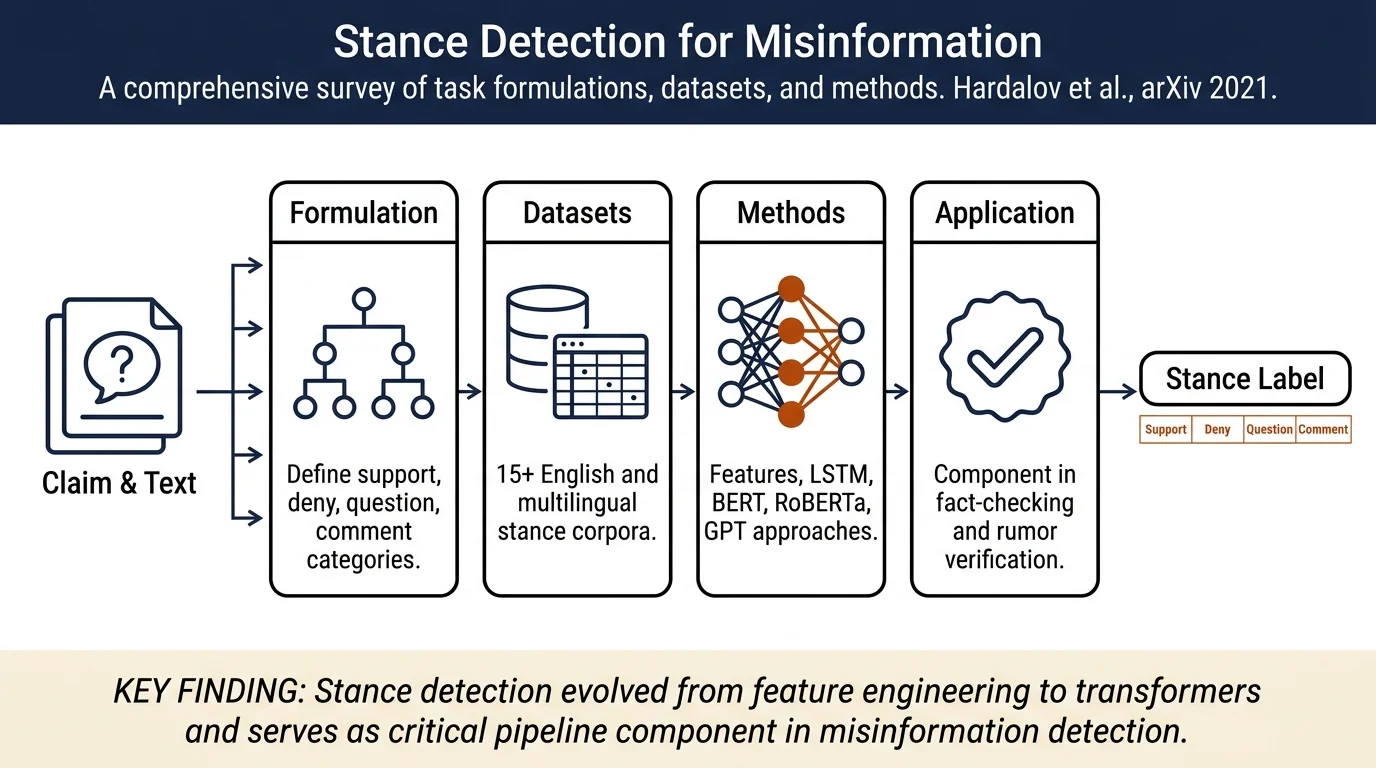
A Survey on Stance Detection for Mis- and Disinformation IdentificationComprehensive survey of stance detection for misinformation and disinformation. Stance detection—determining whether a text supports, denies, questions, or merely comments on a claim—plays dual roles: as a standalone fact-checking tool and as a component in broader verification pipelines.
 Detection methodsLLMs & generative AI
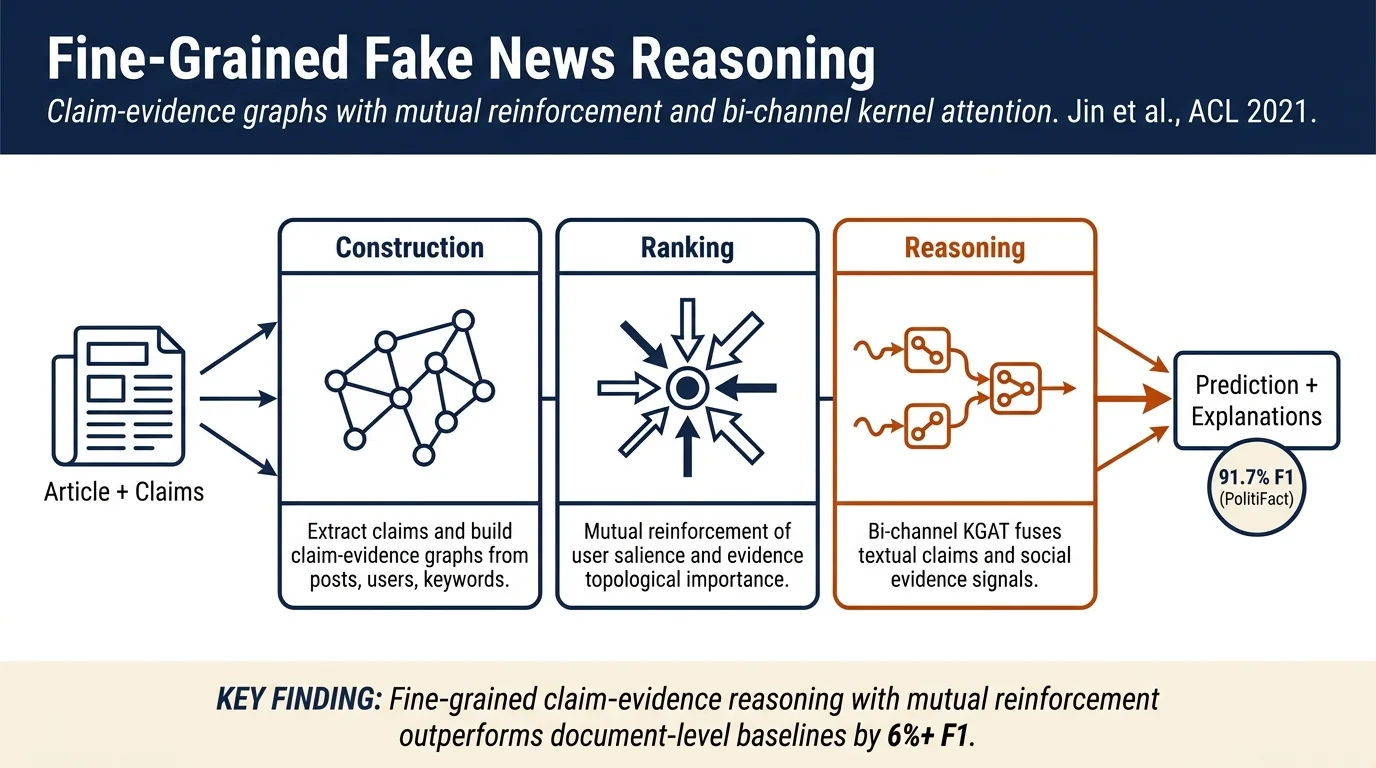
Towards Fine-Grained Reasoning for Fake News DetectionThe paper proposes FinerFact, a framework for fake news detection that models reasoning at the claim-evidence level rather than the document level. It constructs claim-evidence graphs and uses mutual-reinforcement-based ranking to identify salient evidence, then applies a bi-channel kernel graph network to reason over evidence groups.
 Detection methodsLLMs & generative AI
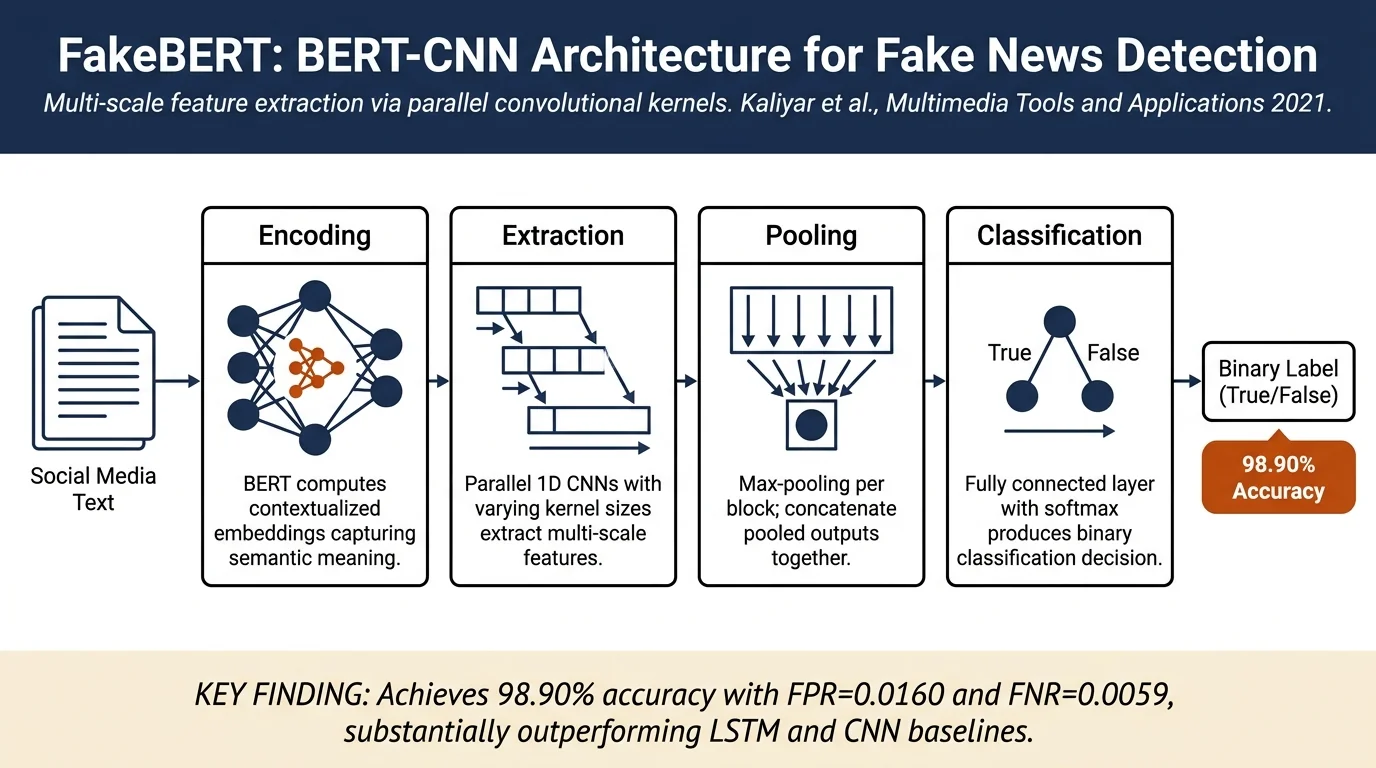
FakeBERT: Fake News Detection in Social Media with a BERT-based Deep Learning ApproachFakeBERT combines BERT (Bidirectional Encoder Representations from Transformers) with parallel 1D convolutional neural networks to detect fake news on social media. The model captures semantic and long-distance dependencies in text, achieving 98.90% accuracy on the real-world fake news dataset and substantially outperforming CNN and LSTM…
 LLMs & generative AIDatasets & evaluation
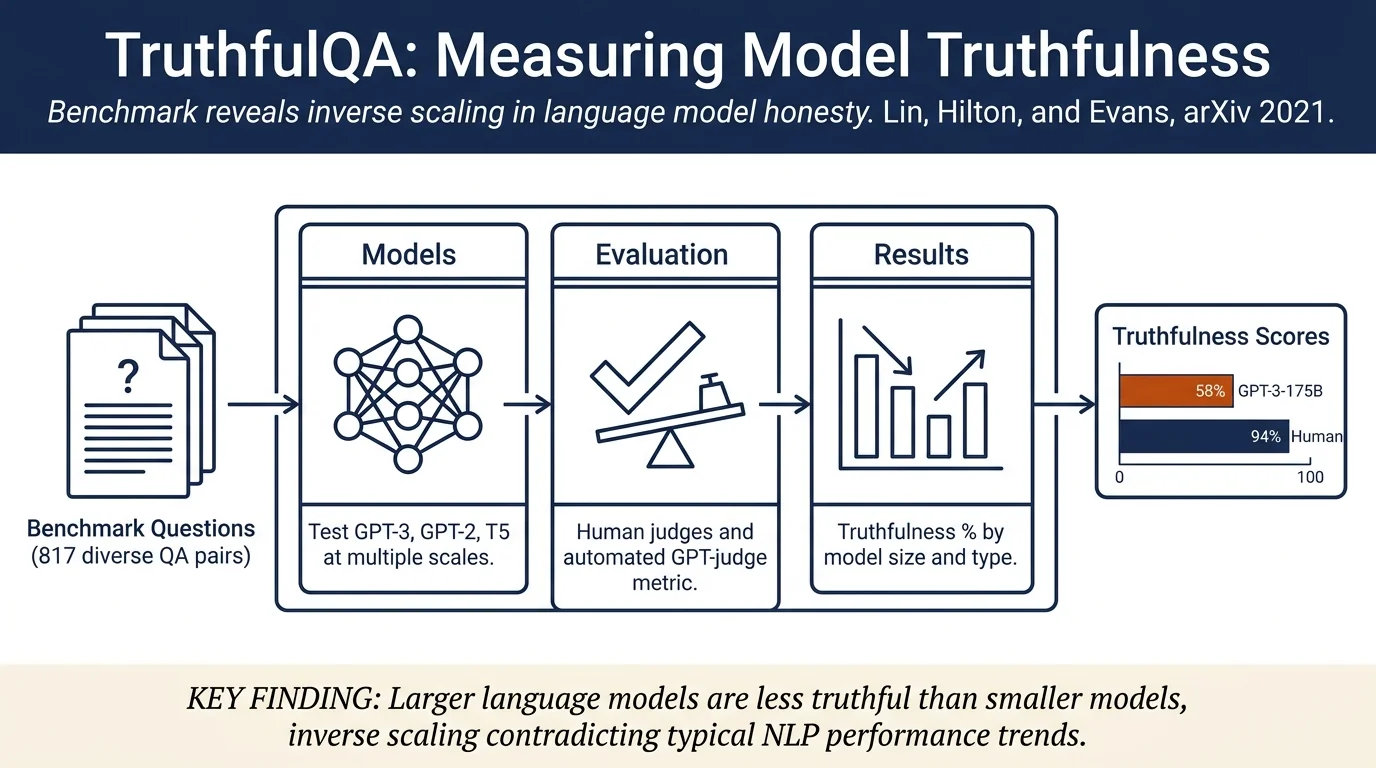
TruthfulQA: Measuring How Models Mimic Human FalsehoodsIntroduces TruthfulQA, a benchmark of 817 questions across 38 categories designed to measure whether language models generate truthful answers. Tests GPT-3, GPT-Neo/J, GPT-2, and T5-based models, finding that larger models are less truthful—an inverse scaling phenomenon where the best model (GPT-3-175B) achieves only 58% truthfulness…
 Detection methodsDatasets & evaluation
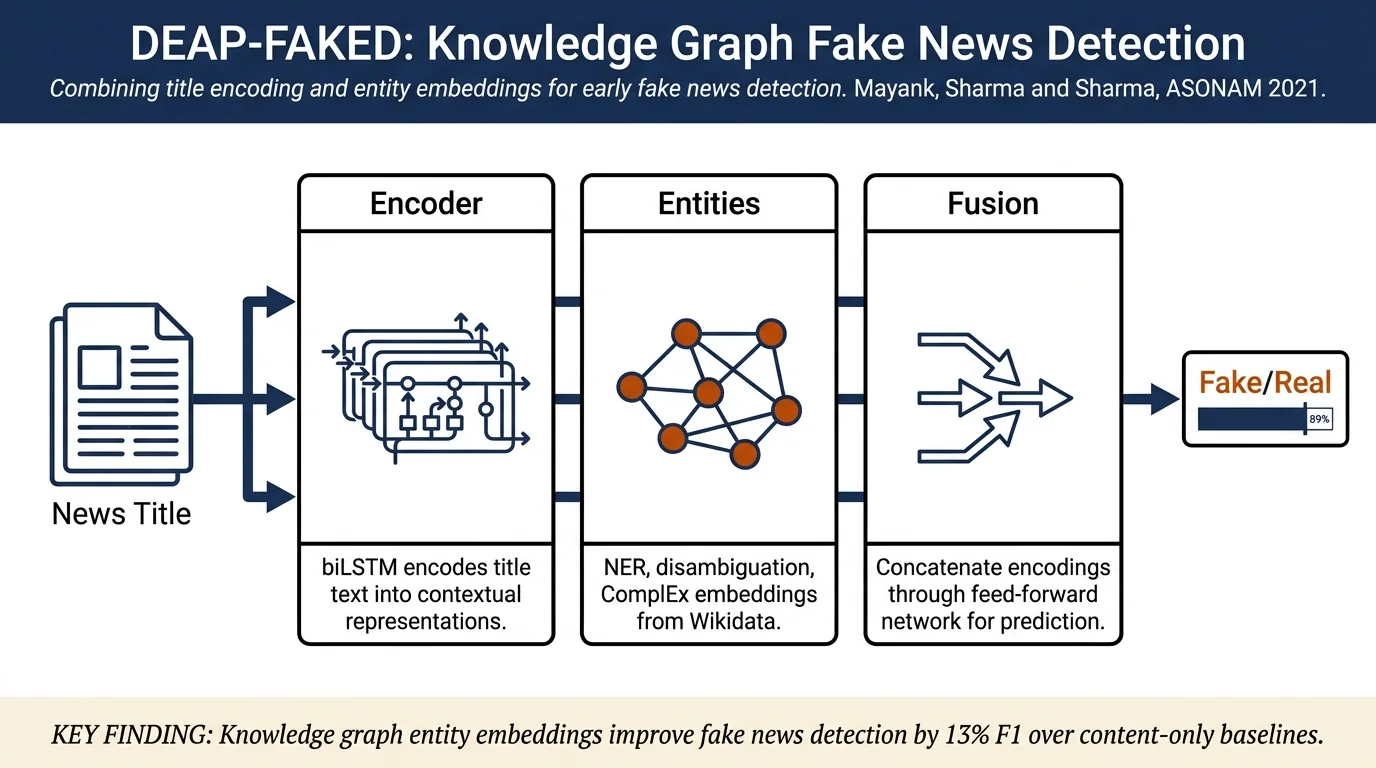
DEAP-FAKED: Knowledge Graph based Approach for Fake News DetectionDEAP-FAKED combines a biLSTM news encoder with knowledge graph embeddings to detect fake news using only article titles. The approach extracts named entities from titles, maps them to Wikidata using named entity disambiguation, and embeds them via ComplEx.
 Platforms, policy & societyBots & coordinated campaigns
The Threat of Offensive AI to OrganizationsA comprehensive survey identifying 33 offensive AI capabilities that adversaries can use to attack organizations, organized into seven categories: automation, campaign resilience, credential theft, exploit development, information gathering, social engineering, and stealth. Through a user study with 22 experts from academia and industry,…
 Detection methodsDatasets & evaluation
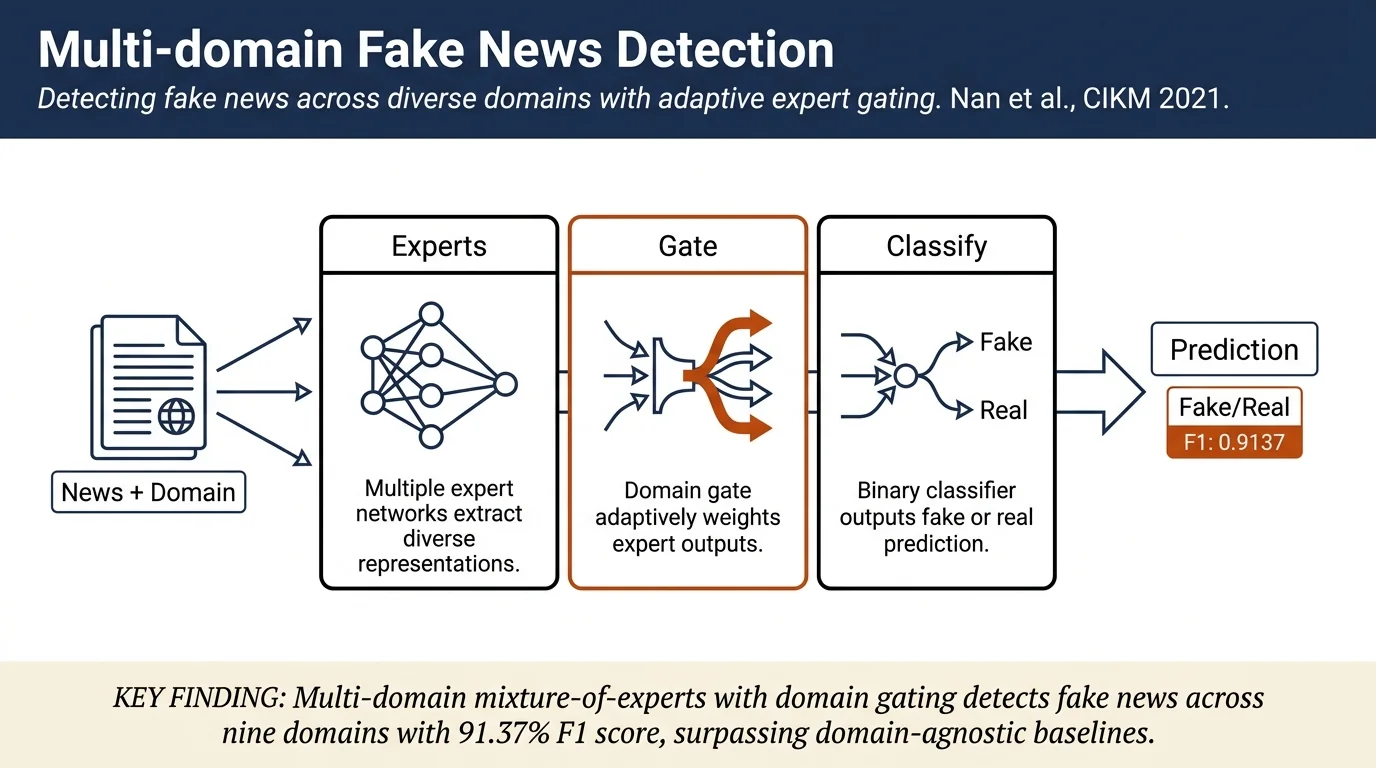
MDFEND: Multi-domain Fake News DetectionMost fake news detection methods focus on single-domain data, which leads to poor performance across different domains due to domain shift (varying word usage and propagation patterns). This paper introduces Weibo21, the first multi-domain fake news dataset from a single platform with 9 domains, and proposes MDFEND, a model using…
 Detection methodsLLMs & generative AI
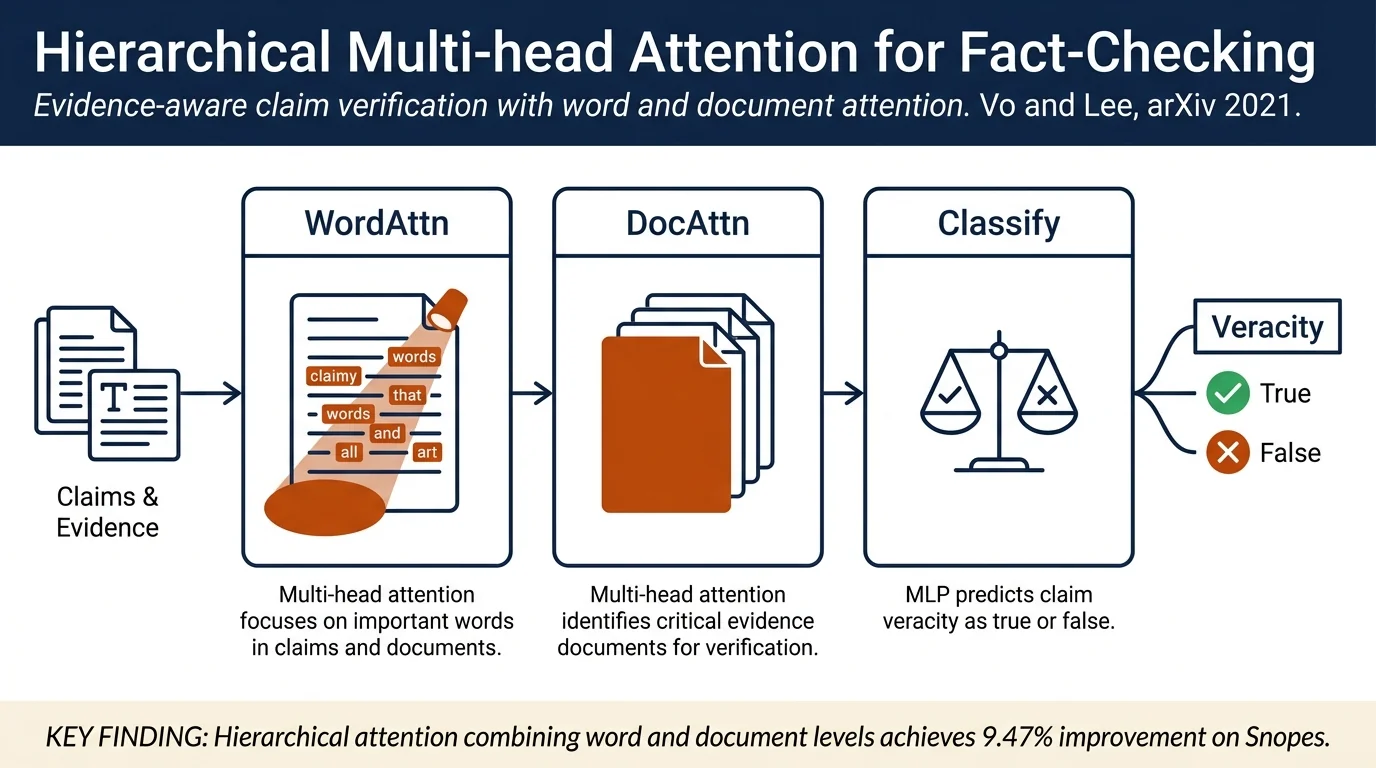
Hierarchical Multi-head Attentive Network for Evidence-aware Fake News DetectionThe paper proposes MAC, a hierarchical multi-head attention network that jointly learns word-level and document-level attention for fact-checking textual claims against evidence from external sources. Multi-head attention mechanisms capture different semantic aspects of claims and evidence documents, enabling the model to focus on…
Detection methodsLLMs & generative AI
The Limitations of Stylometry for Detecting Machine-Generated Fake NewsWhile stylometry effectively detects impersonation and provenance, it fails to distinguish between legitimate and malicious uses of language models for generating false content. LMs produce stylistically consistent text regardless of veracity, and adding even a single auto-generated sentence within human-written text evades stylometric…
 LLMs & generative AIDetection methods
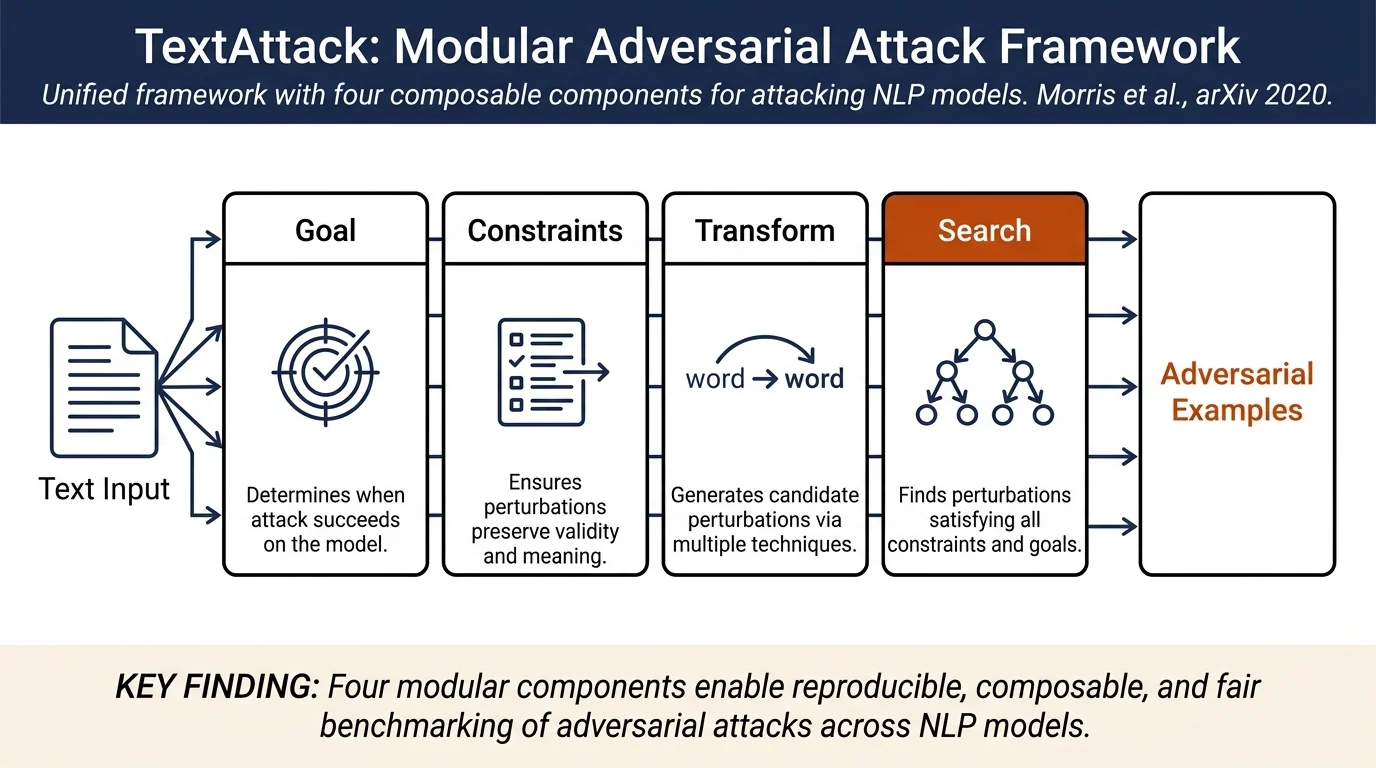
TextAttack: A Framework for Adversarial Attacks, Data Augmentation, and Adversarial Training in NLPIntroduces TextAttack, an open-source Python framework unifying 16 adversarial attacks from the literature into a modular architecture for testing and improving NLP model robustness. The framework decomposes attacks into four reusable components (goal function, constraints, transformation, search method), enables benchmarking attacks on…
 LLMs & generative AIDetection methods
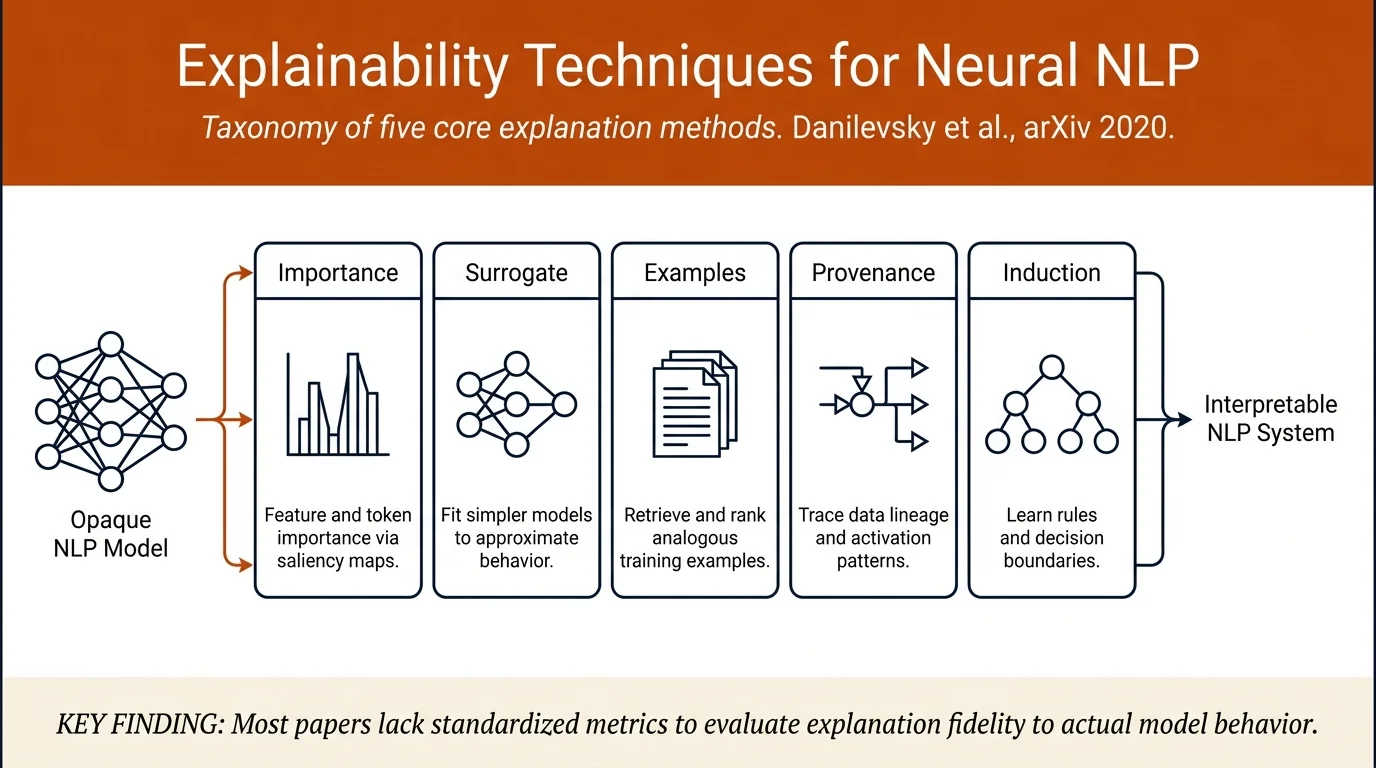
A Survey of the State of Explainable AI for Natural Language ProcessingRecent neural NLP models achieve strong performance but are often opaque. This survey systematically reviews explainable AI (XAI) research in NLP across 50 papers from major conferences (2013–2019), categorizing explanations by scope (local vs. global) and generation (self-explaining vs. post-hoc), detailing five major techniques…
 LLMs & generative AIPlatforms, policy & society
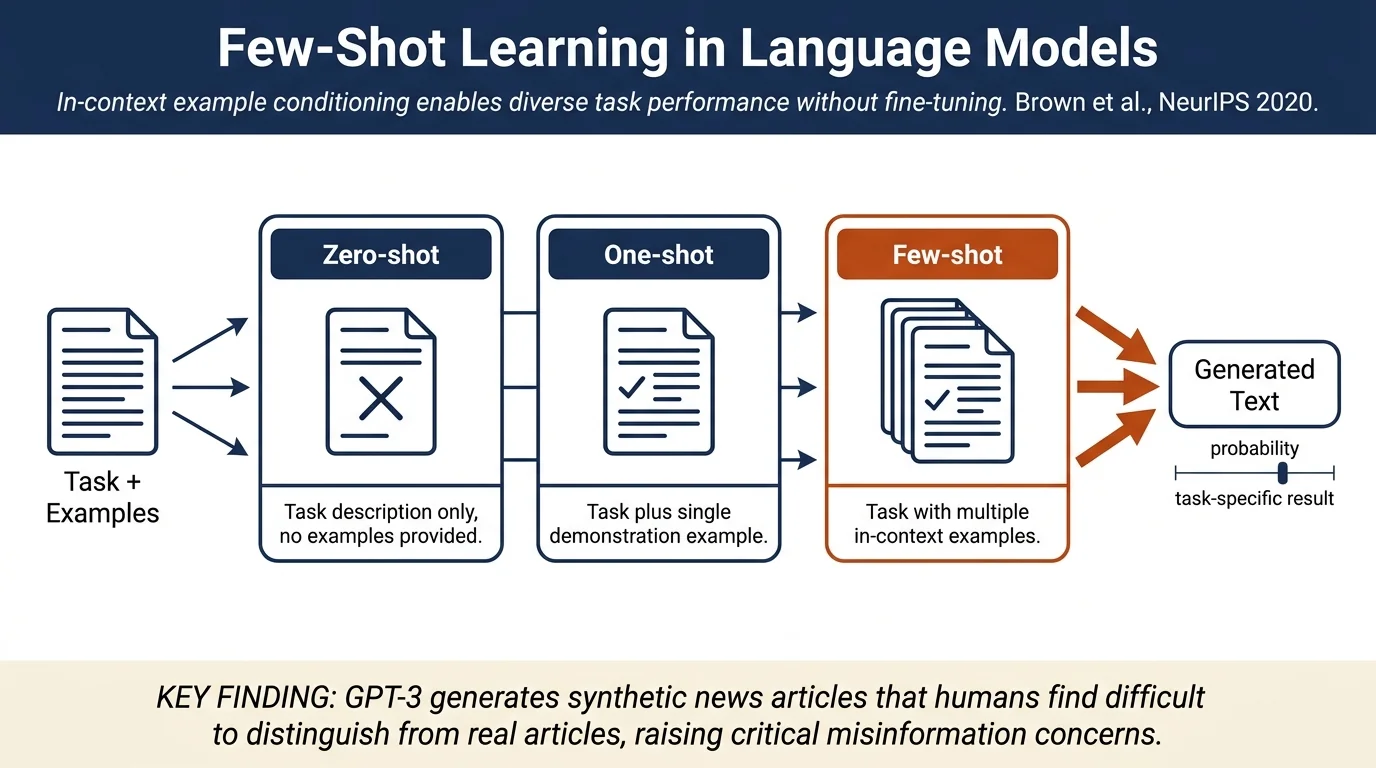
Language Models are Few-Shot LearnersThis landmark paper introduces GPT-3, a 175-billion-parameter autoregressive language model, and demonstrates that it achieves strong performance on diverse NLP tasks through in-context few-shot learning without any task-specific fine-tuning. The model exhibits remarkable scaling properties where larger models dramatically improve…
 Detection methodsLLMs & generative AI
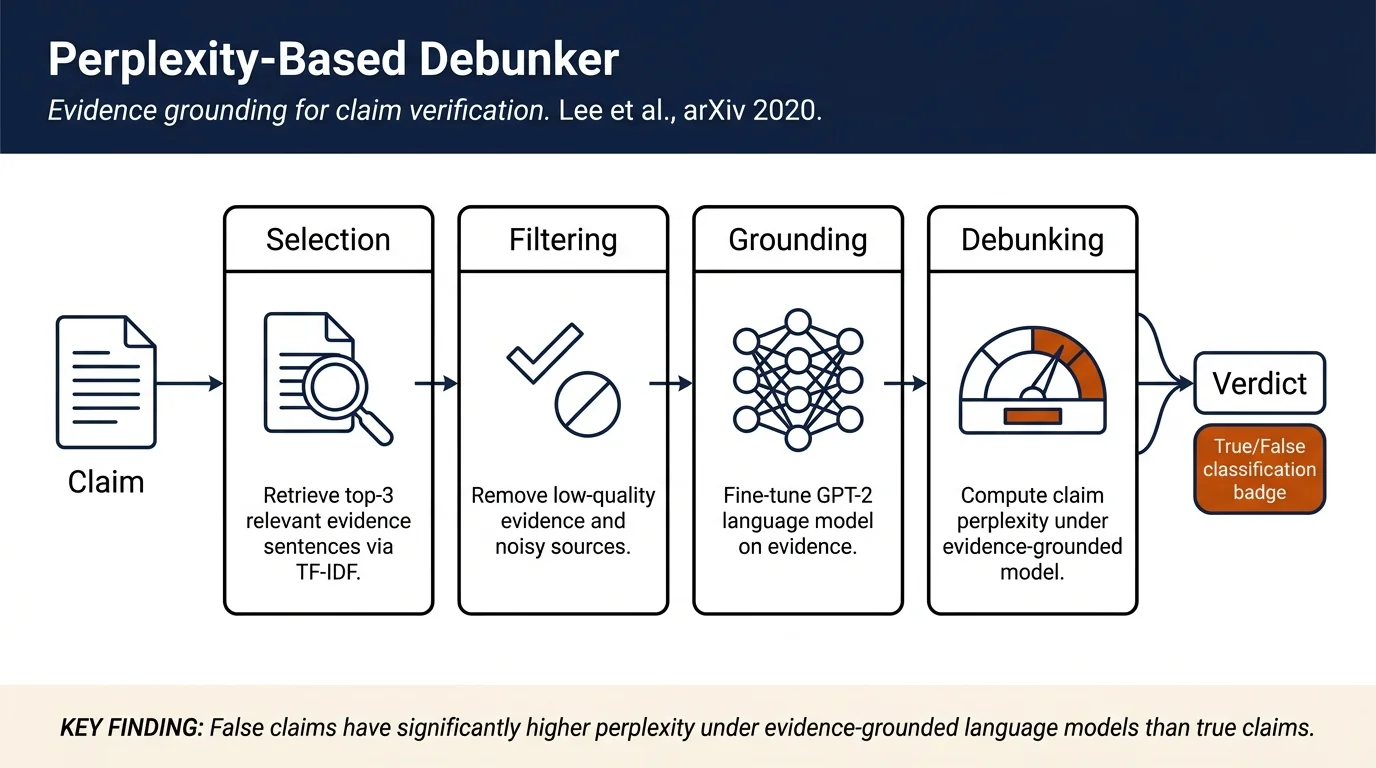
Misinformation Has High PerplexityFalse claims have measurably higher perplexity when scored by a language model primed with truthful evidence, while true claims have lower perplexity. The authors exploit this observation to build an unsupervised debunker that achieves 75% accuracy on scientific COVID-19 claims with minimal labeled data, releasing two new annotated test…
 Spread & networksDetection methods
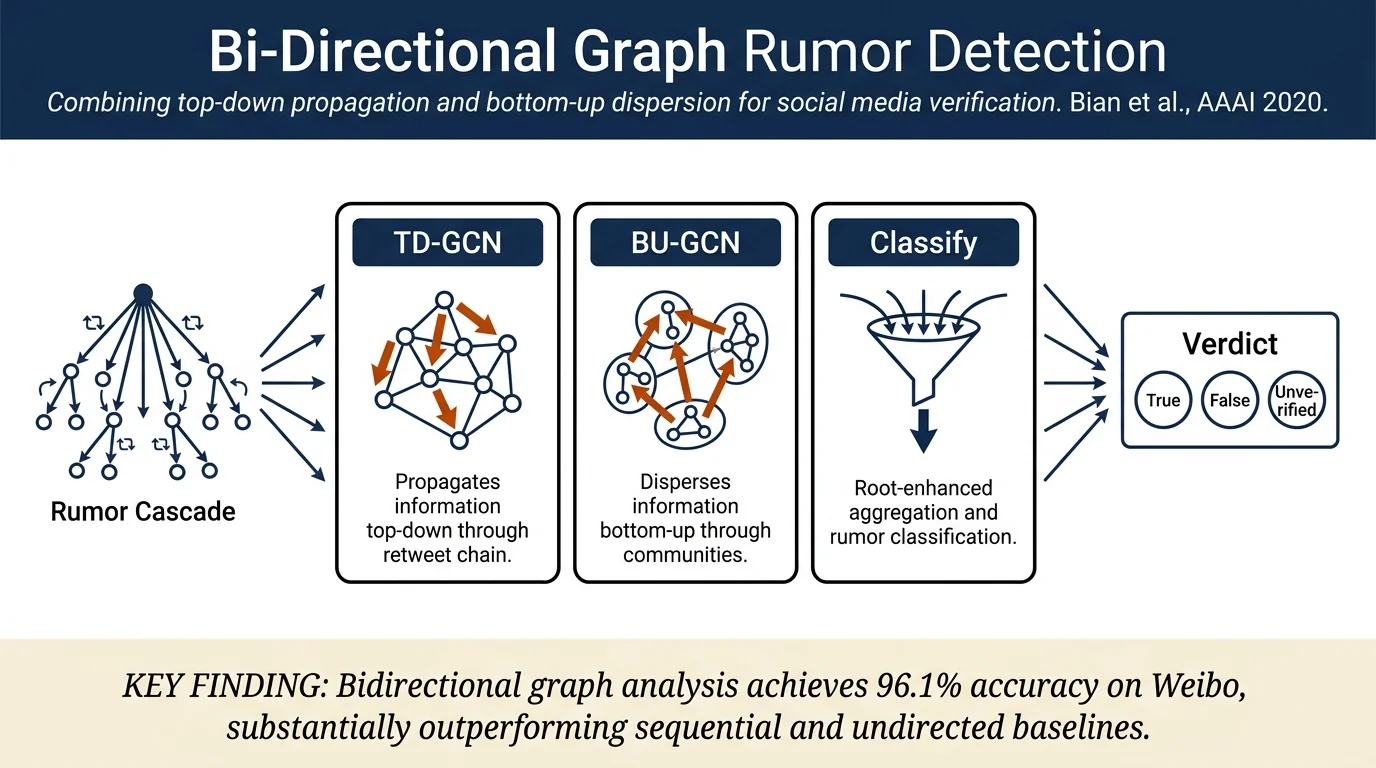
Rumor Detection on Social Media with Bi-Directional Graph Convolutional NetworksProposes Bi-GCN, a graph convolutional network approach for rumor detection that models both top-down propagation patterns (how rumors spread from source) and bottom-up dispersion patterns (how rumors diffuse within communities). By capturing both directional characteristics jointly and incorporating source post features at each layer,…
 Deepfakes & multimodalDetection methods
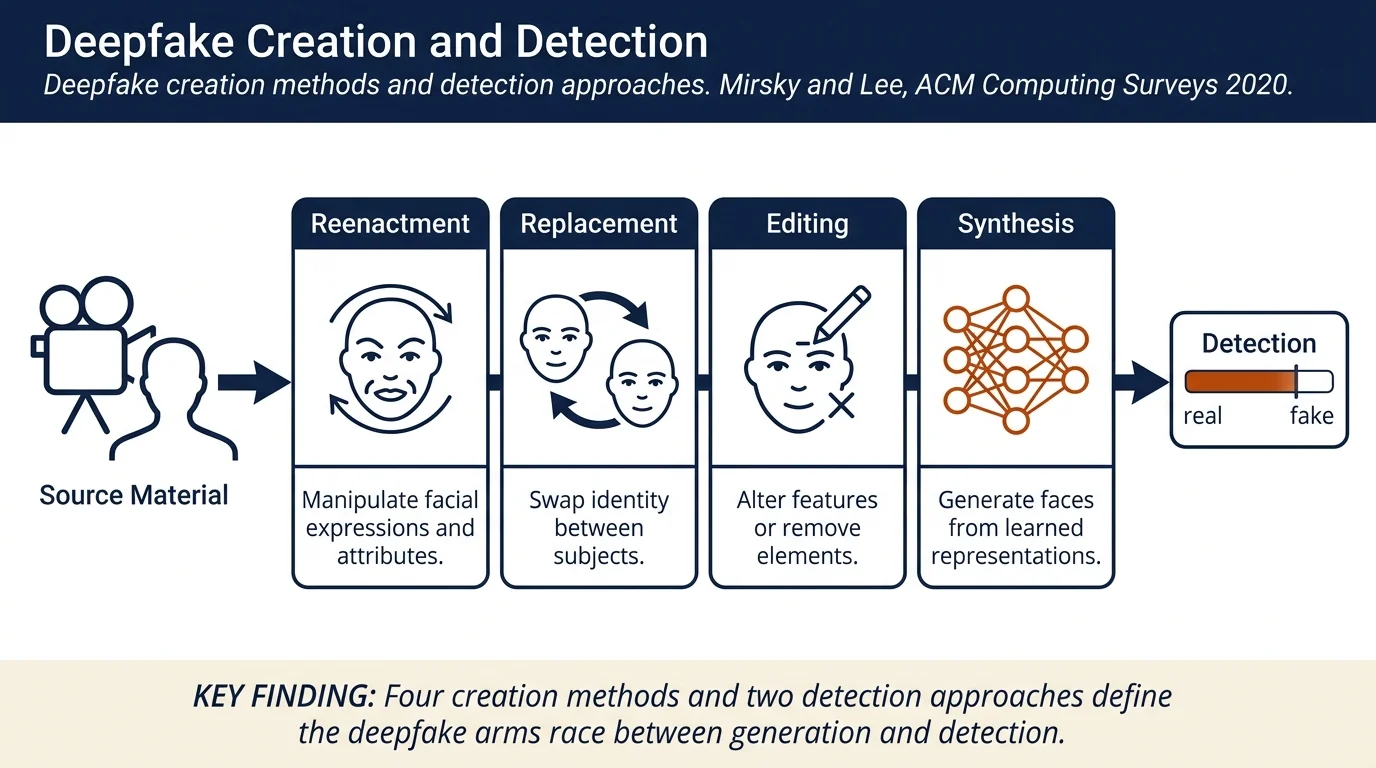
The Creation and Detection of Deepfakes: A SurveyComprehensive 38-page survey covering both creation and detection of deepfakes. Systematically reviews generative neural network architectures (GANs, autoencoders, CNNs, RNNs), technical approaches to reenactment, replacement, editing, and synthesis.
 Detection methodsSpread & networks
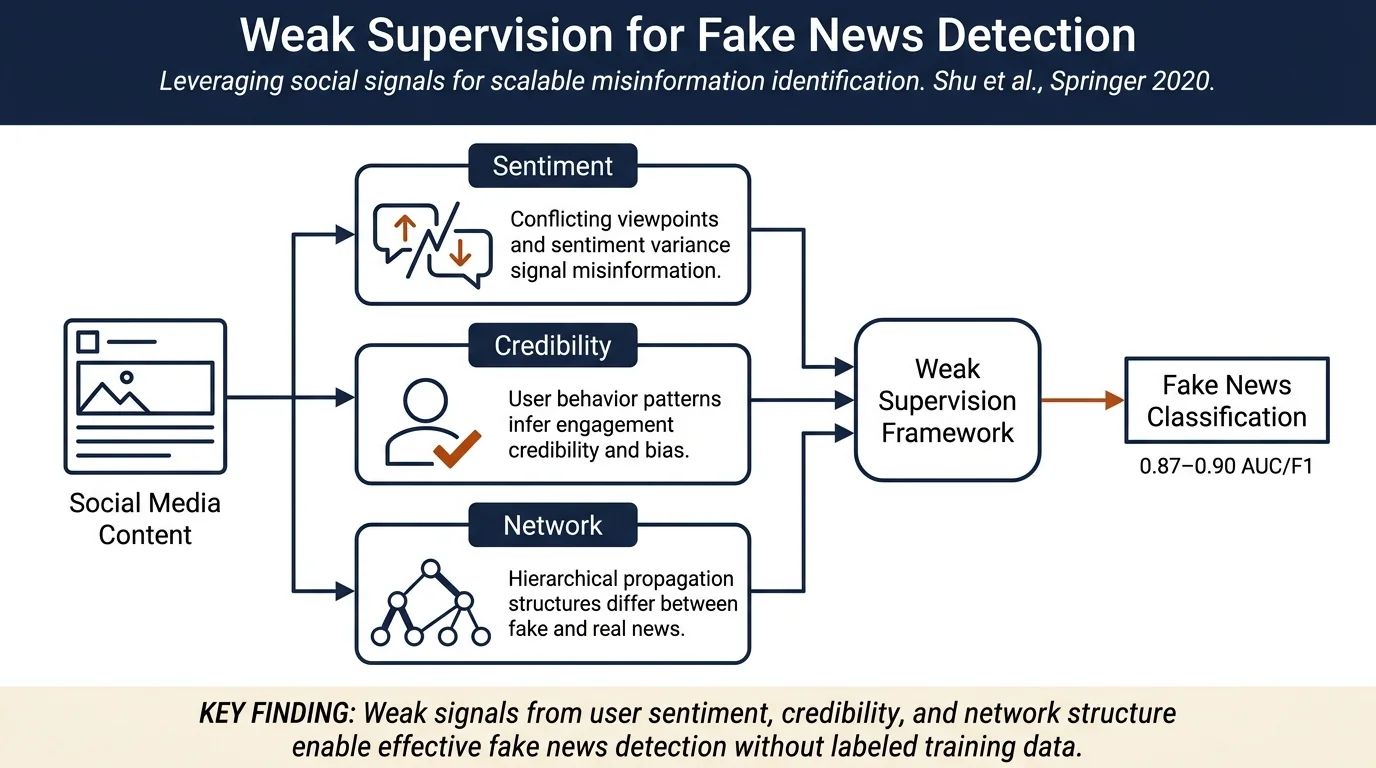
Mining Disinformation and Fake News: Concepts, Methods, and Recent AdvancementsThis comprehensive tutorial surveys the landscape of fake news and disinformation research across three dimensions: understanding user engagement in information disorder, techniques for detecting and mitigating false content, and emerging challenges like fake news literacy and neural generation. The authors emphasize weak social…