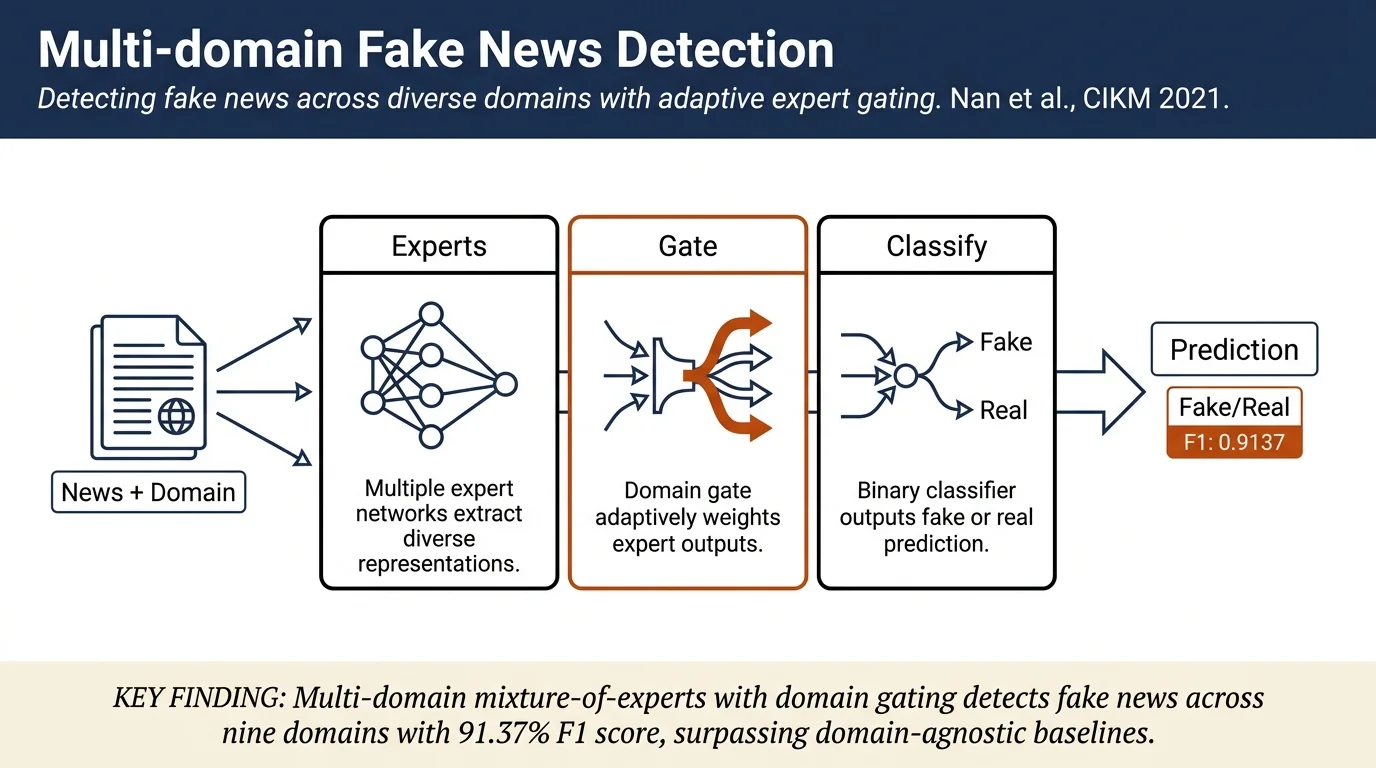
MDFEND: Multi-domain Fake News Detection
Authors: Qiong Nan, Juan Cao, Yongchun Zhu, Yanyan Wang, Jintao Li
Venue: CIKM '21, November 1–5, 2021, Virtual Event, QLD, Australia — DOI
TL;DR
Most fake news detection methods focus on single-domain data, which leads to poor performance across different domains due to domain shift (varying word usage and propagation patterns). This paper introduces Weibo21, the first multi-domain fake news dataset from a single platform with 9 domains, and proposes MDFEND, a model using mixture-of-experts with a domain gate to adaptively aggregate domain-specific representations and achieve state-of-the-art multi-domain detection performance.
Contributions
-
Weibo21 Dataset: First multi-domain fake news detection dataset collected from a single platform (Sina Weibo) with domain labels. Contains 4,488 fake news and 4,640 real news from 9 domains: Science, Military, Education, Disasters, Politics, Health, Finance, Entertainment, and Society. Each item includes news content, timestamp, images, and comments.
-
MDFEND Model: Multi-domain fake news detection framework addressing domain shift via:
- Multiple expert networks (mixture-of-experts) extracting diverse representations
- Domain gate mechanism using domain embedding and sentence embedding to adaptively weight expert outputs
-
Binary classification with shared feature space across domains
-
Systematic Evaluation: Comprehensive comparison of single-domain, mixed-domain, and multi-domain baselines on Weibo21, demonstrating the effectiveness of domain-aware learning.
Method
Representation Extraction: - Input: News content tokenized with BERT, producing word embeddings W - Mask-Attention network extracts sentence-level embedding e_s - Learnable domain embedding e_d for each domain - T expert networks (TextCNN-based) independently extract representations: r_i = Ψ_i(W; θ_i)
Domain Gate: - Takes concatenation of domain embedding e_d and sentence embedding e_s - Feed-forward network G with softmax outputs weight vector a ∈ ℝ^T - Final feature vector: v = Σ(a_i × r_i) for i=1 to T - Weighting adaptively balances expert contributions based on domain and content
Prediction: - Multi-layer perceptron with softmax for binary fake/real classification - Binary Cross-Entropy Loss with balanced class weights
Results
F1-scores on Weibo21:
| Model | Science | Military | Education | Disasters | Politics | Health | Finance | Entertainment | Society | All |
|---|---|---|---|---|---|---|---|---|---|---|
| BERT_single | 0.8192 | 0.7795 | 0.8136 | 0.7885 | 0.8188 | 0.8909 | 0.8464 | 0.8638 | 0.8242 | 0.8272 |
| BERT_all | 0.7777 | 0.9072 | 0.8331 | 0.8512 | 0.8366 | 0.9090 | 0.8735 | 0.8769 | 0.8577 | 0.8795 |
| EANN | 0.8225 | 0.9274 | 0.8624 | 0.8666 | 0.8705 | 0.9150 | 0.8710 | 0.8957 | 0.8877 | 0.8975 |
| MMOE | 0.8755 | 0.9112 | 0.8706 | 0.8770 | 0.8620 | 0.9364 | 0.8567 | 0.8886 | 0.8750 | 0.8947 |
| EDDFN | 0.8186 | 0.9137 | 0.8676 | 0.8786 | 0.8478 | 0.9379 | 0.8636 | 0.8832 | 0.8689 | 0.8919 |
| MDFEND | 0.8301 | 0.9389 | 0.8917 | 0.9003 | 0.8865 | 0.9400 | 0.8951 | 0.9066 | 0.8980 | 0.9137 |
Key findings: - Multi-domain models substantially outperform single-domain and mixed-domain baselines - MDFEND achieves +1.62% F1 improvement over best baseline MMOE (0.9137 vs 0.8947) - Domain gate effectively leverages both domain and content signals - Performance gains across all domains, with largest improvements in disaster (0.9003) and health (0.9400) domains
Connections
- Related to EANN via shared use of adversarial learning to extract domain-invariant features, though EANN targets event-invariance while MDFEND targets cross-domain transfer.
- Extends cross-domain learning literature by applying mixture-of-experts gating mechanism to fake news detection.
- Similar architectural choice as transfer learning methods that learn shared and domain-specific representations.
- Complements Silva et al. (2021) which addresses multimodal cross-domain detection; MDFEND is text-only but systematically evaluates 9 domains on a single platform.
- Addresses domain shift problem identified in content-based detection literature where linguistic and propagation patterns vary across domains.
Notes
Strengths: - First comprehensive multi-domain dataset from a single platform; enables controlled evaluation across domains without platform confounds. - Well-motivated problem: domain shift is a practical challenge for real-world deployment of detection systems. - Elegant solution using mixture-of-experts with domain gating; both theoretically motivated and empirically effective. - Thorough experimental design: evaluates single-domain, mixed-domain, and multi-domain baselines; ablation shows domain gate is essential. - Clear presentation of domain differences (word clouds, propagation patterns) demonstrating domain shift is real.
Limitations: - Evaluation limited to Chinese Weibo data; generalization to other platforms (Twitter, Facebook) or languages unknown. - Weibo21 is relatively small (9,128 total items); comparable English datasets (FakeNewsNet, FEVER) contain orders of magnitude more data. - Domain categories are coarse-grained; many real-world news domains (e.g., medical misinformation vs. general health news) might benefit from finer-grained distinctions. - Domain embeddings are learned jointly; unclear if pre-trained domain representations would improve transfer to new domains. - Mixture-of-experts requires knowing domain label at inference time; fully unsupervised domain discovery remains open. - Text-only approach ignores images and propagation networks available in Weibo dataset; multimodal extension could be valuable.
Follow-ups: - Apply MDFEND to other languages and platforms to establish generalizability. - Extend to truly zero-shot domain adaptation where new domains are never seen during training. - Combine with propagation-based detection methods using the rich social context data in Weibo21. - Investigate learned interactions between modalities (text + images) in Chinese social media. - Explore whether domain gate can dynamically discover domains without manual annotation.