Belief Evolution Network-based Probability Transformation and Fusion
Authors: Qianli Zhou, Yusheng Huang, Yong Deng
Venue: arXiv preprint 2110.03468, 2021 — arXiv
TL;DR
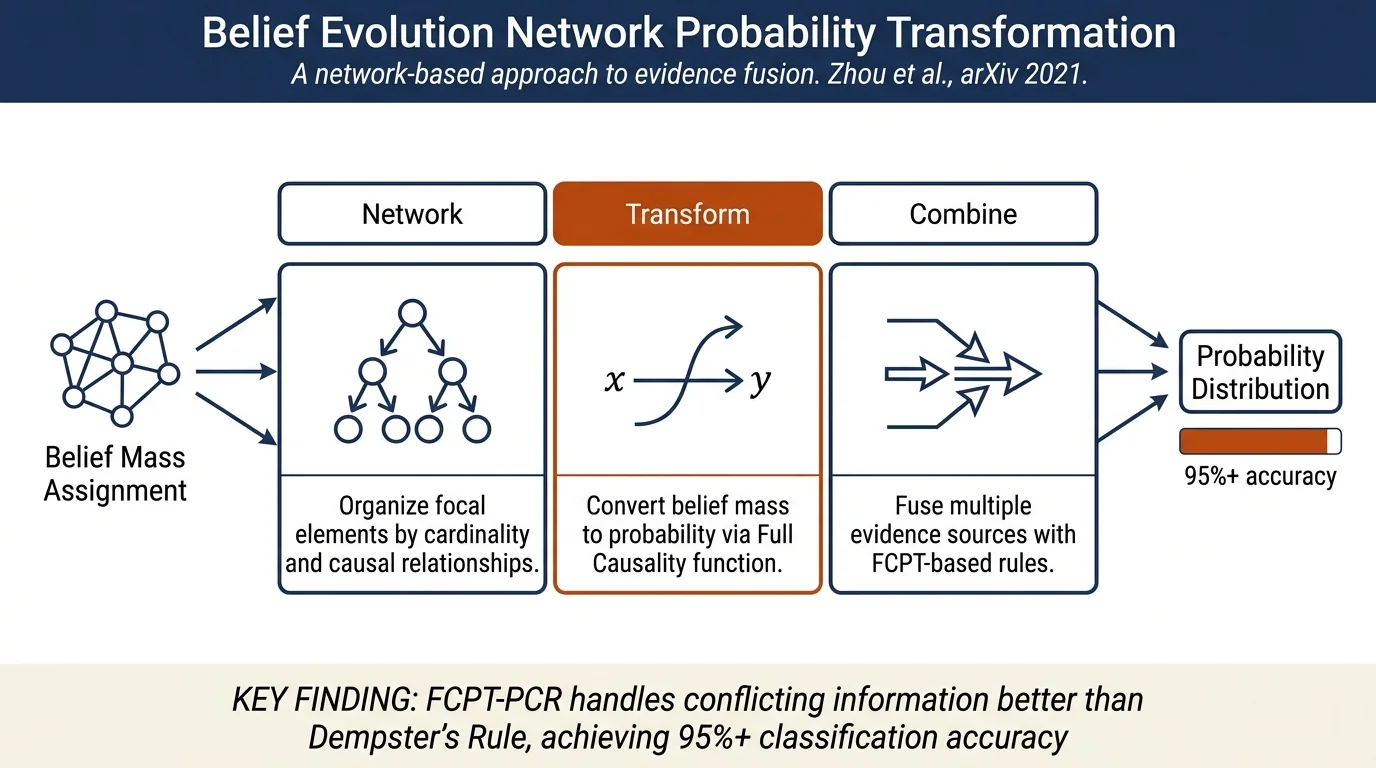
This paper introduces a Belief Evolution Network (BEN) to model the evolution of belief functions and proposes a new Full Causality Probability Transformation (FCPT) method for converting belief mass assignments to probability distributions. The authors also propose FCPT-based fusion rules that outperform traditional Dempster's Rule of Combination in handling conflicting information.
Contributions
- Belief Evolution Network (BEN): A hierarchical network structure representing the causal relationships between focal elements in Dempster-Shafer Theory, modeling how beliefs evolve from complete ignorance to precise knowledge.
- Full Causality (FC) function: A new belief function that captures the complete set of causal relationships between focal elements.
- Full Causality Probability Transformation (FCPT): A new probability transformation method that maintains higher similarity to the original belief mass assignment while achieving favorable properties for decision-making.
- FCPT-based Probability Combination Rule (FCPT-PCR): A fusion rule combining DCR and FCPT that handles both conflicting and identical information better than traditional approaches.
Method
The paper develops a mathematical framework for representing belief functions as a directed acyclic network. The BEN stratifies focal elements by cardinality, with arrows representing evolutionary relationships. Within this framework:
-
The Full Causality function captures the sum of beliefs in all focal elements with causal relationships to a given focal element, incorporating both intersection and inclusion relationships.
-
FCPT interprets probability transformation as an information fusion process on the BEN, where belief gradually transfers from the root node (complete ignorance) to leaf nodes (singletons) through n−1 iterations.
-
FCPT-PCR combines the Disjunctive Combination Rule (DCR) for the first step with FCPT in the second step, addressing limitations of pure DCR in handling both conflicting and identical information.
The paper evaluates these methods using a Bi-Criteria evaluation approach that considers both probabilistic information content (PIC) and similarity to the original belief assignment.
Results
-
Theoretical evaluation: Under Bi-Criteria evaluation, FCPT outperforms existing probability transformation methods (PPT, PTM, PraPI, DSmP, ITP, CuzzP) in balancing similarity to the original belief assignment with information content.
-
Classification results: On UCI datasets (iris and seed), FCPT-PCR achieves classification accuracy of 95.74%–95.89% (iris) and 92.79%–93.20% (seed) across different fold configurations, exceeding both Murphy's method and traditional DCR.
-
Multi-source fusion: FCPT-PCR demonstrates more reasonable results than DCR when fusing conflicting information, exhibiting a "pseudo-Matthew effect" that is more aligned with human decision-making intuitions.
Connections
- Related to Dempster-Shafer Theory — extends the theoretical framework with new network-based representations.
- Related to Information Fusion for combining evidence from multiple sources.
- Methodologically relevant to Uncertainty Quantification approaches in information fusion.
Notes
This is a methodological/foundational paper rather than one focused on misinformation detection per se. However, it provides important theoretical and algorithmic contributions to belief function theory and multi-source information fusion—tools that are applicable to claim verification and evidence aggregation in misinformation detection systems. The FCPT approach addresses a known limitation of Dempster's Rule (the Matthew effect) that is particularly relevant when combining evidence from multiple sources with potential conflicts or biases.
The paper is mathematically rigorous and includes comprehensive comparisons with existing probability transformation methods. Potential limitations include computational complexity for large frame-of-discernment sizes, which the authors acknowledge for future work.