Explore papers
Filter by research area, year and venue. Every filter is in the address bar, so you can share a view as a link.
 LLMs & generative AIDetection methods
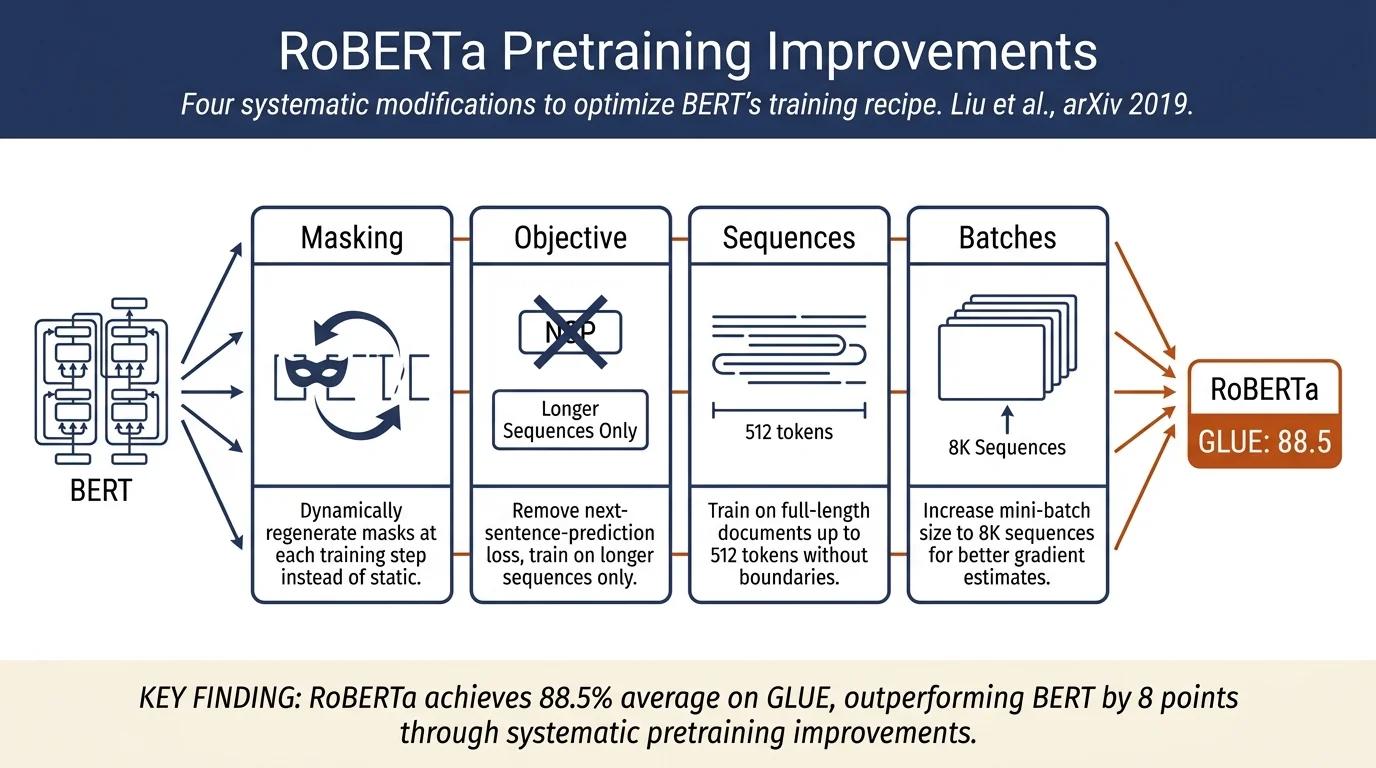
RoBERTa: A Robustly Optimized BERT Pretraining ApproachA replication and improvement study of BERT pretraining showing that BERT was significantly undertrained. RoBERTa introduces four key improvements—training longer with larger batches and more data, removing the next-sentence-prediction objective, training on longer sequences, and dynamically masking tokens—to achieve state-of-the-art…
 Detection methodsDatasets & evaluation
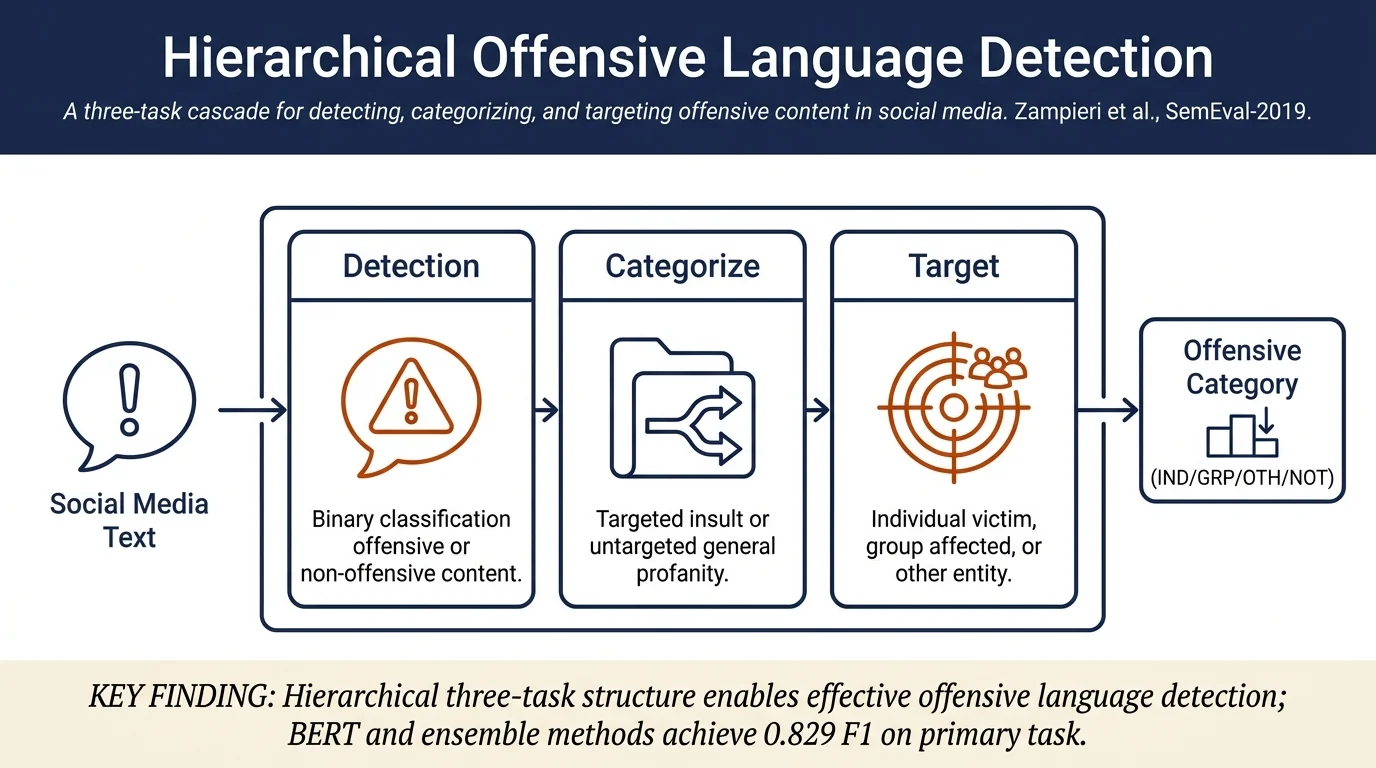
SemEval-2019 Task 6: Identifying and Categorizing Offensive Language in Social MediaSemEval-2019 Task 6 reports on a shared task competition for identifying and categorizing offensive language in social media using the OLID dataset. Approximately 800 teams registered and 115 submitted results across three sub-tasks: offensive language detection (104 teams), offense type categorization (71 teams), and offense target…
 Detection methodsLLMs & generative AI
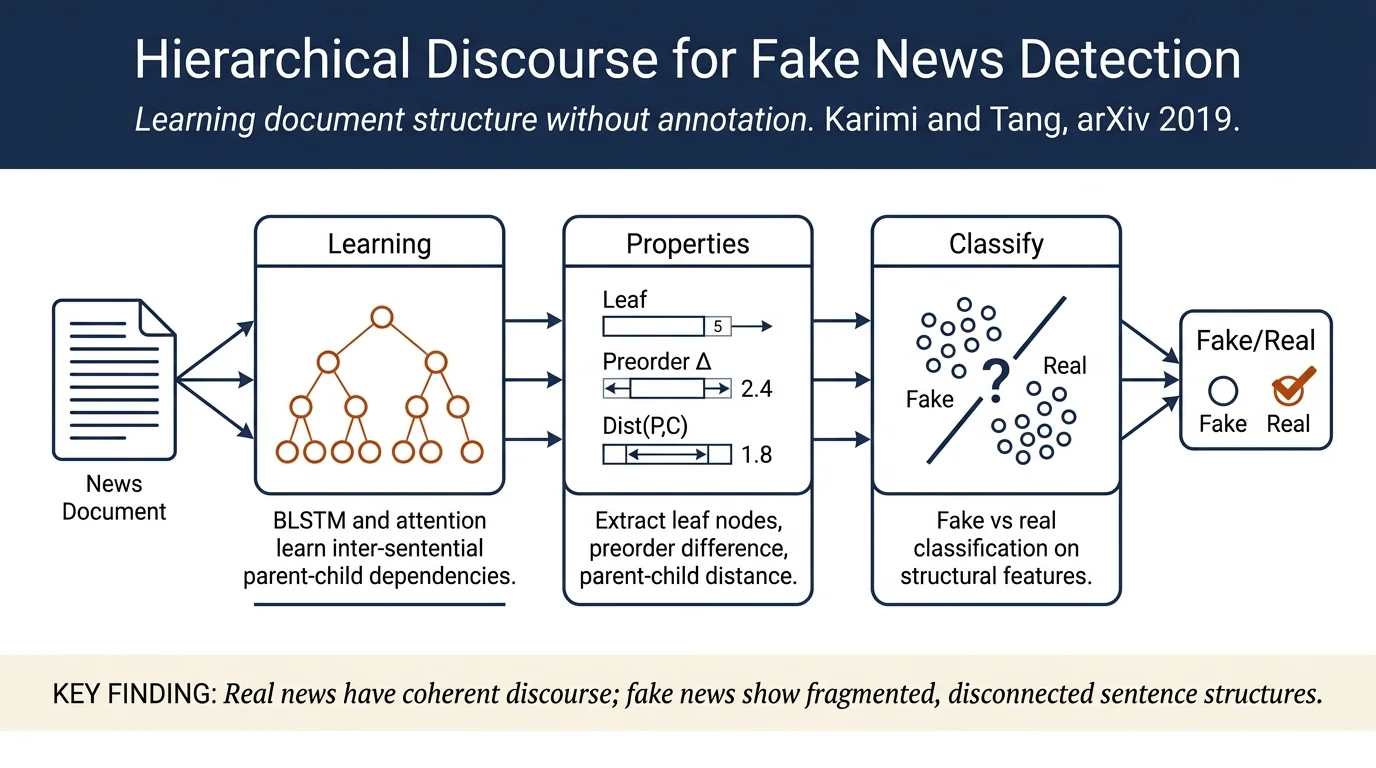
Learning Hierarchical Discourse-level Structure for Fake News DetectionProposes HDSF, a framework that learns hierarchical discourse-level structure (dependency trees of sentences) for fake news detection without annotated corpora. Identifies three structure-related properties that distinguish fake from real news and shows HDSF achieves 82.19% accuracy, outperforming linguistic baselines.
 Fact-checking & verificationDatasets & evaluation
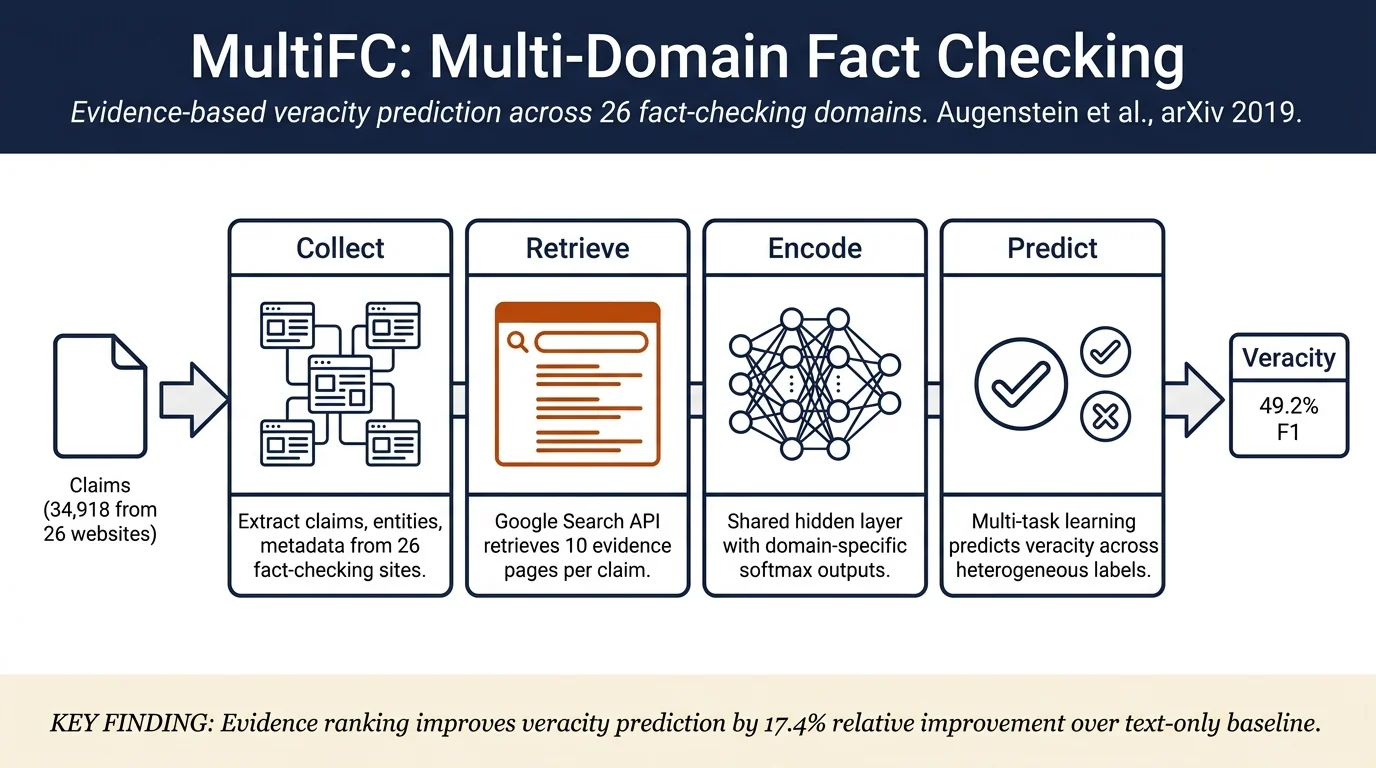
MultiFC: A Real-World Multi-Domain Dataset for Evidence-Based Fact Checking of ClaimsMultiFC is the largest publicly available real-world dataset of naturally occurring factual claims (34,918 claims) collected from 26 fact-checking websites, with rich metadata, evidence pages retrieved via Google Search, and entity linking to Wikipedia. The paper demonstrates that evidence ranking combined with veracity prediction…
 Detection methodsDatasets & evaluation
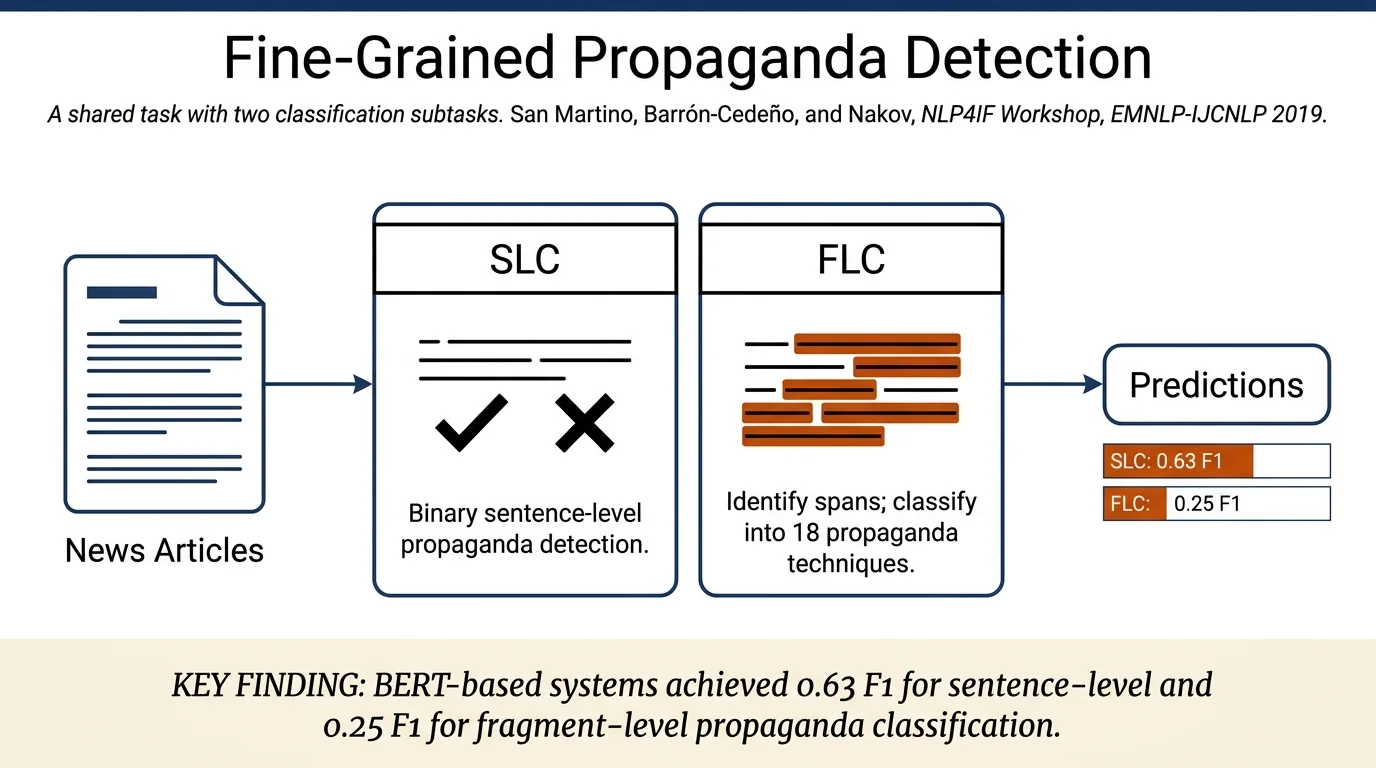
Findings of the NLP4IF-2019 Shared Task on Fine-Grained Propaganda DetectionThis paper reports findings from a shared task on fine-grained propaganda detection in news articles, featuring two subtasks: fragment-level identification and classification into 18 propaganda techniques, and sentence-level binary propaganda detection. The task attracted 90 registered teams with 39 making submissions; winning systems…
 Deepfakes & multimodalDetection methods
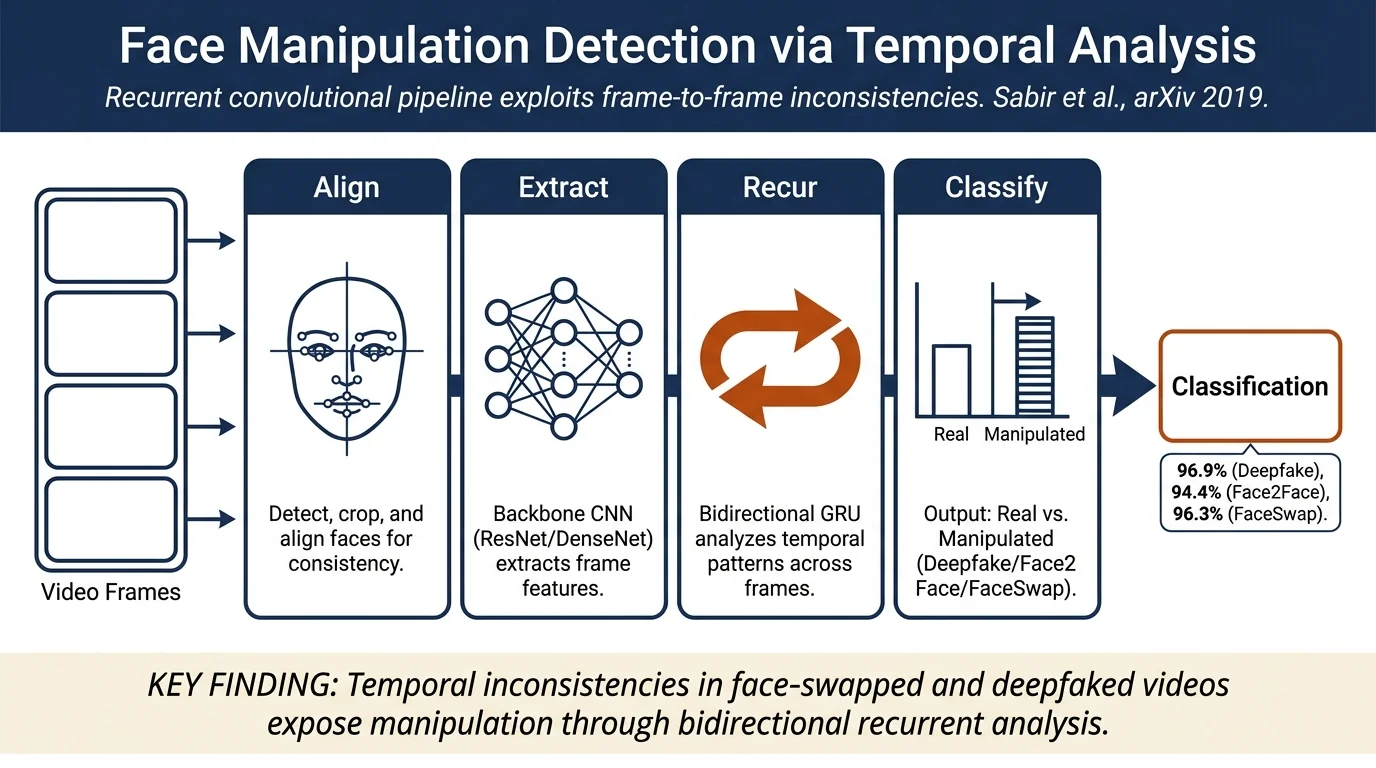
Recurrent Convolutional Strategies for Face Manipulation Detection in VideosThis paper proposes using recurrent convolutional networks to detect face manipulations (Deepfake, Face2Face, FaceSwap) in videos by exploiting temporal discrepancies across frames. Face preprocessing with alignment and bidirectional recurrent networks achieve state-of-the-art on FaceForensics++ with up to 4.55% improvement over prior…
 Detection methodsSpread & networks
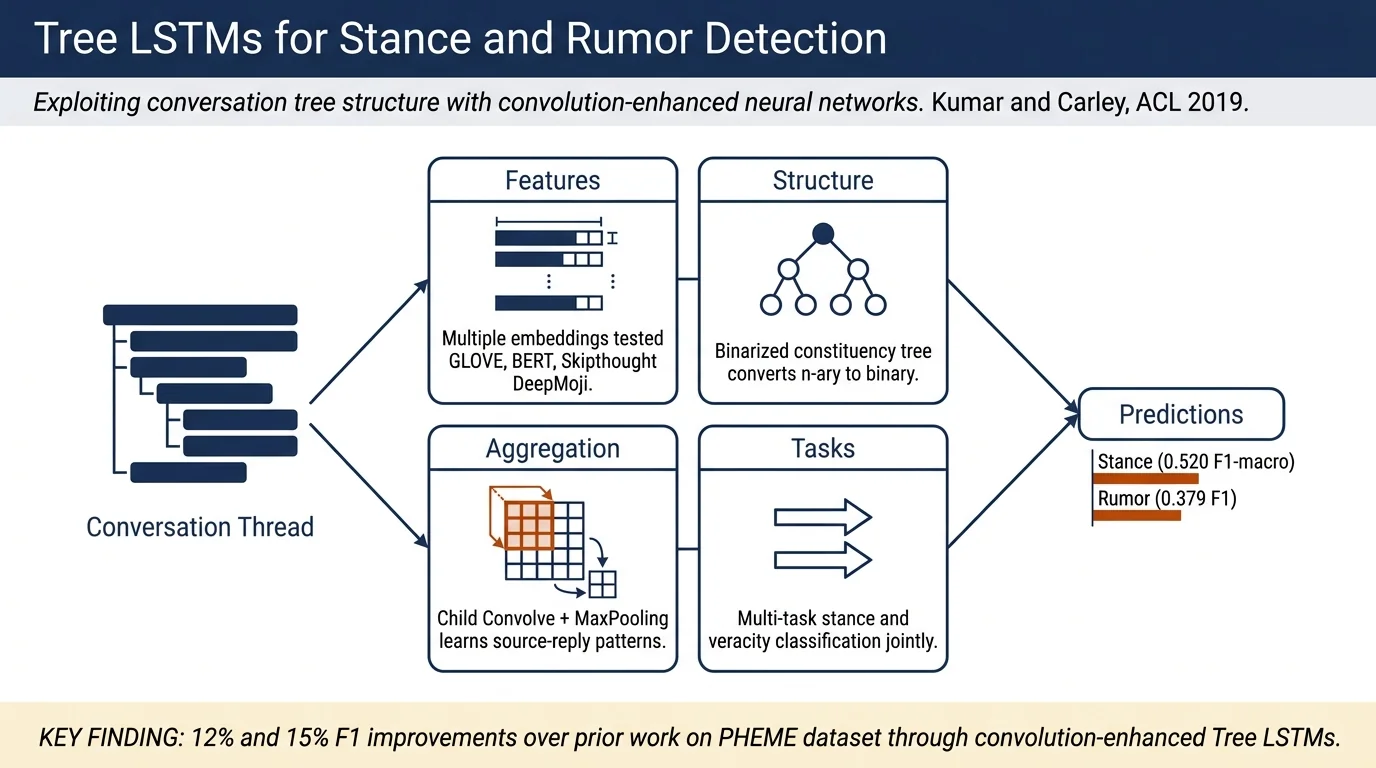
Tree LSTMs with Convolution Units to Predict Stance and Rumor Veracity in Social Media ConversationsProposes Tree LSTM and Binarized Constituency Tree (BCTree) LSTM architectures enhanced with convolution units to classify stance and predict rumor veracity in social media conversation threads. The approach exploits the tree structure inherent in threaded conversations (source post with nested replies) and combines it with convolutional…
 Detection methodsDatasets & evaluation
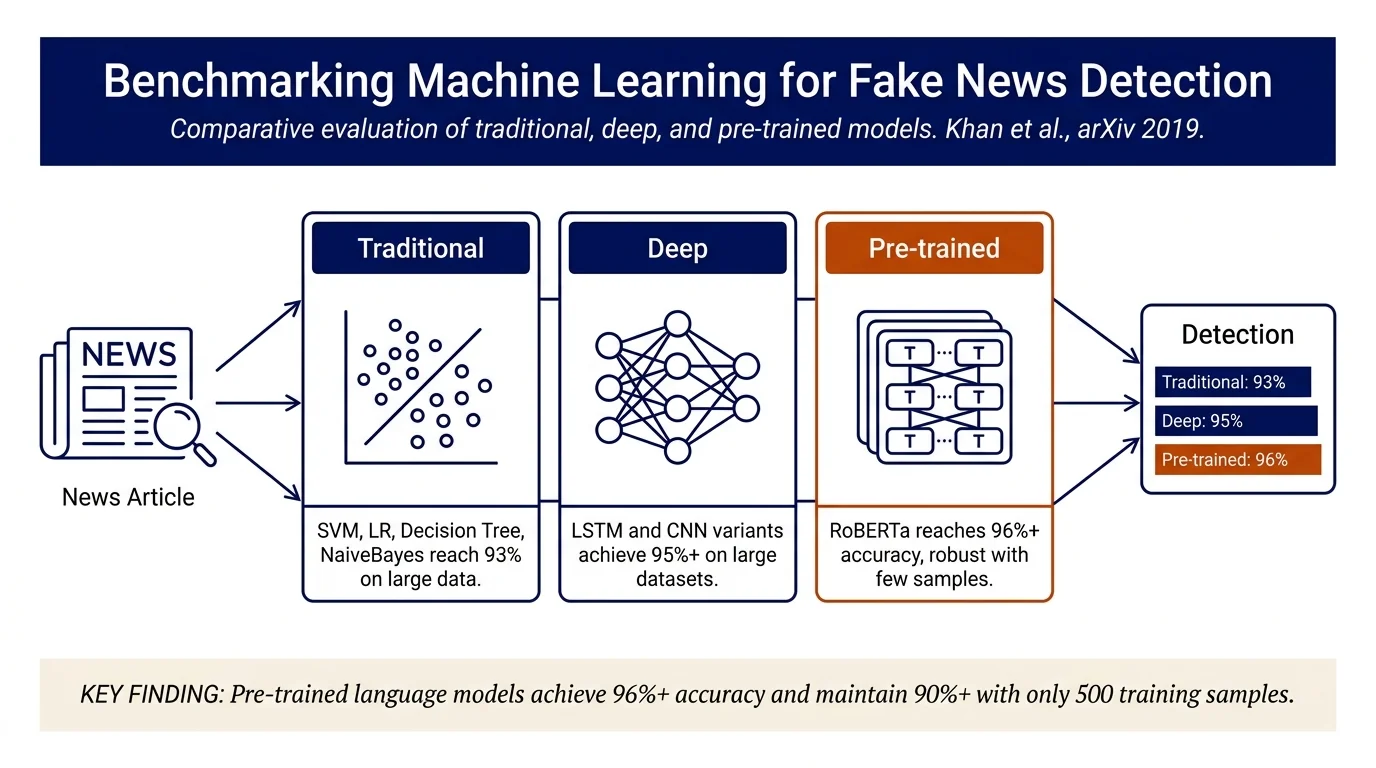
A Benchmark Study of Machine Learning Models for Online Fake News DetectionComprehensive benchmark of 19 machine learning approaches across three fake news datasets (LIAR, Fake or Real News, and an 80k-news combined corpus spanning politics, health, sports, and other topics). Key finding: BERT-based pre-trained models (especially RoBERTa) substantially outperform traditional and deep learning approaches,…
 LLMs & generative AIDetection methods
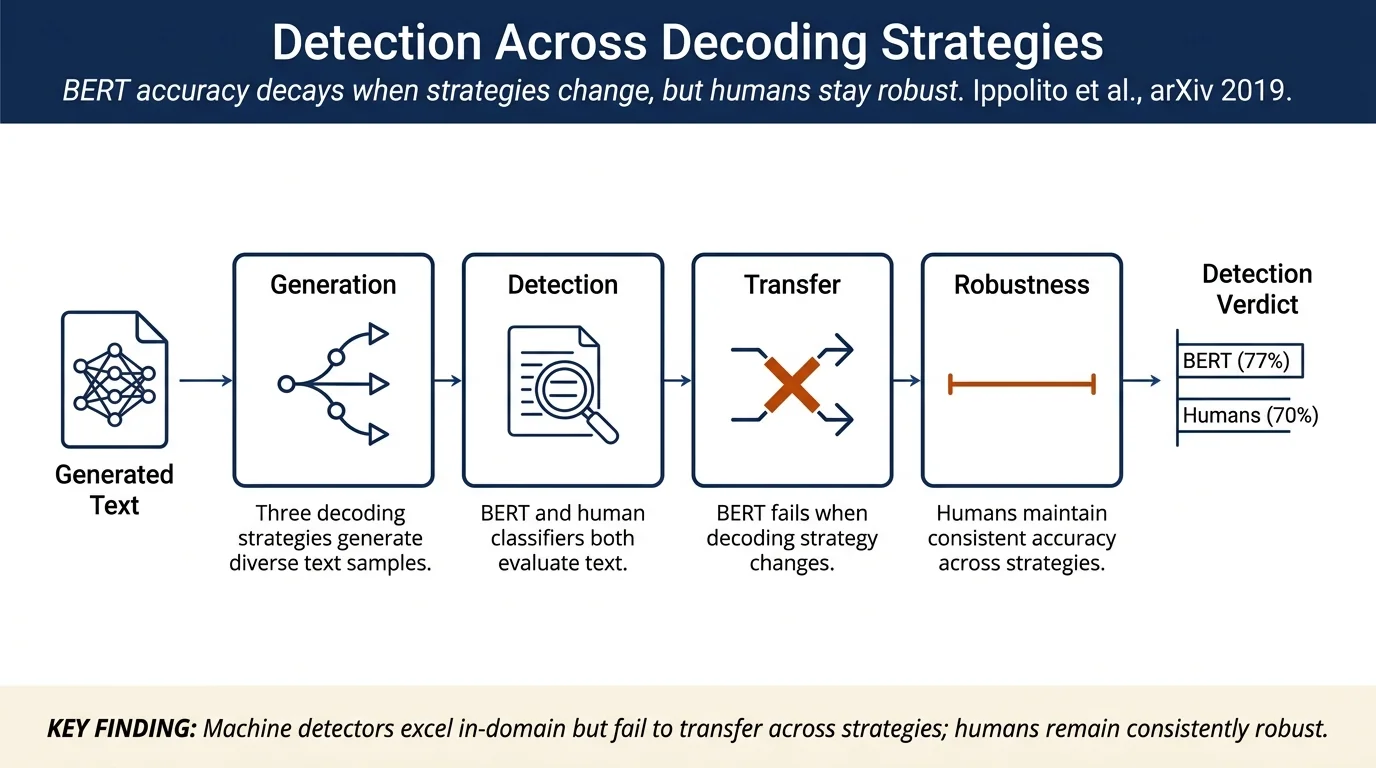
Automatic Detection of Generated Text is Easiest when Humans are FooledIppolito et al. investigate the complementary abilities of humans and machines to detect machine-generated text from GPT-2 under various decoding strategies. They find that fine-tuned BERT detectors outperform humans (achieving 80%+ accuracy on long excerpts versus 71% for expert human raters), but detector performance is highly…
 LLMs & generative AIDetection methods
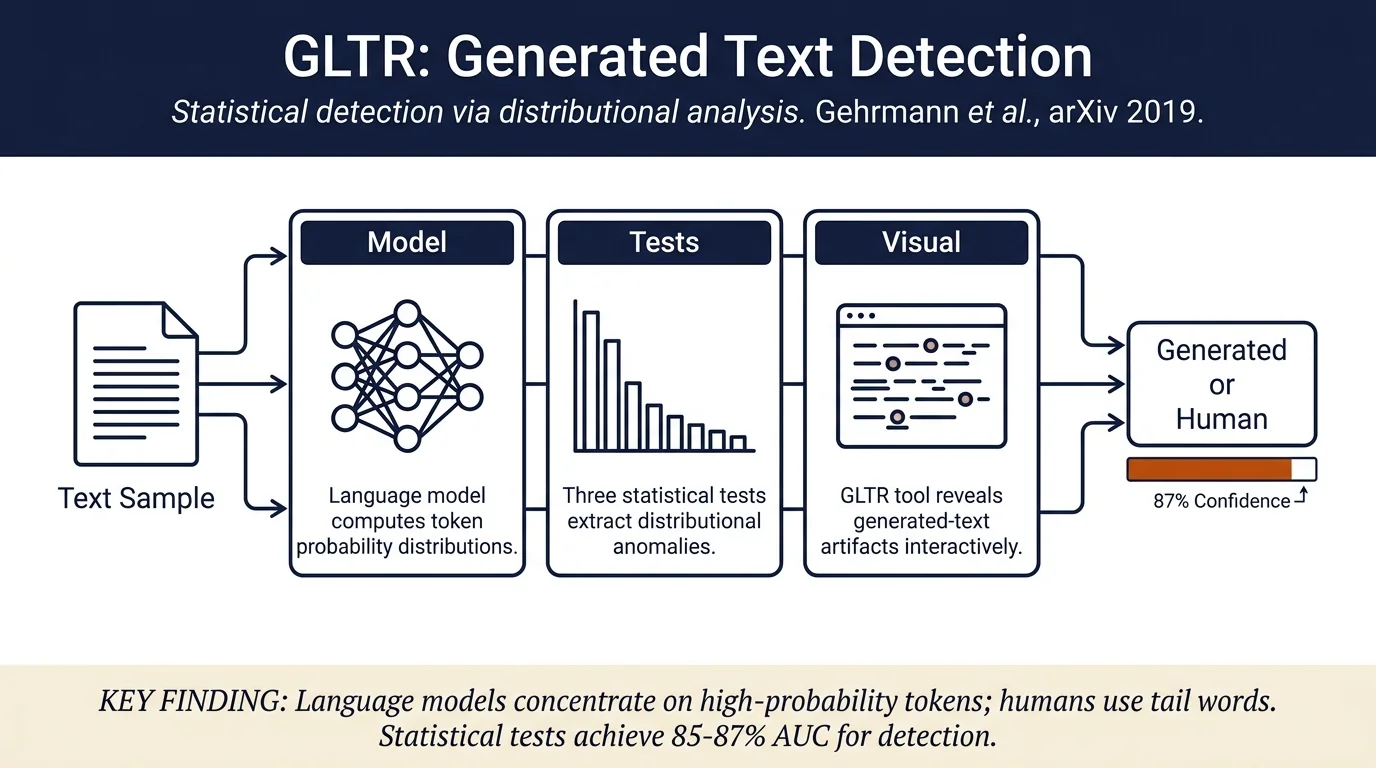
GLTR: Statistical Detection and Visualization of Generated TextGehrmann et al. present GLTR, a visual tool for detecting AI-generated text by analyzing statistical anomalies in language model output. The key insight is that language models sample from the head of the distribution (high-probability words), whereas humans use a wider vocabulary including low-probability choices.
 Deepfakes & multimodalDetection methods
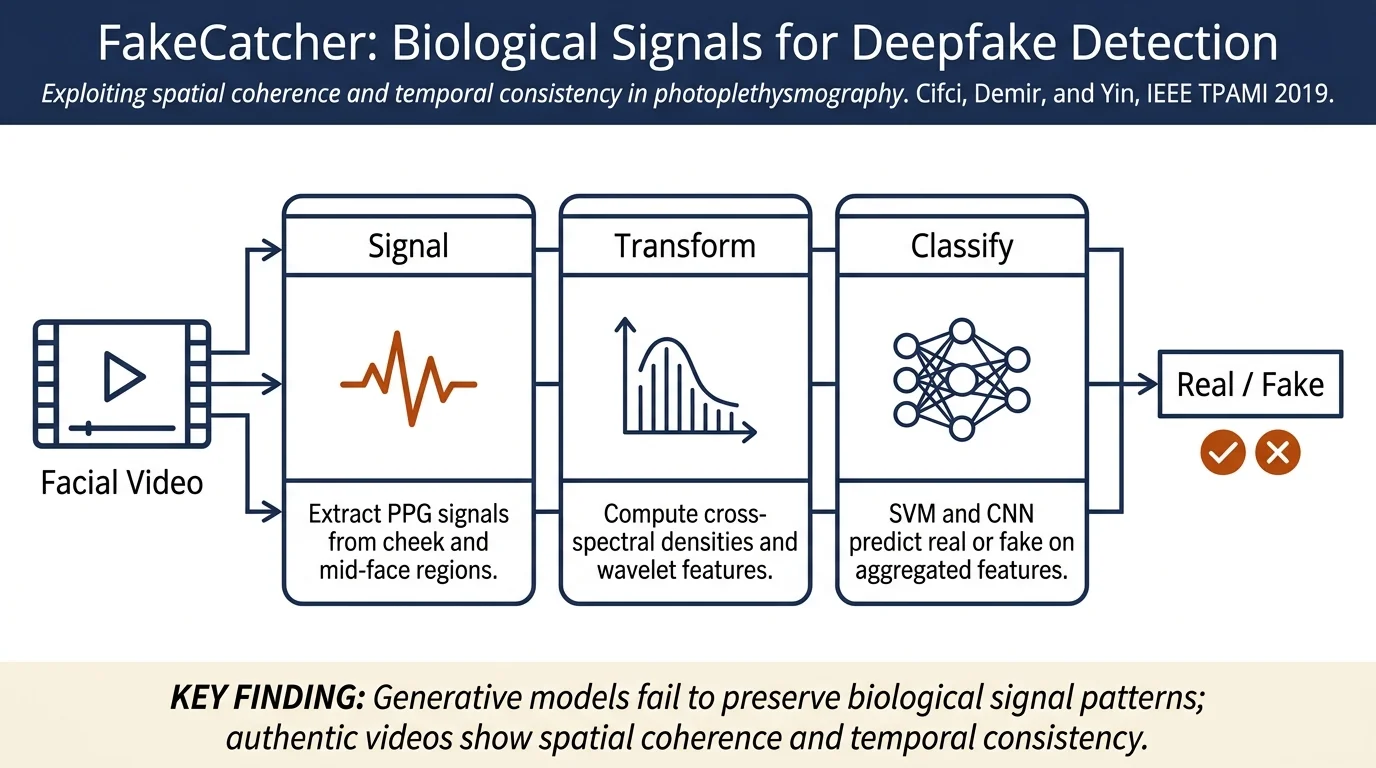
FakeCatcher: Detection of Synthetic Portrait Videos using Biological SignalsFakeCatcher detects deepfakes by analyzing biological signals (photoplethysmography—blood flow patterns) extracted from facial regions. The key insight is that generative models fail to preserve spatial coherence and temporal consistency of these signals in authentic videos, making biological signal analysis a powerful forensic tool…
 LLMs & generative AIDetection methods
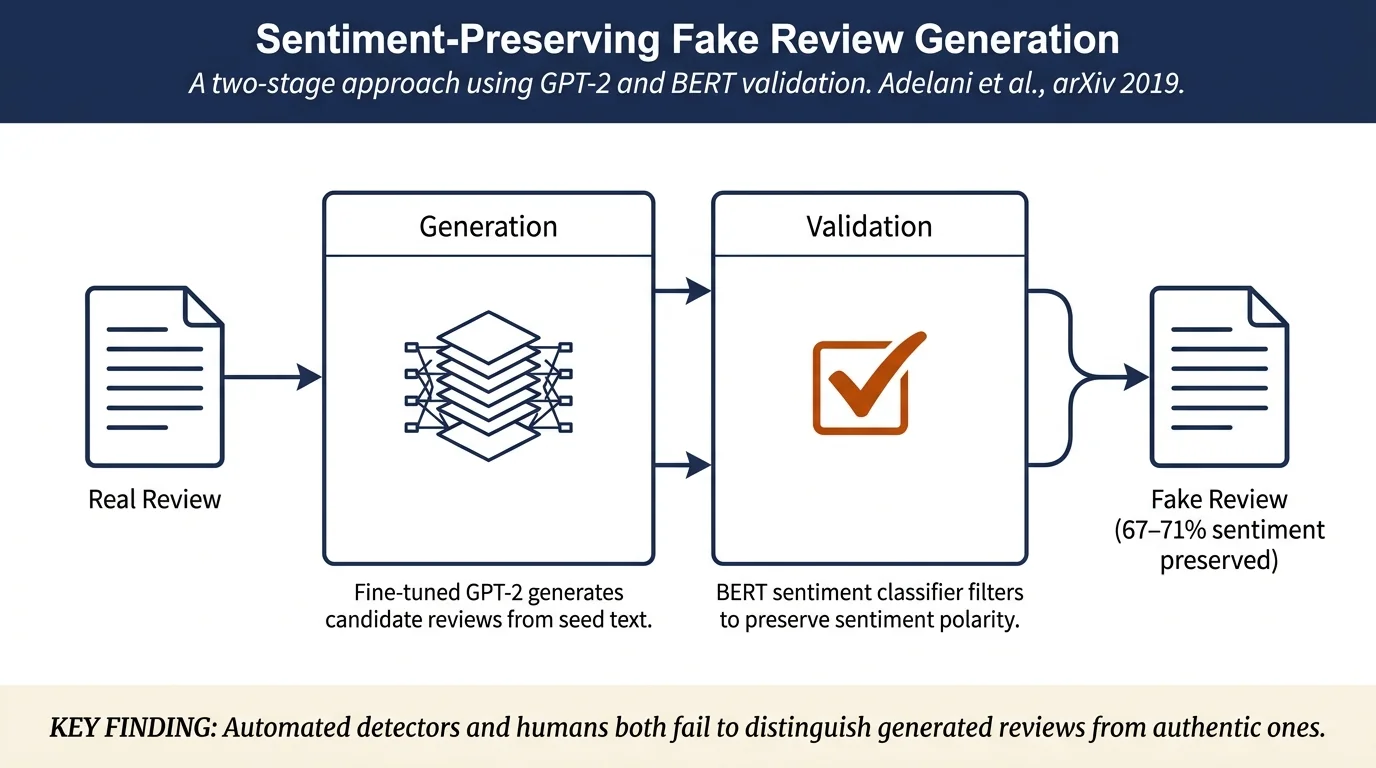
Generating Sentiment-Preserving Fake Online Reviews Using Neural Language Models and Their Human- and Machine-based DetectionThe paper demonstrates a practical attack where low-skilled adversaries can generate high-quality fake product reviews at scale by fine-tuning publicly available GPT-2 models on real review datasets. A two-step approach—generation plus BERT-based validation to preserve sentiment—produces reviews indistinguishable from genuine ones.
 LLMs & generative AIDetection methods
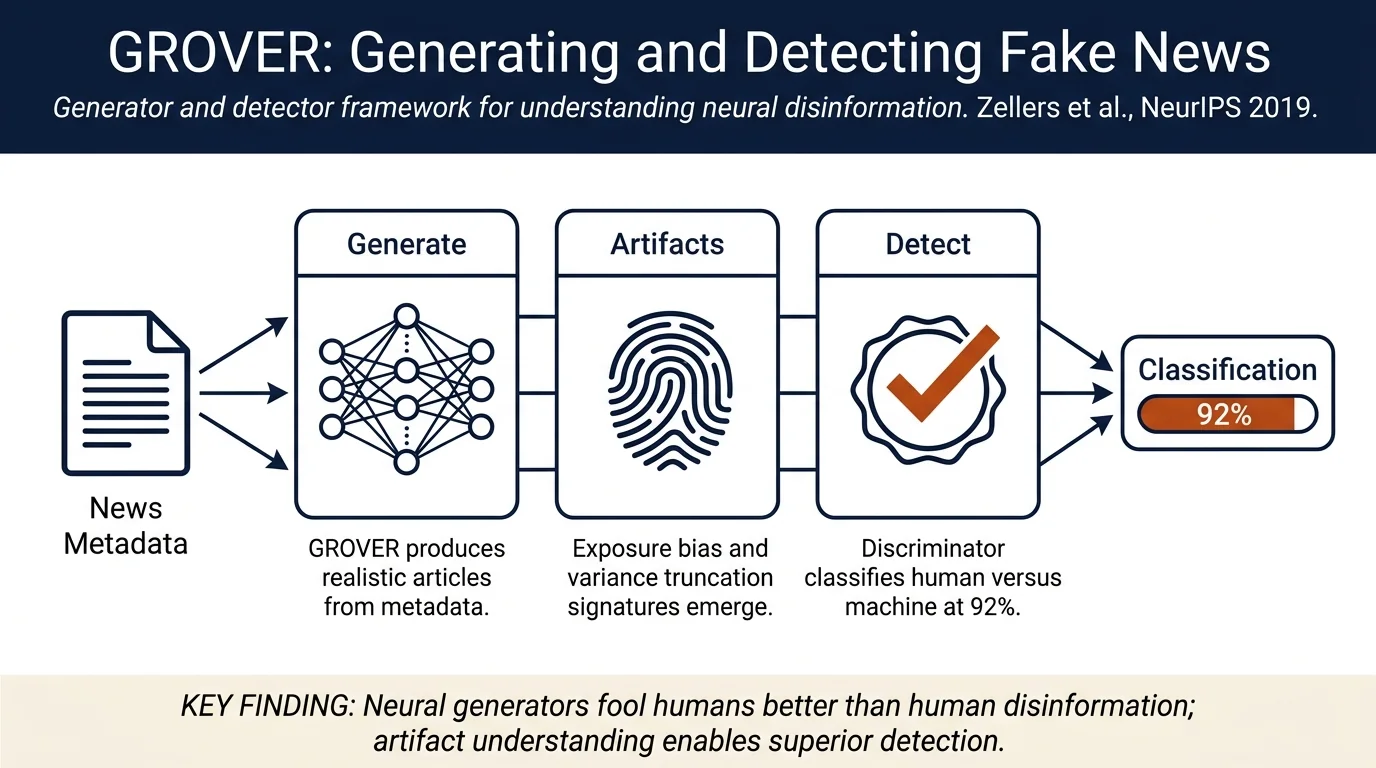
Defending Against Neural Fake NewsZellers et al. introduce GROVER, a conditional neural text generation model that can both generate and detect neural fake news. The paper shows that humans cannot reliably distinguish GROVER-generated propaganda from real human-written disinformation, rating machine-generated propaganda as more trustworthy (2.42/3 vs 2.19/3 for human…
 Spread & networksDetection methods
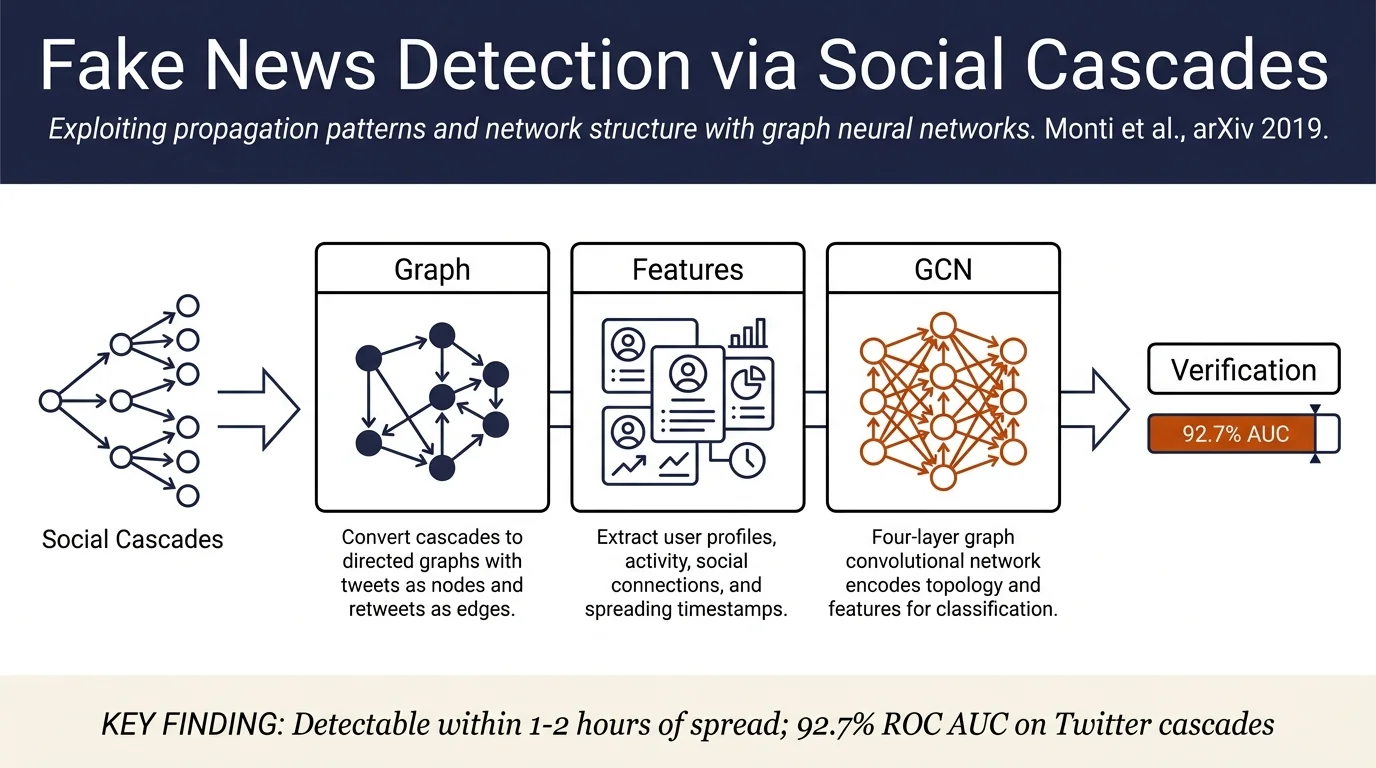
Fake News Detection on Social Media using Geometric Deep LearningA graph neural network approach for fake news detection that exploits social network structure and news propagation patterns rather than content alone. The method integrates user profiles, social connections, and cascade dynamics to achieve 92.7% ROC AUC on Twitter data and can detect fake news within hours of propagation.
 Detection methodsSpread & networks
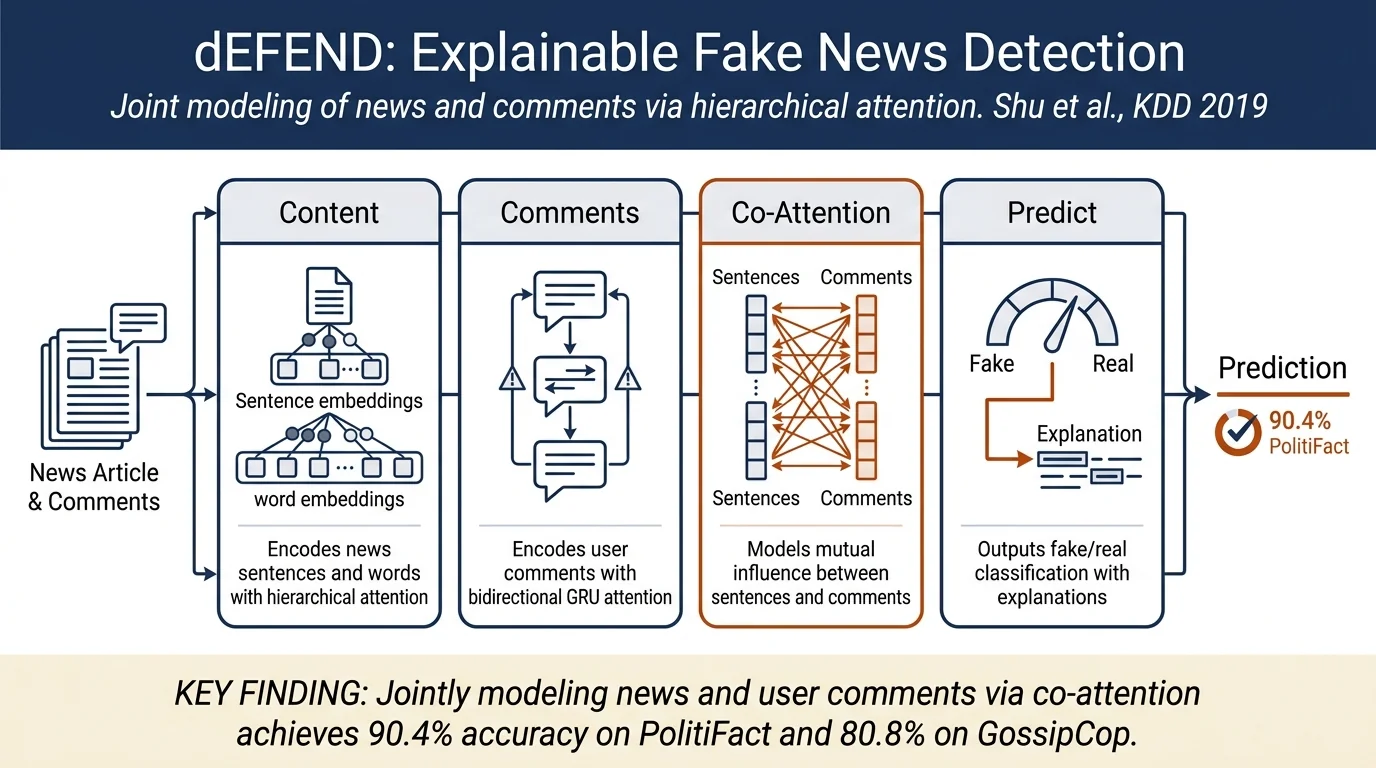
dEFEND: Explainable Fake News DetectionFake news detection on social media typically focuses on content alone, but user comments and reactions provide complementary signals. This paper proposes dEFEND, a hierarchical attention neural network that jointly encodes news sentences and user comments to both detect fake news and explain why a piece of news is detected as fake by…
 Detection methodsDatasets & evaluation
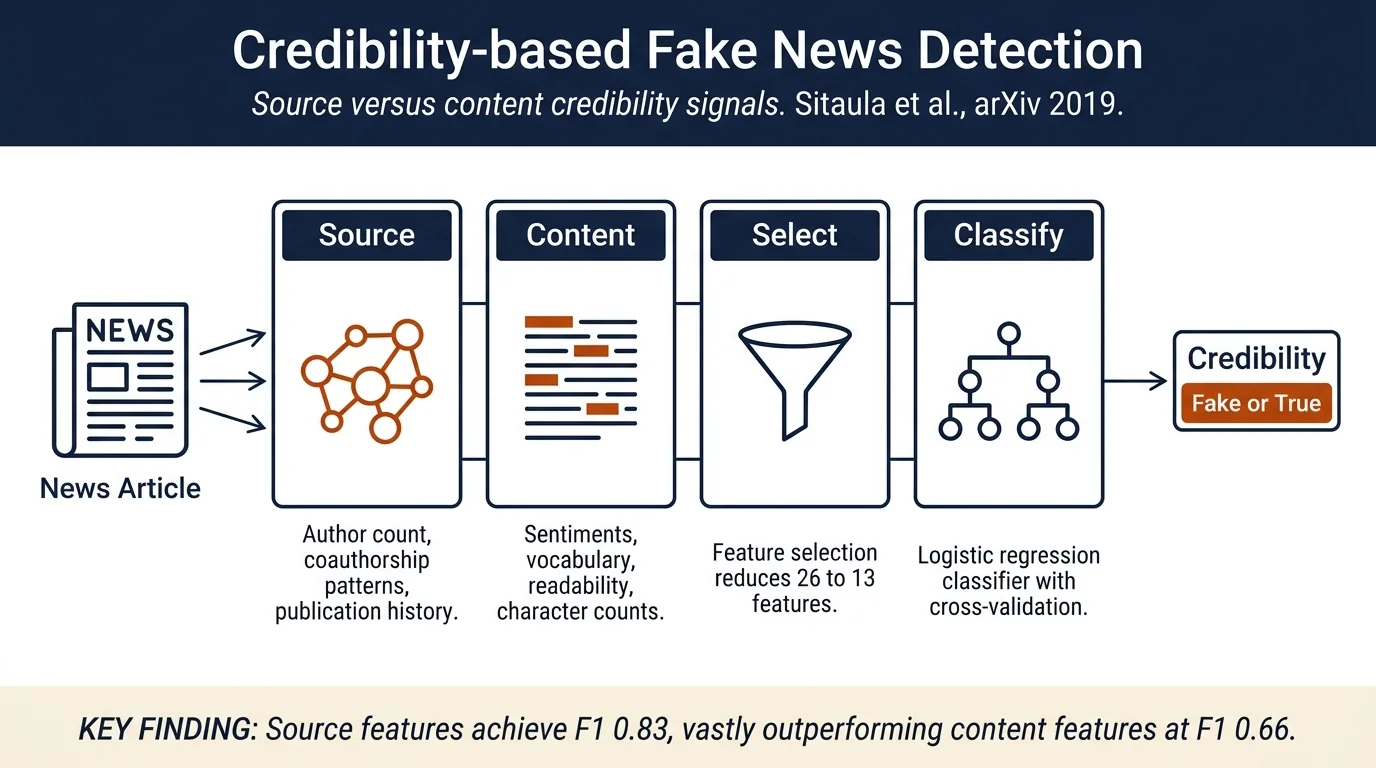
Credibility-based Fake News DetectionRather than relying solely on news text or propagation graphs, this paper frames fake news detection as a credibility assessment problem and operationalizes credibility through source-level signals (author count, coauthorship homophily, author publication history) and content-level signals (sentiments, domain vocabulary, argumentation,…
 Detection methodsDatasets & evaluation
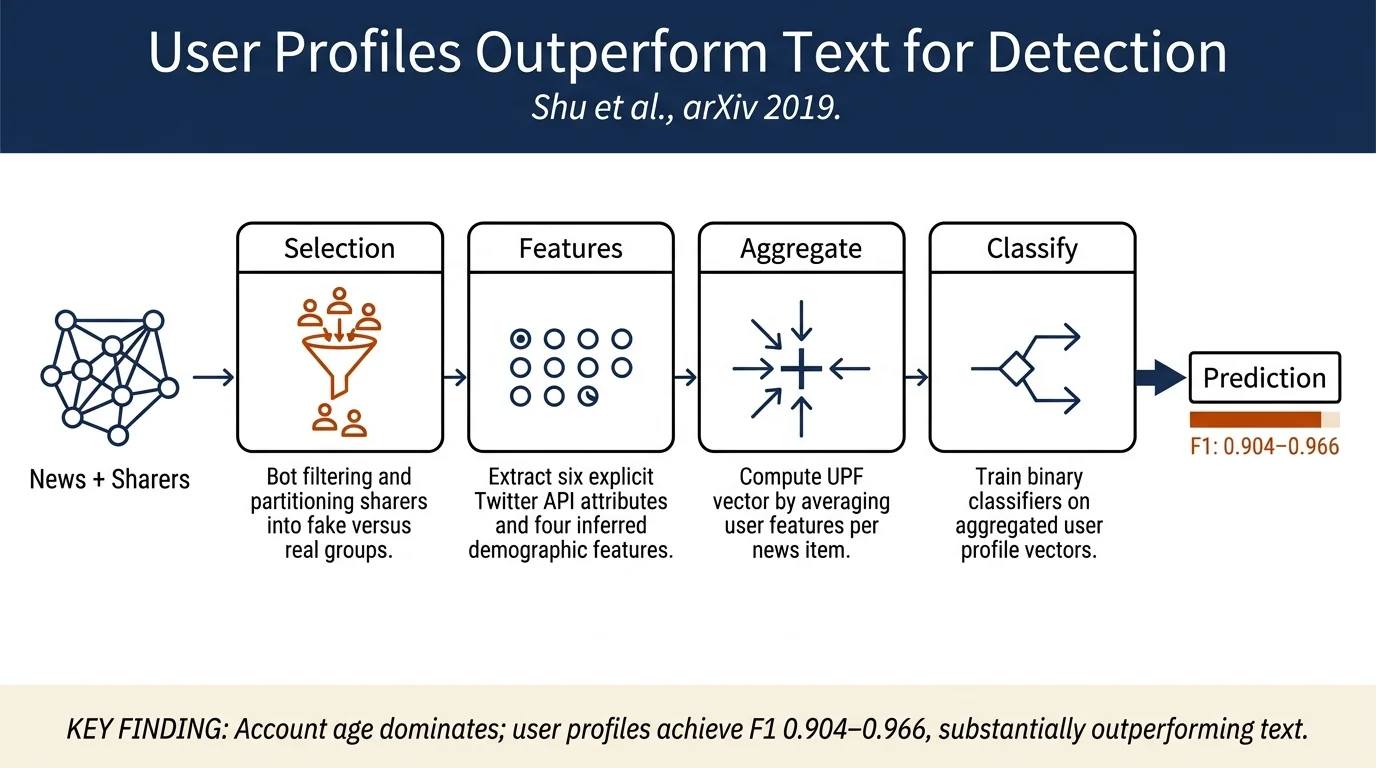
The Role of User Profiles for Fake News DetectionContent-only fake news detectors plateau because fake news is crafted to mimic real news textually. This paper systematically characterizes Twitter users who predominantly share fake versus real news across both partitions of FakeNewsNet (PolitiFact and GossipCop), comparing six explicit Twitter API attributes and four inferred implicit…
 Psychology & interventionsPlatforms, policy & society
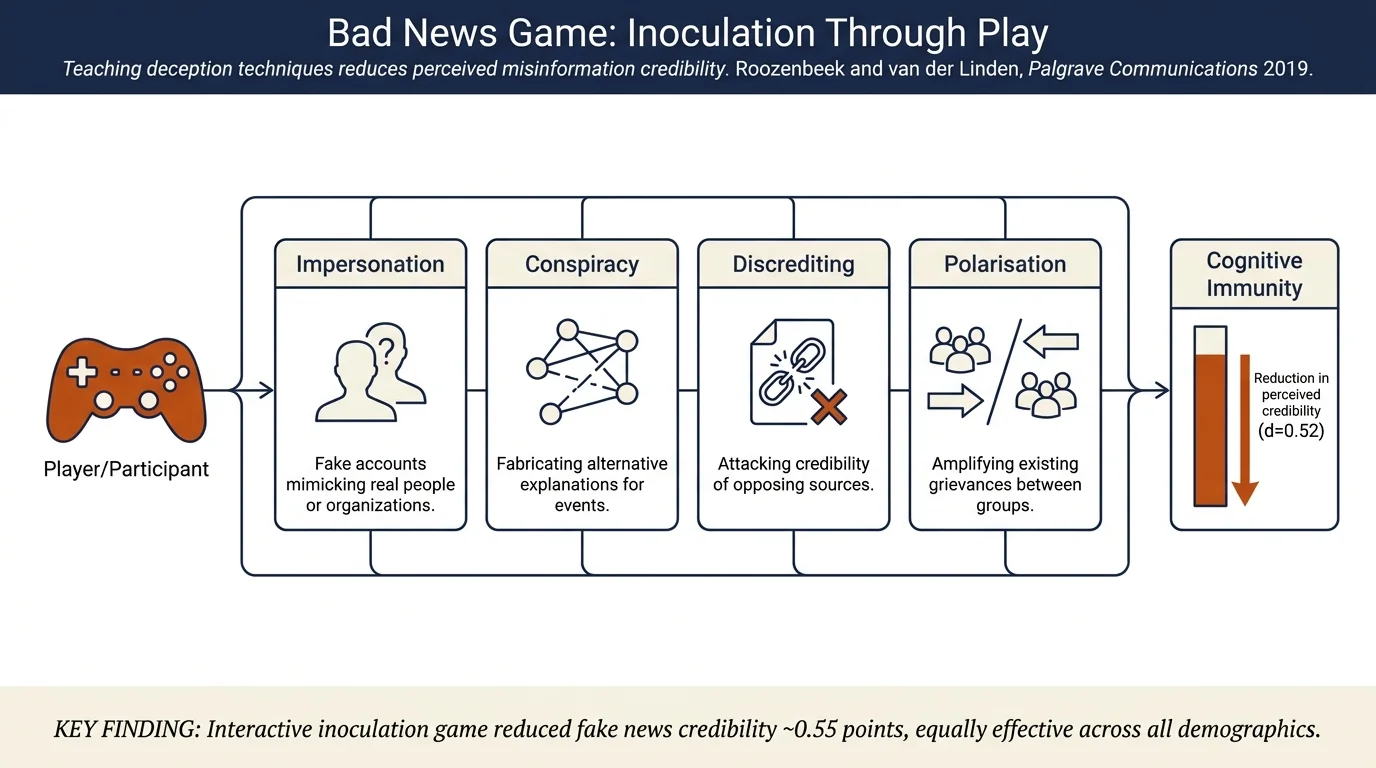
Fake news game confers psychological resistance against online misinformationThis large-scale empirical study demonstrates that a free ~15-minute online browser game teaching six common misinformation production techniques (polarisation, emotional manipulation, conspiracy theories, trolling, discrediting opponents, impersonation) significantly reduces perceived reliability of misinformation across N=15,000…
 Detection methodsDatasets & evaluation
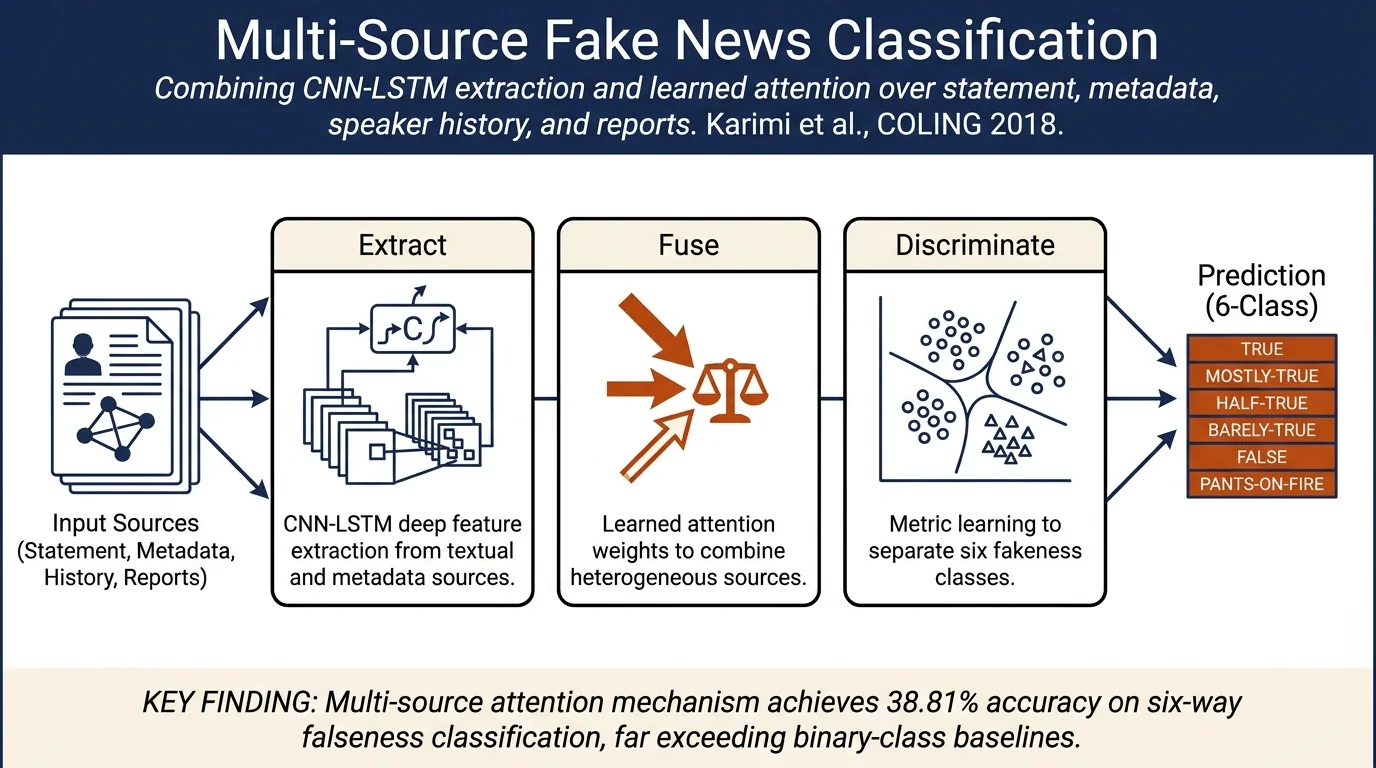
Multi-Source Multi-Class Fake News DetectionProposes MMFD, a multi-source multi-class fake news detection framework combining automated feature extraction (CNN-LSTM), interpretable multi-source fusion (attention mechanism), and fakeness discrimination. Achieves 38.81% accuracy on LIAR dataset across six classes of fakeness (true, mostly-true, half-true, barely-true, false,…
 Deepfakes & multimodalDetection methods
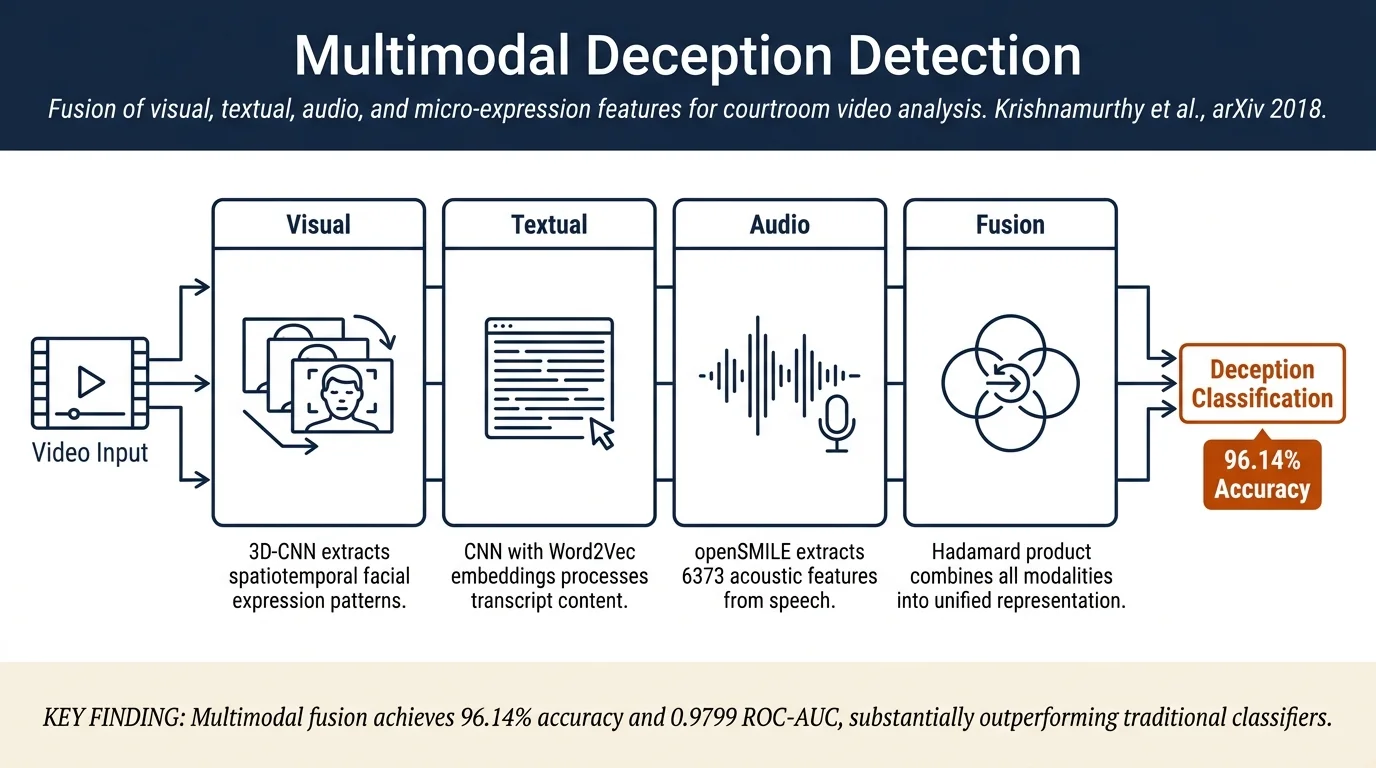
A Deep Learning Approach for Multimodal Deception DetectionThis paper proposes a multimodal neural model for detecting deception in real-life courtroom trial videos by combining visual features from 3D-CNN, audio features from openSMILE, textual features from CNN on transcripts, and manual micro-expression annotations. The model achieves 96.14% accuracy and ROC-AUC of 0.9799, substantially…
 Detection methodsDatasets & evaluation
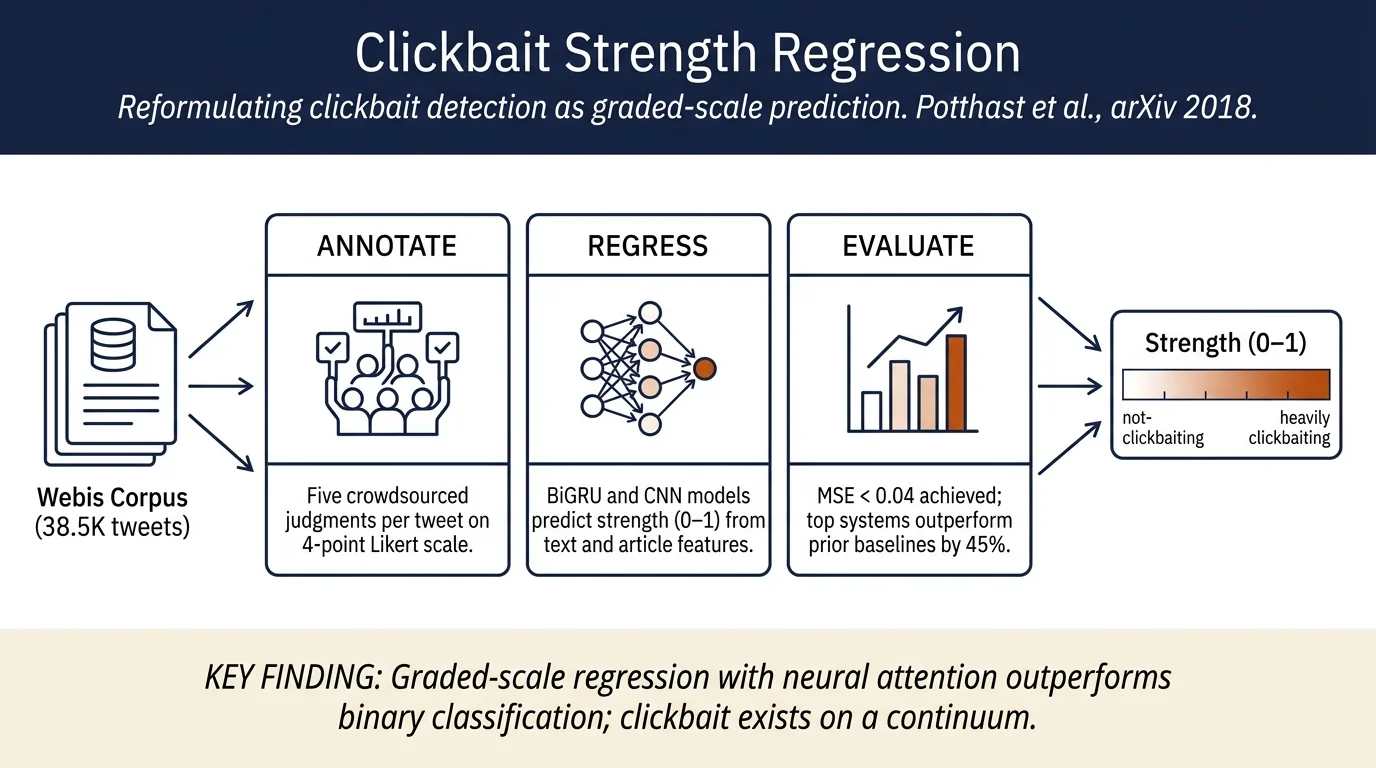
The Clickbait Challenge 2017: Towards a Regression Model for Clickbait StrengthClickbait detection is typically framed as binary classification, but teaser messages exhibit varying degrees of clickbaiting techniques. This paper organizes the Clickbait Challenge 2017, reformulating the task as regression to measure clickbait strength on a graded scale.
 Detection methodsLLMs & generative AI
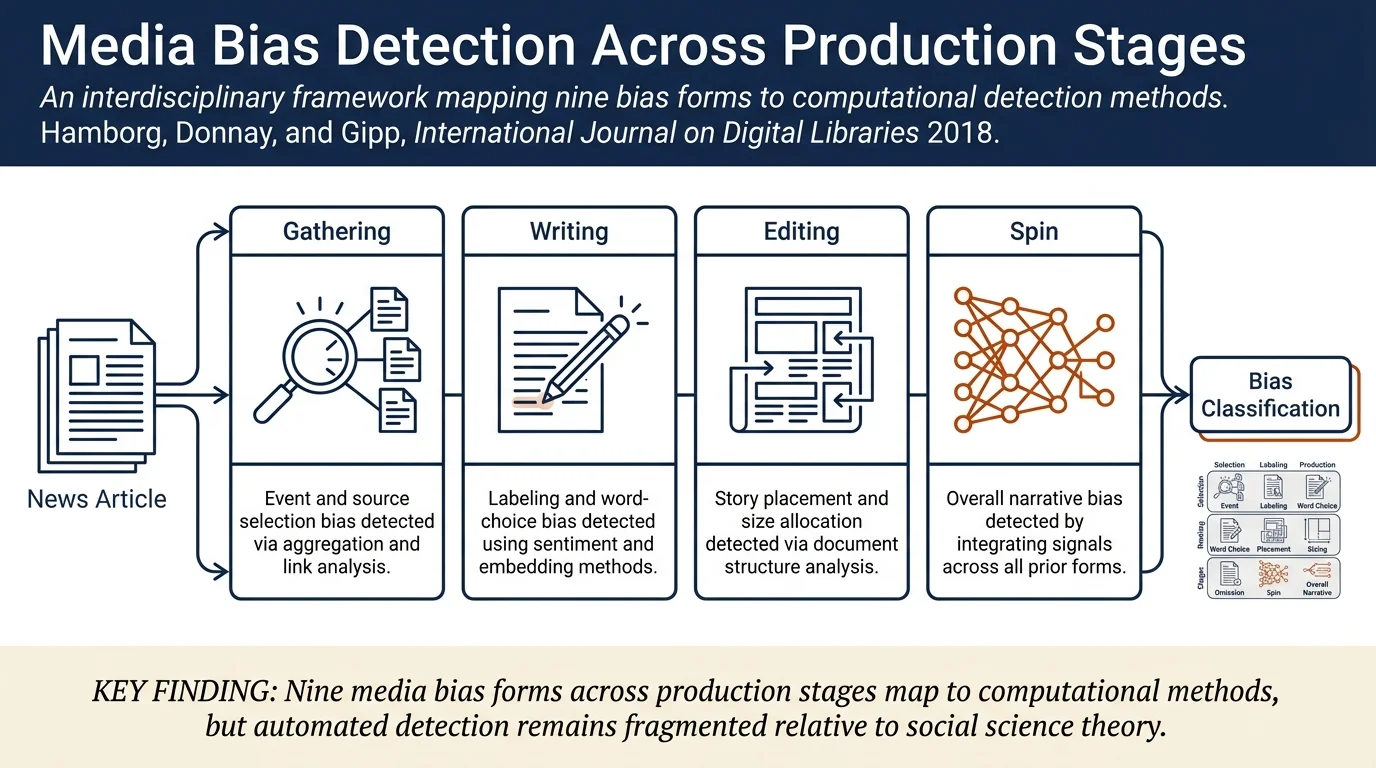
Automated identification of media bias in news articles: an interdisciplinary literature reviewThis paper surveys automated and manual methods for identifying media bias in news articles, bridging social science and computer science approaches. It defines nine distinct forms of media bias and maps social science research onto computational techniques, finding that NLP-based methods are promising for automated detection but remain…
 Platforms, policy & societyDeepfakes & multimodal
The Malicious Use of Artificial Intelligence: Forecasting, Prevention, and MitigationA landmark 2018 report surveying the landscape of potential security threats from malicious uses of AI across three domains—digital, physical, and political security. The work proposes frameworks for forecasting AI-enabled attacks, identifies specific threat scenarios including AI-generated disinformation and deepfakes, and recommends…
 Deepfakes & multimodalDetection methods
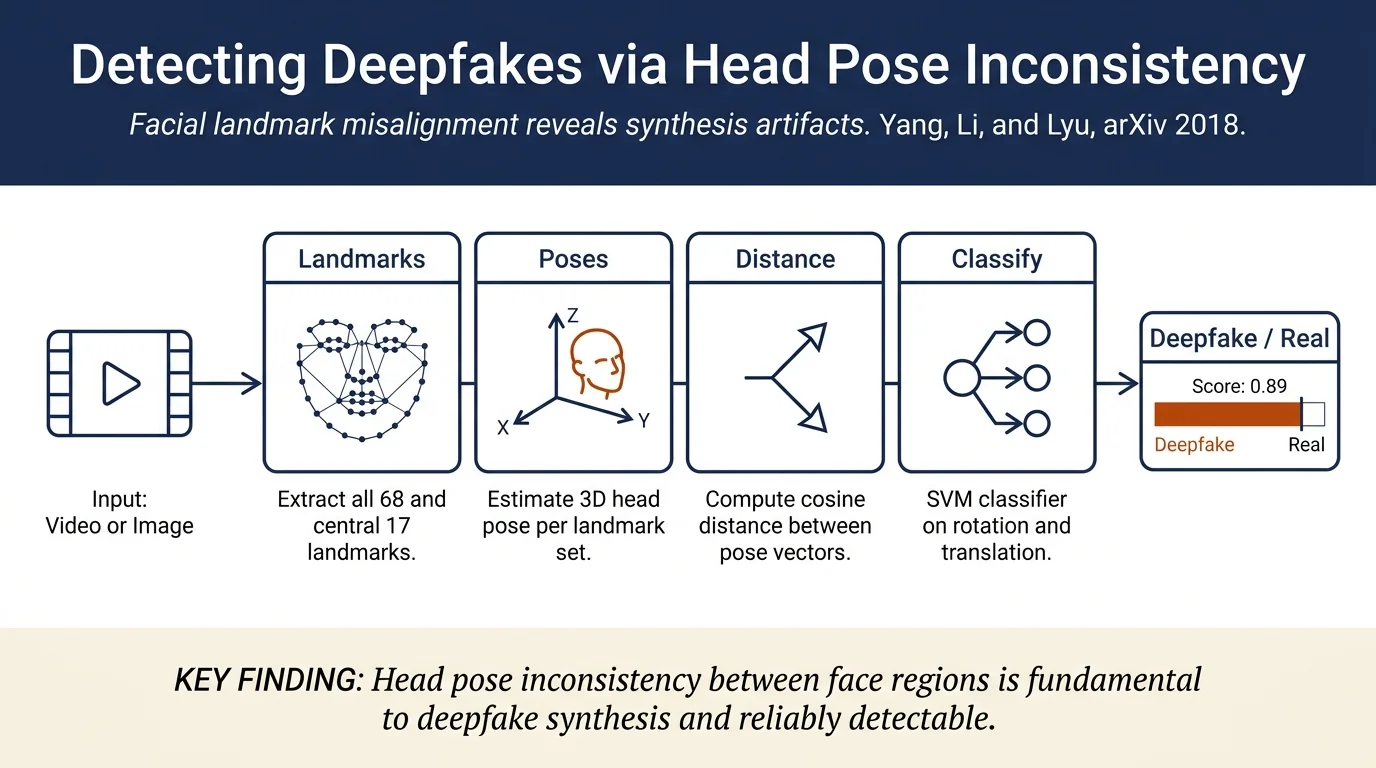
Exposing Deep Fakes Using Inconsistent Head PosesDeepfakes splice a synthesized face into an original image, introducing landmark misalignment errors invisible to the eye but detectable through 3D head pose estimation. The method compares head poses estimated from all facial landmarks versus only the central region; real faces show consistent poses while deepfakes exhibit large…