Explore everything
Filter by research area, year and venue. Every filter is in the address bar, so you can share a view as a link.
 Bots & coordinated campaignsDatasets & evaluation
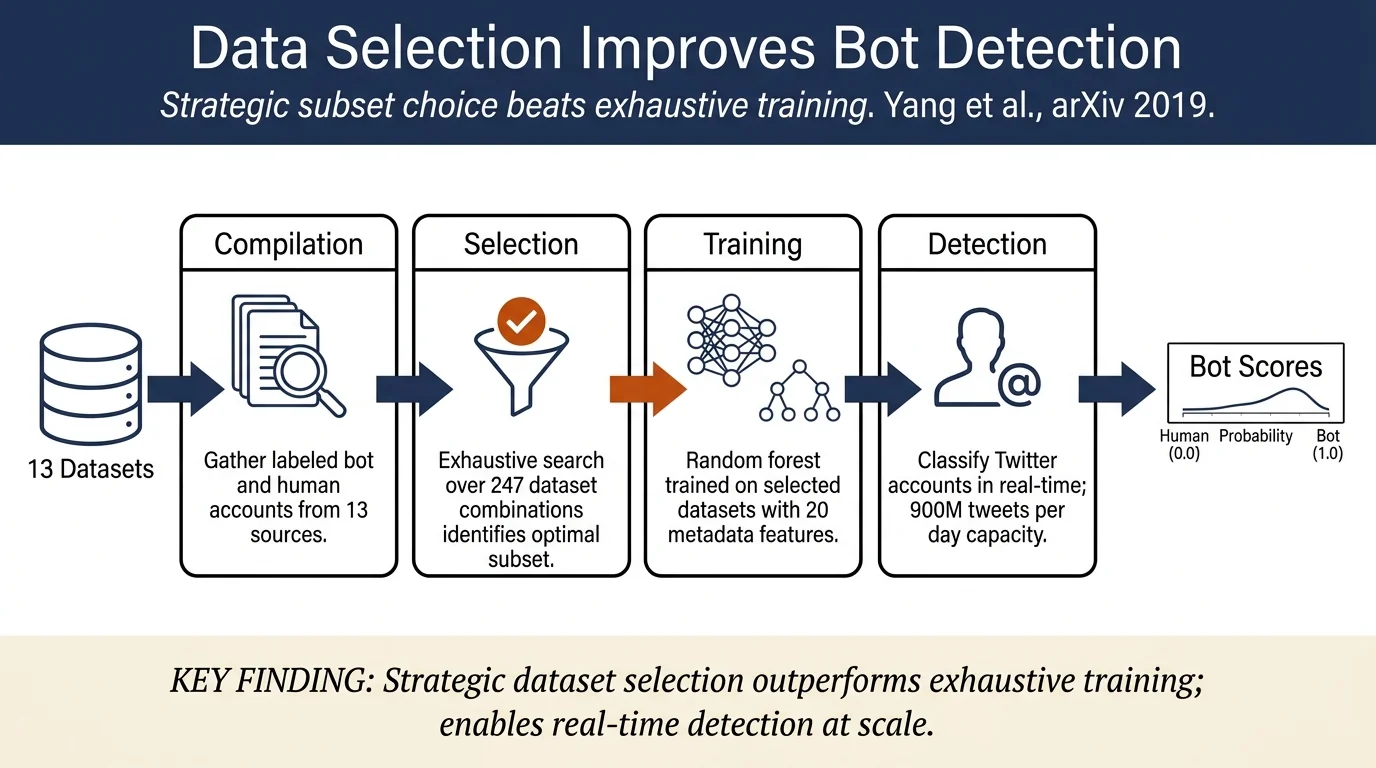
Scalable and Generalizable Social Bot Detection through Data SelectionThis paper addresses scalability and generalization challenges in social bot detection by proposing a framework using only 20 user metadata features, enabling real-time analysis of the full Twitter stream. The key insight is that strategic data selection—training on a carefully chosen subset of 13 compiled datasets—achieves better…
 Spread & networksDetection methods
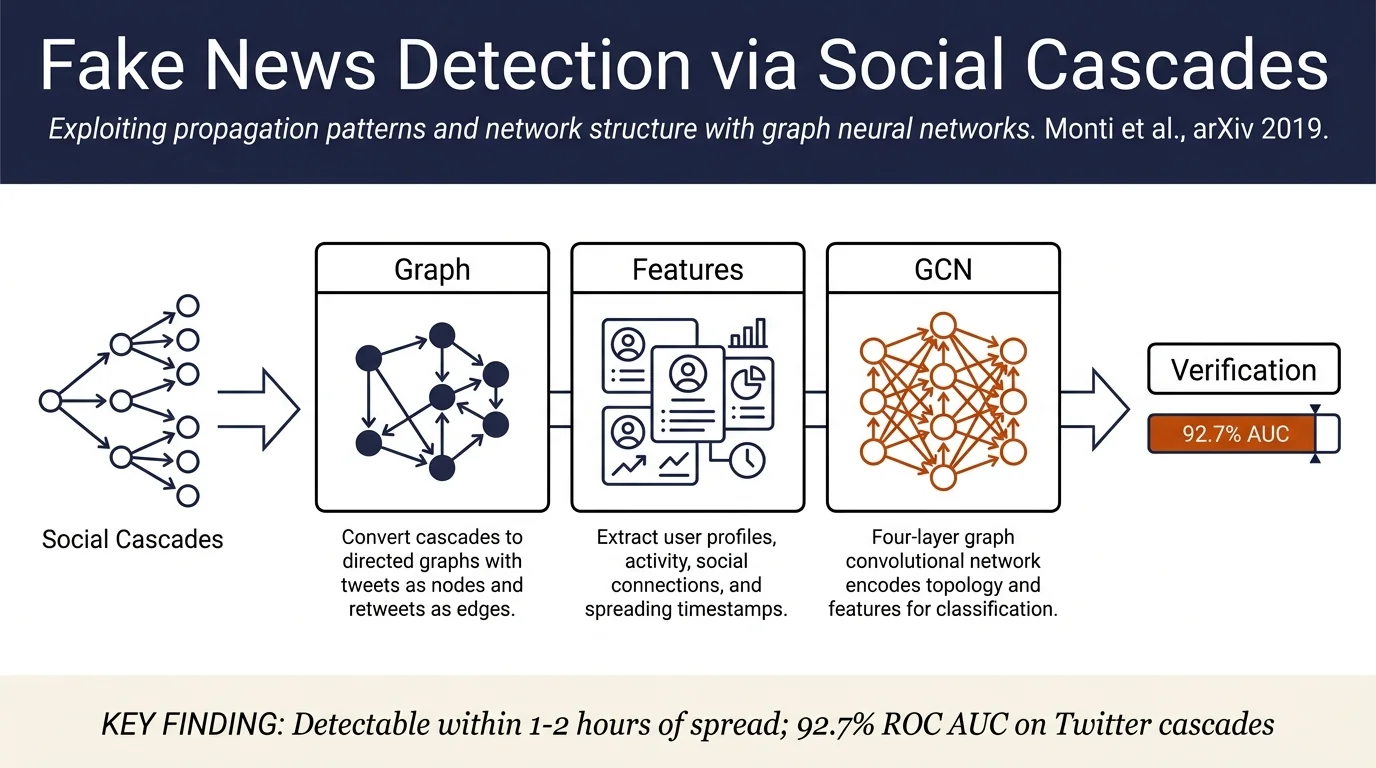
Fake News Detection on Social Media using Geometric Deep LearningA graph neural network approach for fake news detection that exploits social network structure and news propagation patterns rather than content alone. The method integrates user profiles, social connections, and cascade dynamics to achieve 92.7% ROC AUC on Twitter data and can detect fake news within hours of propagation.
 Spread & networksDetection methods
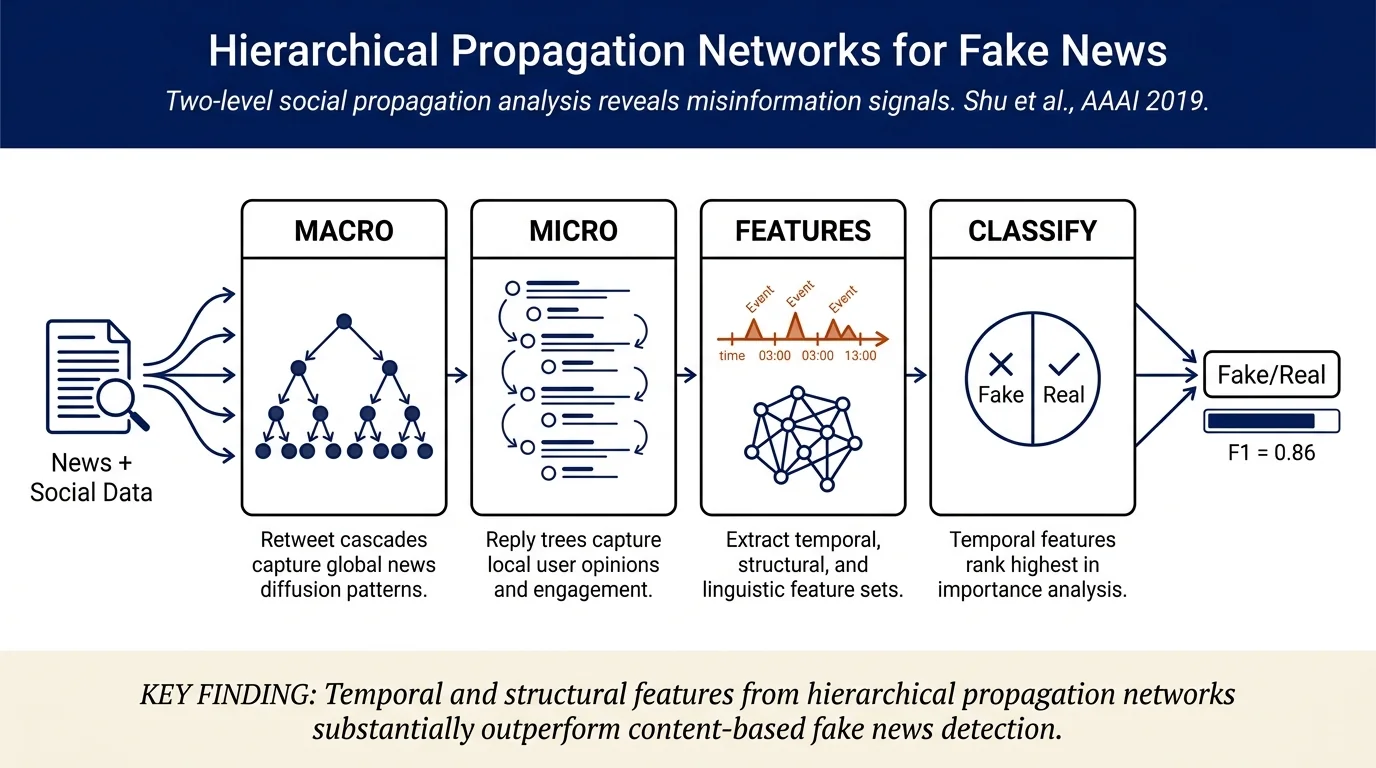
Hierarchical Propagation Networks for Fake News Detection: Investigation and ExploitationContent-only fake news detection has limited performance because fake news is deliberately crafted to mimic real news. This paper constructs hierarchical propagation networks from both macro-level (tweet/retweet cascade) and micro-level (reply conversation) granularity, extracts structural, temporal, and linguistic features from both…
 Detection methodsDatasets & evaluation
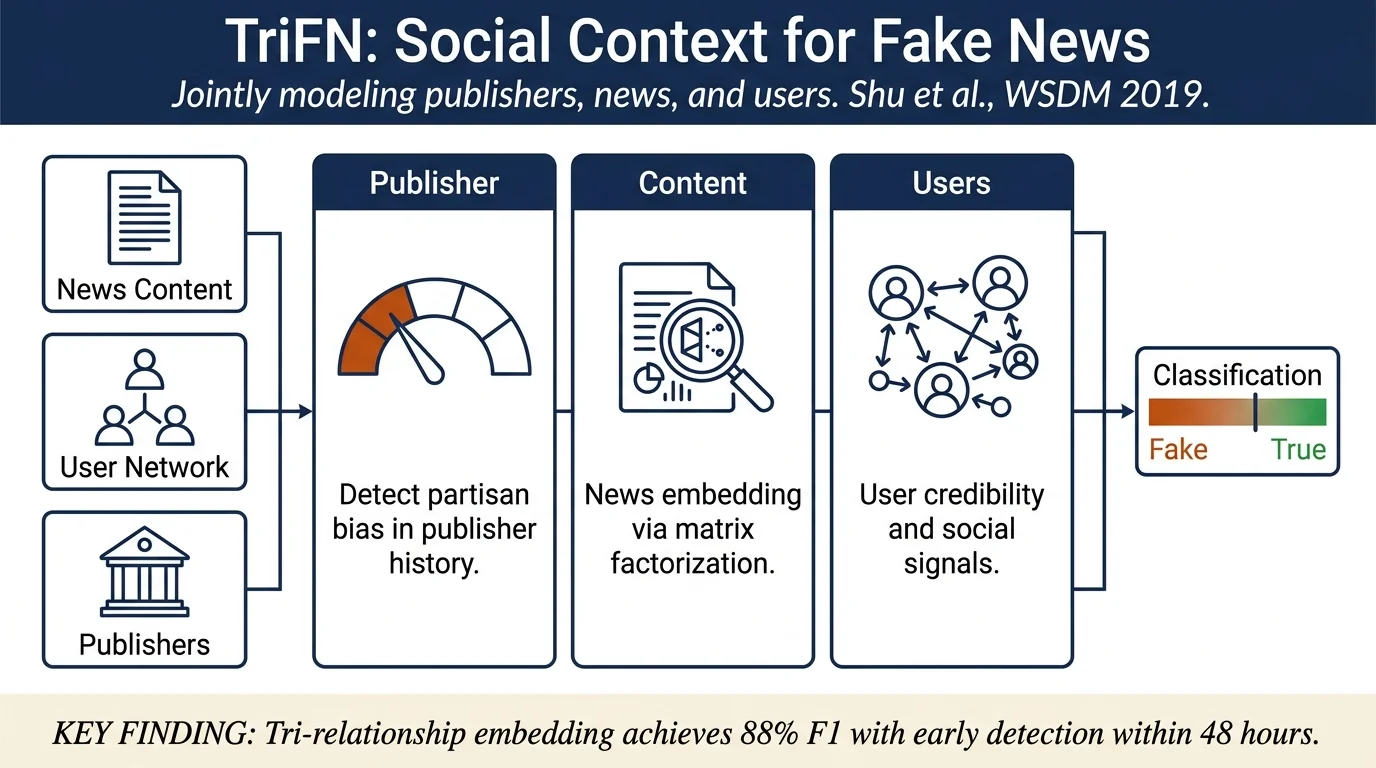
Beyond News Contents: The Role of Social Context for Fake News DetectionContent-only detection is insufficient because fake news is crafted to mimic real news. This paper argues that the tri-relationship among publishers, news pieces, and users forms rich social context for detection: partisan-biased publishers more likely publish fake news, and low-credibility users more likely share it.
 LLMs & generative AIDetection methods
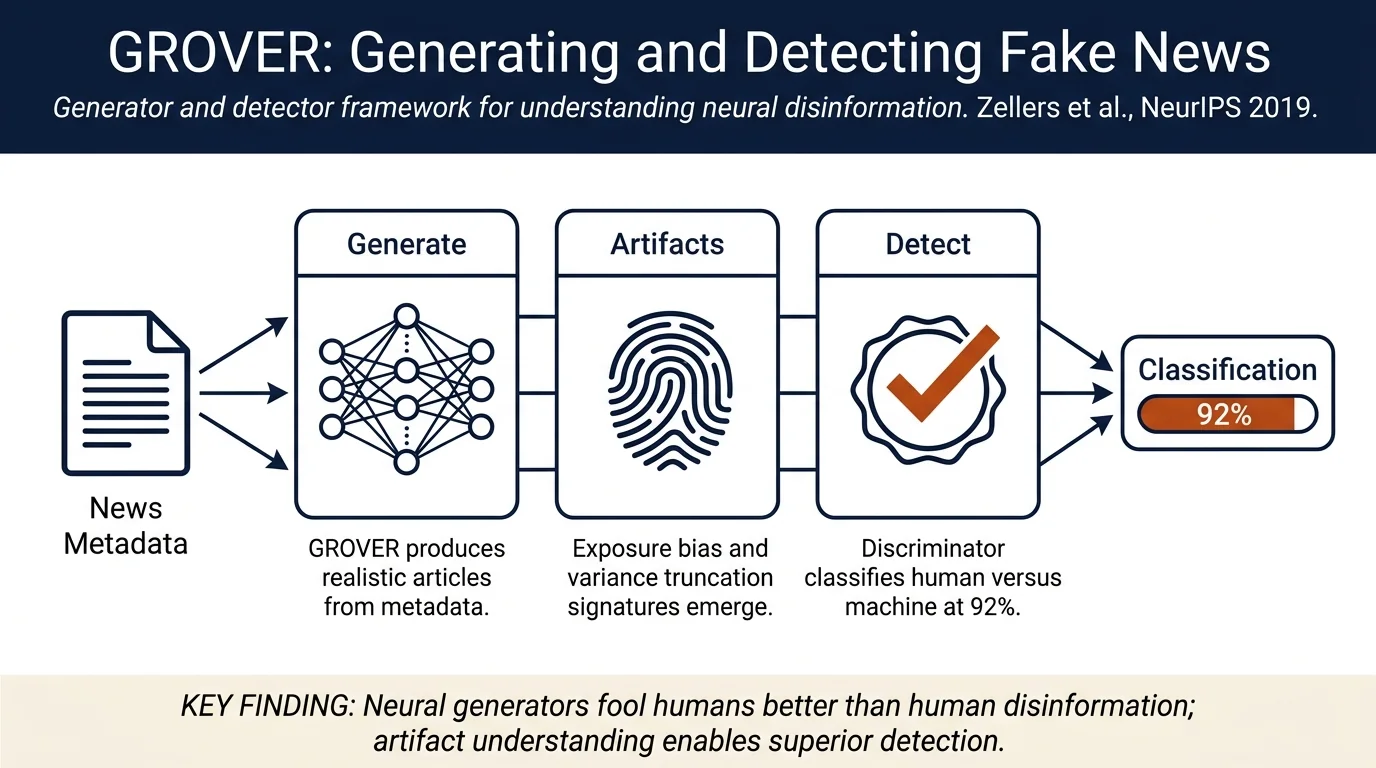
Defending Against Neural Fake NewsZellers et al. introduce GROVER, a conditional neural text generation model that can both generate and detect neural fake news. The paper shows that humans cannot reliably distinguish GROVER-generated propaganda from real human-written disinformation, rating machine-generated propaganda as more trustworthy (2.42/3 vs 2.19/3 for human…
 Deepfakes & multimodalDetection methods
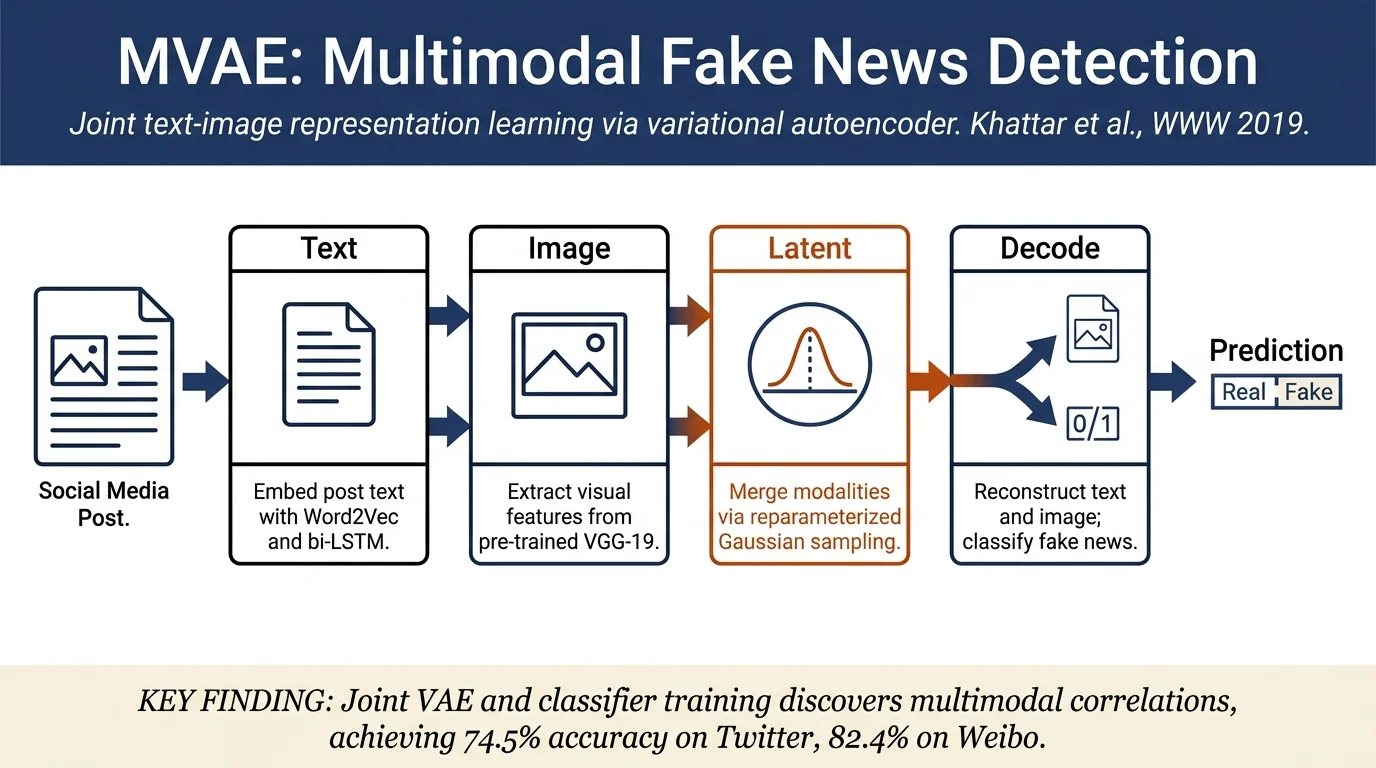
MVAE: Multimodal Variational Autoencoder for Fake News DetectionThe paper proposes MVAE, a variational autoencoder that learns shared representations of text and images in social media posts to detect fake news. The model jointly trains an encoder-decoder (to discover correlations across modalities) with a binary classifier.
 Detection methodsSpread & networks
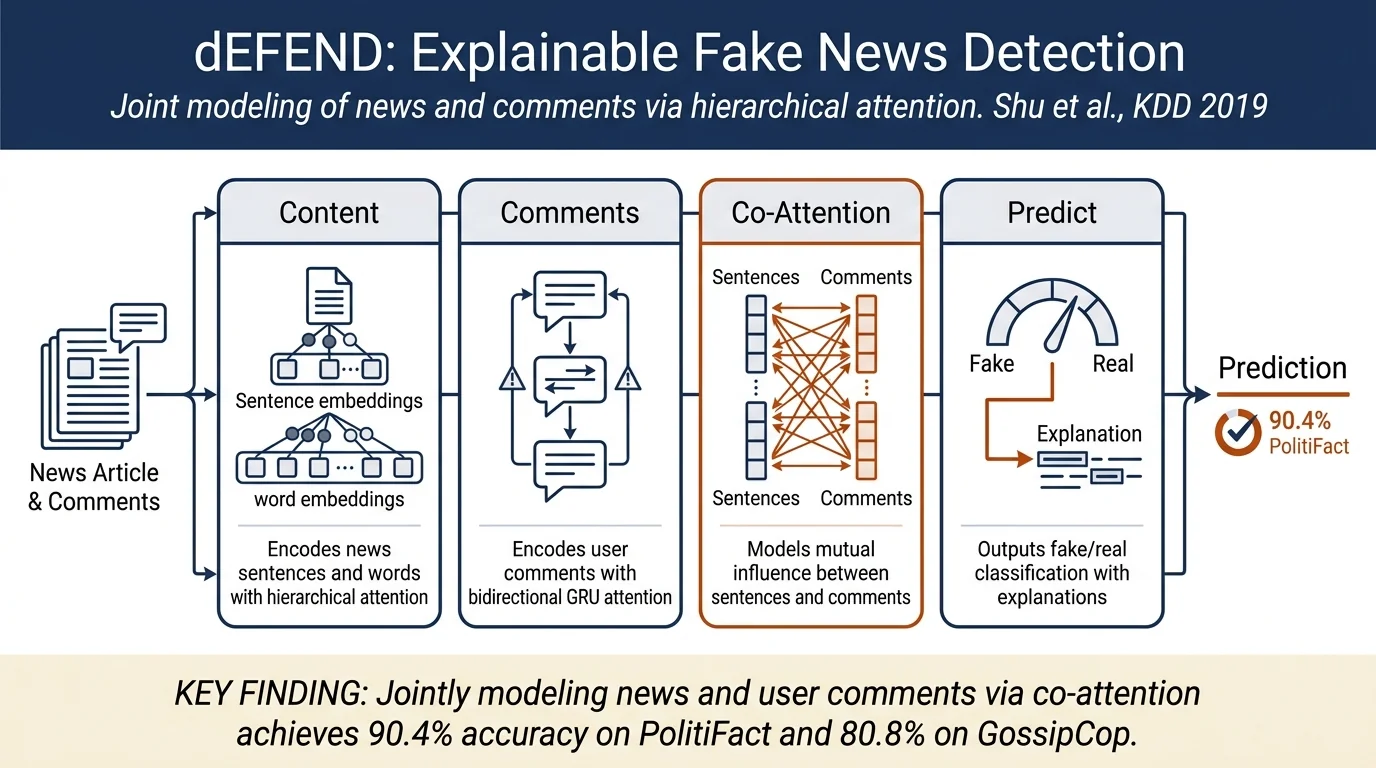
dEFEND: Explainable Fake News DetectionFake news detection on social media typically focuses on content alone, but user comments and reactions provide complementary signals. This paper proposes dEFEND, a hierarchical attention neural network that jointly encodes news sentences and user comments to both detect fake news and explain why a piece of news is detected as fake by…
 Spread & networksDetection methods
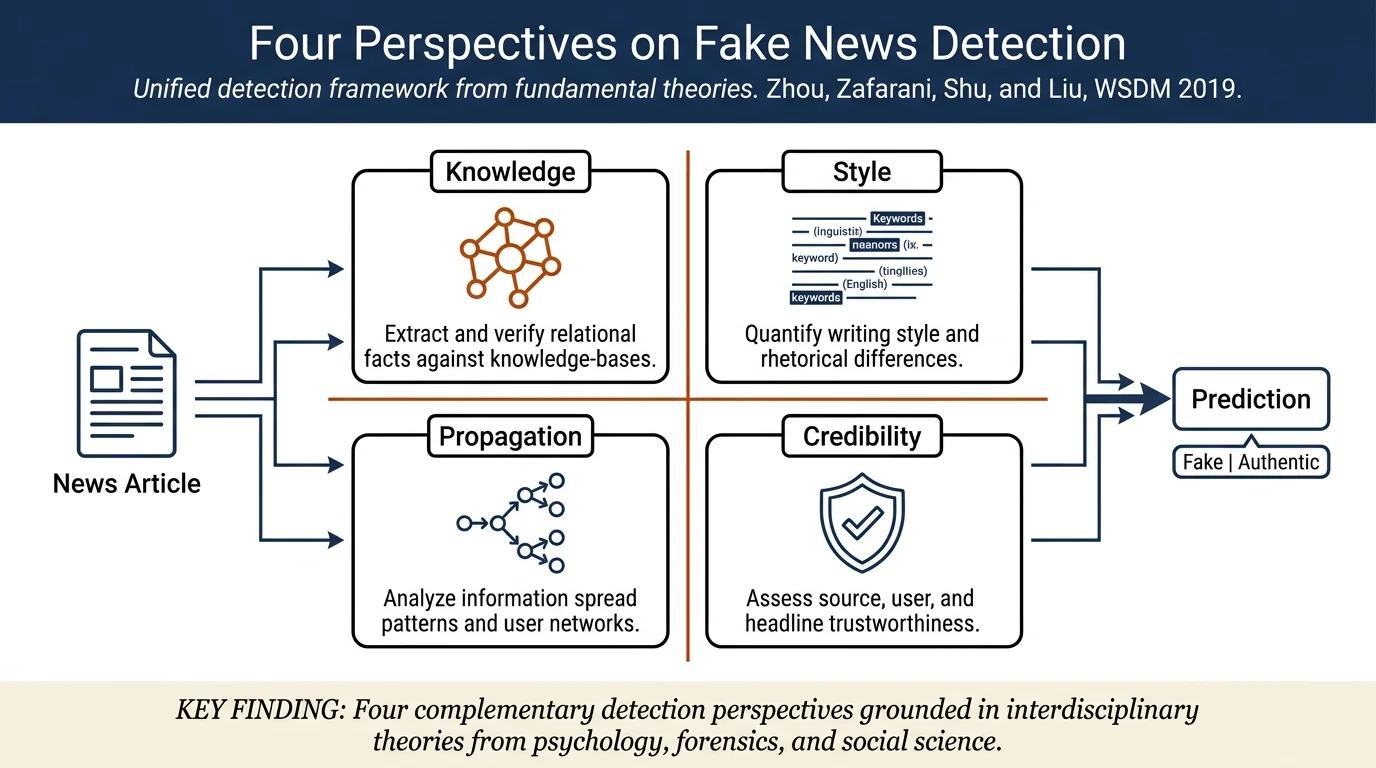
Fake News: Fundamental Theories, Detection Strategies and ChallengesA comprehensive tutorial framework addressing fake news research across three dimensions: (1) fundamental theories from psychology, social science, economics, and forensics explaining human vulnerability to misinformation and why individuals participate in fake news activities; (2) detection strategies unified across four perspectives…
 Detection methodsDatasets & evaluation
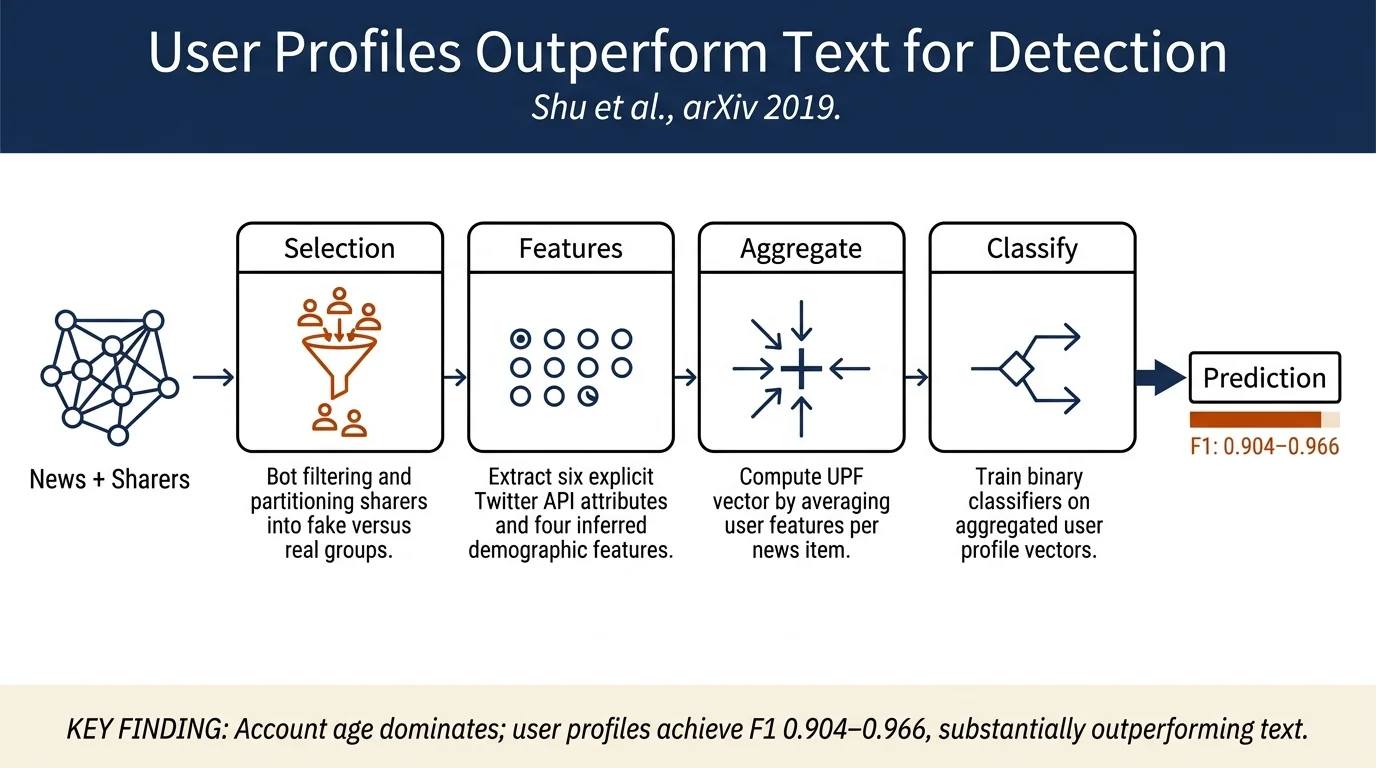
The Role of User Profiles for Fake News DetectionContent-only fake news detectors plateau because fake news is crafted to mimic real news textually. This paper systematically characterizes Twitter users who predominantly share fake versus real news across both partitions of FakeNewsNet (PolitiFact and GossipCop), comparing six explicit Twitter API attributes and four inferred implicit…
 Detection methodsDatasets & evaluation
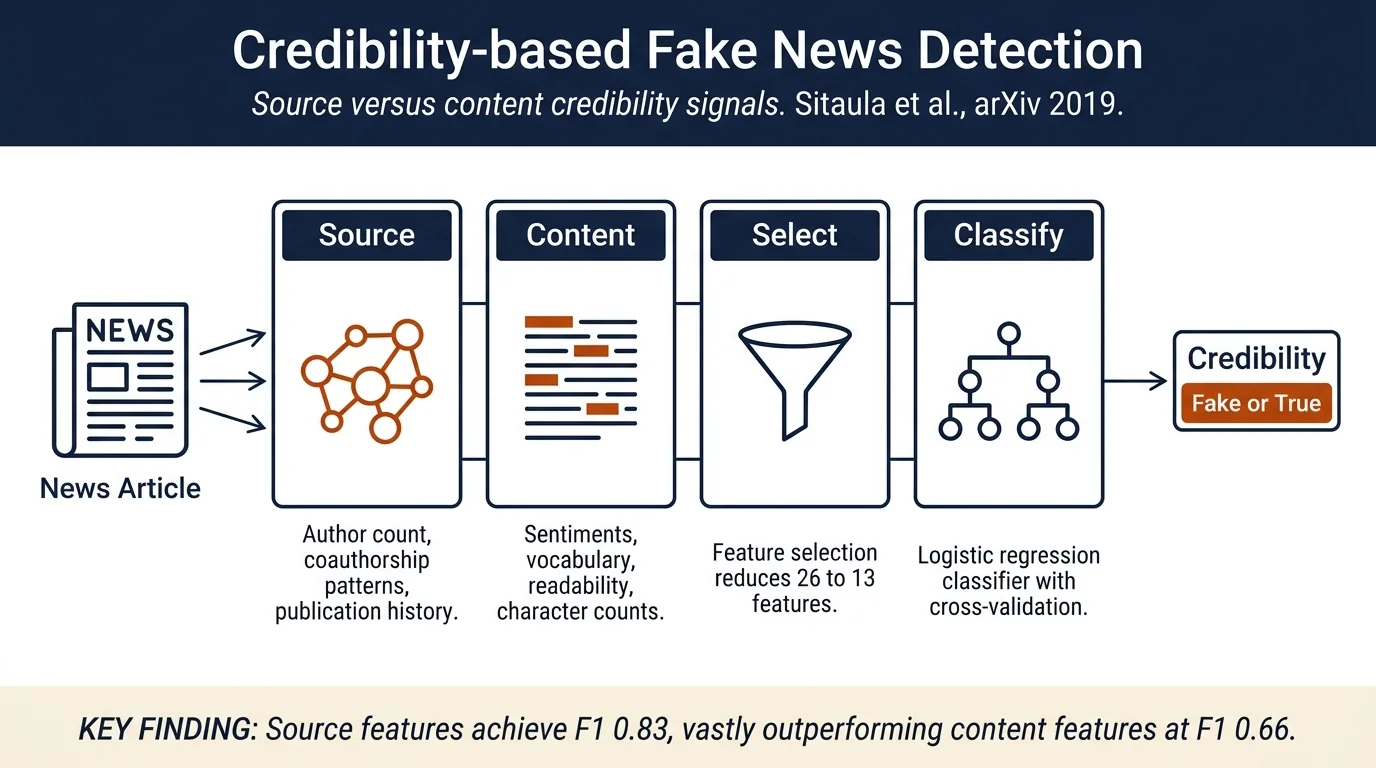
Credibility-based Fake News DetectionRather than relying solely on news text or propagation graphs, this paper frames fake news detection as a credibility assessment problem and operationalizes credibility through source-level signals (author count, coauthorship homophily, author publication history) and content-level signals (sentiments, domain vocabulary, argumentation,…
 Spread & networksDetection methods
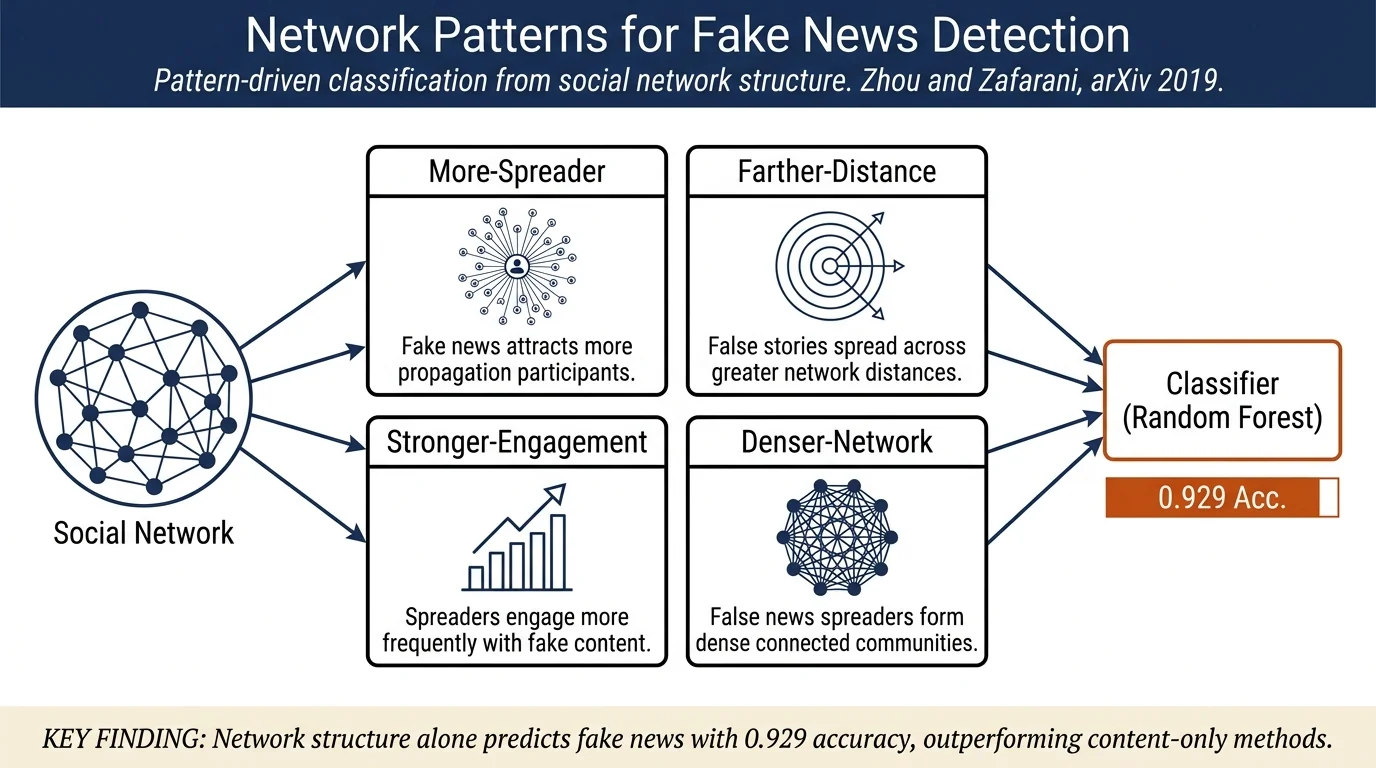
Network-based Fake News Detection: A Pattern-driven ApproachThis paper proposes a pattern-driven, network-based fake news detection model that identifies and quantifies four empirically grounded behavioral patterns in social networks: fake news attracts more spreaders, spreads farther, elicits stronger engagement, and is spread by denser networks than true news. These patterns are operationalized…
 Detection methodsDatasets & evaluation
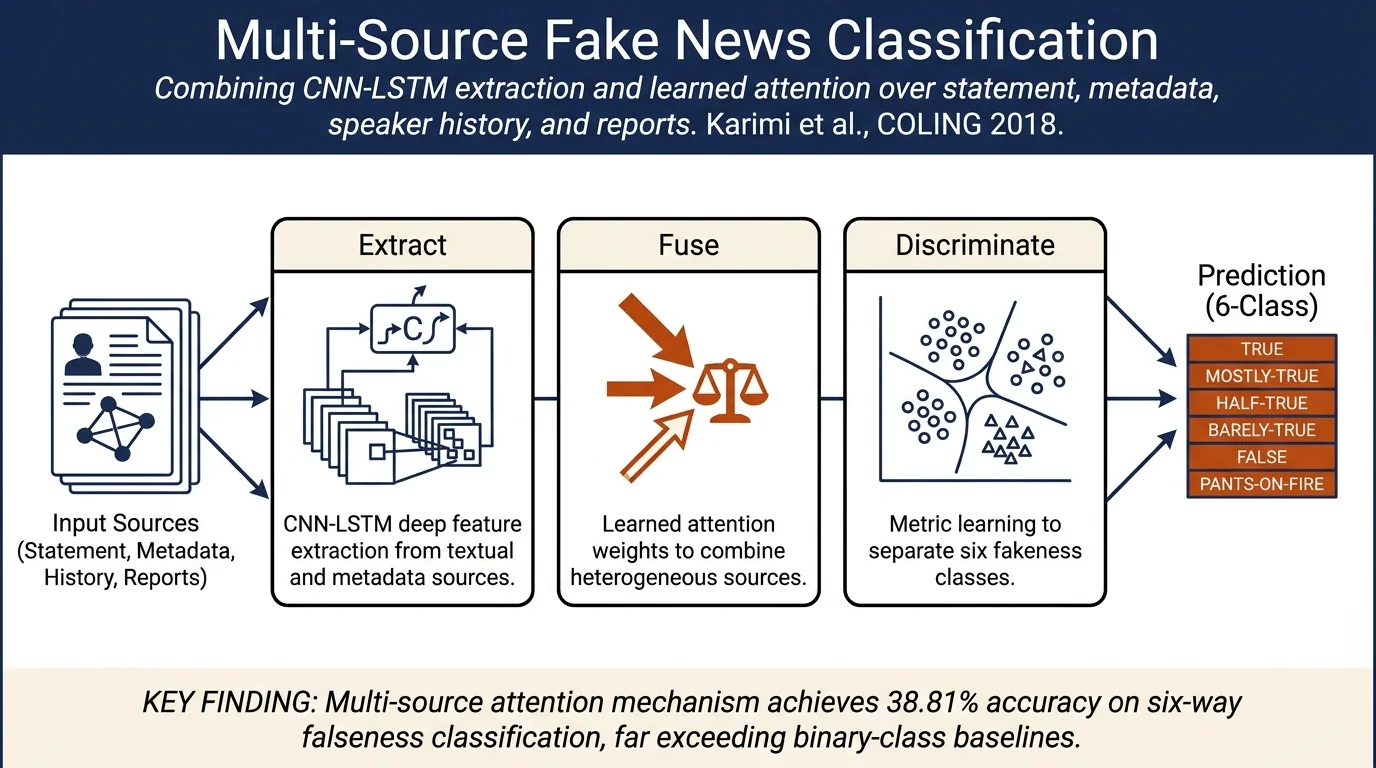
Multi-Source Multi-Class Fake News DetectionProposes MMFD, a multi-source multi-class fake news detection framework combining automated feature extraction (CNN-LSTM), interpretable multi-source fusion (attention mechanism), and fakeness discrimination. Achieves 38.81% accuracy on LIAR dataset across six classes of fakeness (true, mostly-true, half-true, barely-true, false,…
 Psychology & interventionsDetection methods
How technology can fight extremism and online harassmentYasmin Green, head of Jigsaw, presents two technological interventions addressing online harms rooted in human psychology. For radicalization: the "Redirect Method" (piloted 2016) uses online advertising to intercept users searching for extremist content (e.g., "How do I join ISIS?") and show them counter-propaganda videos from credible…
 Deepfakes & multimodalDetection methods
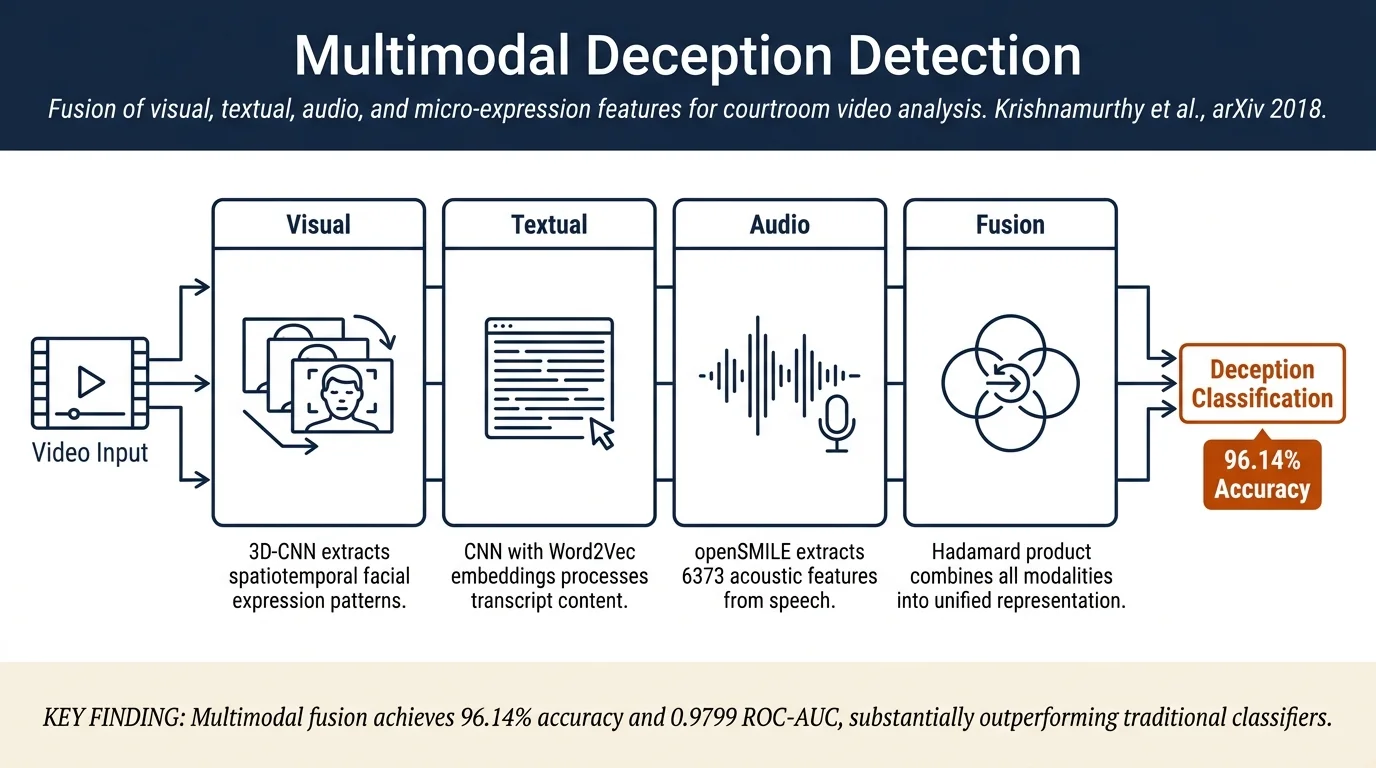
A Deep Learning Approach for Multimodal Deception DetectionThis paper proposes a multimodal neural model for detecting deception in real-life courtroom trial videos by combining visual features from 3D-CNN, audio features from openSMILE, textual features from CNN on transcripts, and manual micro-expression annotations. The model achieves 96.14% accuracy and ROC-AUC of 0.9799, substantially…
 Detection methodsLLMs & generative AI
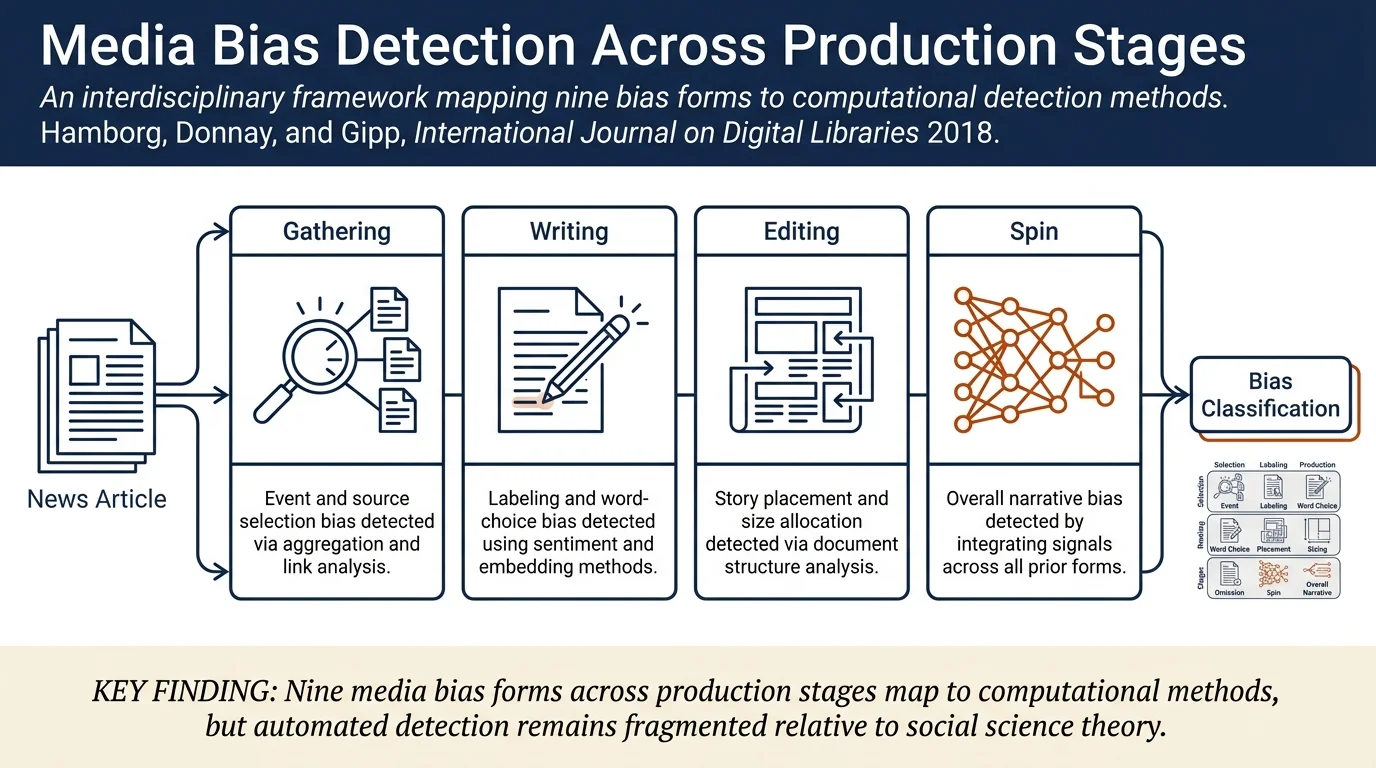
Automated identification of media bias in news articles: an interdisciplinary literature reviewThis paper surveys automated and manual methods for identifying media bias in news articles, bridging social science and computer science approaches. It defines nine distinct forms of media bias and maps social science research onto computational techniques, finding that NLP-based methods are promising for automated detection but remain…
 Detection methodsDatasets & evaluation
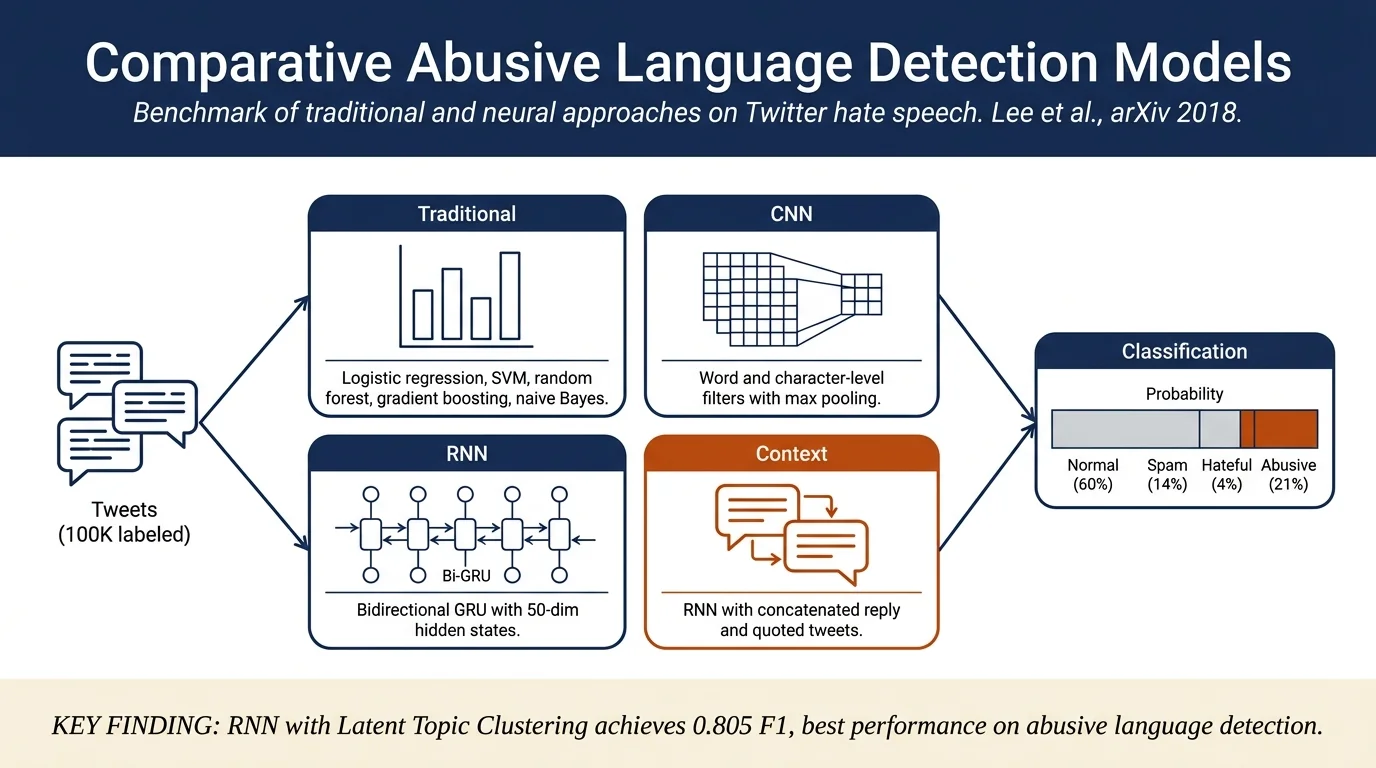
Comparative Studies of Detecting Abusive Language on TwitterConducts the first comprehensive benchmark of traditional machine learning and neural network models on the Hate and Abusive Speech on Twitter dataset (100K tweets). Bidirectional GRU networks with Latent Topic Clustering achieve the best performance (0.805 F1), outperforming traditional methods like logistic regression and SVM.
 Detection methodsDatasets & evaluation
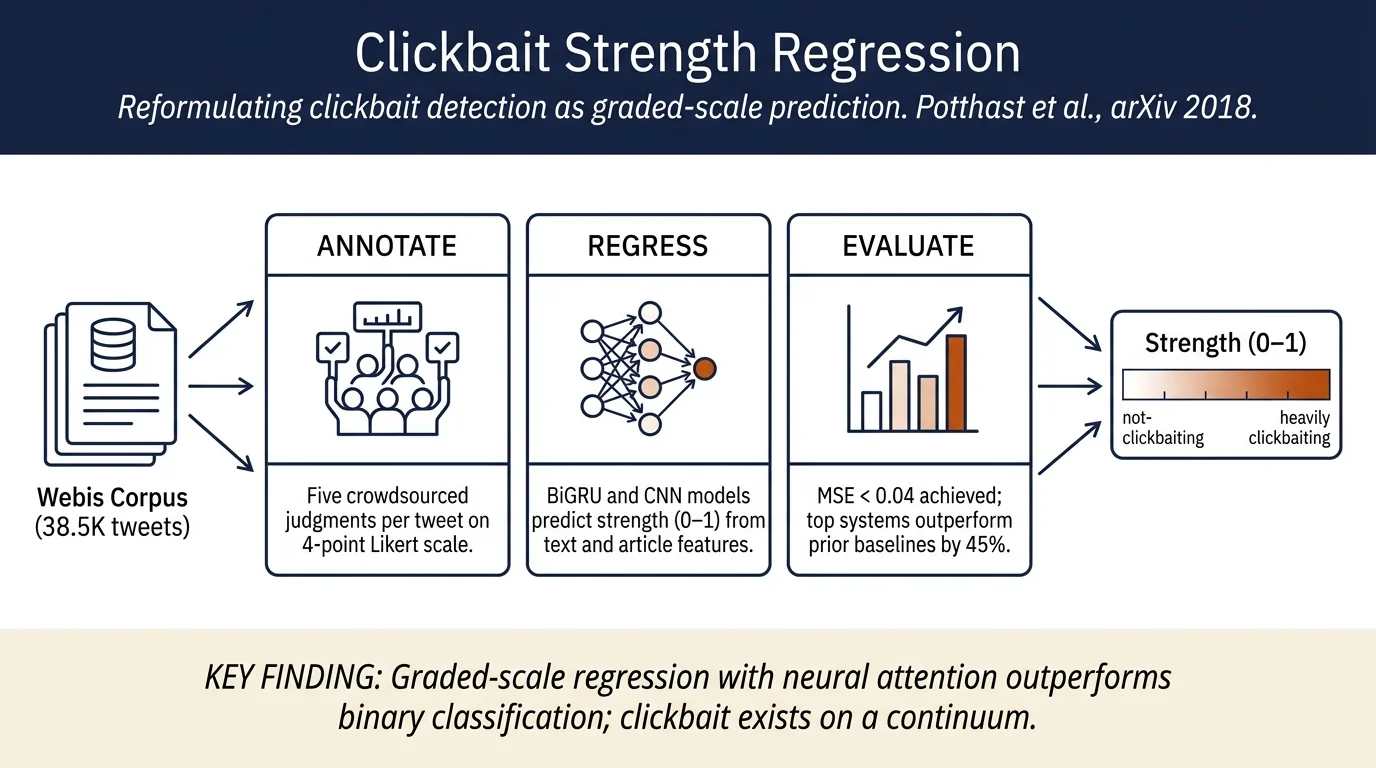
The Clickbait Challenge 2017: Towards a Regression Model for Clickbait StrengthClickbait detection is typically framed as binary classification, but teaser messages exhibit varying degrees of clickbaiting techniques. This paper organizes the Clickbait Challenge 2017, reformulating the task as regression to measure clickbait strength on a graded scale.
 Deepfakes & multimodalDatasets & evaluation
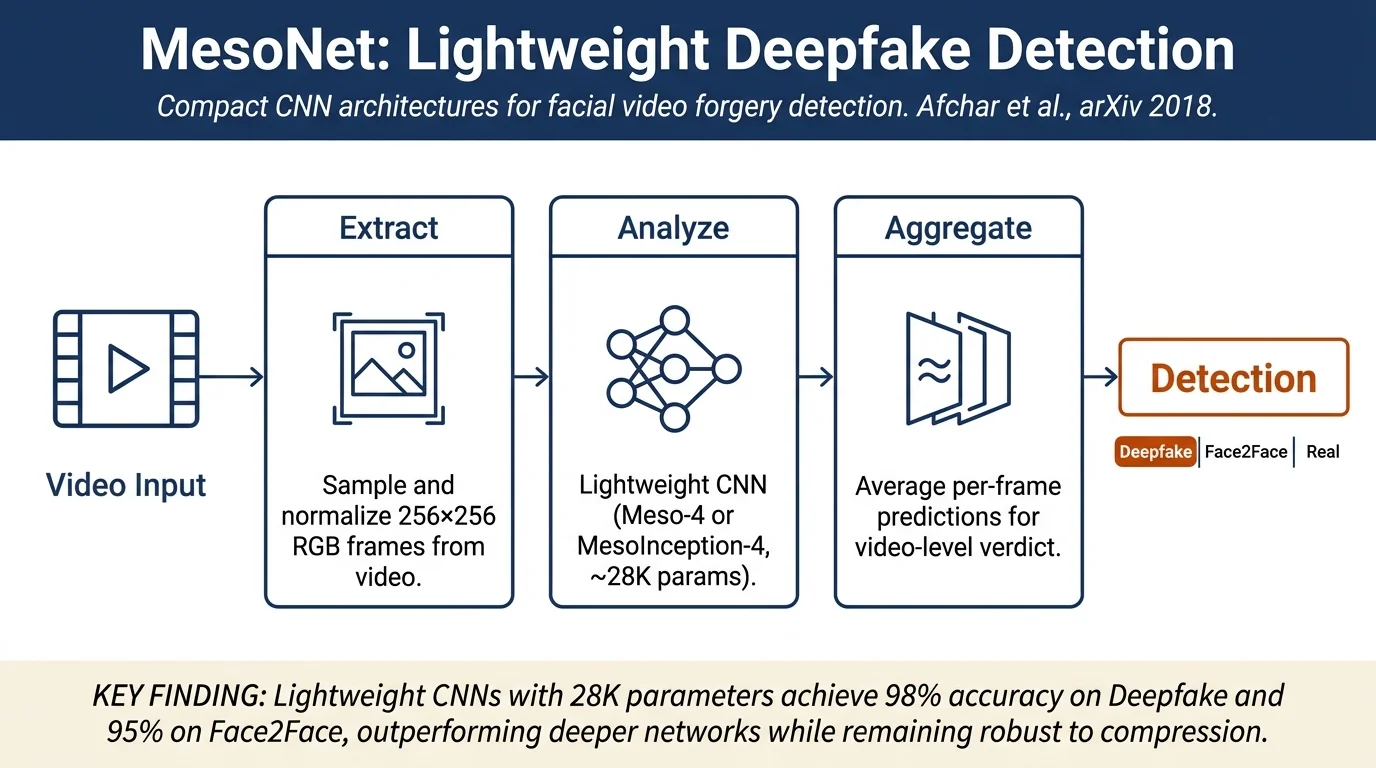
MesoNet: A Compact Facial Video Forgery Detection NetworkThis paper proposes two lightweight CNN architectures (Meso-4 and MesoInception-4) to detect facial video forgeries created by Deepfake and Face2Face techniques. Operating at the mesoscopic level of image analysis, the networks achieve 98% detection accuracy for Deepfake and 95% for Face2Face videos under realistic compression conditions.
 Detection methodsFact-checking & verification
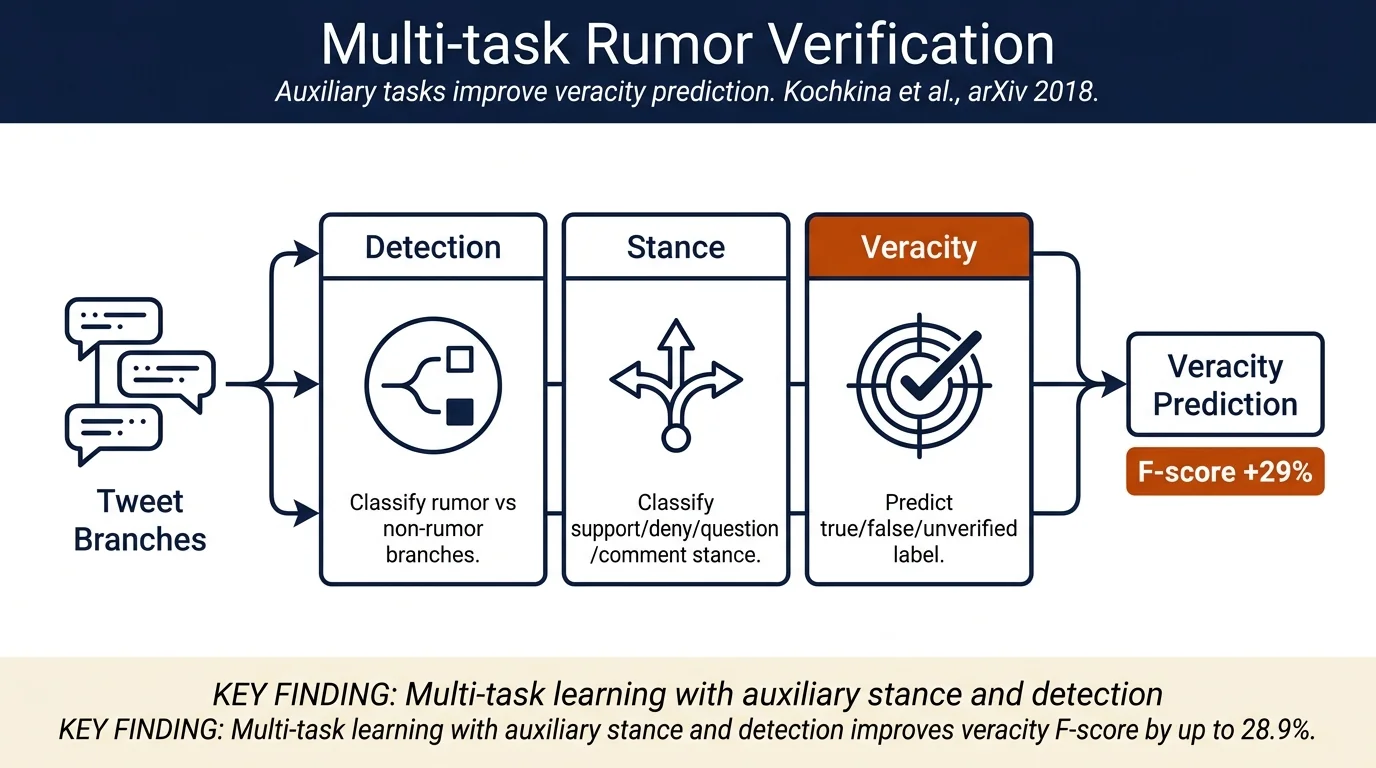
All-in-one: Multi-task Learning for Rumour VerificationThis paper proposes a multi-task learning framework for rumor verification that jointly trains veracity classification (the main task) with auxiliary tasks—rumor detection and stance classification. The approach outperforms single-task baselines on both RumourEval and PHEME datasets, demonstrating that sharing representations across…
 Deepfakes & multimodalDetection methods
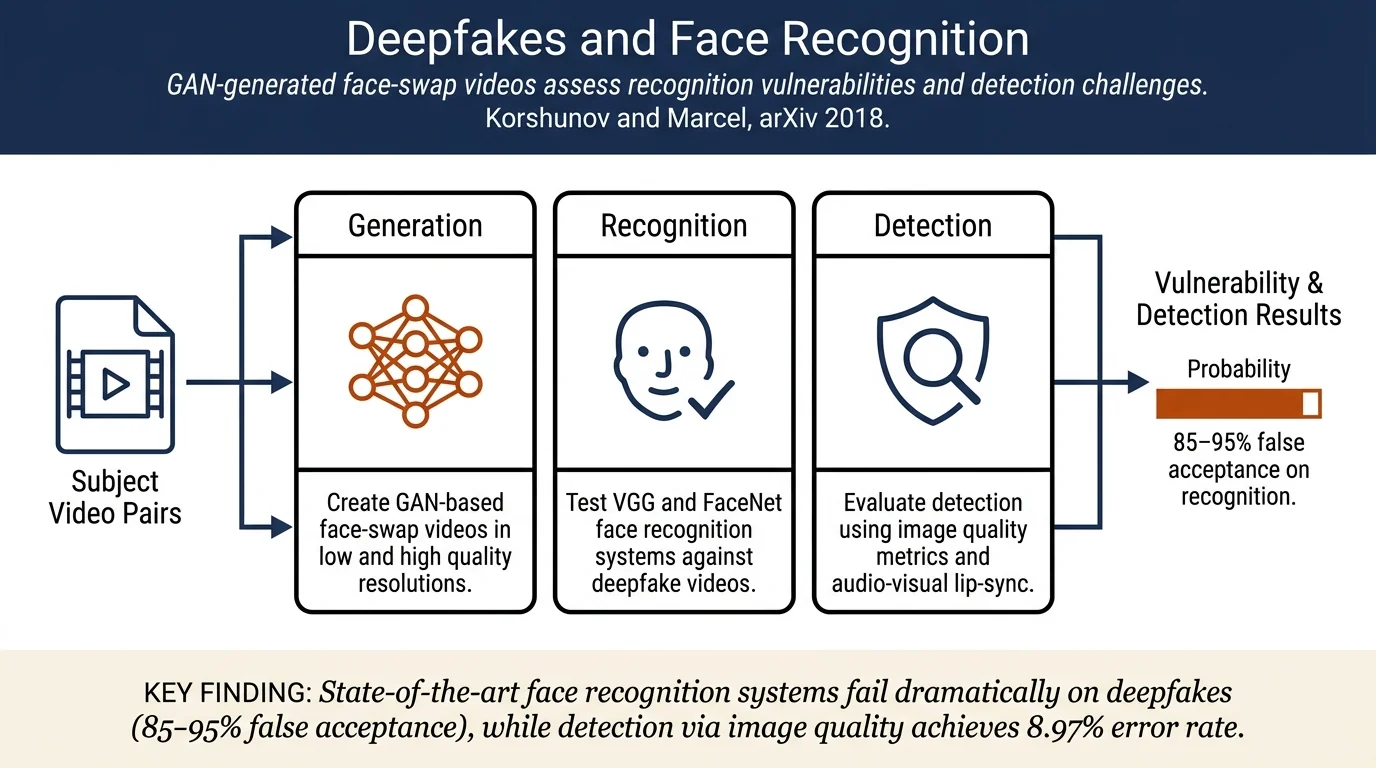
DeepFakes: a New Threat to Face Recognition? Assessment and DetectionGAN-based face-swapping (Deepfakes) pose a significant threat to face recognition systems: VGG and FaceNet achieve false acceptance rates of 85.62% and 95.00% on high-quality Deepfakes. The authors release the first public Deepfake video database (620 videos from 16 subject pairs) and show that image quality metrics with SVM achieve…
 Deepfakes & multimodalDetection methods
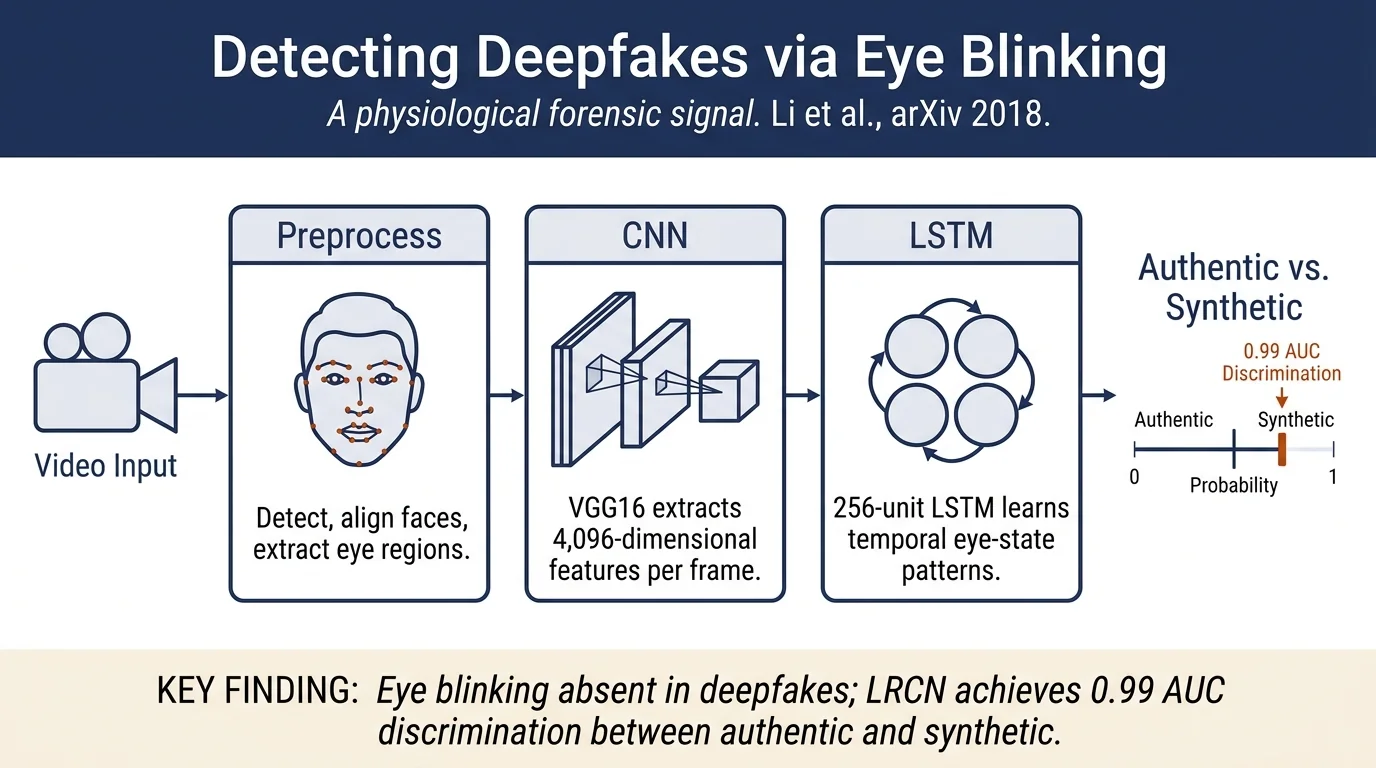
In Ictu Oculi: Exposing AI Generated Fake Face Videos by Detecting Eye BlinkingDetects DeepFake videos by exploiting the absence of natural eye blinking patterns in AI-generated faces. Uses a Long-term Recurrent Convolutional Network (LRCN) combining CNN for feature extraction with LSTM-RNN for temporal modeling of eye state, achieving 0.99 AUC on authentic vs. synthesized videos—a forensic signal invisible to the…
 Deepfakes & multimodalDetection methods
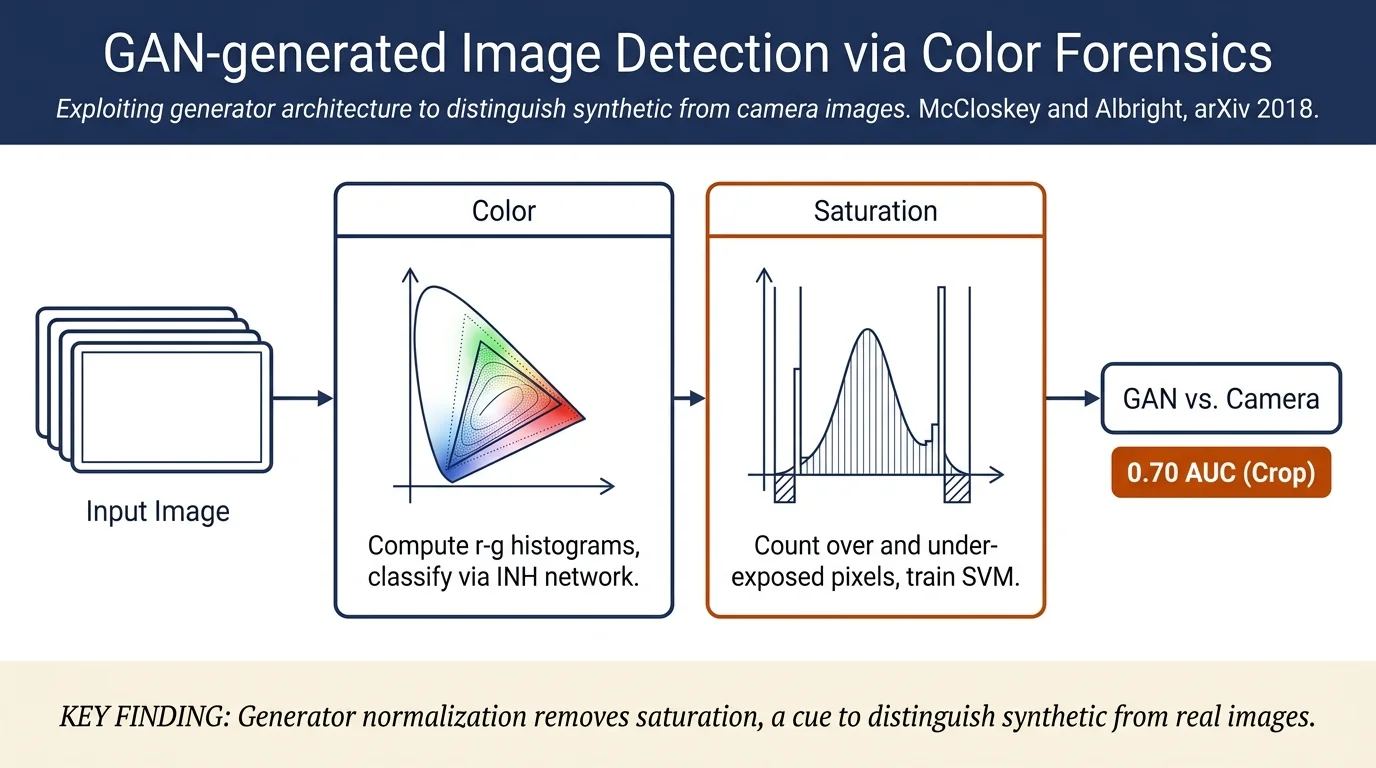
Detecting GAN-generated Imagery using Color CuesThis paper identifies two forensic cues to distinguish GAN-generated images from real camera imagery by analyzing how generator networks process color. The first cue exploits overlapping color channel weights in the generator (unlike camera spectral sensitivities); the second leverages the fact that generator normalization suppresses…
 Fact-checking & verificationDetection methods
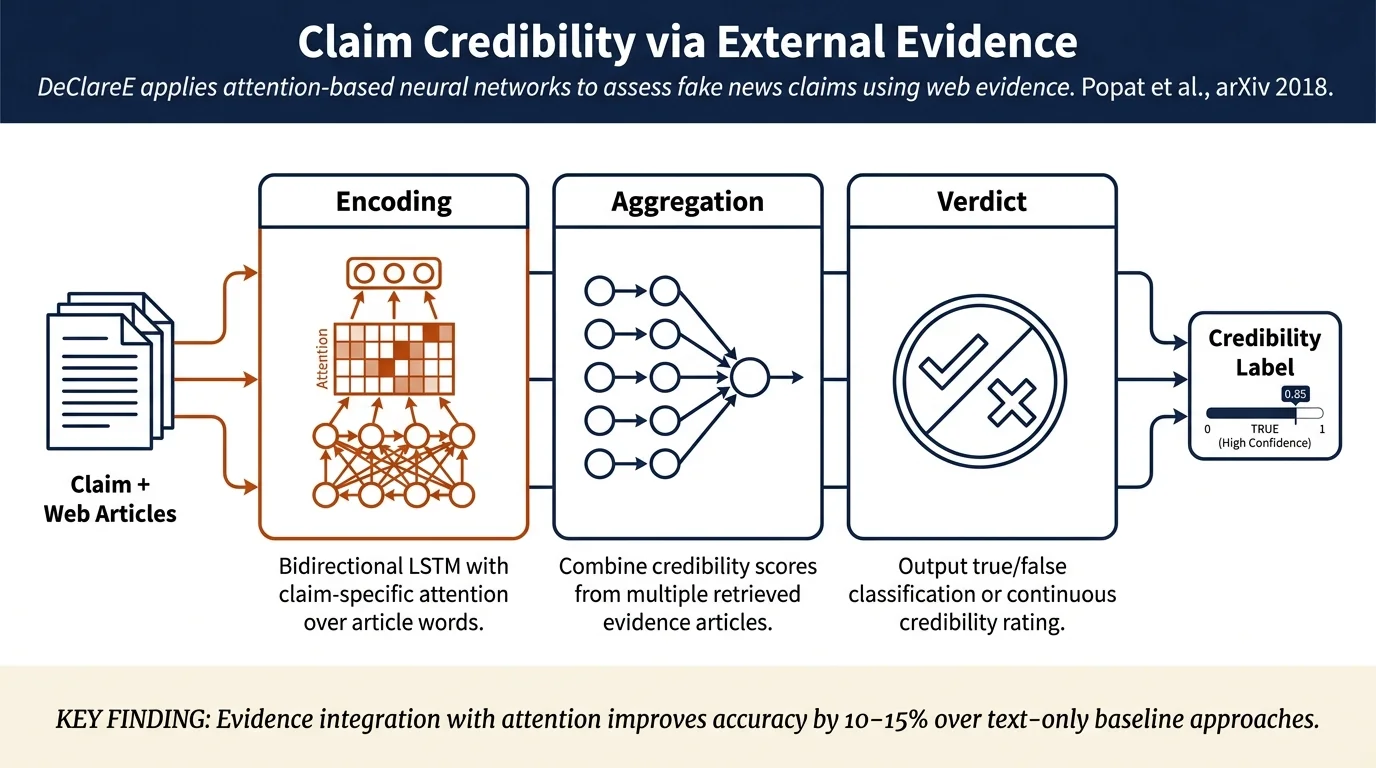
DeClareE: Debunking Fake News and False Claims using Evidence-Aware Deep LearningDeClareE is an end-to-end neural network for evidence-aware credibility assessment of arbitrary natural-language claims. The model combines claim and evidence article representations using bidirectional LSTMs with claim-specific attention, automatically discovering which web articles support or refute a claim without hand-crafted…
 Spread & networksDetection methods
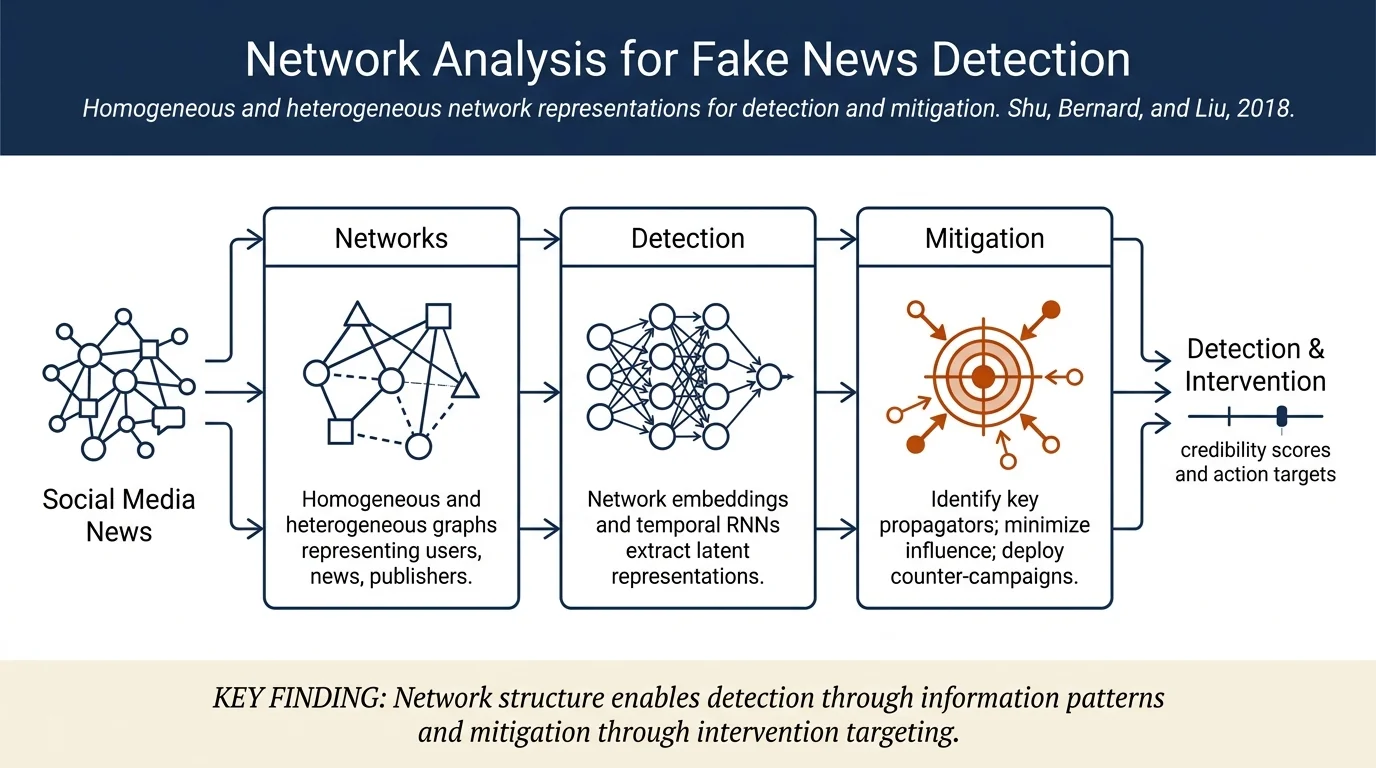
Studying Fake News via Network Analysis: Detection and MitigationThis chapter surveys network-based approaches to fake news detection and mitigation on social media, organizing fake news dissemination along three dimensions (content, social, temporal) and introduces methods exploiting network structure: homogeneous networks (friendship, diffusion, credibility) and heterogeneous networks (knowledge,…