Explore papers
Filter by research area, year and venue. Every filter is in the address bar, so you can share a view as a link.
 Spread & networksDetection methods
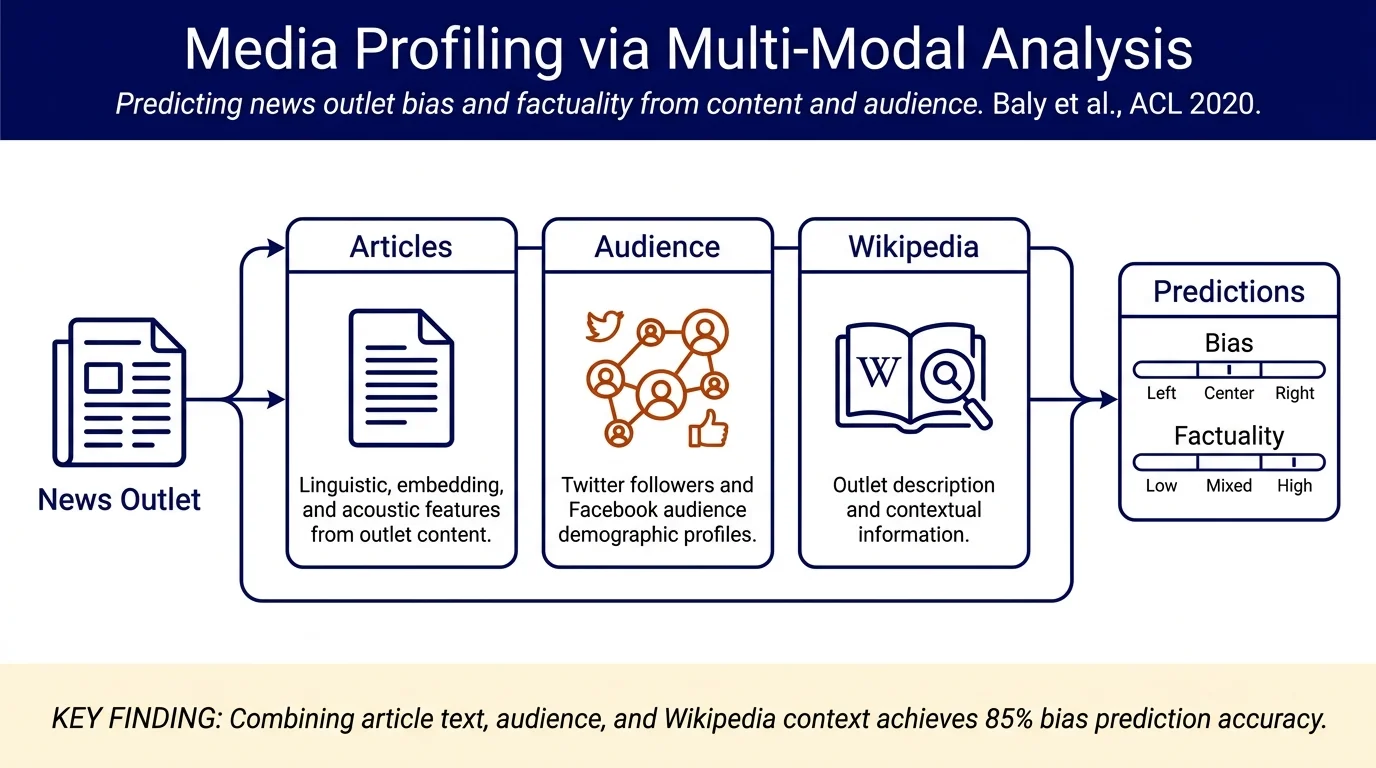
What Was Written vs. Who Read It: News Media Profiling Using Text Analysis and Social Media ContextThis paper predicts the political bias (left/center/right) and factuality (low/mixed/high) of news outlets by analyzing what articles they publish, who follows them on social media, and what Wikipedia says about them. The system achieves 85% accuracy on bias prediction by combining article text, YouTube video features, Twitter audience…
 Datasets & evaluationDeepfakes & multimodal
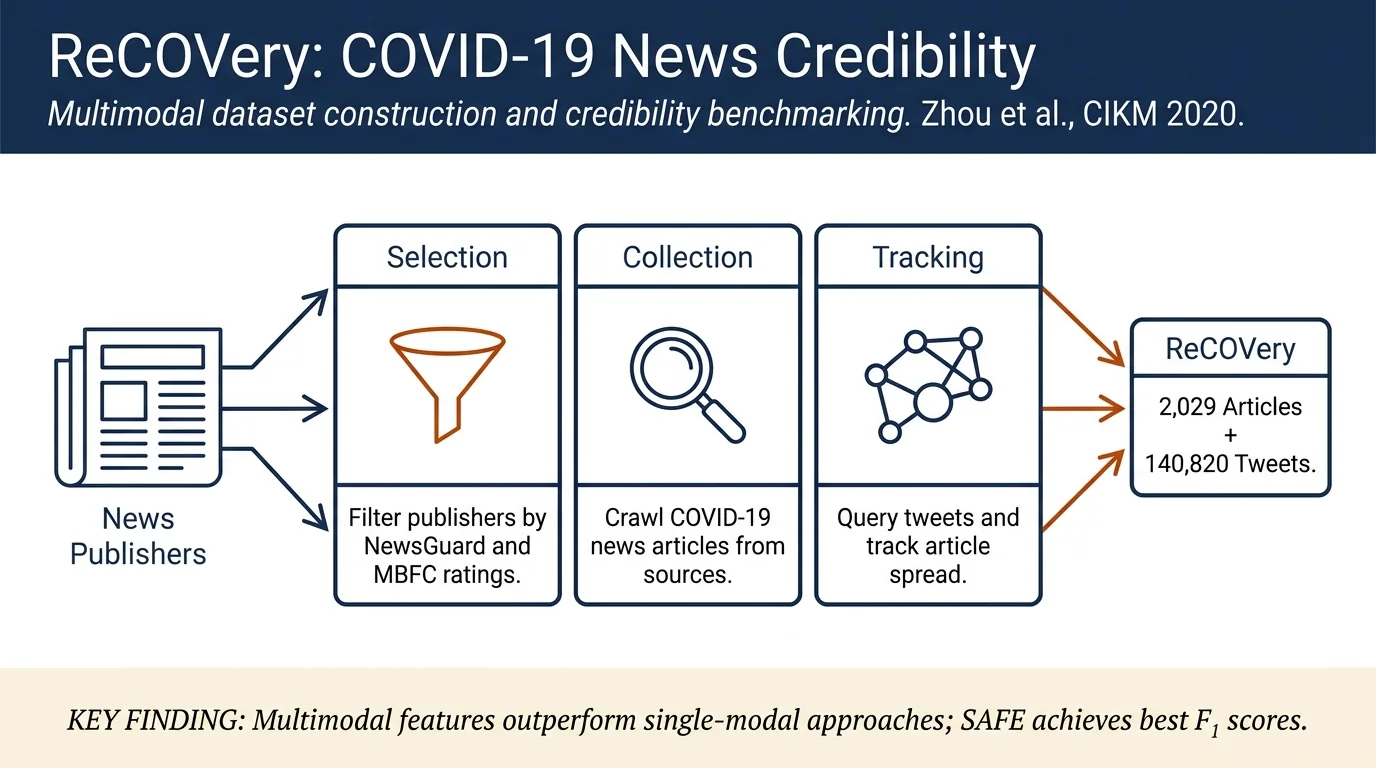
ReCOVery: A Multimodal Repository for COVID-19 News Credibility ResearchThe COVID-19 pandemic triggered a parallel "infodemic" of low-credibility news; this paper constructs ReCOVery, a multimodal repository of 2,029 COVID-19 news articles with binary credibility labels inherited from their publisher's NewsGuard/MBFC ratings, paired with 140,820 tweets tracking social spread. The key design trade-off is…
 Detection methodsDatasets & evaluation
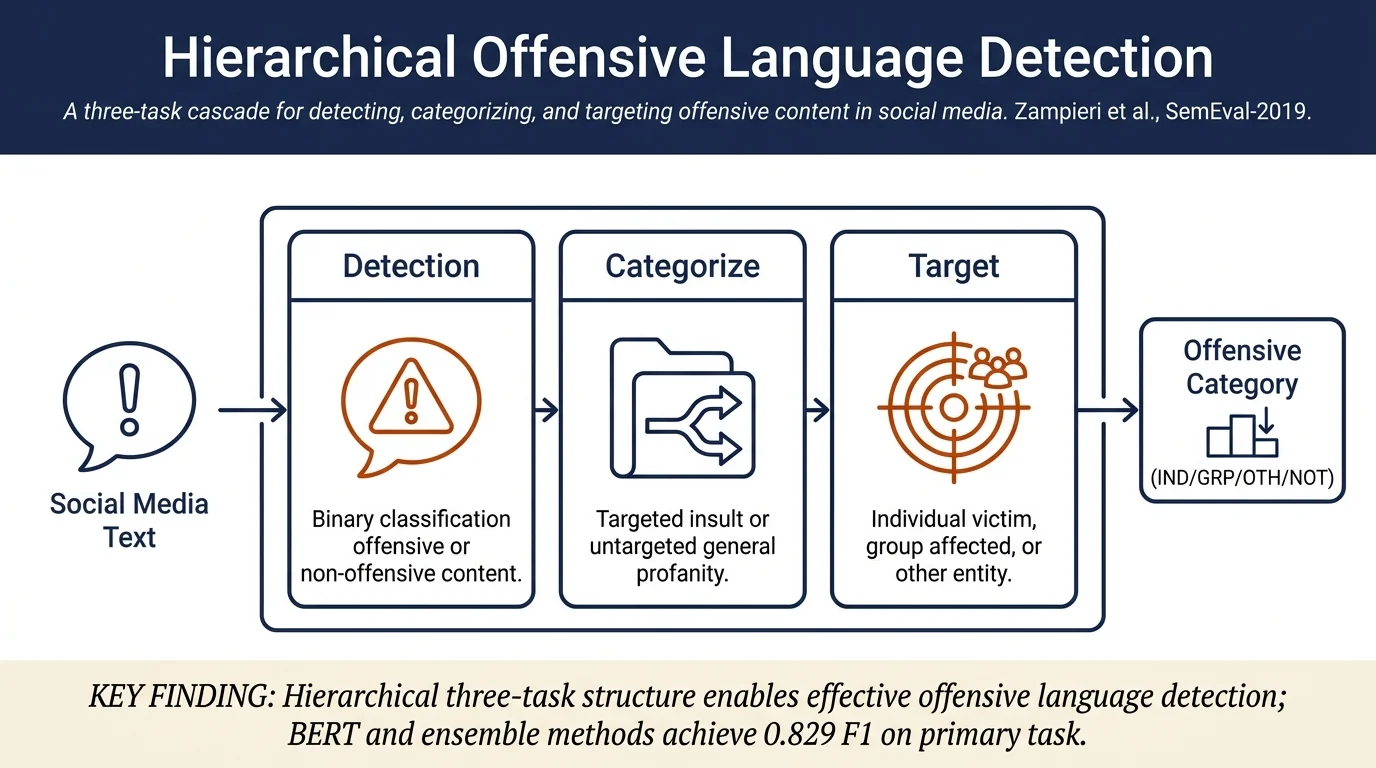
SemEval-2019 Task 6: Identifying and Categorizing Offensive Language in Social MediaSemEval-2019 Task 6 reports on a shared task competition for identifying and categorizing offensive language in social media using the OLID dataset. Approximately 800 teams registered and 115 submitted results across three sub-tasks: offensive language detection (104 teams), offense type categorization (71 teams), and offense target…
 Datasets & evaluationDetection methods
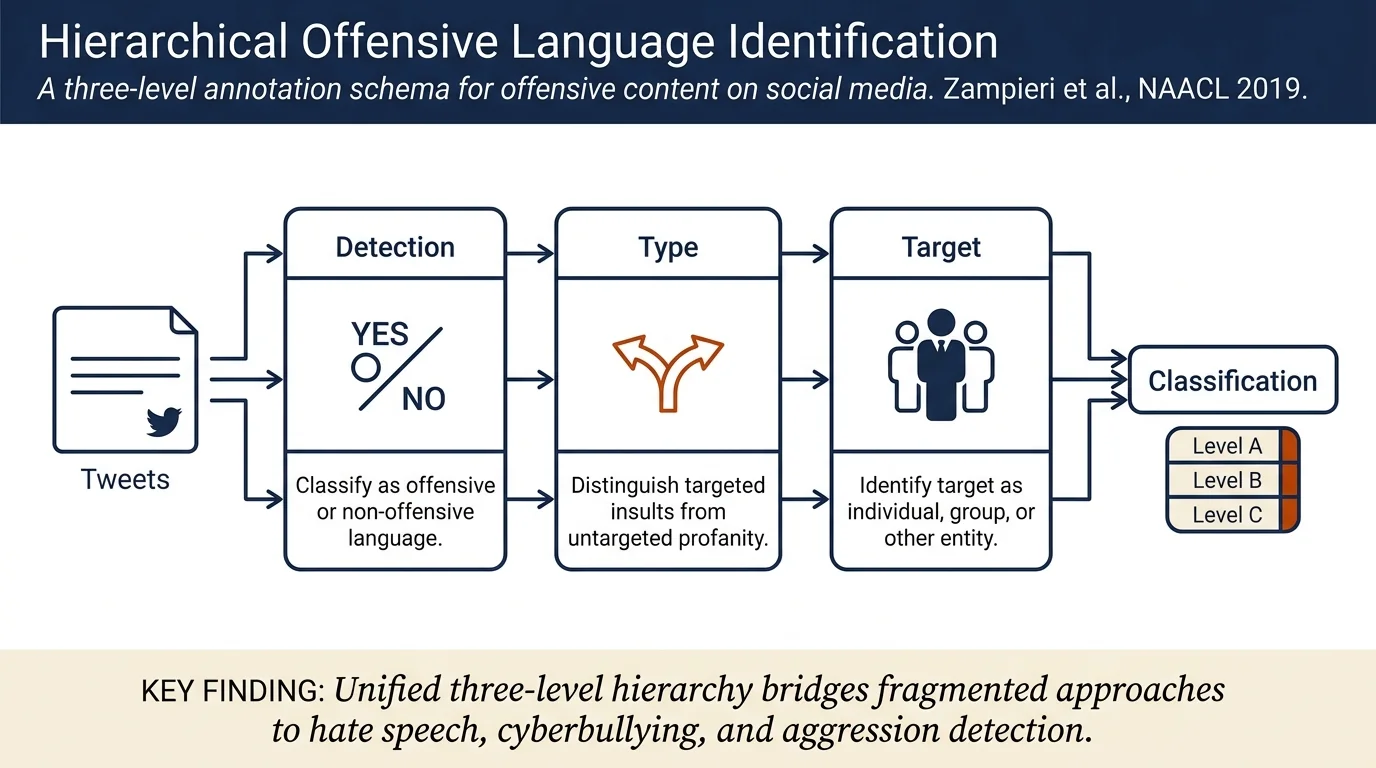
Predicting the Type and Target of Offensive Posts in Social MediaThis paper introduces OLID (Offensive Language Identification Dataset), a large-scale dataset of 14,100 English tweets annotated with a three-level hierarchical schema for detecting offensive content. The hierarchy distinguishes offensive from non-offensive posts (Level A), categorizes offense type as targeted insults or untargeted…
 Detection methodsDatasets & evaluation
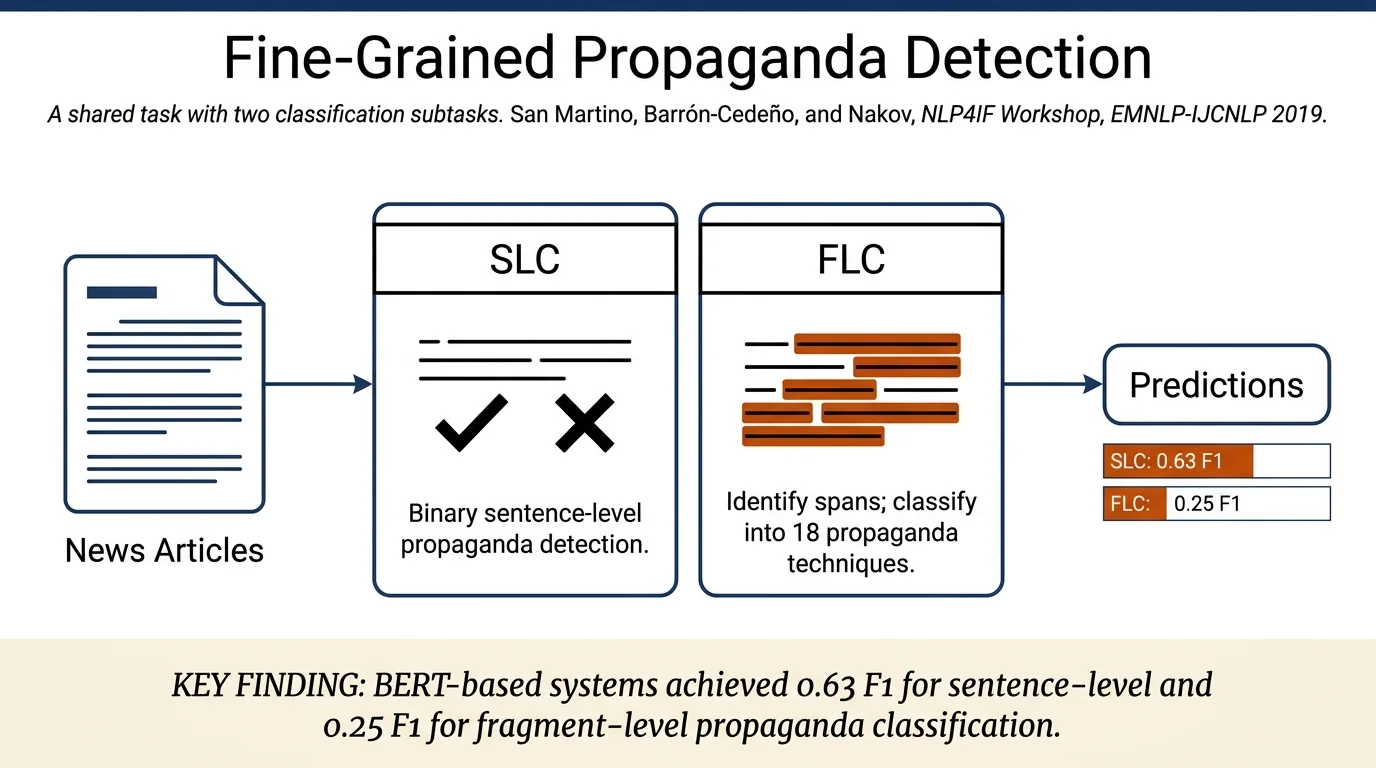
Findings of the NLP4IF-2019 Shared Task on Fine-Grained Propaganda DetectionThis paper reports findings from a shared task on fine-grained propaganda detection in news articles, featuring two subtasks: fragment-level identification and classification into 18 propaganda techniques, and sentence-level binary propaganda detection. The task attracted 90 registered teams with 39 making submissions; winning systems…
 Spread & networksDatasets & evaluation
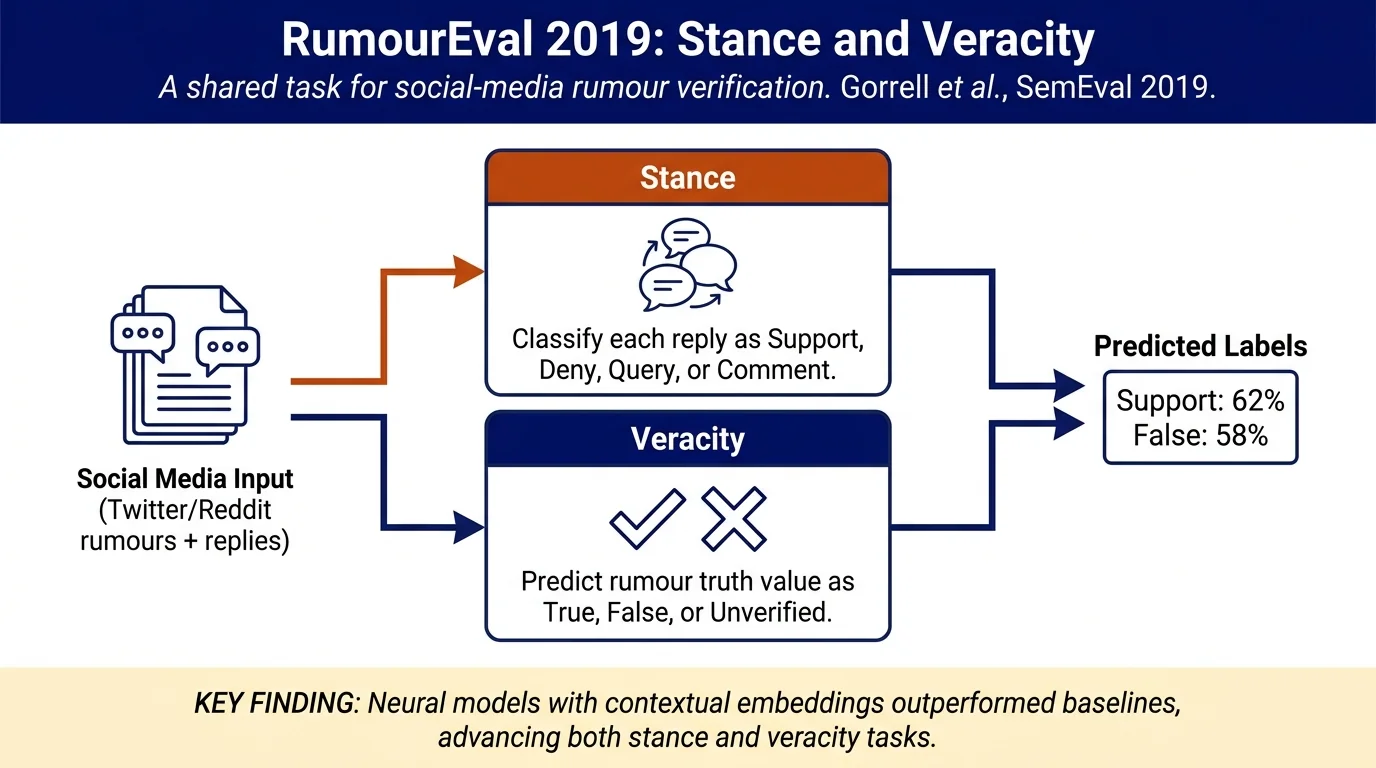
RumourEval 2019: Determining Rumour Veracity and Support for RumoursRumourEval 2019 is a shared task for rumour stance detection and veracity prediction on social media. Extending the 2017 edition, it introduces Reddit data alongside Twitter, provides datasets annotated for SDQC stance (Support/Deny/Query/Comment) and three-way veracity labels, and received 22 system submissions showing that modern…
 Detection methodsDatasets & evaluation
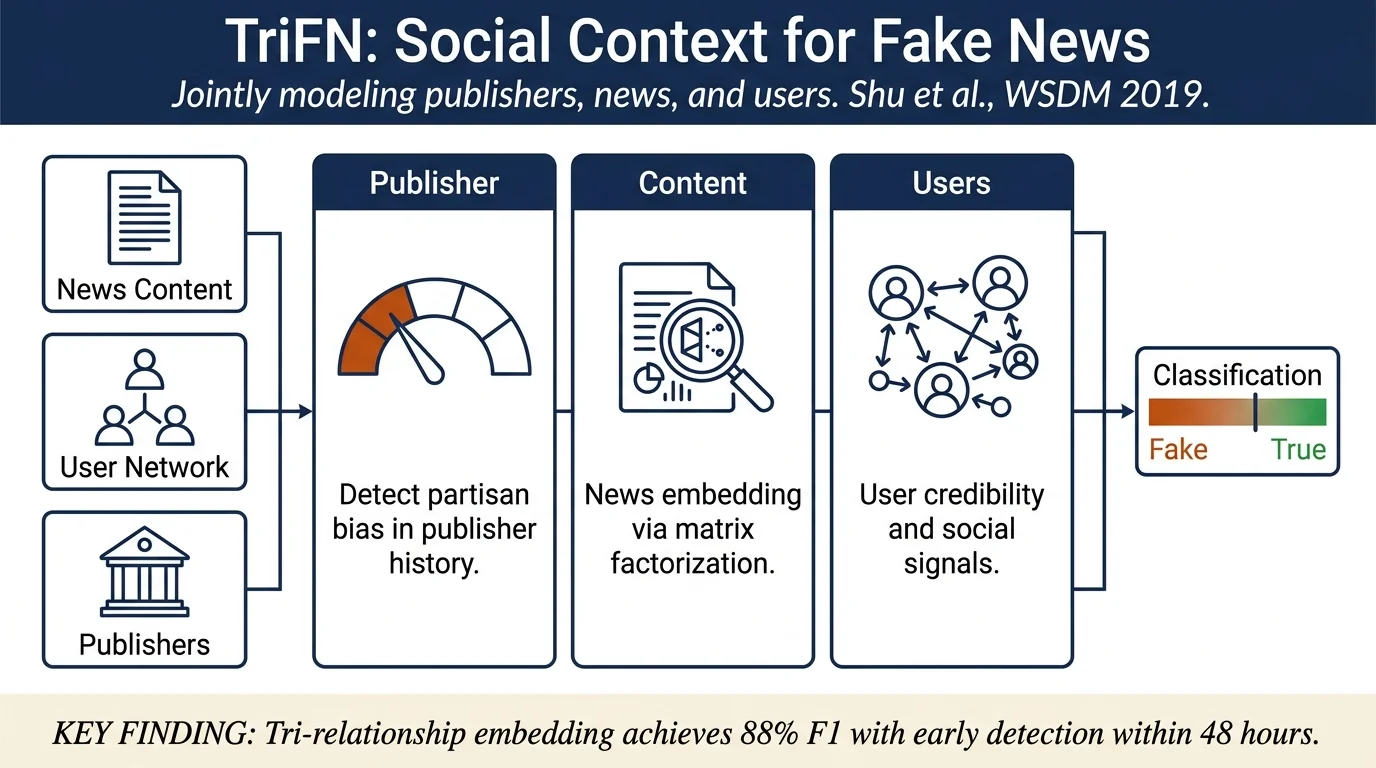
Beyond News Contents: The Role of Social Context for Fake News DetectionContent-only detection is insufficient because fake news is crafted to mimic real news. This paper argues that the tri-relationship among publishers, news pieces, and users forms rich social context for detection: partisan-biased publishers more likely publish fake news, and low-credibility users more likely share it.
 Spread & networksDetection methods
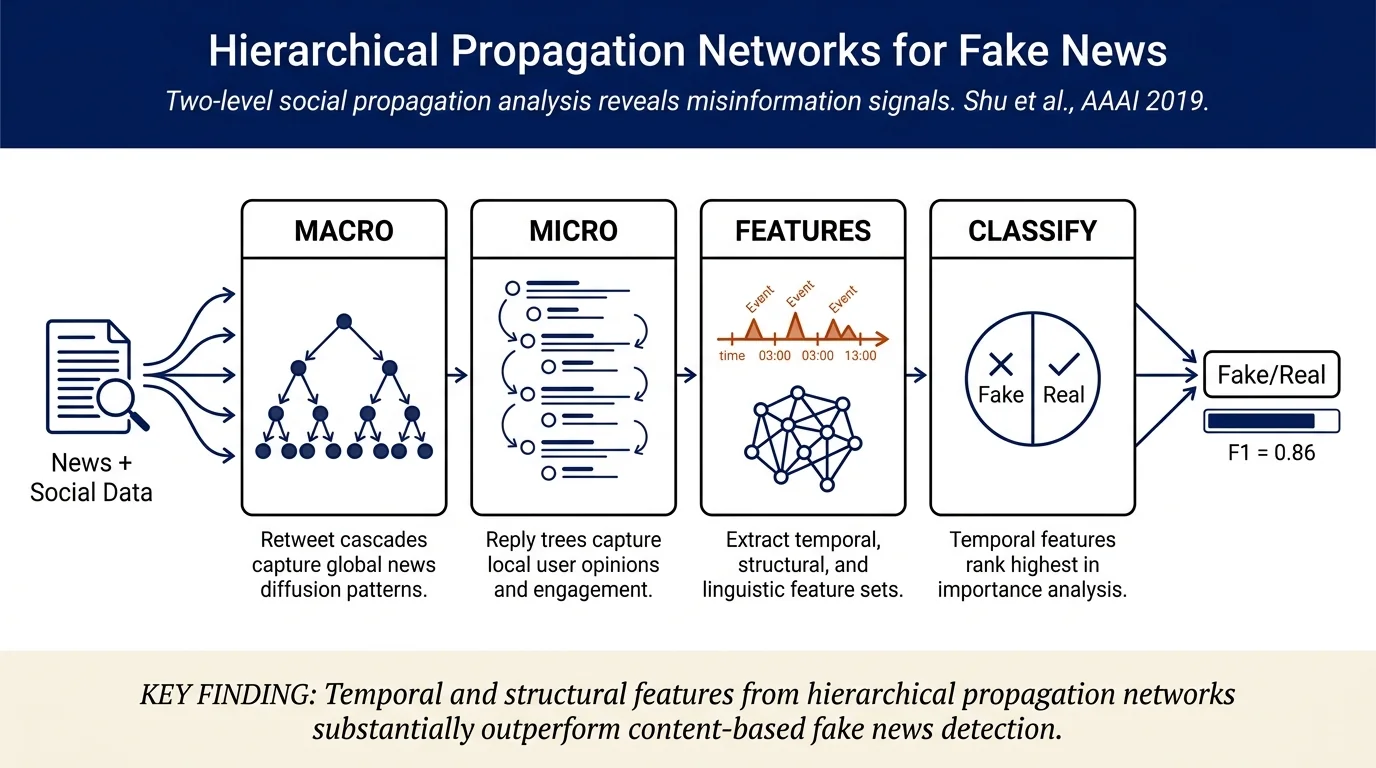
Hierarchical Propagation Networks for Fake News Detection: Investigation and ExploitationContent-only fake news detection has limited performance because fake news is deliberately crafted to mimic real news. This paper constructs hierarchical propagation networks from both macro-level (tweet/retweet cascade) and micro-level (reply conversation) granularity, extracts structural, temporal, and linguistic features from both…
 Deepfakes & multimodalDetection methods
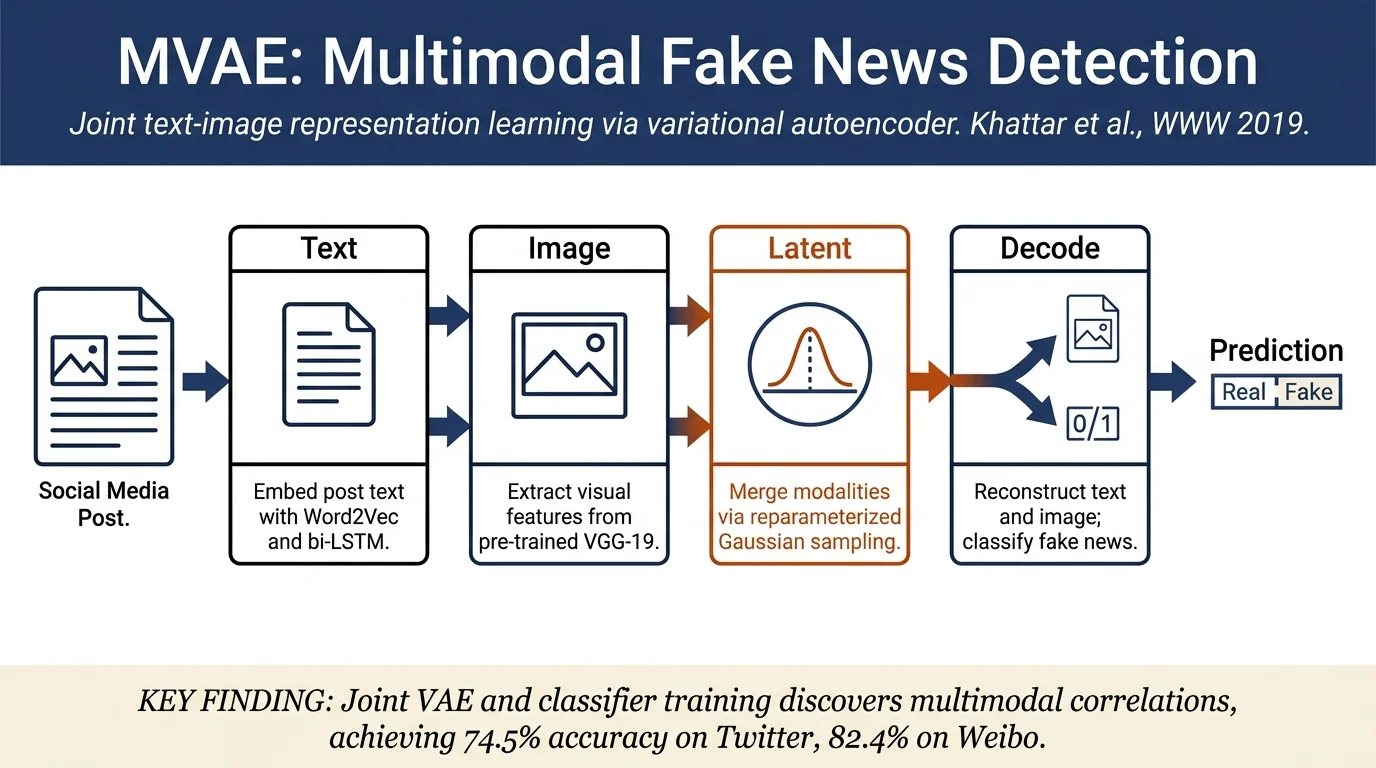
MVAE: Multimodal Variational Autoencoder for Fake News DetectionThe paper proposes MVAE, a variational autoencoder that learns shared representations of text and images in social media posts to detect fake news. The model jointly trains an encoder-decoder (to discover correlations across modalities) with a binary classifier.
 Detection methodsDatasets & evaluation
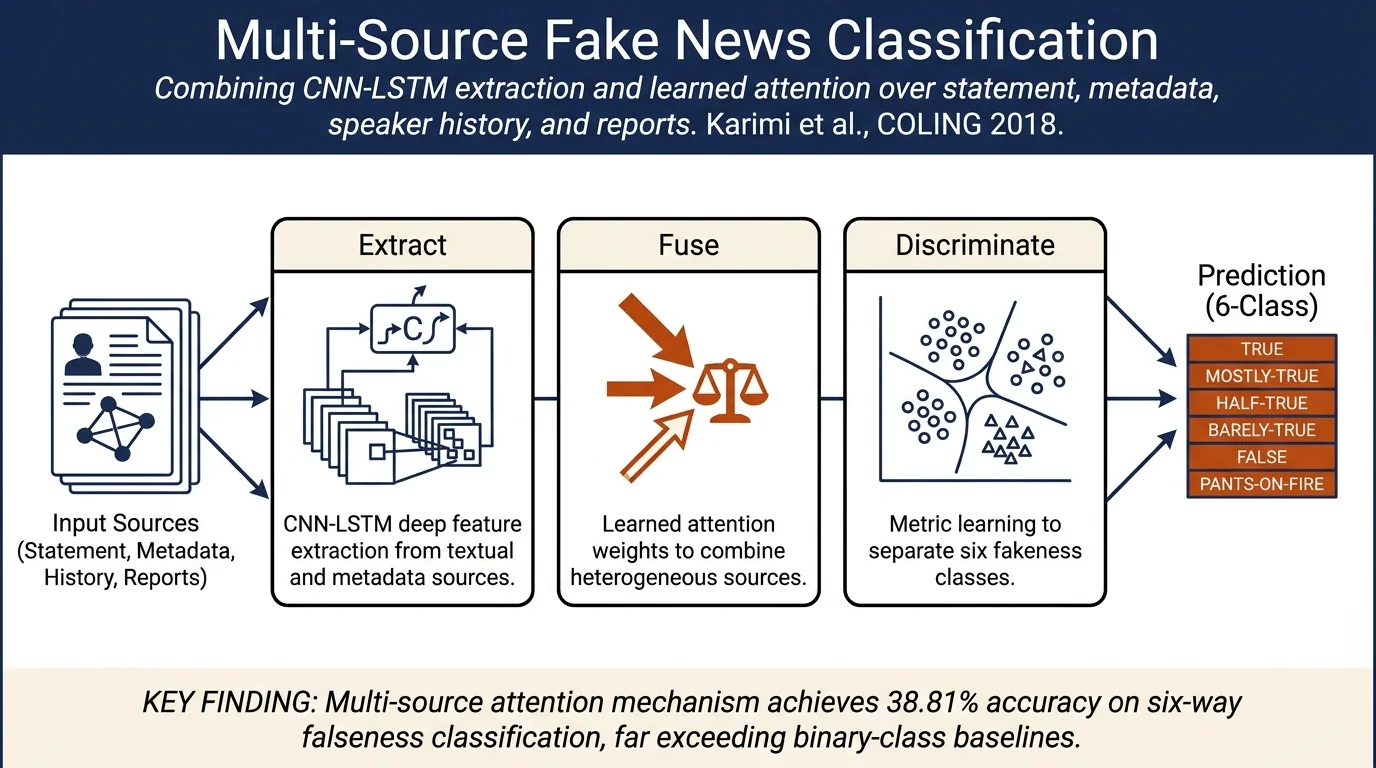
Multi-Source Multi-Class Fake News DetectionProposes MMFD, a multi-source multi-class fake news detection framework combining automated feature extraction (CNN-LSTM), interpretable multi-source fusion (attention mechanism), and fakeness discrimination. Achieves 38.81% accuracy on LIAR dataset across six classes of fakeness (true, mostly-true, half-true, barely-true, false,…
 Detection methodsDatasets & evaluation
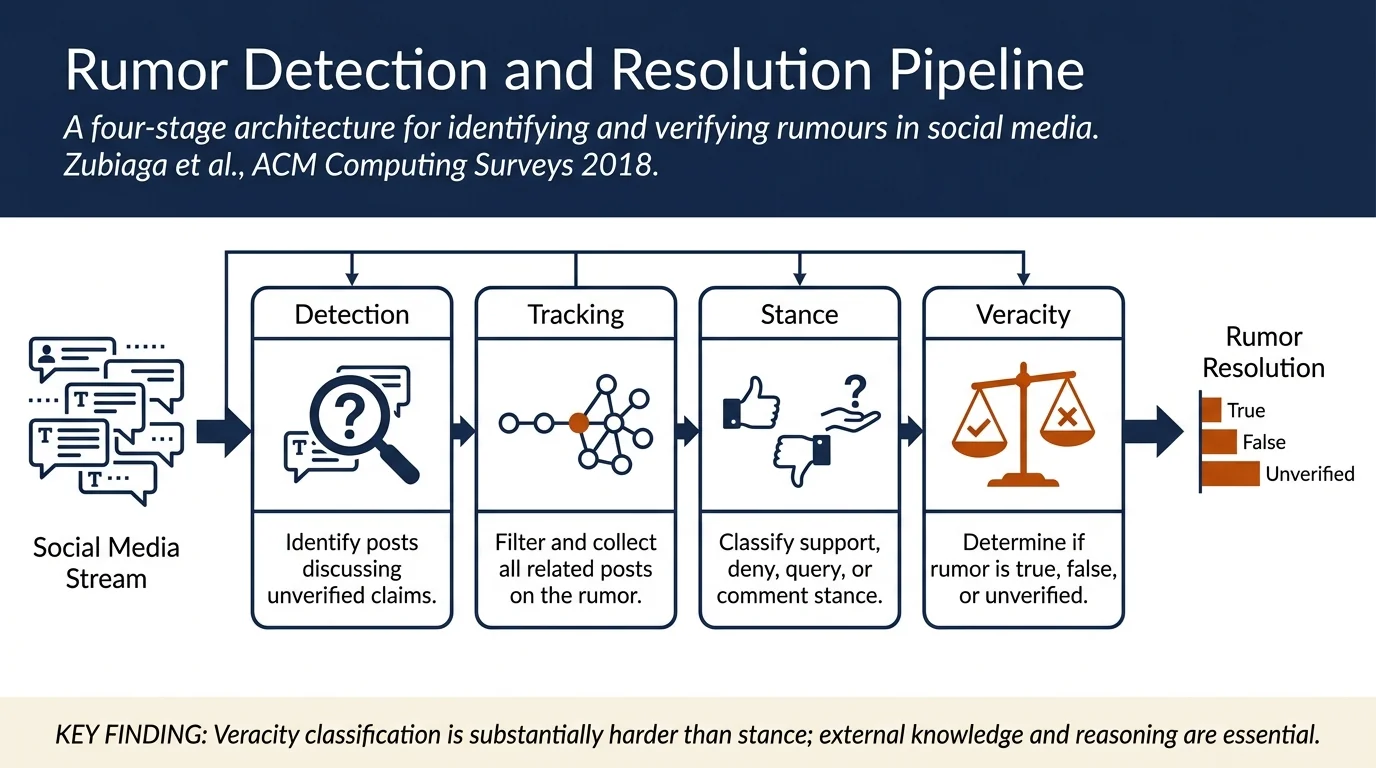
Detection and Resolution of Rumours in Social Media: A SurveyComprehensive survey of rumour detection and resolution in social media covering the entire pipeline: rumour definition and characterization, data collection strategies, annotation schemes, detection approaches for both emerging and long-standing rumours, tracking of rumour propagation, stance classification (support/deny/query/comment),…
 Fact-checking & verificationDatasets & evaluation
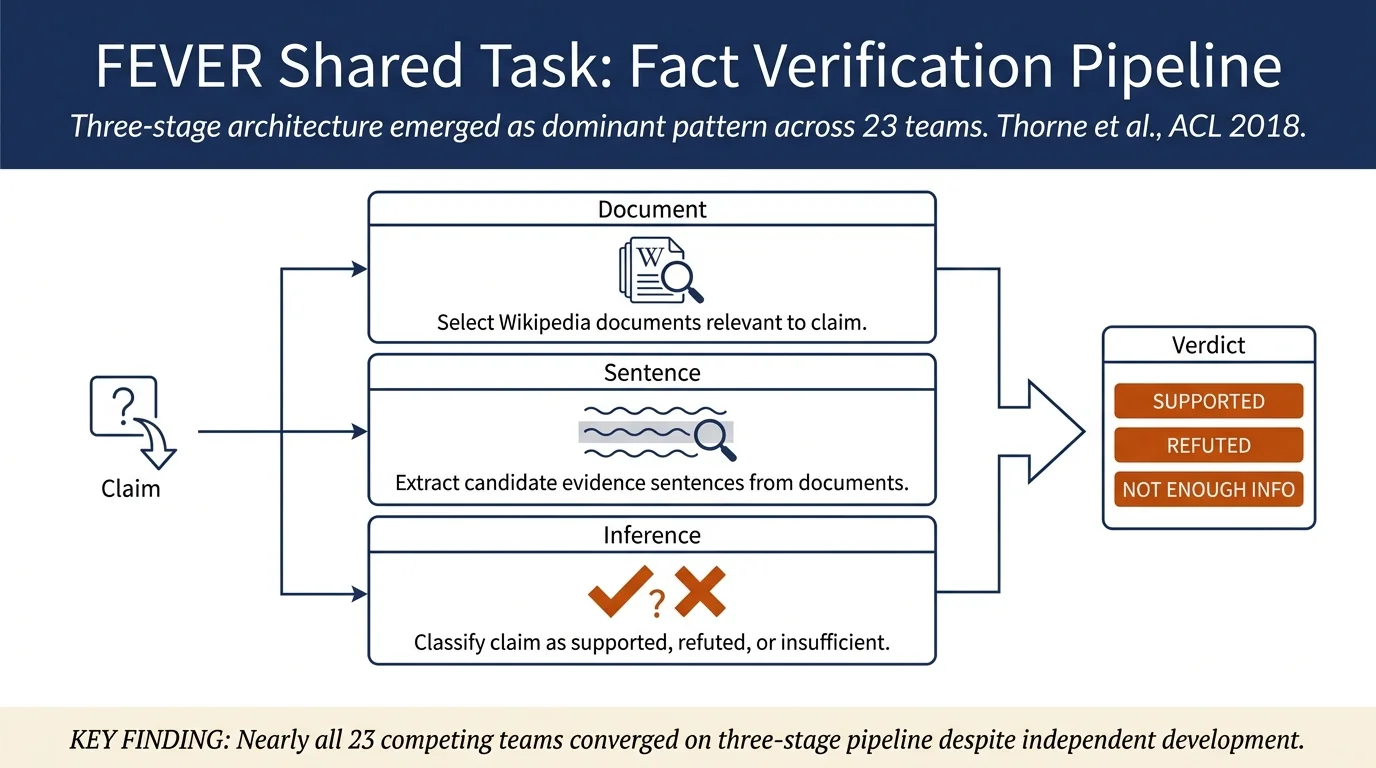
The Fact Extraction and VERification (FEVER) Shared TaskThis paper presents results of the first FEVER shared task competition, which challenged 23 teams to classify whether human-written factoid claims could be SUPPORTED or REFUTED using evidence retrieved from Wikipedia. The best system achieved 64.21% FEVER score, demonstrating the difficulty of joint evidence retrieval and natural…
 Detection methodsDatasets & evaluation
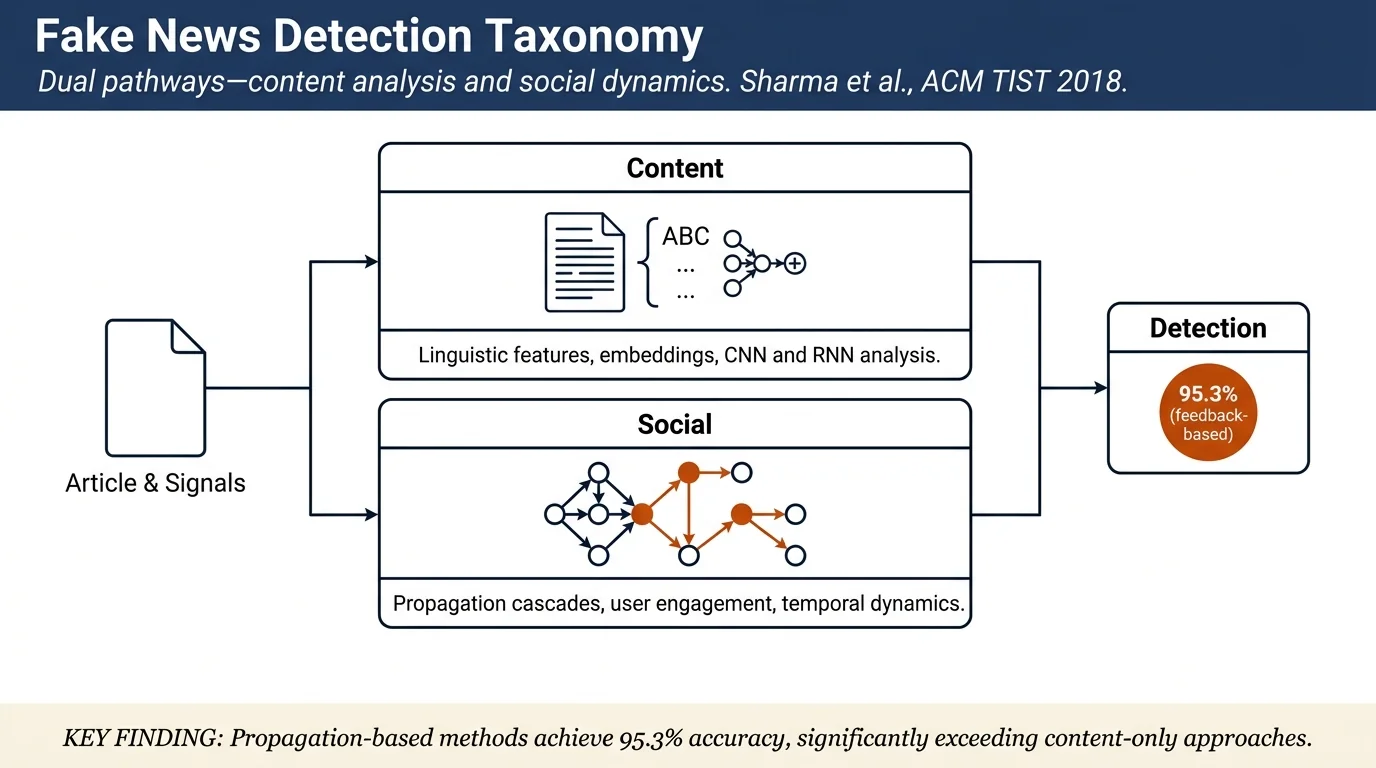
Combating Fake News: A Survey on Identification and Mitigation TechniquesThis comprehensive survey of fake news detection and mitigation organizes existing methods into two broad categories: content-based approaches (linguistic and deep learning methods) and feedback-based approaches (exploiting propagation patterns, user responses, and temporal dynamics). The authors consolidate 23+ publicly available…
 Deepfakes & multimodalDetection methods
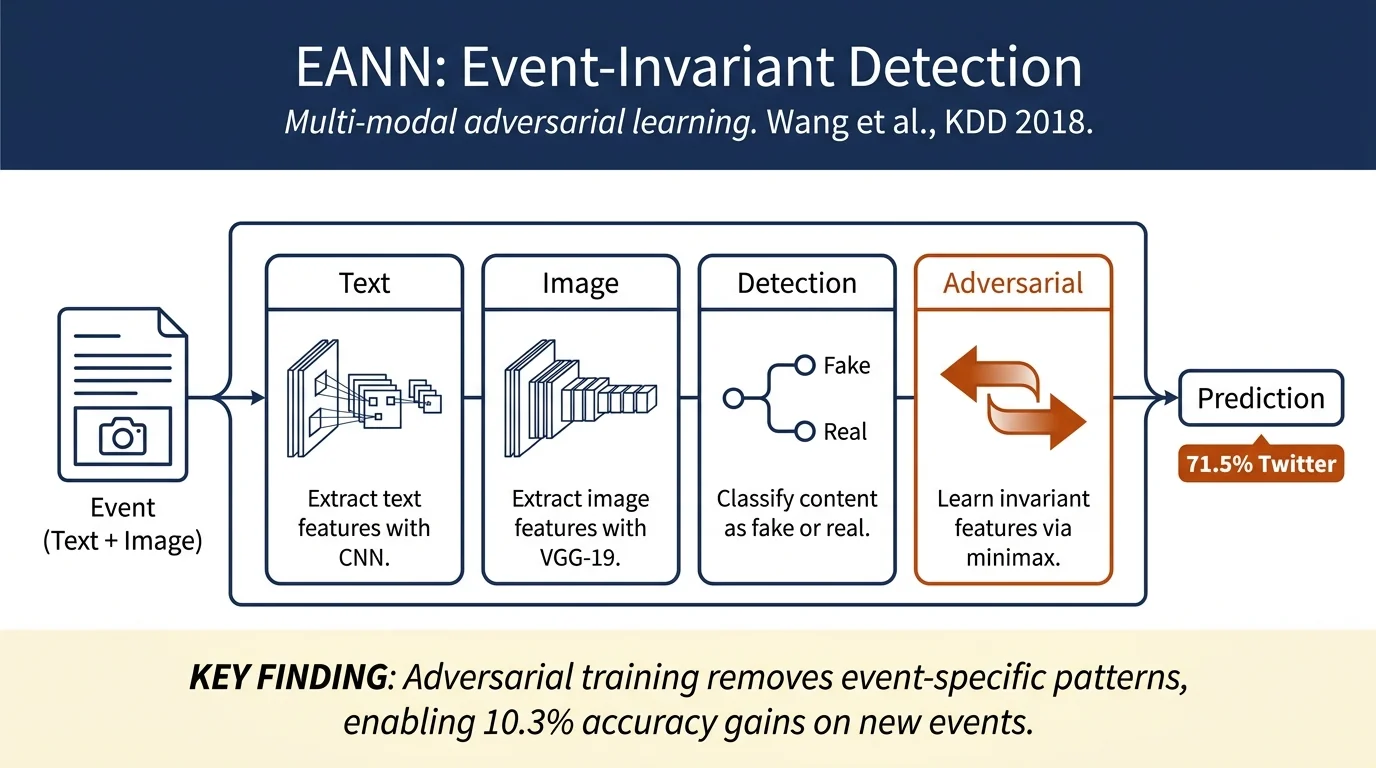
EANN: Event Adversarial Neural Networks for Multi-Modal Fake News DetectionThe paper proposes EANN, an adversarial neural network that detects fake news on newly emerged events by learning event-invariant features. An event discriminator forces the multi-modal feature extractor to remove event-specific features while preserving shared patterns across events.
Fact-checking & verificationDatasets & evaluation
ClaimBuster: The first end-to-end fact-checking systemFoundational work introducing ClaimBuster, an end-to-end automated fact-checking system. Introduces a dataset of 23,533 human-annotated U.S. debate statements with check-worthiness labels, establishing baselines for automated claim check-worthiness detection and ranking.
 Detection methodsDatasets & evaluation
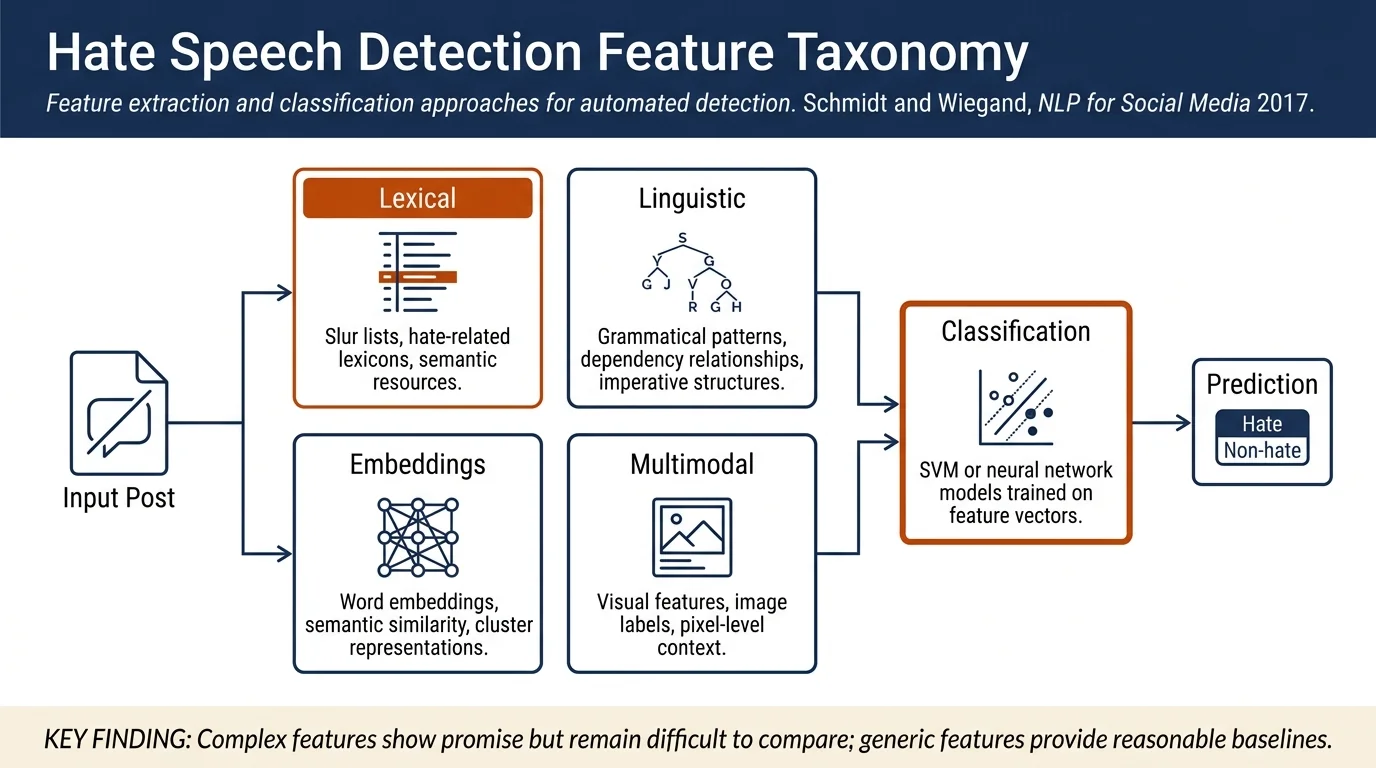
A Survey on Hate Speech Detection using Natural Language ProcessingThis survey systematically reviews automatic hate speech detection methods, covering feature extraction techniques (surface features, embeddings, sentiment analysis, lexical resources, linguistic features, knowledge bases), classification approaches (mostly supervised learning with SVMs and neural networks), annotation practices, and key…
 Detection methodsSpread & networks
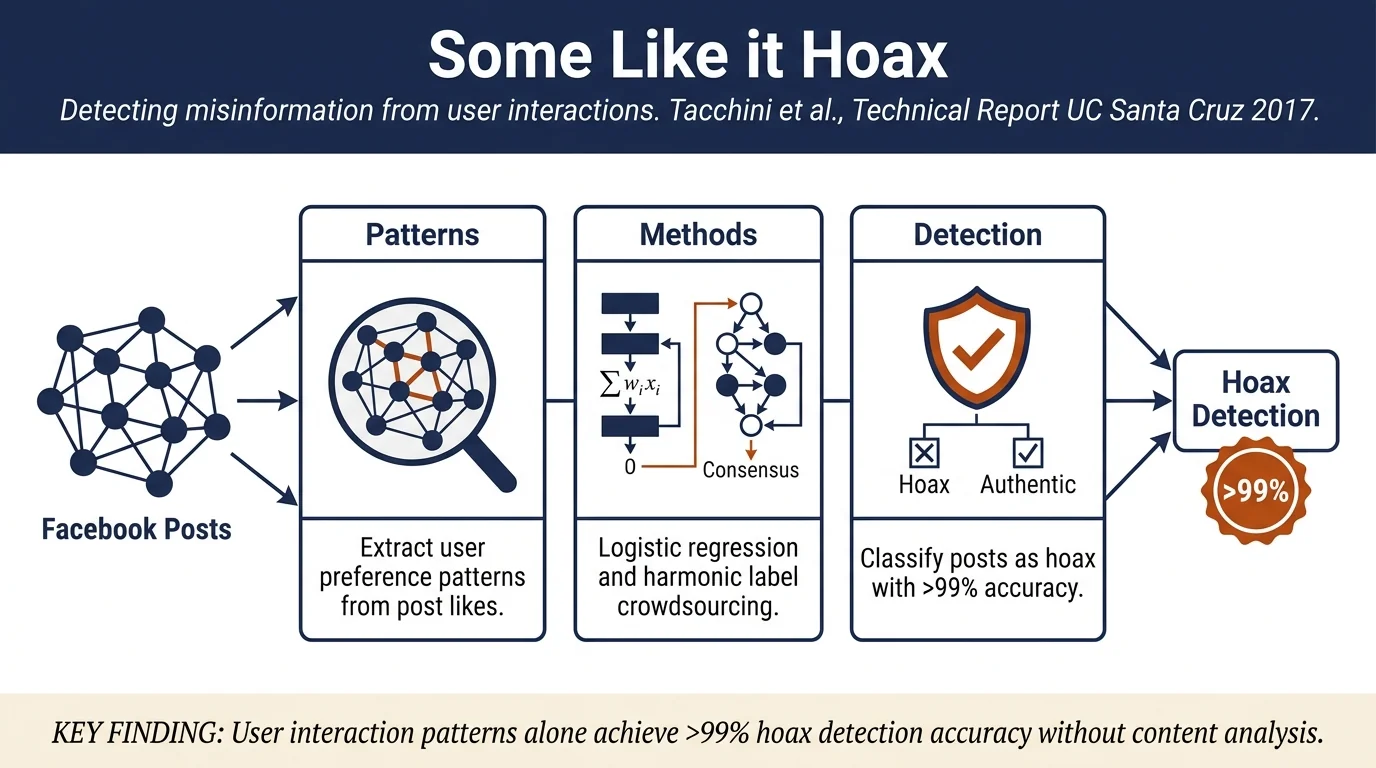
Some Like it Hoax: Automated Fake News Detection in Social NetworksHoaxes on Facebook can be detected with 99% accuracy using user interaction patterns (who "liked" posts) rather than content analysis. Two algorithms—logistic regression and harmonic boolean crowdsourcing—achieve high accuracy even with minimal labeled training data, and knowledge transfers across different Facebook communities.
 Detection methodsLLMs & generative AI
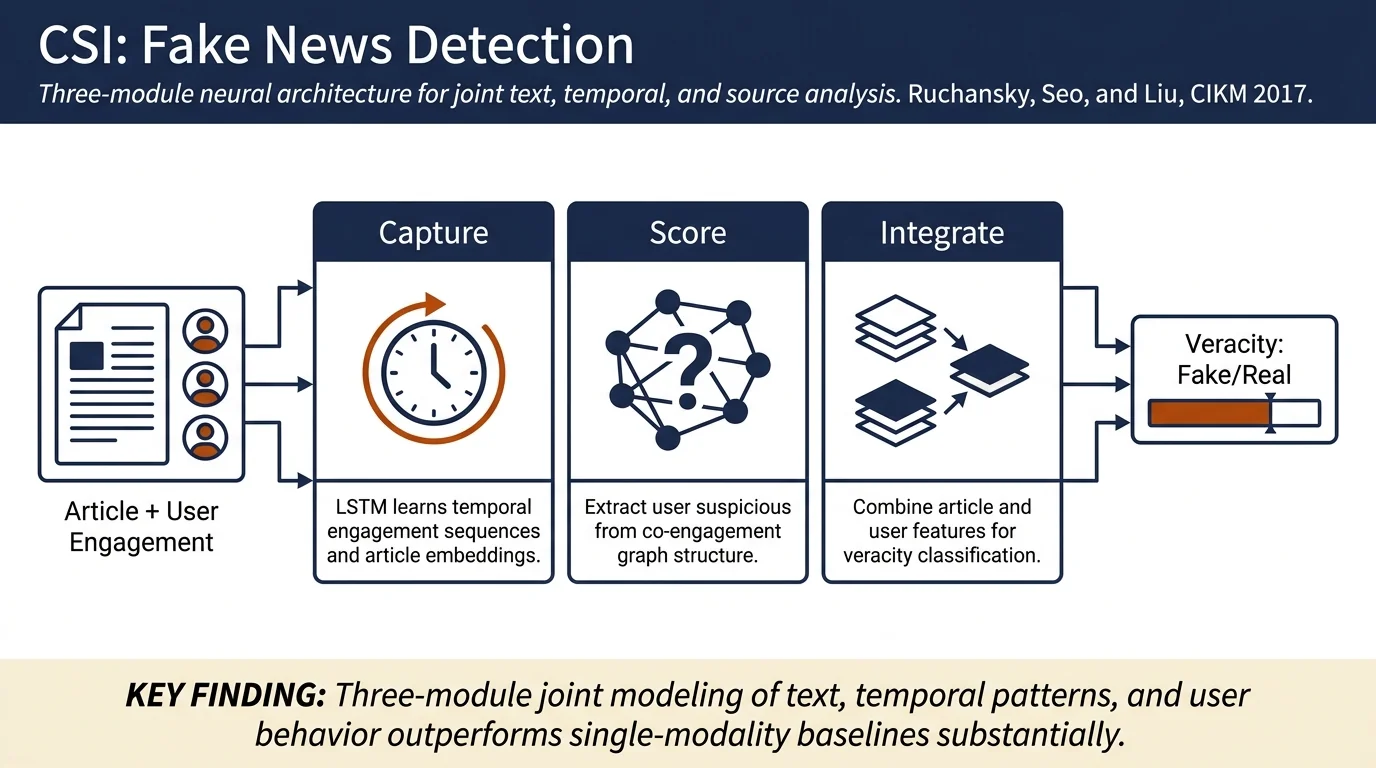
CSI: A Hybrid Deep Model for Fake News DetectionCSI is a three-module deep learning model that detects fake news by jointly modeling article text, temporal patterns of user engagement (response), and user behavior patterns (source). The Capture module uses LSTM to learn temporal response signals; the Score module learns user suspiciousness from co-engagement patterns; the Integrate…
 Detection methodsSpread & networks
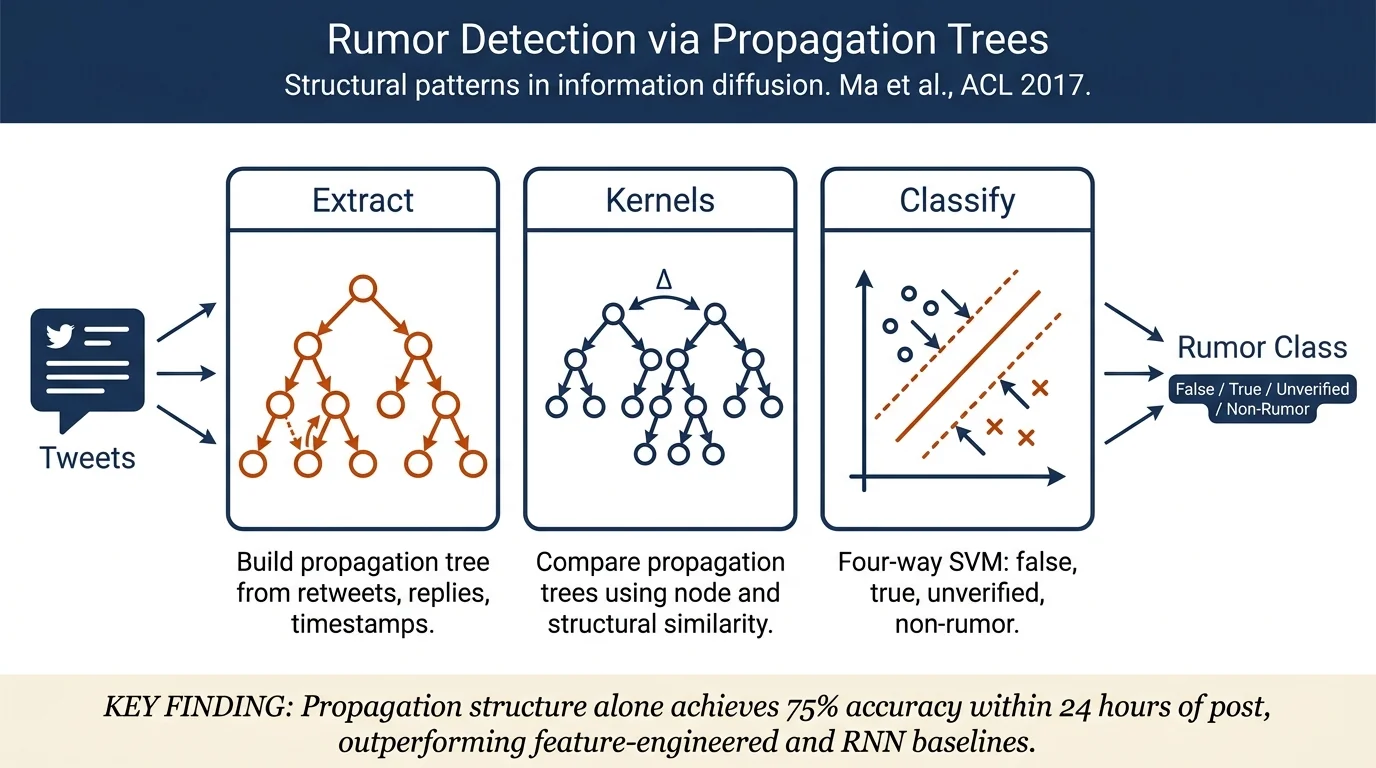
Detect Rumors in Microblog Posts Using Propagation Structure via Kernel LearningThis paper addresses rumor detection in microblog posts by modeling information diffusion as propagation trees and proposing a kernel-based method (PTK) that captures high-order structural patterns differentiating rumors from non-rumors. The approach extends to context-sensitive variants (cPTK) and achieves superior early detection…
 Spread & networksDatasets & evaluation
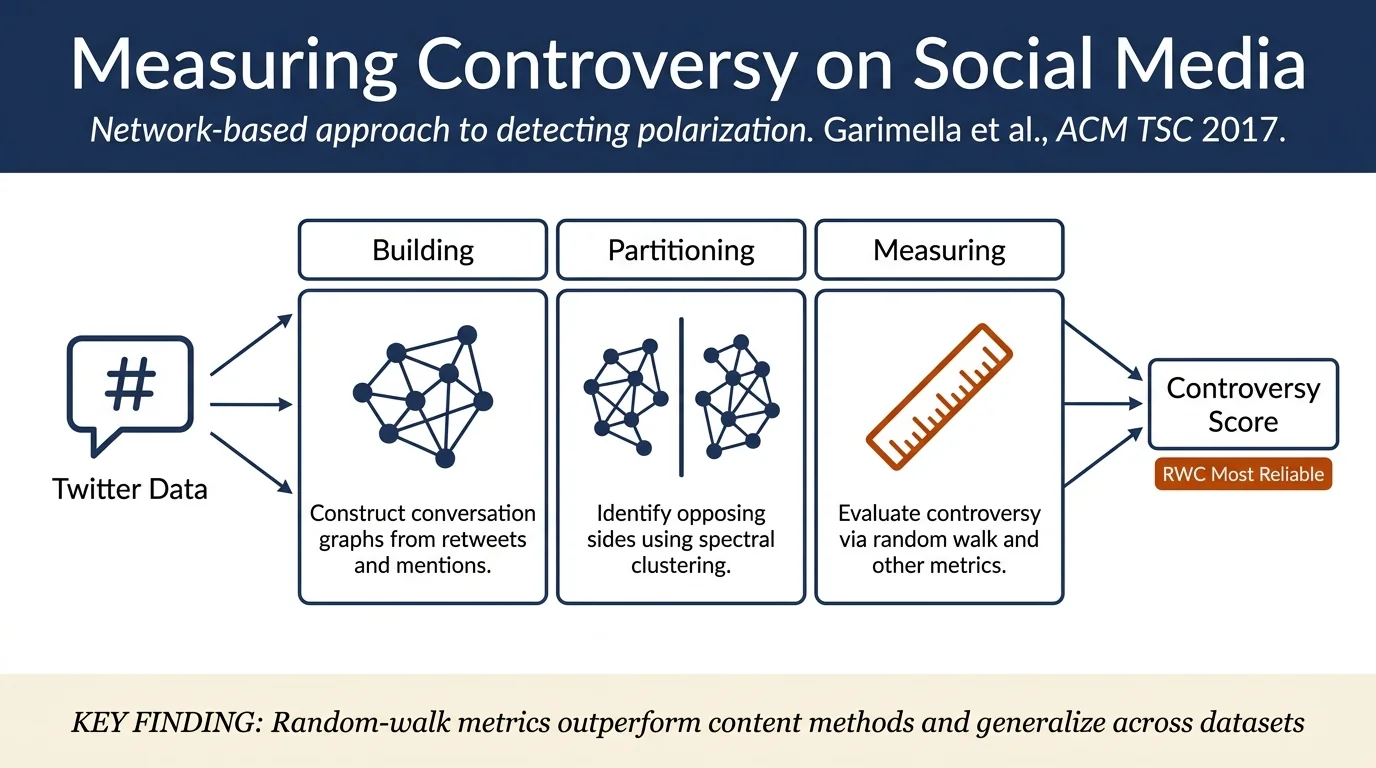
Quantifying Controversy on Social MediaThis work presents a graph-based pipeline to measure controversy in social media discussions. The authors build conversation graphs from Twitter interactions (retweets, follows, mentions), partition them to identify opposing sides, and apply multiple controversy measures—with a random-walk-based metric (RWC) emerging as the most reliable…
 Spread & networksDatasets & evaluation
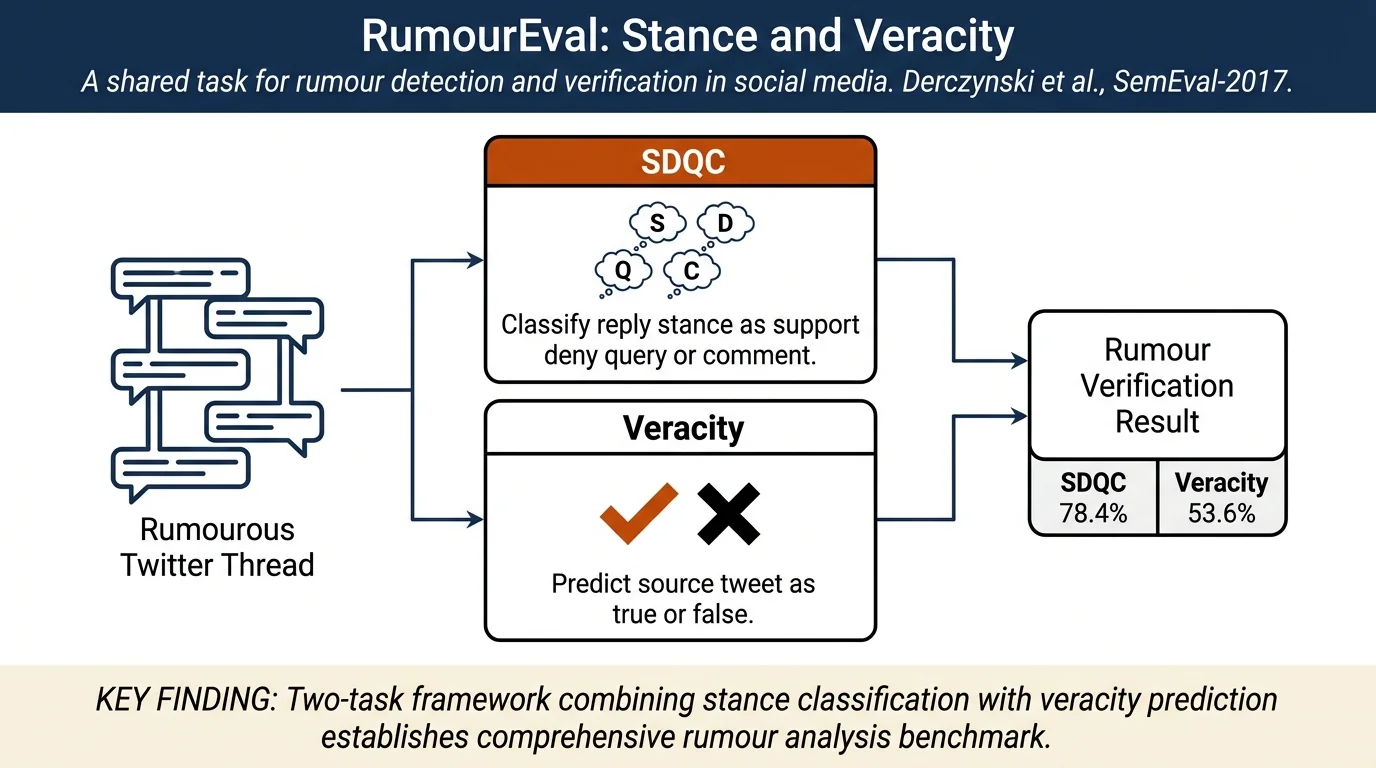
SemEval-2017 Task 8: RumourEval: Determining rumour veracity and support for rumoursRumourEval is a shared task benchmark for detecting and verifying rumours in social media. It introduces two subtasks: (a) stance classification (SDQC: Support/Deny/Query/Comment) of replies to rumourous claims, and (b) veracity prediction (true/false) of source tweets.
 Bots & coordinated campaignsPlatforms, policy & society
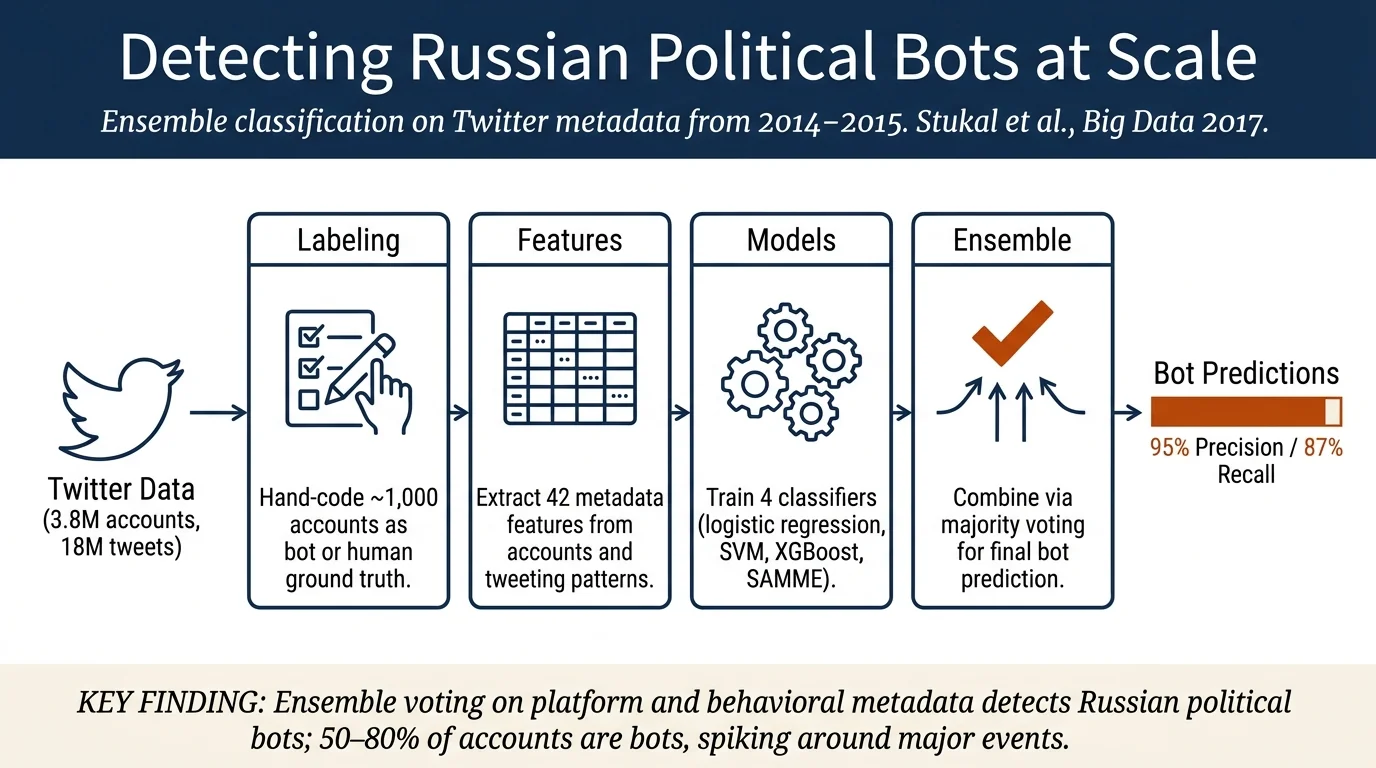
Detecting Bots on Russian Political TwitterAutomated Twitter accounts (bots) represent 50% of activity in Russian political discourse. Using supervised ensemble classifiers on 3.8M accounts and 18M tweets from 2014–2015, the authors achieve 95% precision in detecting bots while maintaining 75% recall.
 Datasets & evaluationFact-checking & verification
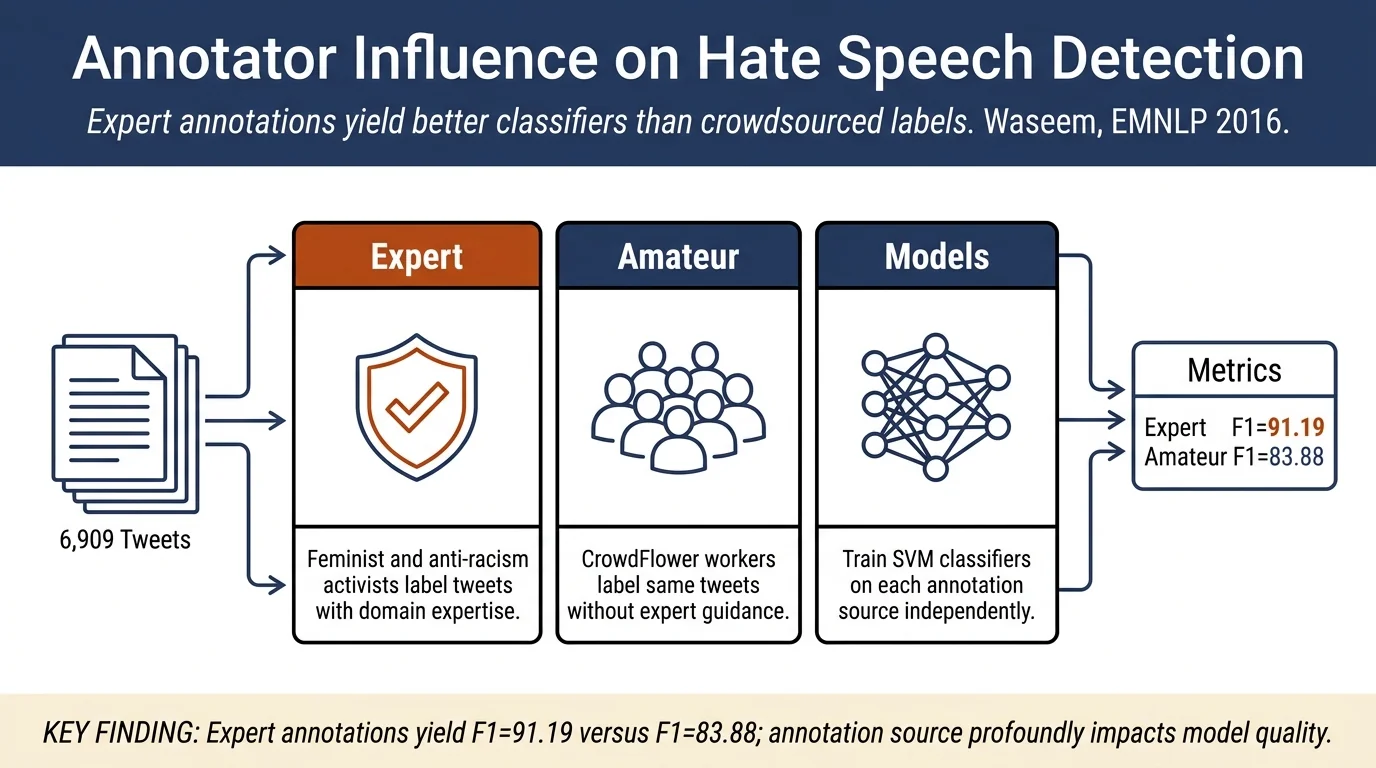
Are You a Racist or Am I Seeing Things? Annotator Influence on Hate Speech Detection on TwitterThis paper compares hate speech detection systems trained on expert annotations (from feminist and anti-racism activists) versus amateur annotations (crowdsourced via CrowdFlower) on 6,909 tweets. Systems trained on expert annotations significantly outperform those trained on amateur data, and amateur annotators systematically label more…
 Bots & coordinated campaignsDatasets & evaluation
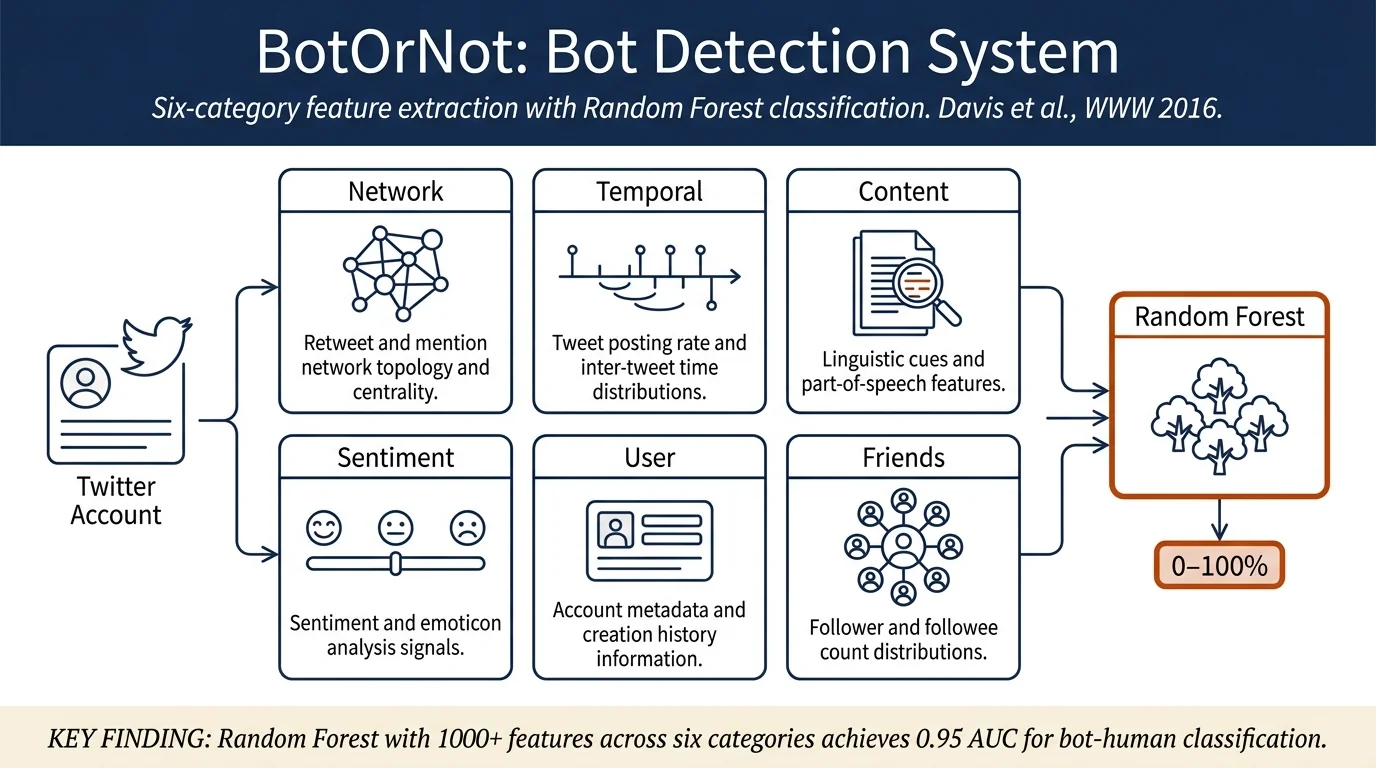
BotOrNot: A System to Evaluate Social BotsBotOrNot is a publicly available service and API that evaluates whether a Twitter account is controlled by a human or automated bot. Using 1,000+ features across six categories (network, user, friends, temporal, content, sentiment), the system applies Random Forest classification to achieve 0.95 AUC on a labeled dataset of 15k bots and…