Explore papers
Filter by research area, year and venue. Every filter is in the address bar, so you can share a view as a link.
 Spread & networksPlatforms, policy & society
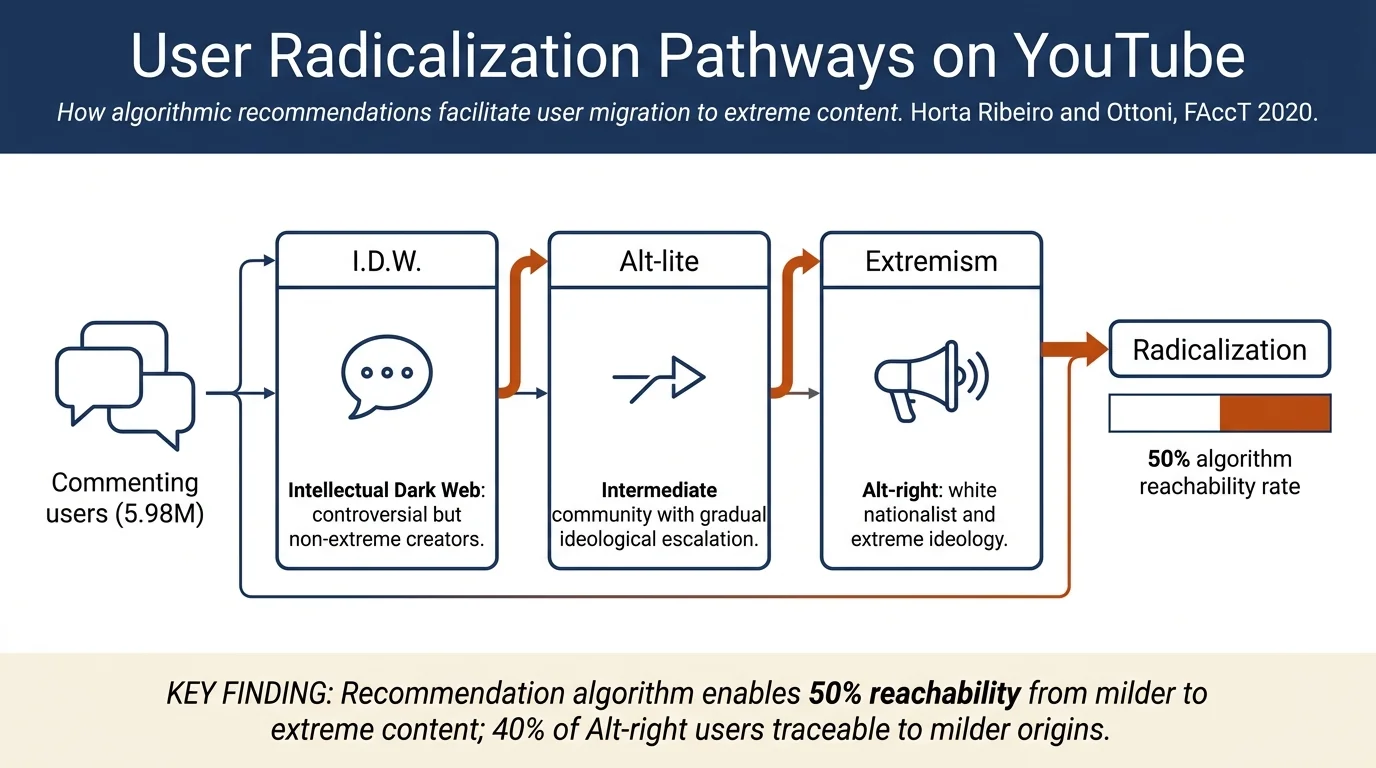
Auditing Radicalization Pathways on YouTubeFirst large-scale quantitative audit of user radicalization on YouTube. The authors tracked 349 channels across three ideological communities (Intellectual Dark Web, Alt-lite, Alt-right) and found strong evidence that users systematically migrate toward more extreme content.
 Bots & coordinated campaignsDeepfakes & multimodal
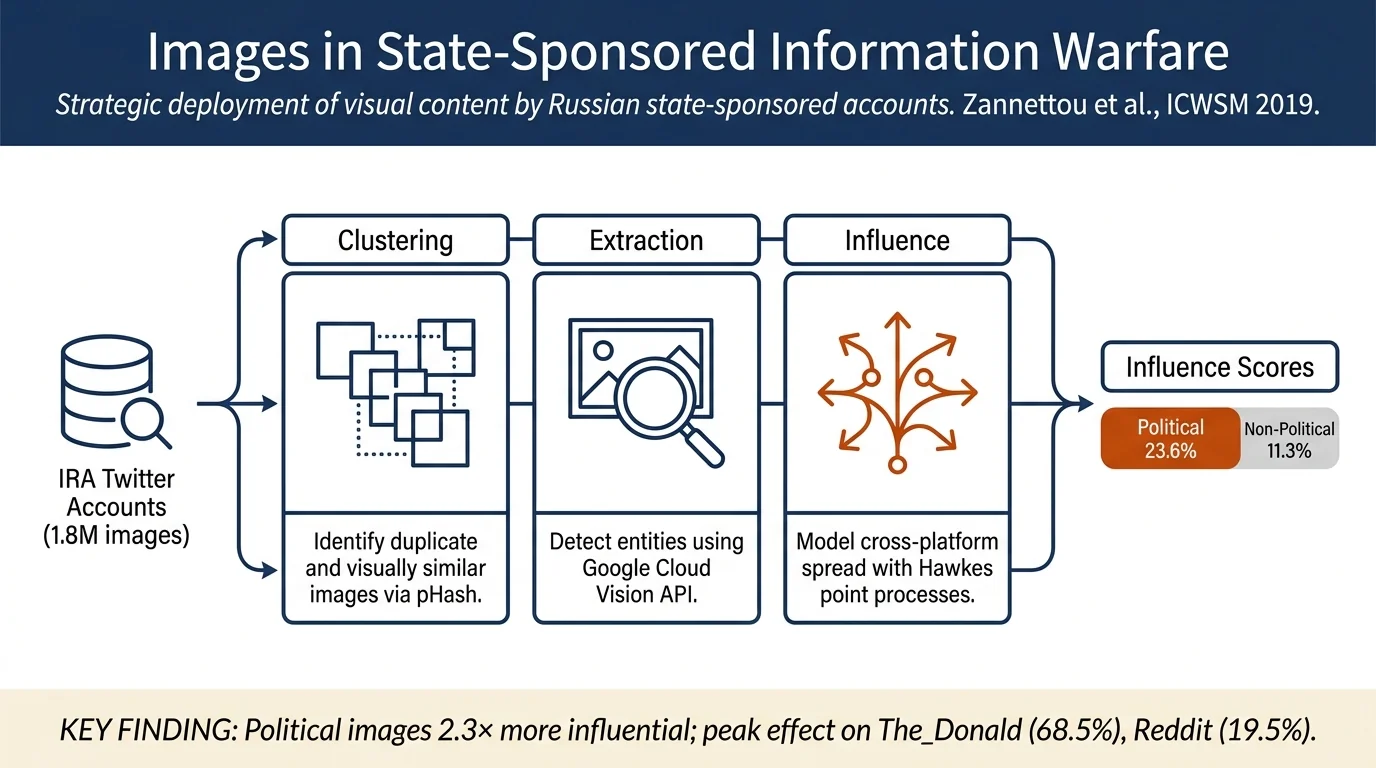
Characterizing the Use of Images in State-Sponsored Information Warfare Operations by Russian Trolls on TwitterLarge-scale analysis of 1.8M images posted by ~3.6K Russian state-sponsored Twitter accounts (IRA-controlled). Russian trolls strategically deployed images and memes to maximize political influence, with political imagery 2+ times more effective than general content.
 Bots & coordinated campaignsDatasets & evaluation
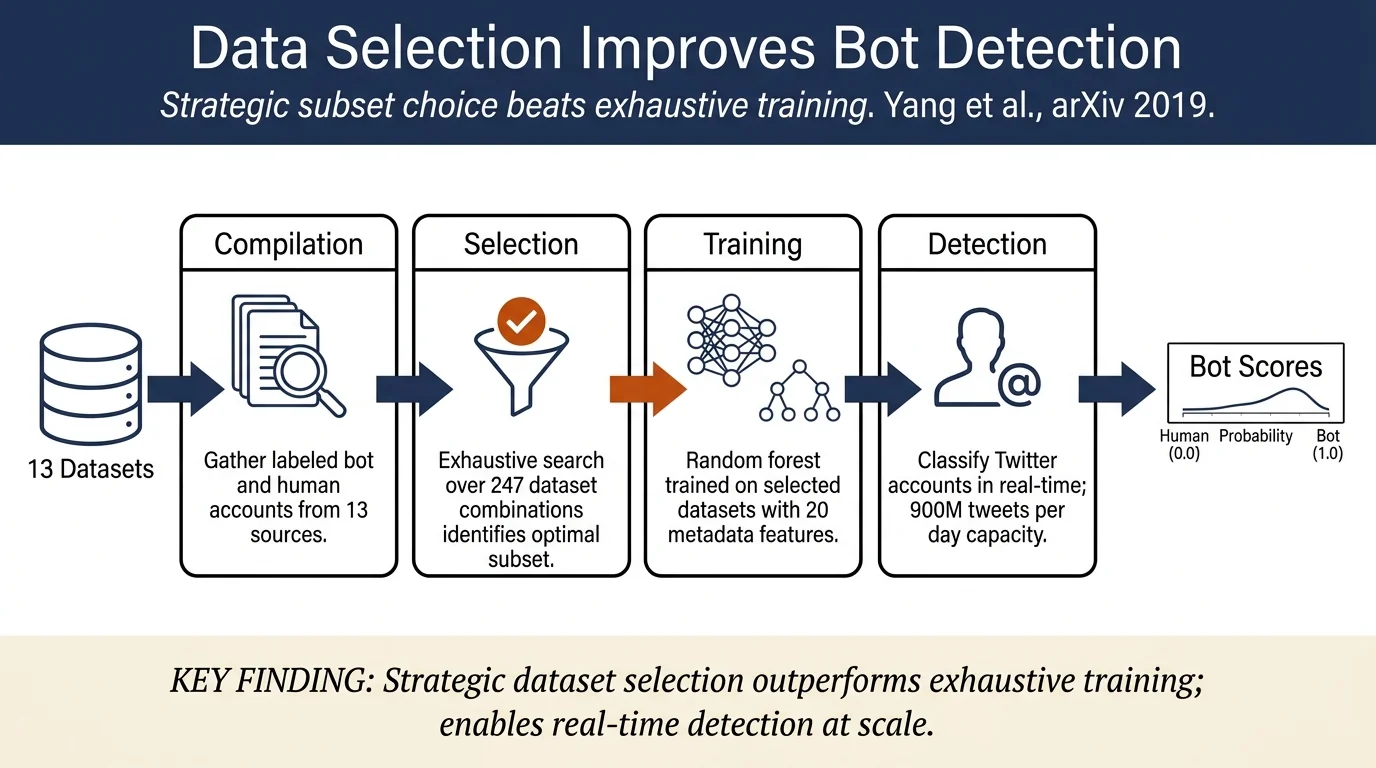
Scalable and Generalizable Social Bot Detection through Data SelectionThis paper addresses scalability and generalization challenges in social bot detection by proposing a framework using only 20 user metadata features, enabling real-time analysis of the full Twitter stream. The key insight is that strategic data selection—training on a carefully chosen subset of 13 compiled datasets—achieves better…
 Bots & coordinated campaignsDatasets & evaluation
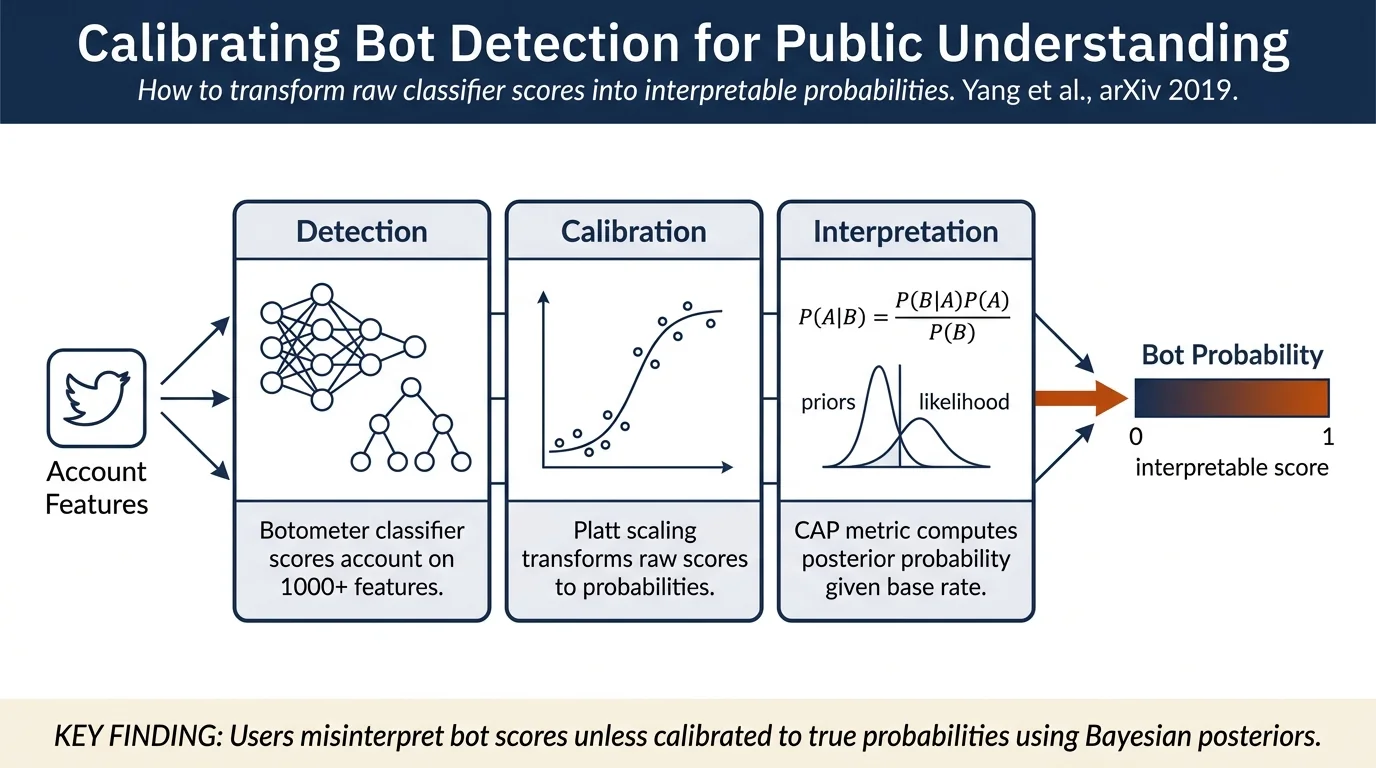
Arming the public with artificial intelligence to counter social botsThis paper reviews social bot types, their impact on online discourse, and detection methods, then presents Botometer as a case study in how detection tools are used and interpreted by the public. The authors conducted a user experience survey (731 participants) revealing that while users find the tool useful, they struggle with…
 Bots & coordinated campaignsDetection methods
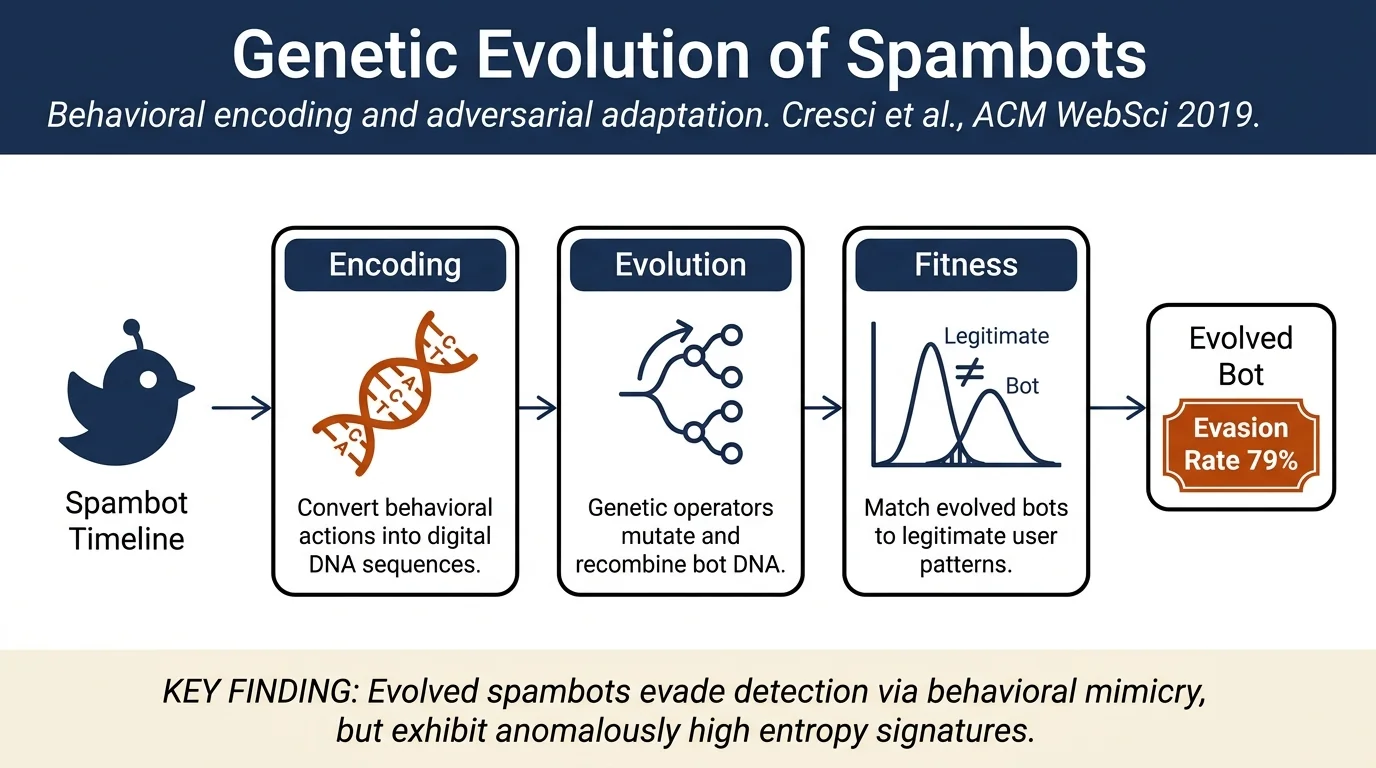
Better Safe Than Sorry: an Adversarial Approach to improve Social Bot DetectionProposes GenBot, a novel genetic algorithm that synthesizes evolved versions of existing spambots by encoding behavioral timelines as "digital DNA" sequences and iteratively evolving them to resemble legitimate user behavior. Tests the evolved bots against three state-of-the-art detection systems and finds they largely evade detection…
 LLMs & generative AIDetection methods
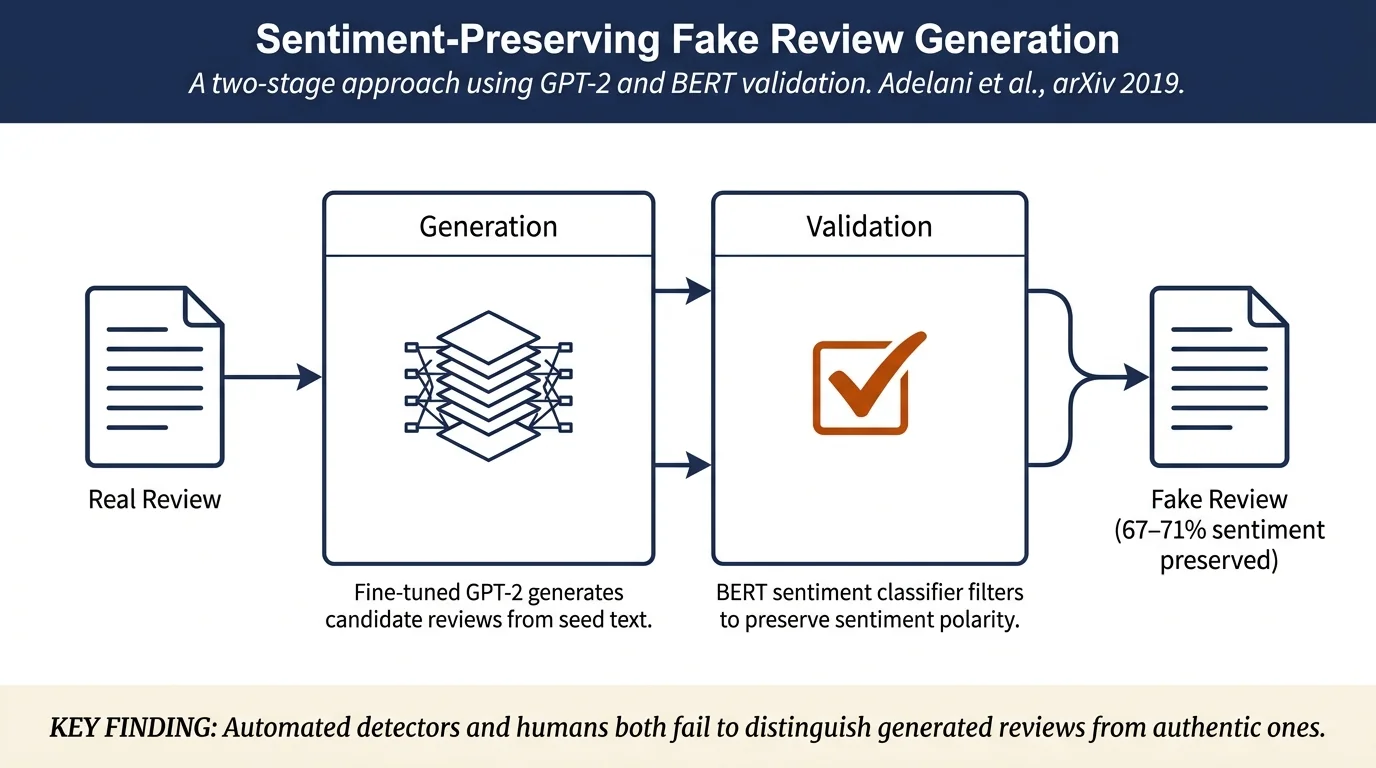
Generating Sentiment-Preserving Fake Online Reviews Using Neural Language Models and Their Human- and Machine-based DetectionThe paper demonstrates a practical attack where low-skilled adversaries can generate high-quality fake product reviews at scale by fine-tuning publicly available GPT-2 models on real review datasets. A two-step approach—generation plus BERT-based validation to preserve sentiment—produces reviews indistinguishable from genuine ones.
 Spread & networksBots & coordinated campaigns
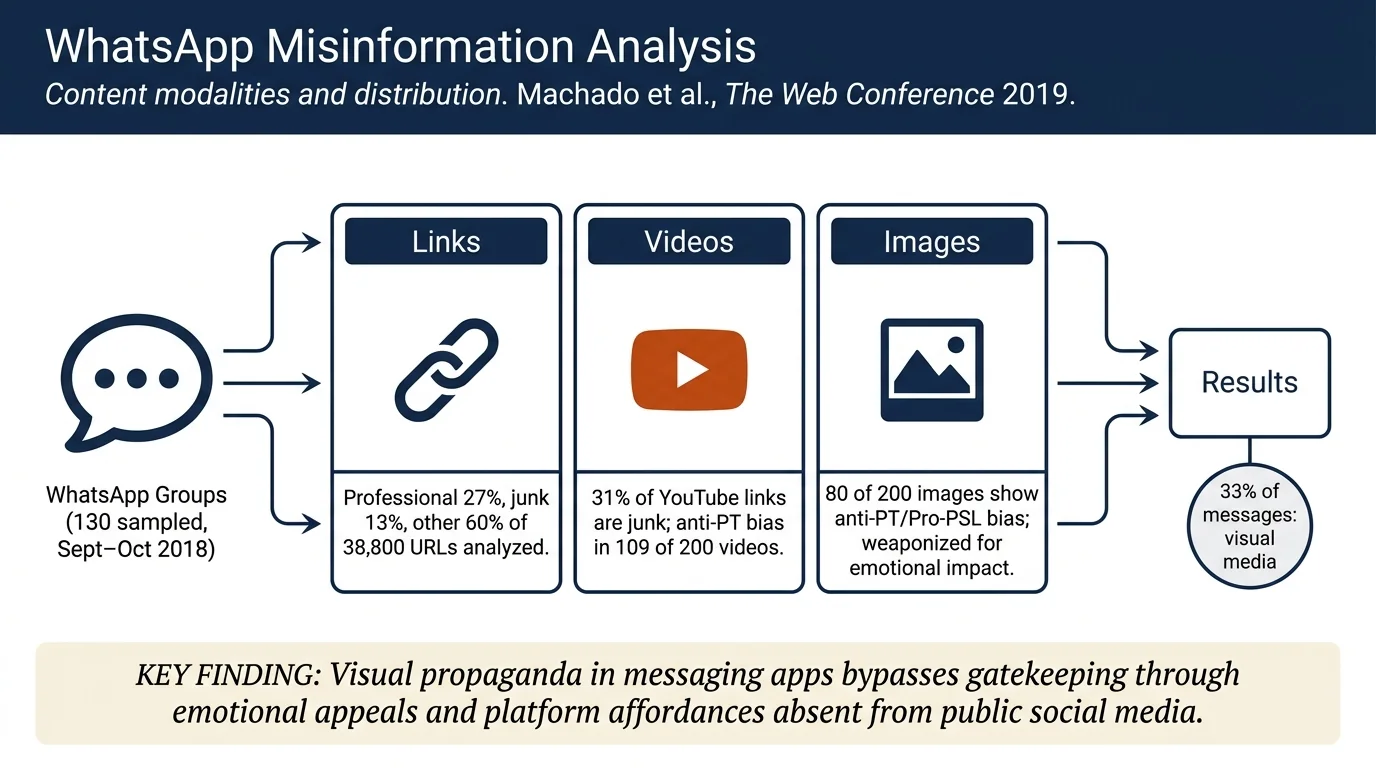
A Study of Misinformation in WhatsApp groups with a focus on the Brazilian Presidential ElectionsStudy of 130 public WhatsApp groups during the 2018 Brazilian presidential election found that 13.1% of shared links pointed to junk news sources, with 40% of links directing to YouTube—a platform used strategically to bypass platform moderation. Videos and images dominated message content (33% of all messages) and were heavily…
 Bots & coordinated campaignsPlatforms, policy & society
Coordinating a Multi-Platform Disinformation Campaign: Internet Research Agency Activity on Three U.S. Social Media Platforms, 2015 to 2017This paper analyzes Russian Internet Research Agency activity across Facebook, Twitter, and Reddit from 2015–2017 using vector autoregression models on 3,126 Facebook ads, 1.9M tweets, and 12,603 Reddit posts. Key finding: Reddit activity influenced subsequent Twitter activity (a "trial balloon" effect), but the IRA's Twitter engagement…
 Bots & coordinated campaignsSpread & networks
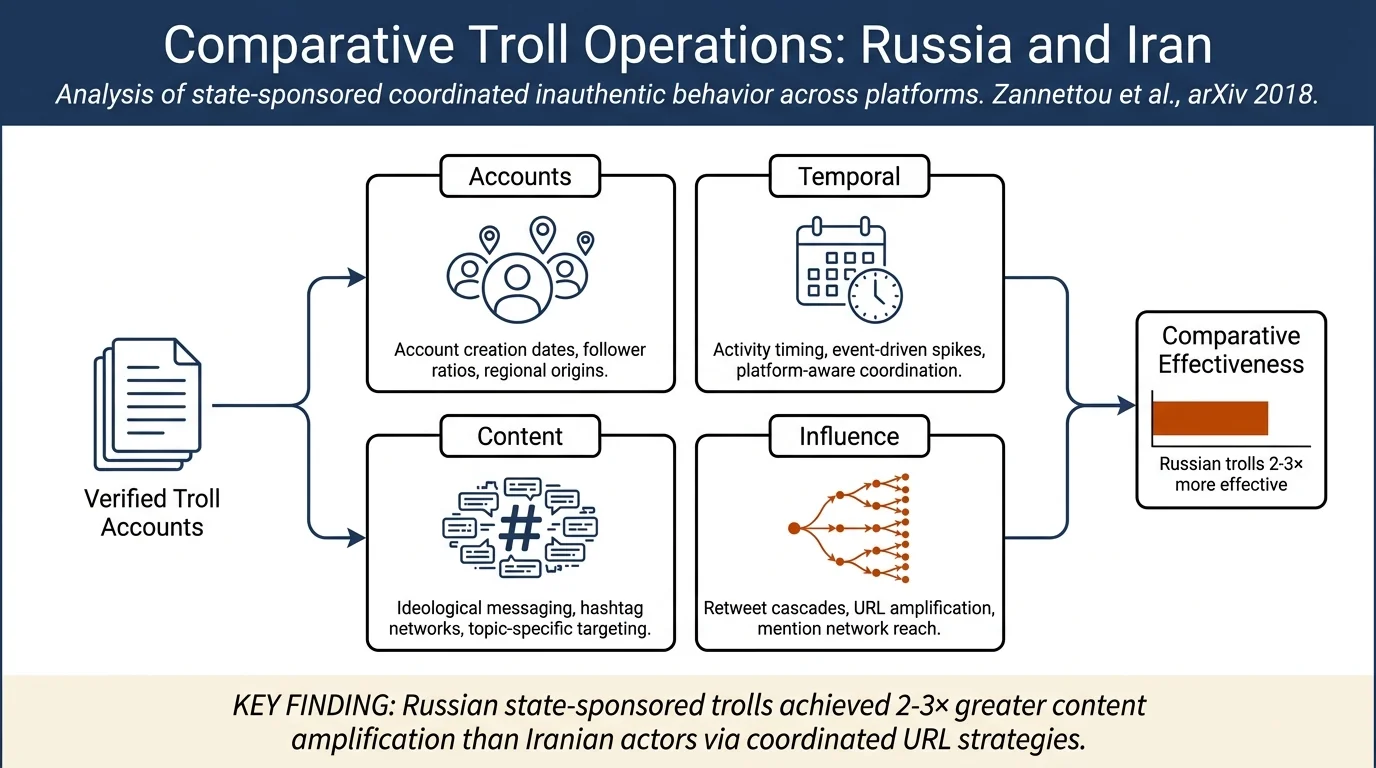
Who Let The Trolls Out? Towards Understanding State-Sponsored TrollsComparative analysis of 934 Russian and 770 Iranian state-sponsored trolls across Twitter and Reddit (10M posts) reveals distinct operational patterns: Russian trolls prioritized URL amplification (retweets, mentions) and pro-Trump messaging; Iranian trolls pursued regional and anti-Trump narratives motivated by real-world events. Both…
 Spread & networksBots & coordinated campaigns
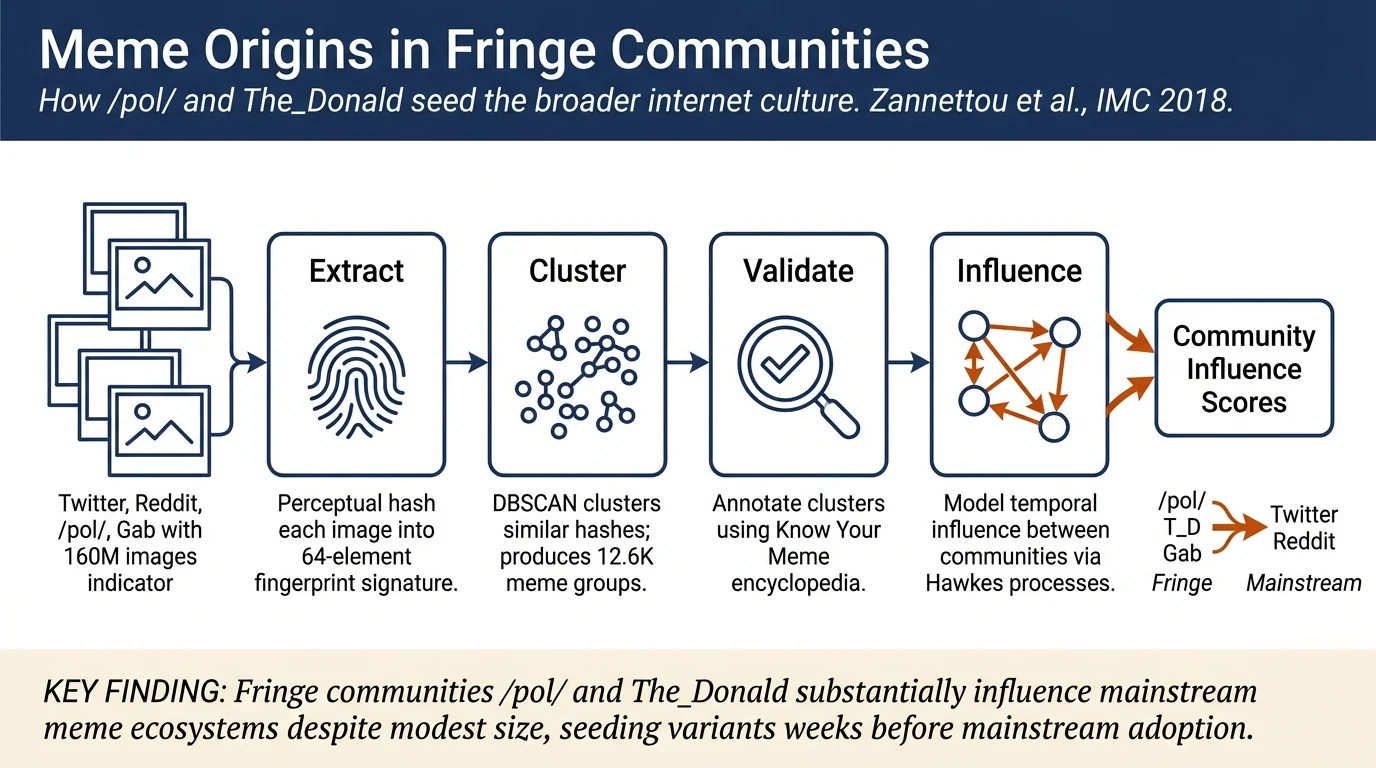
On the Origins of Memes by Means of Fringe Web CommunitiesLarge-scale empirical study of how image memes originate and propagate across fringe and mainstream Web communities. Analyzes 160M images posted to Twitter, Reddit, /pol/, and Gab (2016–2017) using perceptual hashing, clustering, and custom distance metrics.
 Bots & coordinated campaignsPlatforms, policy & society
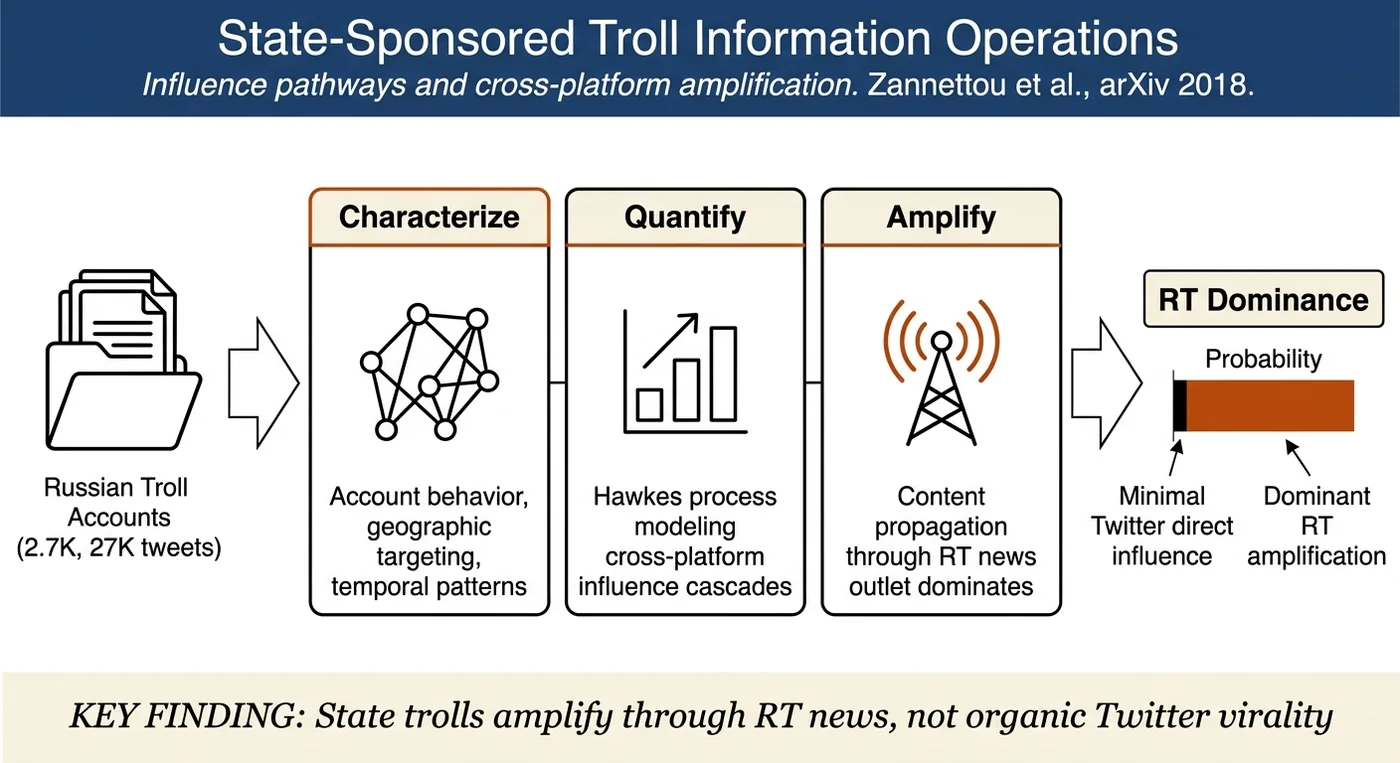
Disinformation Warfare: Understanding State-Sponsored Trolls on Twitter and Their Influence on the WebLarge-scale empirical study of 2.7K Russian state-sponsored troll accounts and 27K tweets (Jan 2016–Sep 2017) reveals minimal direct Twitter influence but significant content amplification through RT news outlet. Trolls actively target political events, adopt multiple identities, concentrate geographically in USA/Germany/Eastern Europe,…
 Spread & networksBots & coordinated campaigns
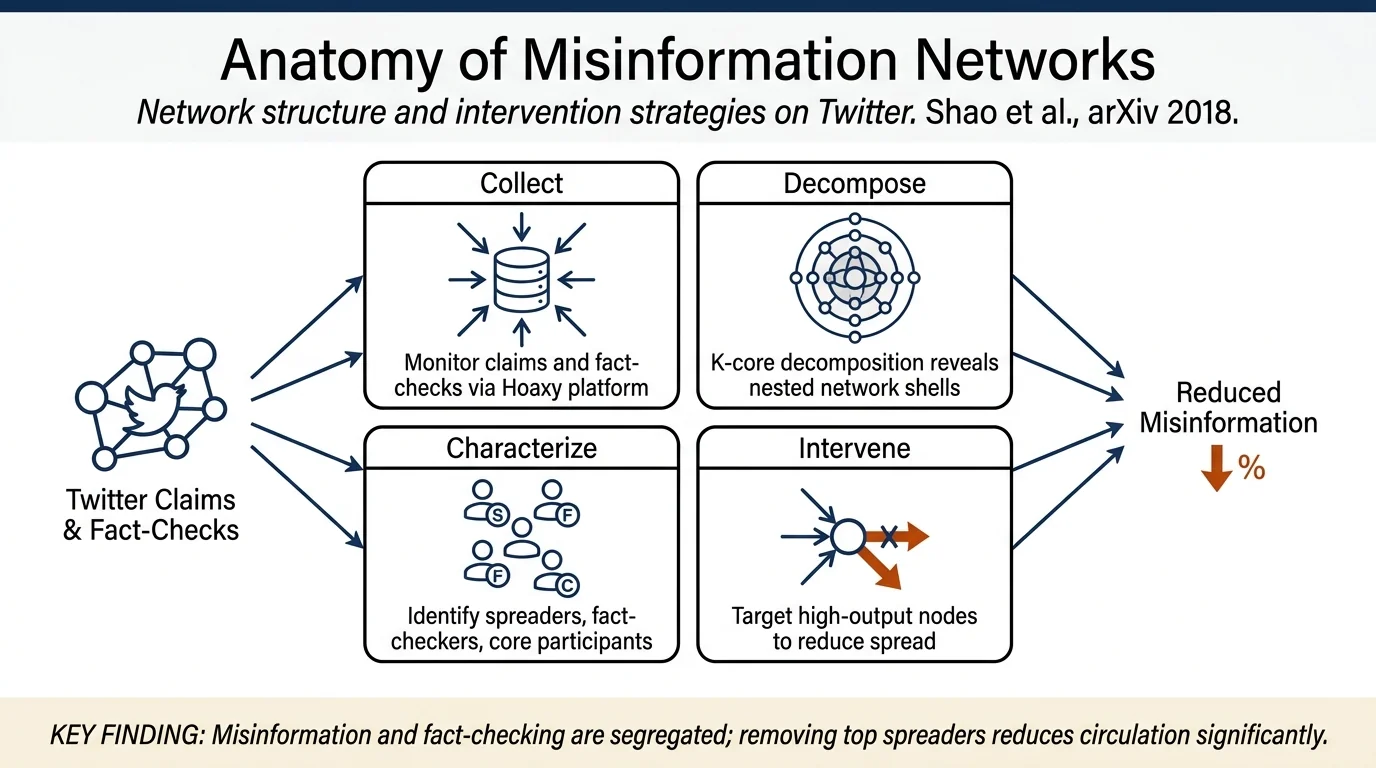
Anatomy of an online misinformation networkA network analysis of misinformation and fact-checking spread during the 2016 US Presidential Election reveals stark segregation between the two communities on Twitter. The core of the network is dominated by misinformation spreaders; fact-checking nearly disappears in the densest regions.
 Bots & coordinated campaignsSpread & networks
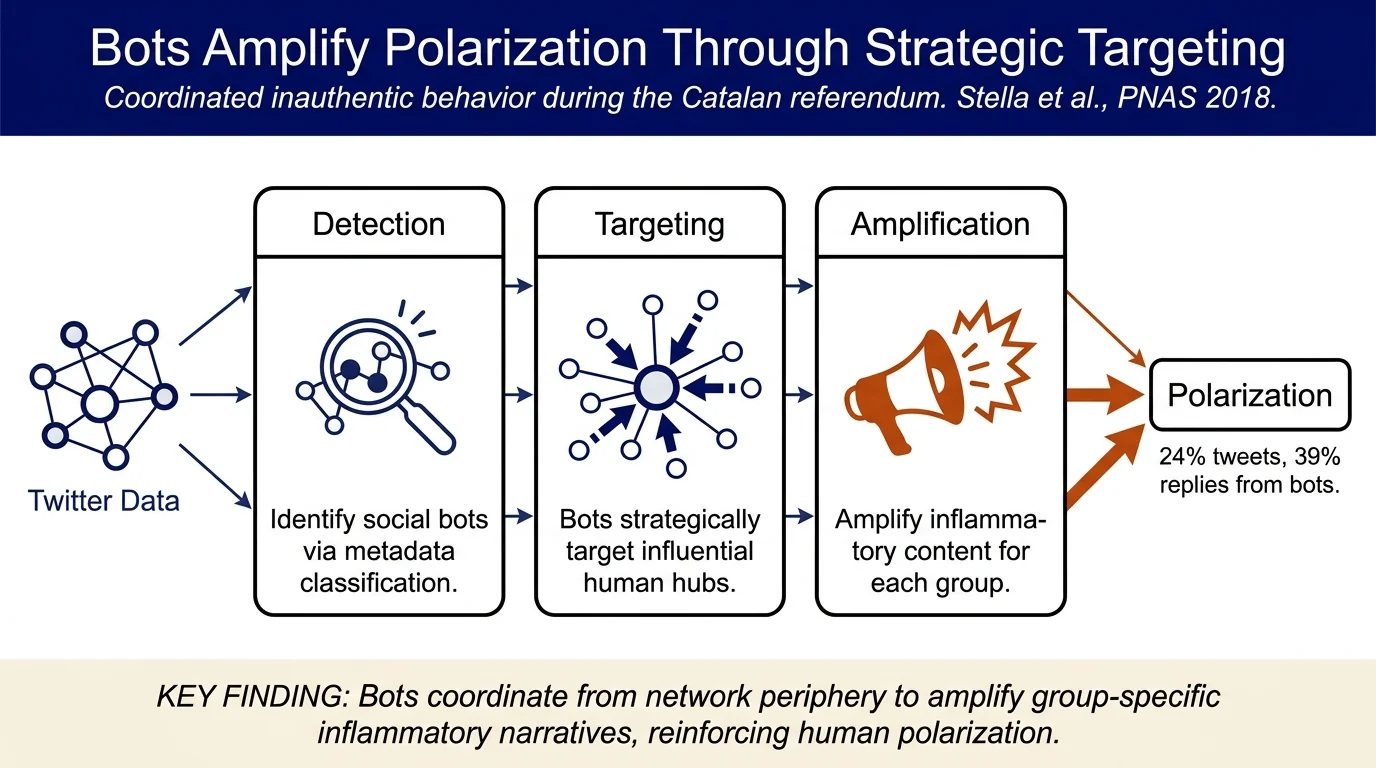
Bots increase exposure to negative and inflammatory content in online social systemsSocial bots during the 2017 Catalan independence referendum strategically targeted influential humans to amplify negative and inflammatory content. Operating from network peripheries, bots coordinated sentiment-driven amplification that exacerbated polarization, with approximately one in three referendum-related tweets generated by bots.
 Spread & networksBots & coordinated campaigns
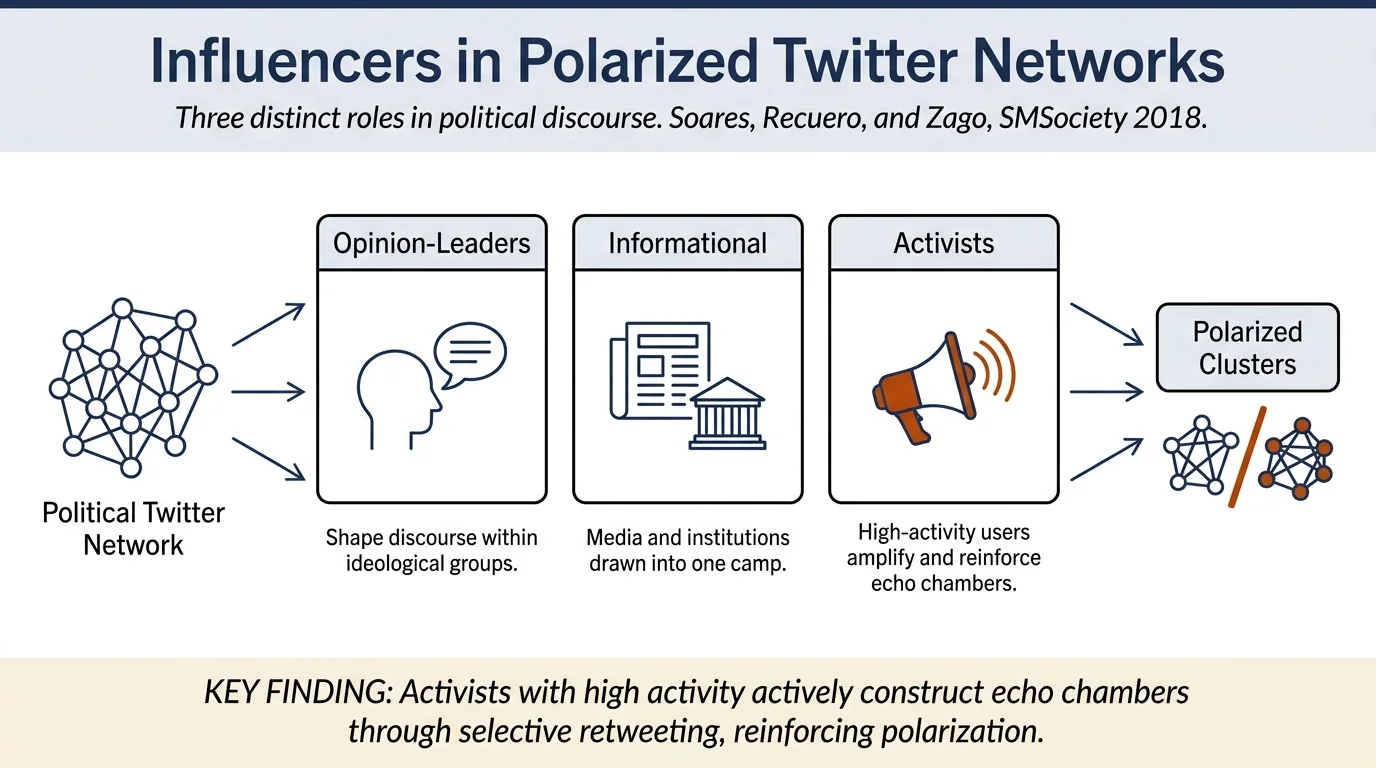
Influencers in Polarized Political Networks on TwitterThis paper identifies three types of influencers in polarized political Twitter conversations during Brazil's 2016 Dilma Rousseff impeachment: "opinion leaders" who shape discourse within ideological groups, "informational influencers" (media/institutions) drawn into one camp, and "activists" who amplify like-minded messages. The…
 Bots & coordinated campaignsDetection methods
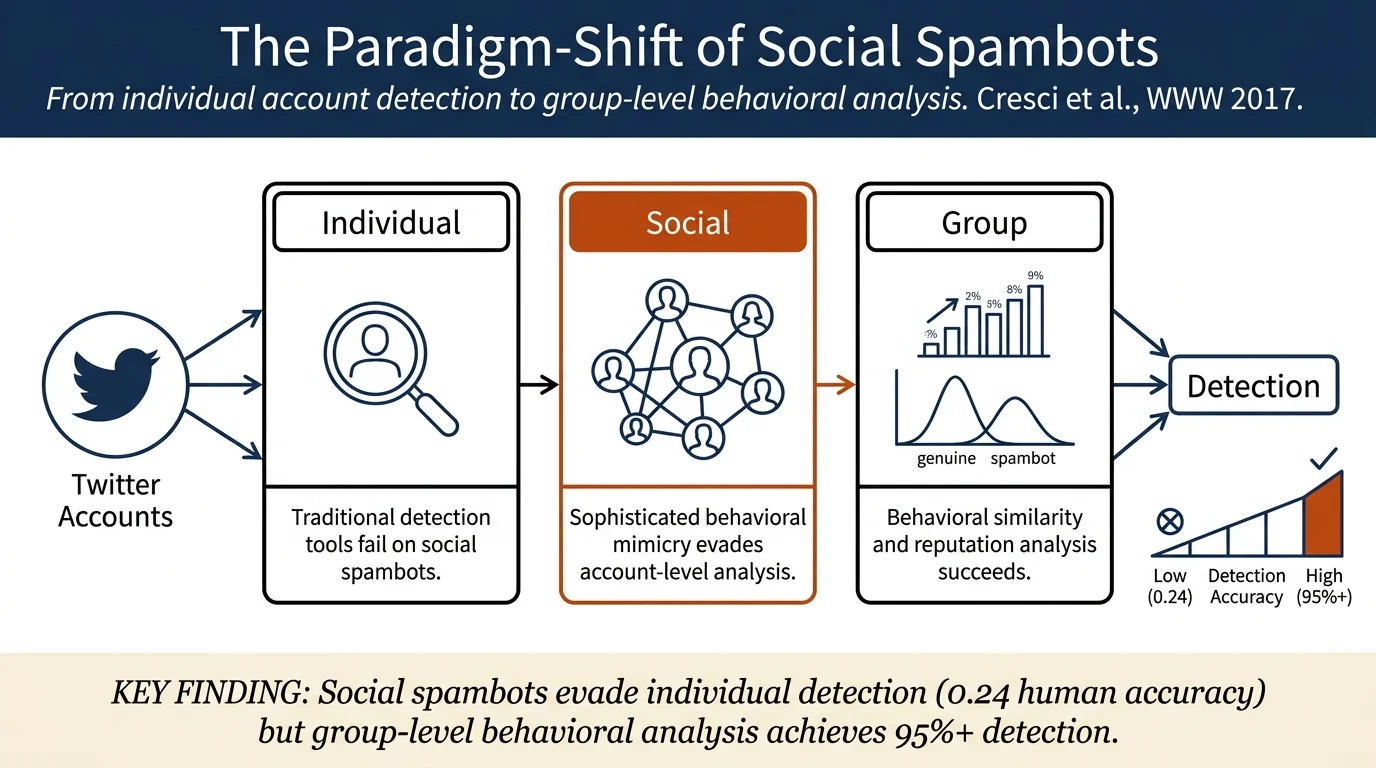
The Paradigm-Shift of Social Spambots: Evidence, Theories, and Tools for the Arms RaceThis paper provides empirical evidence of a paradigm shift in spambot design on Twitter, where new "social spambots" closely mimic genuine user behavior and successfully evade detection. Neither Twitter's automated systems, human annotators, nor established academic detection tools can effectively identify these accounts; however,…
 Bots & coordinated campaignsDatasets & evaluation
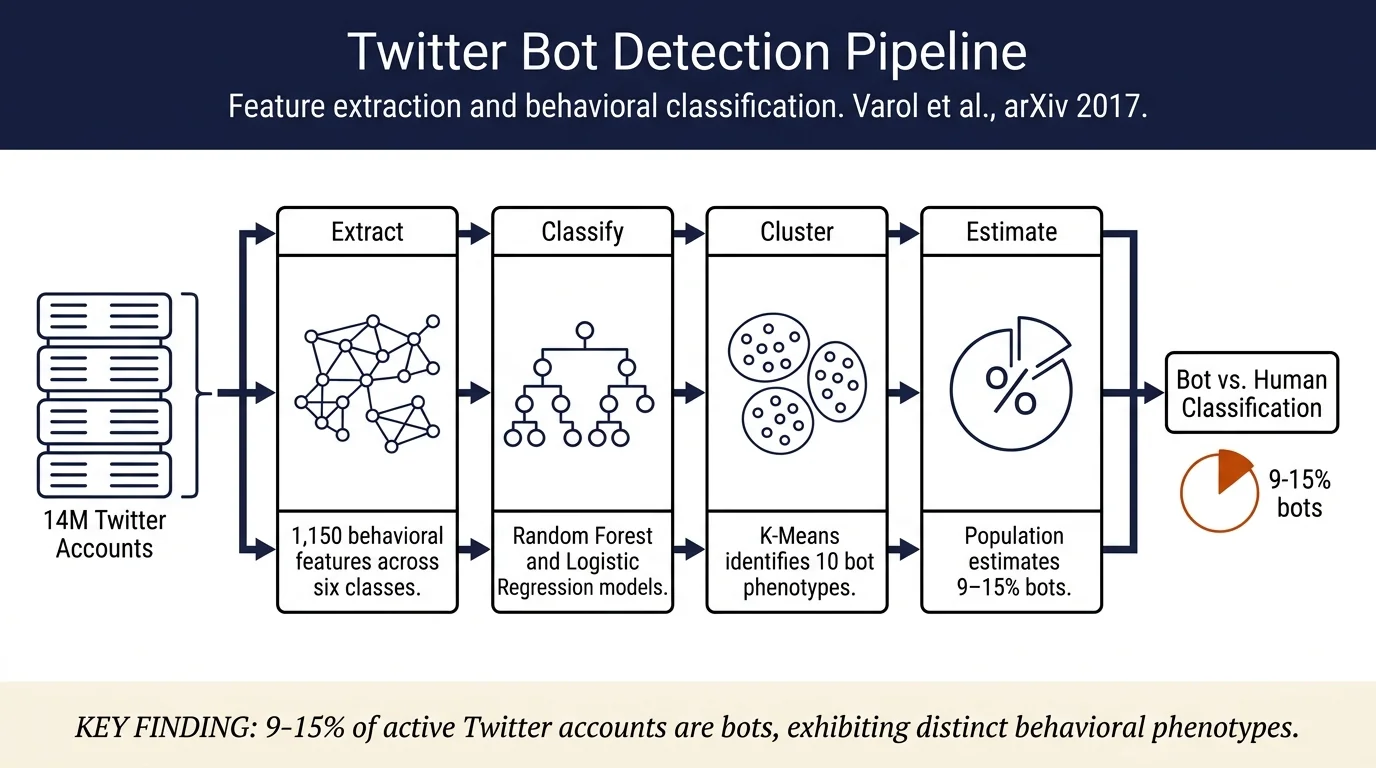
Online Human-Bot Interactions: Detection, Estimation, and CharacterizationSocial media accounts controlled by software can mimic human behavior while executing coordinated campaigns. This paper develops a machine-learning framework extracting 1,150 behavioral features from Twitter account metadata, posting patterns, and social networks to classify bots with 95% accuracy on honeypot data.
 Spread & networksBots & coordinated campaigns
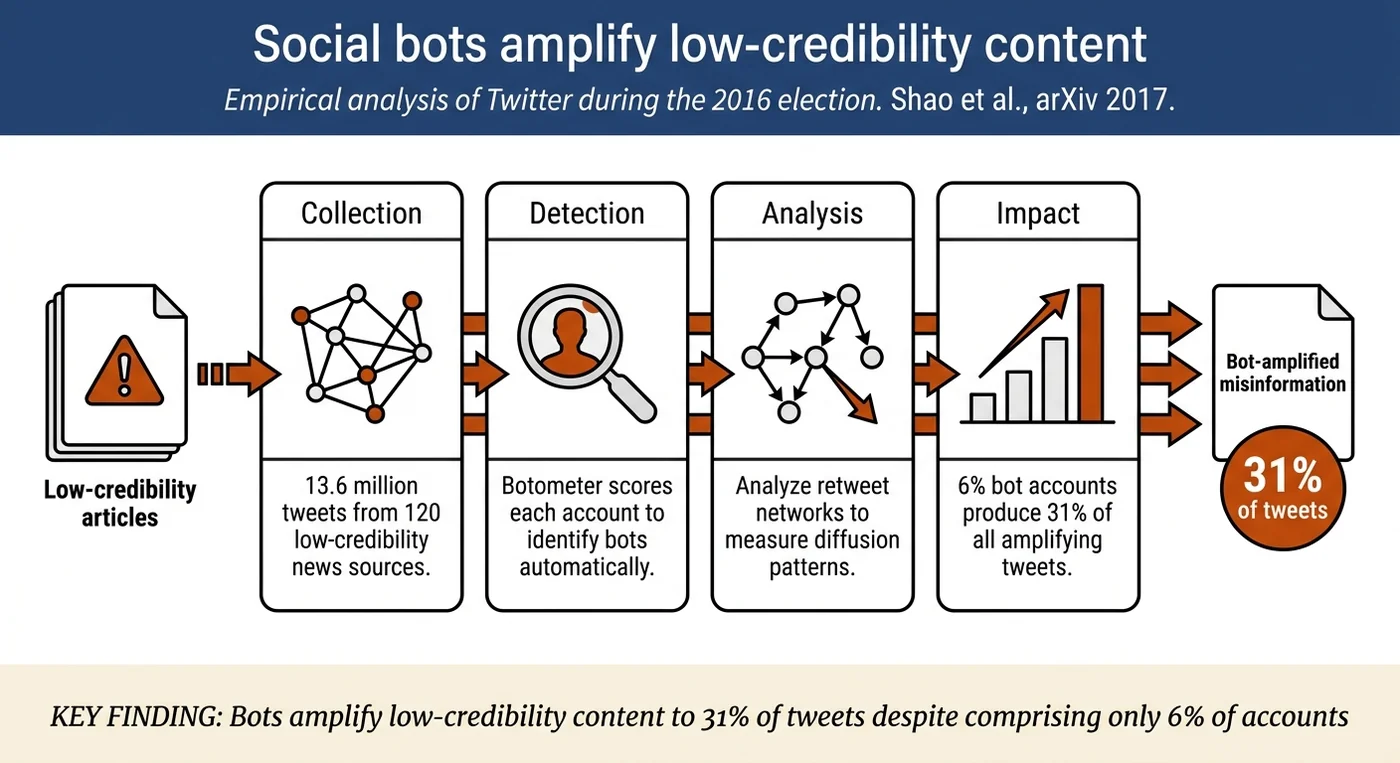
The spread of low-credibility content by social botsEmpirical analysis of 14 million Twitter messages during the 2016 U.S. election finds social bots disproportionately amplify low-credibility content: though bots comprise only 6% of accounts sharing such content, they account for 31% of tweets. Bots employ two strategies—rapid early amplification and targeting of influential users—making…
 Bots & coordinated campaignsPlatforms, policy & society
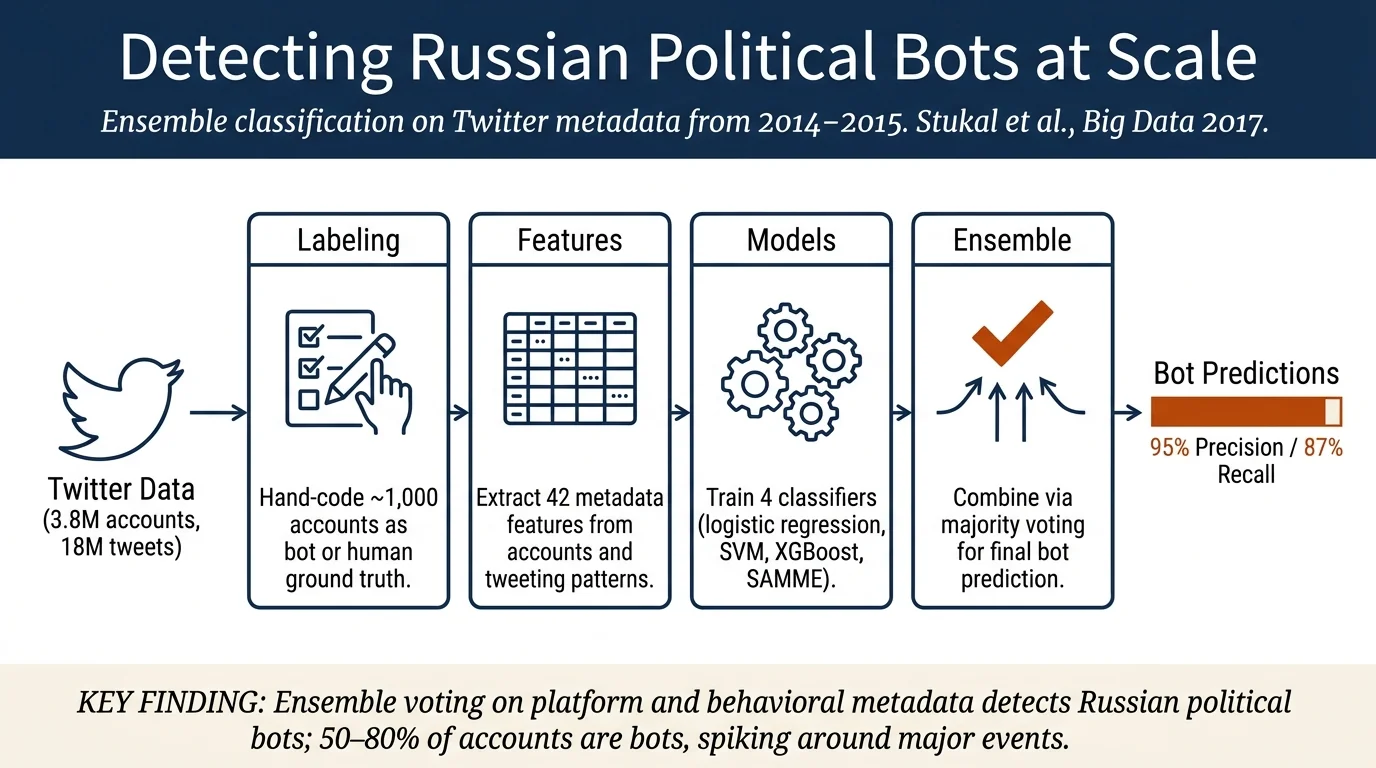
Detecting Bots on Russian Political TwitterAutomated Twitter accounts (bots) represent 50% of activity in Russian political discourse. Using supervised ensemble classifiers on 3.8M accounts and 18M tweets from 2014–2015, the authors achieve 95% precision in detecting bots while maintaining 75% recall.
 Spread & networksBots & coordinated campaigns
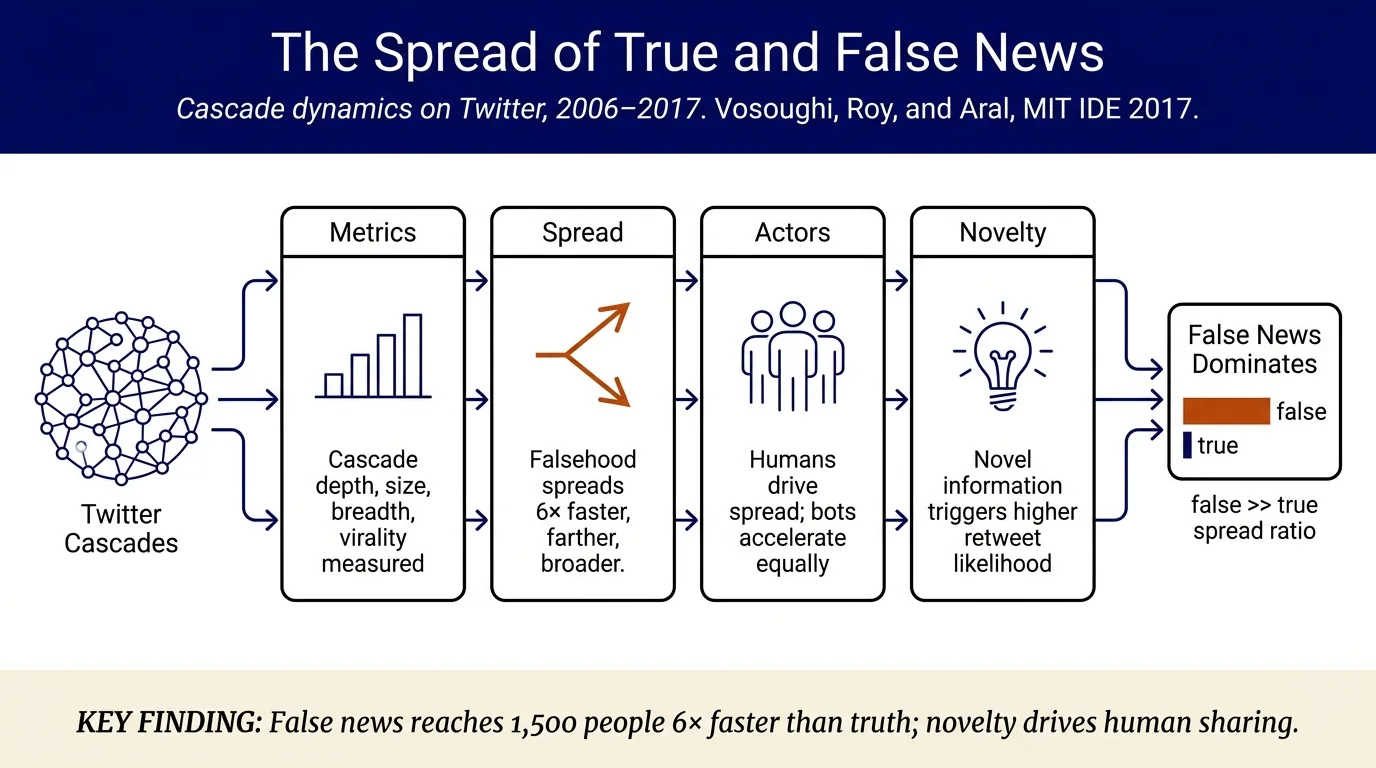
The Spread of True and False News OnlineAnalyzes 126,000 verified true and false news cascades from Twitter (2006–2017) covering 3 million users and 4.5 million shares. False news diffuses significantly farther, faster, deeper, and more broadly than truth across all categories, with false political news spreading fastest.
 Bots & coordinated campaignsDatasets & evaluation
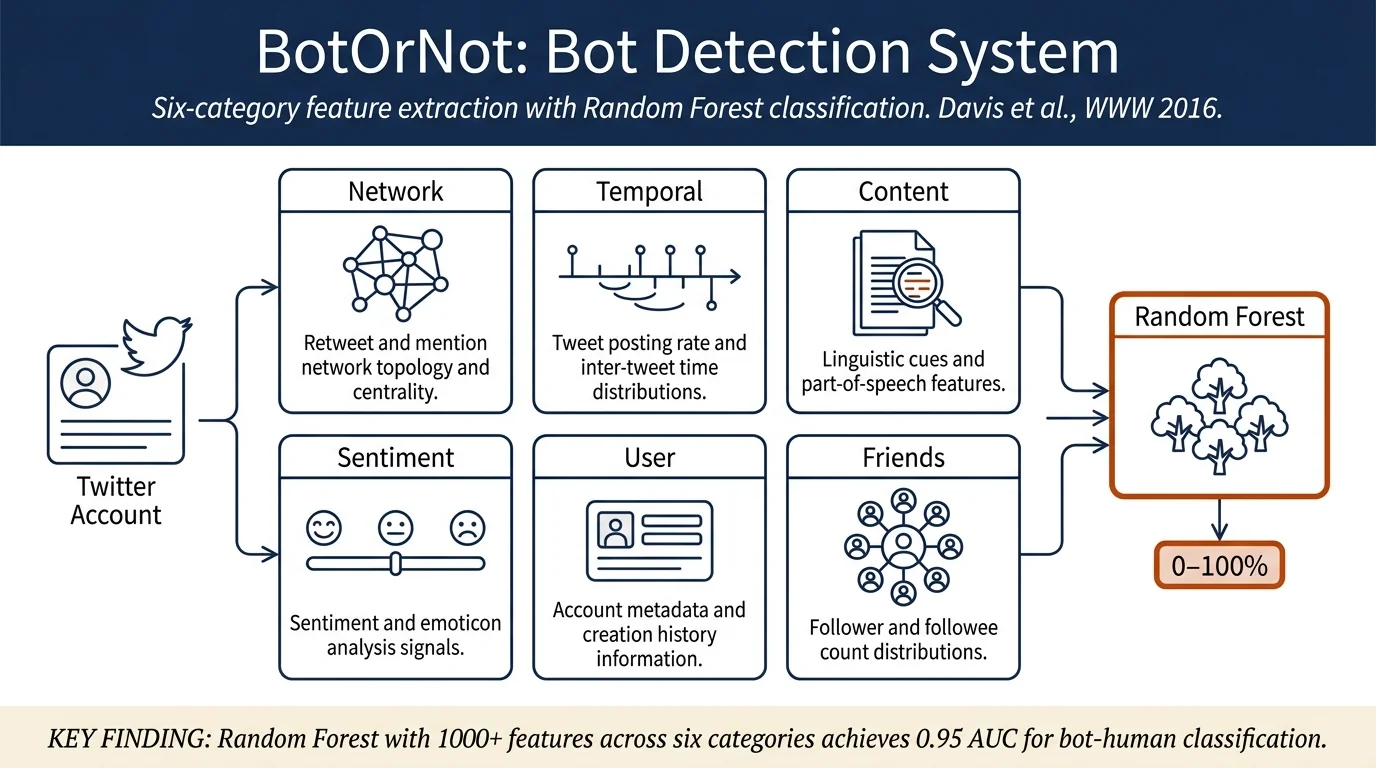
BotOrNot: A System to Evaluate Social BotsBotOrNot is a publicly available service and API that evaluates whether a Twitter account is controlled by a human or automated bot. Using 1,000+ features across six categories (network, user, friends, temporal, content, sentiment), the system applies Random Forest classification to achieve 0.95 AUC on a labeled dataset of 15k bots and…
 Bots & coordinated campaignsDetection methods
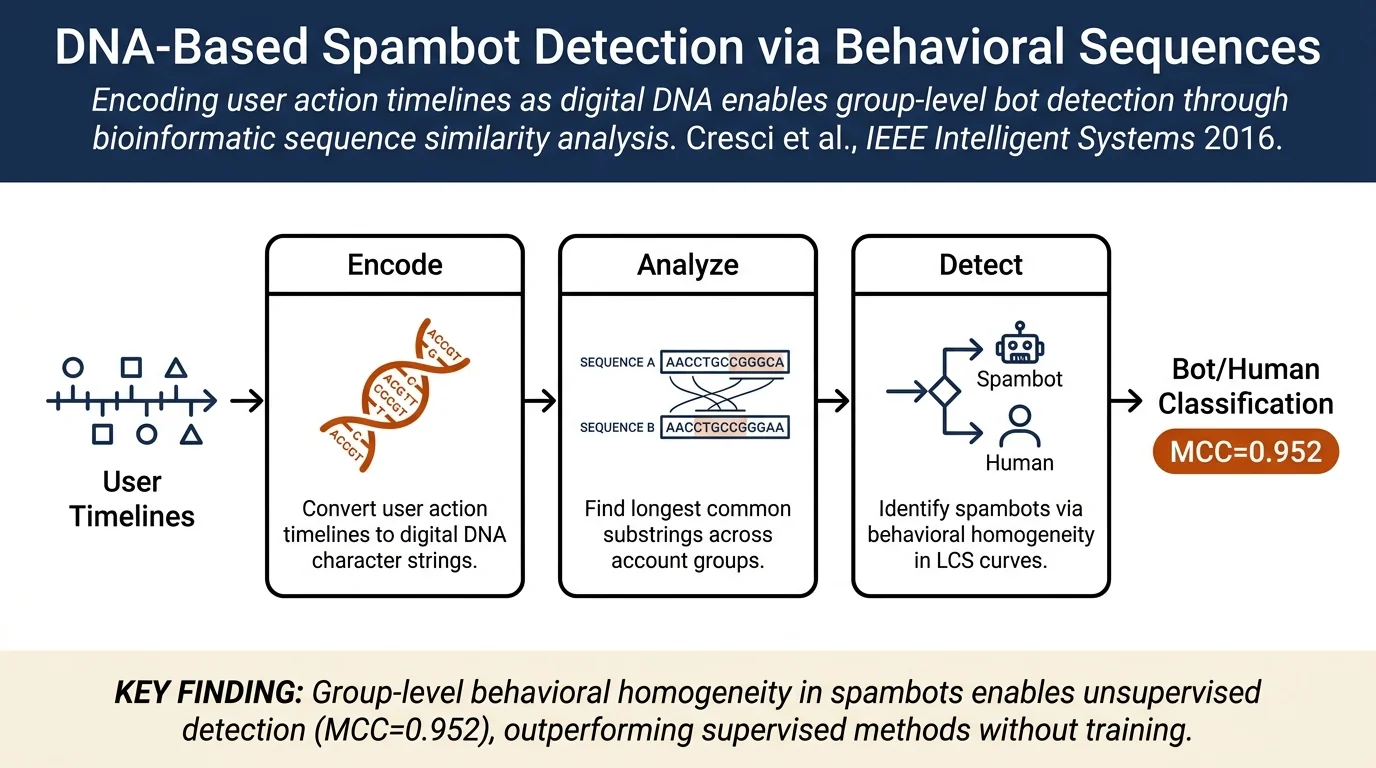
DNA-Inspired Online Behavioral Modeling and Its Application to Spambot DetectionProposes a novel methodology to characterize online user behavior using DNA-inspired digital sequences, where each user action (tweet type, content features) is encoded as a character in a string. Applies standard bioinformatic DNA analysis techniques—specifically longest common substring (LCS) analysis—to detect spambots on Twitter by…
 Bots & coordinated campaignsDetection methods
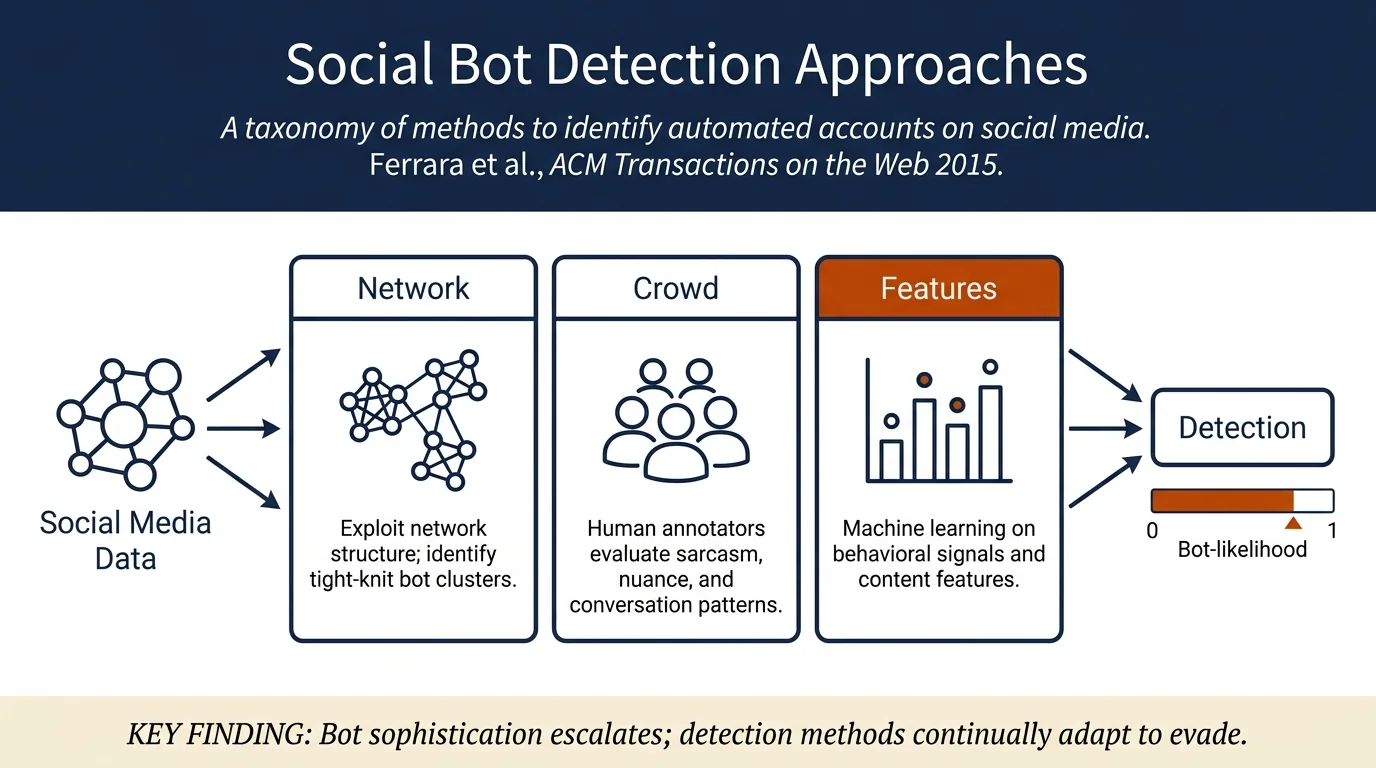
The Rise of Social BotsSocial bots—automated software agents in social media—are increasingly sophisticated and pose real threats including misinformation spread, trend manipulation, and election interference. This paper characterizes modern bot behavior, surveys detection challenges, and proposes a taxonomy of detection approaches: graph-based methods…
 Spread & networksBots & coordinated campaigns
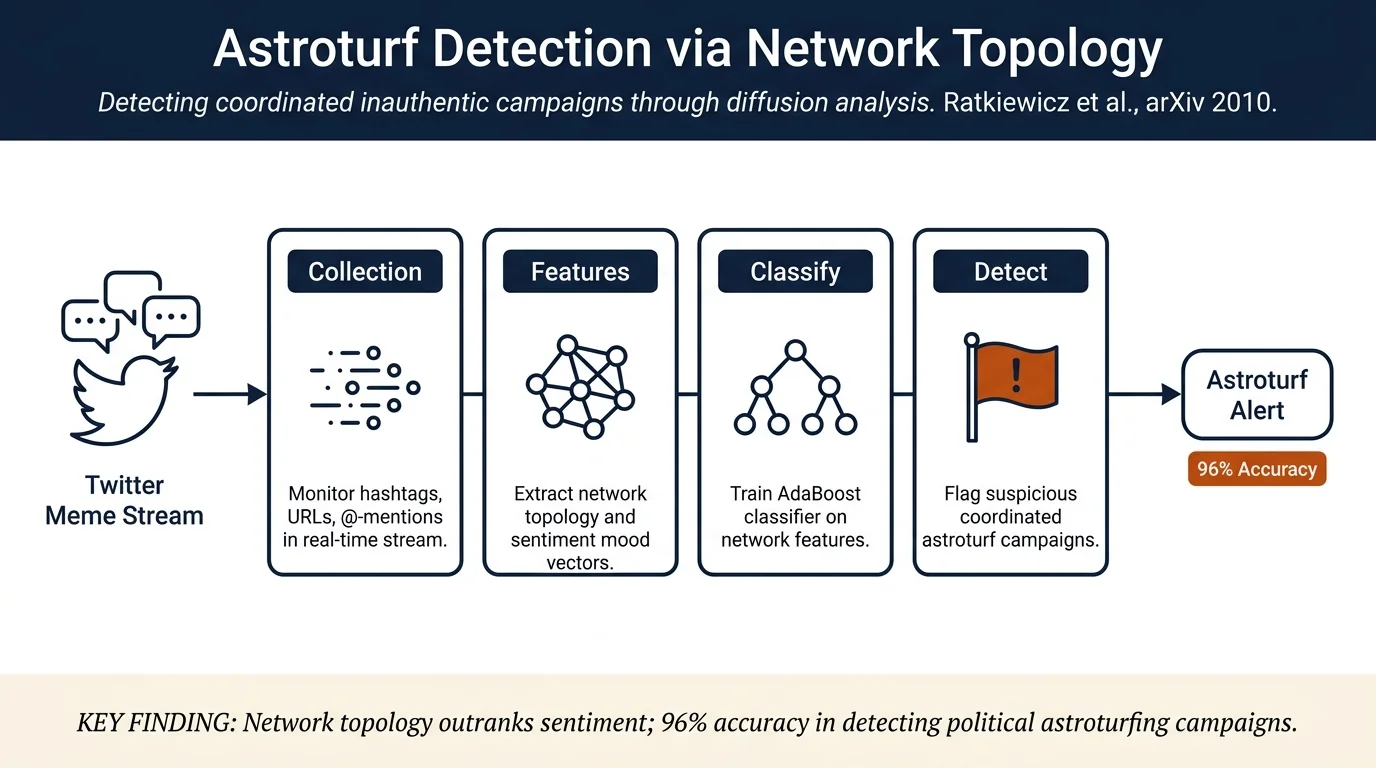
Detecting and Tracking the Spread of Astroturf Memes in Microblog StreamsPolitical campaigns increasingly use social media to amplify deceptive memes that mimic organic grassroots behavior—termed "astroturfing." This paper introduces the Truthy system, which analyzes meme diffusion networks on Twitter to detect orchestrated campaigns through network topology and sentiment analysis, achieving ~90%…