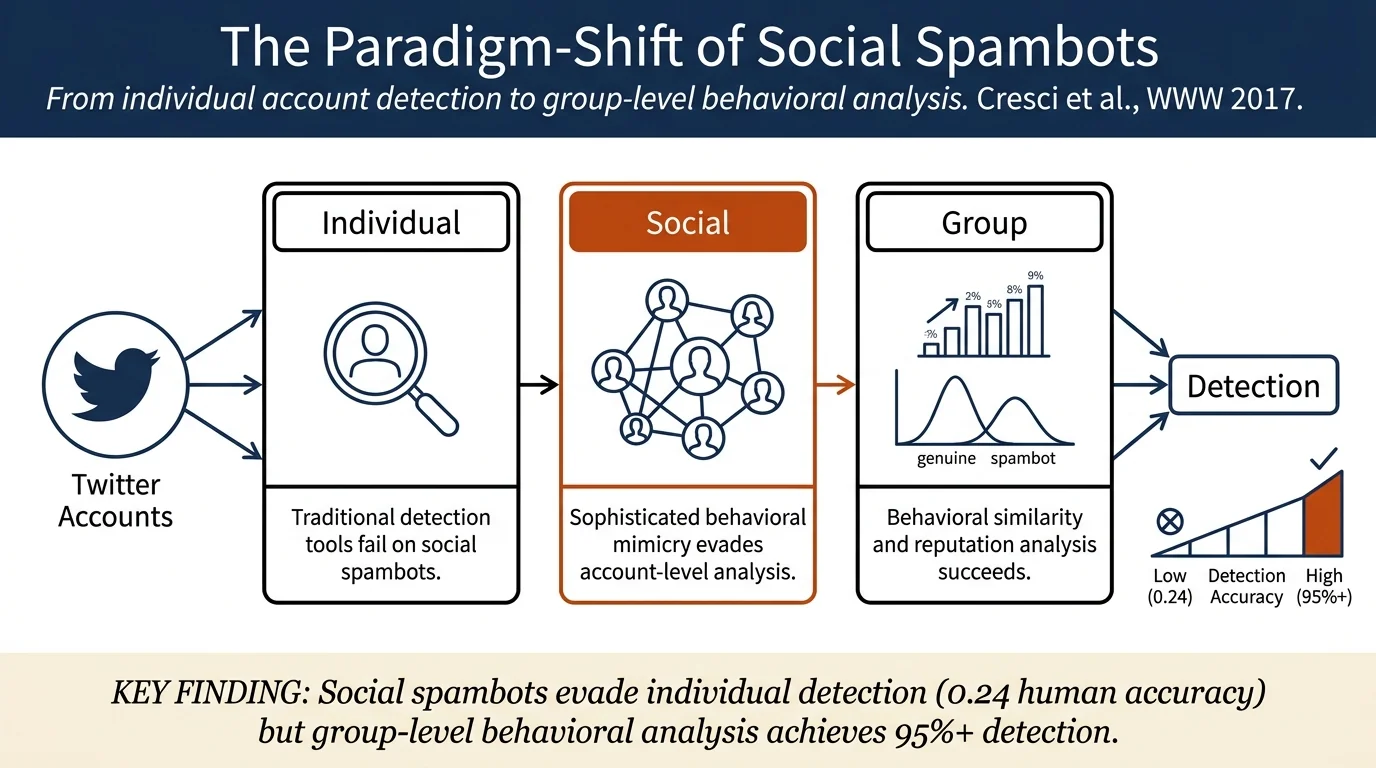
The Paradigm-Shift of Social Spambots: Evidence, Theories, and Tools for the Arms Race
Authors: Stefano Cresci, Roberto Di Pietro, Marinella Petrocchi, Angelo Spognardi, Maurizio Tesconi
Venue: WWW 2017 Companion, April 3–7, 2017, Perth, Australia — DOI
TL;DR
This paper provides empirical evidence of a paradigm shift in spambot design on Twitter, where new "social spambots" closely mimic genuine user behavior and successfully evade detection. Neither Twitter's automated systems, human annotators, nor established academic detection tools can effectively identify these accounts; however, emerging group-level detection approaches show promise.
Contributions
- Empirical evidence of a novel wave of Twitter spambots that evade detection through sophisticated human-like behavior mimicry
- Evaluation of state-of-the-art detection techniques (BotOrNot?, supervised classifiers, unsupervised clustering) against social spambots, showing widespread failure
- Crowdsourcing evaluation (13,284 annotations from 247 contributors) demonstrating humans achieve only 0.24 accuracy on social spambots vs. 0.91 on traditional spambots
- Critical review of emerging group-based detection methods as a paradigm shift from individual account analysis
- Public release of annotated datasets spanning genuine accounts, social spambots, traditional spambots, and fake followers
Method
The paper employs multiple evaluation methodologies:
-
Real-world survivability analysis: Monitored account status over time via Twitter API to measure suspension rates for different account types. Accounts created 2009–2014 were tracked to assess platform detection capabilities.
-
Crowdsourcing campaign: Recruited 247 tech-savvy Twitter users to classify 4,428 accounts. Used quality control mechanisms including test questions (70% threshold), multi-annotator consensus (3 per account), and Fleiss' kappa inter-rater agreement.
-
Benchmarking detection tools: Evaluated BotOrNot? (supervised, 1,000+ features), C. Yang et al.'s evolving-spambot classifier (supervised), Miller et al.'s stream clustering (unsupervised), Ahmed & Abulaish's graph-clustering approach (unsupervised), and Cresci et al.'s digital DNA method (unsupervised).
-
Emerging methods analysis: Studied group-level detection approaches (e.g., Viswanath et al.'s tamper detection via reputation distribution divergence, Cresci et al.'s digital DNA via Longest Common Substring similarity).
Results
Survivability: Social spambots #1, #2, #3 showed 95.2%, 96.1%, 99.6% survival rates respectively—nearly identical to genuine accounts (96.5%), but vastly higher than traditional spambots #2 (1% survival, 99% suspension).
Human performance: Crowdworkers achieved 0.24 accuracy on social spambots (1,065 false negatives, only 328 true positives from 1,393 accounts), with κ = 0.186 inter-rater agreement indicating confusion. Traditional spambots: 0.91 accuracy, κ = 0.007. Genuine accounts: 0.92 accuracy, κ = 0.410.
Detection tools: - BotOrNot?: F-Measure 0.288, Recall 0.208 on test set #1 (social spambots #1) - C. Yang et al.: F-Measure 0.261, Recall 0.170 on test set #1 - Miller et al. (stream clustering): F-Measure 0.435, best among traditional unsupervised methods - Ahmed & Abulaish (graph clustering): MCC 0.886 (test #1), 0.847 (test #2) — best overall - Cresci et al. digital DNA: MCC 0.952 (test #1), 0.867 (test #2) — highest scores
Emerging trends: Group-level analysis of reputation score distributions and behavioral similarity (digital DNA) effectively distinguished social spambots from genuine accounts, suggesting a paradigm shift from account-centric to collective-behavior-centric detection.
Connections
- Extends The Rise of Social Bots by providing quantitative evidence of a new generation of bots that is harder to detect
- Related to Online Human-Bot Interactions: Detection, Estimation, and Characterization on bot behaviors in social networks
- Precedes and influences Anatomy of an online misinformation network which uses similar datasets and builds on spambot detection
- Cites and benchmarks techniques from The spread of low-credibility content by social bots and others in the bot detection literature
- Group detection paradigm influenced by It takes a village to manipulate the media: coordinated link sharing behavior and related work on coordinated behavior
Notes
This is a landmark paper establishing the "social spambot" phenomenon and providing the first large-scale empirical evidence that automation detection techniques require fundamental rethinking. The paradigm shift from individual account features to group-level behavioral analysis has become central to modern misinformation and spam detection. The paper's public datasets and comprehensive benchmarking make it foundational for the field. The finding that humans cannot reliably detect social spambots—despite succeeding with traditional bots—has important implications for human-in-the-loop moderation systems.