The Rise of Social Bots
Authors: Emilio Ferrara, Onur Varol, Clayton Davis, Filippo Menczer, Alessandro Flammini
Venue: ACM Transactions on the Web, 2015 — arXiv:1407.5225
TL;DR
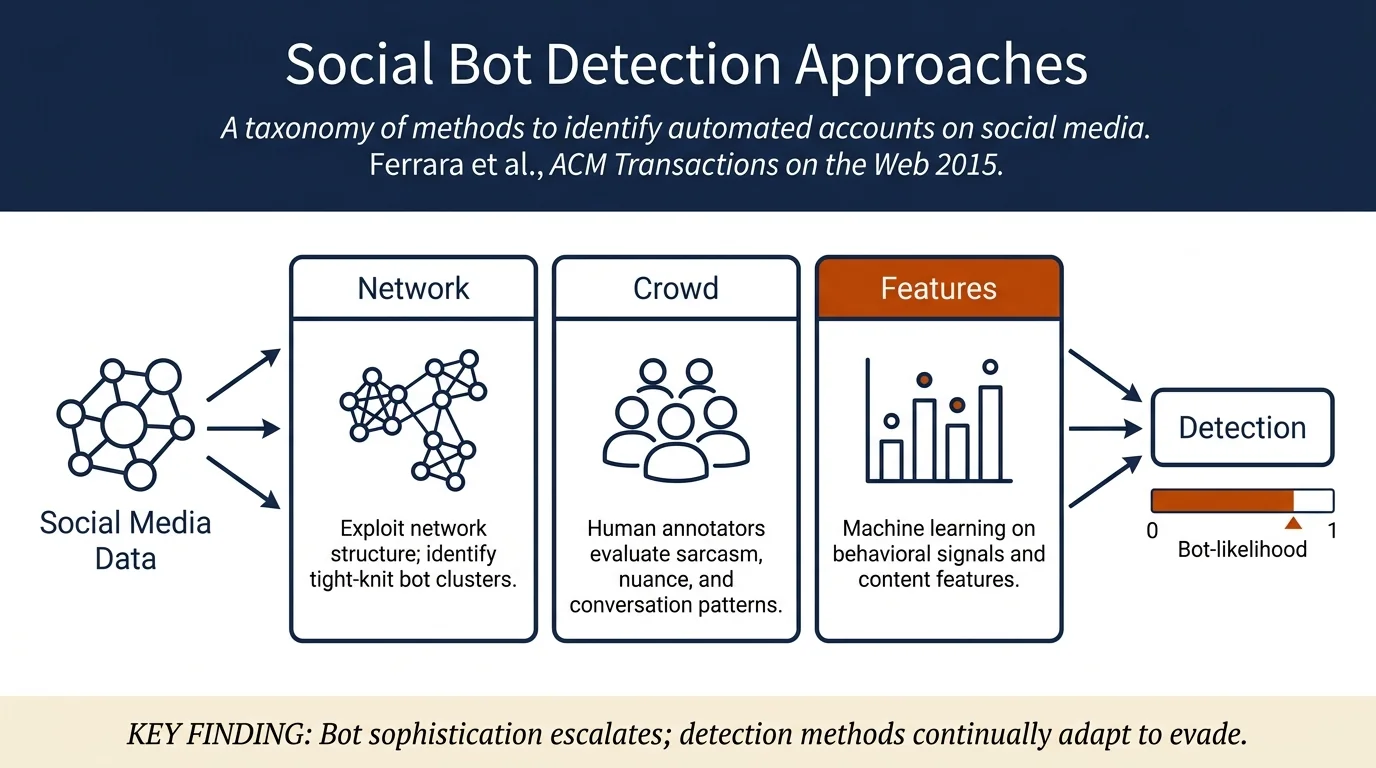
Social bots—automated software agents in social media—are increasingly sophisticated and pose real threats including misinformation spread, trend manipulation, and election interference. This paper characterizes modern bot behavior, surveys detection challenges, and proposes a taxonomy of detection approaches: graph-based methods analyzing network structure, crowd-sourcing systems using human judgment, and machine learning methods leveraging behavioral features.
Contributions
- Comprehensive overview of social bot phenomena, including benign (customer service, news aggregation) and malicious variants (misinformation, influence operations)
- Taxonomy categorizing bot detection systems into three classes: network-based, crowd-sourced, and feature-based approaches
- Analysis of distinguishing features between bot and human behavior (retweet volume, account age, reply patterns, sentiment)
- Discussion of the arms race between bot sophistication and detection methods, including sophisticated bots that mimic temporal and content patterns
Method
The paper surveys literature and observational evidence on social bots. The authors analyze detection strategies across three primary categories:
Graph-based detection: Exploits structural properties of social networks (follow relationships, network clustering patterns, community detection). Example: SybilRank identifies bots by assuming sybil accounts form tight-knit clusters with fewer external connections to legitimate users.
Crowd-sourced detection: Uses human annotators to identify bots, leveraging capabilities that machines struggle with—evaluating sarcasm, detecting phishing attempts, assessing conversation nuance. The authors describe the Online Social Turing Test platform: workers evaluate conversational features like sarcasm or persuasive language to classify accounts.
Feature-based detection: Applies machine learning to behavioral signals. They categorize features into classes: - Network features (diffusion patterns, centrality, mentions) - User features (account metadata: followers, following, age, tweet count) - Friend features (statistics on follower/following distributions) - Timing features (temporal patterns of tweet generation, Poisson process similarity) - Content features (linguistic patterns, URL/hashtag frequency) - Sentiment features (emotion analysis of posted content)
Example: Bot or Not! tool uses highly-predictive features to achieve 95% detection accuracy on the Texas A&M dataset (15,000 human-annotated examples).
Results
Behavioral differences: Social bots exhibit distinctive patterns—they retweet far more frequently than humans, produce fewer tweets, generate fewer replies and mentions, retweet content less often relative to their activity level, and tend to have longer usernames. These patterns enable classification via simple z-score thresholding.
Detection performance: Feature-based systems like Bot or Not! achieve high accuracy (~95%) on labeled datasets, but performance degrades on newer, more sophisticated bots. Network-based approaches depend critically on community detection methodology. Crowd-sourcing yields high consensus on obvious bots but exhibits high false-positive rates and doesn't scale well.
Challenges: The paper emphasizes the escalating sophistication of bots—they now search the Web for relevant information, time posts strategically, engage in complex interactions, and coordinate across accounts, making simple detection rules increasingly ineffective.
Connections
- Related to social media as a platform for coordinated inauthentic behavior
- Methodologically related to coordinated inauthentic behavior detection
- Building on earlier work cited in Russian bot campaigns and detection frameworks
- Informs broader misinformation detection strategies, particularly on Twitter
- Connected to information operations and Twitter dynamics
Notes
This is a foundational paper for social bot research, combining a broad literature review with actionable taxonomy of detection approaches. Its emphasis on the arms race between bot sophistication and detection remains prescient—modern bots now use web scraping, temporal adaptation, and synchronized campaigns. The paper's honest assessment of detection limitations (high false positives, vulnerability to new attack strategies) is valuable; it sets realistic expectations rather than overselling detection capabilities.
The feature-based approach is well-presented with concrete examples (Bot or Not!, timing via Poisson processes), making it accessible to readers unfamiliar with network analysis. The acknowledgment that different platforms (Twitter, Facebook, Tumblr) have different infiltration dynamics is important and often overlooked.
A limitation is that the paper (written in 2014) predates some of the most sophisticated bot behaviors now observed—coordinated sockpuppet farms, language-model-generated content, and microinfluence campaigns. However, the taxonomy remains useful for organizing detection literature.