Explore everything
Filter by research area, year and venue. Every filter is in the address bar, so you can share a view as a link.
 Psychology & interventionsFact-checking & verification
Psychological Inoculation Against MisinformationSander van der Linden introduces psychological inoculation as a scalable alternative to fact-checking for building societal resistance to misinformation. Drawing on inoculation theory and his flagship intervention, the Bad News game, he demonstrates how preemptively exposing people to weakened examples of six core manipulation techniques…
 LLMs & generative AIDatasets & evaluation
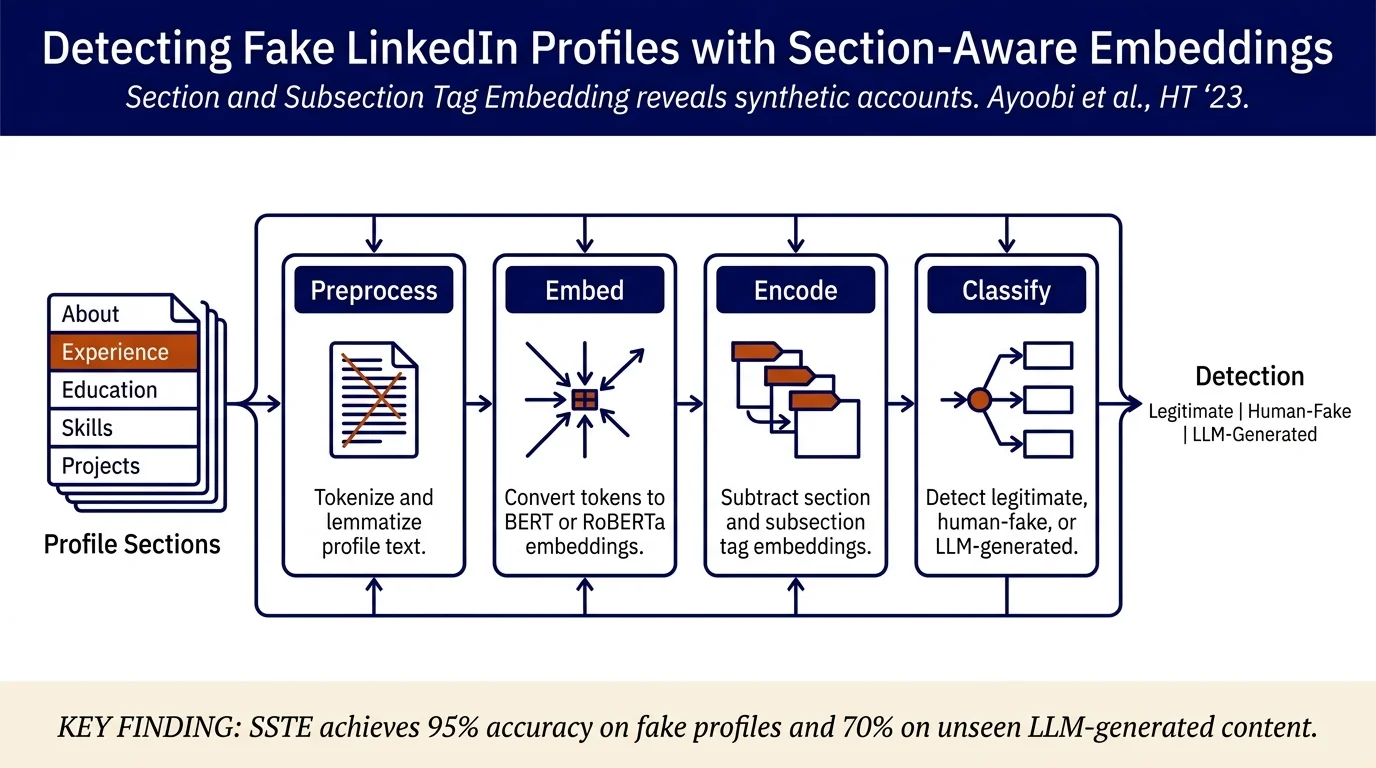
The Looming Threat of Fake and LLM-generated LinkedIn Profiles: Challenges and Opportunities for Detection and PreventionLinkedIn's lack of verification enables fake accounts that harm legitimate users and the platform's integrity. This work introduces a dataset of 3600 profiles (legitimate, manually created fake, and ChatGPT-generated) and proposes SSTE, a method that detects fake profiles immediately after registration using only profile text.
 LLMs & generative AIDeepfakes & multimodal
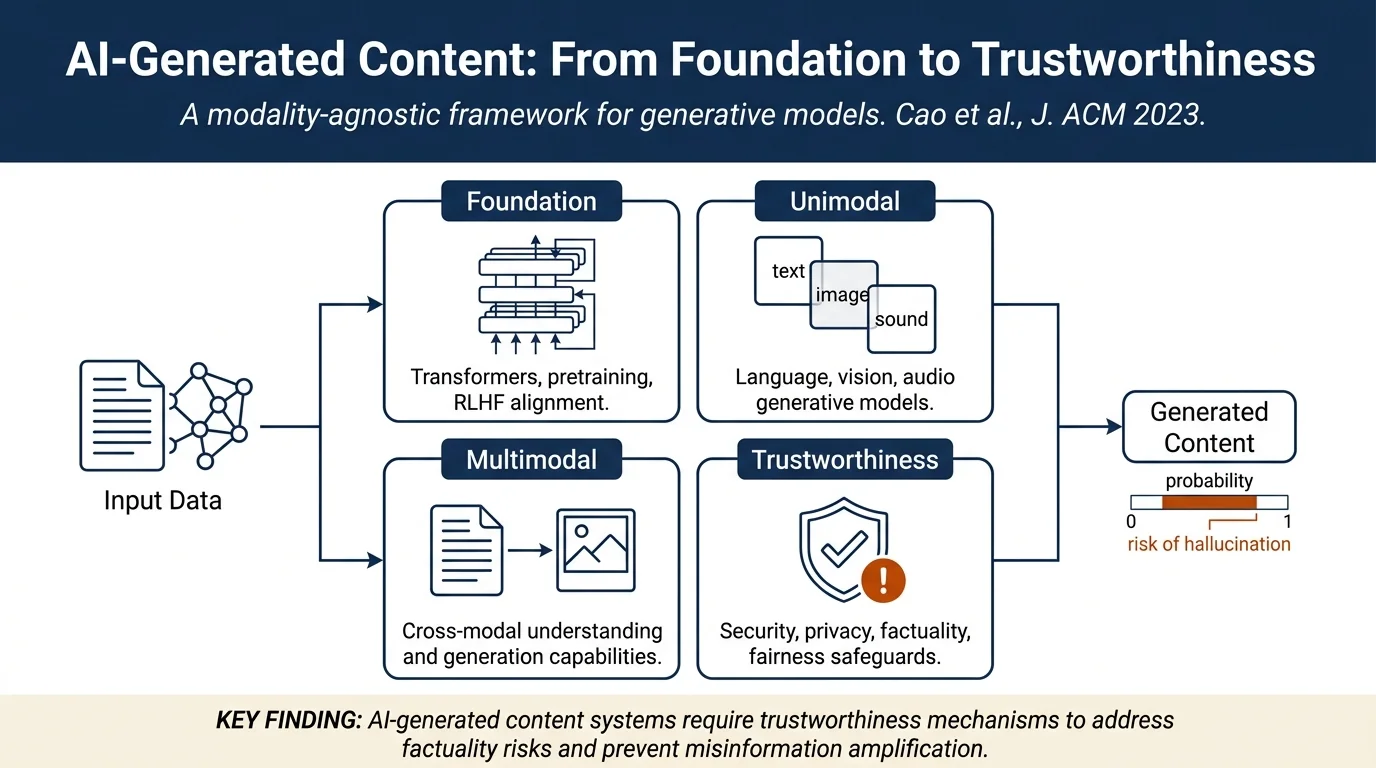
A Comprehensive Survey of AI-Generated Content (AIGC): A History of Generative AI from GAN to ChatGPTThis is the first comprehensive survey of AI-Generated Content (AIGC) covering the history, techniques, and applications of generative models from GANs through ChatGPT. It addresses both the impressive capabilities of these models (text, image, audio, video generation) and critical concerns including factuality, security, privacy, and…
 LLMs & generative AIDatasets & evaluation
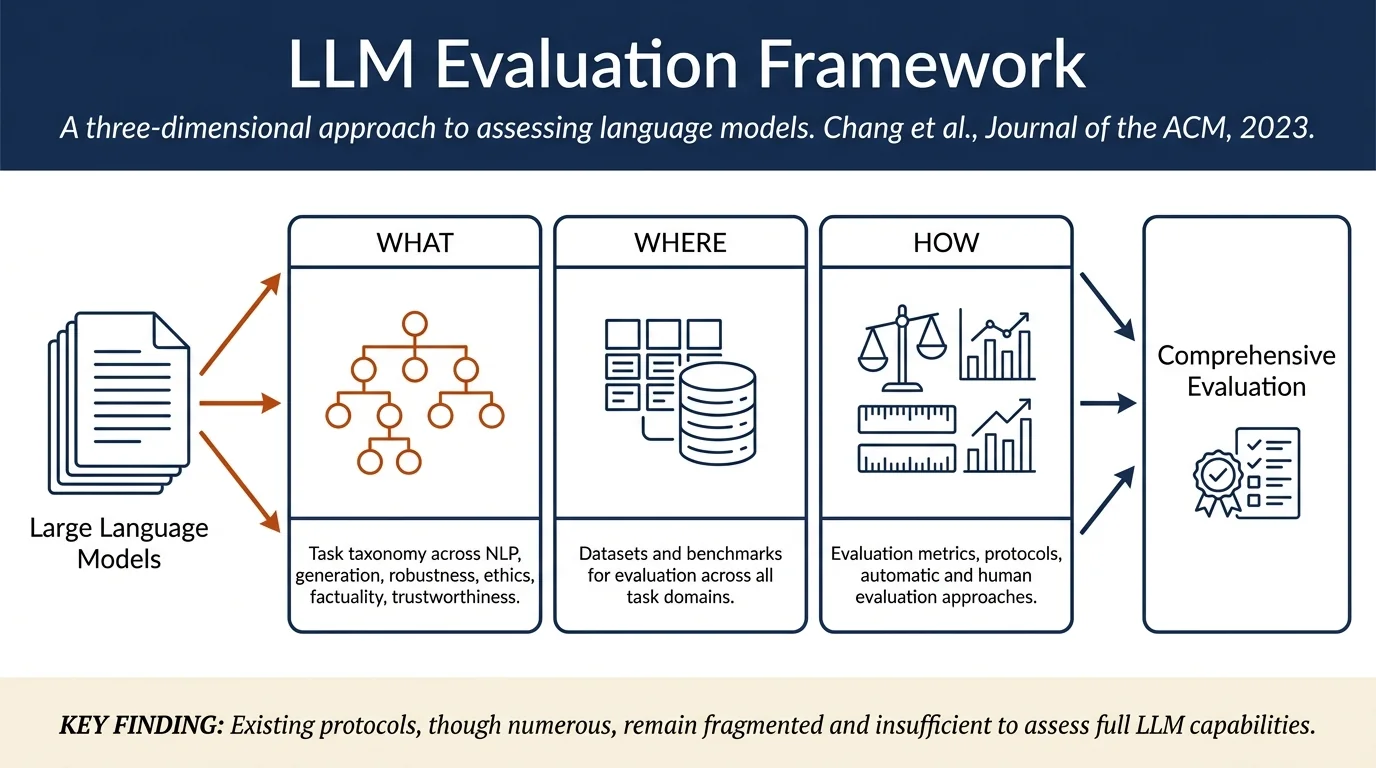
A Survey on Evaluation of Large Language ModelsThis survey provides a comprehensive review of evaluation methodologies for large language models across three dimensions: what to evaluate, where to evaluate, and how to evaluate. The paper encompasses evaluation tasks spanning natural language processing, natural language generation, robustness, ethics, bias detection, trustworthiness,…
 LLMs & generative AIDetection methods
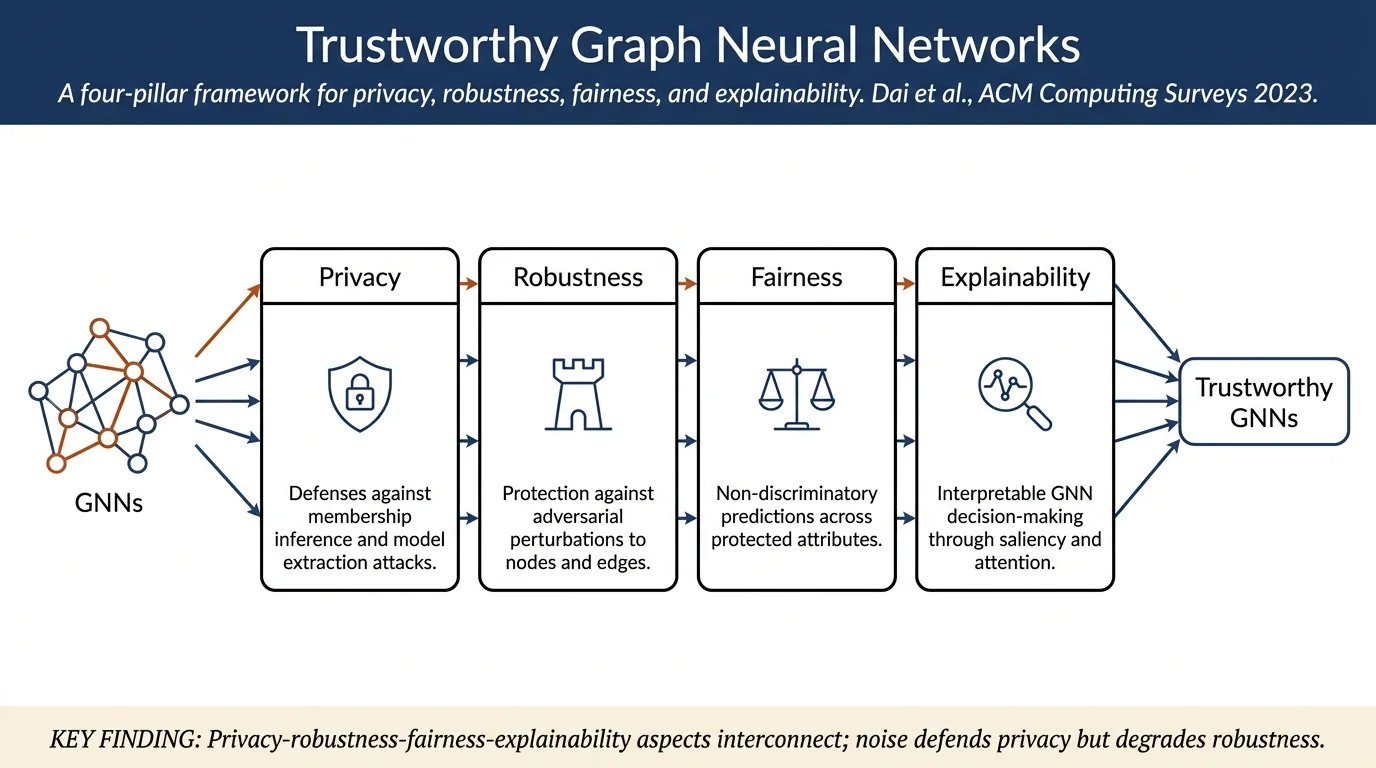
A Comprehensive Survey on Trustworthy Graph Neural Networks: Privacy, Robustness, Fairness, and ExplainabilityA comprehensive survey of trustworthy Graph Neural Networks covering four critical dimensions: privacy attacks and defenses against membership/property inference and model extraction; robustness against adversarial perturbations; fairness mechanisms to prevent discrimination in graph-based predictions; and explainability methods to…
 Platforms, policy & societyLLMs & generative AI
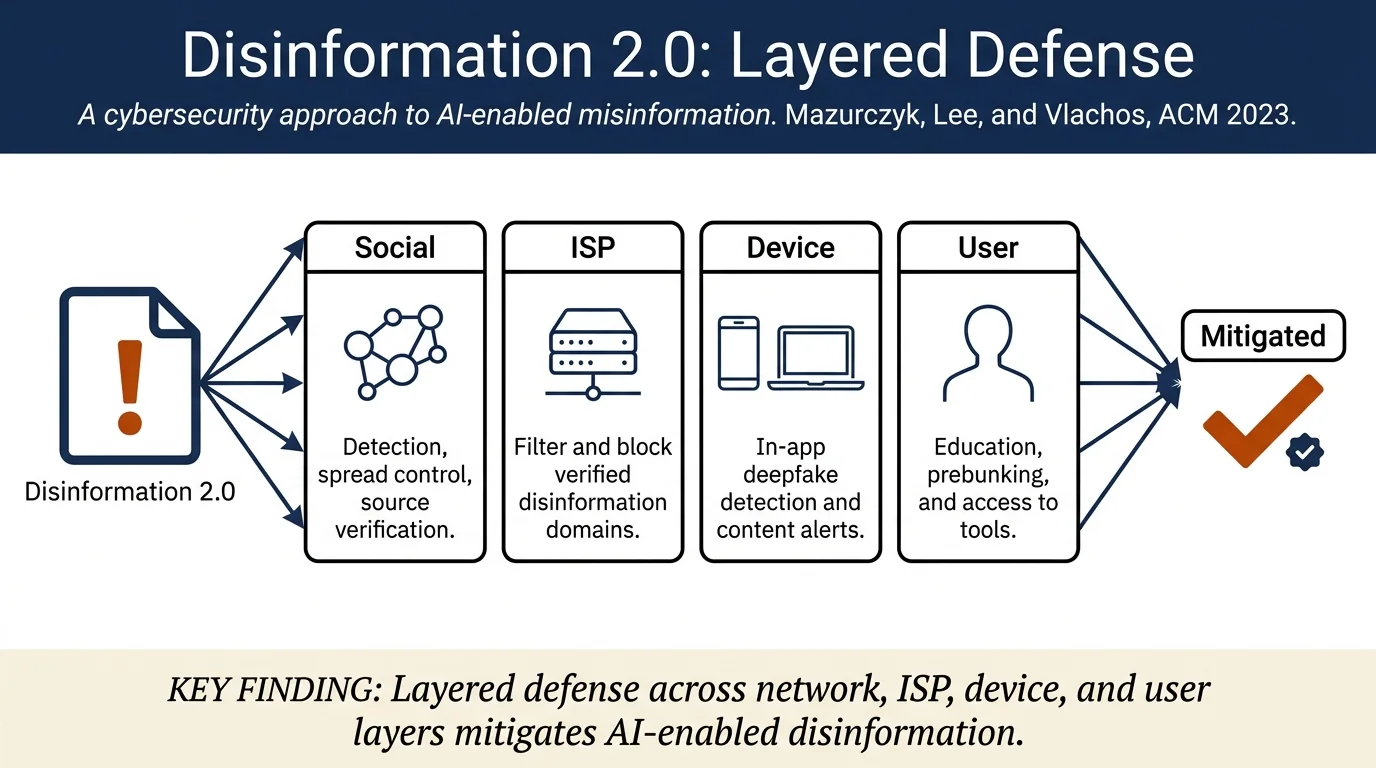
Disinformation 2.0 in the Age of AI: A Cybersecurity PerspectiveDisinformation should be treated as a cybersecurity threat, particularly as AI advances enable its creation and dissemination at unprecedented scale. The paper introduces "disinformation 2.0"—where generative AI, perturbation techniques, detection evasion, and optimized spread strategies make false content more persuasive and harder to…
 Spread & networksPlatforms, policy & society
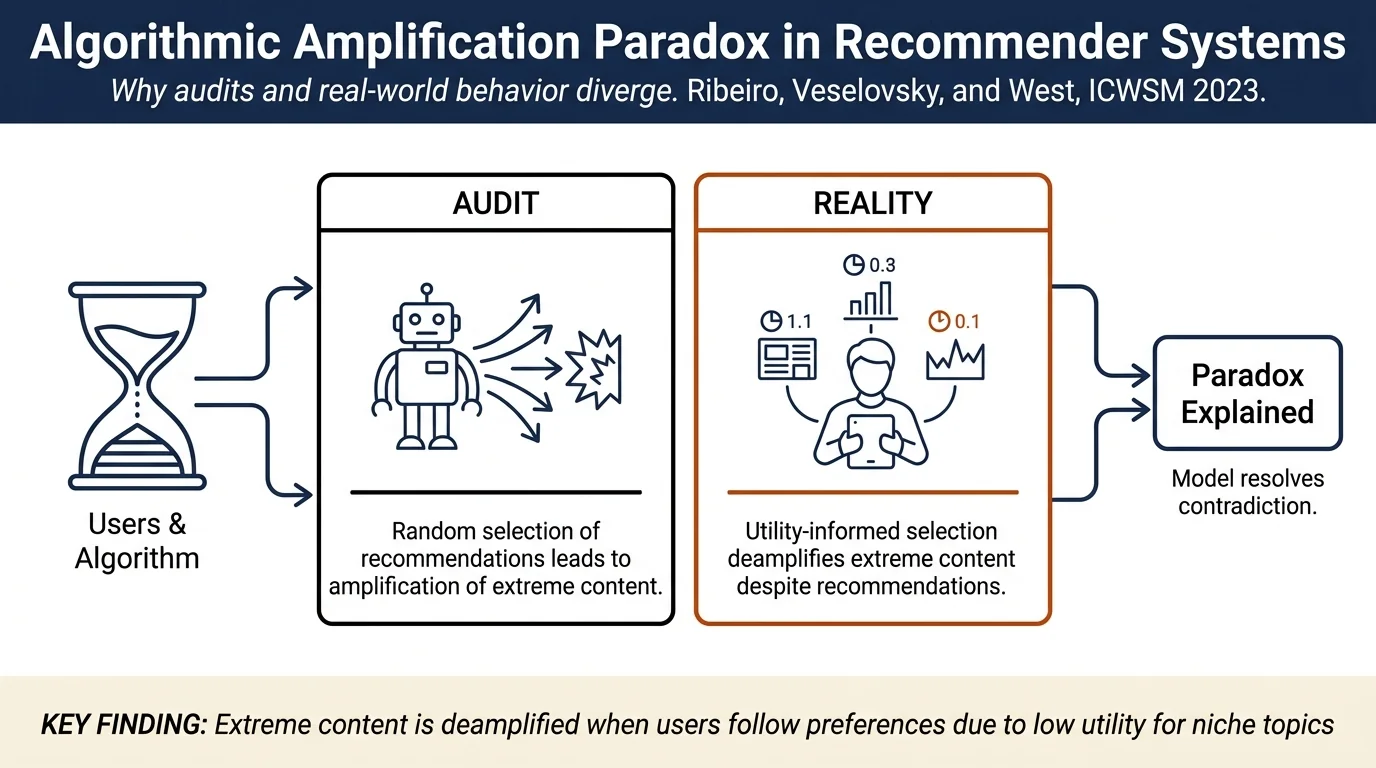
The Amplification Paradox in Recommender SystemsAlgorithmic audits find that blindly following YouTube recommendations leads to extreme content, yet real user logs show recommendations don't drive extreme content consumption. Using an agent-based model with realistic user preferences, the authors show this paradox arises because users rarely consume niche content even when recommended…
 LLMs & generative AIDetection methods
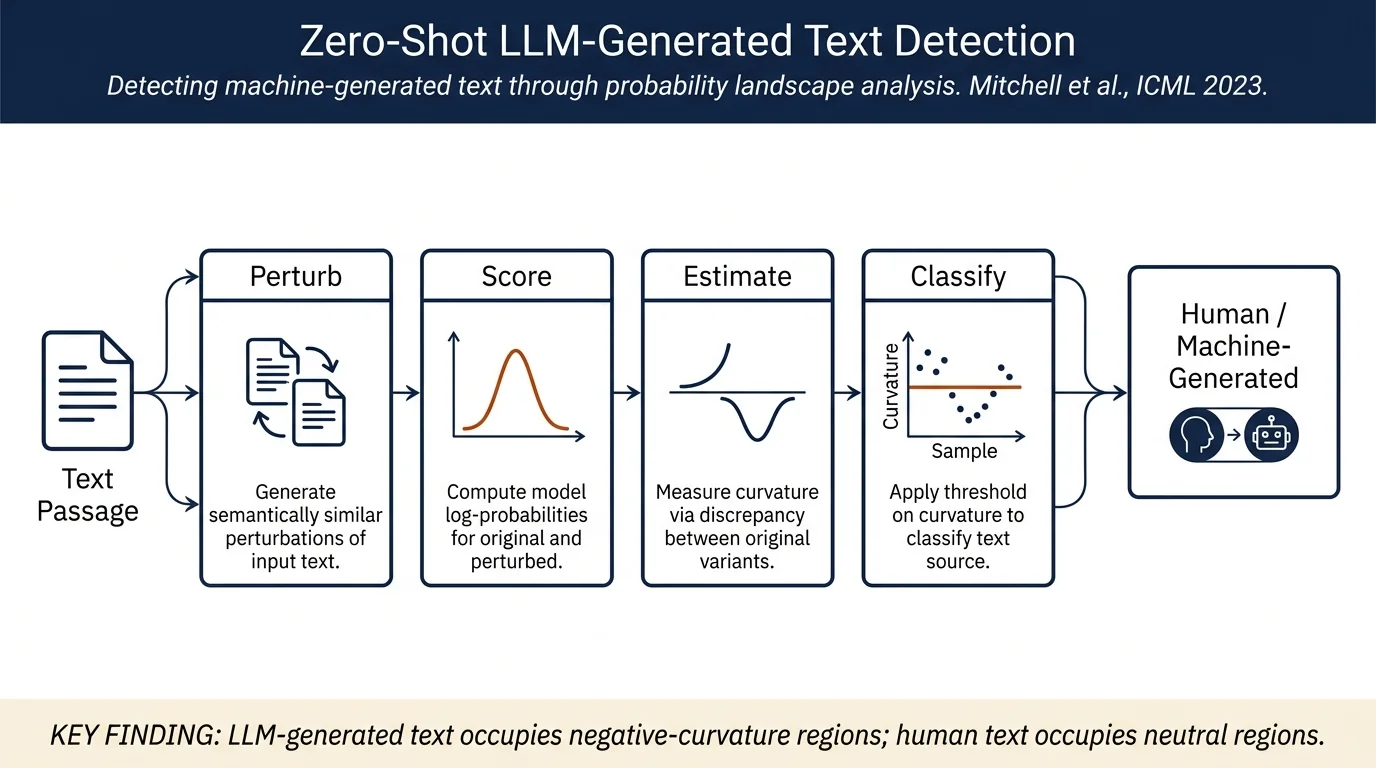
DetectGPT: Zero-Shot Machine-Generated Text Detection using Probability CurvatureThis paper identifies that text sampled from language models tends to occupy negative-curvature regions of the model's log-probability landscape, whereas human-written text occupies more neutral regions. DetectGPT leverages this observation to detect machine-generated text in a zero-shot manner by analyzing probability curvature, without…
 LLMs & generative AIDetection methods
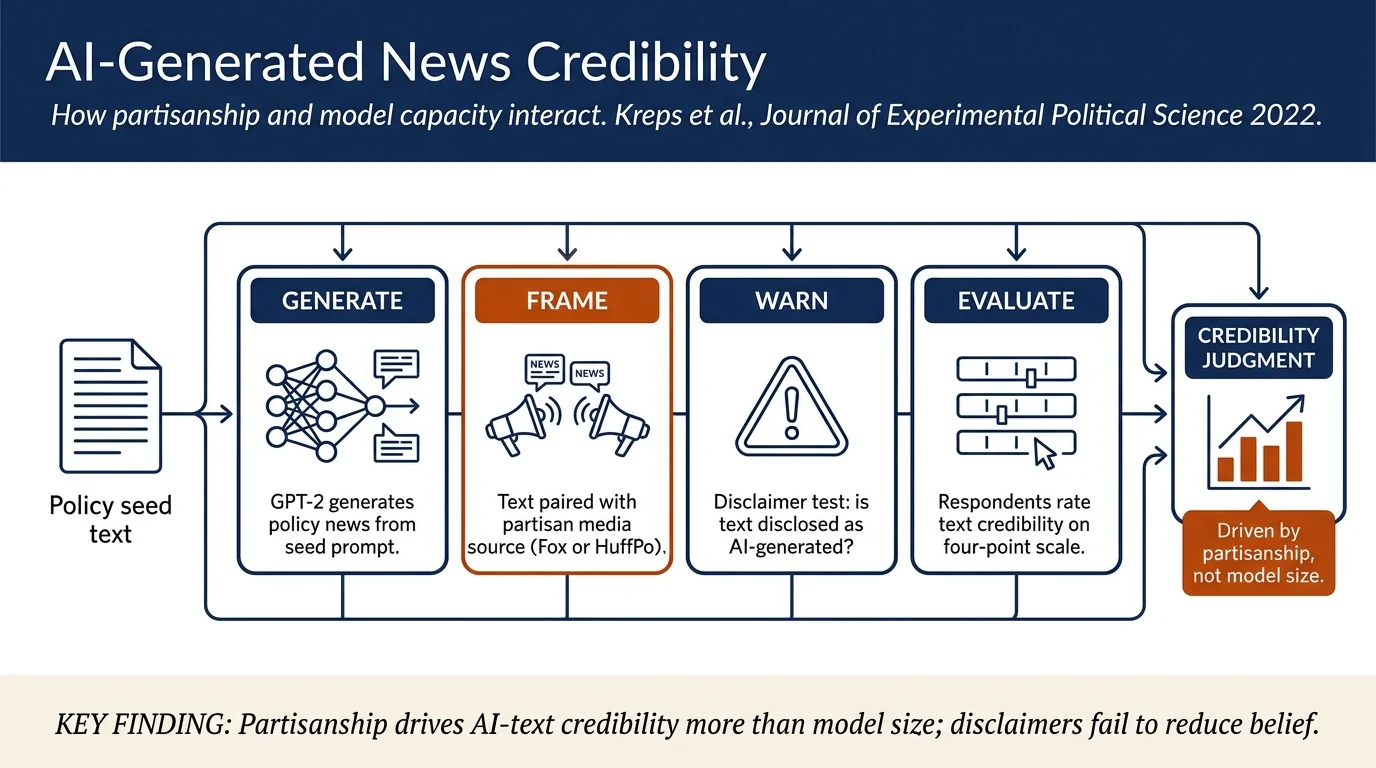
All the News That's Fit to Fabricate: AI-Generated Text as a Tool of Media MisinformationThree experiments investigate whether AI-generated news text can be credible and influence public opinion. The authors find that GPT-2 models (355M to 1.5B parameters) generate text nearly indistinguishable from human-written baseline news, particularly when politically congruent stories are paired with partisan audiences.
 Spread & networksDetection methods
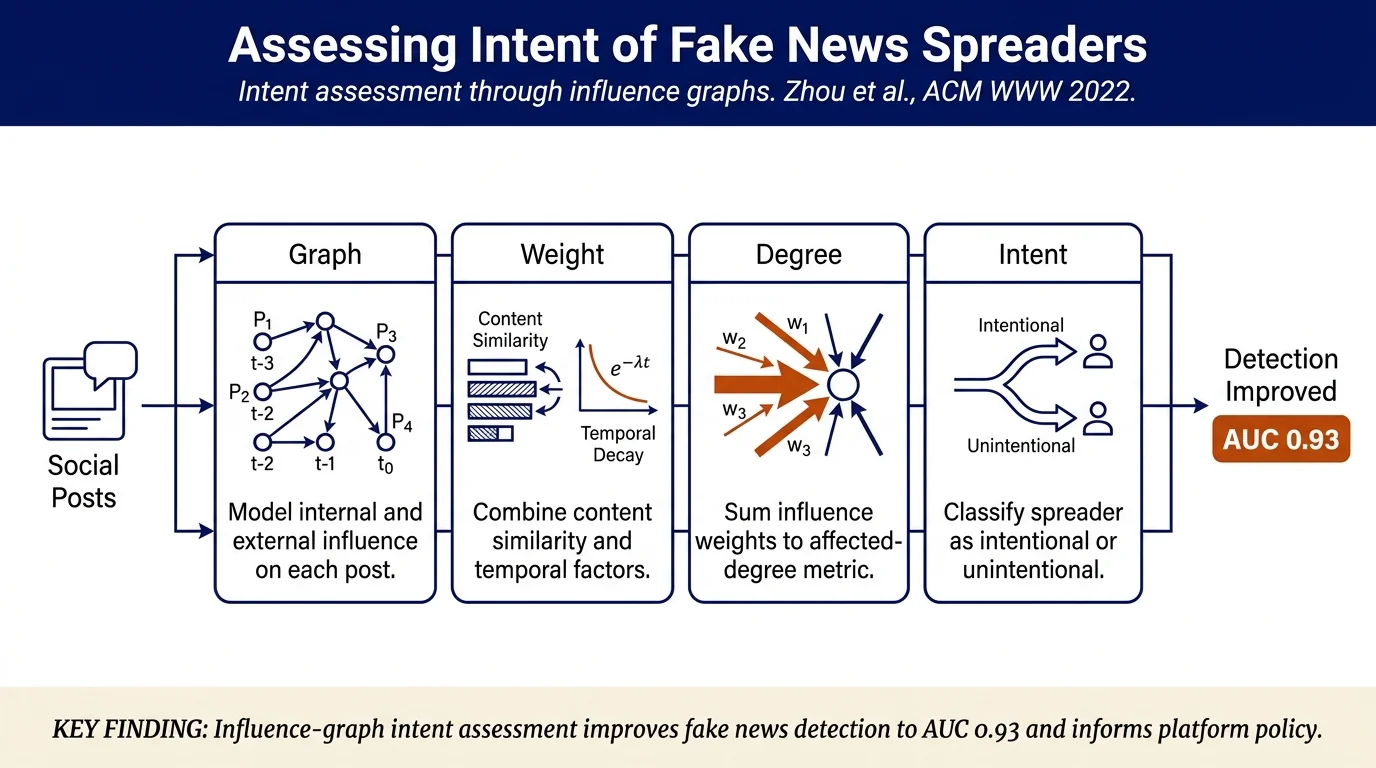
"This is Fake! Shared it by Mistake": Assessing the Intent of Fake News SpreadersThis work is the first to systematically assess whether individuals spread fake news intentionally or unintentionally. The authors propose an influence graph that captures psychological (internal) and social (external) factors driving unintentional spreading, validate it on two datasets with manually-annotated spreader intent, and…
 Platforms, policy & societyDetection methods
A Comprehensive Survey on Trustworthy Recommender SystemsRecommender systems, while beneficial to users, can amplify harmful content, introduce discrimination, and enable adversarial attacks. This survey provides a comprehensive framework for trustworthy recommender systems across six critical dimensions: Safety & Robustness (defense against adversarial attacks), Non-discrimination & Fairness…
 Deepfakes & multimodalDatasets & evaluation
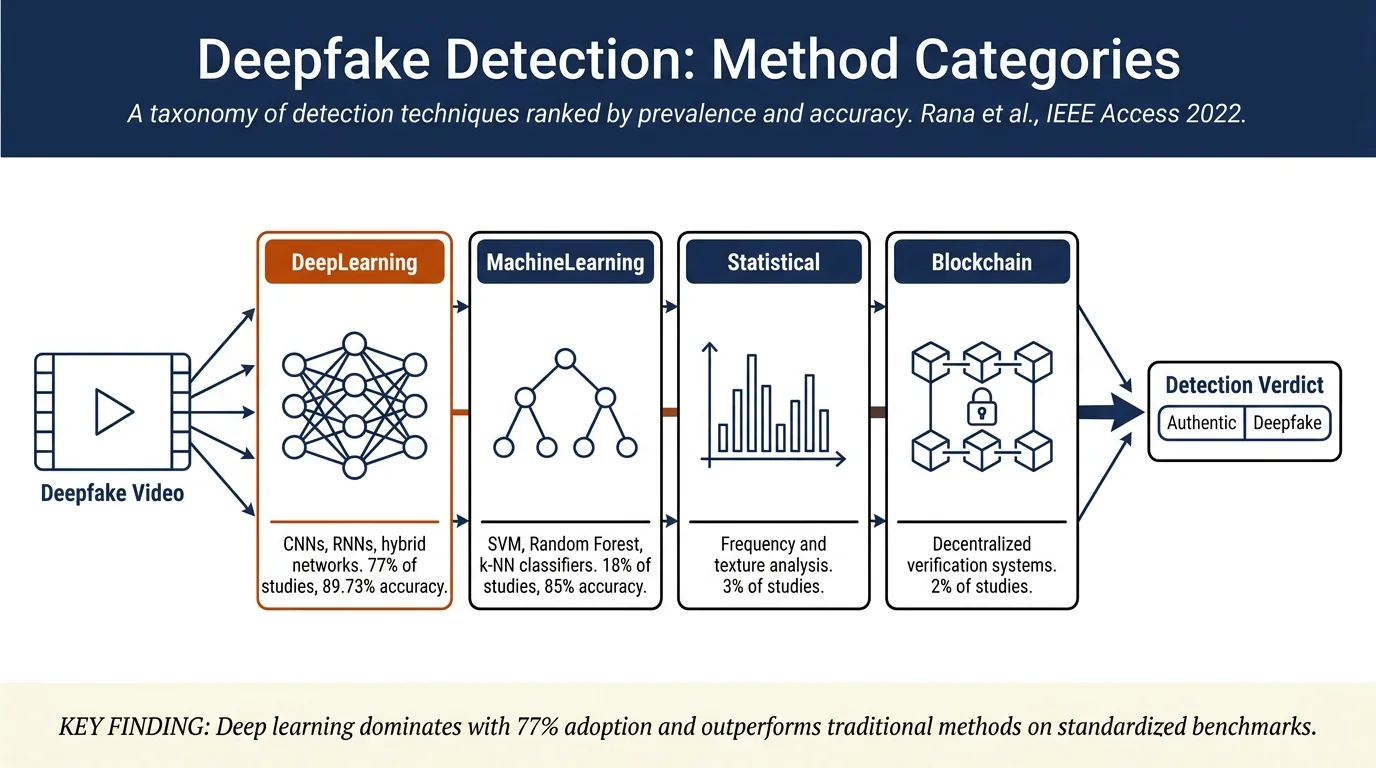
Deepfake Detection: A Systematic Literature ReviewSystematic review of 112 deepfake detection studies (2018–2020) categorizing techniques into deep learning, machine learning, statistical, and blockchain methods. Deep learning approaches (77% of studies, primarily CNNs) significantly outperform non-deep methods, achieving ~89.7% mean accuracy.
 Spread & networksPlatforms, policy & society
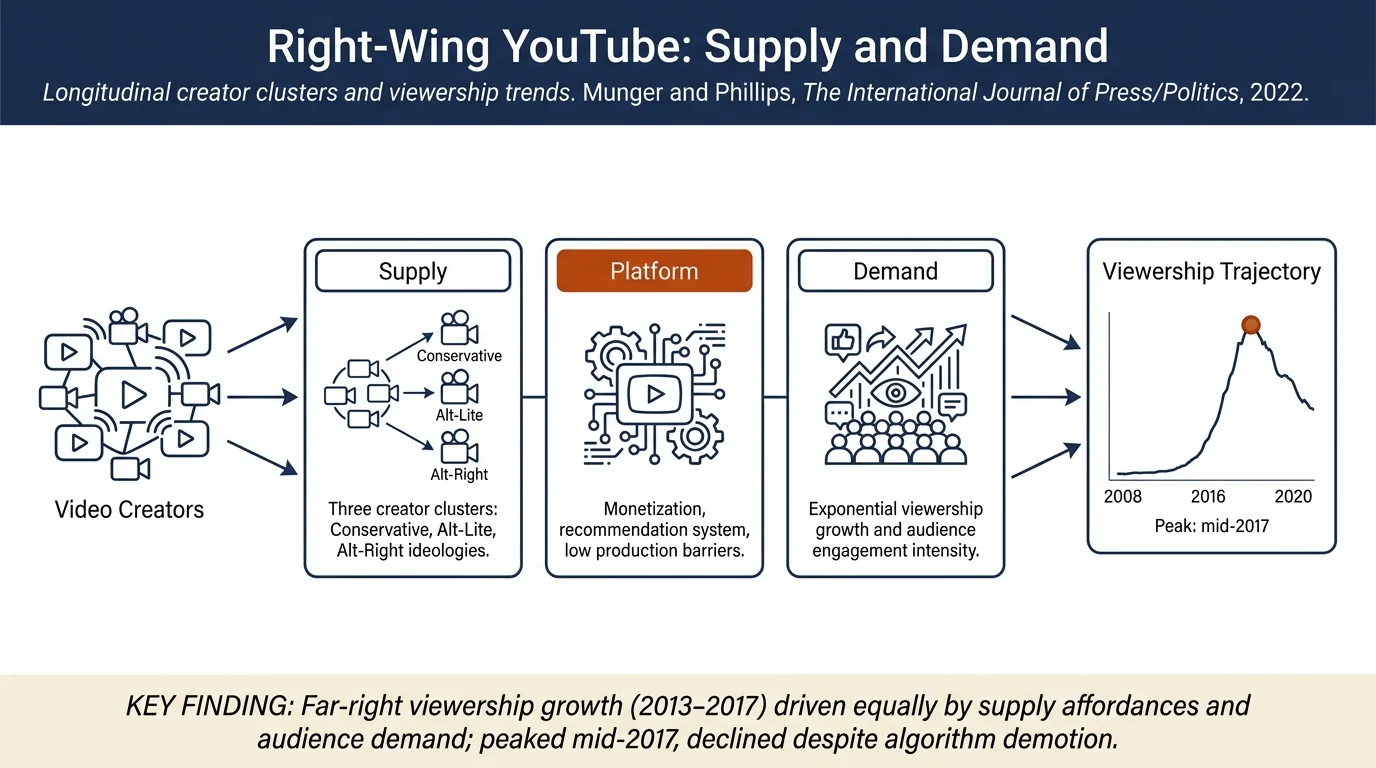
Right-Wing YouTube: A Supply and Demand PerspectiveYouTube has become the dominant platform for right-wing political content in the US, driven by supply-side affordances (low creation barriers, monetization, algorithmic recommendation) and demand-side audience appetite for alternative media. Using longitudinal analysis of creator clusters (Conservative, Alt-Lite, Alt-Right), the authors…
 Psychology & interventionsFact-checking & verification
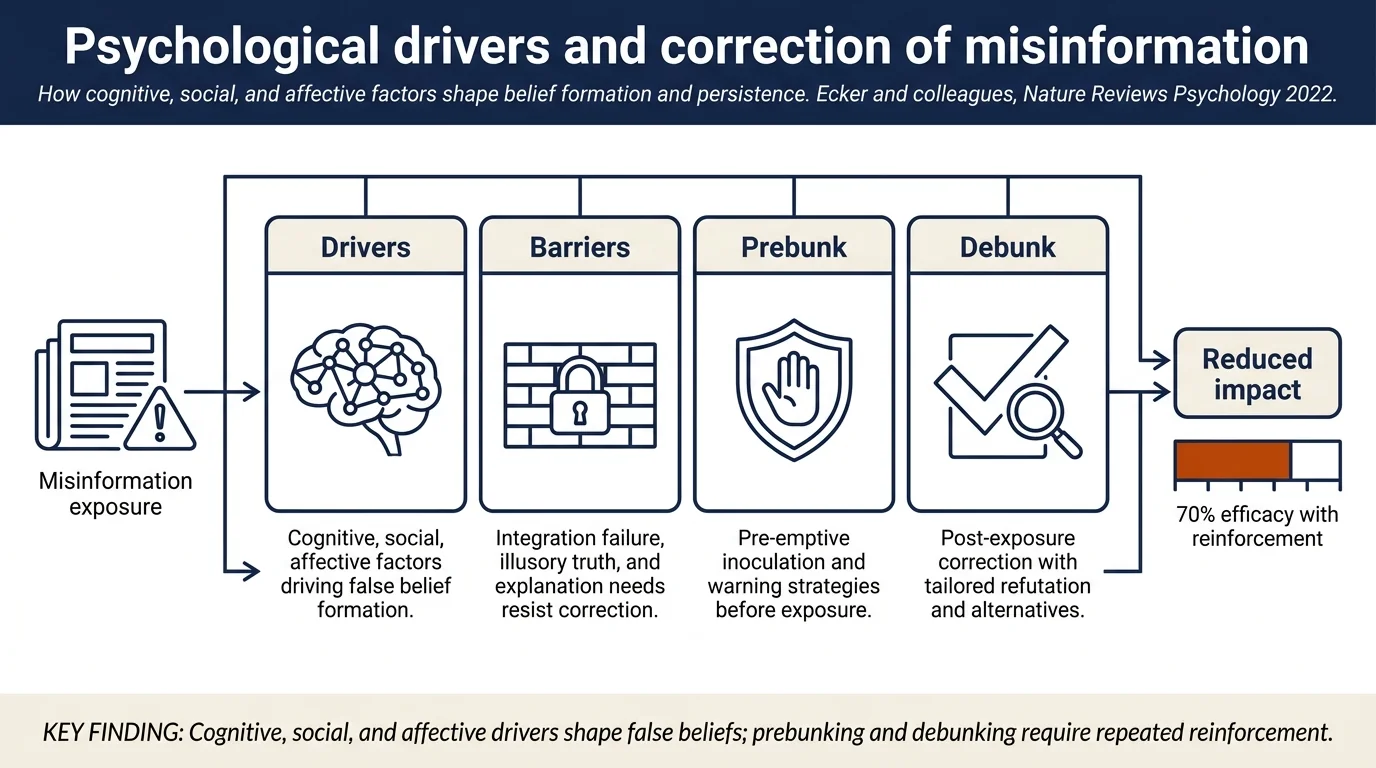
The psychological drivers of misinformation belief and its resistance to correctionThis comprehensive review establishes that misinformation's power lies not in exposure but in how cognitive, social, and affective factors shape belief formation and persist even after correction. False beliefs arise from intuitive thinking, memory failures, emotional content, in-group bias, and source credibility judgments; corrections…
 Psychology & interventionsPlatforms, policy & society
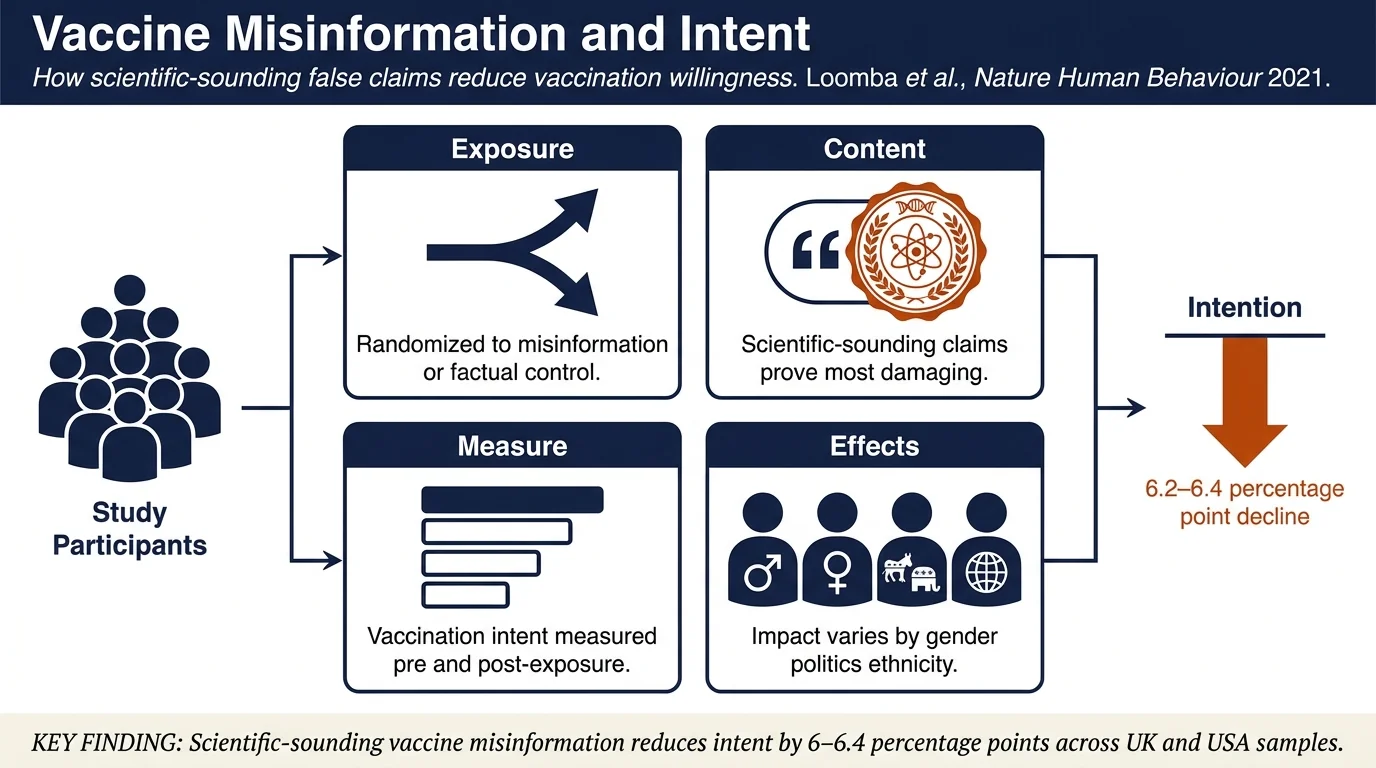
Measuring the impact of COVID-19 vaccine misinformation on vaccination intent in the UK and USARandomized controlled trial on 8,001 respondents (4,000 UK, 4,001 USA) measuring causal impact of exposure to COVID-19 vaccine misinformation. Exposure to misinformation reduced vaccination intent by 6.2 percentage points in the UK and 6.4 in the USA relative to exposure to factual information.
 Platforms, policy & societySpread & networks
How to Demolish the Disinformation InfrastructureKate Starbird, co-principal investigator at the University of Washington's Center for an Informed Public, discusses the state of disinformation in the aftermath of platform removals (Trump, QAnon), focusing on how moderation actions redirect harmful activity to alternative ("alt-tech") platforms rather than eliminating it. She emphasizes…
 Psychology & interventionsPlatforms, policy & society
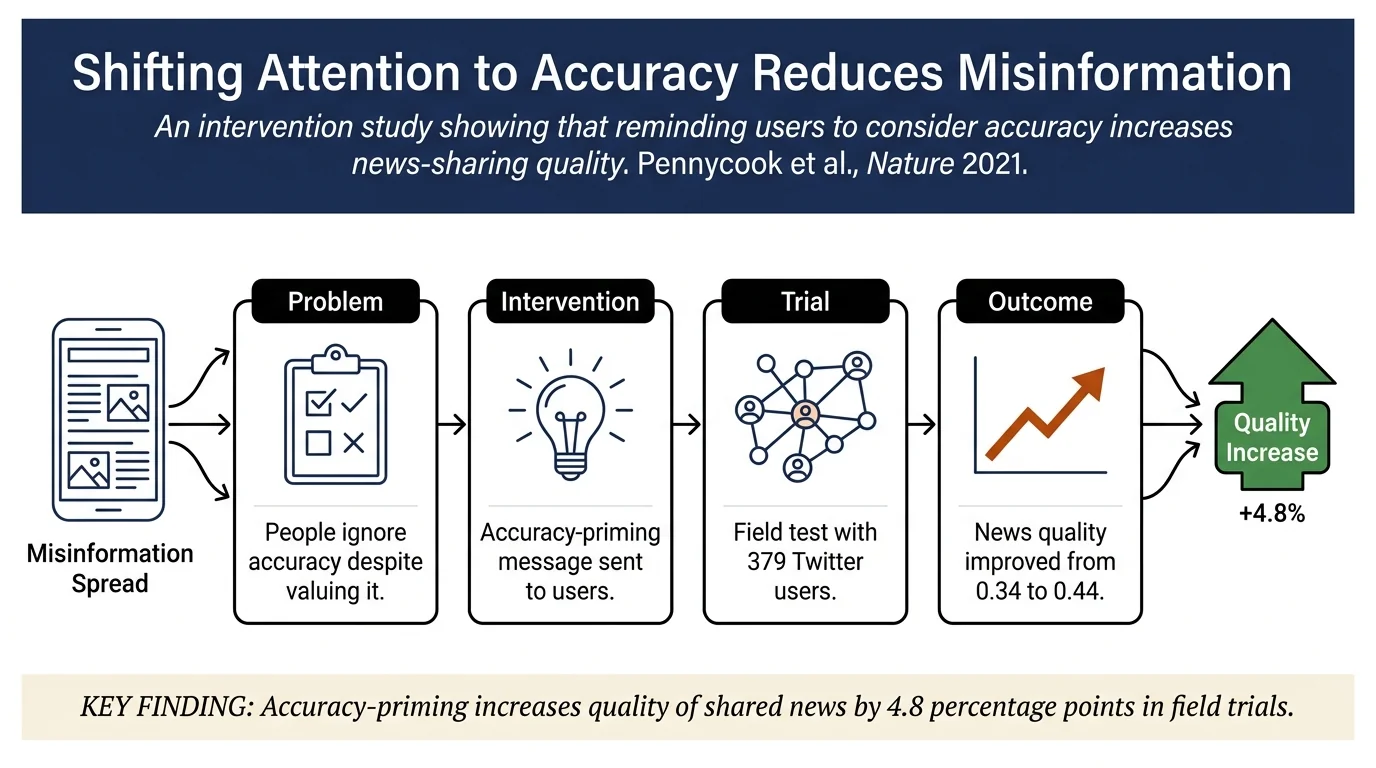
Shifting attention to accuracy can reduce misinformation onlineThe paper shows through six online experiments and a Twitter field trial that simply drawing people's attention to accuracy can substantially reduce their sharing of misinformation. When asked to rate the accuracy of headlines before deciding whether to share them, participants share more accurate content; a Twitter field experiment…
 Spread & networksDatasets & evaluation
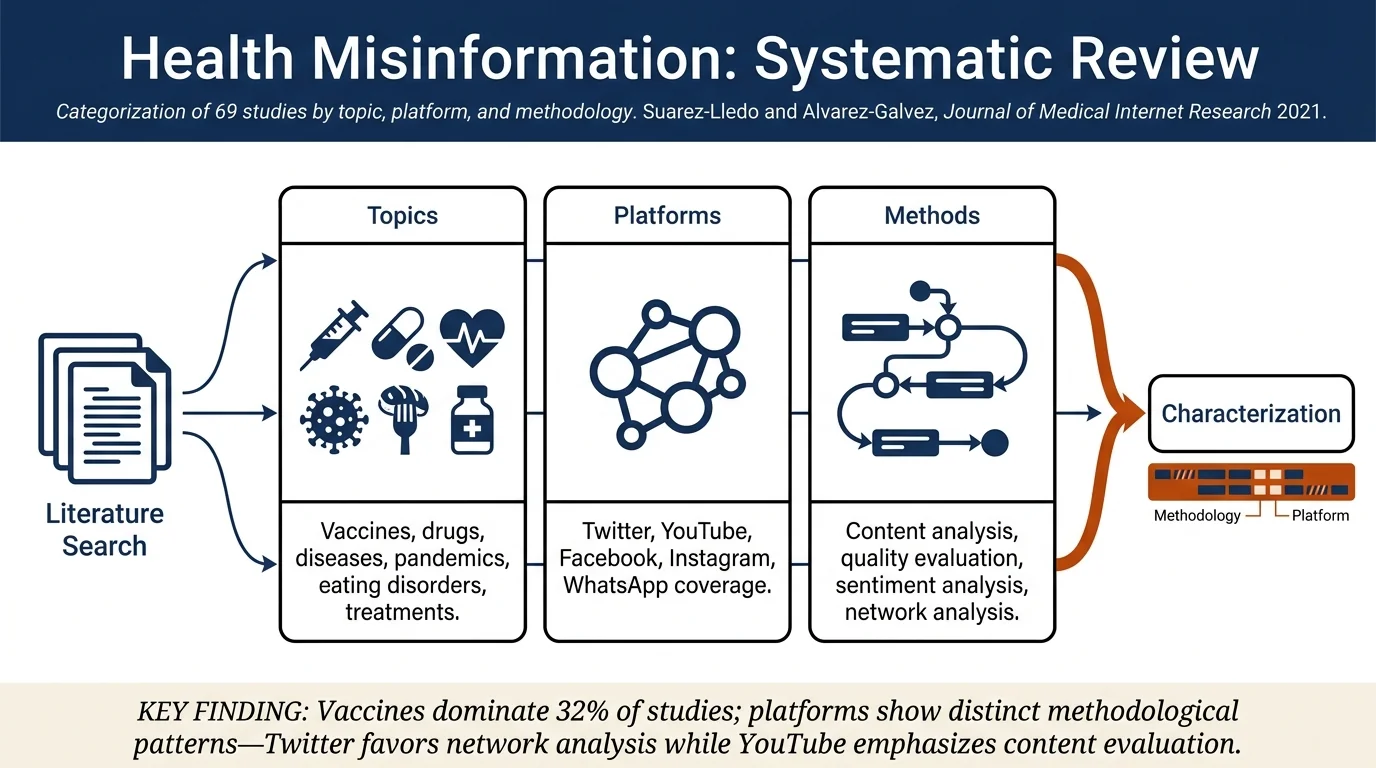
Prevalence of Health Misinformation on Social Media: Systematic ReviewSystematic review of 69 studies examining health misinformation prevalence across social media platforms. Vaccines, drugs, and smoking are the most-studied topics; Twitter is the primary platform for misinformation about smoking and substances, while vaccines are discussed broadly across platforms.
 Deepfakes & multimodalDetection methods
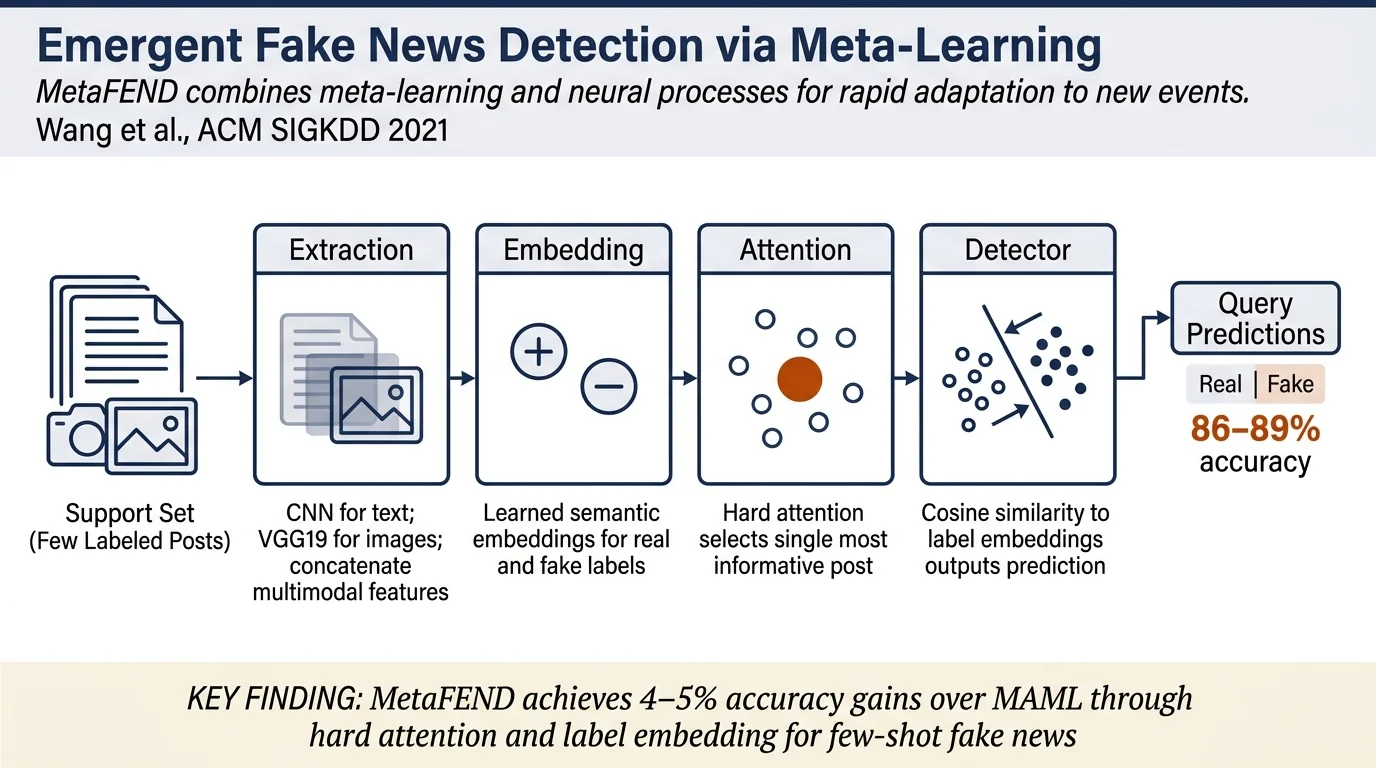
Multimodal Emergent Fake News Detection via Meta Neural Process NetworksExisting fake news detectors trained on labeled data perform poorly on novel, emergent events due to domain shift. The paper proposes MetaFEND, which combines meta-learning and neural processes to leverage a handful of labeled posts from a new event to quickly adapt a detection model.
 Spread & networksDetection methods
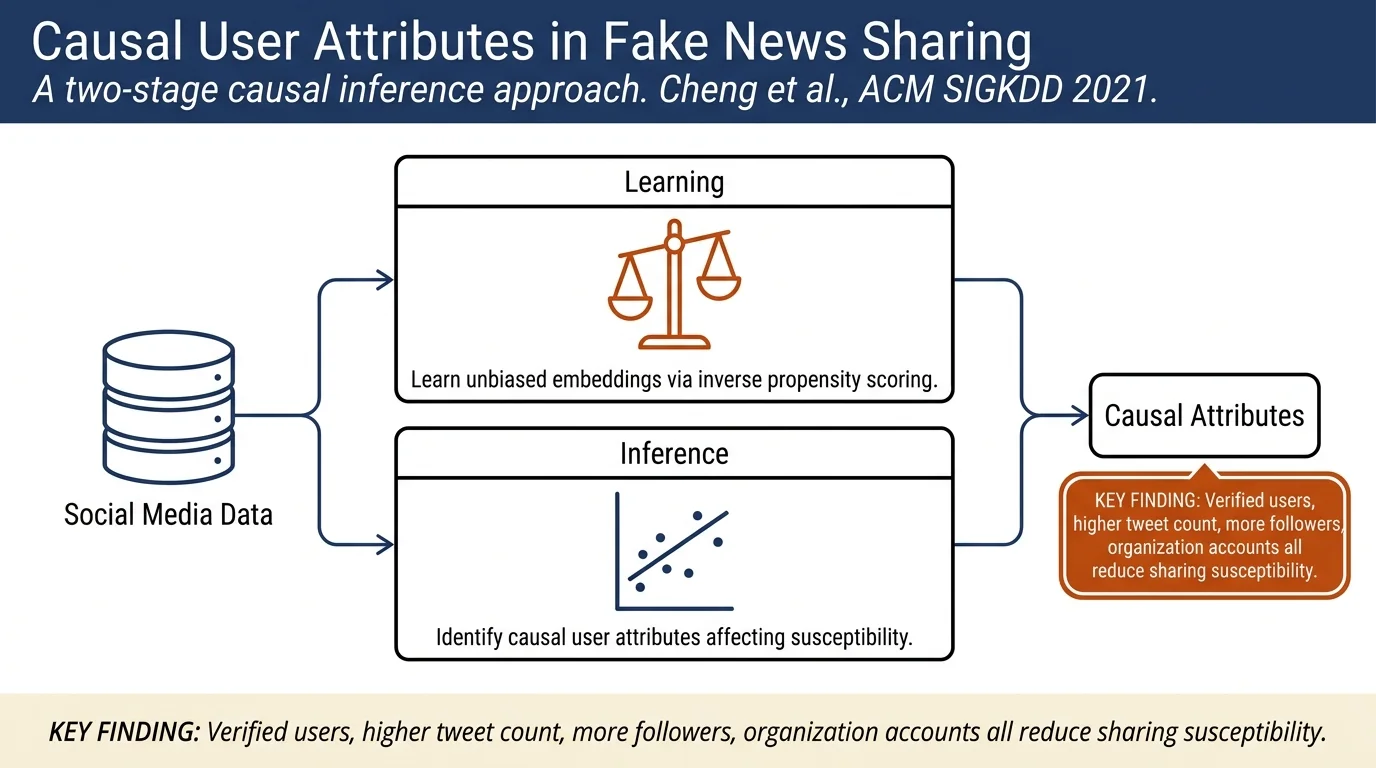
Causal Understanding of Fake News Dissemination on Social MediaThe paper addresses the fundamental causal question: what user attributes cause susceptibility to share fake news? Rather than observing correlations, the authors use inverse propensity scoring (IPS) to learn unbiased embeddings of fake news sharing behavior, treating these embeddings as confounders in a causal model.
 Detection methodsSpread & networks
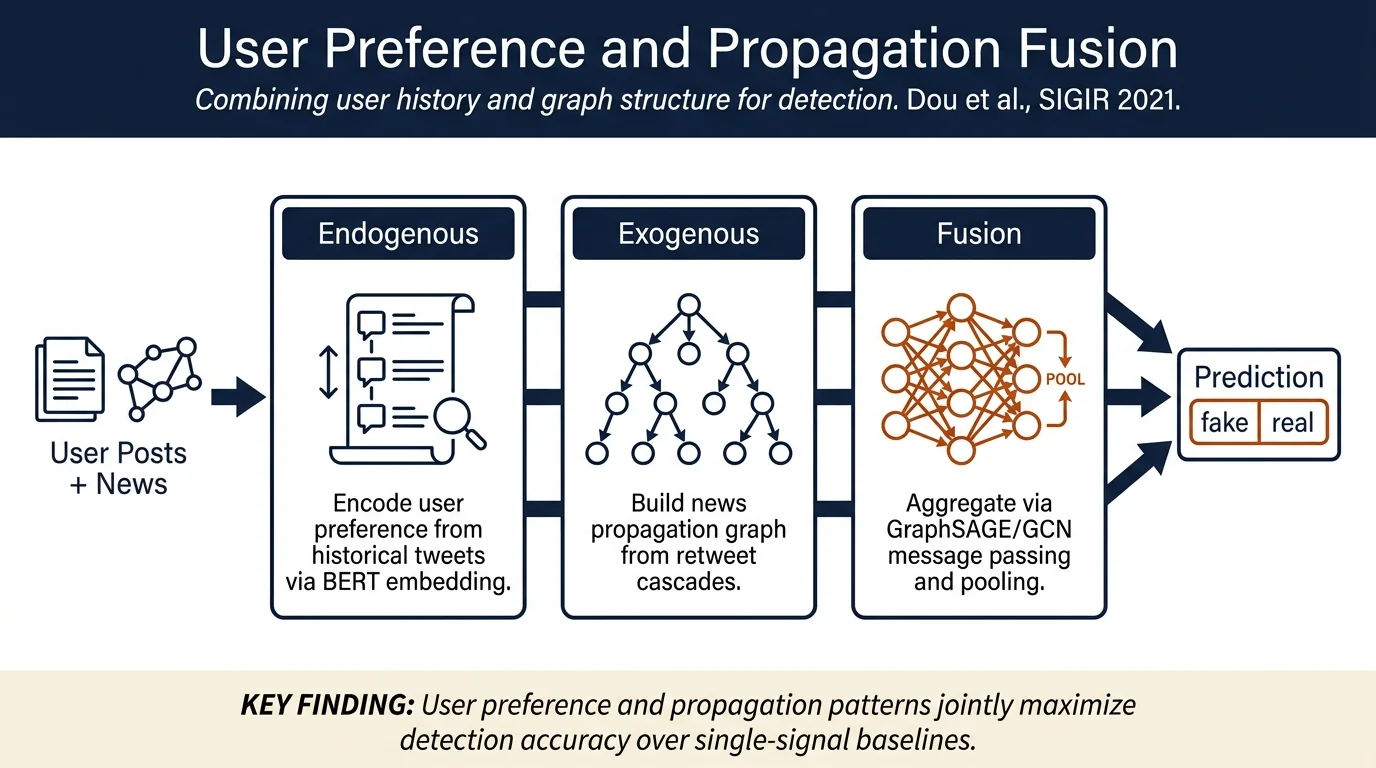
User Preference-aware Fake News DetectionProposes UPFD, which detects fake news by jointly modeling user endogenous preferences (from historical posts) and exogenous context (news propagation graphs) via GNNs. Shows confirmation bias drives news sharing decisions, and historical user behavior provides complementary signals to improve detection over content-only and graph-only…
 Detection methodsLLMs & generative AI
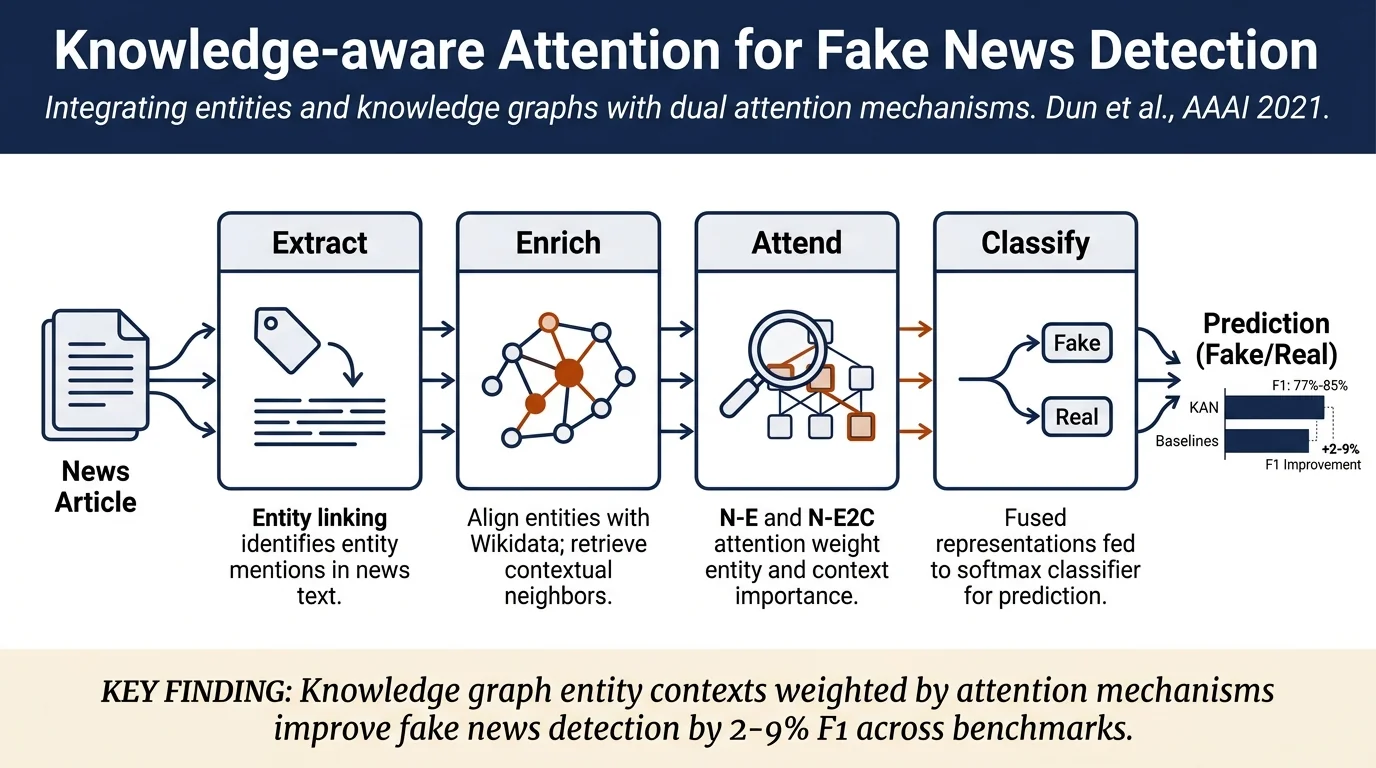
KAN: Knowledge-aware Attention Network for Fake News DetectionMost fake news detection models rely on textual features and social context but ignore knowledge-level relationships among entities in news. This paper proposes KAN, which extracts entity mentions from news, aligns them with knowledge graphs (Wikidata), and uses two attention mechanisms (N-E and N-E2C) to measure entity and…
 Detection methodsLLMs & generative AI
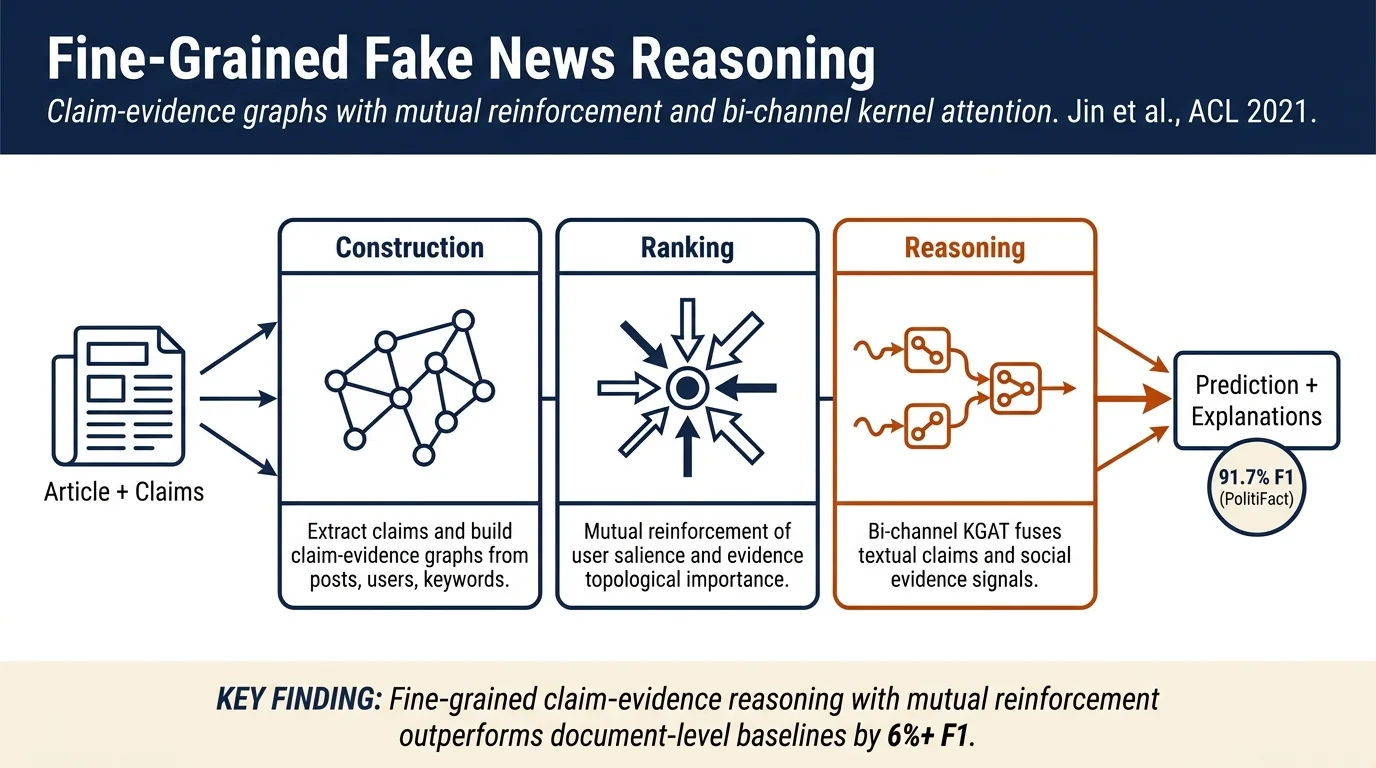
Towards Fine-Grained Reasoning for Fake News DetectionThe paper proposes FinerFact, a framework for fake news detection that models reasoning at the claim-evidence level rather than the document level. It constructs claim-evidence graphs and uses mutual-reinforcement-based ranking to identify salient evidence, then applies a bi-channel kernel graph network to reason over evidence groups.
 Detection methodsLLMs & generative AI
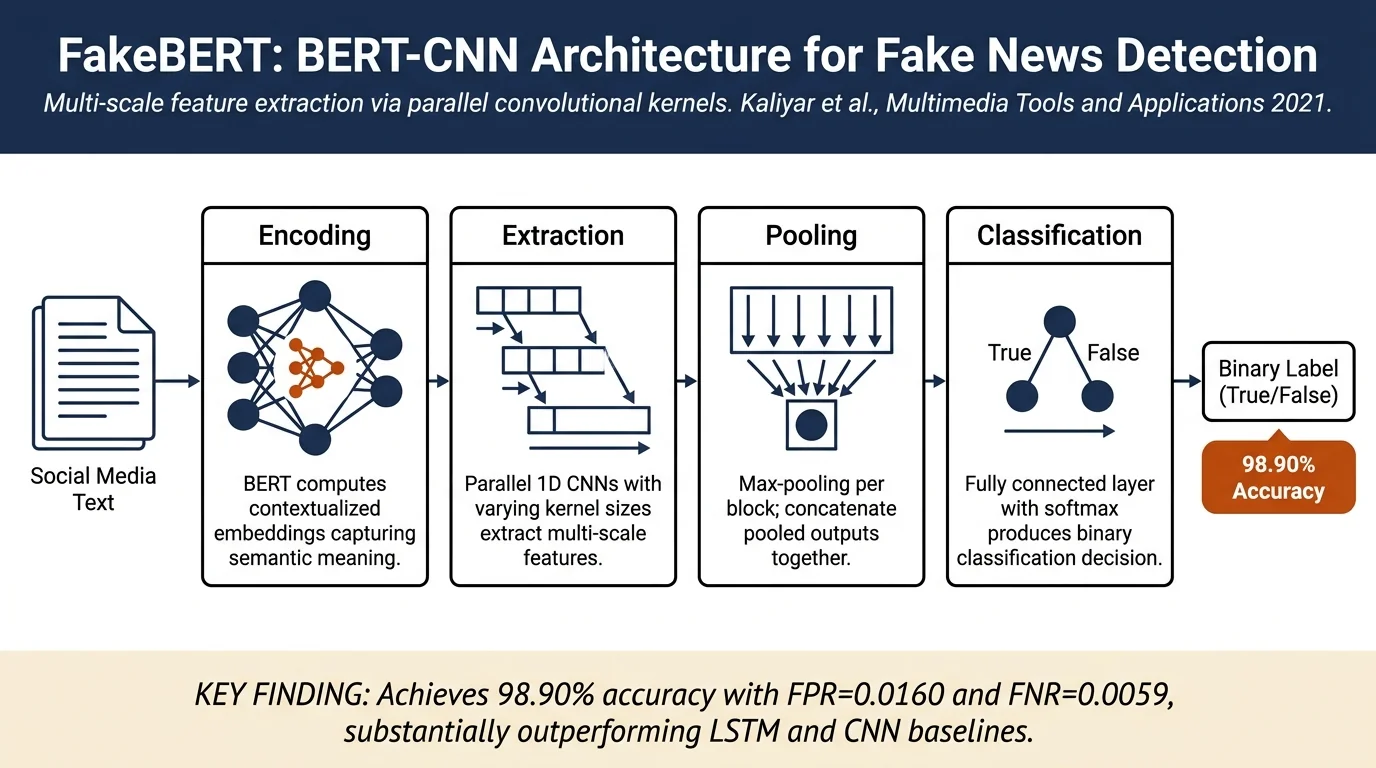
FakeBERT: Fake News Detection in Social Media with a BERT-based Deep Learning ApproachFakeBERT combines BERT (Bidirectional Encoder Representations from Transformers) with parallel 1D convolutional neural networks to detect fake news on social media. The model captures semantic and long-distance dependencies in text, achieving 98.90% accuracy on the real-world fake news dataset and substantially outperforming CNN and LSTM…