The Amplification Paradox in Recommender Systems
Authors: Manoel Horta Ribeiro, Veniamin Veselovsky, Robert West Venue: ICWSM 2023 — arXiv
TL;DR
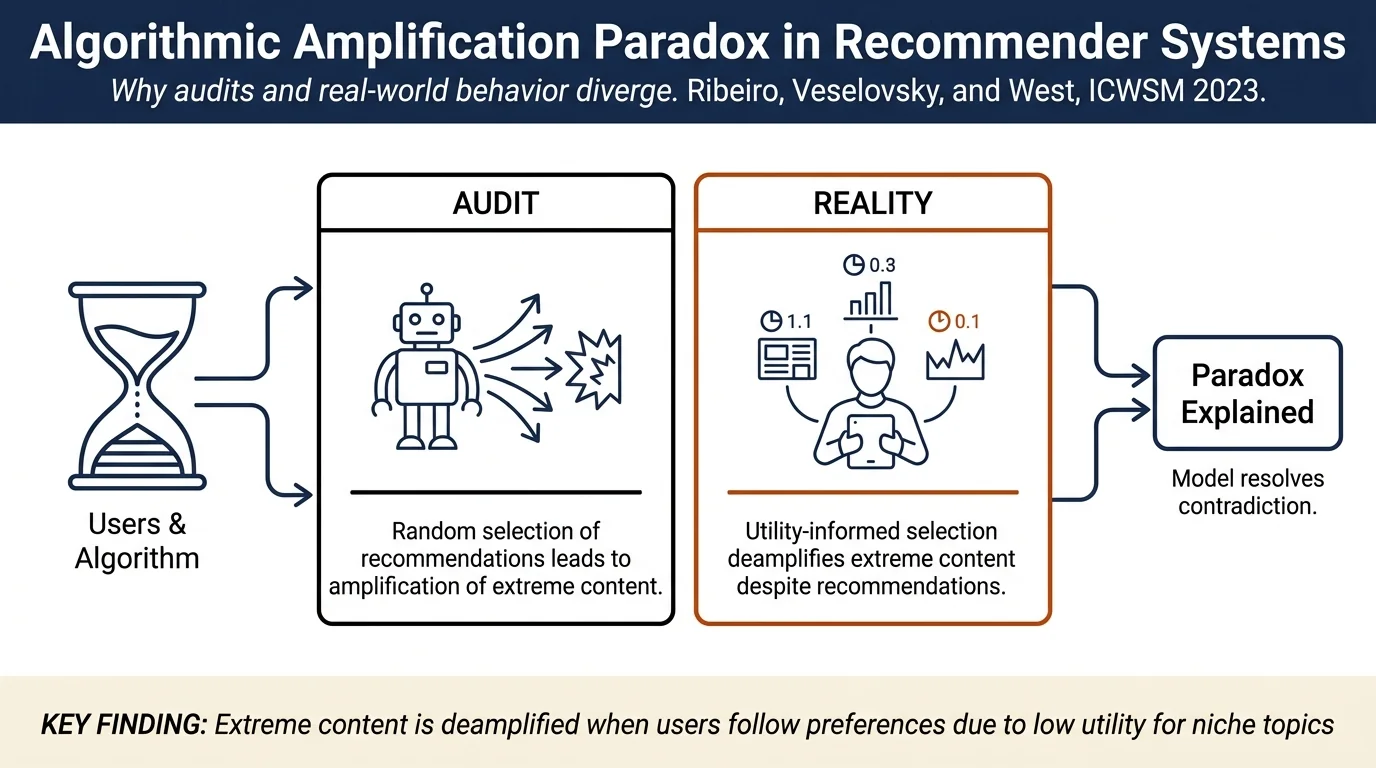
Algorithmic audits find that blindly following YouTube recommendations leads to extreme content, yet real user logs show recommendations don't drive extreme content consumption. Using an agent-based model with realistic user preferences, the authors show this paradox arises because users rarely consume niche content even when recommended due to low utility, causing the recommender system to deamplify rather than amplify such content.
Contributions
- Proposes an explanation for the "amplification paradox": the contradiction between audit studies showing algorithmic amplification of extreme content and real-world logs showing recommendations aren't primary drivers of extreme content
- Develops an agent-based model incorporating collaborative filtering and user utility preferences to explain both observations
- Argues for a utility-based notion of algorithmic amplification rather than assuming all algorithmic promotion is amplification
- Demonstrates that algorithmic audits are limited without modeling realistic user behavior and preferences
Method
The paper constructs an agent-based model with three key components:
User preferences. Users span a political spectrum (Far Left to Far Right) with topic-dependent utilities following a beta-binomial distribution. Extreme topics have narrow appeal, concentrated among fringe users.
Collaborative-filtering recommender system. Uses cosine similarity between users to score items via the standard collaborative filtering formula. Recommends items with highest predicted scores.
User interaction. Simulates users making consumption choices either uniformly at random ("random selection") or with probability proportional to utility ("utility-informed selection").
Two simulations test different hypotheses: Simulation #1 uses random selection (mimicking bot audits that ignore preferences), while Simulation #2 uses utility-informed selection (mimicking real users).
Results
Simulation #1 (random selection): Replicates audit findings — users blindly following recommendations become increasingly exposed to Far Left and Far Right (extreme, niche) content, matching prior work on YouTube recommendation bias.
Simulation #2 (utility-informed selection): Extreme content is deamplified relative to its "relative utility" (what users would consume without recommendations). Despite recommendations favoring extreme topics, users' low utility for them causes consumption to remain below the counterfactual baseline.
Key insight: across all starting conditions, extreme content is never consumed above relative utility when users follow preferences — matching empirical findings from real YouTube user logs.
Connections
- Right-Wing YouTube: A Supply and Demand Perspective and Examining the consumption of radical content on YouTube — empirical YouTube recommendation studies finding algorithm does not drive extreme content (motivating this work)
- Examining the consumption of radical content on YouTube — real user traces showing radicalization is not algorithmic-driven
- The echo chamber effect on social media — studies of filter bubbles and echo chambers, phenomena the model informs
- Exposure to opposing views on social media can increase political polarization — algorithmic exposure to opposing viewpoints and polarization
Notes
The paper makes a critical methodological point: audits that assume users blindly follow recommendations miss a crucial behavioral reality. The agent-based model is intentionally simple, presented as an "existence proof" that shows how collaborative filtering plus content nicheness alone can explain contradictory findings. The authors acknowledge not thoroughly exploring parameter sensitivity, but argue this does not undermine the explanatory value for the paradox.
The utility-based framing of algorithmic amplification — content is amplified only when consumed above what user preferences alone would predict — is pragmatic and differs from regulatory framing that treats all algorithmic prominence as amplification. This distinction has implications for both research methodology and policy design.