Explore papers
Filter by research area, year and venue. Every filter is in the address bar, so you can share a view as a link.
 Datasets & evaluationSpread & networks
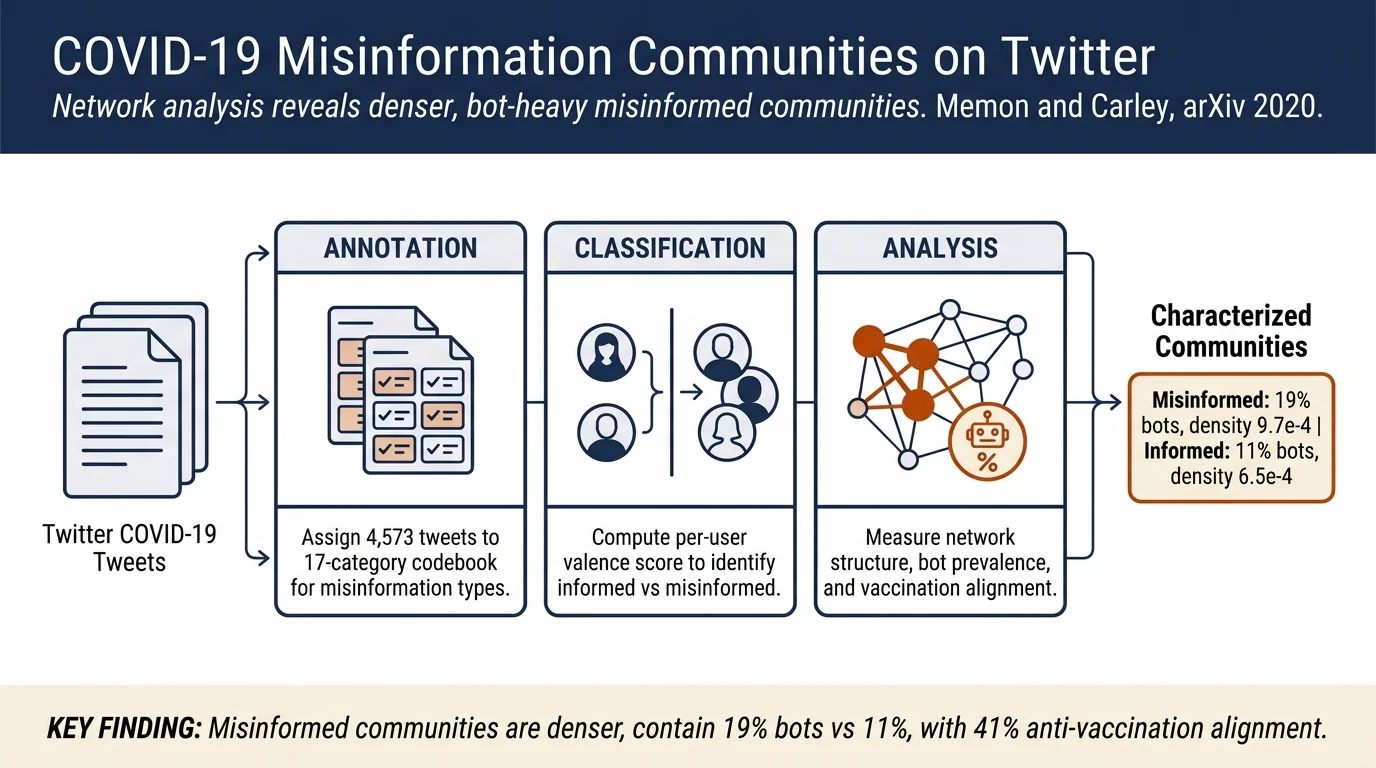
Characterizing COVID-19 Misinformation Communities Using a Novel Twitter DatasetThis paper presents CMU-MisCOV19, a manually annotated Twitter dataset of 4,573 COVID-19 tweets across 17 categories, and characterizes misinformed versus informed online communities. Key findings: misinformed communities are significantly denser (higher network density), contain more bots (19% vs 11%), and demonstrate higher…
 Datasets & evaluationSpread & networks
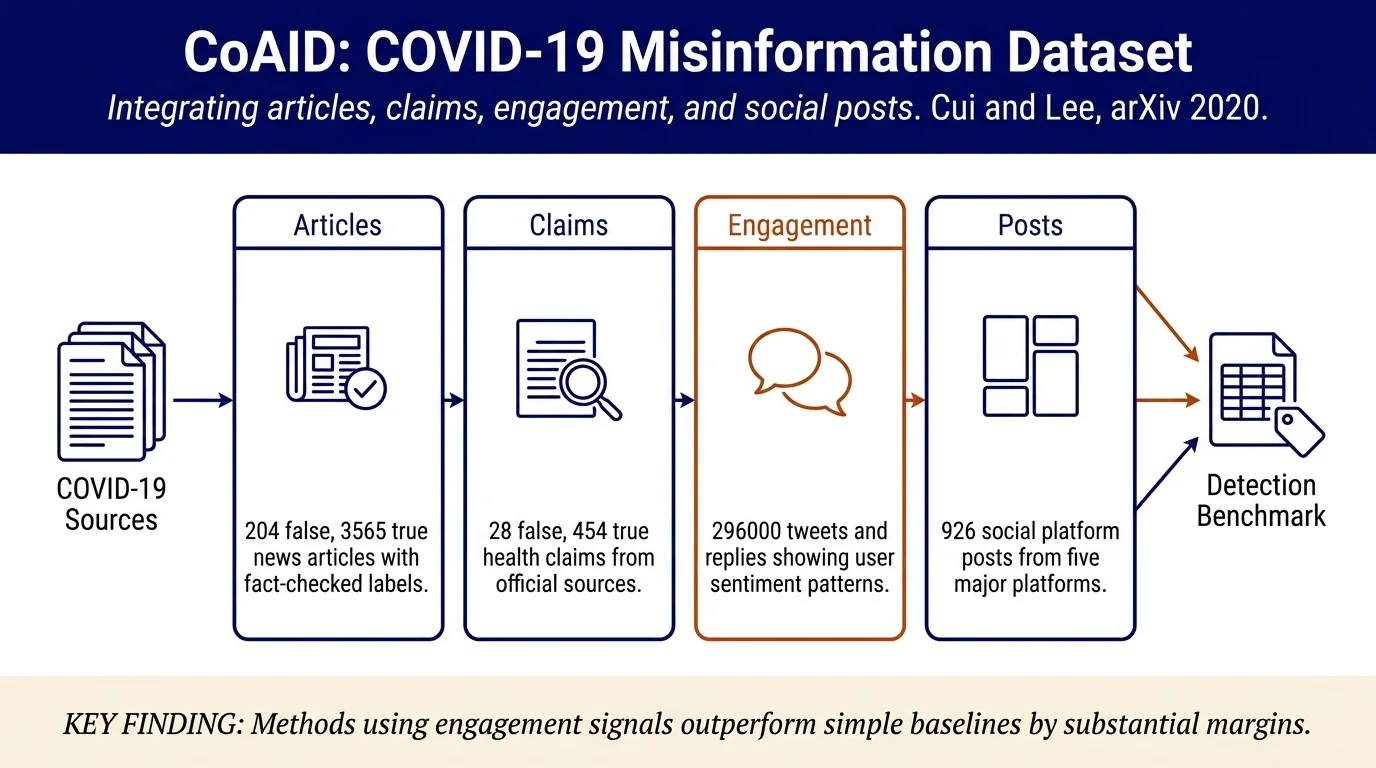
CoAID: COVID-19 Healthcare Misinformation DatasetCoAID is a benchmark dataset for COVID-19 healthcare misinformation detection comprising 4,251 news articles (204 fake, 3,565 true), 28 fake claims and 454 true claims, 296,000 user engagements from social platforms, and 926 social media posts with ground-truth labels. The dataset bridges text content, user engagement features, and…
 Spread & networksPlatforms, policy & society
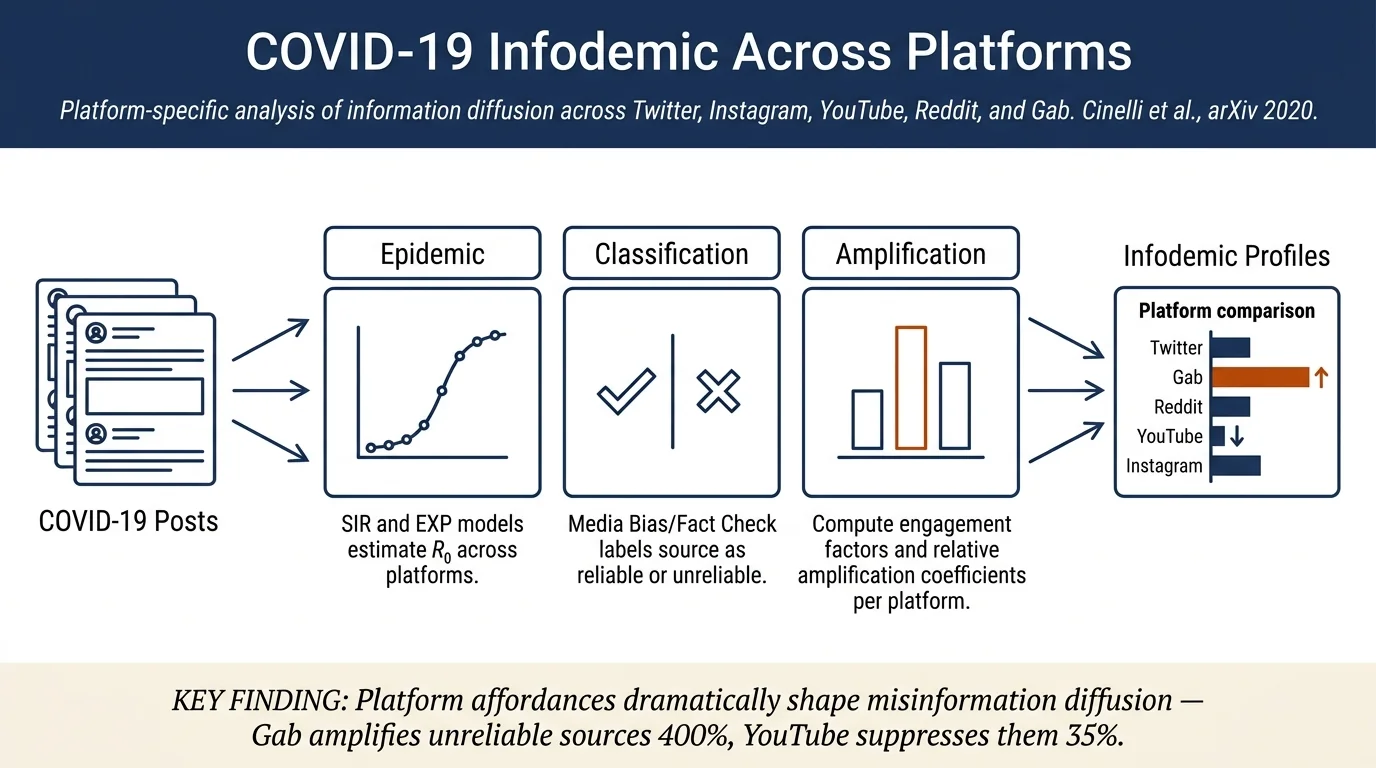
The COVID-19 Social Media InfodemicComparative analysis of COVID-19 information diffusion across five social media platforms (Twitter, Instagram, YouTube, Reddit, Gab) using epidemic models. All platforms exhibit infodemic characteristics (basic reproduction number R₀ 1), with platform-dependent differences in how misinformation spreads relative to reliable information.
 Spread & networksDetection methods
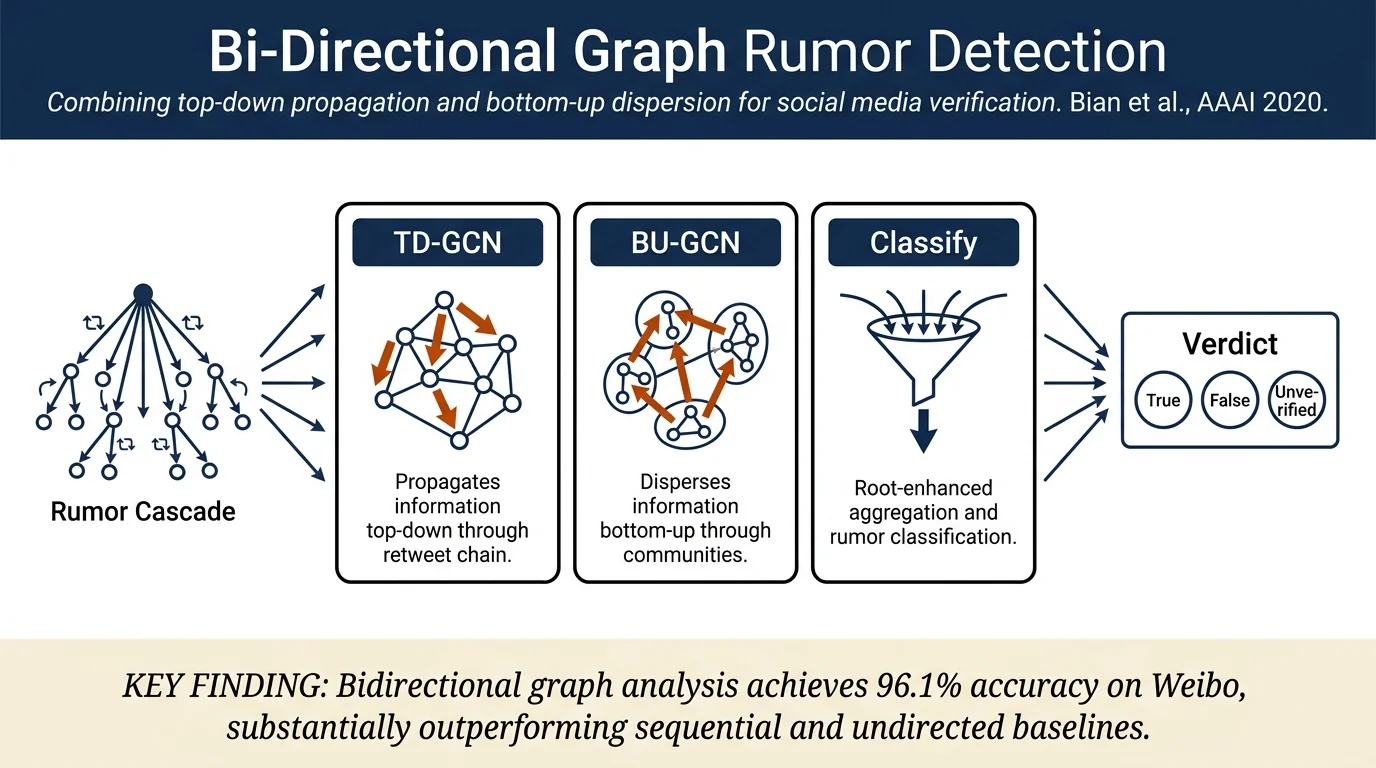
Rumor Detection on Social Media with Bi-Directional Graph Convolutional NetworksProposes Bi-GCN, a graph convolutional network approach for rumor detection that models both top-down propagation patterns (how rumors spread from source) and bottom-up dispersion patterns (how rumors diffuse within communities). By capturing both directional characteristics jointly and incorporating source post features at each layer,…
 Spread & networksDetection methods
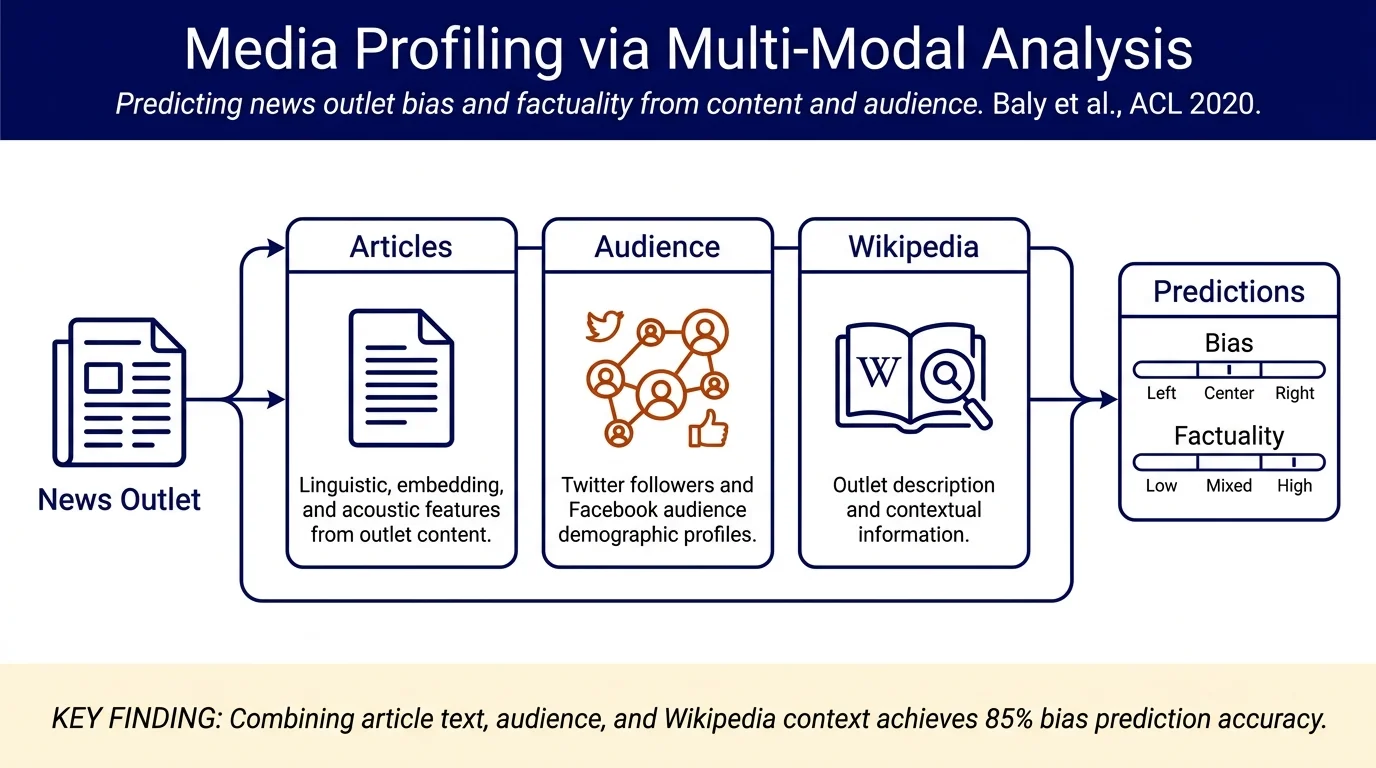
What Was Written vs. Who Read It: News Media Profiling Using Text Analysis and Social Media ContextThis paper predicts the political bias (left/center/right) and factuality (low/mixed/high) of news outlets by analyzing what articles they publish, who follows them on social media, and what Wikipedia says about them. The system achieves 85% accuracy on bias prediction by combining article text, YouTube video features, Twitter audience…
 Platforms, policy & societySpread & networks
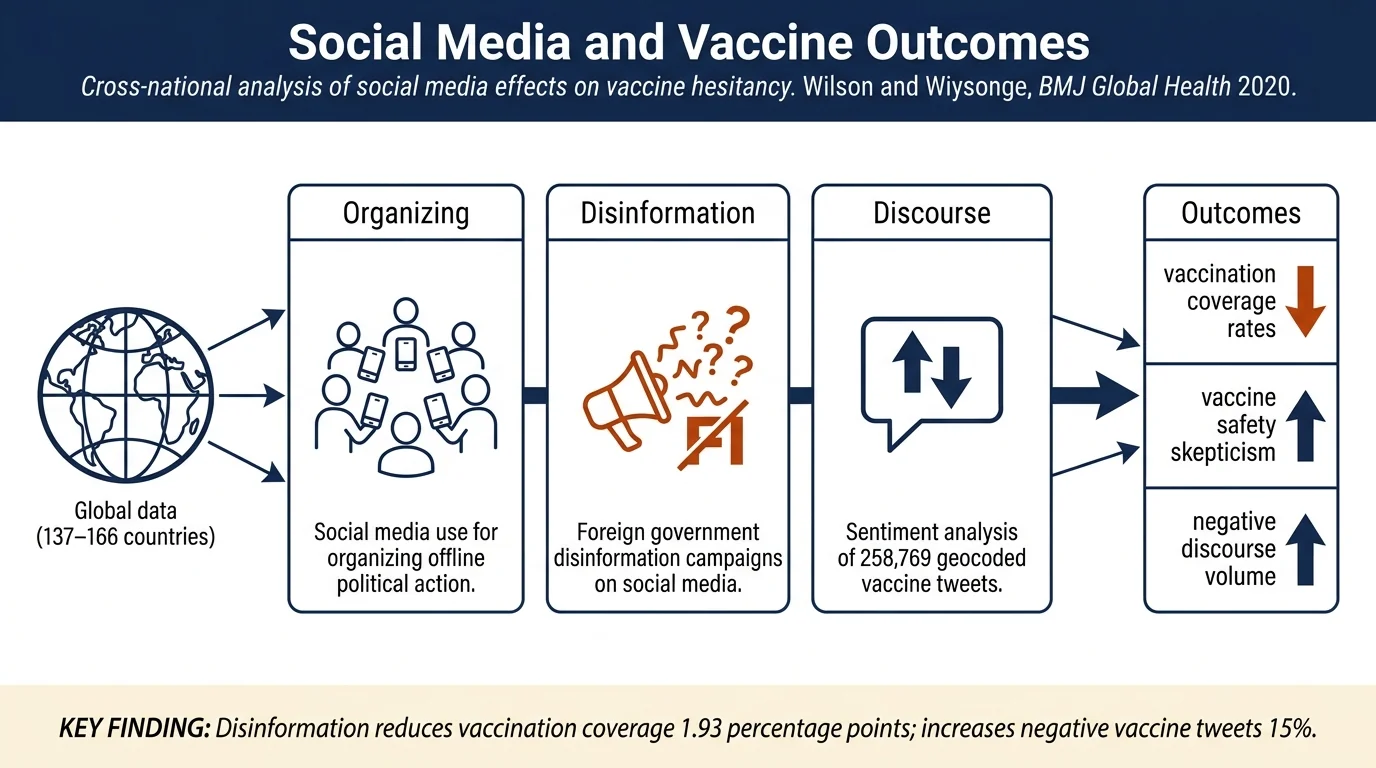
Social media and vaccine hesitancyLarge-scale cross-national analysis finds that social media use to organize offline action predicts public vaccine safety skepticism, while foreign disinformation campaigns significantly reduce vaccination coverage year-over-year. A one-point increase on the five-point disinformation scale correlates with a two-percentage-point drop in…
 Spread & networksPlatforms, policy & society
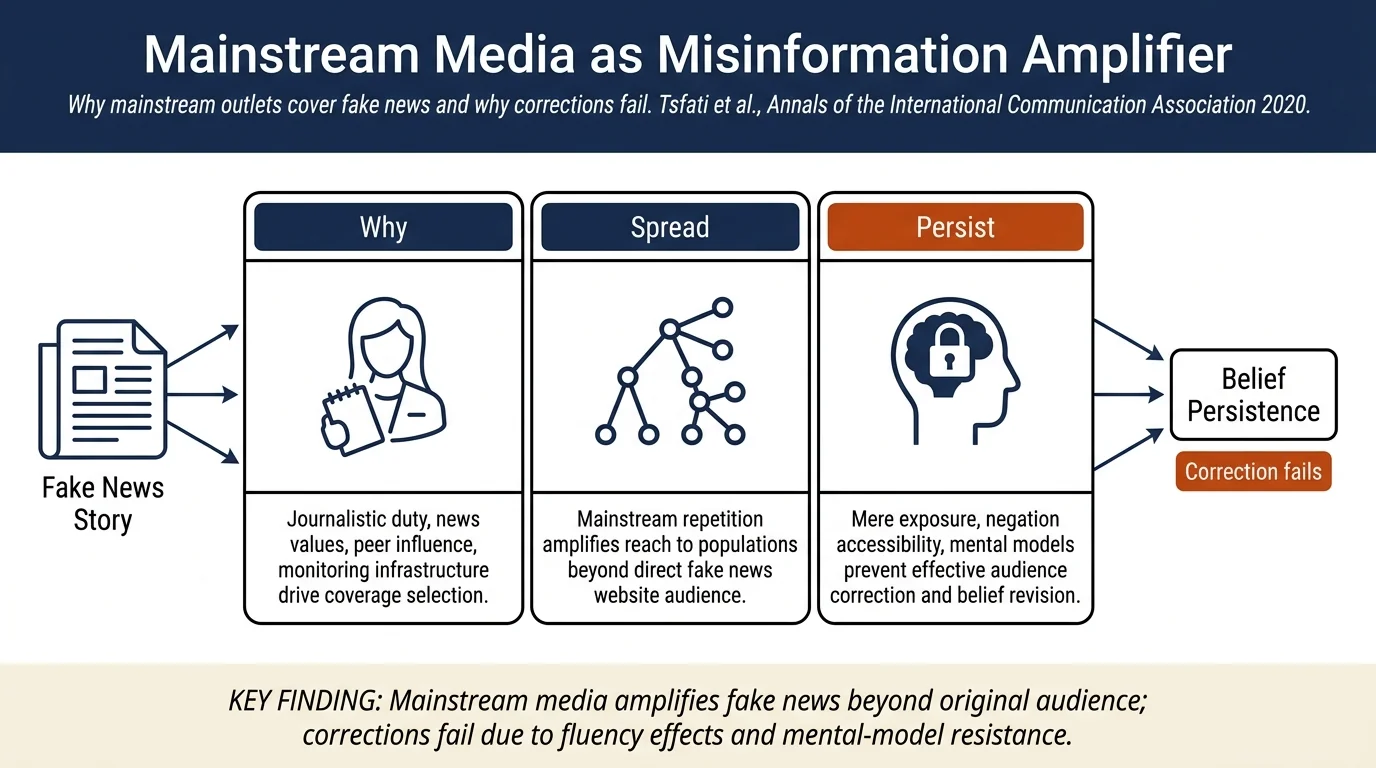
Causes and consequences of mainstream media dissemination of fake news: literature review and synthesisWhile fake news websites have limited direct reach, mainstream media coverage is probably how most people encounter fake news stories. This synthesis identifies why mainstream outlets cover falsehoods (journalists' professional duties, news values, peer psychology, technical infrastructure) and explores how mainstream coverage amplifies…
 Spread & networksPlatforms, policy & society
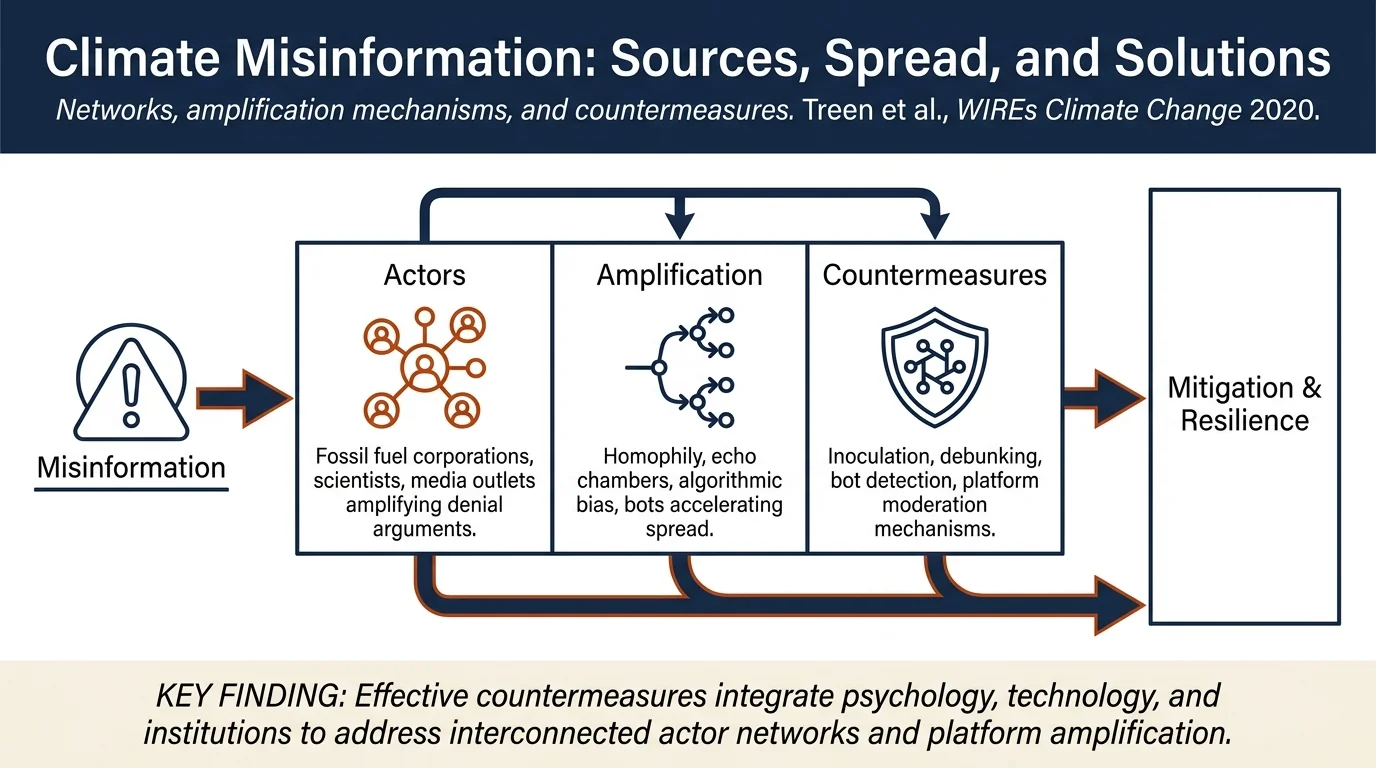
Online misinformation about climate changeComprehensive literature review examining climate change misinformation from multiple disciplinary angles. Defines misinformation vs. disinformation, identifies networks of actors (scientists, governments, industry, media) spreading false claims, examines how social media characteristics (homophily, echo chambers, algorithmic bias)…
 Bots & coordinated campaignsPlatforms, policy & society
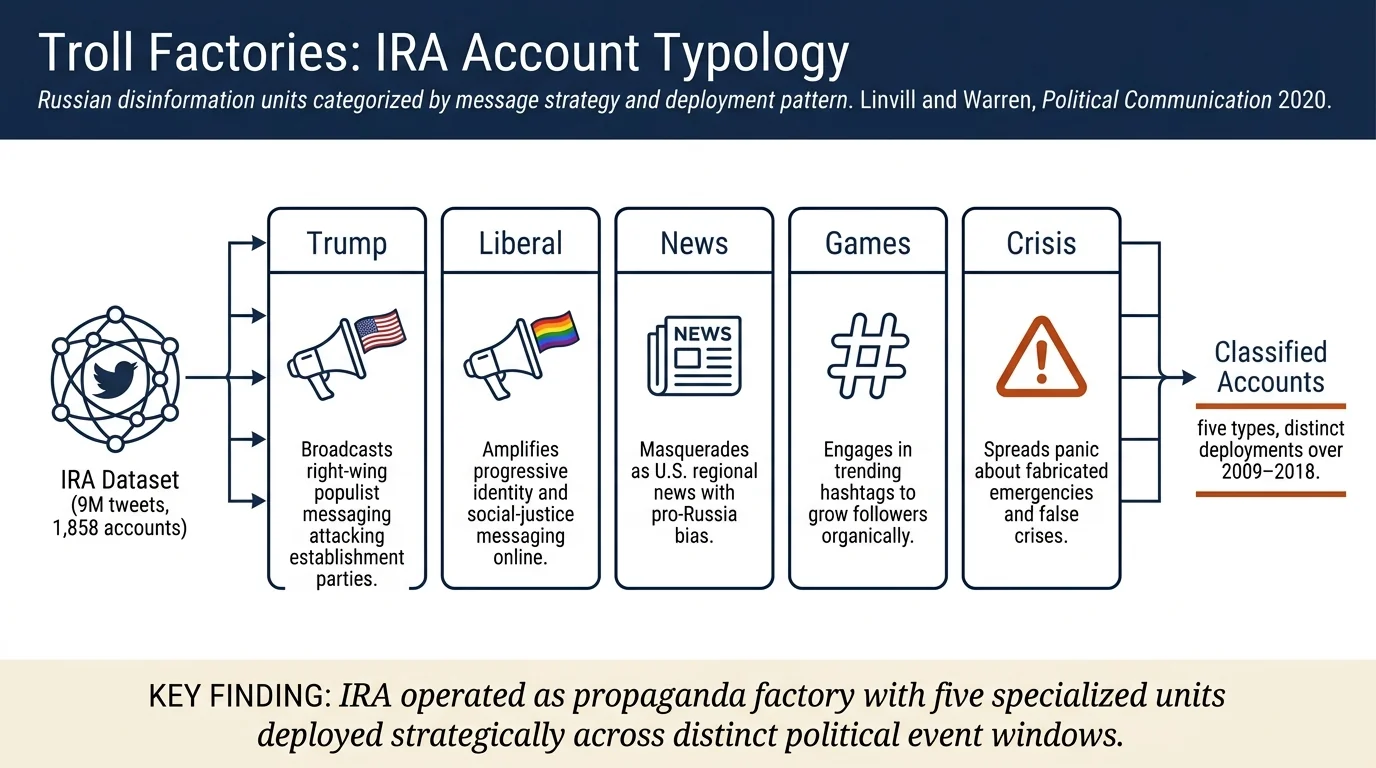
Troll Factories: Manufacturing Specialized Disinformation on TwitterLinvill and Warren analyze 9.04 million tweets from Russia's Internet Research Agency (IRA) spanning 2009–2018, identifying five specialized account categories—Right Troll, Left Troll, News Feed, Hashtag Gamer, and Fearmonger—each with distinct behavioral patterns, temporal deployment strategies, and communication styles. The authors…
 Bots & coordinated campaignsPlatforms, policy & society
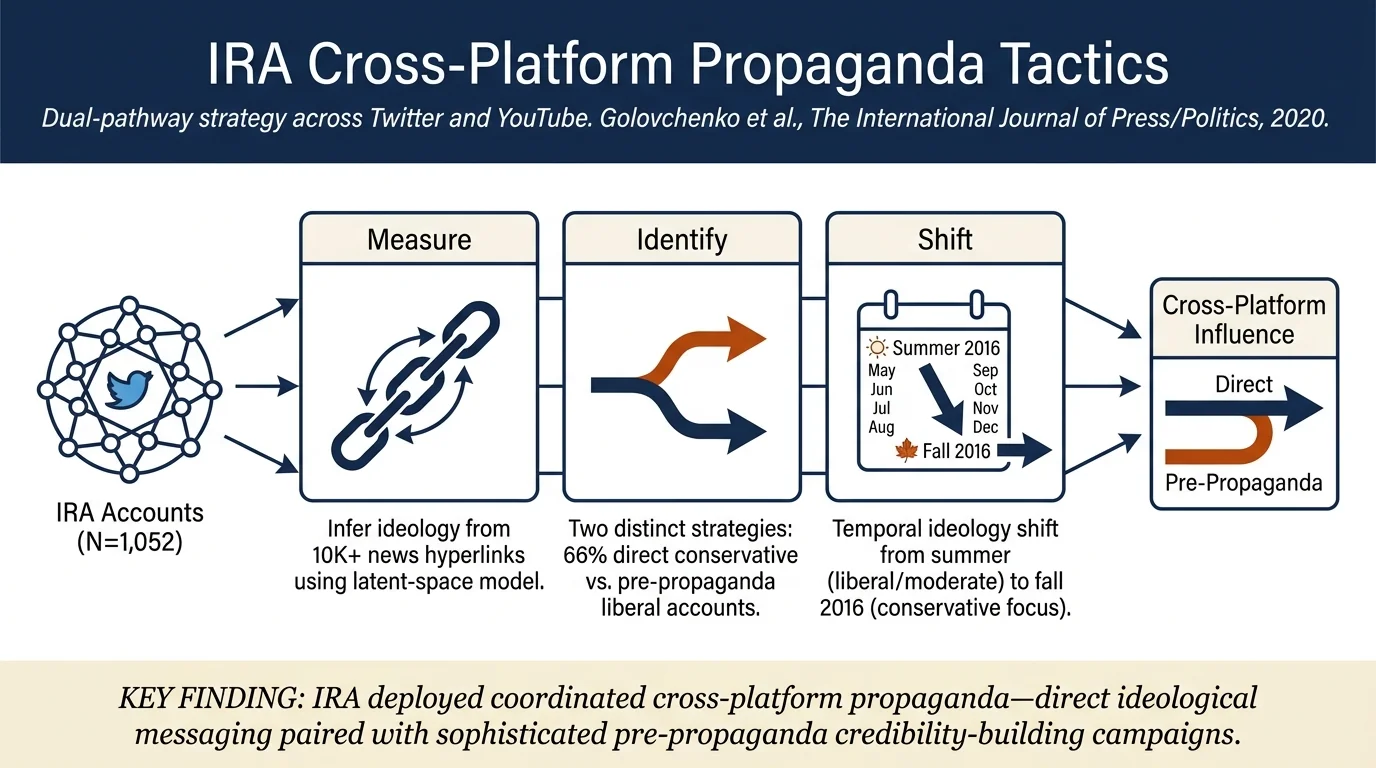
Cross-Platform State Propaganda: Russian Trolls on Twitter and YouTube during the 2016 U.S. Presidential ElectionThis paper analyzes 1,052 Russian IRA Twitter accounts to understand their propaganda strategy during the 2016 U.S. presidential election. By examining hyperlinks to news stories and YouTube videos, the authors find IRA accounts linked to conservative sources more frequently than liberal ones, consistent with supporting Trump.
 Bots & coordinated campaignsSpread & networks
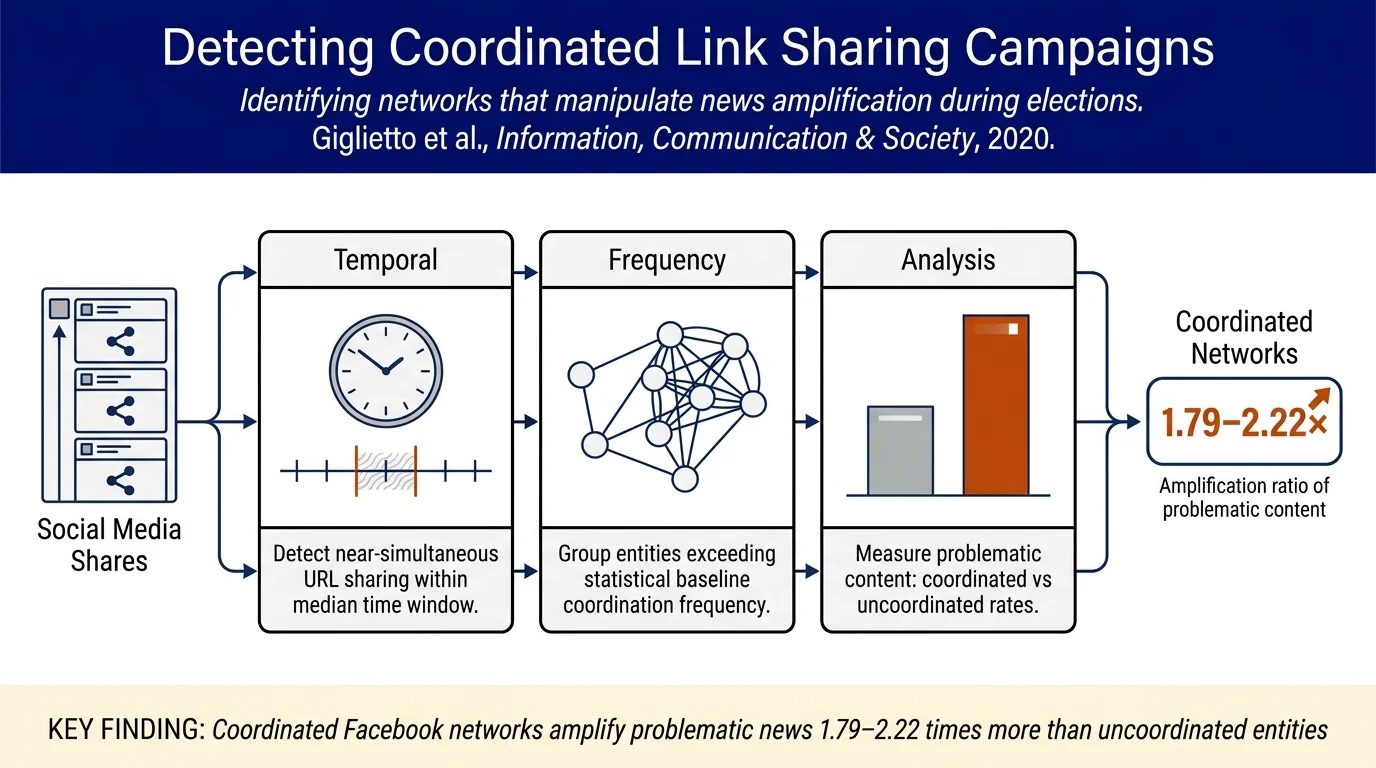
It takes a village to manipulate the media: coordinated link sharing behavior during 2018 and 2019 Italian electionsCoordinated networks of Facebook pages and groups substantially amplified problematic news during Italian elections: coordinated entities shared problematic domains 1.79×–2.22× more frequently than uncoordinated ones. The paper introduces a method to detect "coordinated inauthentic behavior" by identifying entities that…
 Psychology & interventionsSpread & networks
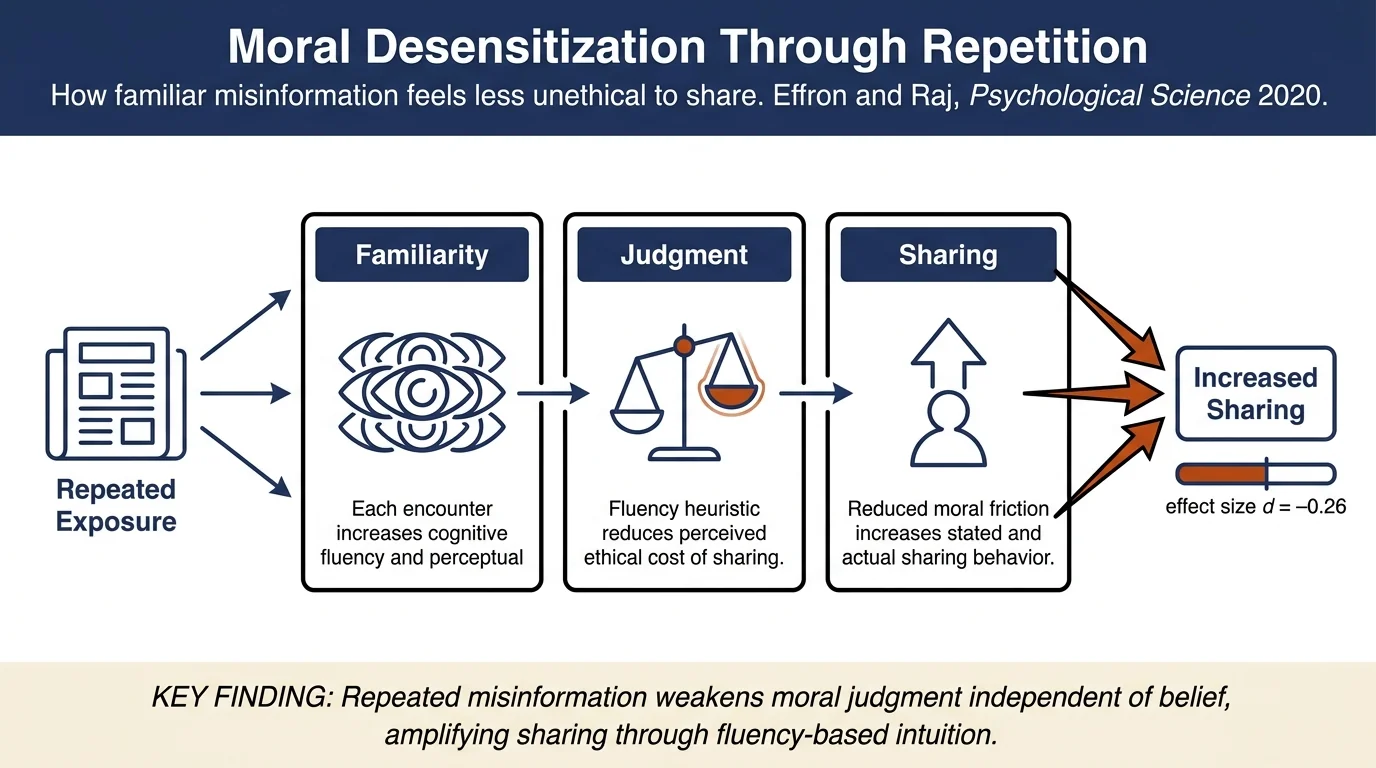
Misinformation and Morality: Encountering Fake-News Headlines Makes Them Seem Less Unethical to Publish and ShareFour preregistered experiments (N=2,587) show that repeatedly encountering fake-news headlines reduces moral condemnation of spreading them—regardless of whether people believe them. This "moral repetition effect" operates via fluency: familiar headlines feel less unethical to share, stronger inclinations to promote them online, and…
 Spread & networksPlatforms, policy & society
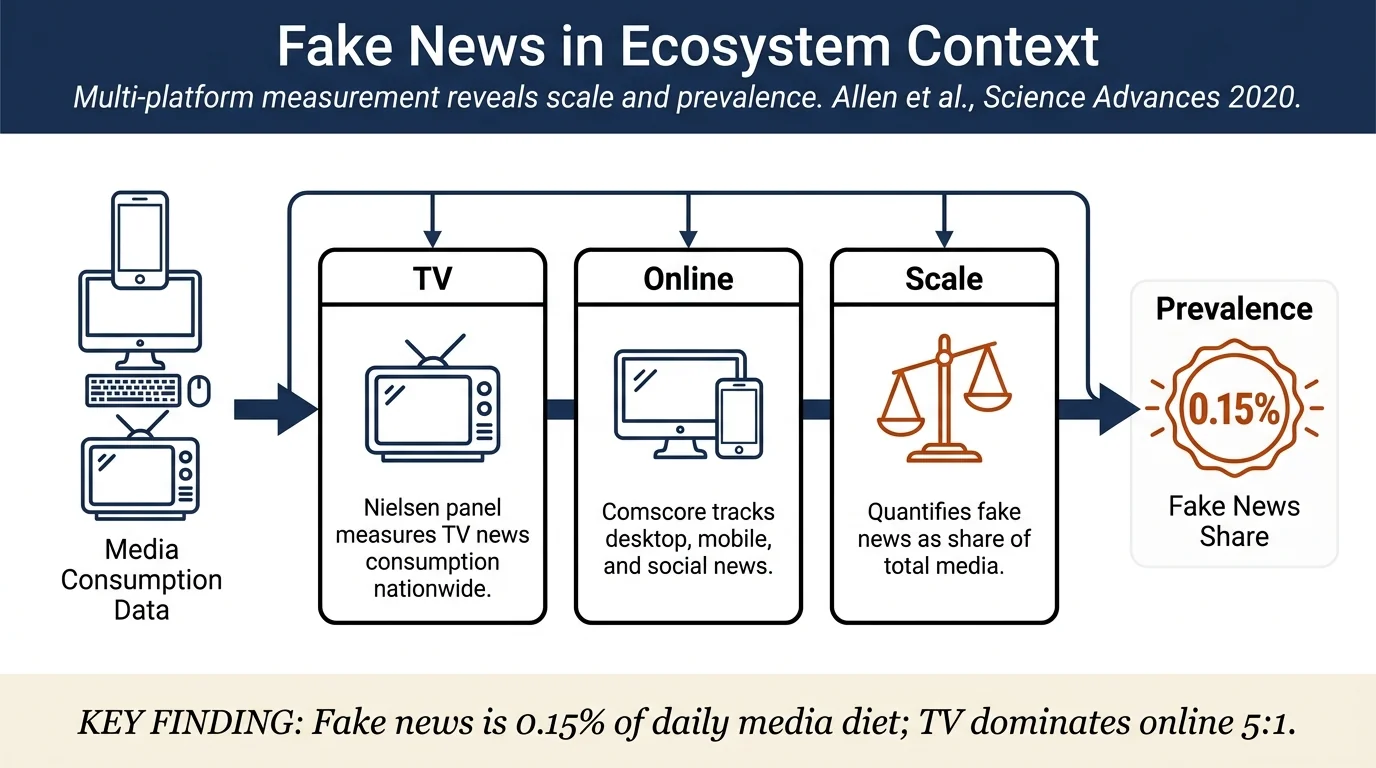
Evaluating the fake news problem at the scale of the information ecosystemUsing nationally representative data on mobile, desktop, and TV consumption spanning 2016–2018, the authors show that fake news comprises only 0.15% of Americans' daily media diet, while TV dominates news consumption by a 5:1 ratio over online. The paper challenges the widespread narrative of fake news as a pervasive crisis and suggests…
 Datasets & evaluationDeepfakes & multimodal
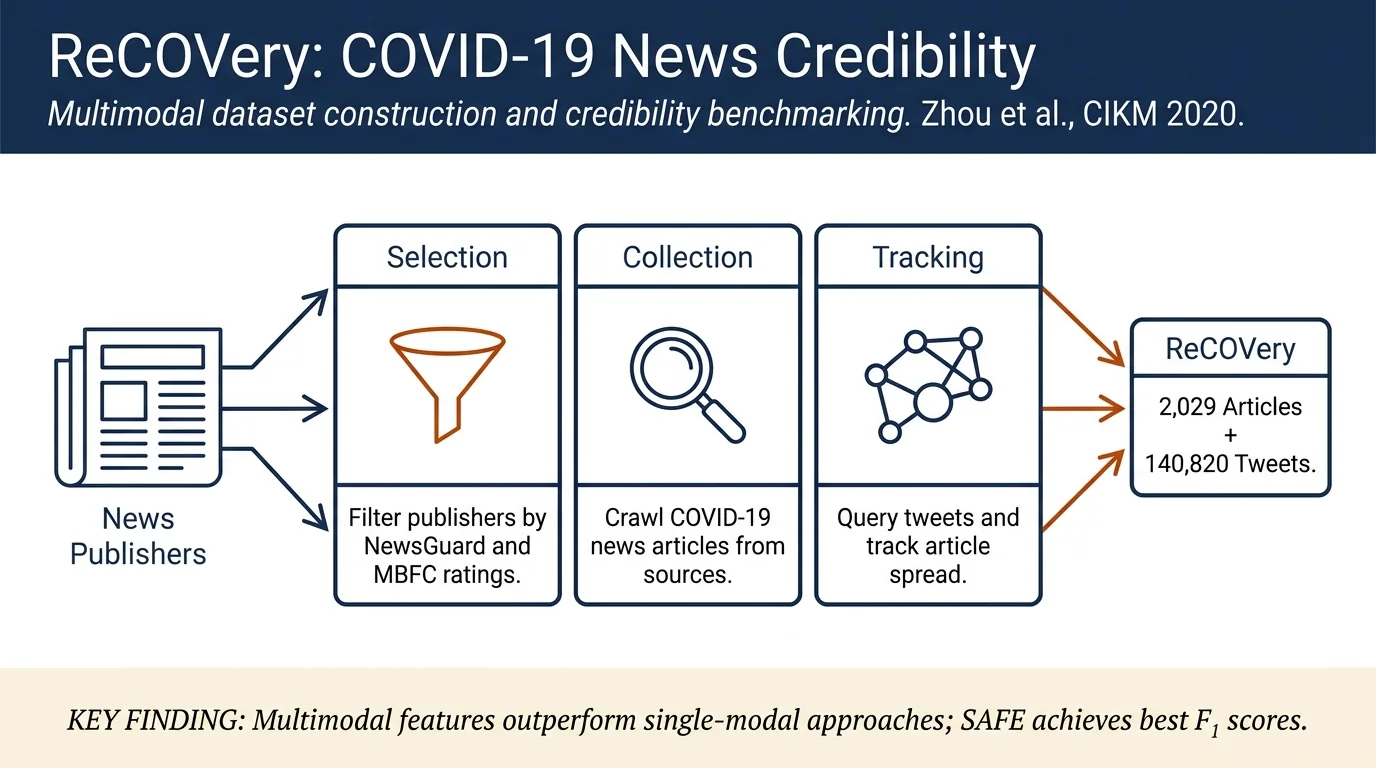
ReCOVery: A Multimodal Repository for COVID-19 News Credibility ResearchThe COVID-19 pandemic triggered a parallel "infodemic" of low-credibility news; this paper constructs ReCOVery, a multimodal repository of 2,029 COVID-19 news articles with binary credibility labels inherited from their publisher's NewsGuard/MBFC ratings, paired with 140,820 tweets tracking social spread. The key design trade-off is…
 Spread & networksDetection methods
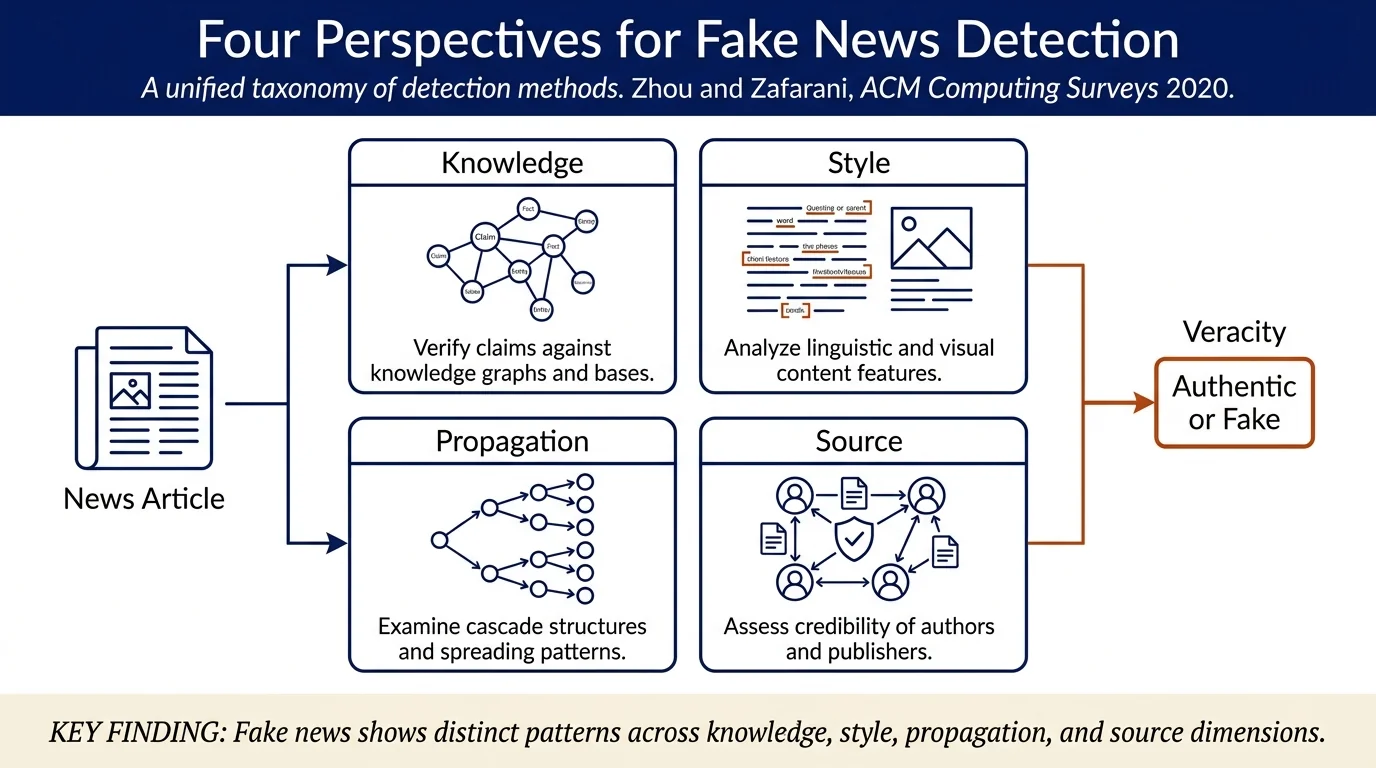
A Survey of Fake News: Fundamental Theories, Detection Methods, and OpportunitiesThis comprehensive survey defines fake news across both broad and narrow framings, systematizes detection methods across four perspectives (knowledge, style, propagation, source), connects detection strategies to interdisciplinary theories from psychology and social sciences, and identifies six open research challenges including early…
 Datasets & evaluationDetection methods
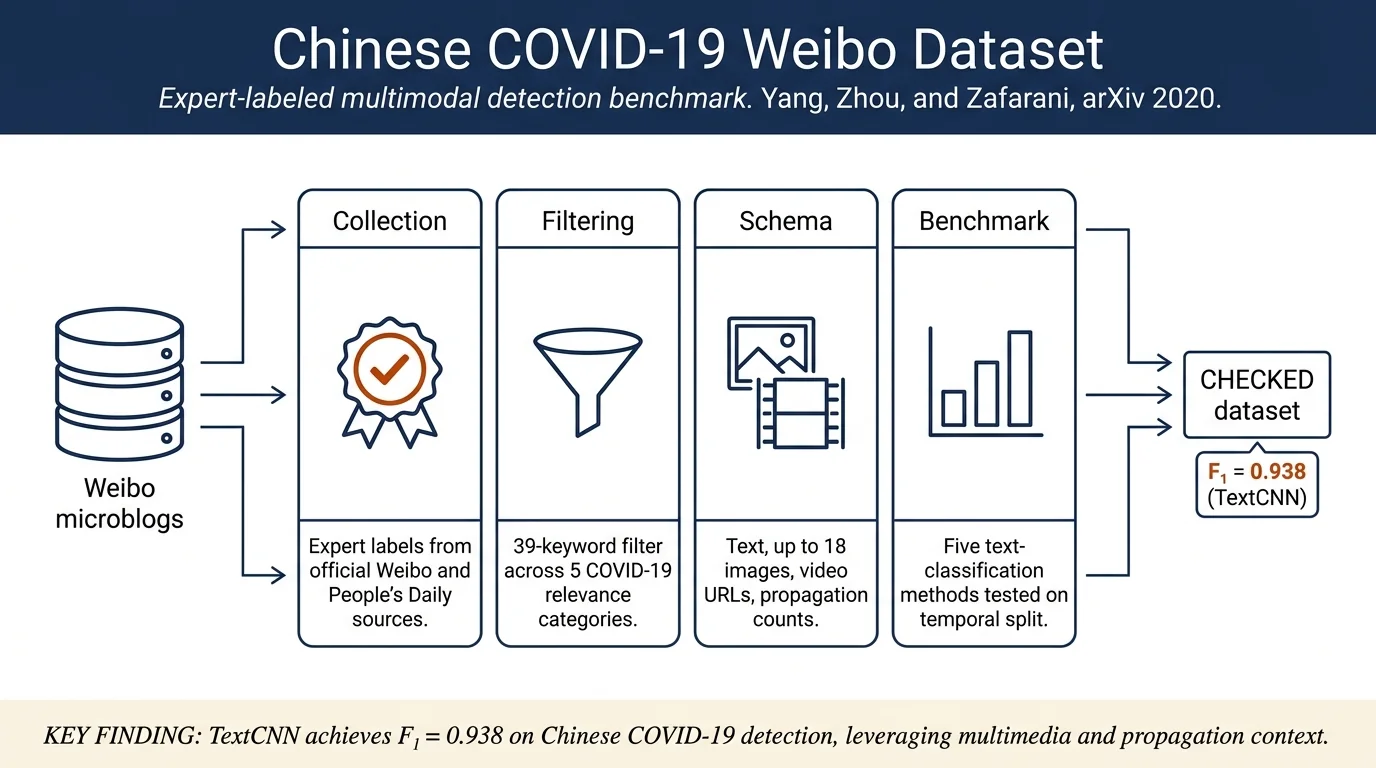
CHECKED: Chinese COVID-19 Fake News DatasetCHECKED is the first Chinese-language, fact-checked COVID-19 social media dataset — 2,104 Weibo microblogs (344 fake, 1,760 real) spanning December 2019 to August 2020, labeled using Weibo's expert-operated Community Management Center for fake posts and People's Daily official account for real posts. Each microblog carries rich…
 Spread & networksDetection methods
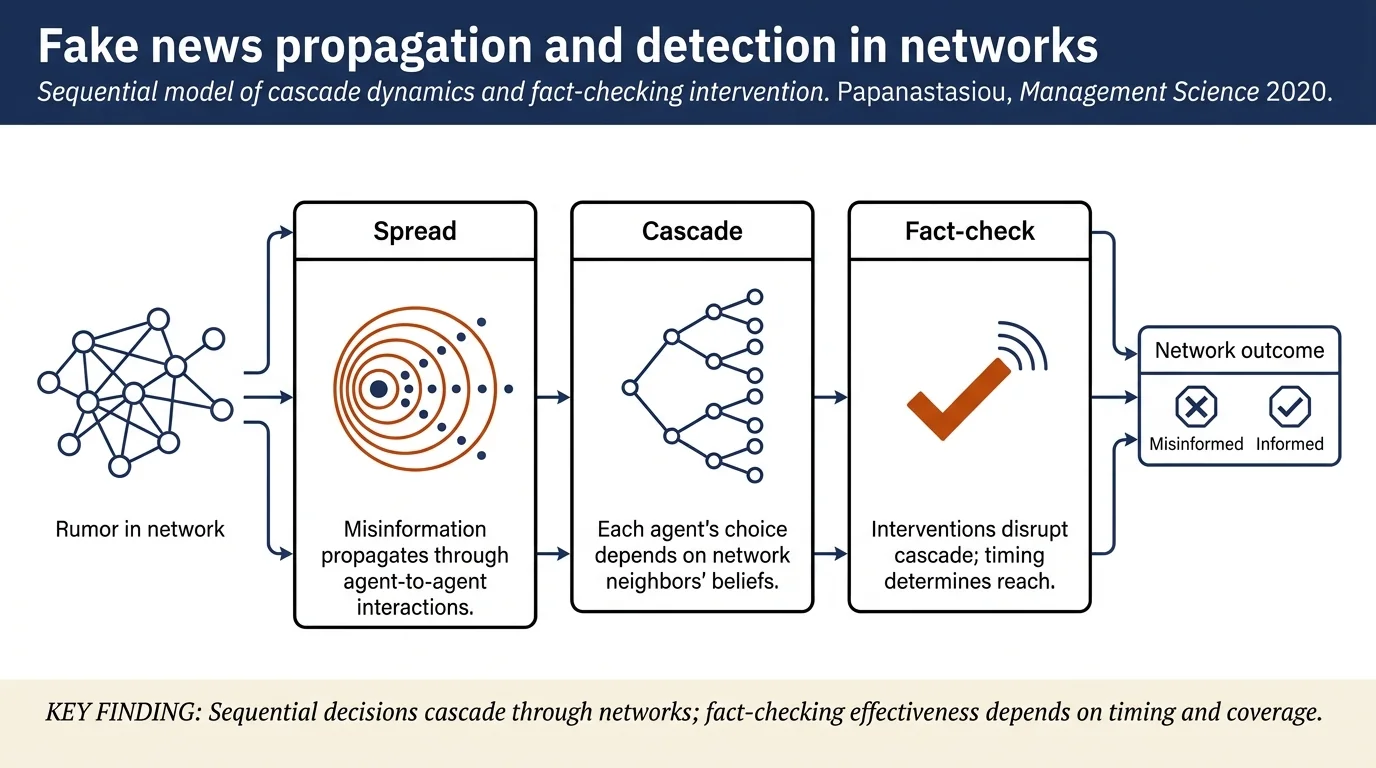
Fake news propagation and detection: A sequential modelFoundational sequential social learning model of misinformation spread and fact-checking. Introduces the framework for analyzing how agents' decisions cascade through a network and how fact-checking affects collective outcomes.
 Spread & networksPlatforms, policy & society
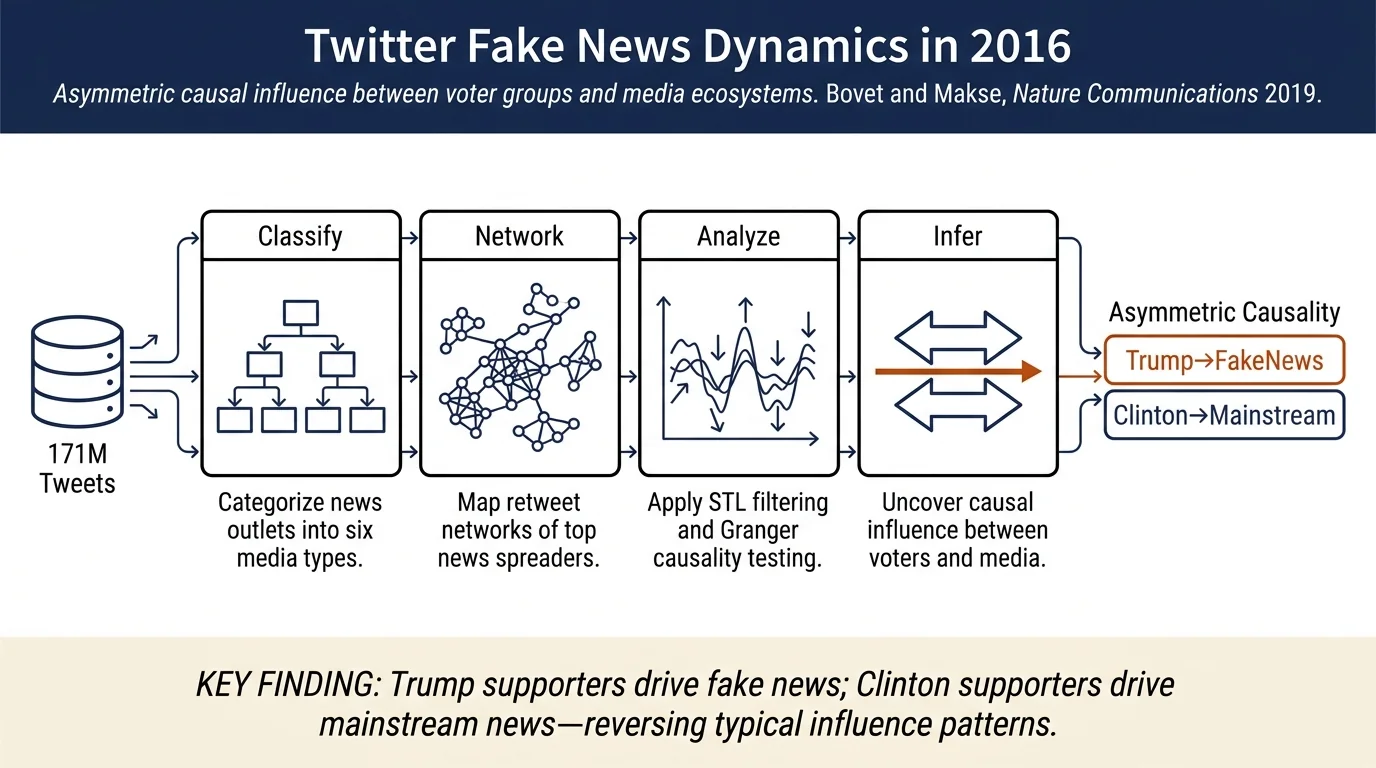
Influence of fake news in Twitter during the 2016 US presidential electionUsing 171 million tweets from the five months preceding the 2016 U.S. election, this study found that 25% of news-sharing tweets contained fake or extremely biased content. Network analysis revealed distinct clusters of fake, biased, and mainstream news spreaders.
 Spread & networksPlatforms, policy & society
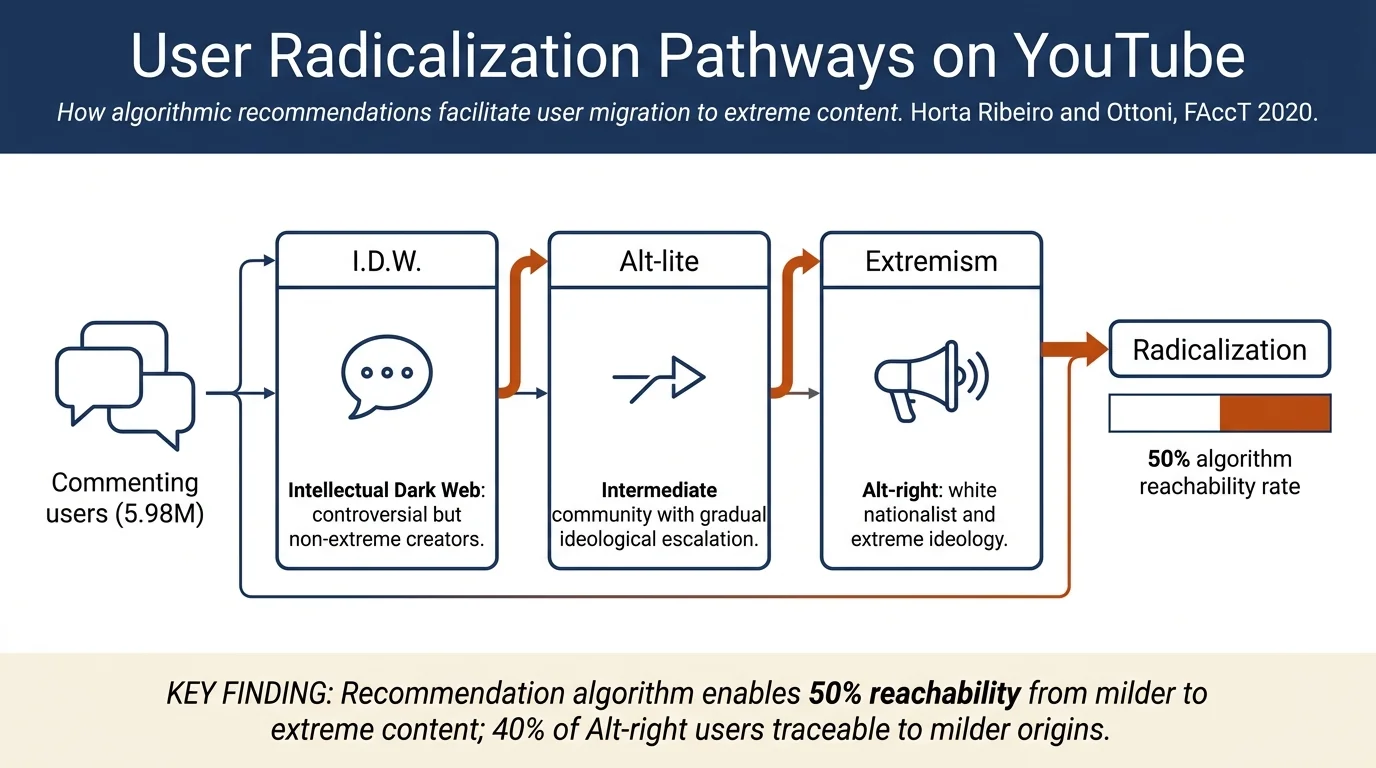
Auditing Radicalization Pathways on YouTubeFirst large-scale quantitative audit of user radicalization on YouTube. The authors tracked 349 channels across three ideological communities (Intellectual Dark Web, Alt-lite, Alt-right) and found strong evidence that users systematically migrate toward more extreme content.
 Datasets & evaluationSpread & networks
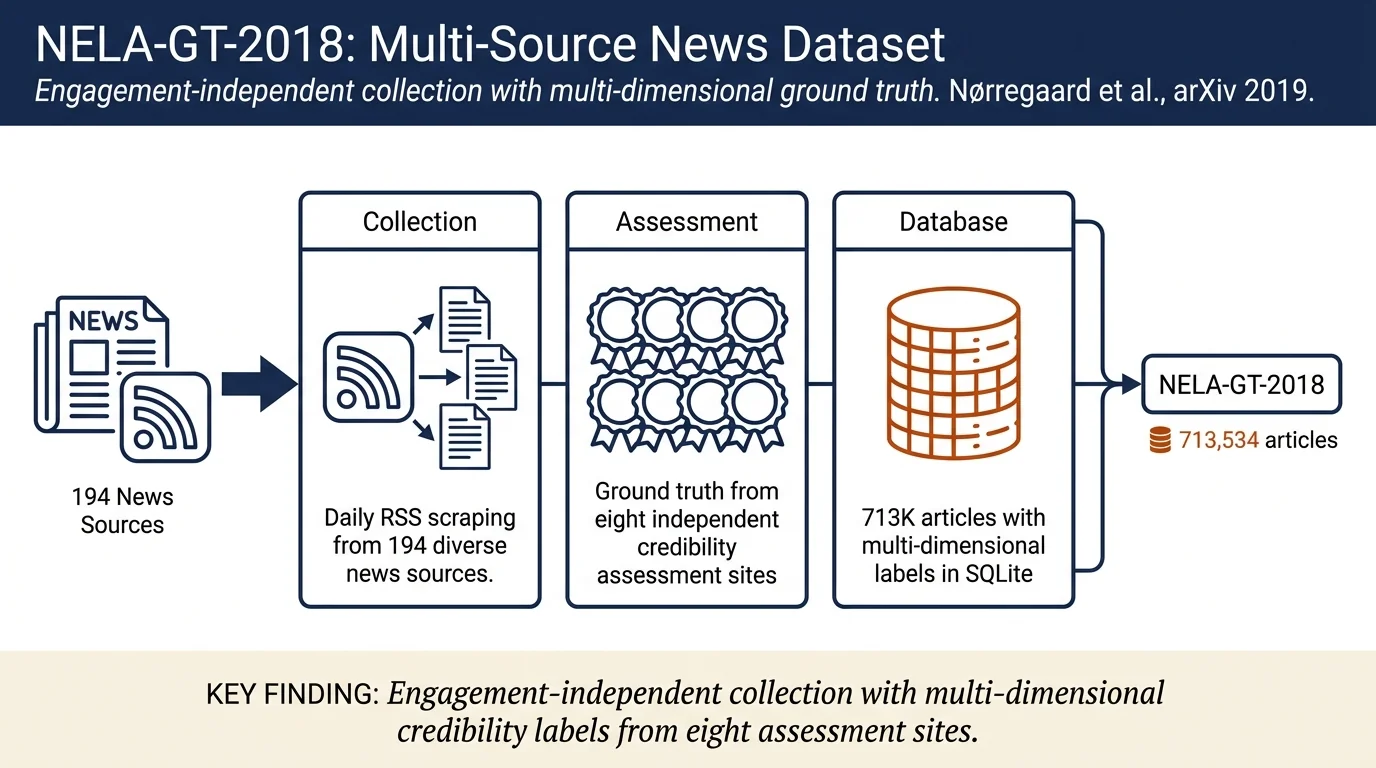
NELA-GT-2018: A Large Multi-Labelled News Dataset for The Study of Misinformation in News ArticlesNELA-GT-2018 is a large, engagement-independent collection of 713,534 news articles from 194 sources across 10 months (Feb–Nov 2018). It combines multi-source-level ground truth labels from eight independent assessment sites (NewsGuard, Pew Research, Wikipedia, OpenSources, Media Bias/Fact Check, AllSides, BuzzFeed News, PolitiFact)…
 Detection methodsSpread & networks
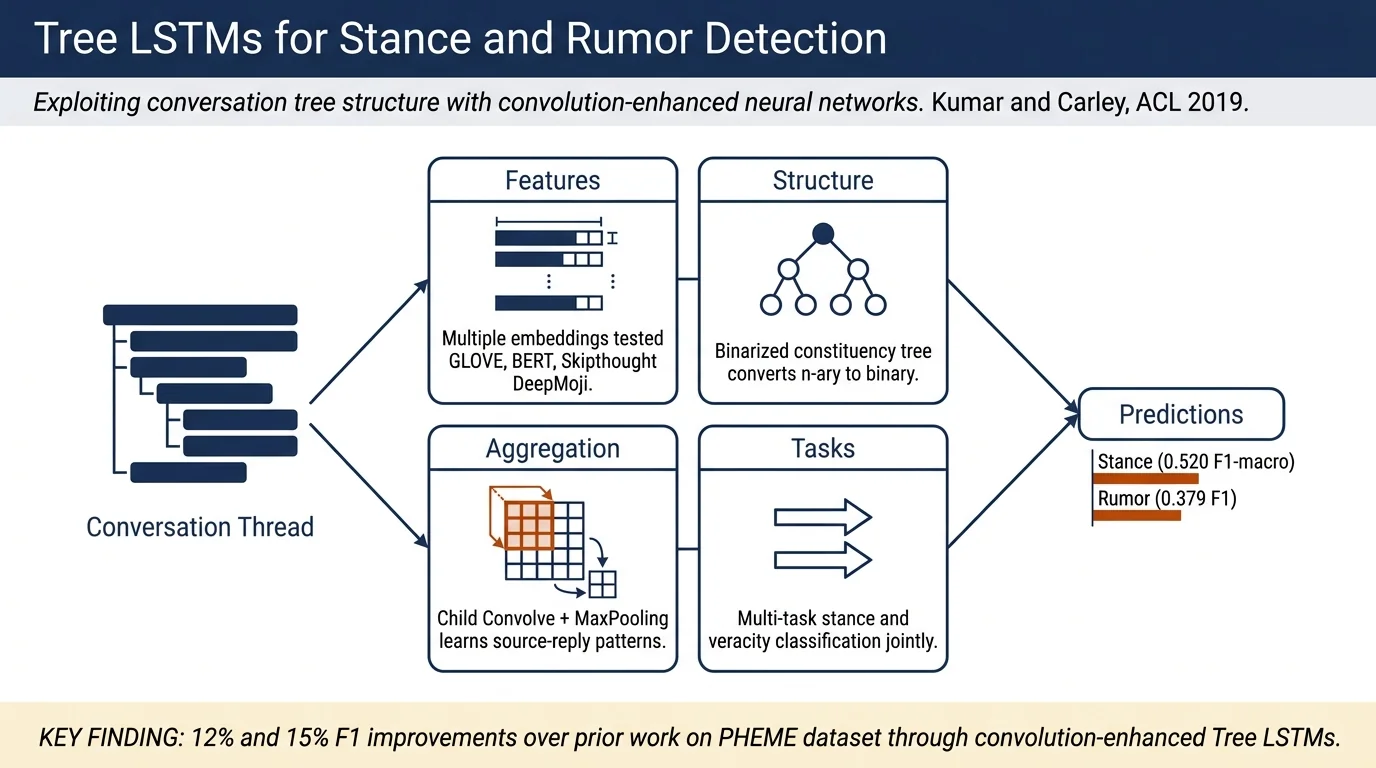
Tree LSTMs with Convolution Units to Predict Stance and Rumor Veracity in Social Media ConversationsProposes Tree LSTM and Binarized Constituency Tree (BCTree) LSTM architectures enhanced with convolution units to classify stance and predict rumor veracity in social media conversation threads. The approach exploits the tree structure inherent in threaded conversations (source post with nested replies) and combines it with convolutional…
 Spread & networksDatasets & evaluation
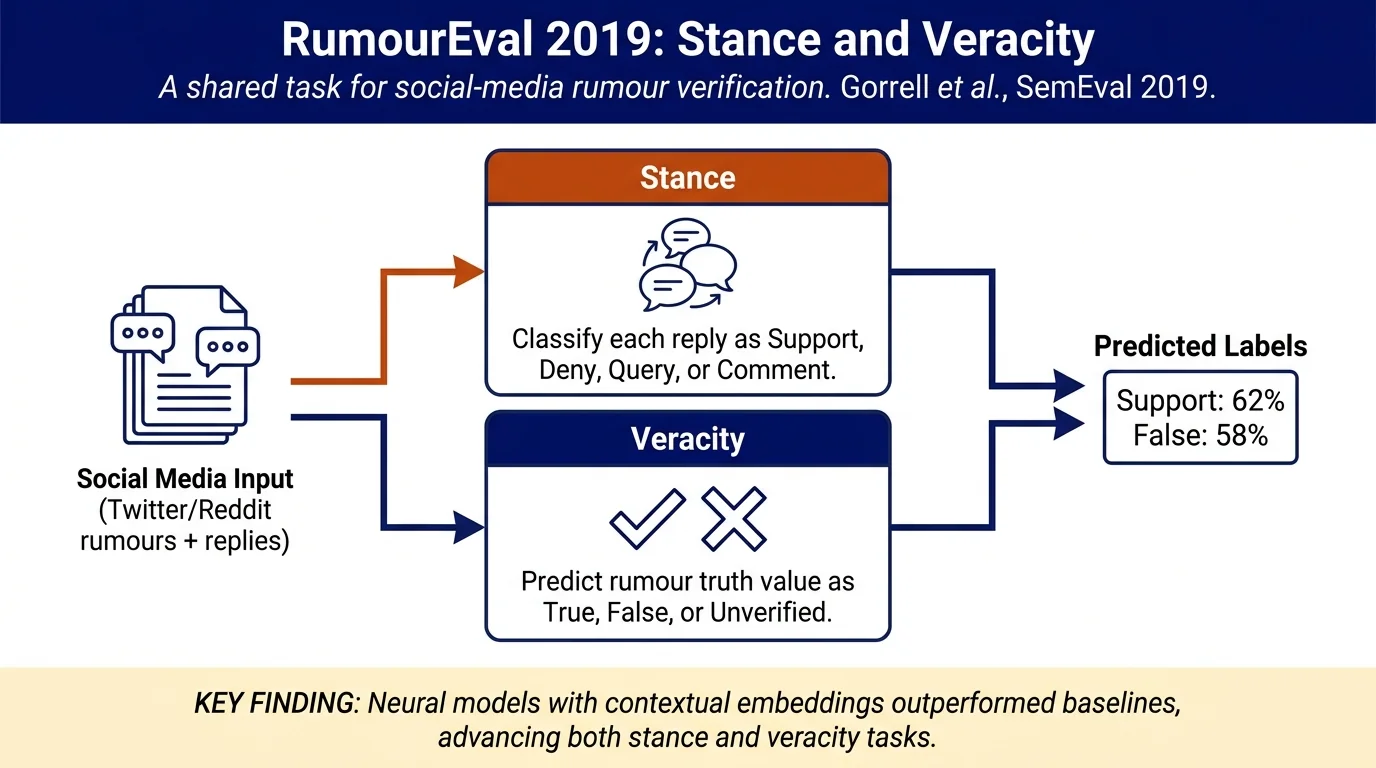
RumourEval 2019: Determining Rumour Veracity and Support for RumoursRumourEval 2019 is a shared task for rumour stance detection and veracity prediction on social media. Extending the 2017 edition, it introduces Reddit data alongside Twitter, provides datasets annotated for SDQC stance (Support/Deny/Query/Comment) and three-way veracity labels, and received 22 system submissions showing that modern…
 Spread & networksDetection methods
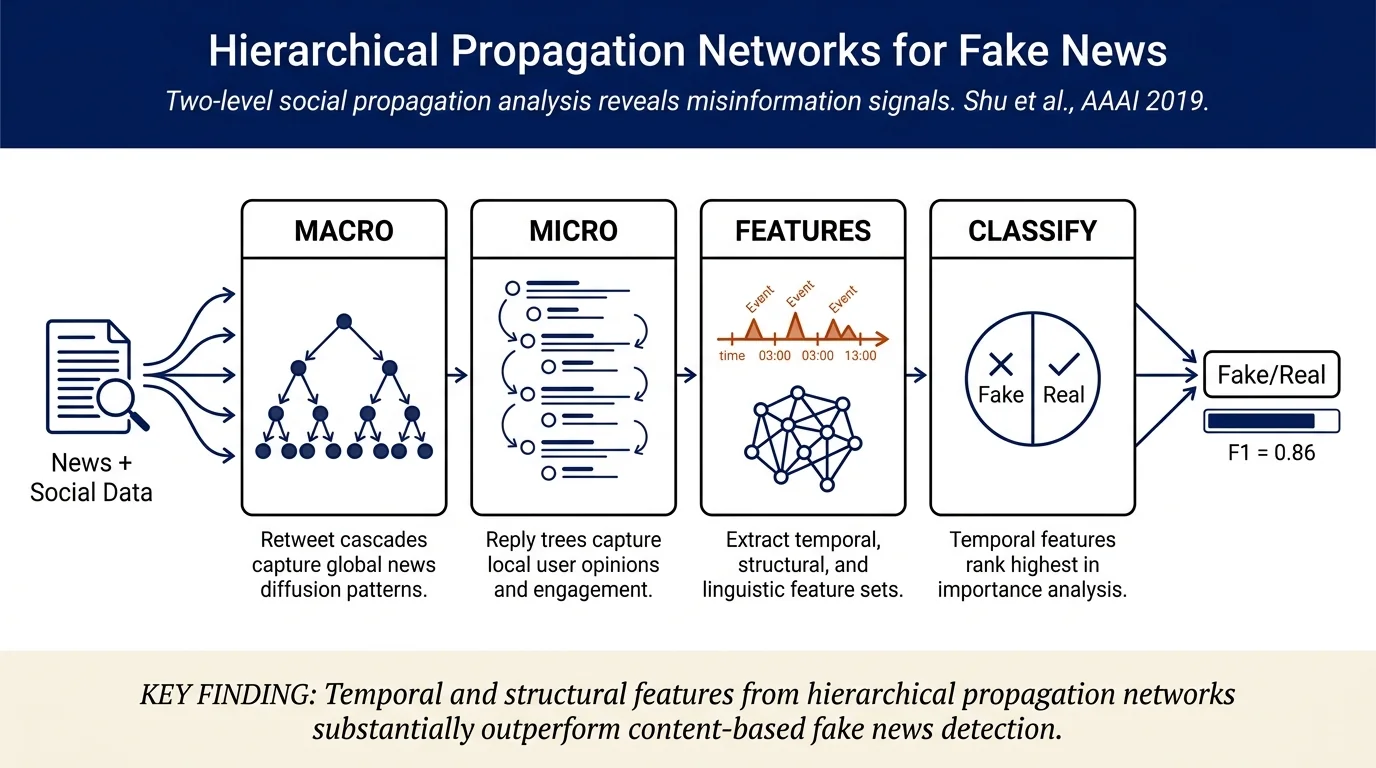
Hierarchical Propagation Networks for Fake News Detection: Investigation and ExploitationContent-only fake news detection has limited performance because fake news is deliberately crafted to mimic real news. This paper constructs hierarchical propagation networks from both macro-level (tweet/retweet cascade) and micro-level (reply conversation) granularity, extracts structural, temporal, and linguistic features from both…
 Spread & networksDetection methods
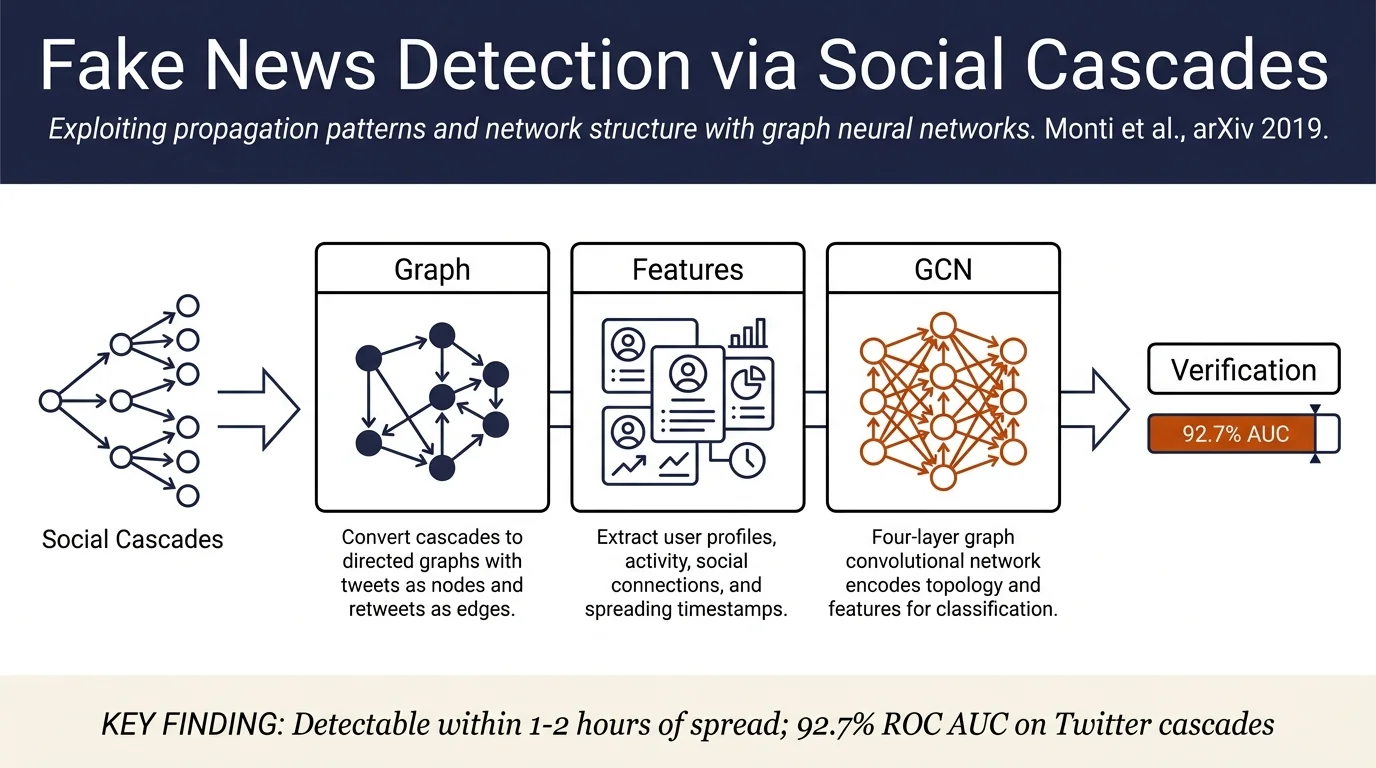
Fake News Detection on Social Media using Geometric Deep LearningA graph neural network approach for fake news detection that exploits social network structure and news propagation patterns rather than content alone. The method integrates user profiles, social connections, and cascade dynamics to achieve 92.7% ROC AUC on Twitter data and can detect fake news within hours of propagation.