Explore everything
Filter by research area, year and venue. Every filter is in the address bar, so you can share a view as a link.
 Deepfakes & multimodalDetection methods
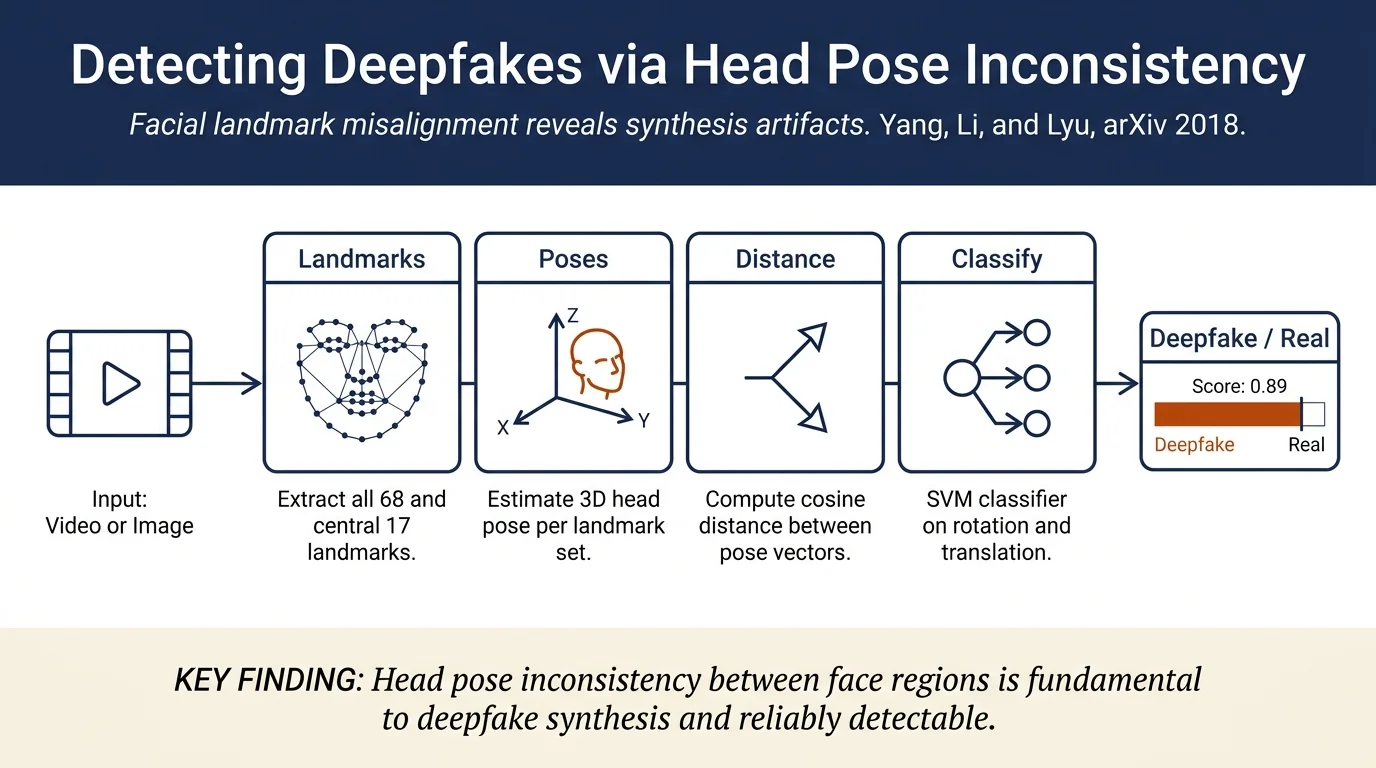
Exposing Deep Fakes Using Inconsistent Head PosesDeepfakes splice a synthesized face into an original image, introducing landmark misalignment errors invisible to the eye but detectable through 3D head pose estimation. The method compares head poses estimated from all facial landmarks versus only the central region; real faces show consistent poses while deepfakes exhibit large…
 Detection methodsDeepfakes & multimodal
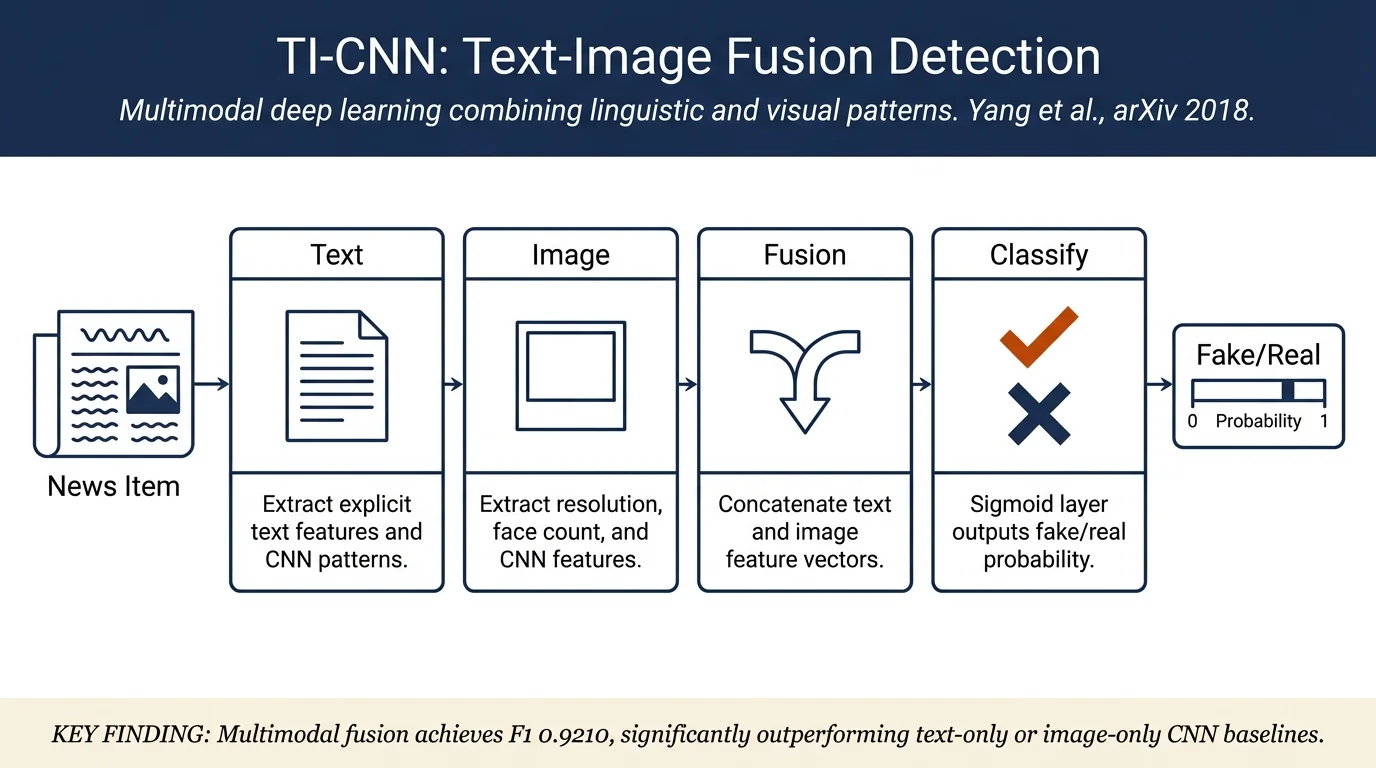
TI-CNN: Convolutional Neural Networks for Fake News DetectionThis paper proposes TI-CNN, a multimodal deep learning model that combines explicit and latent features from both text and images to detect fake news. Through analysis of 20,015 news items, the authors identify distinctive linguistic and visual patterns in fake versus real news, and demonstrate that their unified CNN-based approach…
 Deepfakes & multimodalDetection methods
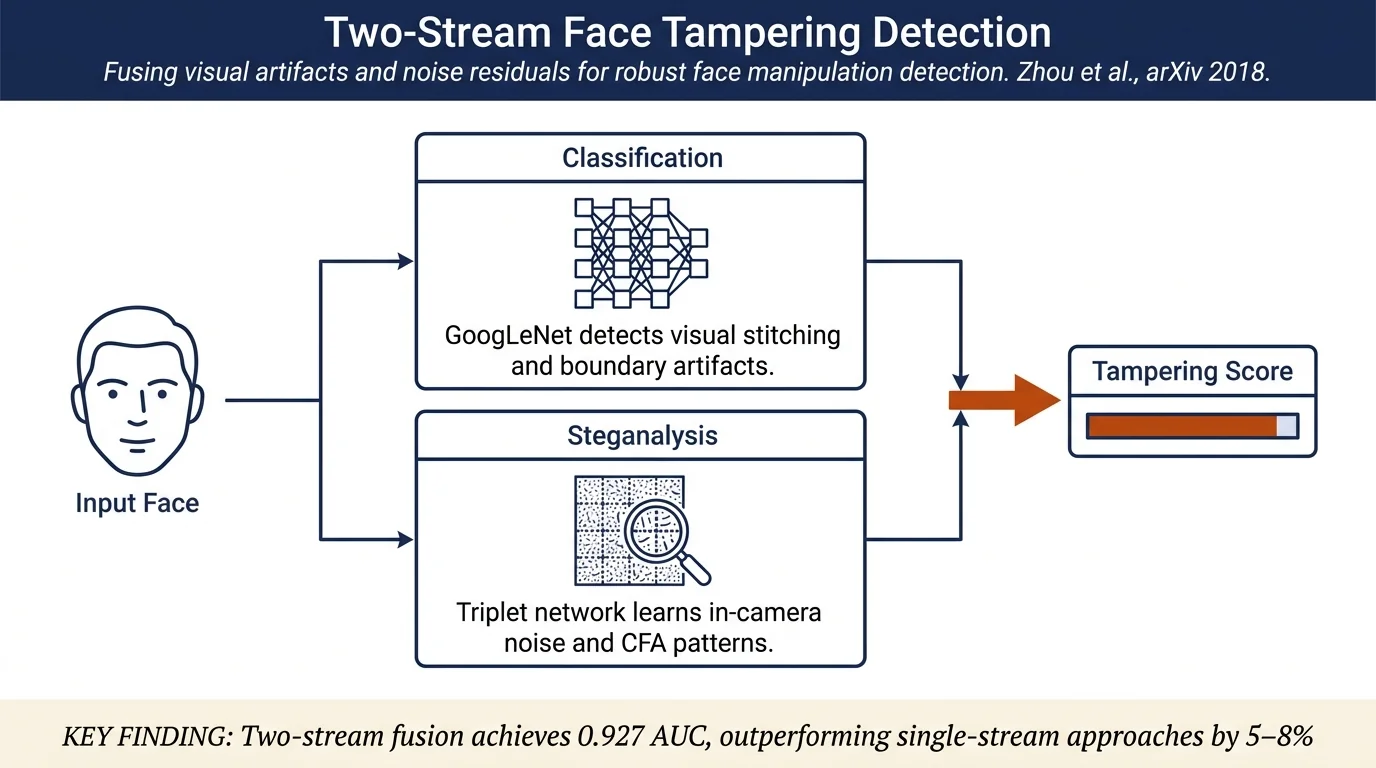
Two-Stream Neural Networks for Tampered Face DetectionThe paper proposes a two-stream neural network for detecting face tampering (face swaps) in images. One stream uses GoogLeNet to classify tampered faces by visual artifacts, while the second stream uses steganalysis features with a triplet network to capture low-level noise inconsistencies.
 Detection methodsDatasets & evaluation
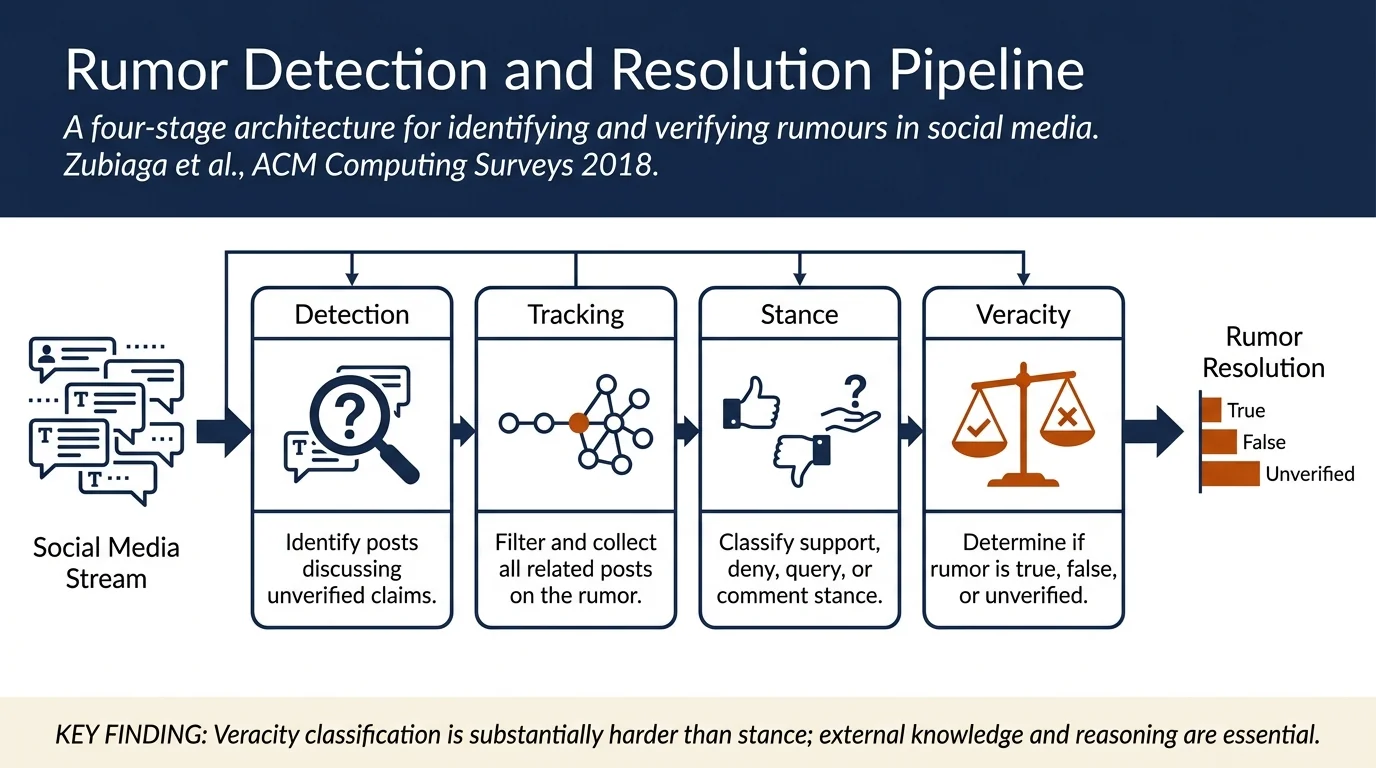
Detection and Resolution of Rumours in Social Media: A SurveyComprehensive survey of rumour detection and resolution in social media covering the entire pipeline: rumour definition and characterization, data collection strategies, annotation schemes, detection approaches for both emerging and long-standing rumours, tracking of rumour propagation, stance classification (support/deny/query/comment),…
 Spread & networksDetection methods
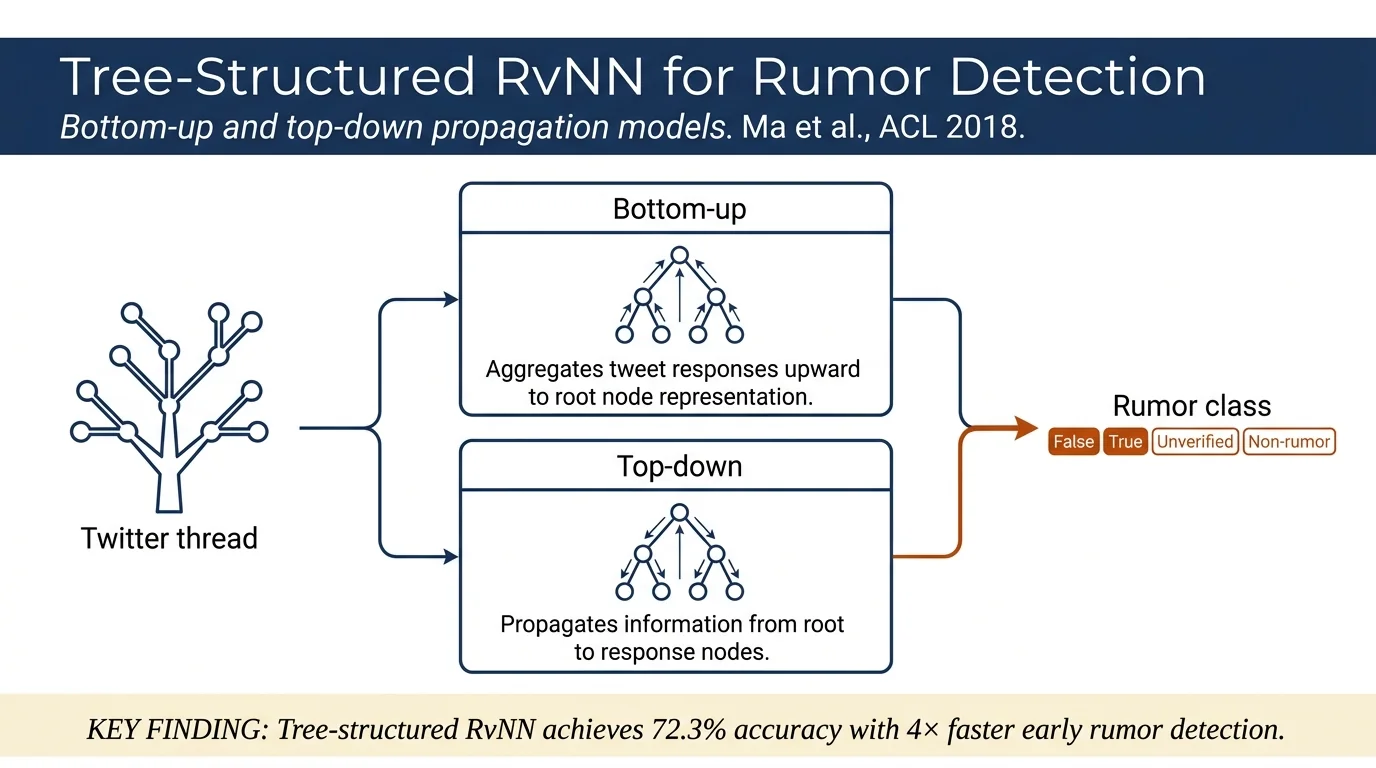
Rumor Detection on Twitter with Tree-structured Recursive Neural NetworksProposes two variants of recursive neural networks (RvNN)—bottom-up and top-down—that operate on propagation tree structures of tweets to detect rumors. Rather than treating tweets sequentially, the model learns representations that respect how tweets actually propagate in response threads.
 Detection methodsDatasets & evaluation
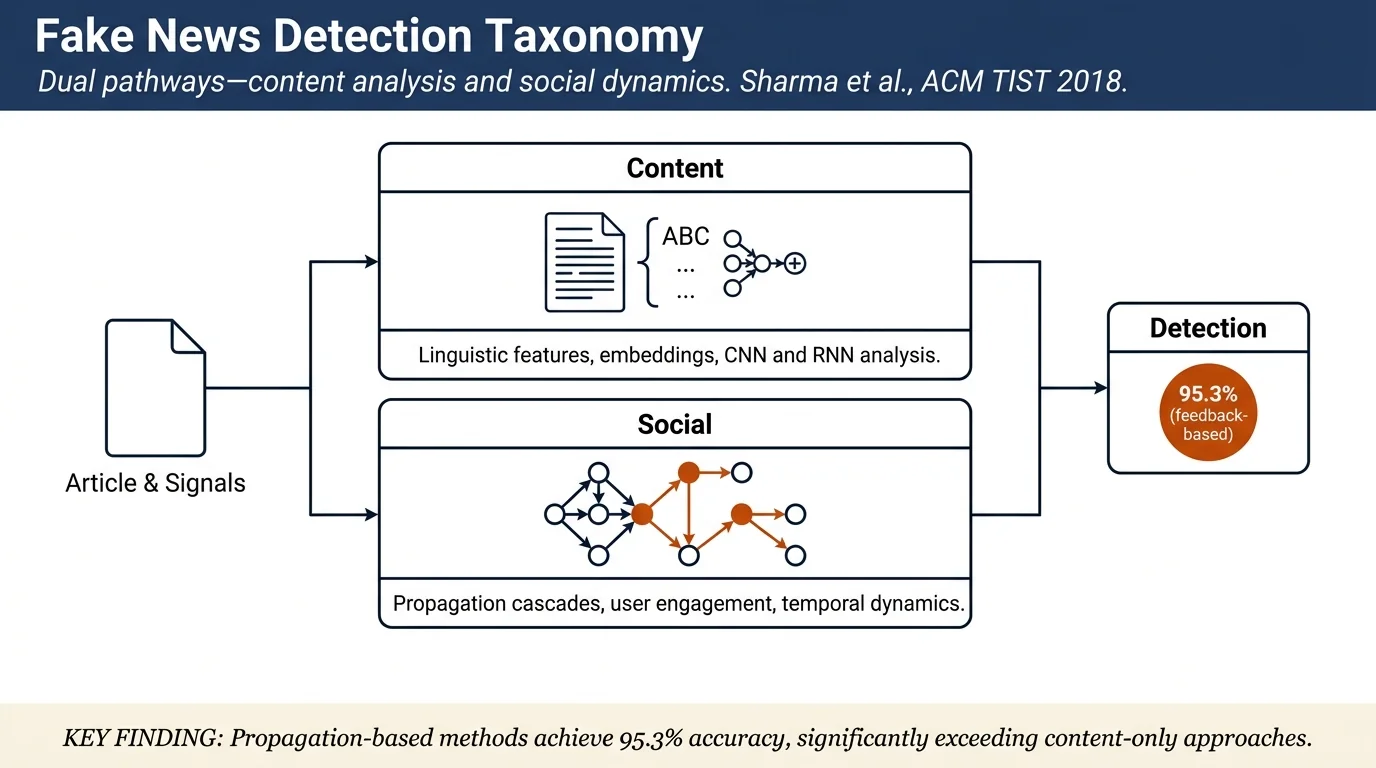
Combating Fake News: A Survey on Identification and Mitigation TechniquesThis comprehensive survey of fake news detection and mitigation organizes existing methods into two broad categories: content-based approaches (linguistic and deep learning methods) and feedback-based approaches (exploiting propagation patterns, user responses, and temporal dynamics). The authors consolidate 23+ publicly available…
 Datasets & evaluationSpread & networks
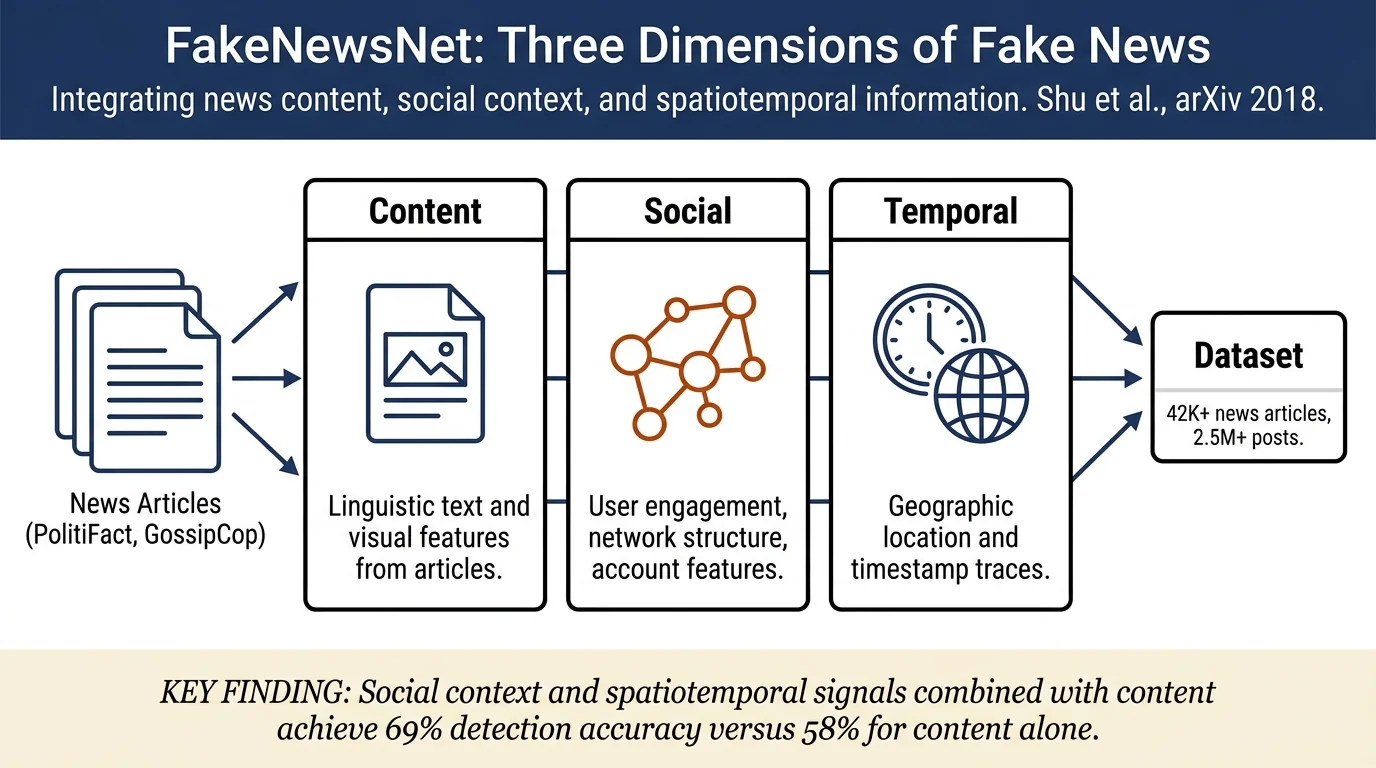
FakeNewsNet: A Data Repository with News Content, Social Context and Spatiotemporal Information for Studying Fake News on Social MediaFakeNewsNet is a multi-dimensional repository for fake news research on social media, integrating news content (linguistic and visual features), social context (user engagement, network structure, response patterns), and spatiotemporal information (location, timestamps). The dataset contains both fake and real news from PolitiFact and…
 Deepfakes & multimodalDetection methods
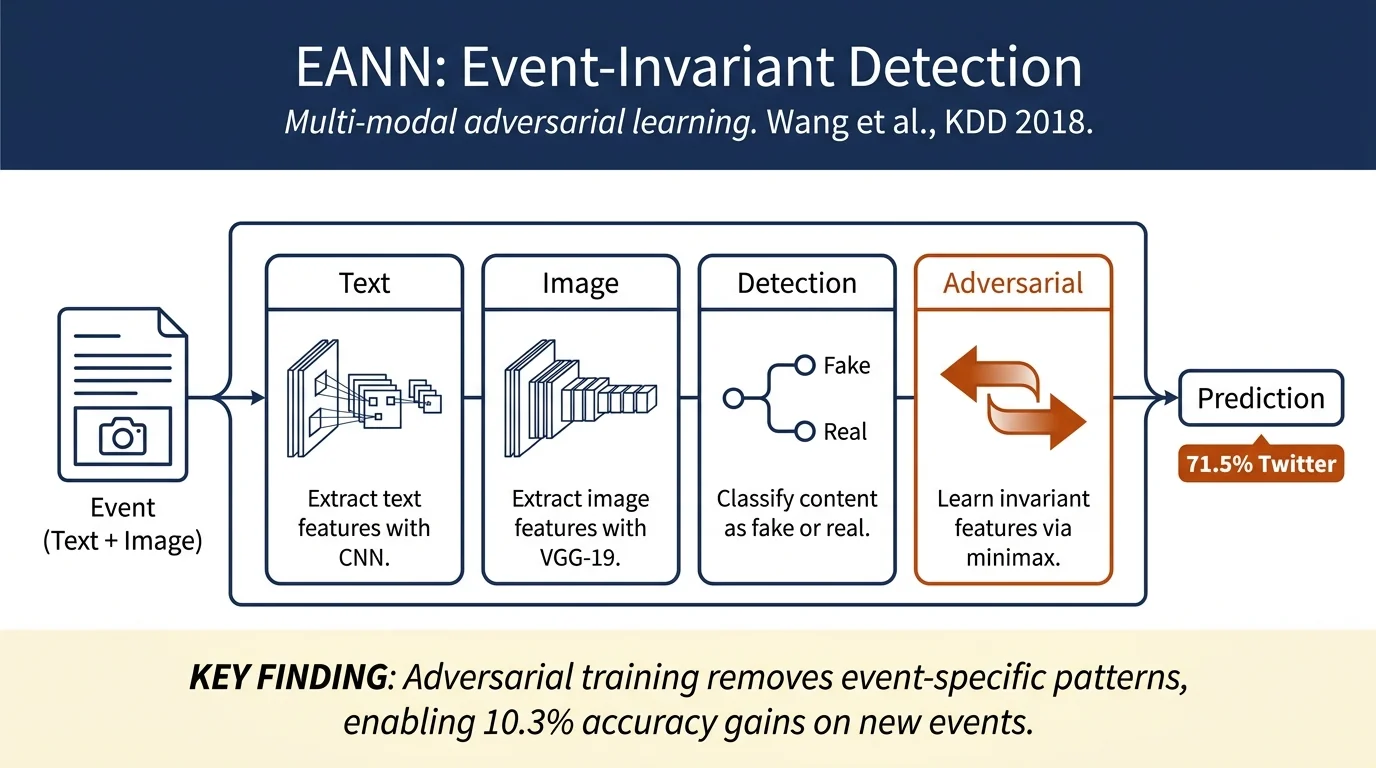
EANN: Event Adversarial Neural Networks for Multi-Modal Fake News DetectionThe paper proposes EANN, an adversarial neural network that detects fake news on newly emerged events by learning event-invariant features. An event discriminator forces the multi-modal feature extractor to remove event-specific features while preserving shared patterns across events.
 Spread & networksDetection methods
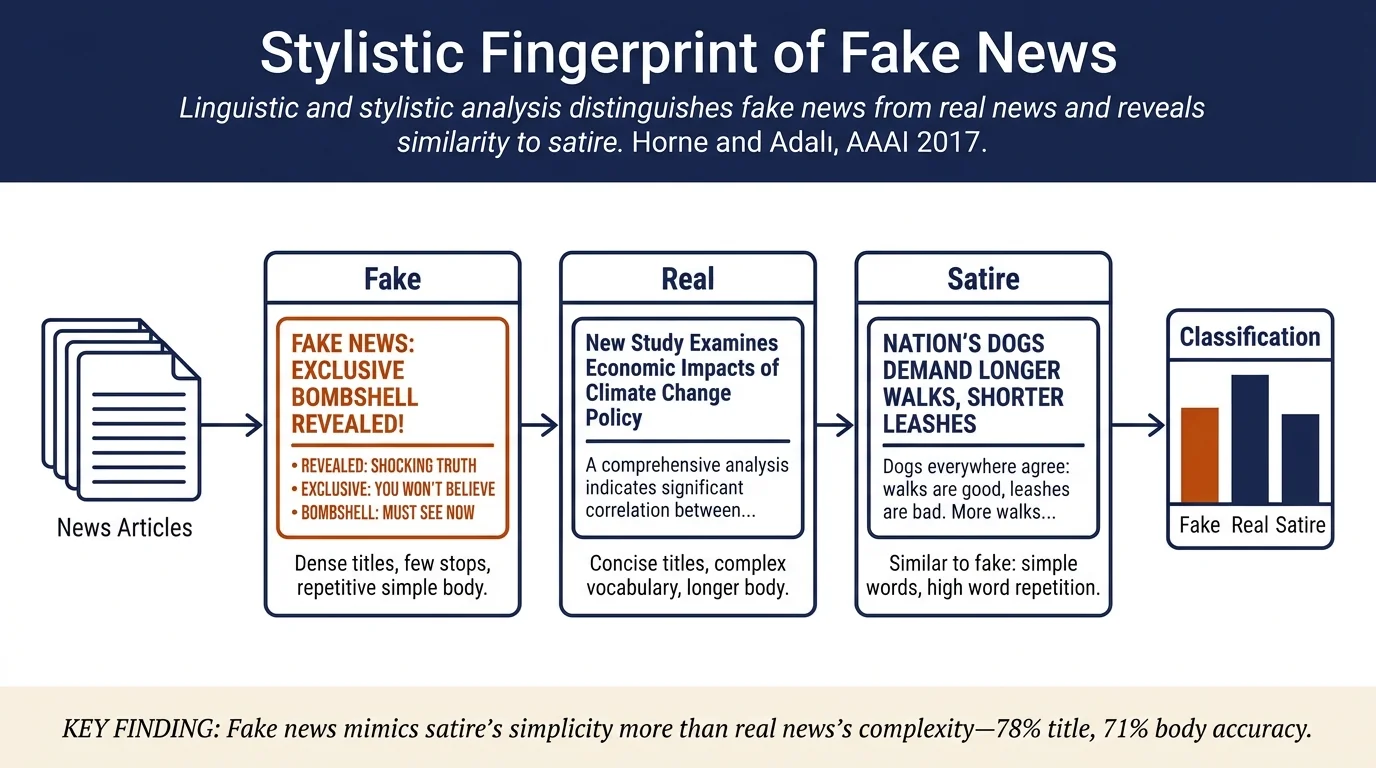
This Just In: Fake News Packs a Lot in Title, Uses Simpler, Repetitive Content in Text Body, More Similar to Satire than Real NewsFake news differs systematically from real news in stylistic features, especially titles. Contrary to the assumption that fake news mimics real news, it is actually more similar to satire: packed titles with fewer stop words and more proper nouns, combined with shorter, repetitive body text with simpler language.
 Detection methodsSpread & networks
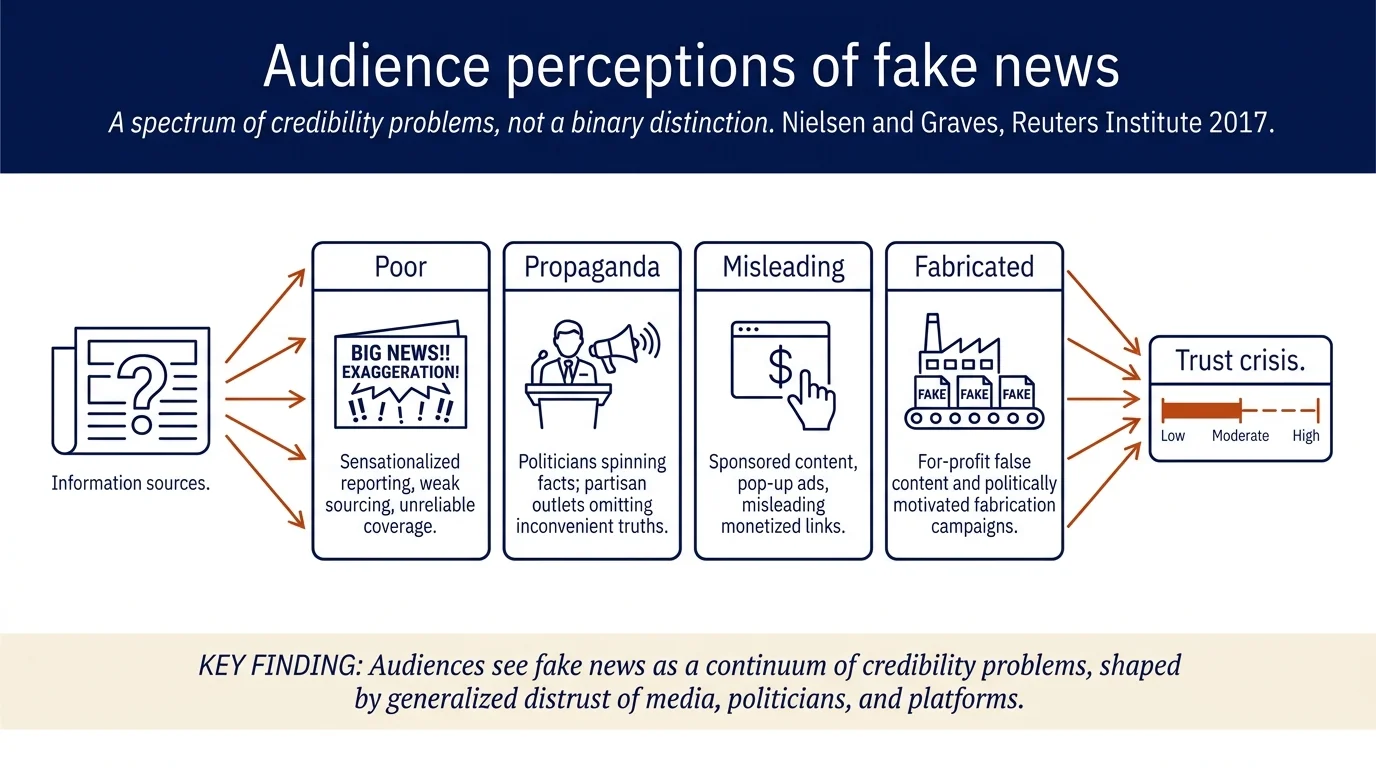
"News you don't believe": Audience perspectives on fake newsUsing focus groups and surveys across the US, UK, Spain, and Finland, Nielsen and Graves find that ordinary people see fake news as a spectrum rather than a binary distinction—encompassing poor journalism, political propaganda, misleading advertising, and fabricated content. Audiences experience the "fake news" problem as one of degree,…
 Detection methodsDatasets & evaluation
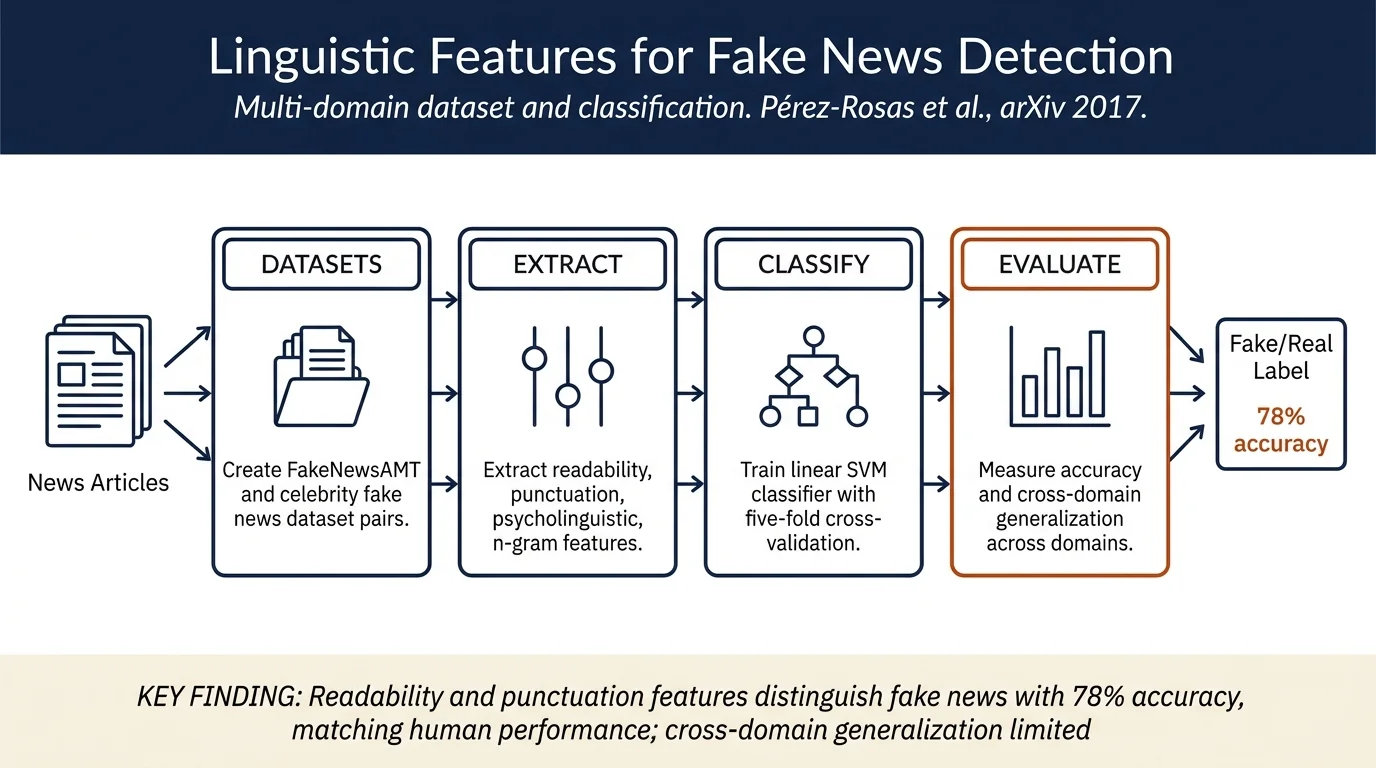
Automatic Detection of Fake NewsThis paper introduces two novel fake news detection datasets covering seven news domains and analyzes linguistic properties that distinguish fake from legitimate content. Using linguistic features including readability metrics, word categories, and punctuation patterns, the authors build classifiers achieving up to 78% accuracy and…
 Detection methodsLLMs & generative AI
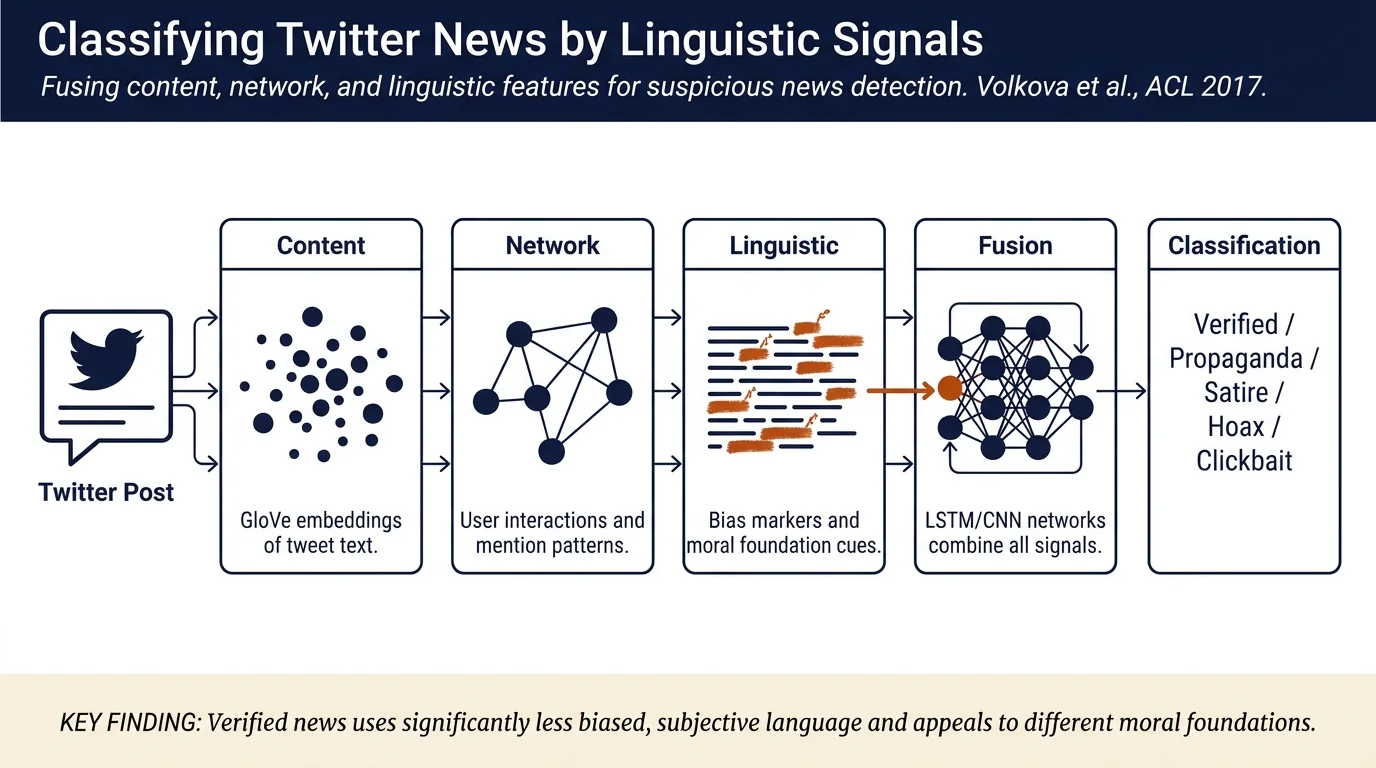
Separating Facts from Fiction: Linguistic Models to Classify Suspicious and Trusted News Posts on TwitterThis paper presents neural network models combining tweet content, social network interactions, and linguistic features (bias markers, subjectivity cues, moral foundations) to classify Twitter news posts as suspicious (propaganda, hoaxes, clickbait, satire) or verified. The models achieve 95% accuracy on binary classification and 0.7…
 Detection methodsDatasets & evaluation
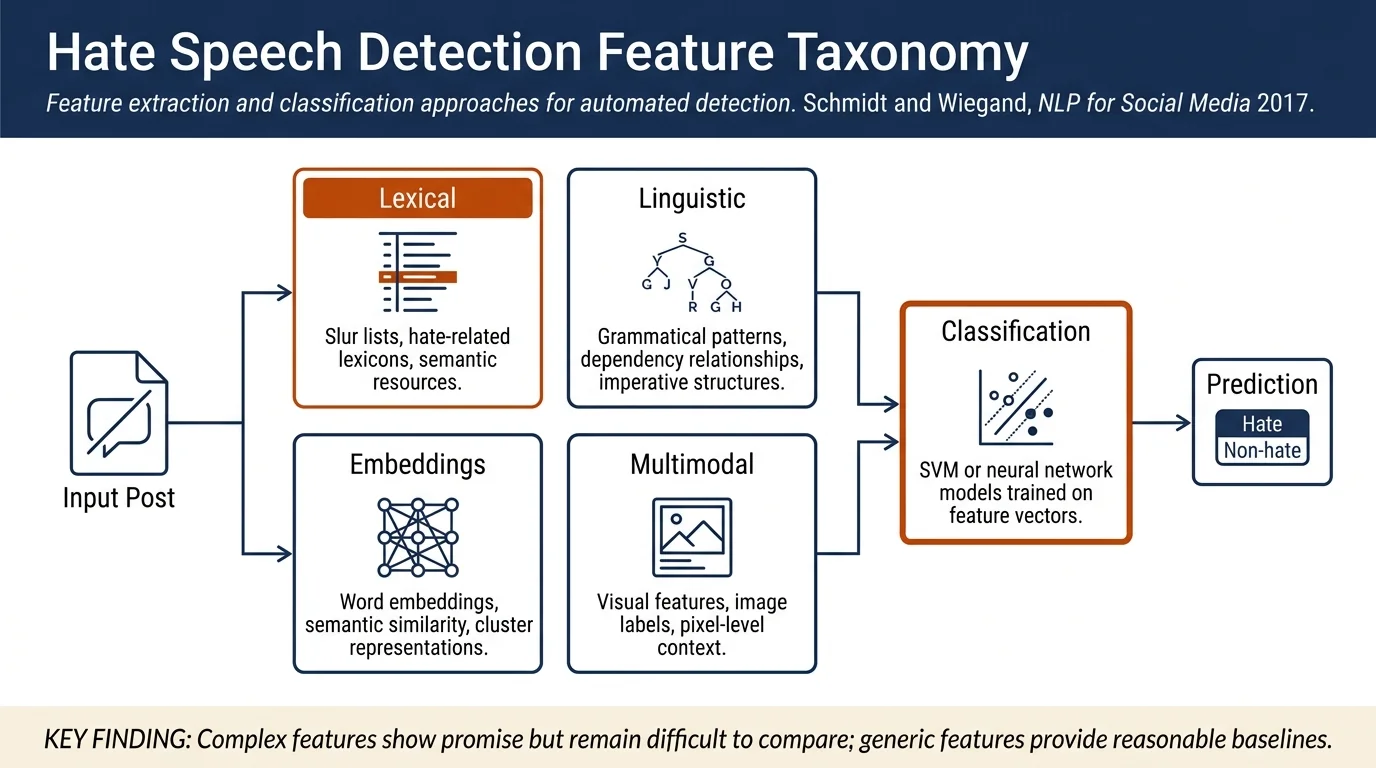
A Survey on Hate Speech Detection using Natural Language ProcessingThis survey systematically reviews automatic hate speech detection methods, covering feature extraction techniques (surface features, embeddings, sentiment analysis, lexical resources, linguistic features, knowledge bases), classification approaches (mostly supervised learning with SVMs and neural networks), annotation practices, and key…
 Bots & coordinated campaignsDetection methods
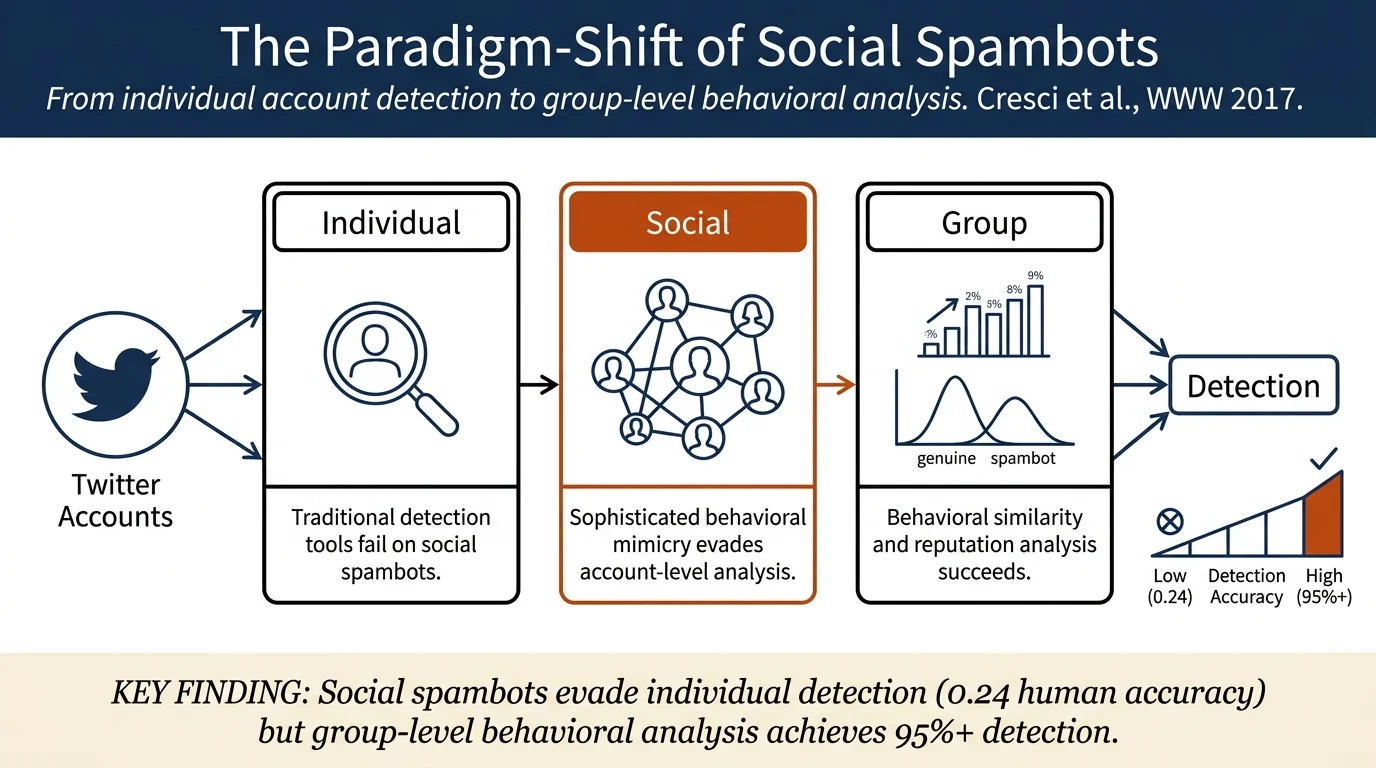
The Paradigm-Shift of Social Spambots: Evidence, Theories, and Tools for the Arms RaceThis paper provides empirical evidence of a paradigm shift in spambot design on Twitter, where new "social spambots" closely mimic genuine user behavior and successfully evade detection. Neither Twitter's automated systems, human annotators, nor established academic detection tools can effectively identify these accounts; however,…
 Spread & networksDetection methods
Turing at SemEval-2017 Task 8: Sequential Approach to Rumour Stance Classification with Branch-LSTMThis paper proposes Branch-LSTM, a sequential neural model for rumour stance classification in Twitter conversations. By decomposing conversation threads into linear branches and modeling them with LSTM layers, the approach captures conversational context while assigning stance labels (Support/Deny/Query/Comment) to each tweet.
 Fact-checking & verificationDatasets & evaluation
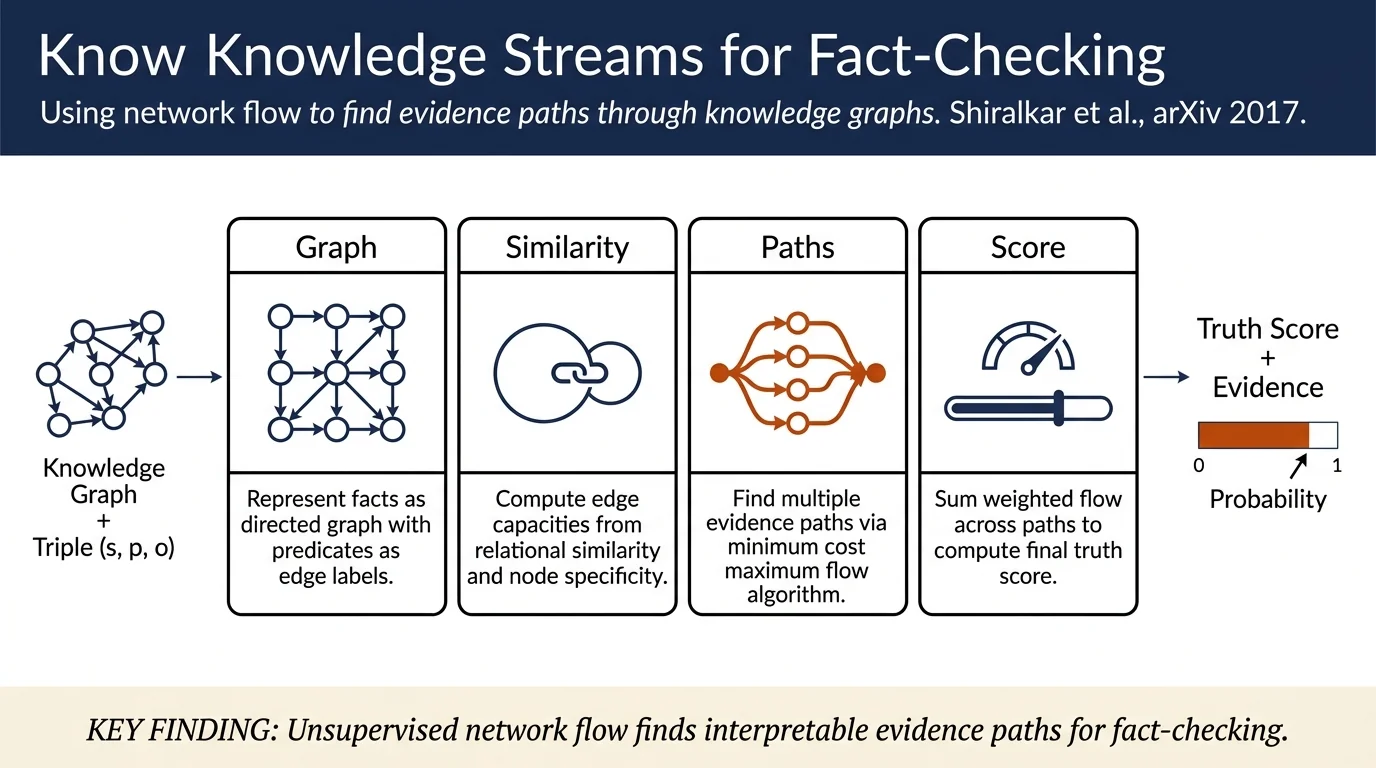
Finding Streams in Knowledge Graphs to Support Fact CheckingKnowledge Stream (KS) is an unsupervised network-flow approach for computational fact-checking that treats a knowledge graph as a flow network. For a triple (subject, predicate, object), KS finds multiple paths connecting subject to object and uses edge capacities (based on relational similarity and node specificity) to compute a truth…
 Detection methodsSpread & networks
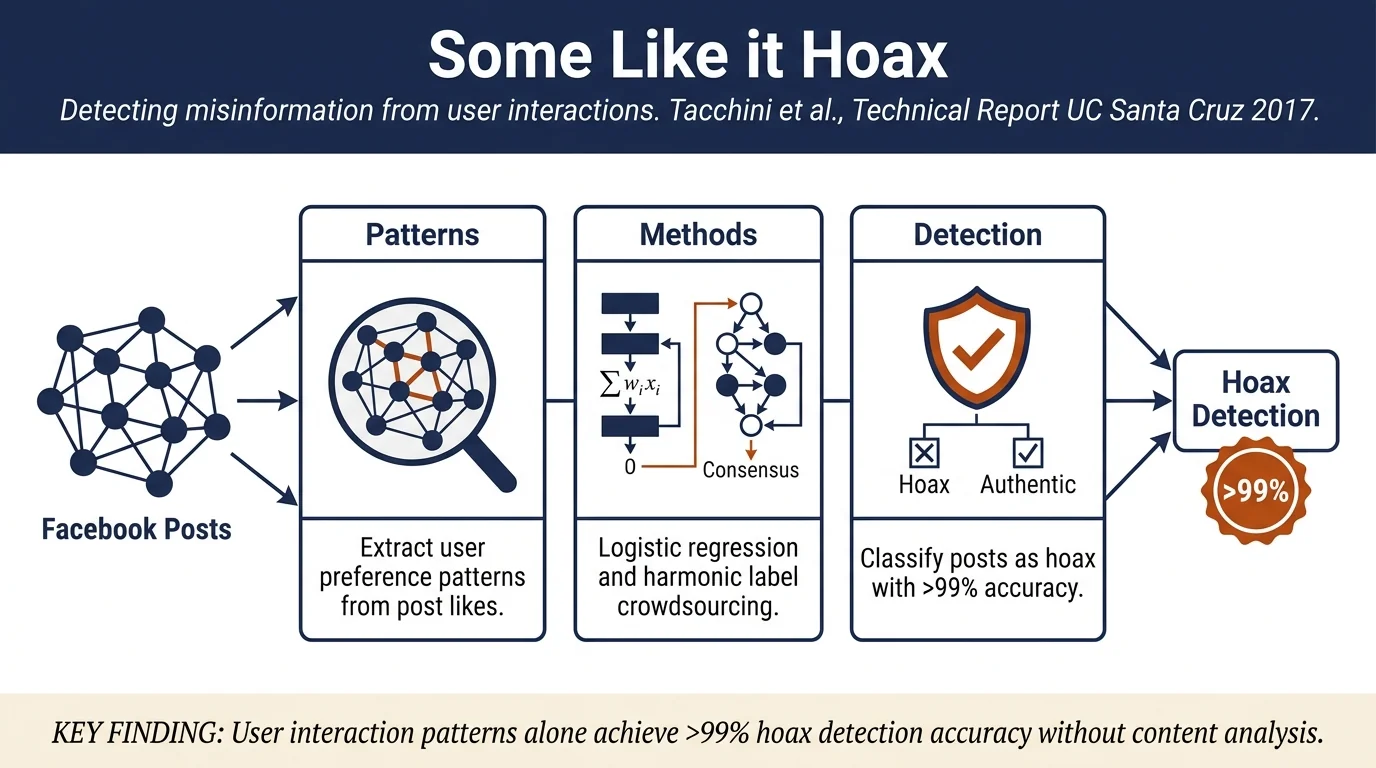
Some Like it Hoax: Automated Fake News Detection in Social NetworksHoaxes on Facebook can be detected with 99% accuracy using user interaction patterns (who "liked" posts) rather than content analysis. Two algorithms—logistic regression and harmonic boolean crowdsourcing—achieve high accuracy even with minimal labeled training data, and knowledge transfers across different Facebook communities.
 Datasets & evaluationFact-checking & verification
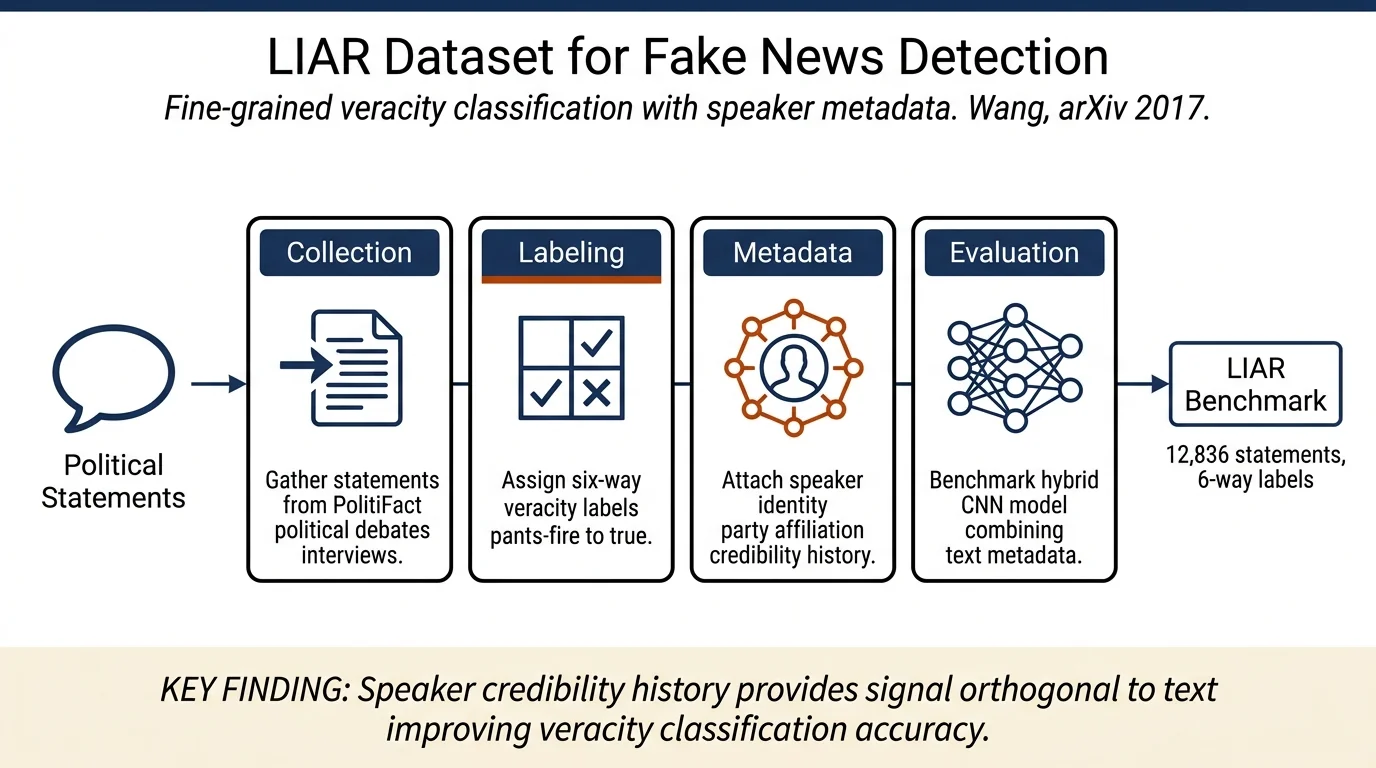
Liar, Liar Pants on Fire: A New Benchmark Dataset for Fake News DetectionThis paper introduces LIAR, a benchmark dataset of 12,836 manually labeled short statements from POLITIFACT.COM spanning 2007–2016, addressing the critical lack of labeled data for fake news detection. Each statement is annotated with fine-grained veracity labels (pants-fire, false, barely-true, half-true, mostly-true, true) and rich…
 Spread & networksDetection methods
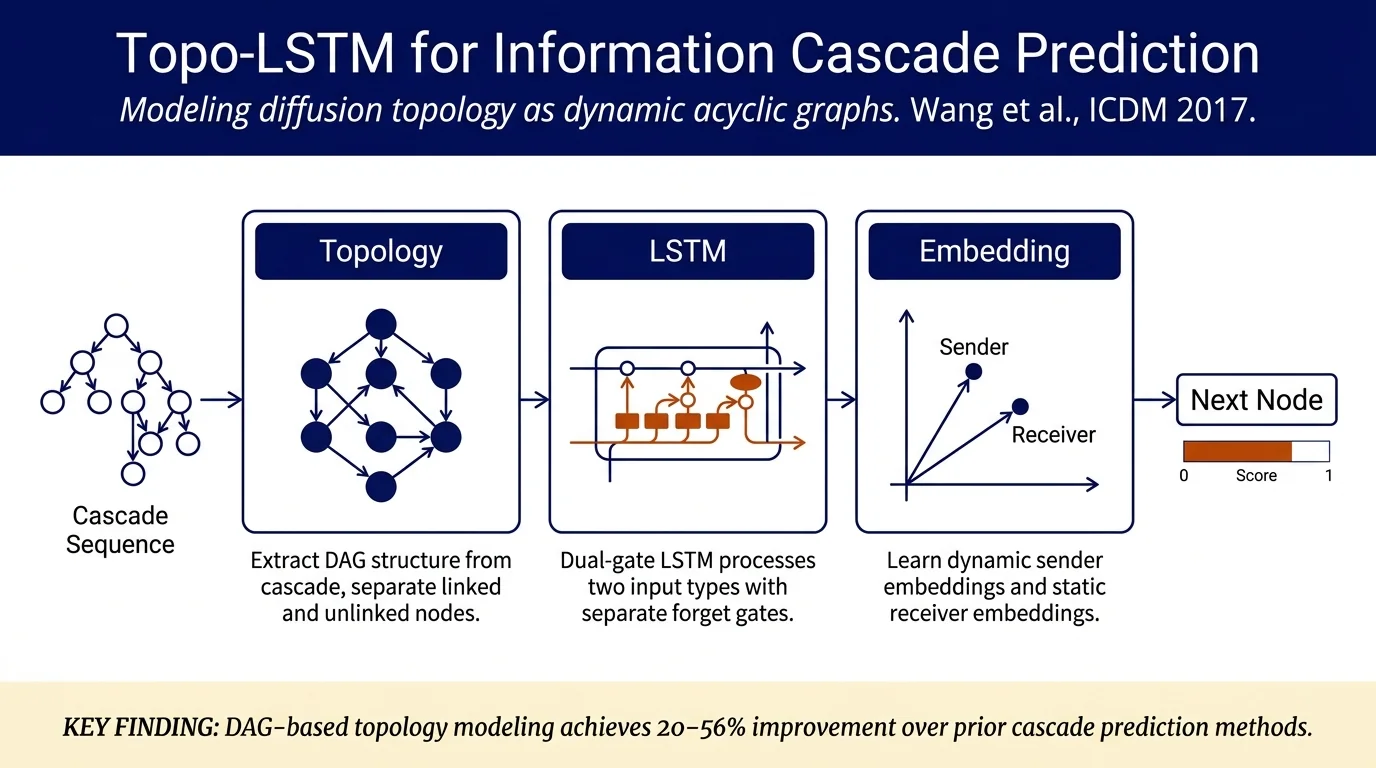
Topological Recurrent Neural Network for Diffusion PredictionWang et al. propose Topo-LSTM, a novel LSTM architecture for modeling dynamic directed acyclic graphs (DAGs) to predict which node will be activated next in information cascades. The key insight is that information diffusion on networks should be modeled explicitly as diffusion topologies—graphs showing how information spreads from…
 Detection methodsSpread & networks
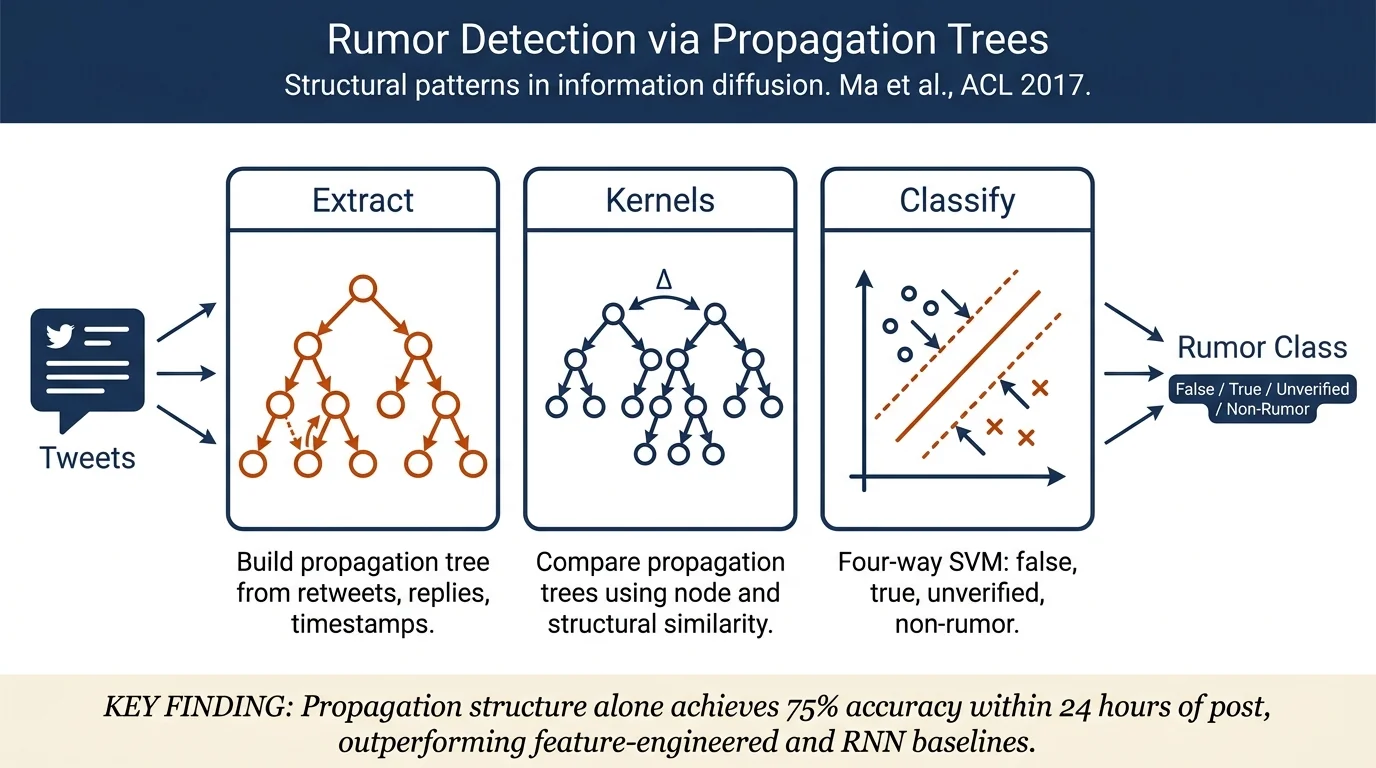
Detect Rumors in Microblog Posts Using Propagation Structure via Kernel LearningThis paper addresses rumor detection in microblog posts by modeling information diffusion as propagation trees and proposing a kernel-based method (PTK) that captures high-order structural patterns differentiating rumors from non-rumors. The approach extends to context-sensitive variants (cPTK) and achieves superior early detection…
 Detection methodsDatasets & evaluation
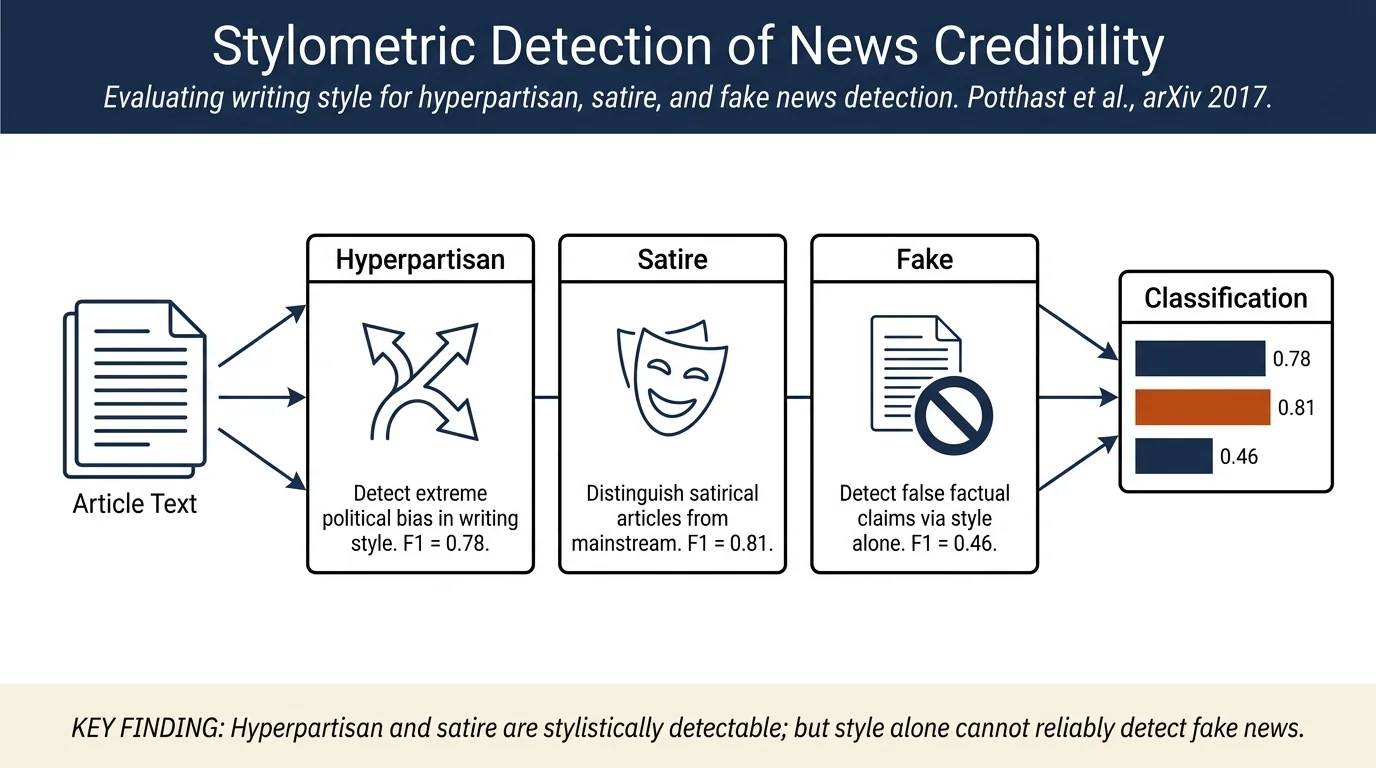
A Stylometric Inquiry into Hyperpartisan and Fake NewsThis paper investigates whether writing style alone can distinguish hyperpartisan news from mainstream and fake news from real news. Using a manually fact-checked corpus of 1,627 articles from BuzzFeed, the authors find that hyperpartisan news is stylistically distinct from mainstream (F1 = 0.78), satire is easily distinguishable from…
 Detection methodsFact-checking & verification
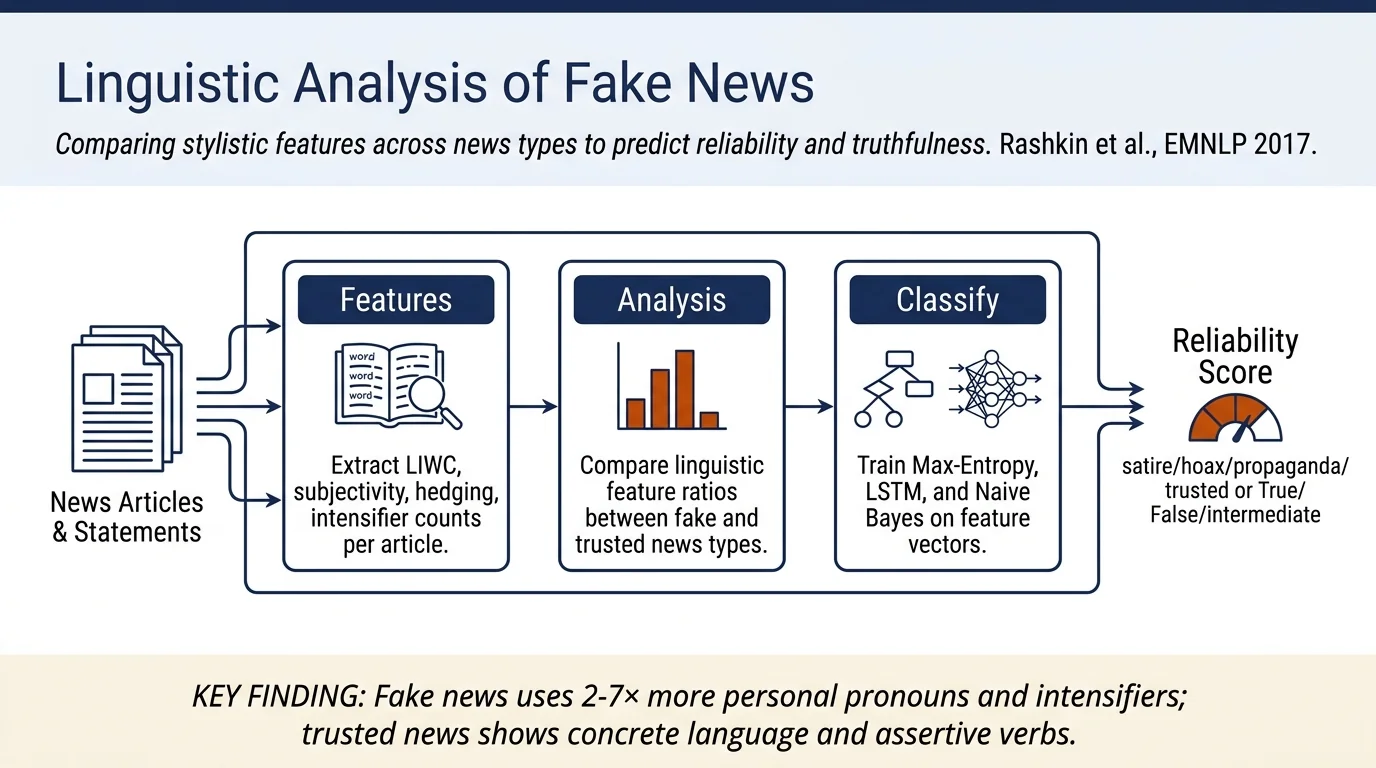
Truth of Varying Shades: Analyzing Language in Fake News and Political Fact-CheckingThis paper performs a linguistic analysis of fake news across four categories—satire, hoaxes, propaganda, and trusted news—using lexical features (LIWC, subjectivity, hedging, intensifiers). Experiments show that fake news articles use more first-person pronouns, exaggerative language (superlatives, modal adverbs), and hedging, while…
 Detection methodsLLMs & generative AI
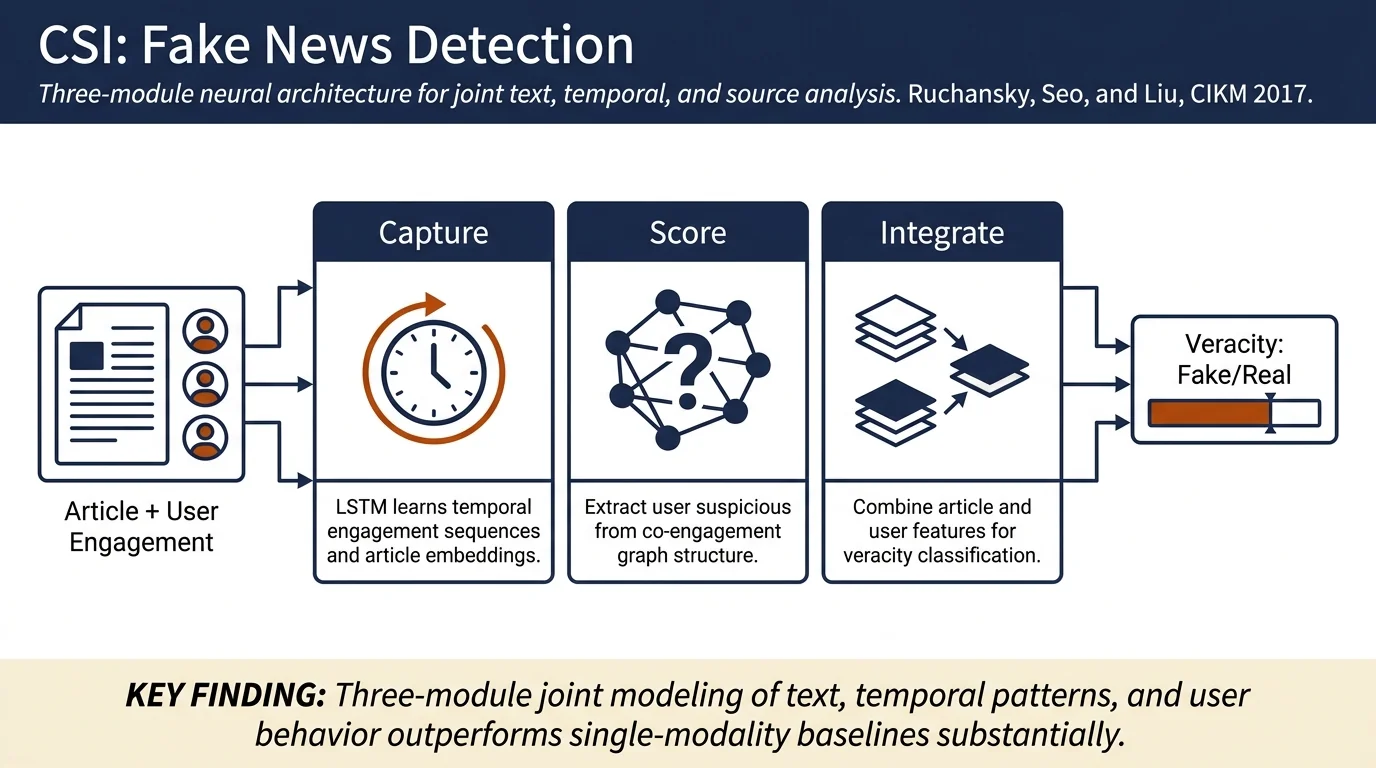
CSI: A Hybrid Deep Model for Fake News DetectionCSI is a three-module deep learning model that detects fake news by jointly modeling article text, temporal patterns of user engagement (response), and user behavior patterns (source). The Capture module uses LSTM to learn temporal response signals; the Score module learns user suspiciousness from co-engagement patterns; the Integrate…
 Detection methodsDatasets & evaluation
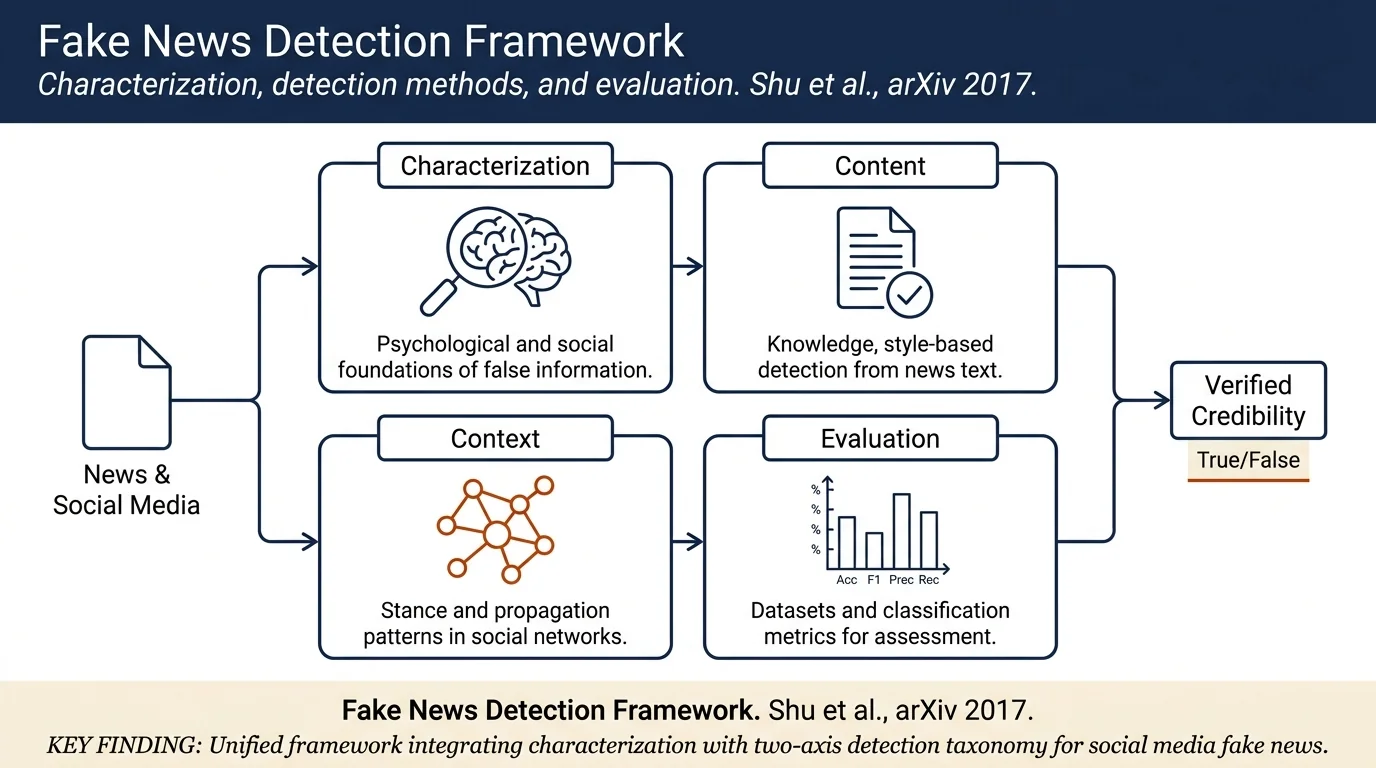
Fake News Detection on Social Media: A Data Mining PerspectiveThis comprehensive survey reviews fake news detection on social media through a data mining lens. It frames the problem around two key aspects—characterization (understanding the psychological and social foundations of fake news) and detection (building computational methods using news content and social context features).