 Miriam Metzger
 Andrew J. Flanagin
Contributions
- Synthesizes interdisciplinary research on credibility evaluation (psychology, communication, information science, education) into a coherent framework
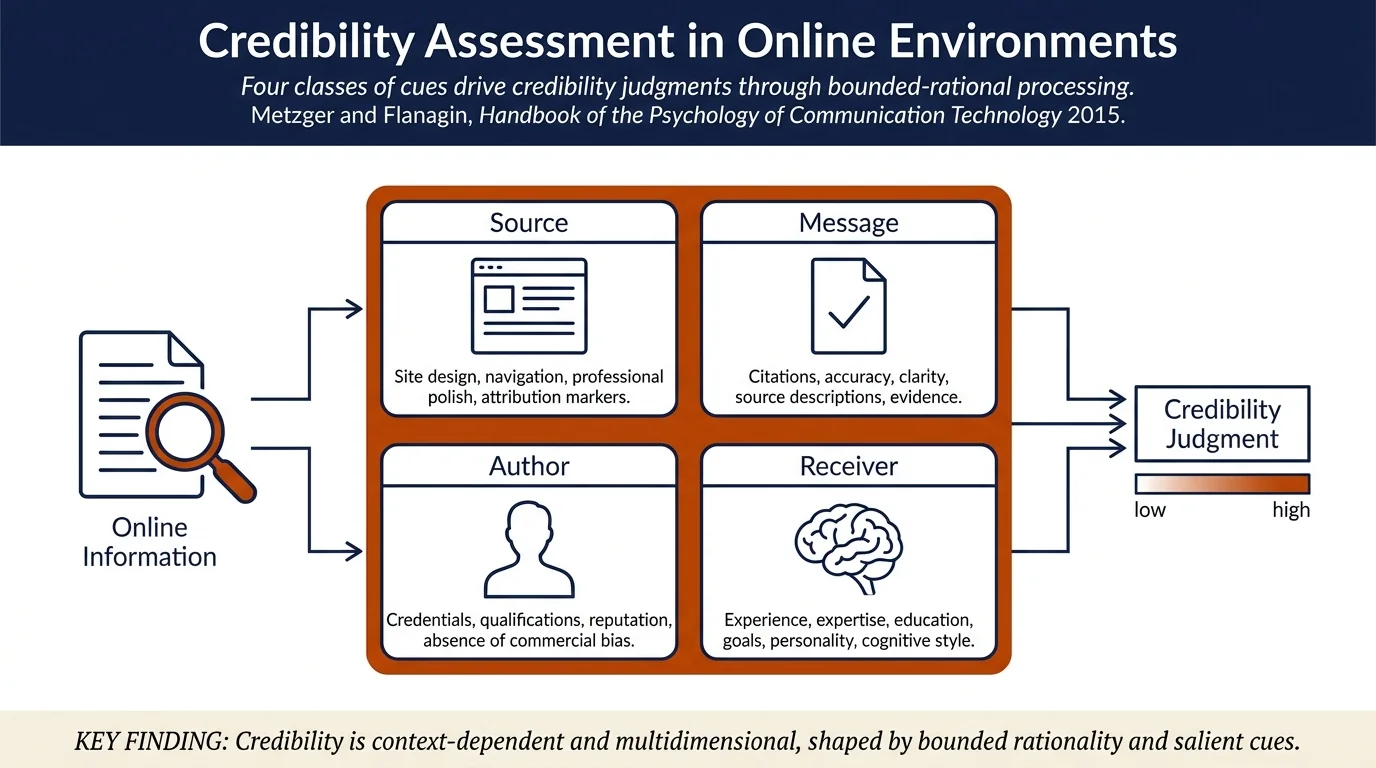
- Identifies four classes of factors affecting credibility evaluation: site/source cues, message cues, author cues, and receiver characteristics
- Applies theoretical frameworks (Limited Capacity Model, Prominence-Interpretation Theory, heuristic processing) to explain how people navigate competing credibility cues
- Addresses credibility challenges specific to networked digital media: proliferation of information, removal of institutional gatekeepers, user-generated content, and "disintermediation"
- Discusses special challenges with Wikipedia, collaborative content, and mixed expert/user-generated information environments
- Proposes research directions for understanding heuristic vs. analytic credibility evaluation, social influence effects, and contexts where accuracy matters most
Method
The chapter synthesizes empirical research across multiple disciplines on how people evaluate online information credibility. It draws on studies using focus groups, experiments, and surveys examining how credibility judgments form in computer-mediated communication contexts. The authors organize findings around psychological mechanisms (information processing theories), cue-based models (what features people attend to), and receiver characteristics (who relies on what cues).
Results and Key Findings
Credibility evaluation is multidimensional and context-dependent. Credibility is a subjective perceptual judgment (not an objective property), affected by what the information receiver notices and interprets. It differs from trust, which assumes confidence in another's best interests.
Information processing views explain how people judge credibility. The Limited Capacity Model shows people cannot process all available information and so rely on salient cues. Prominence-Interpretation Theory describes how credibility evaluation is a two-step process: noticing a cue, then interpreting its meaning.
Four classes of cues influence credibility judgments:
-
Site/source cues: Professional design, easy navigation, site organization, attribution, certifications, presence of contact information, presence of privacy policies, sponsorship by reputable organizations, lack of advertising
-
Message cues: Presence of citations and references, message accuracy and clarity, writing tone and professionalism, information breadth and depth, description of sources and evidence, task relevance
-
Author cues: Author identification, qualifications and credentials, reputation and name recognition, absence of commercial motive
-
Receiver characteristics: Past experience with source, general Internet experience, education and literacy, motivation and goals for the search, personality traits (e.g., cognitive style)
Challenges in contemporary digital media. Digital media have made credibility assessment more difficult: vast amounts of unfiltered information from diverse sources, lack of professional gatekeeping, potential for misinformation, unclear source attribution, mixing of expert and user-generated content, and difficulty determining responsibility for information.
Wikipedia and user-generated content present unique credibility challenges. Users face conflicting cues when evaluating Wikipedia entries: they skeptically recognize it originates from unknown contributors but also perceive it as credible by comparison to traditional sources. Children and adults show generational differences in evaluating user-generated encyclopedia entries. Social disintermediation—the phenomenon where individual opinions and crowd-sourced information compete with expert-vetted content—complicates credibility evaluation.
Optimistic bias affects credibility judgments. People tend to believe information from online sources they prefer and question information they distrust, independent of actual quality. This bias operates across demographics and education levels.
Social influence and group dynamics matter. When information is provided by multiple sources or endorsed by others, people view it as more credible, even when those endorsements lack real authority or when the information has been biased by aggregation processes.
Notes
A comprehensive, psychology-focused treatment of credibility assessment suited for researchers designing interventions or studying how people judge information quality. The strength of this chapter is its systematic organization of multidisciplinary research into actionable psychological mechanisms. Its emphasis on multiple, often-competing cues reflects real complexity but also suggests why credibility evaluation is error-prone. The 2015 publication predates recent algorithmic amplification and deepfake challenges, so "disintermediation" is framed as the primary credibility driver rather than algorithmic ranking. The discussion of Wikipedia and user-generated content remains highly relevant as collaborative information platforms continue evolving. Notable that the paper frames credibility as subjective perception rather than as objective information quality—a distinction important for understanding both misinformation spread and media literacy interventions.