User-generated content (UGC) refers to information, reviews, ratings, and media produced by ordinary Internet users rather than by professional journalists, credentialed experts, or institutional publishers. UGC is both a democratic opportunity—aggregating the experiential knowledge of many people—and a credibility challenge: sources lack traditional markers of expertise or editorial oversight, and can be manipulated, biased, or deliberately misleading.
Scope and examples
Ratings and reviews: Product reviews on Amazon, movie ratings on IMDb, restaurant reviews on Yelp, accommodation reviews on Airbnb.
Social media content: Posts, comments, images, and videos shared on Facebook, Twitter, TikTok, Reddit, and similar platforms.
Wikis and collaborative knowledge bases: Wikipedia, Citizendium, and similar projects where users collectively author content.
Discussion forums and question-answer sites: Comments on news articles, threads on specialized forums, questions and answers on Stack Exchange.
Location-based information: User-submitted information in Google Maps, Waze, Foursquare, and geographic information systems.
News and journalism: User-submitted citizen journalism, eyewitness accounts, crowdsourced investigations, and participatory news projects.
Credibility challenges specific to UGC
Lack of gatekeeping: Unlike newspapers or academic journals, most UGC platforms lack editorial verification, fact-checking, or vetting processes before publication.
Anonymity and pseudonymity: Users often contribute anonymously or under pseudonyms, making it difficult to verify their identity, expertise, or track record.
Incentive structures: Platforms may reward engagement, controversy, or sensationalism rather than accuracy. Users may be motivated by attention, ideology, revenge, or financial gain rather than truth-seeking.
Aggregation opacity: Ratings and reviews are often aggregated (averages, sorting algorithms), making it unclear whether a consensus reflects genuine convergence or is shaped by bots, sock-puppet accounts, or strategic voting.
Manipulation vulnerabilities: UGC is vulnerable to spam, astroturfing (fake grassroots campaigns), coordinated inauthentic behavior (bots, coordinated teams), and "review bombing" (coordinated rating attacks).
Credibility mechanisms and signals
Despite these challenges, UGC can acquire credibility through:
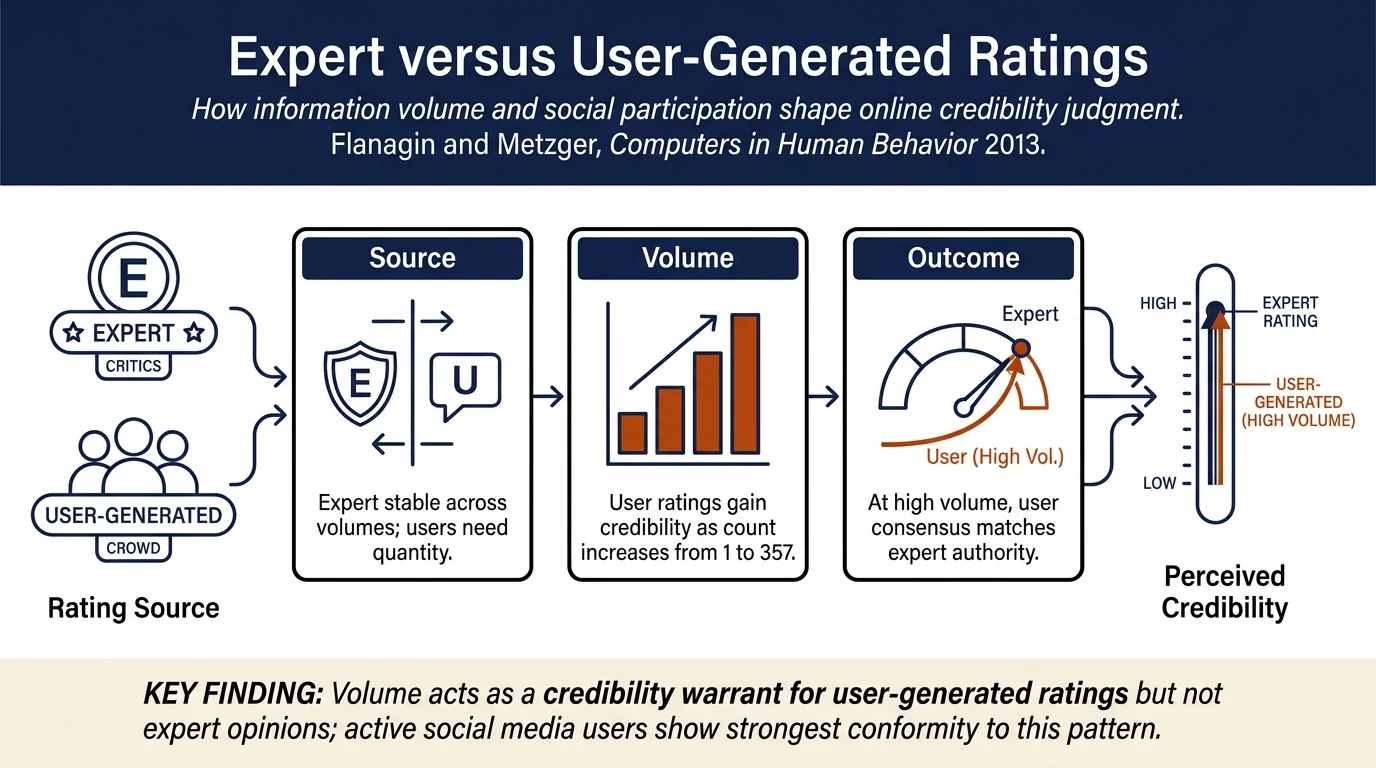
Volume: Aggregated opinions from many users can serve as a "warrant" or "signal" of reliability; the idea that individual manipulations are diluted in large numbers. High-volume consensus can outweigh the credibility concerns about individual sources.
Diversity of sources: When many independent users converge on the same judgment, it reduces the possibility that all are mistaken or coordinated.
Transparency of reasoning: Detailed reviews that explain reasoning and trade-offs are perceived as more credible than bare ratings.
Community reputation systems: Platforms that track user history (prior accuracy, helpfulness ratings from other users) allow consumers to weight contributions differently based on track record.
Corroboration with professional sources: When user-generated and expert information align, credibility increases for both.
Receiver characteristics: Users' own familiarity and comfort with social media predict how much they trust and rely on UGC; active contributors to UGC are more trusting of it.
Role in misinformation
User-generated content is both a vector for misinformation and a resource for fact-checking:
Vector: Misinformation often spreads via UGC—rumors, conspiracy theories, false health claims, and fabricated news shared on social media before professional fact-checkers can respond.
Detection resource: UGC also contains eyewitness accounts, early signals of false claims, and crowdsourced fact-checking efforts that can aid detection.
Amplification risk: False claims endorsed by many users can appear credible through volume, even if unverified (the "illusory truth effect" amplified by aggregation).
Key papers
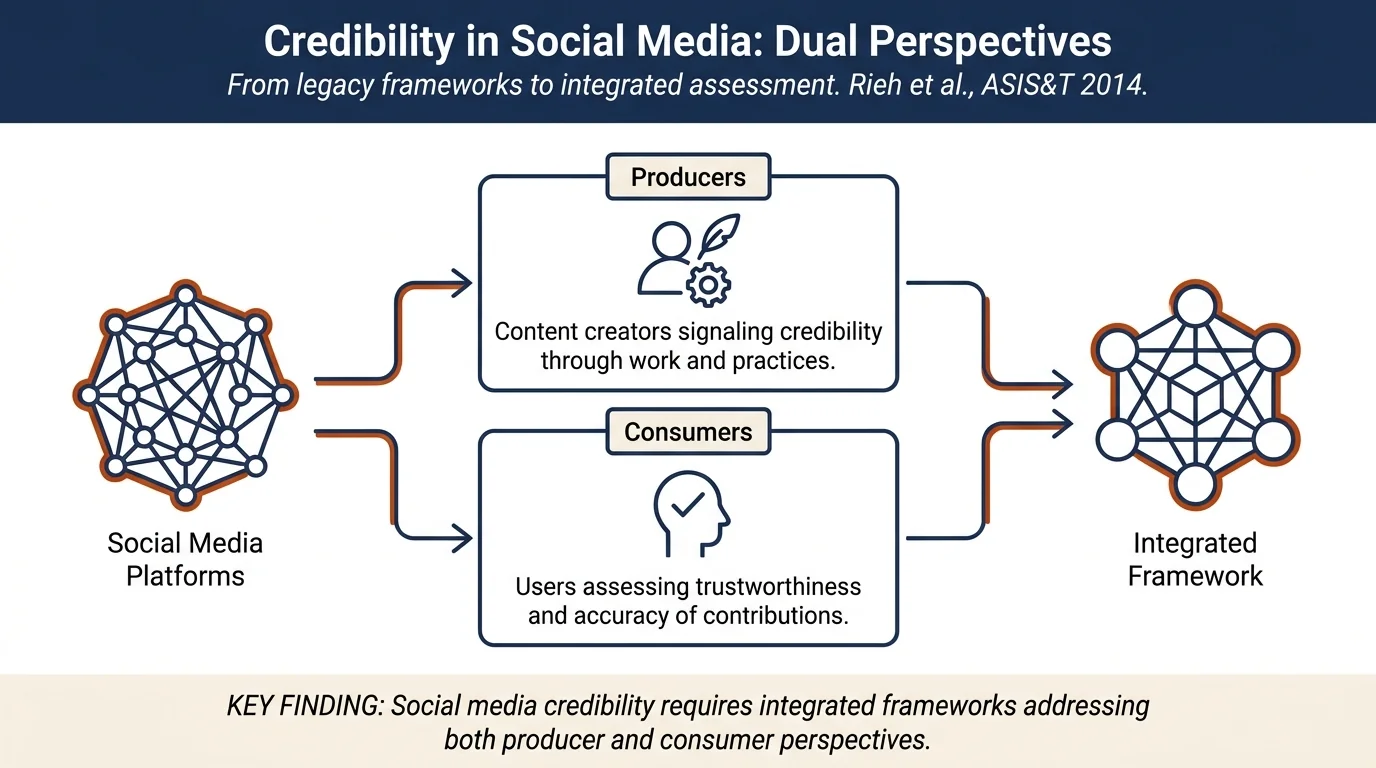
- Rieh, Morris, Metzger, Francke & Jeon (2014) — Credibility Perceptions of Content Contributors and Consumers in Social Media — Panel examining credibility assessment and establishment across diverse user-generated content platforms including Wikipedia, blogs, Twitter, and social Q&A; establishes that credibility dimensions (trustworthiness, reliability, accuracy, completeness) differ from traditional media where expertise and authoritativeness were primary signals.
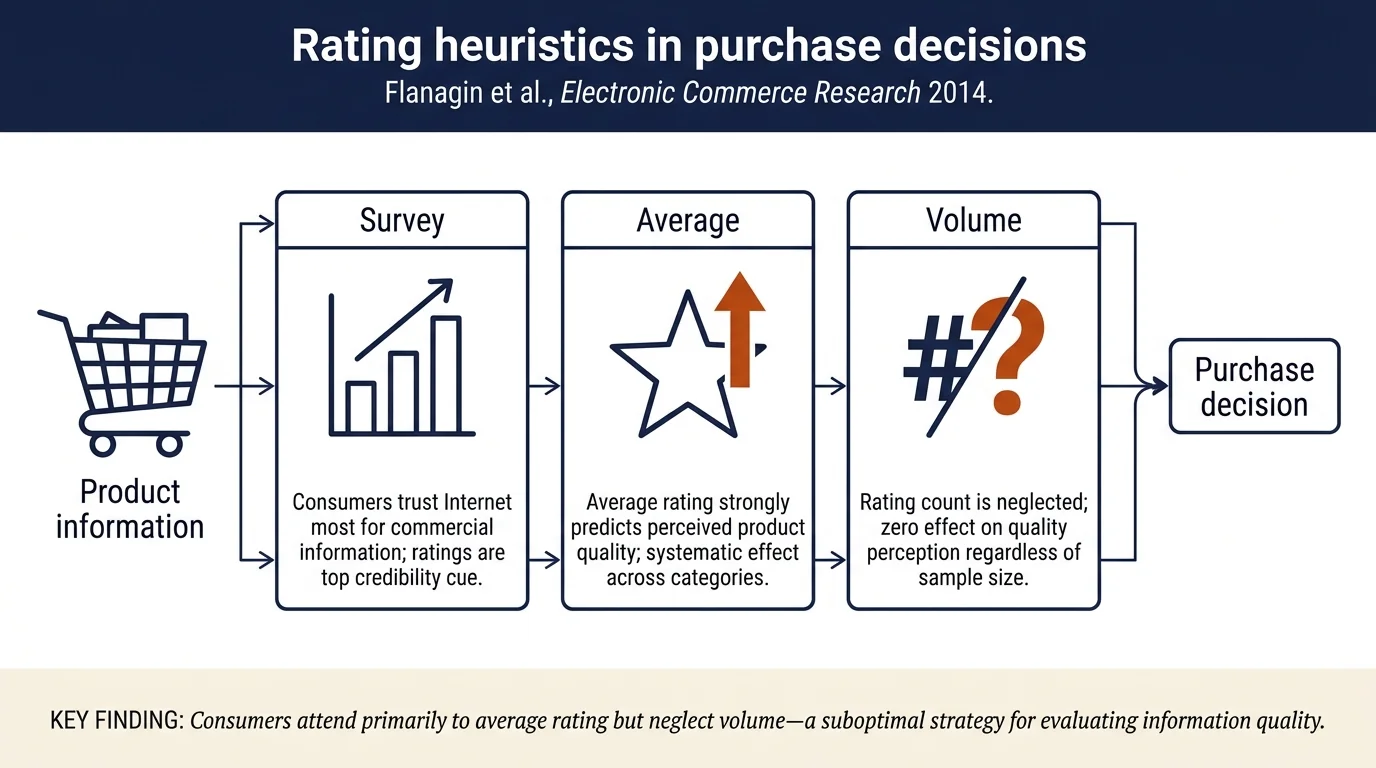
- Flanagin, Metzger, Pure, Markov & Hartsell (2014) — Nationally representative study of consumer reliance on user-generated product ratings for purchase decisions; demonstrates that aggregated user ratings are perceived as highly credible and strongly influence purchase behavior; identifies that consumers employ heuristic processing (focusing on average rating but ignoring volume) when evaluating UGC.
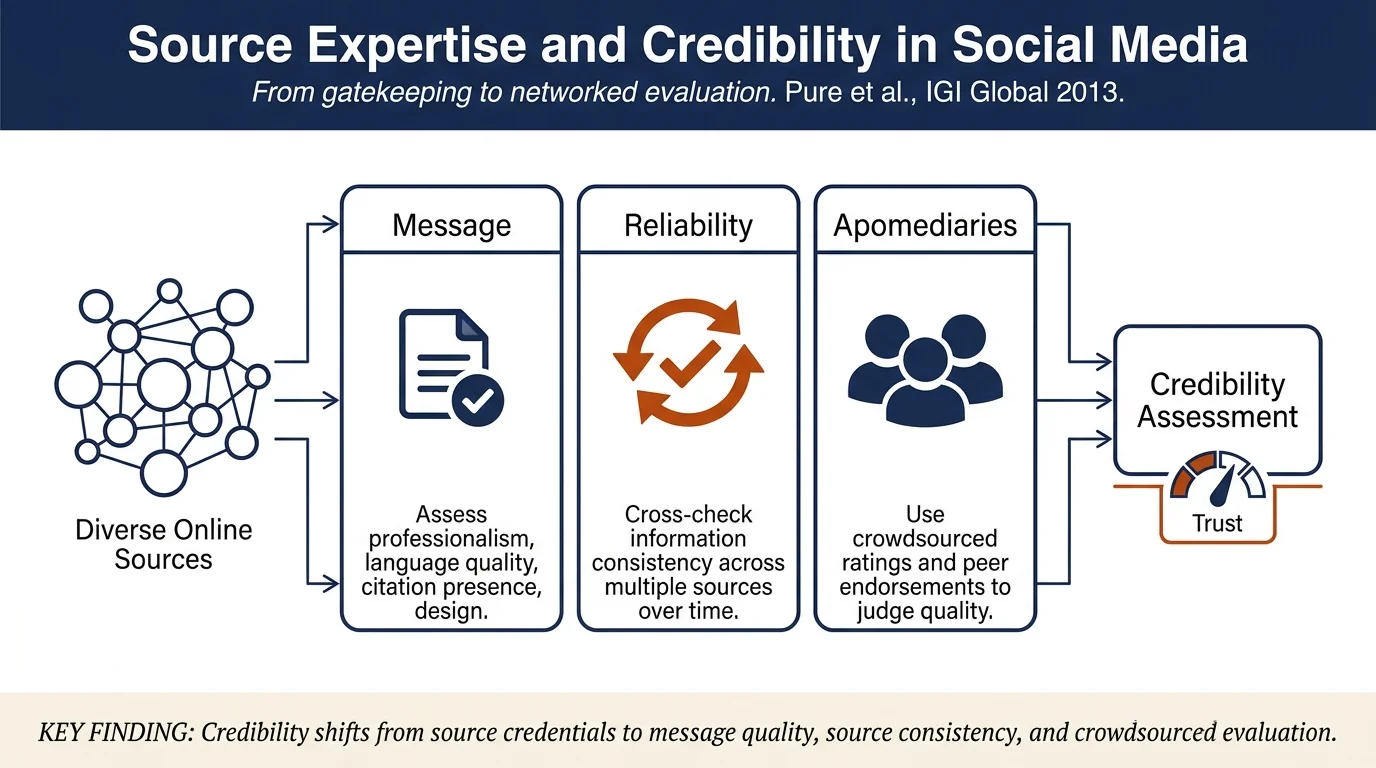
- Pure, Metzger, Markov, Flanagin, Mangus & Hartsell (2013) — Foundational chapter on credibility assessment in social media; proposes apomediaries framework showing how non-expert intermediaries like Amazon reviewers and Wikipedia editors enable evaluation of UGC; demonstrates that volume and community validation become key credibility signals when traditional source authority is absent.
- Flanagin & Metzger (2013) — Empirical study (N=1,207) on trust in expert versus user-generated ratings; demonstrates that information volume increases credibility of user ratings but not expert ratings, and that active social media contributors are more susceptible to these effects.
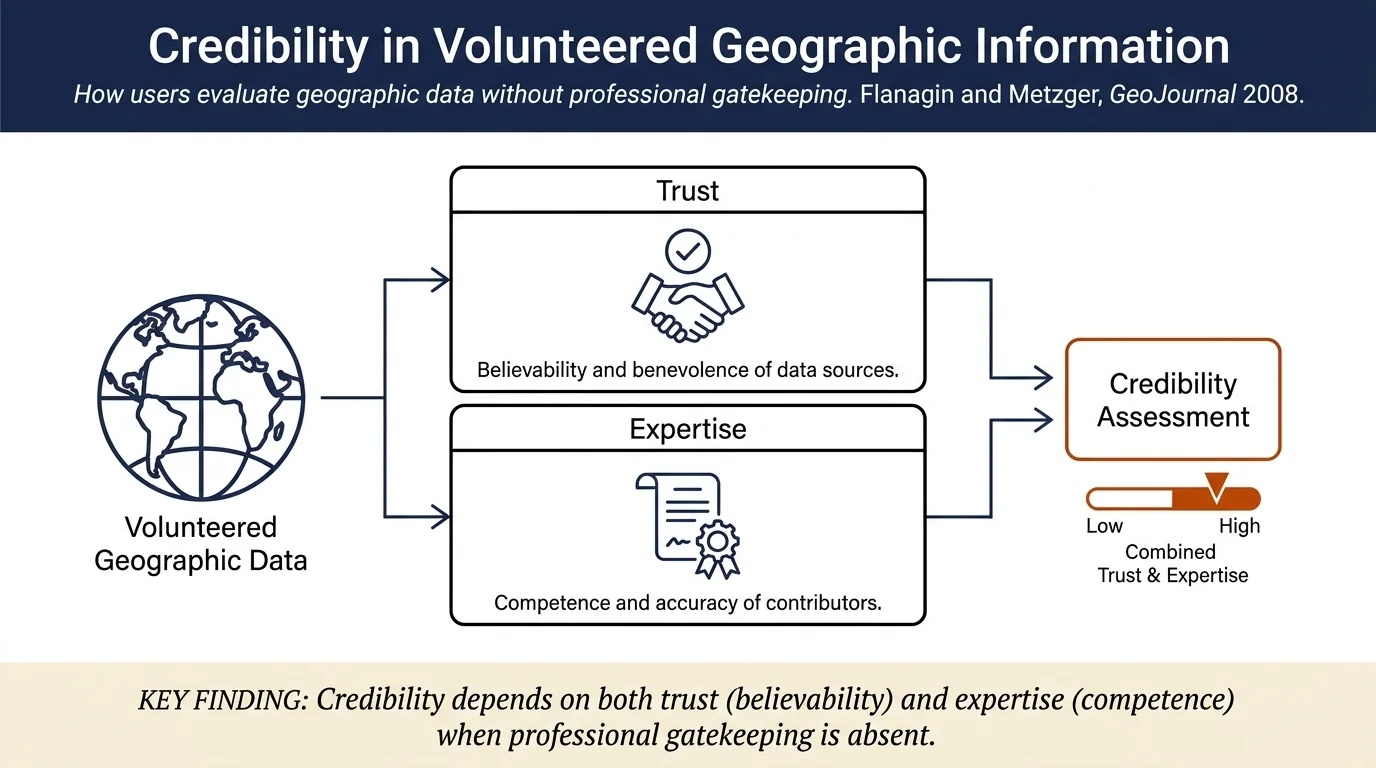
- Flanagin & Metzger (2008) — Position paper on credibility challenges in user-generated geographic information; develops frameworks for understanding trust and expertise in information-abundant, ungatekept environments like Wikipedia and OpenStreetMap.
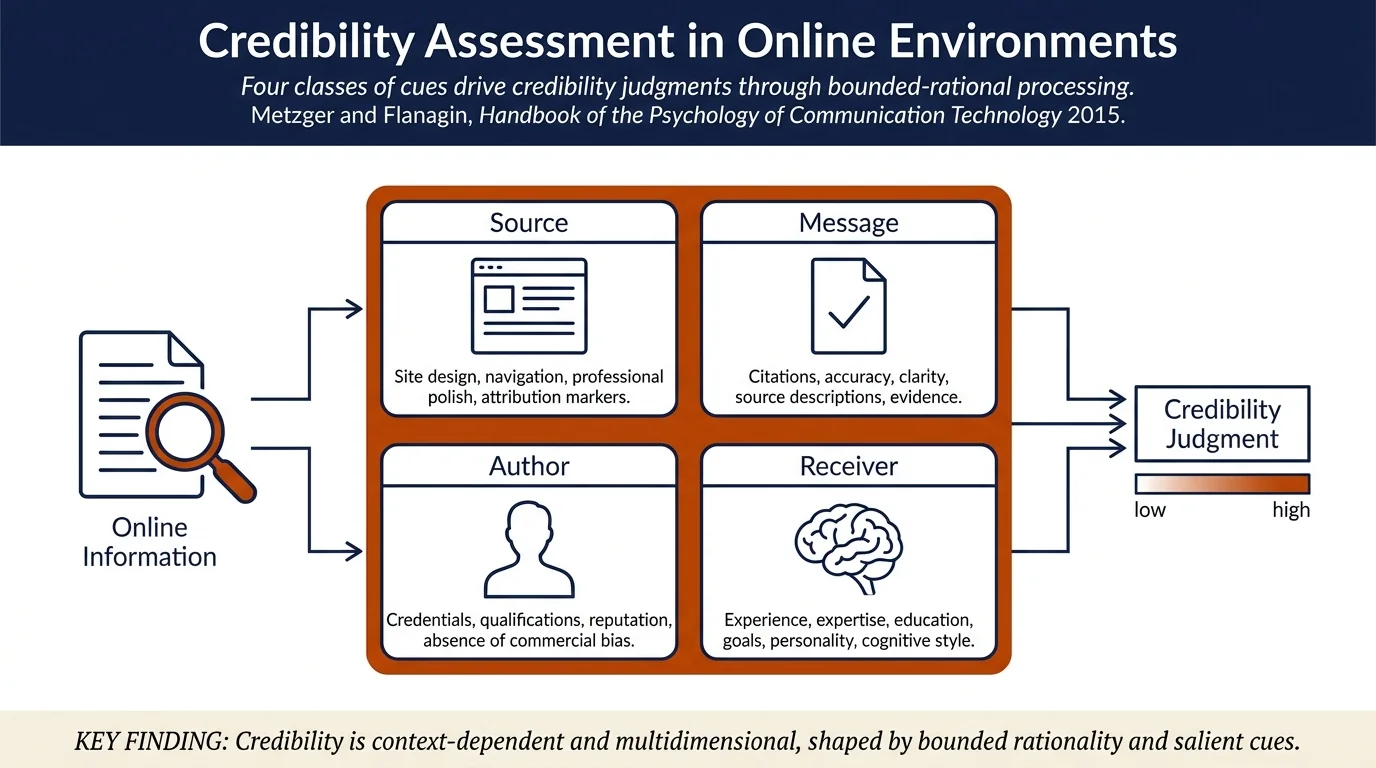
- Metzger & Flanagin (2015) — Handbook chapter on credibility assessment; identifies special challenges of user-generated content (lack of gatekeeping, anonymity, incentive misalignment) and explains how users navigate them via heuristics and community reputation systems.
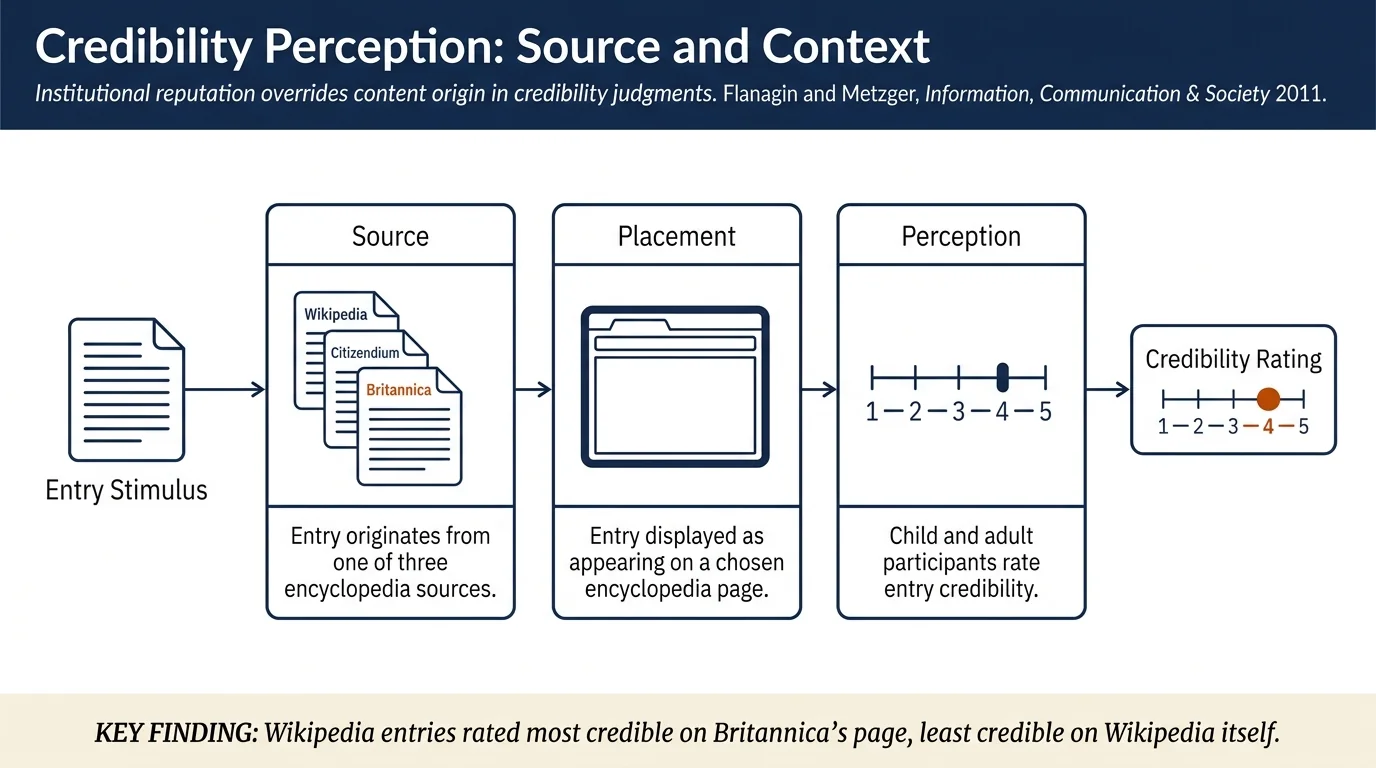
- Flanagin & Metzger (2010) — Large-scale survey (N=2,747 children and parents) showing that youth perceive Wikipedia (a large-scale UGC project) as highly credible, though they often misunderstand its editorial model.
- Flanagin & Metzger (2011) — Quasi-experiment showing that identical content is perceived as more credible when attributed to Britannica than to Wikipedia, demonstrating that institutional authority overrides actual content source in credibility judgments.
Related topics
- Source Credibility — framework for assessing trustworthiness of UGC producers
- Online trust — how people form trust in anonymous or unfamiliar sources
- Information evaluation — how people assess UGC quality
- Social media and misinformation — primary platforms for UGC distribution
- Crowdsourcing — systematic use of UGC for specific tasks (fact-checking, journalism, geographic information)
Open questions
- Can volume reliably serve as a credibility signal when coordinated inauthentic behavior is ubiquitous?
- How do algorithmic rankings and recommendation systems interact with UGC credibility signals?
- What role does transparency about how contributions are aggregated play in trust?
- How can platforms balance openness (enabling all users to contribute) with credibility (reducing manipulation)?
Papers on this topic
 Detection methodsPsychology & interventions
Psychological Approaches to Credibility Assessment Online
 Detection methods
Mitigating risk in ecommerce transactions: perceptions of information credibility and the role of user-generated ratings in product quality and purchase intention
 Detection methodsPlatforms, policy & society
Credibility Perceptions of Content Contributors and Consumers in Social Media
 Detection methods
Trusting expert- versus user-generated ratings online: The role of information volume, valence, and consumer characteristics
 Detection methodsPlatforms, policy & society
Understanding and Evaluating Source Expertise in an Evolving Media Environment
 Detection methods
From Encyclopædia Britannica to Wikipedia: Generational differences in the perceived credibility of online encyclopedia information
 Detection methods
The credibility of volunteered geographic information