Contributions
- Comprehensive literature review integrating source, message, and media credibility traditions from communication research
- Framework distinguishing three overlapping but conceptually distinct credibility constructs
- Analysis of how online information differs from traditional media (lack of professional gatekeeping, convergence of genres, difficulty in detecting alterations)
- Examination of technological and structural features affecting credibility perceptions on the Web
- Translation of classical credibility dimensions (expertise, trustworthiness, attractiveness, dynamism) to the Web context
- Discussion of information literacy and empowerment as strategies for credibility assessment in online environments
Method
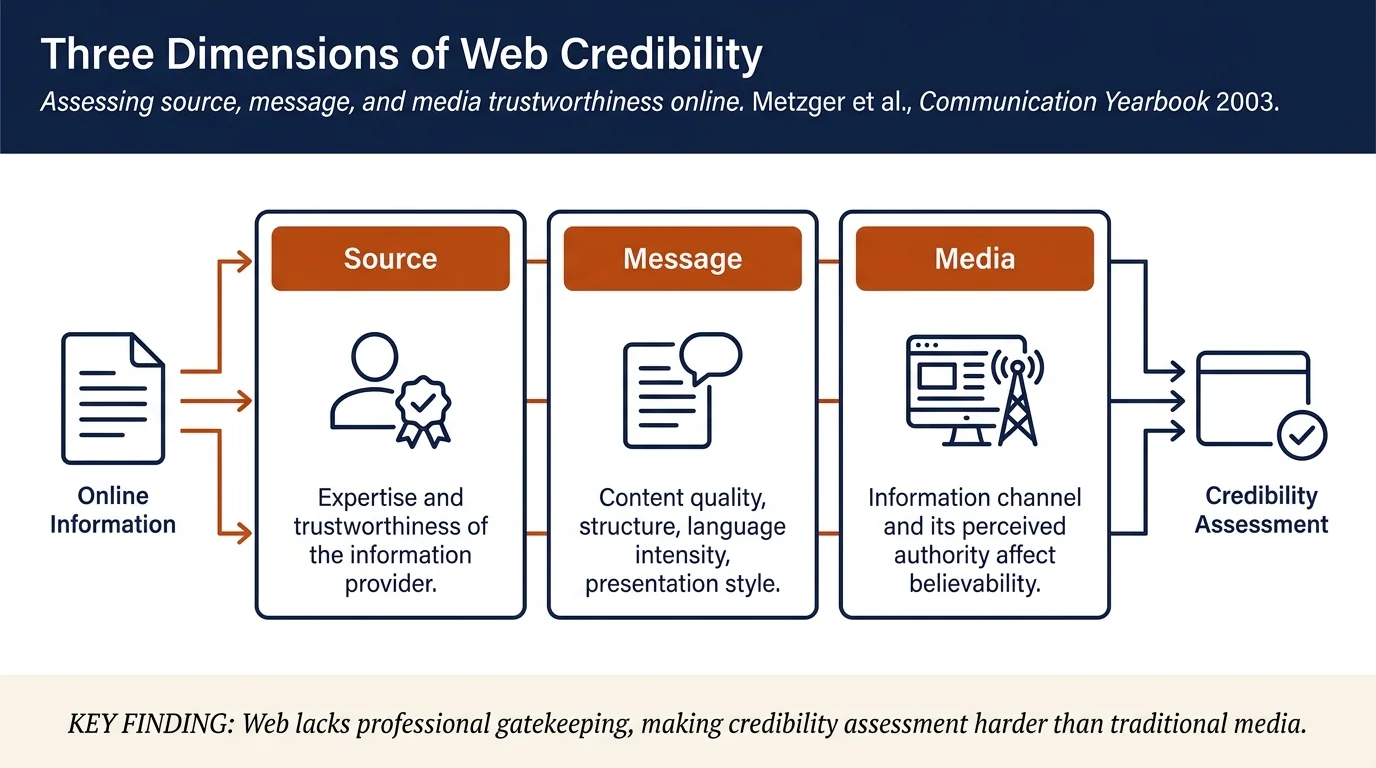
A systematic literature review spanning research from the 1950s onward. The authors trace the evolution of credibility research through three primary streams: (1) source credibility, examining dimensions like expertise and trustworthiness in persuasion contexts; (2) message credibility, considering message structure, content, and presentation; and (3) media credibility, comparing perceived believability across communication channels (newspapers, television, radio, online). They synthesize findings across these traditions and apply them to understand credibility assessment in the Web-based information environment.
Results
The paper identifies critical differences between traditional and online credibility assessment:
- Source credibility dimensions: Expertise and trustworthiness are primary, but secondary dimensions (dynamism, composure, sociability) also influence credibility judgments
- Message credibility factors: Structure, content quality, language intensity, message discrepancy, and presentation style all impact perceived credibility
- Media credibility: Television traditionally rated highest, but this reflects its visual nature and perceived authority; newspapers rated favorably for depth and space for fact-checking
- Online challenges: Absence of professional-level gatekeeping, seamless blending of advertising and information content, difficulty in detecting digital alteration, malleability of digital information
- Web site credibility: Expertise communicated through site design, author credentials, and policy statements; trustworthiness enhanced by physical address, clear privacy policies, and absence of commercial clutter
The paper demonstrates that classical dimensions of source, message, and organizational credibility can be translated to assess Web sites, though users' assessments are complicated by the absence of established reputation and the ease of creating professional-looking but unvetted content.
Notes
This paper is a canonical reference in the credibility assessment literature and directly addresses the core mission of GUIDE. It provides the theoretical framework for understanding how users evaluate sources, messages, and media in online environments—foundational to misinformation detection and information literacy. The synthesis of 50+ years of credibility research makes it essential context for any work on fake-news detection and source evaluation. Its analysis of how the Web's structural features (lack of gatekeeping, genre convergence, ease of professional-looking forgery) create novel credibility challenges remains highly relevant to contemporary misinformation research.