 Miriam Metzger
 Andrew J. Flanagin
Contributions
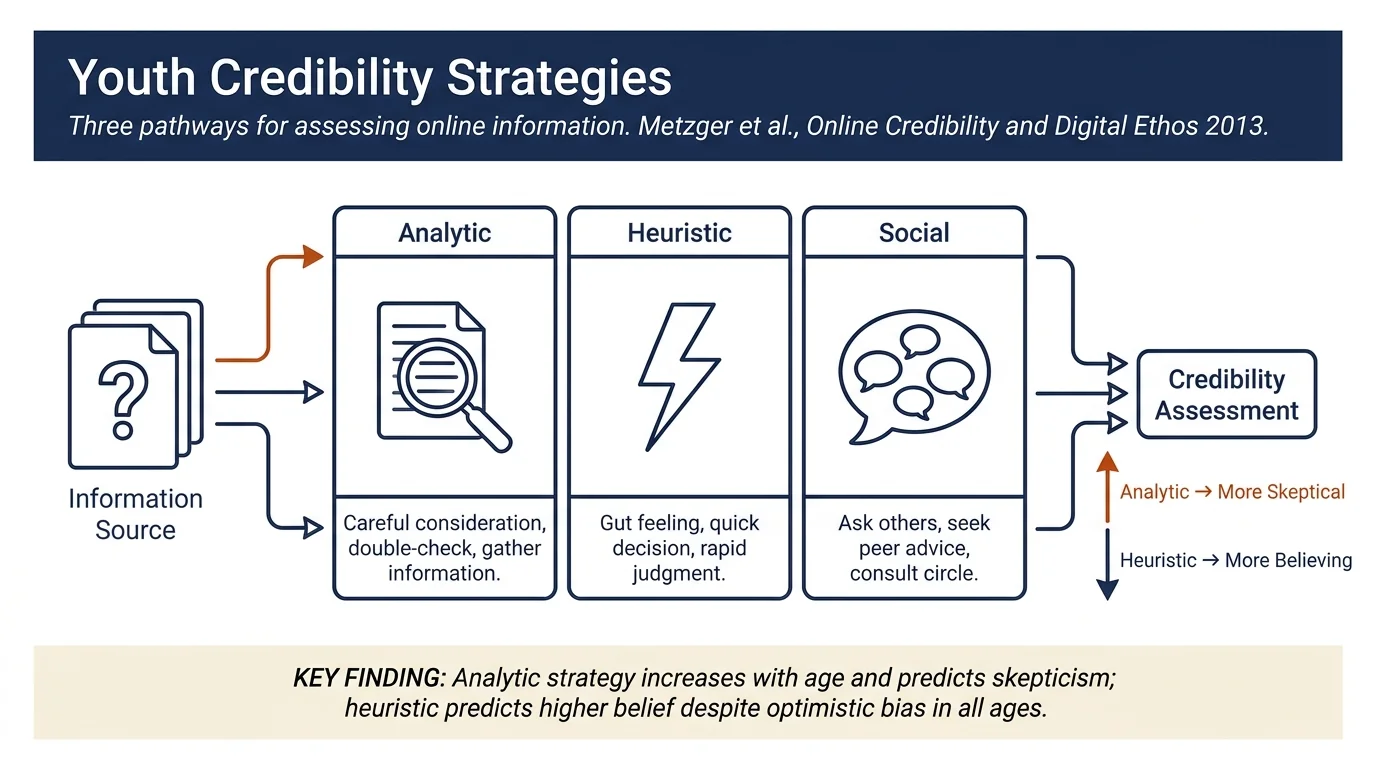
- Empirical characterization of three distinct strategies youth use to evaluate online information credibility: analytic (effortful consideration), heuristic (relying on feelings and quick cues), and social (asking others for help or advice).
- Demonstration that children's credibility beliefs vary significantly by information type (schoolwork > news > entertainment > commercial), with younger children more credulous about health/educational content and older children more skeptical of entertainment.
- Large-scale evidence of optimistic bias in youth credibility assessment: even younger children perceive themselves as equally or more skilled than typical Internet users, with this misalignment correcting somewhat by age 18.
- Identification of predictors of credibility concern: children with negative online experiences, parental discussion about trustworthiness, formal instruction in credibility evaluation, flexible thinking, and lower social trust show greater concern for credibility.
- Finding that personality traits and cognitive dispositions (need for cognition, faith in intuition) influence strategy choice: youth relying on heuristic methods tend toward higher credibility beliefs; those employing analytic methods show greater skepticism and concern.
- Evidence that Internet use patterns matter: children immersed in virtual worlds and spending more time online develop greater skepticism about online information as they accrue direct experience with unreliable sources.
Method
Study design: Large-scale, Web-based survey of a nationally representative U.S. sample of children ages 11–18 with Internet access.
Participants:
- Primary sample: 2,747 children ages 11–18 with Internet access in the United States
- Fielded by Knowledge Networks, a probability-based online panel representative of U.S. Internet households
- Approximately 340 respondents per age cohort (11–18 years)
- Demographics: 75% white/non-Hispanic; 12% Hispanic; 9% black/non-Hispanic; 4% other/mixed race; household income averaging $60,000–$85,000; mean age 14.33 years ($SD = 2.28$); 53% male
Survey administration:
- Multi-step development: literature review, focus groups with children ages 9–18, consultation with developmental and cognitive psychology experts, iterative refinement with parent-child dyads, hour-long pilot interviews with 40 children, full field pilot test
- Survey topics based on credibility literature and existing instruments for trust, credibility, and quality
- Pilot tested with 183 college students to refine terminology and operationalization
- Final administration fielded June–July 2009
Key measures:
Credibility concern: How often children think about credibility when online; how concerned they feel people should be (5-point Likert scales).
Credibility beliefs: "How much do you believe information you find on the Internet about [topic]?" for schoolwork, health, news, entertainment, commercial topics (Likert scales); relative believability across media types (Internet, television, books, magazines, newspapers, radio, in-person conversation).
Information evaluation strategies: Extent to which children base credibility assessment on heuristic methods (gut feelings, quick decisions), analytic methods (careful consideration, double-checking, gathering all information), and social methods (asking others for advice).
Perceived Internet skill: Self-assessed technical skill, search skill, knowledge of latest trends and features; operationalized as comparison to "typical Internet user" (7-point scale, midpoint = "about the same").
Personality and cognitive traits: Need for cognition (tendency to engage in effortful thinking); flexible thinking (willingness to consider alternatives); faith in intuition; social trust (propensity to trust strangers and others generally).
Internet use patterns: Hours/week online; years of experience; use for social networking, contributing information, virtual-world immersion (e.g., games like World of Warcraft), commercial purposes.
Parental mediation: Whether parents discuss trustworthiness of online information; whether parents restrict access or control Internet use.
Formal instruction: Whether child received instruction in evaluating credibility of online information in school setting.
Statistical methods: Stepwise multiple regression to identify predictors of credibility concerns and beliefs; $F$-tests and post-hoc pairwise comparisons to test age and information-type effects; correlation analysis for associations between personality and strategy use.
Results
Credibility Concern
79% of children report thinking about credibility "some" or "more often" when online. Concern about credibility does not decrease with age ($r = -.10, p < .001$), but older children (18 years) show significantly greater concern that people should be concerned about credibility online than younger children (11 years) ($F = 2.51, df = 2, 2732, p < .05$).
Credibility Beliefs by Information Type
Children significantly vary in believability assessments across information types ($F = 928.64, df = 5, 8620, p < .001$, partial $\eta^2 = .35$):
- Highest credibility: Schoolwork information (Internet most believable at 40%; followed by projects at 34%; then in-person sources at 7%)
- High credibility: News (Television 34%, Newspapers 24%, Internet 11%)
- Moderate credibility: Health information (Doctors/professionals highest; Internet and books equal second)
- Entertainment information: Internet 40%, Television 28%, Magazines 11%
- Lower credibility: Commercial information (Internet 41%, In-person 33%)
Wikipedia findings: Nearly all youth (99%) have heard of Wikipedia; 84% have used it. However, when asked to identify what Wikipedia is from a list of options (e.g., "a user-generated site where anyone can contribute," "a social networking site," etc.), only 78% correctly identified it. Moreover, children view information attributed to Wikipedia as less credible than content from Britannica or Citizendium, even when substantively identical (all within same Wikipedia content).
Age differences: Older children generally believe information from the Internet, books, and magazines more than younger children; older children believed health information from radio less than younger kids.
Methods for Evaluating Credibility
Children report using three distinct approaches (analyzed via stepwise regression for strategy use controlling for age):
| Strategy | Mean | SD | Relative use |
|---|---|---|---|
| Analytic (careful consideration, double-checking, gathering information) | 3.45 | 0.74 | 57.2% report using often; increases with age ($r = .09, p < .001$) |
| Social (asking others, consulting social circle) | 2.92 | 0.71 | 29.6% report using often; similar across ages |
| Heuristic (gut feelings, quick decisions) | 2.96 | 0.67 | 29.7% report using often; stable across ages |
Analytic method use is significantly more prevalent than social and heuristic methods ($F = 575.92, df = 2, 5554, p < .001$, partial $\eta^2 = .17$). Older children report using all three methods more frequently than younger children, but the relative ranking (analytic > heuristic/social) holds across all age groups.
Predictors of Credibility Concern and Beliefs
Regression analysis identified multiple significant predictors (Table 1 summarizes coefficients):
For credibility concern:
- Increased concern: Formal instruction in credibility evaluation ($\beta = .07^*$); having heard about false information online and been concerned ($\beta = .06^*$); parental discussion about trustworthiness ($\beta = .11^{***}$); flexible thinking ($\beta = .12^{*}$)
- Decreased concern: Race (non-white youth slightly more concerned; $\beta = -.06^*$); need for cognition ($\beta = -.09^{***}$)
For credibility beliefs (how much to believe information):
- More believing: Younger age ($\beta = -.10^{***}$); lower Internet social trust ($\beta = -.20^{***}$); lower general social trust ($\beta = -.11^{***}$); higher faith in intuition ($\beta = .08^{*}$); heuristic evaluation style ($\beta = -.09^{***}$)
- More skeptical: Analytic evaluation style ($\beta = .05^*$); higher Internet skill self-assessment ($\beta = .04^{*}$); site design quality ($\beta = .10^{***}$)
Perceived Skill in Credibility Evaluation
In comparison to a "typical Internet user," even youngest children perceived themselves as equally or slightly better at evaluating credibility online ($M = 3.47, SD = 1.37$) on a 7-point scale (midpoint = 3). Children showed no strong developmental change in self-other comparison ($M = 3.55, SD = 1.47$) across ages, indicating a persistent optimistic bias where self-perception exceeds objective performance.
Interestingly, older children report a slightly less favorable comparison to typical users than younger kids ($r = -.11, p < .001$), suggesting some correction of overconfidence with experience.
Notes
Strengths:
- Representative sample: Knowledge Networks panel yields a sample demographically representative of U.S. Internet households, reducing selection bias vs. convenience samples.
- Comprehensive strategy measurement: Distinguishes three cognitive pathways (analytic, heuristic, social) rather than treating credibility evaluation as monolithic; operationalizes strategies as self-assessed frequency rather than self-efficacy.
- Information-type variation: Demonstrates that credibility assessment is context-dependent; youth do not apply uniform skepticism.
- Predictor modeling: Stepwise regression identifies which demographic, personality, and usage patterns predict concerns and beliefs, providing actionable targets for intervention.
- Optimistic bias documentation: Evidence of persistent overconfidence in perceived skill vs. typical users has implications for digital literacy education; overconfidence may undermine willingness to apply critical thinking.
Limitations:
- Self-report on strategies: Children report how often they use each strategy, not observed in situ; actual credibility evaluation may differ from reported frequency.
- Snapshot in 2009: Fielded during early social-media era; contemporary youth media diet (algorithmic feeds, visual platforms, deepfakes) has evolved substantially; replication needed.
- Causality: Regression identifies correlates of credibility concern, not causal effects; e.g., does parental discussion cause greater concern, or do concerned children prompt more discussion?
- Self-assessment of skill: Perceived Internet skill is self-reported comparison to peers, not validated against actual performance; overconfidence may be even more pronounced than self-reports suggest.
- Limited outcome data: Study measures beliefs and self-reported strategies, not downstream outcomes (e.g., susceptibility to actual misinformation, detection of fabricated claims).
Key implications:
- Credibility literacy is not automatic in digital natives: Despite comfort with technology, youth employ both effortful (analytic) and intuitive (heuristic) evaluation; education should explicitly teach analytic methods.
- Optimistic bias is persistent: Youth believe they are better at credibility assessment than peers/typical users, even at young ages; this overconfidence may impede adoption of skeptical habits.
- Information type shapes assessment: Youth do not transfer skepticism across domains; a child skeptical of entertainment may be credulous about educational or health information. Media literacy must be domain-specific.
- Experience and instruction matter: Children with negative online experiences, parental discussion, and formal instruction show greater credibility concern; suggests that accumulated contact with unreliable information builds protective skepticism.
- Personality predicts strategy: Children high in need for cognition and analytical disposition gravitate toward effortful evaluation; those with faith-in-intuition tendency rely on gut feelings. Intervention design could tailor pedagogy to cognitive style.