Contributions
- Systematically catalogs cognitive heuristics people employ during online credibility evaluation
- Identifies the reputation heuristic, endorsement heuristic, consistency heuristic, self-confirmation heuristic, expectancy-violation heuristic, and persuasive-intent heuristic as primary strategies
- Examines how digital media environments alter traditional credibility assessment by removing institutional gatekeepers
- Proposes research agenda for understanding heuristic-based credibility evaluation in networked information environments
- Links cognitive science literature on bounded rationality to information-evaluation behavior online
Method
The paper synthesizes empirical research on how information consumers evaluate credibility in online settings. It examines findings from focus groups, experiments, and survey studies conducted by the authors and colleagues on credibility judgment processes. The analysis focuses on six cognitive heuristics that recent studies show information consumers employ when assessing trustworthiness of online sources and information.
Results and Key Findings
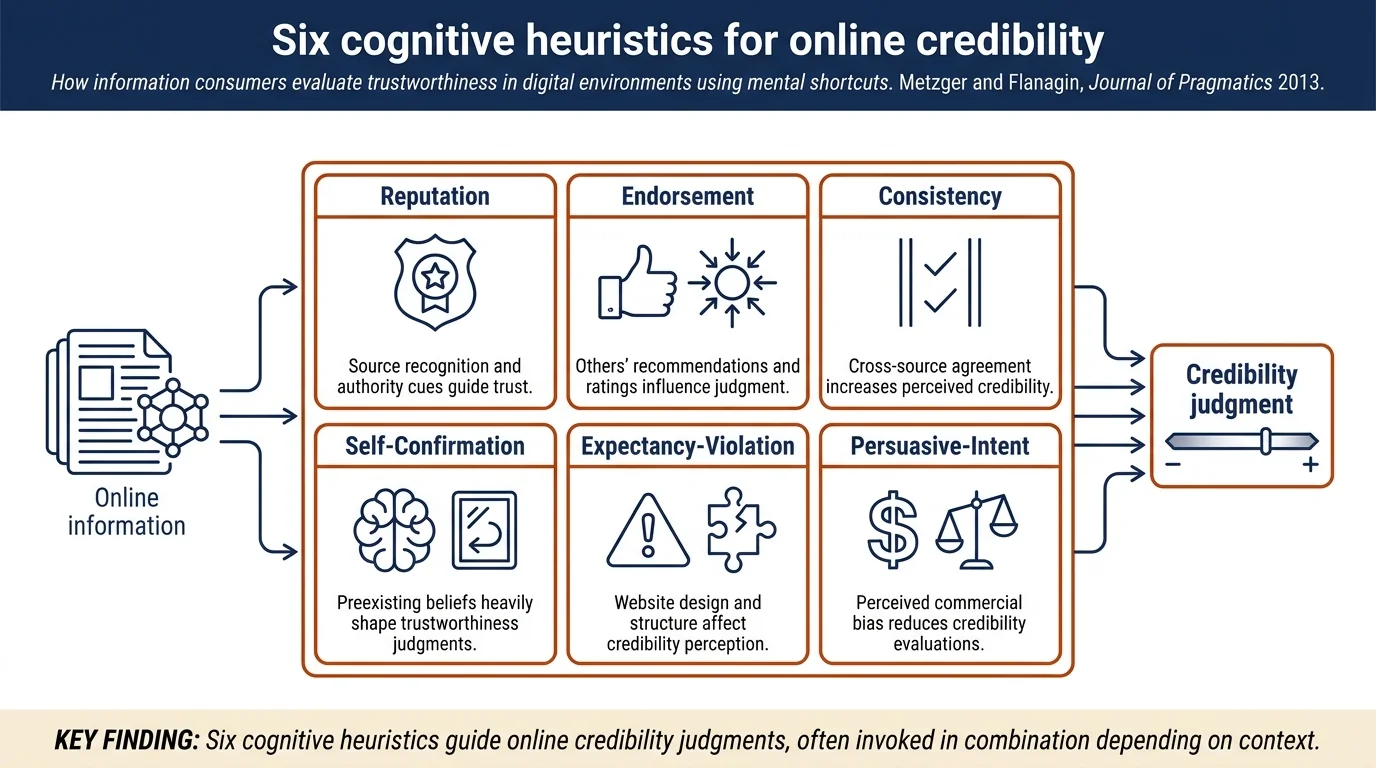
Reputation heuristic: Familiarity with a source or recognition of its name serves as a credibility cue; people tend to believe recognized alternatives over unfamiliar ones. Reputation judgments in online spaces rely on source credentials and whether sites are "official authorities."
Endorsement heuristic: People believe information and sources that others endorse, without scrutiny of the content's actual merit. This encompasses both known others and aggregated testimonials, reviews, and ratings.
Consistency heuristic: People validate information by checking whether it appears consistently across multiple sources, requiring less effort than examining credentials or arguments.
Self-confirmation heuristic: People treat information as credible if it confirms their preexisting beliefs; they overlook or discount information that contradicts their views.
Expectancy-violation heuristic: Violations of users' expectations about website appearance or functionality (poor design, unexpected content structure) create negative credibility evaluations, irrespective of actual information quality.
Persuasive-intent heuristic: People judge information as less credible when they perceive commercial intent, advertising, or bias in its presentation.
The paper notes these heuristics can be combined, nested, and invoked in different orders depending on context, information-seeking goals, and individual differences in motivation and cognitive style.
Notes
A canonical reference for how cognitive science explains credibility judgments in online settings. The heuristics taxonomy has become a standard framework cited in misinformation and media-literacy research. The paper's strength lies in synthesizing prior empirical work into a coherent, actionable model; its scope is bounded to heuristic processes (it does not address institutional or technological interventions). The emphasis on multiple, potentially competing heuristics reflects research showing that credibility evaluation is rarely a single-step process. Worth noting: the 2013 publication predates the most recent polarization and algorithmic-amplification challenges, so its framing of "disintermediation" as the primary driver of credibility challenges is narrower than contemporary work acknowledges.