Contributions
- Synthesis of credibility assessment literature spanning communication, information science, and digital literacy
- Comprehensive taxonomy of credibility evaluation criteria (accuracy, authority, objectivity, currency, coverage)
- Description and critique of the checklist approach to credibility training
- Presentation of alternative models: cognitive authority, contextual/dual processing frameworks
- Empirical review of how users actually evaluate online credibility (frequency of verification behaviors)
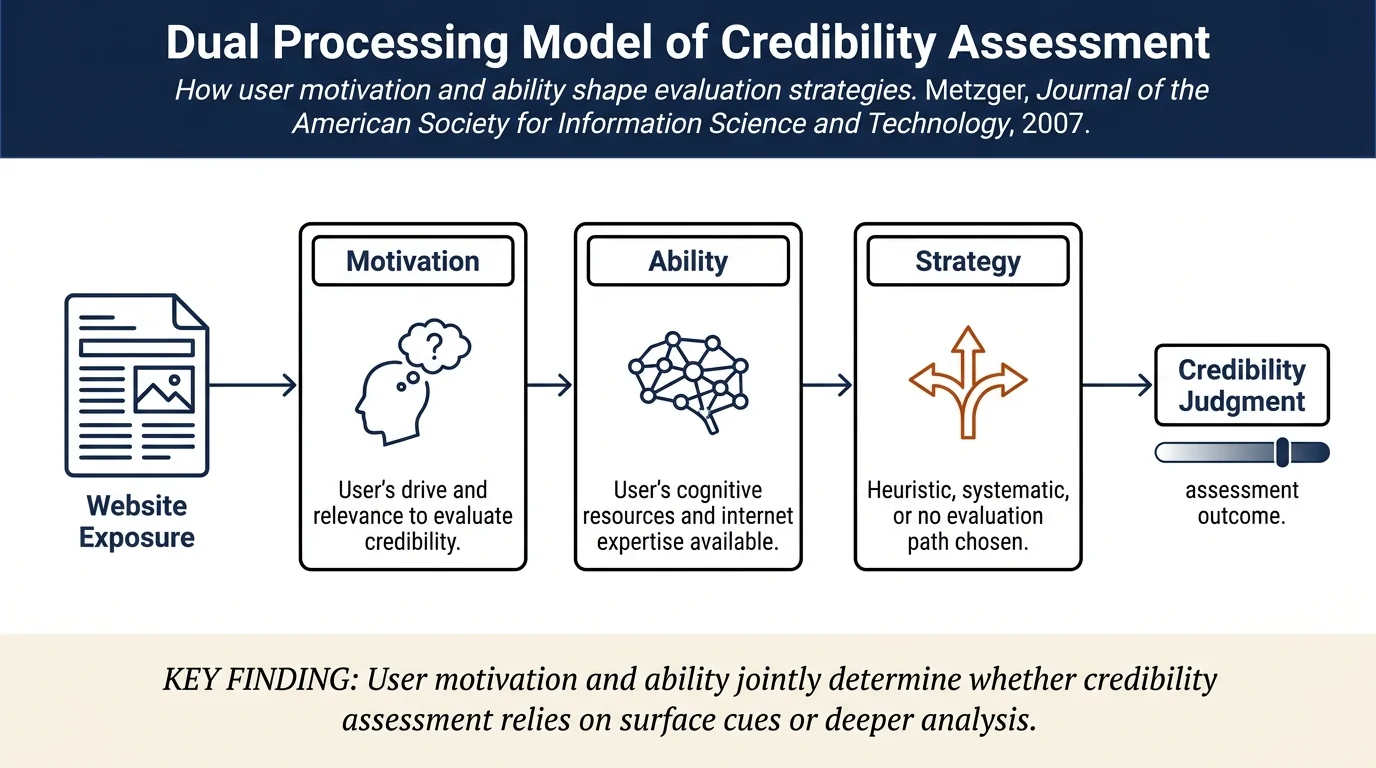
- Proposal of a dual processing model integrating users' motivation and cognitive ability
- Recommendations for educators, system designers, and researchers on improving credibility assessment
Method
This is a literature review synthesizing research from communication, information science, and education fields. Metzger synthesizes findings from multiple empirical studies on how users assess online information credibility, including:
- Studies examining verification behaviors across different user populations (college students, general Internet users)
- Research on factors influencing credibility judgments (presentation, content, source characteristics)
- Analysis of existing models and frameworks for credibility assessment
She then proposes an integrative framework combining dual processing theory from psychology with specific aspects of credibility assessment.
Results
Key findings on user evaluation behaviors:
- Users are frequently not rigorous in evaluating online information; many rely on surface heuristics
- Evaluation frequency varies by information type and user motivation
- Most commonly reported verification behaviors: checking currency, seeking additional sources, evaluating author qualifications
- Least practiced: looking for official endorsements or checking domain/URL suffixes
- Web design and presentation are primary factors in users' credibility judgments
- Users rarely employ the comprehensive criteria recommended by digital literacy programs
The dual processing model distinguishes three phases:
- Exposure phase: Web site exposure → Motivation to evaluate → Ability to evaluate
- Evaluation phase: Three possible paths based on motivation/ability: No evaluation, Heuristic/peripheral evaluation, Systematic/central evaluation
- Judgment phase: Credibility judgment outcome
This model explains why users may skip evaluation entirely (low motivation), use surface cues (ability constraints), or conduct deeper assessment (high motivation + ability).
Factors influencing credibility assessment include:
- Site characteristics: Design quality, navigation, professionalism, presence of author information, currency indicators
- Content characteristics: Comprehensiveness, accuracy, bias, objectivity, presence of citations
- Source characteristics: Authority, expertise, trustworthiness, reputation
- User factors: Prior knowledge, Internet experience, information need urgency, domain-specific expertise
Notes
Strengths:
- Integrates perspectives from multiple disciplines (communication, information science, psychology)
- Grounds theoretical models in empirical observation of actual user behavior
- Honest about gap between recommended practices and actual user behavior
- Proposes dual processing model that explains heterogeneity in user approaches
- Clear implications for education and system design
Limitations:
- Empirical studies reviewed often used small, specialized populations (college students, health information seekers)
- Limited longitudinal data on how credibility assessment practices change over time
- Some proposed theoretical models have limited empirical testing
Significance:
This paper is foundational for understanding credibility assessment in the context of online misinformation. It establishes that credibility is not a simple property of information but a judgment influenced by user motivation, ability, and cognitive resources. This insight explains why naive educational approaches (just teaching criteria) often fail—users with low motivation or high cognitive load will continue using heuristics regardless of training. The dual processing framework has influenced subsequent work on misinformation interventions and platform design.