 Andrew J. Flanagin
 Miriam Metzger
Contributions
- Historical framing of source credibility from classical rhetoric through digital-era challenges
- Synthesis of research on cross-media credibility comparisons (digital vs. traditional channels)
- Analysis of digital platforms (blogs, Wikipedia, YouTube, social media) and their credibility dynamics
- Framework for understanding how digital media disrupt traditional authority signals (institutional affiliation, professional training, gatekeeping)
- Identification of key challenges in online credibility assessment: information overload, context deficits, narrowcasting, algorithm-mediated exposure
Key Concepts
Source credibility dimensions:
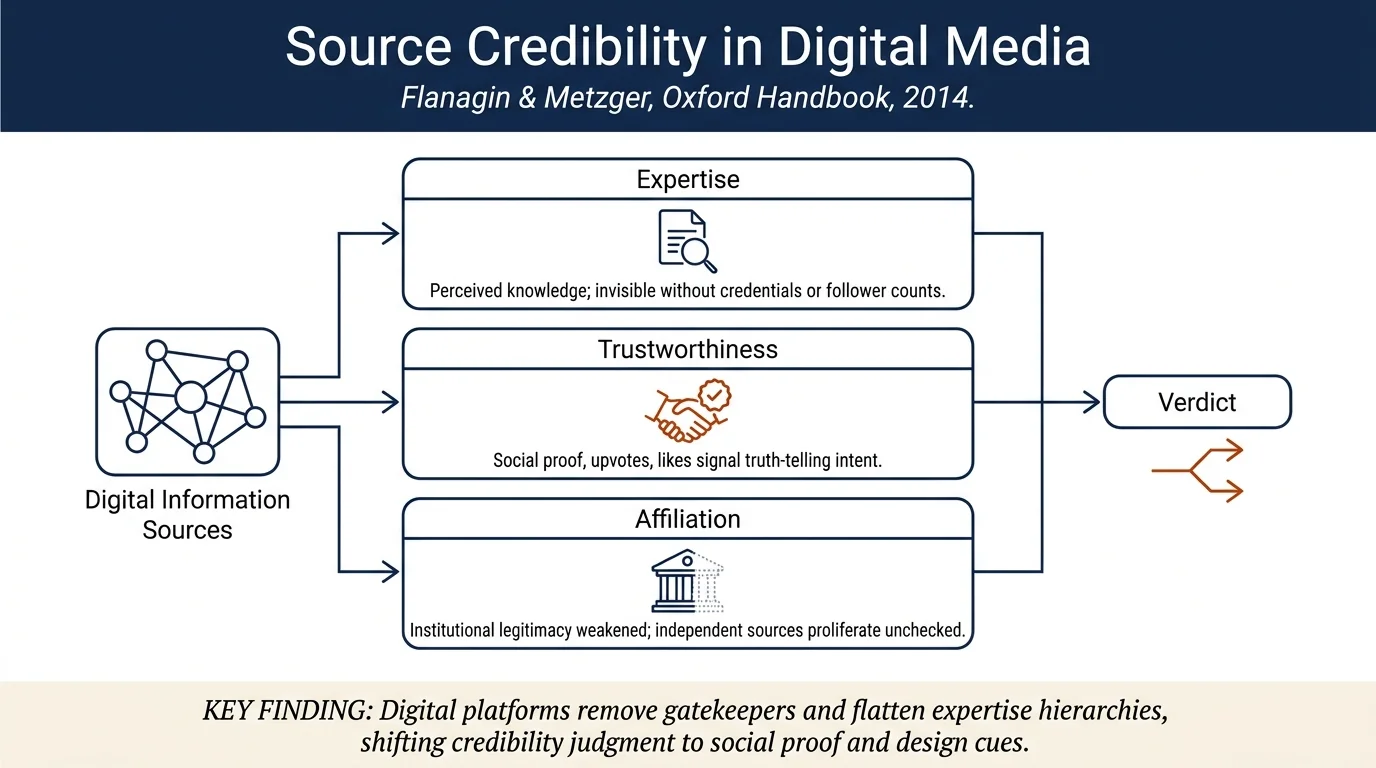
- Expertise: Perceived specialized knowledge; in digital contexts, often invisible or difficult to verify
- Trustworthiness: Perceived motivation to tell the truth; complicated by pseudonymity and algorithmic curation
- Institutional affiliation: Organizational reputation and gatekeeping; weakened for independent digital publishers
Digital vs. traditional media: Early research (Flanagin & Metzger 2000, Kiousi 2001) found newspapers rated higher than online news. Later studies show mixed results: in some contexts, online news rivals or exceeds traditional outlets; in others, blogs and social media rate lower due to perceived bias and lack of editorial oversight. YouTube viewers report greater cynicism toward government information but higher political self-efficacy.
Platform-specific findings:
- Blogs: Users rate blogs lower than traditional media on credibility and accuracy, though highly credible blogs can outperform low-credibility traditional sources. Political involvement predicts positive blog credibility judgments.
- Wikipedia: User-generated encyclopedia entries rate nearly as credible as expert-vetted sources (Britannica) among lay users, despite concerns about vandalism and bias. Institutional affiliation and information placement drive perceptions more than content quality.
- Social media: YouTube videos and Facebook political content generate polarized credibility judgments; viewers exposed to alternative sources (e.g., candidate-run versus mainstream news channels) show differential cynicism and efficacy.
Credibility heuristics online: When information is abundant and contexts ambiguous, users rely on cognitive shortcuts: source expertise (follower counts, credentials), trustworthiness signals (institutional logos, professional design), and social proof (upvotes, shares, likes). These heuristics often conflict—a source may have high social endorsement but low institutional legitimacy.
Research Gaps and Challenges
- Narrowcasting and selective exposure: As users customize their information diets through social media algorithms, credibility judgments may become polarized—different groups perceive different sources as credible based on ideological alignment.
- Authority collapse: Digital media flatten hierarchies of expertise; a physician and a Facebook commenter appear equally in a feed, complicating source-verification heuristics.
- Missing attribution: Web aggregators and social shares often strip source metadata, forcing credibility judgments on content divorced from institutional context.
- Deepfakes and synthetic media: Emerging technologies will further complicate visual and audio credibility cues.
Notes
This is a comprehensive handbook chapter that contextualizes credibility research for political communication scholars. It bridges classical rhetoric and contemporary digital-media challenges, making it essential reading for anyone studying political misinformation or trust online. The chapter's synthesis of historical context (Aristotle → Hovland → digital era) and platform-specific findings makes it a canonical reference. However, as a 2014 chapter, it predates major events (2016 election, Cambridge Analytica, TikTok rise) that reshaped credibility discourse; newer work should be consulted for post-2015 developments, especially around algorithmic amplification and coordinated inauthentic behavior.