 Miriam Metzger
 Andrew J. Flanagin
 Christo Wilson
Contributions
- Proposes a novel observational method to measure expressed (dis)belief in misinformation using social media comments as a proxy for public understanding and responses to false claims
- Collects and manually annotates a dataset of 6,809 tweets responding to fact-checked claims with binary labels for expressed belief and disbelief, disambiguating these labels into mutually exclusive categories via crowdsourced annotation
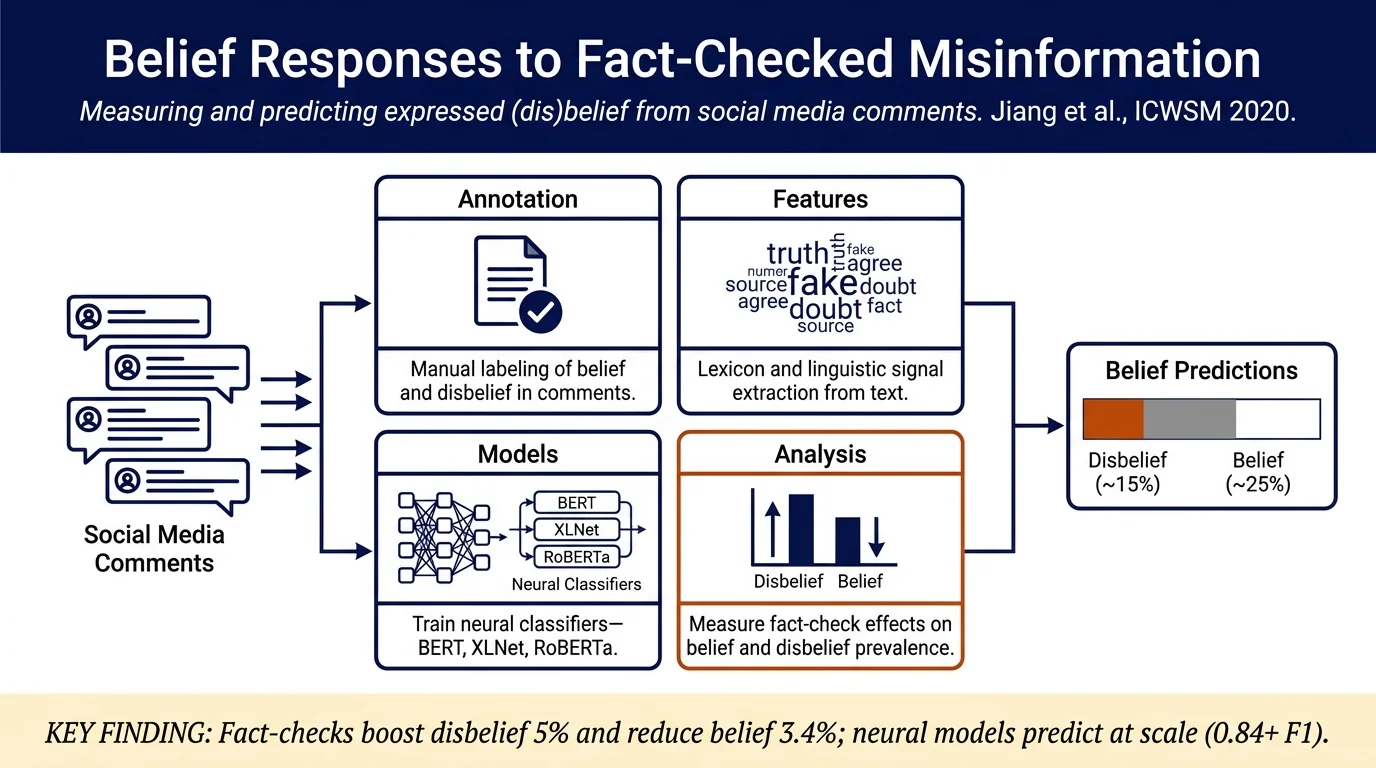
- Develops an array of NLP classifiers (lexicon-based methods with LIWC and ComLex; neural transfer-learning models: BERT, XLNet, RoBERTa) that achieve high precision-recall tradeoffs for real-world deployment, using an unbiasedness criterion to handle class imbalance
- Provides empirical answers to four research questions: (RQ1) the prevalence of expressed (dis)belief varies with claim veracity and is small but non-zero; (RQ2) time effects are extremely weak; (RQ3) fact-checks produce small but measurable positive effects on disbelief and belief reduction; (RQ4) expressed (dis)belief distributions differ significantly across mainstream social media platforms
Method
The study used an observational approach combining dataset collection, manual annotation, and classifier training:
Data collection: The authors queried PolitiFact's archival fact-checking articles published January 1–June 30, 2018, identifying 5,303 fact-checked claims and collecting $1.5m$ Twitter comments via archived tweet IDs. After filtering for non-empty comments and language consistency, 6,809 tweets remained across Facebook (2.6m comment sample), Twitter (1.5m), and YouTube (828k), targeting a narrow 1% temporal window in the archive to ensure a representative cross-platform sample.
Annotation: Comments were manually annotated by trained student annotators and verified by a faculty communication expert using a binary annotation scheme: belief (person believes the claim), disbelief (person rejects the claim), or neither. Inter-annotator agreement was high (Cohen's $\kappa$ above 70% for pairwise agreement; 88.9% for three-way majority vote). The final binary label was obtained by majority vote over three annotators where two or more disagreed, yielding a 3-label schema: belief, disbelief, neither.
Classifier development: Multiple models were trained and evaluated using 80% training, 20% test split:
- Lexicon-based: LIWC (Linguistic Inquiry and Word Count) and ComLex (custom domain-specific lexicon) with log-odds ratio scoring to identify words differentially associated with belief/disbelief
- Linear models: Logistic regression on lexicon-derived features (LIWC: 102 categories; ComLex: 300 categories)
- Neural transfer-learning: Pre-trained transformers (BERT, XLNet, RoBERTa) fine-tuned on the labeled dataset with custom classification heads
Evaluation metrics: unbiasedness (balanced error rates, Fisher's exact test), binary-$F_1$ scores, macro-$F_1$ scores, and micro-$F_1$ scores. Models were compared using threshold-varying precision-recall curves, selecting thresholds to optimize for unbiasedness and F1.
Analysis of effects: Regression models quantified the effects of temporal dynamics and fact-checks on (dis)belief using ordinary least squares (OLS) with comments as the unit of analysis. Time effects ($\Delta_{c,m}$) were modeled as the difference between comment timestamp and claim publication date; fact-check effects ($1_{F>0}$) as a binary indicator of whether a fact-check article was published before the comment. The model was: $\hat{b} = \beta_0 + \beta_1 \Delta_{c,m} + \beta_2 \mathcal{I}(\Delta_{c,m} > 0) + \epsilon$.
Results
Prevalence (RQ1): For true/mixed/false claims on social media, expressed disbelief prevalence was 12%–15% and expressed belief was 20%–26%, with large variation across claims (Figure 3). Disbelief increased as claim veracity decreased (true: 12% disbelief, mixed: 14%, false: 15%), while belief decreased (true: 26%, mixed: 21%, false: 20%).
Time effect (RQ2): Negligible. Disbelief awareness increased only 0.001% per day and belief decreased 0.002% per day after claim publication (Table 2, $\beta_1$ estimates, $p < 0.001$). Despite high effect-size heterogeneity across individual claims, the population-level time effect was substantially smaller than the initial false claim's effect on (dis)belief.
Fact-check effect (RQ3): Small but significant. Following publication of a fact-check article (controlling for time), disbelief increased 5% ($\beta_2 = +9.96 \times 10^{-8}$, $p < 0.001$) and belief decreased 3.4% ($\beta_2 = -5.41 \times 10^{-2}$, $p < 0.001$). Effect sizes were small because the analysis was performed at the comment level, with vast sample sizes.
Classifier performance: Linear classifiers with lexicon-derived features achieved macro-$F_1$ scores of 0.647 (disbelief) and 0.666 (belief). Neural transfer-learning classifiers (BERT, XLNet, RoBERTa) achieved macro-$F_1$ scores of approximately 0.84–0.86 for disbelief and 0.78–0.80 for belief (Figure 5). RoBERTa was the best performer, achieving 0.864 macro-$F_1$ for disbelief and 0.884 micro-$F_1$ overall.
Platform differences (RQ4): Facebook comments expressed significantly less disbelief than YouTube; Twitter disbelief was intermediate. Belief differences across platforms were not significant for Twitter vs. YouTube, but Facebook expressed more belief than YouTube (Figure 7). These platform differences suggest divergent audience compositions or platform affordances affect how users respond to misinformation.
Notes
Strengths:
- Large-scale observational study spanning 1.5+ million social media comments across three major platforms, providing genuine population-level prevalence estimates of expressed (dis)belief
- Rigorous annotation protocol with high inter-rater reliability and transparent majority-vote schema; disambiguation of belief/disbelief as mutually exclusive categories via crowdsourcing
- Comprehensive classifier development pipeline comparing lexicon-based, linear, and neural approaches with principled evaluation metrics (unbiasedness, F1 tradeoffs) for real-world deployment
- Clear research questions and straightforward statistical modeling; temporal and fact-check effects examined simultaneously via regression controlling for confounds
- Addresses a gap in the literature: prior surveys asked people via questionnaire about belief; this study measures expressed belief in-the-wild, reducing self-report bias
Limitations:
- Comments are an imperfect proxy for true underlying belief; not all users comment, and commenting behavior may not reflect private beliefs (Hawthorne effect, differential self-expression across demographics)
- Fact-checked claims are non-representative of the broader misinformation ecosystem; claims that reach PolitiFact or Snopes tend to be high-profile political or health claims, not uniform across all misinformation types
- Dataset limited to narrow temporal window (Jan–Jun 2018) in response to 2016 election cycle; generalizability to other periods and geopolitical contexts unknown
- Linguistic signals used by classifiers may conflate expressed (dis)belief with sarcasm, satire, or irony (not fully disambiguated in annotation)
- Small absolute effect sizes for time and fact-check interventions; practical significance remains unclear despite statistical significance