 Andrew J. Flanagin
 Miriam Metzger
Contributions
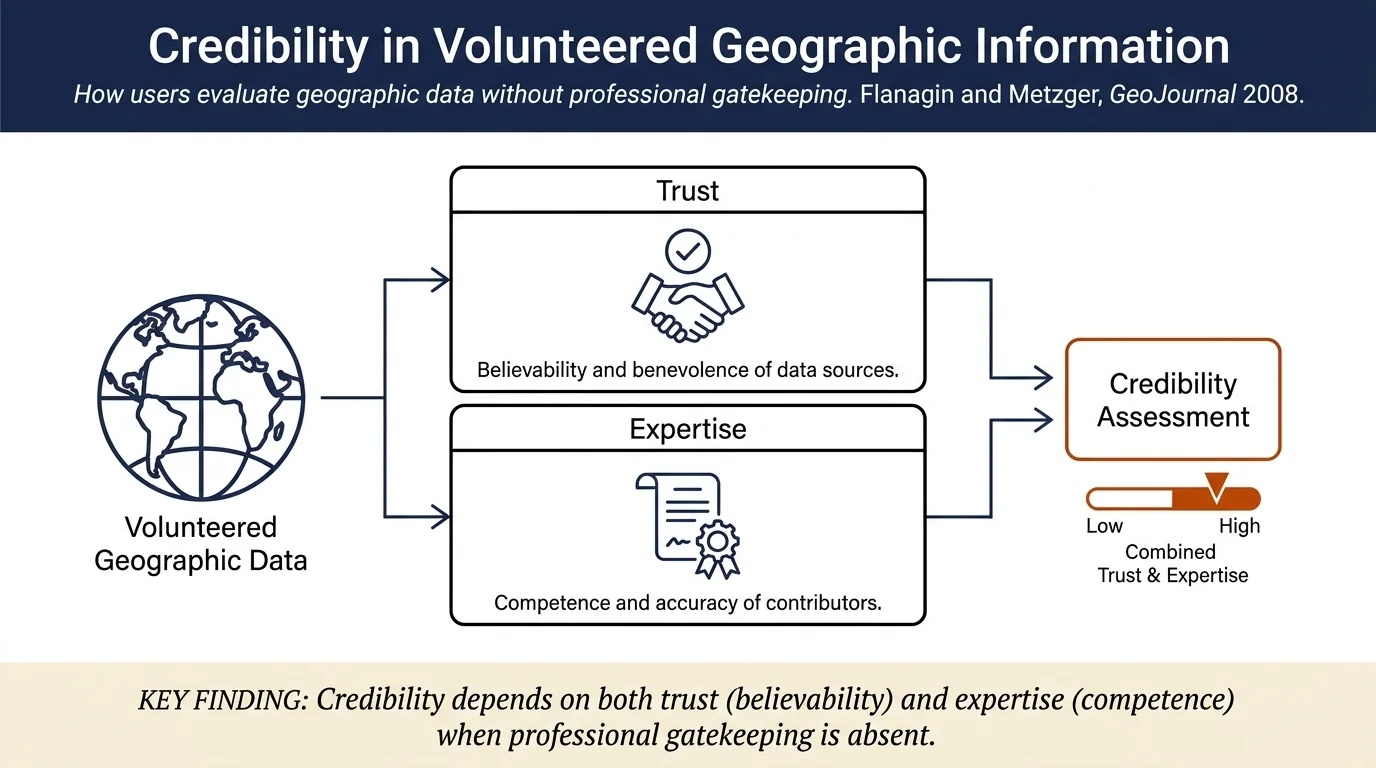
- Framework integrating trust and expertise as the core dimensions of credibility, applicable to both factual and subjective geographic information
- Identification of four critical challenges specific to VGI credibility: information abundance (too much to evaluate), source authentication (identity and credentials often unavailable), context deficit (removed from original production circumstances), and technology-mediated evaluation (hyperlinked structure obscures provenance)
- Discussion of how traditional credibility assessment conventions break down in VGI contexts where professional gatekeepers are absent
- Analysis of heuristic cues (source professionalism, layout, consistency, reputation signals) that users employ to judge credibility quickly despite high cognitive load
- Research agenda distinguishing credibility-as-accuracy (whether information is factually correct) from credibility-as-perception (whether users believe information), with implications for different VGI domains (factual geographic data vs. subjective editorial interpretation)
- Strategies for improving VGI credibility: transparency mechanisms (source attribution, edit histories, versioning), community oversight (Wikipedia-style review and rating systems), and education enabling users to evaluate geographic information systematically
Method
This is a conceptual and position paper; it does not report original empirical data. Instead, Flanagin and Metzger synthesize existing credibility research, examine case studies of major VGI systems (Wikipedia, Google Earth, Google Maps, OpenStreetMap), and apply credibility theory to the emerging landscape of user-generated geographic information. The authors leverage their prior empirical research on web credibility and media literacy to frame the theoretical challenges and opportunities.
Key arguments
Information environment and social computing: The proliferation of networked computers and social computing practices has enabled large-scale geographic information sharing. 35% of U.S. Internet users have created content, 34% have shared it, and 32% have rated products/services. The lowered barriers to contribution mean traditional information production — controlled by trained experts and institutional gatekeepers — has been supplemented and sometimes replaced by collaborative, distributed creation.
Credibility and its dimensions: Credibility is fundamentally multidimensional, encompassing:
- Trust: Believability or benevolence—whether the source is perceived as honest and well-intentioned. Trust is subjective and receiver-dependent.
- Expertise: Perceived competence, knowledge, and accuracy. Expertise includes both objective credentials (training, reputation) and subjective factors (perceived familiarity, consistency with receiver expectations).
Both dimensions are perceptual; technically inaccurate information can be perceived as credible if source trust/expertise appear high, and vice versa.
Information abundance and gatekeeping: Historically, geographic information was produced by trained professionals (cartographers, surveyors, GIS specialists) and vetted before publication. This limited supply created information scarcity and high barriers to entry. VGI systems (Flickr for photos, Wikmedia commons, OpenStreetMap) invert this model: anyone can contribute. Benefits include unprecedented coverage, real-time updates, and local expertise. Costs include loss of professional verification, inconsistency in quality and accuracy, and cognitive overload for users evaluating vast information variety.
Specific VGI credibility challenges:
-
Source transparency: In VGI, the author's identity, credentials, and intentions are often opaque. Users see geographic data or maps but cannot easily learn who created them, what training they had, or what biases might exist. This context deficit undermines systematic credibility evaluation.
-
Multiplicity and re-purposing: Geographic data created for one purpose (e.g., local hikers tagging trails on OpenStreetMap) are often re-aggregated and re-used in other contexts (e.g., emergency response systems). Users may not know the original production intent or quality standards, creating intertextual credibility ambiguity.
-
Heuristic reliance: Given the volume and complexity of VGI, users rely on quick heuristics to judge credibility: "Does the site look professional?" "Are edits attributed to real people?" "Does the data agree with other sources I've seen?" These cues are useful but vulnerable to manipulation—spoofed professional-looking sites, fake contributors, and coordinated misinformation can exploit credibility heuristics.
-
Accuracy vs. perception mismatch: A map or geographic dataset might be objectively accurate but lack signals (citations, source attribution, edit history) that users use to judge it credible. Conversely, poorly constructed but polished-looking geographic materials can appear highly credible despite inaccuracy.
Strategies for VGI credibility assessment: The authors discuss emerging approaches:
- Transparency tools: Wikipedia-style edit histories showing who changed what and when; version control revealing how information has evolved; source attribution for each data point.
- Community oversight: Ratings and reviews by other contributors; community-driven deletion and merge decisions; mechanisms for flagging disputes.
- User training: Educating individuals in geographic literacy, critical evaluation of data sources, and understanding the limitations of crowdsourced information.
- System design: Tools like WikiScanner (IP address lookup) revealing editor identities; browser plugins showing edit patterns and author reputation; integration of multiple data sources to highlight consensus or disagreement.
Domain specificity: Credibility evaluation differs for different information types. Factual geographic data (coordinates, map boundaries) might be assessed differently than editorial information (neighborhood descriptions, local history). Some VGI users (emergency responders, planners) require high certainty; others (casual map browsers) tolerate more ambiguity.
Results and implications
The paper does not report experimental results but instead outlines implications of VGI credibility challenges:
-
For users: VGI literacy becomes increasingly important as geographic information proliferates. Users must learn to evaluate sources, compare multiple VGI systems, and understand the limitations of crowdsourced data.
-
For VGI system designers: Transparency, community oversight, and educational support can partially mitigate credibility concerns but cannot eliminate them entirely. No single tool or mechanism suffices.
-
For information professionals (cartographers, GIS specialists, planners): VGI is neither uniformly trustworthy nor uniformly unreliable. Strategic integration of VGI with traditional authoritative data sources — where VGI provides coverage and real-time updates, professionals provide verification — may offer a balanced approach.
-
For researchers: Questions remain about the factors that influence credibility judgments of VGI specifically (beyond generic web credibility cues), the role of community reputation systems, and whether education can improve VGI evaluation accuracy in practice.
Notes
Strengths:
- Prescient positioning of VGI credibility challenges before large-scale adoption of collaborative geographic platforms (the paper anticipated Wikipedia's centrality to geographic knowledge, Google Maps' impact, and OpenStreetMap's growth)
- Clear integration of communication theory (trust/expertise dimensions) with geographic information systems literature
- Acknowledgment of both benefits and risks of VGI rather than dismissing user-generated content as inherently unreliable
- Practical recommendations grounded in credibility theory and emerging VGI systems at the time
- Recognition that credibility is multidimensional and context-dependent, not a binary property
Limitations:
- Conceptual rather than empirical; lacks systematic data on how users actually evaluate VGI credibility or which transparency mechanisms are most effective
- Written in 2008, before many VGI ecosystems matured; some specific technical details (e.g., collaborative filtering algorithms) are dated
- Limited discussion of adversarial contexts where bad actors deliberately manipulate VGI to introduce misinformation
- Relatively brief treatment of the political and social dimensions of geographic information (e.g., whose knowledge counts, power asymmetries in mapping practices)
Significance:
This paper is foundational for understanding how credibility assessment changes when information production is decoupled from professional gatekeeping. The frameworks developed here — trust/expertise dimensions, heuristic cues, information abundance challenges — apply far beyond geographic information to any user-generated content system (social media, review platforms, collaborative knowledge bases). The paper's prescience in identifying VGI as a credibility challenge anticipated the broader questions facing information integrity researchers: how do we evaluate source reliability when anyone can publish, when institutional gatekeepers are bypassed, and when information abundance overwhelms systematic evaluation? The paper also contributes to the broader communication literature by grounding credibility theory in emerging digital contexts and showing that classic trust/expertise frameworks remain useful even when information systems radically change.