Contributions
- First empirical work examining social and group-based credibility assessment processes online, moving beyond isolated individual judgment models
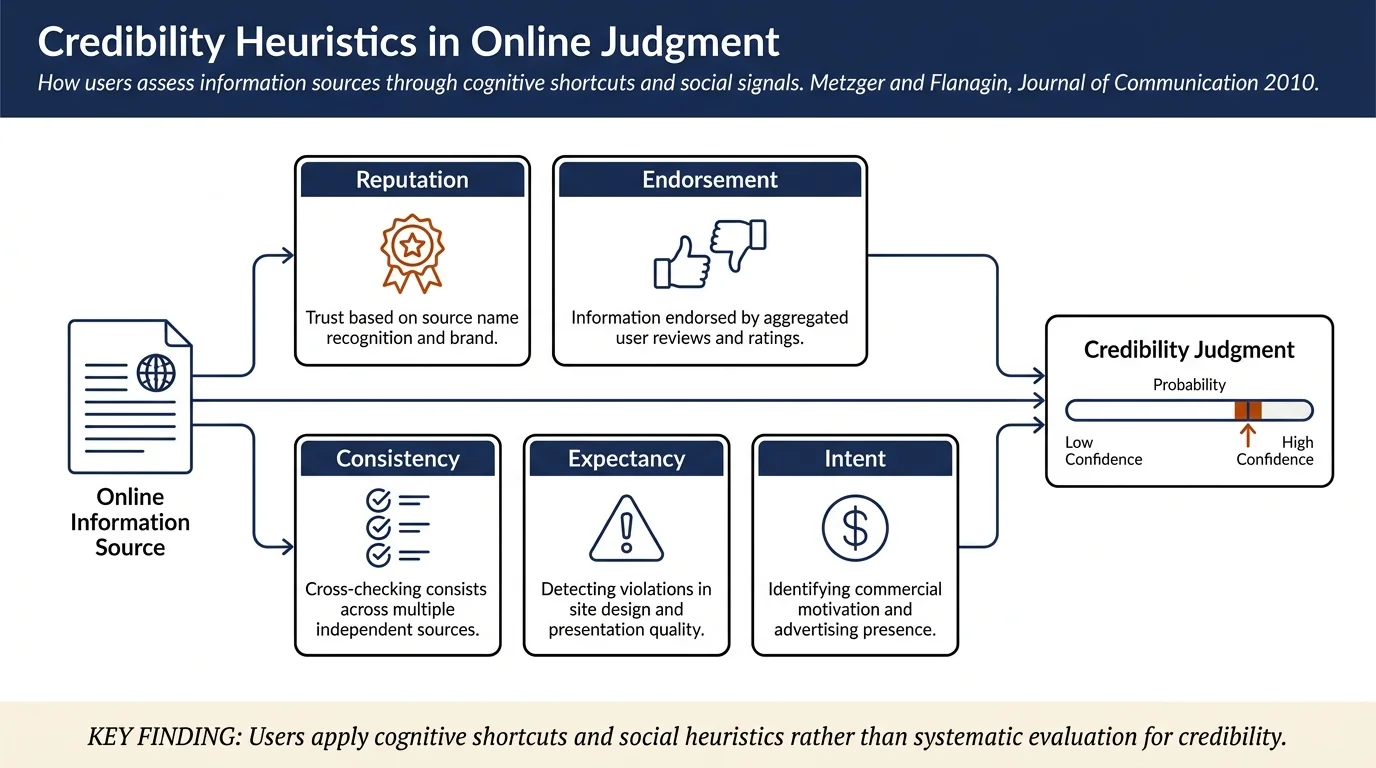
- Identified five cognitive heuristics routinely invoked by users: reputation (source name recognition), endorsement (others' recommendations), consistency (alignment with existing beliefs), expectancy violation (violations of format/design expectations), and persuasive intent (detection of commercial motivation)
- Demonstrated that users rely heavily on social information pooling—aggregated reviews, ratings, testimonials—rather than effortful systematic evaluation of source credentials
- Showed that social computing tools (wikis, ratings systems, blogs) enable new forms of distributed credibility assessment, decoupling authority from institutional hierarchy
Method
Qualitative study using focus groups rather than surveys to capture naturalistic credibility-assessment strategies. Conducted 11 focus groups (7–12 participants each, mean 10) across 10 U.S. cities, with 109 total participants screened for demographic diversity and internet experience (ranging from "beginner" to "advanced"). Sessions were video and audio recorded, fully transcribed, and analyzed using the constant comparison method; categorical responses were grouped by frequency, specificity, and similarity to extract emergent themes.
Results
Data analysis revealed four central themes on social and group-based credibility assessment:
Social information pooling. Participants heavily relied on user-generated feedback systems—reviews, ratings, testimonials—to assess credibility. Many reported checking the number and tone of reviews (favoring balanced negative/positive reviews over all-positive ones), using reputation systems on e-commerce sites, and consulting discussion forums. Testimonials from real users were deemed more credible than manufacturer claims.
Social confirmation of personal opinion. Participants sought information that matched their existing beliefs and reported stopping their search once they found confirming sources. They looked for like-minded individuals and valued information found through personal social networks. This selectivity introduced biases but also served as a credibility filter (e.g., "I trust information that agrees with people I already trust").
Enthusiast endorsements. Participants relied on non-credentialed but knowledgeable "enthusiasts" offering guidance via public forums, blogs, and wikis. Trust in enthusiasts grew over time through repeated interaction and demonstrated expertise. However, participants were skeptical of Wikipedia and other self-edited sources, perceiving them as less trustworthy than traditional authorities.
Resource sharing via interpersonal exchange. Participants actively sought recommendations from friends and family and shared URLs and credible sites through e-mail and conversation. Interpersonal recommendations were perceived as highly reliable, particularly from trusted sources.
The analysis also revealed five cognitive heuristics:
Reputation heuristic. Participants relied on site or source reputation and name recognition (e.g., trusting Amazon or government websites more readily than unfamiliar sources) to avoid more effortful evaluation. Brand reputation served as a proxy for credibility.
Endorsement heuristic. People perceived information as credible if endorsed by others (consensus heuristic / bandwagon effect). Trust derived from aggregated feedback (star ratings, comment volumes) was used to infer source credibility.
Consistency heuristic. Participants validated information by checking consistency across multiple sites. If information found across different sources aligned, it was deemed credible without deeper scrutiny. Cross-validation requires more effort than other heuristics but still less than systematic evaluation.
Expectancy violation heuristic. Violations of expectations about site appearance, functionality, or information format (poor design, unexpected data requests, grammatical errors, redirect loops) triggered suspicion and negative credibility judgments. Professional presentation served as a credibility signal.
Persuasive intent heuristic. Detection of advertising or commercial motivation triggered negative credibility judgments. Intrusive ads, pop-ups, and aggressive persuasion were immediate signals of low credibility. However, some participants took persuasive intent as a positive signal (e.g., ".com" domains associated with commercial but transparent information).
Notes
This is a foundational empirical study documenting how ordinary people actually evaluate credibility online, grounding the field's understanding of user behavior in qualitative data. The five heuristics taxonomy has become a widely-cited framework in credibility research. The work highlights that credibility assessment is not a deliberate, systematic process but rather reliant on quick cognitive shortcuts, which has significant implications for misinformation vulnerability: users readily trust sources aligned with existing beliefs or endorsed by perceived peers, often without scrutinizing content quality or source expertise. The finding that social media and ratings systems enable new forms of distributed credibility assessment is particularly prescient given subsequent developments in platform design and peer-to-peer verification.