 Andrew J. Flanagin
 Miriam Metzger
Contributions
- First large-scale, nationally representative survey of how children and adolescents (11–18 years) assess information credibility online, filling a major gap in the literature.
- Comprehensive documentation of youth Internet usage patterns, including time spent online, primary activities, parental control strategies, and perceived skill levels.
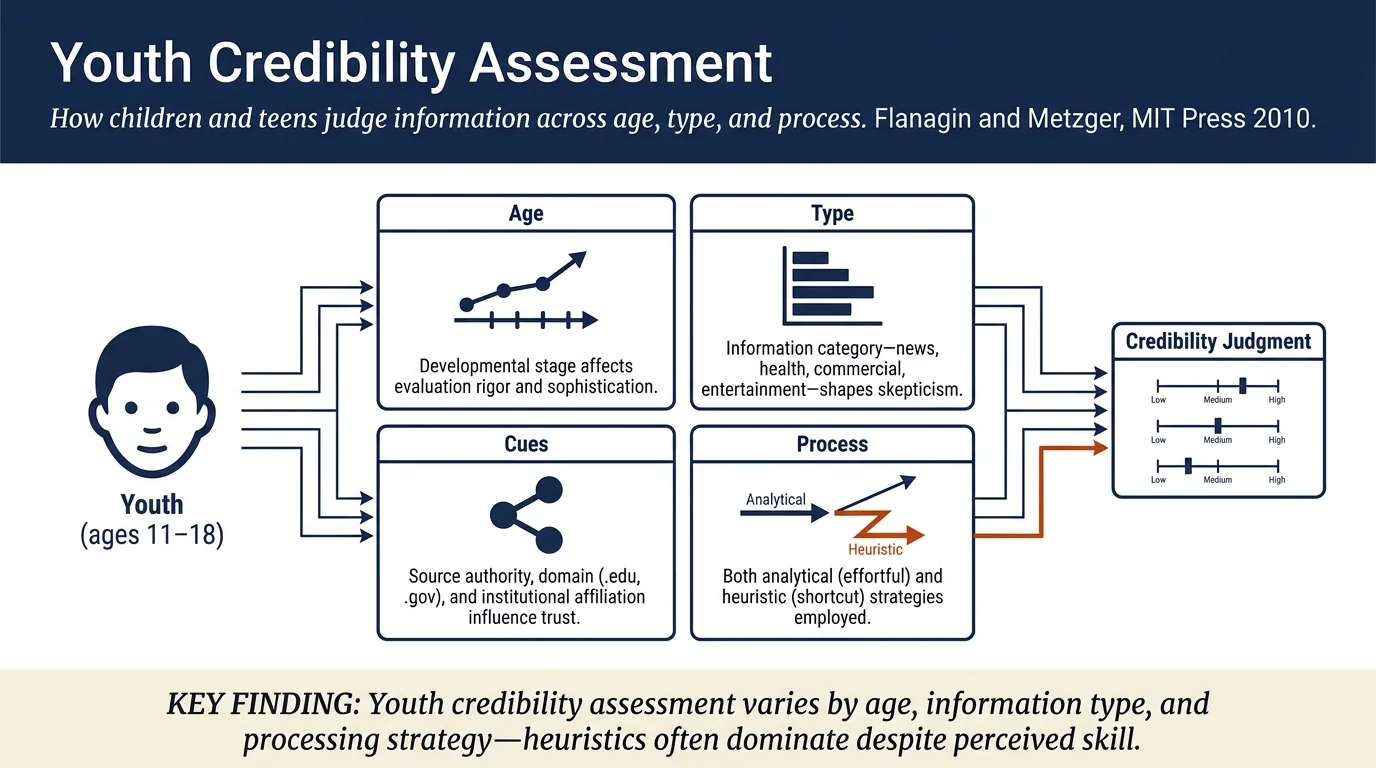
- Empirical evidence that children's credibility concerns stem from both analytic evaluation and heuristic processing, with the mix varying by information type and age.
- Demonstration that children differentiate credibility assessment by content type: children are skeptical of commercial/entertainment information but more credulous about health, educational, and news information.
- Finding that Wikipedia is perceived as highly credible by youth, often more credible than other online sources, but actual source of encyclopedia content is often misattributed.
- Evidence that parental involvement (discussing trustworthiness, monitoring, controlling) is associated with children's credibility concerns, suggesting parental mediation influences credibility literacy.
- Identification of an "optimistic bias": both children and parents believe they are better at assessing credibility than the average user, and parents believe themselves more credible than their children.
Method
Study design: Large-scale, Web-based survey administered through Knowledge Networks, a nationally representative online panel.
Participants:
- Primary sample: 2,747 children ages 11–18 with Internet access in the United States
- Parent sample: 1 parent per child ($N = 2,747$) surveyed on household digital media use and parenting practices
- Approximately equal representation across age cohorts (340–385 participants per year of age)
- Demographically representative: 75% white, 9% black, 9% Hispanic, 4% other/mixed race; household income averaging $60,000–$85,000; 53% of parents had college education or higher
Survey administration:
- Fielded June 17–July 12, 2009
- Online survey via Knowledge Networks' panel system
- 3,136 parent-child pairs invited; 2,747 completed (91.7% qualified completion rate; 46.3% response rate)
- Longitudinal weighting applied to match U.S. Census demographics for Internet households
Survey instruments:
- Multi-step, multi-method development: literature review, focus groups with children ages 9–18, consultation with developmental and cognitive psychology experts, iterative refinement with parent-child dyads, pilot testing with 183 college students
- Questionnaire sections: 1. Children's Internet use: frequency, duration, activities, skill self-assessment 2. Perceived trust and credibility of online information 3. Factors affecting credibility judgments (source, presentation, verification behaviors) 4. Child–parent dyads and credibility assessments 5. Website exposure and evaluation (hoax sites, commercial content, encyclopedia entries)
Key measures:
- Internet usage: hours per week, age at first use, parental control methods
- Credibility perception: 5-point Likert scales on perceived trustworthiness of different information sources (Internet, Wikipedia, news sites, commercial sites, health sites, blogs)
- Credibility factors: open-ended and multiple-choice questions about why children trust or distrust information
- Website credibility evaluation: presented participants with actual websites (hoax sites, legitimate sites, Wikipedia entries) and asked credibility judgments
Statistical methods:
- Descriptive statistics and cross-tabulation for survey findings
- Generalized linear models for predictors of credibility concerns
- Child–parent agreement analysis for credibility assessments
Results
Internet Usage Among Youth
- Early adoption: 97% of children in the sample were online by eighth grade; majority began between second and sixth grade
- Frequency and duration: Children spend an average of 13.5 hours per week online (range: 1–26 hours); usage increases with age, from 8.2 hours/week for 11-year-olds to 16.4 hours/week for 18-year-olds
- Primary activities: Social networking, information search, entertainment (gaming and media viewing), commercial activity (shopping), information contribution (blogs, forums)
- Parental control: 75% of parents control their child's Internet access; primary methods include placing computer in common location (53%), limiting sites (42%), limiting time (42%), controlling access in other ways (25%); oversight decreases substantially as children age
Perceived Trust and Credibility
- Internet as credible source: 89% of youth report online information as "some" to "a lot" believable; concern about credibility does not decrease credibility reliance
- Source credibility rankings: Internet rated most believable for schoolwork, entertainment, and commercial information; second most believable for health information; rated highly for news information
- Wikipedia credibility: Children find Wikipedia substantially credible, though many misidentify its source or operation; entries appearing to come from established encyclopedias (Britannica, Encyclopædia Britannica) are rated more credible than when attributed correctly to Wikipedia
- Platform-specific beliefs: Children report finding entertainment and health information equally believable online as other sources; more skeptical of strangers and anonymous sources; somewhat skeptical of blogs
- Bad experiences: One-third of children reported bad experiences with false information online (e.g., heard a false rumor about someone, received scam email, encountered hoax information)
Factors Affecting Credibility Assessment
Analytic processes:
- 73% of children have received some form of information literacy training (at school or home)
- Children report examining multiple cues: author reputation, information currency, consistency across sources
- Concern about credibility is driven largely by analytic evaluation (effortful, deliberate), not just heuristic processing
Heuristic processes:
- Children rely on cues like source authority, visual design, and ease of access
- Institutional affiliation strongly influences credibility (e.g., .gov, .org, .edu domains trusted more than commercial)
- Older children show greater diversity and rigor in credibility assessment; younger children rely more on surface-level cues
Information-type differences:
- News information: Mostly believed, with 70%+ credibility; children report Internet is second-most believable source after TV
- Health information: High credibility; children report Internet is second-most credible source after doctors/health professionals
- Entertainment information: Generally believed; credibility does not vary much across source
- Commercial information: Lower credibility; children recognize persuasive intent but many still believe product ratings highly
Child–Parent Dyads and Credibility
- Agreement: Parents and children generally agree on what is credible. Correlation in credibility beliefs is moderate to strong across most information types
- Disagreement: Major source of disagreement is who is better at assessing credibility:
- Parents believe they are more adept at assessing credibility than their children
- Children believe they are highly skilled Internet users (though often overestimate their skill)
- Gap is largest for younger children; narrows with age
- Parents believe younger children in particular are at risk from false information
Website Exposure and Evaluation
- Hoax websites: Approximately 90% of children showed appropriate skepticism when presented with hoax websites (e.g., sites claiming false information like "Dihydrogen Monoxide")
- Encyclopedia entries: Children perceived encyclopedia entries as credible overall; perceived credibility of same content varied significantly by source attribution (Wikipedia entry less credible than content from Britannica or Citizendium, even when substantively identical)
- Commercial content: Children generally rate product reviews as credible; older children show slightly higher influence from review quantity and rating aggregates
Notes
Strengths:
- Representative sample: Large, nationally representative online panel (Knowledge Networks) reduces selection bias compared to convenience samples (e.g., college students or recruited samples).
- Comprehensive scope: Covers multiple dimensions of credibility assessment (sources, media types, information categories, demographic differences), not just a single cue or narrow domain.
- Age range: Spans 11–18 years, capturing critical developmental periods in cognition and media use; allows examination of age-related trends.
- Child–parent dyads: Unique inclusion of parallel parent data enables examination of family dynamics in credibility literacy.
- Multi-step instrument development: Questionnaire refined through focus groups, expert consultation, and pilot testing, suggesting good construct validity.
Limitations:
- Self-report: Credibility judgments are reported, not observed in situ; may not reflect actual behavior when children encounter information online.
- Snapshot in time (2009): Conducted during the early social-media era; youth media use and credibility strategies may have evolved substantially with algorithmic feeds, visual media (TikTok), and AI-generated content.
- Limited detail on methodology: As a monograph report (not a journal article), some statistical details and validity coefficients are not fully reported; Appendix B provides additional methodological detail but is not fully accessible here.
- Generalization: Results are representative of U.S. Internet households but may not generalize to countries with different media environments or media regulation.
- Analysis level: Largely descriptive and correlational; causal inference about parental mediation or credibility training requires experimental or longitudinal designs.
Implications:
- Credibility literacy is not automatic: Despite digital nativity, youth do not naturally engage sophisticated credibility evaluation; both analytic and heuristic processes are present, with heuristics often dominant.
- Institutional affiliation is a powerful cue: Children (like adults) rely heavily on source reputation and institutional authority; this can be leveraged for credibility education but also exploited in misinformation.
- Parental mediation matters: Discussion between parents and children about trustworthiness is associated with credibility concerns; suggests that co-viewing and co-browsing with guidance may improve credibility literacy.
- Information type shapes assessment: Children apply different standards to different content; commercial skepticism does not transfer to news or health, suggesting that credibility literacy may be domain-specific.
- Wikipedia misunderstanding: High credibility assigned to Wikipedia but misattribution of content suggests that platform design and labeling could improve understanding of user-generated versus expert-vetted information.
Future directions:
- Update with contemporary youth (2020s), when algorithmic feeds and visual media (TikTok, YouTube Shorts, AI-generated images) dominate.
- Examine in-situ behavior: observe children's actual credibility evaluation strategies when encountering information naturally.
- Longitudinal follow-up: assess whether credibility concerns and literacy evolve over time, and whether parental mediation at age 11 predicts behavior at 18.
- Intervention trials: test whether credibility education programs improve youth verification strategies and reduce susceptibility to misinformation.
- Cross-cultural comparison: extend to multiple countries to identify whether credibility assessment patterns are culturally universal or shaped by media institutions and regulation.
Related works by these authors
This monograph synthesizes and extends the authors' prior work on credibility:
- Perceptions of Internet Information Credibility — Earlier empirical study of how adults assess credibility; lays groundwork for the youth extension here.
- The role of site features, user attributes, and information verification behaviors on the perceived credibility of web-based information — Experimental study of website design features and credibility; provides theoretical context for understanding how design influences youth judgments.
- The credibility of volunteered geographic information — Conceptual framework for understanding credibility in user-generated information systems; relevant to Wikipedia findings here.
- From Encyclopædia Britannica to Wikipedia: Generational differences in the perceived credibility of online encyclopedia information — Follow-up with overlapping sample; quasi-experimental test of placement and source cues in credibility; directly extends findings from this monograph.
Similar papers
The Special Case of Youth and Digital Information CredibilityBelieving the Unbelievable: Understanding Young People's Information Literacy Beliefs and Practices in the United StatesDigital Media and Youth: Unparalleled Opportunity and Unprecedented ResponsibilityDigital Media, Youth, and Credibility
Discussed in GUIDE by
Source Credibility, Expertise, and Trust in Health and Risk Messaging Hocevar et al. · 2017Comparative Optimism in Online Credibility Evaluation Among Parents and Children Metzger et al. · 2015Mitigating risk in ecommerce transactions: perceptions of information credibility and the role of user-generated ratings in product quality and purchase intention Flanagin et al. · 2014The Special Case of Youth and Digital Information Credibility Metzger et al. · 2013The Perceived Credibility of Online Encyclopedias among Children Flanagin & Metzger · 2010The Perceived Credibility of Personal Web Page Information as Influenced by the Sex of the Source Flanagin & Metzger · 2003