 Andrew J. Flanagin
 Miriam Metzger
Contributions
- First systematic empirical examination of how people (across generations) perceive the credibility of user-generated versus expert-vetted online encyclopedic information.
- Demonstrates that the context in which information appears (which encyclopedia's page it appears on) is a critical credibility cue that may override actual content origin.
- Identifies significant generational differences: children's credibility judgments are placement-driven (context matters most); adults' judgments emphasize both content origin and placement.
- Shows that information from Wikipedia is perceived as significantly more credible when attributed to Encyclopædia Britannica, indicating weak understanding of how Wikipedia operates and reliance on source-reputation heuristics.
Method
The study employed a quasi-experimental design with two large-scale surveys:
Participants: 2,747 children (11–18 years) and 3,991 adults (18+ years), representative of the US Internet-using population, surveyed online in 2009 by Knowledge Networks.
Questionnaire: Multi-stage, multi-method development process including focus groups and iterative refinement. Surveys included questions about Wikipedia usage, knowledge of how it operates, and perceived credibility. The core instrument contained a quasi-experiment with embedded experimental stimuli.
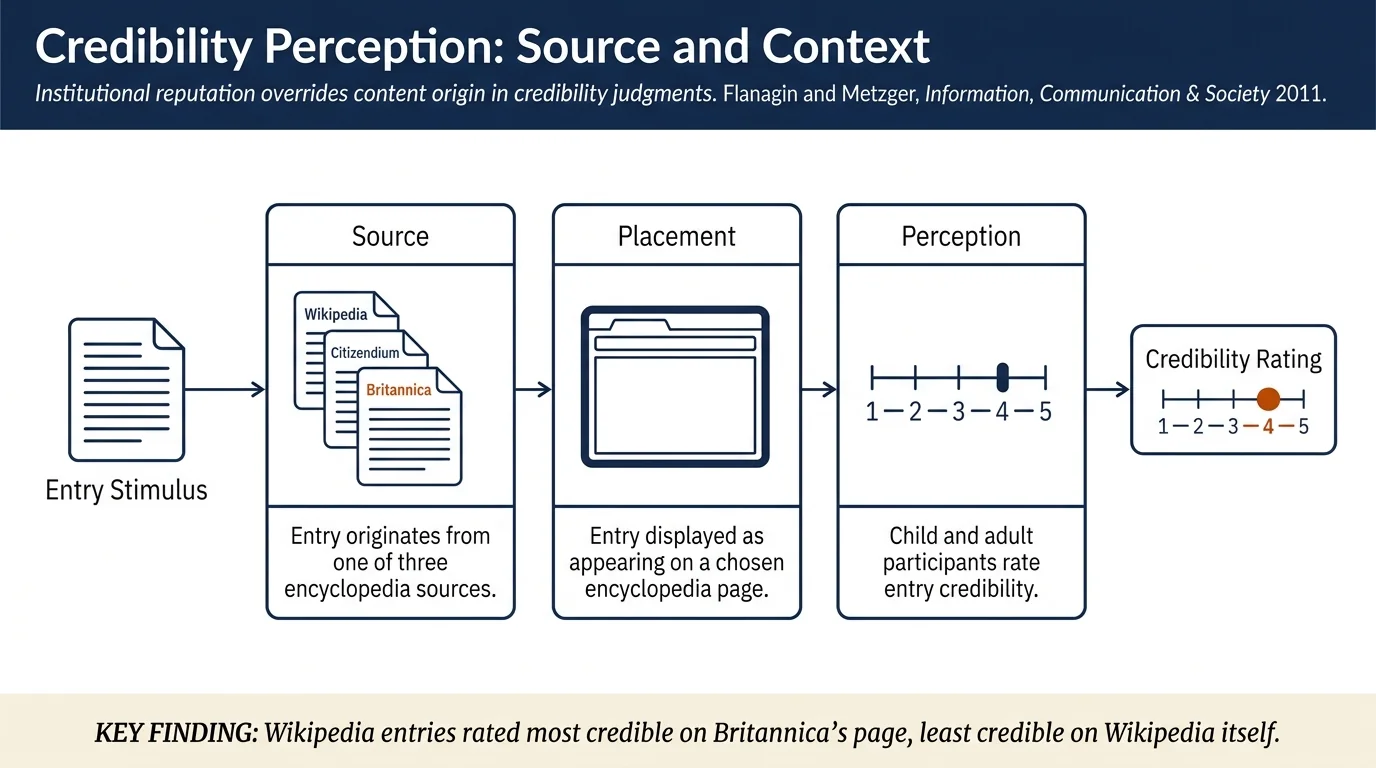
Quasi-experimental stimuli: 18 different web page images were created, each showing an encyclopedia entry on the actual page of one of three online encyclopedias: Wikipedia (user-generated, anonymous contributors), Citizendium (user-generated with named contributors reviewed by experts), and Encyclopædia Britannica (expert-vetted, 250+ years of authority). Two topics (global warming, homeopathy) were selected; entries were edited to be roughly equal in length and substantive content across sources.
Credibility measures: Participants viewed entries and rated perceived credibility on 5-point Likert scales (1 = "not at all," 5 = "a whole lot"). Perceived information credibility was the primary outcome; familiarity with each encyclopedia was statistically controlled.
Statistical analysis: Generalized Linear Model (GLM) for the survey data; ANCOVA (Analysis of Covariance) for the quasi-experiment, with two independent variables: (1) encyclopedia entry source (which encyclopedia the entry actually came from) and (2) encyclopedia entry placement (which encyclopedia's page it appeared on). Interaction effects were examined separately for children and adults.
Results
Survey findings:
- 98.7% of children and 97.5% of adults had heard of Wikipedia.
- Many people (9% of children, 19% of adults) admitted they did not know what Wikipedia is, despite recognizing the name.
- Children and adults did not differ significantly on frequency of Wikipedia use or general credibility ratings of Wikipedia information (mean ratings ~3.0 on 5-point scale for both groups).
- Both groups reported others should believe information on Wikipedia less than they themselves believe it (indicating an "optimistic bias" effect).
Quasi-experimental findings for children ($N = 183$):
- Encyclopedia entry placement had a highly significant main effect ($F(2, 170) = 15.58, p < 0.001$). Entries on Britannica's page were rated most credible ($\bar{X} = 3.63, SE = 0.12$); entries on Citizendium's page ($\bar{X} = 3.34, SE = 0.17$) and Wikipedia's page ($\bar{X} = 2.63, SE = 0.13$) were rated significantly less credible.
- Encyclopedia entry source (actual origin) had no main effect ($F(2, 170) = 0.90, p = 0.41$).
- Significant interaction: Encyclopedia placement and source interacted significantly ($\eta^2 = 0.07$). Critically, children rated Wikipedia-sourced entries as least credible when shown on Wikipedia ($\bar{X} = 2.15, SE = 0.22$), but most credible when shown on Britannica's page ($\bar{X} = 3.99, SE = 0.21$). Children's credibility judgments were entirely driven by page placement, not actual content origin.
Quasi-experimental findings for adults ($N = 283$):
- Encyclopedia placement was significant ($F(2, 269) = 10.22, p < 0.001$). Britannica entries were perceived most credible ($\bar{X} = 3.52, SE = 0.12$); Wikipedia entries significantly less credible ($\bar{X} = 2.83, SE = 0.11$). Citizendium fell in between.
- Encyclopedia source was also significant ($F(2, 269) = 9.26, p < 0.001$). Entries that actually originated from Britannica ($\bar{X} = 3.41, SE = 0.12$) were more credible than those from Wikipedia ($\bar{X} = 3.30, SE = 0.11$).
- Interaction between placement and source ($\eta^2 = 0.07$). Unlike children, adults showed nuanced effects: they trusted Britannica content most regardless of placement; Wikipedia entries appearing on Britannica's page ($\bar{X} = 3.99, SE = 0.21$) were perceived as significantly more credible than when shown on Wikipedia ($\bar{X} = 2.83, SE = 0.11$).
- Both children and adults rated Citizendium entries similarly regardless of placement ($p = 0.15$), suggesting weaker recognition and institutional affiliation cues for Citizendium.
Direct comparison: Entries that actually originated from Wikipedia were perceived as least credible when shown on a Wikipedia page, yet most credible when shown on Encyclopædia Britannica's page. This demonstrates that content origin was essentially invisible to both age groups; credibility judgments were anchored to institutional reputation and page context.
Notes
Strength: This is a rare experimental study with large, representative samples and a clever quasi-experimental design that isolates the effects of information placement from content origin. The finding that Wikipedia-sourced content is perceived as most credible when falsely attributed to Britannica is striking and actionable.
Limitation: The study used only two topics (global warming, homeopathy). Results may not generalize to other domains; controversial topics might evoke different heuristics. Additionally, the quasi-experiment presented text pages, not live Wikipedia interfaces with their distinctive design cues (edit history links, talk pages, edit counts), which might prime different credibility heuristics in real-world browsing.
Implications: The results suggest that:
- Users rely heavily on institutional reputation rather than on understanding Wikipedia's actual editorial processes or content accuracy.
- Placing Wikipedia content on a trusted source's page can reverse credibility assessments, suggesting that platform interventions (e.g., source labeling, explicit content origin attribution) might be needed to surface actual information provenance.
- Generational familiarity with Wikipedia does not automatically translate to sophisticated credibility assessment; both children and adults employ the same reputation-based heuristics.
Future directions: Extend to additional topics, examine live Wikipedia interfaces with full metadata visible, investigate whether explicit training on Wikipedia's processes can reduce reliance on placement-based heuristics, and examine whether repeated exposure to accurate Wikipedia content (via behavioral priming) shifts credibility perceptions over time.