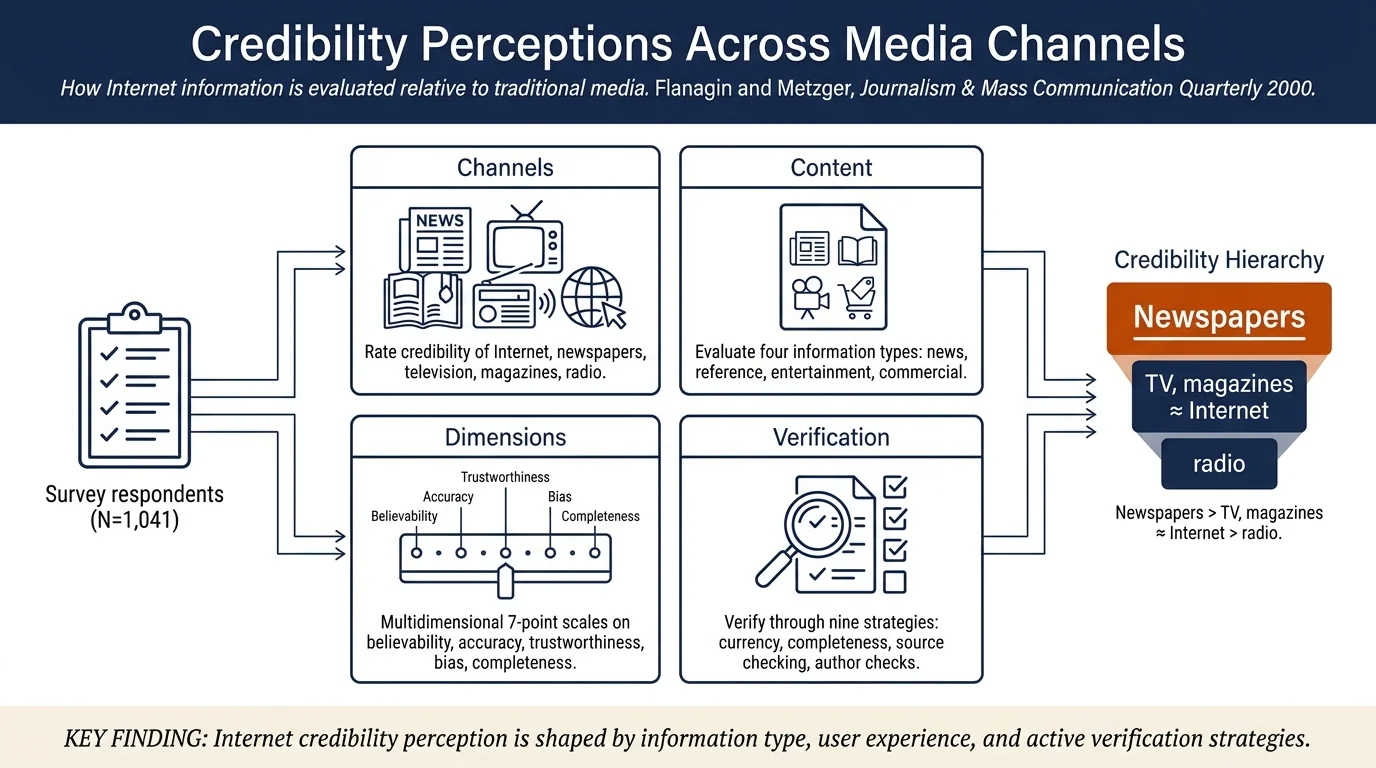
Contributions
- Establishes comparative credibility ratings across Internet/WWW, newspapers, television, magazines, and radio for multiple information types (news, reference, entertainment, commercial)
- Identifies information type as a significant factor in perceived credibility: news and reference information rated more credibly than entertainment and commercial information
- Demonstrates that user experience with the Internet correlates positively with Internet credibility perception
- Documents the specific verification strategies Internet users employ when evaluating online information
- Finds that newspapers are perceived as significantly more credible than all other media channels
Method
The authors surveyed 1,041 respondents (N=1,041), primarily from the U.S. West Coast, combining undergraduate students and community respondents. Respondents rated the credibility of five media channels—Internet/WWW, newspapers, television, magazines, and radio—across four information types: news, reference (factual information), entertainment, and commercial.
Media credibility was operationalized as a multidimensional construct using 7-point scales across believability, accuracy, trustworthiness, bias, and completeness. Verification of Internet information was measured using a 5-point scale assessing nine verification strategies: (1) checking whether information is current; (2) checking completeness; (3) considering opinion vs. fact; (4) seeking other sources; (5) considering author's goals; (6) checking author identity; (7) looking for official approval or recommendation; (8) checking contact information; (9) verifying author qualifications.
Results
Primary finding (RQ1): Internet/WWW information was rated significantly less credible than newspaper information (mean difference substantial) but statistically equivalent to television and magazines. The medium effect was highly significant (F = 114.12, p < .001).
Information type effects (RQ3): News and reference information were perceived as significantly more credible than entertainment and commercial information. This pattern held across media, though newspapers showed uniquely high credibility for reference and news information.
Internet experience effects (H1–H3): More experienced Internet users rated Internet information as more credible than less experienced users (H1 supported). However, Internet experience did not make users rate Internet information as more credible than information from other media overall (H2 not supported). Internet experience was positively correlated with verification of online information (H3 supported).
Verification behaviors (RQ4): Respondents employed verification strategies at varying rates: checking currency ranked highest (mean 3.19), followed by checking completeness (2.98) and considering opinion vs. fact (2.91). Less common were verifying author qualifications (2.10) and checking contact information (2.20). Verification behavior varied significantly by information type: reference information was verified more rigorously than news or entertainment information.
Key result: News information obtained via the Internet showed an exception to the general Internet credibility gap—the Internet was rated equivalently to magazines and radio for news, but not for reference information. This suggests the content medium (news vs. reference) interacts with channel effects.
Notes
This is a landmark study establishing empirical baselines for Internet credibility perceptions in the early web era (1998–1999 data collection). The work predates widespread misinformation and social-media scale but establishes enduring patterns: users do discriminate among information types, experience shapes trust, and verification requires active user engagement.
The finding that newspapers maintain credibility superiority across most information types reflects pre-2008 media trust patterns and may not generalize post-digitalization. The gap between Internet and traditional media credibility persists in later work, though the overall credibility of news media has declined substantially.
The verification strategies identified here remain relevant: the paper documents that users attempt source-checking, seeking multiple sources, and author-verification—but do so inconsistently and with low rate of application of some strategies. This has implications for both information literacy interventions and platform design to support credibility assessment.