 Andrew J. Flanagin
 Miriam Metzger
Contributions
- Demonstrates empirically that online consumers find web-based commercial information credible relative to traditional information sources (television, newspapers, magazines, in-person consultation)
- Provides experimental evidence that average product ratings significantly influence perceptions of product quality across multiple product categories (cameras, toothbrushes, luggage)
- Shows that product quality acts as a mediator between user ratings and purchase intention—ratings affect purchasing decisions by shaping perceived quality, not by direct persuasion
- Identifies that consumers neglect the number of ratings in favor of average rating, even when rating volume varies dramatically (4 ratings vs. 1,002 ratings); shows this heuristic is suboptimal because rating volume provides information independent of average rating
- Reveals consumer susceptibility to informational social influence and cognitive heuristics in evaluating product information online
Method
Nationally representative survey (N=3,991 U.S. adults) and controlled experiment (N=2,139 participants).
Survey component: Measured perceived credibility of web-based commercial information by asking which of several information sources (Internet, television, books, magazines, newspapers, radio, in-person consultation) users would trust for product information and evaluated the importance of various factors (ratings, recommendations, website credibility cues) in assessing commercial information credibility.
Experimental component: Presented participants with product pages from Amazon.com featuring three product types (digital camera, electric toothbrush, rolling luggage) with systematically manipulated ratings information. The experiment used a 7 (number of ratings: 4, 16, 102, 1,002) by 7 (average rating: 1.6, 2.32, 3.0, 3.68, 4.4, 4.84, 5.0 stars) factorial design, with participants randomly assigned to conditions. Dependent variables measured perceived product quality ("On a scale of 0 to 10, how would you rate the quality of this product?") and purchase intention ("If you needed a [product], how likely would you be to purchase this particular one?") on a scale where scale midpoint of 5 is defined as "The quality is about average."
Results
Survey findings:
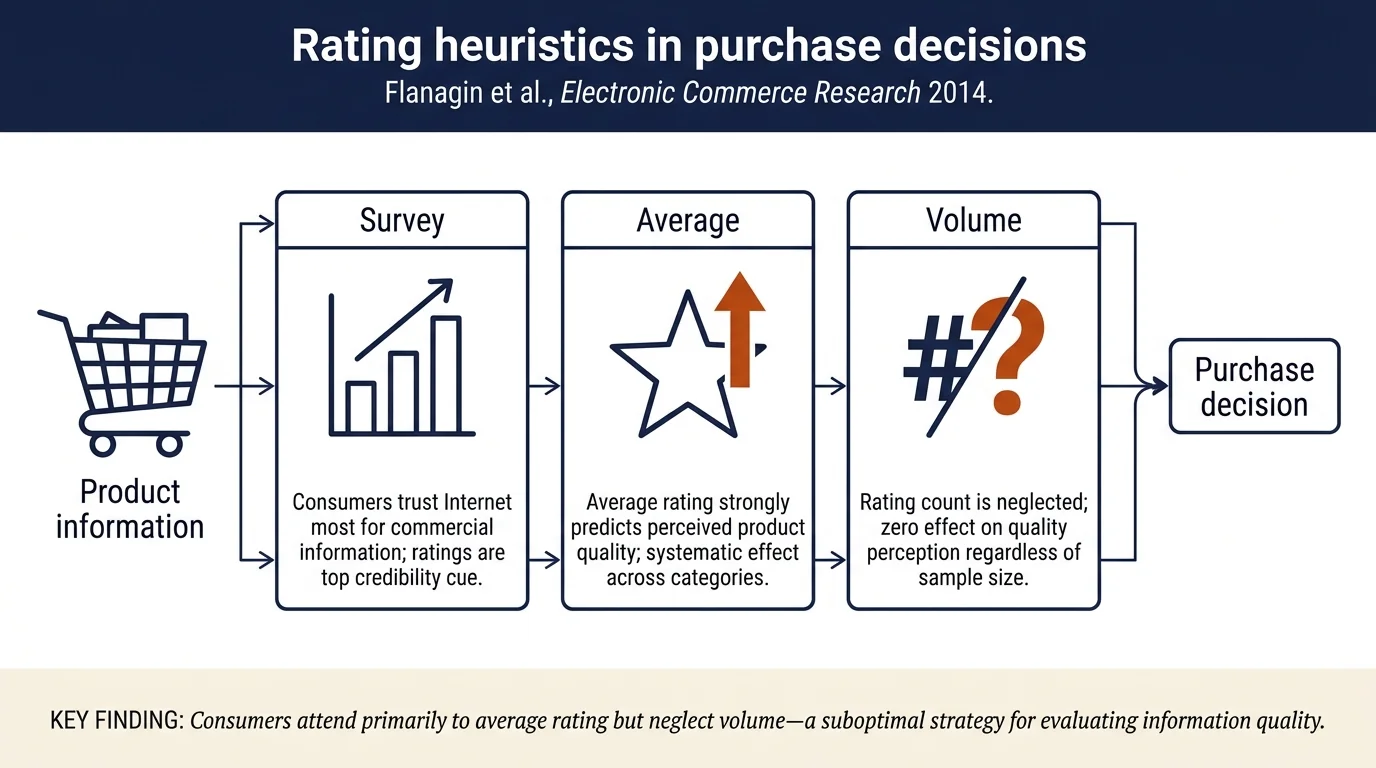
- Consumers report higher relative trust in the Internet for commercial information than all other sources ($\chi^2$ = 5456.32, $df$ = 6, $p < .001)$. When comparing the Internet to other channels, 49% of respondents indicate they would trust web-based information most for product information, compared to 30% who indicated they would believe someone they talk to in person.
- Among various credibility cues, the existence of "high ratings, positive comments, or good reviews" ranks most important for credibility evaluation (mean rating $\bar{X} = 3.75$, $SD = 1.00$), significantly more important than website security, information currency, information completeness, or whether the website is easy to use.
Experiment findings:
Average rating effects: Significant multivariate effects for average star rating across all three product types (cameras [$F(6, 673) = 18.32$, $p < .001$, partial $\eta^2 = .14$]; luggage [$F(6, 679) = 6.75$, $p < .001$, partial $\eta^2 = .06$]; toothbrush [$F(6, 742) = 1.56$, $p = .162$]). As average ratings increased, perceived product quality increased systematically. At low rating levels (1.6 stars), mean perceived quality approximately 4.0; at high levels (5.0 stars), mean approximately 8.0.
Rating volume effects: No main effect of rating volume on perceived product quality or purchase intention across product types. Contrary to Hypothesis 2, consumers do not attend to the number of ratings provided. Even when rating volume varies from 4 to 1,002 ratings, perceived product quality is statistically equivalent when average rating is held constant. This finding contradicts prior focus-group research and suggests that people employ heuristic processing, focusing on average rating but neglecting volume as a credibility indicator.
Mediation effects: Product quality fully mediates the relationship between average ratings and purchase intention. Sequential mediation model (Sobel test $t = 22.23$, $p < .001$) demonstrates that user ratings influence purchasing decisions by shaping perceptions of product quality, not through direct persuasive effects. This finding supports the theoretical framing of ratings as a risk-mitigation mechanism: ratings reduce perceived uncertainty about product quality, which in turn influences willingness to purchase.
Notes
This paper documents an important limitation of human credibility assessment online: the reliance on average rating (a summary statistic) while neglecting rating volume (which provides independent information about sample size and reliability). The finding that rating volume has zero effect on credibility perception, even at extreme differences (4 vs. 1,002 ratings), suggests consumers apply simple heuristics that can be exploited by biased or manipulated rating systems. The mediation finding—that ratings influence purchases by affecting perceived quality rather than through direct persuasion—provides a theoretical account of why user-generated ratings are so influential in e-commerce and aligns with broader literature on how consumers reduce uncertainty in high-risk transactions. The nationally representative survey grounds findings in a generalizable population, strengthening claims about typical consumer behavior. Future work should examine whether this same pattern holds across product categories with higher stakes (health, security) and whether interventions highlighting rating volume can improve credibility assessment.