 Andrew J. Flanagin
 Miriam Metzger
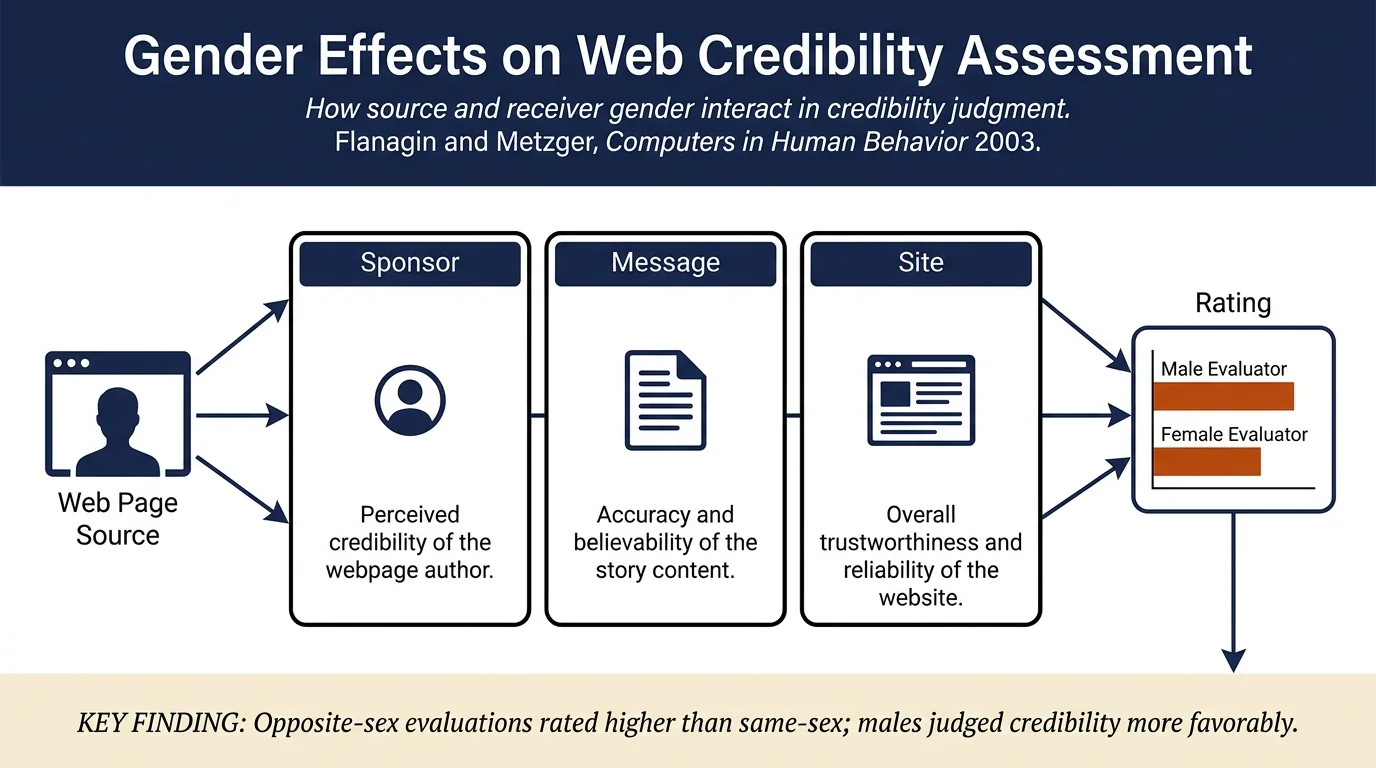
Contributions
- First empirical investigation of gender effects on credibility perception of personal web pages
- Demonstrates that opposite-sex source evaluations yield higher credibility ratings than same-sex evaluations
- Shows males rate personal web pages more favorably than females across multiple credibility dimensions
- Identifies sex-based interaction effects between source gender and receiver gender in online contexts
- Applies source credibility research to the online environment with controlled experimental design
Method
The study employed a 2×2 field experiment design with 156 participants (62.8% female, mean age 30.38 years). Participants viewed one of two realistic personal web pages constructed by researchers ("Jeff Newman" or "Julie Newman"), each featuring a male or female photograph. All pages contained identical content—a story about the potentially harmful effects of radiation on pregnant women—but were attributed to either a male or female source.
Credibility was measured across three dimensions using validated scales: (1) sponsor credibility (5 items measuring perceived credibility of the webpage author), (2) message credibility (5 items assessing believability, accuracy, and trustworthiness of the information), and (3) site credibility (6 items measuring perceived trustworthiness, reliability, and authoritativeness of the website overall). Control variables included information verification behavior, Internet/web experience, and demographics.
The pretest phase involved 118 participants rating eight pilot photographs to select equally attractive male and female images for the main study. Participants were instructed to browse the web page naturally, read the story, verify information if desired, and complete an online questionnaire.
Results
A 2 (source sex) × 2 (receiver sex) MANOVA revealed significant main effects for receiver sex on both message and site credibility. Males ($M = 4.39$) rated both message and site credibility higher than females ($M = 4.00$; $F[1, 145] = 8.98$, $p < 0.01$). Males rated the credibility of the radiation story significantly higher than females across both male and female web sites ($F[1, 145] = 5.32$, $p < 0.05$).
Crucially, significant sex interactions emerged: women judged the female website and its message as significantly less credible (message $M = 3.56$; site $M = 3.25$) than the male website (message $M = 3.82$; site $M = 4.14$; $p < 0.05$). Men showed the opposite pattern, rating Julie's (female) site as more credible than Jeff's (male) site overall ($M = 3.87$ vs. $M = 4.66$, $p < 0.05$). Same-sex credibility evaluations were lower than opposite-sex evaluations across both male and female evaluators.
Sponsor credibility showed no significant main effect but interesting patterns in direction, suggesting that credibility attributions differ between the message content and the person presenting it.
Notes
This paper is a foundational empirical study on how demographic characteristics of sources affect credibility perception in web-based information. The finding that opposite-sex evaluations are more favorable than same-sex evaluations—contradicting predictions from similarity-matching theory in this context—merits careful interpretation. The reduced cues environment of personal web pages (lacking traditional editorial gatekeeping) makes source-based cues more salient, amplifying gender effects compared to traditional media contexts.
A key contribution is demonstrating that sex differences in credibility assessment are robust even when information content is held constant, and that the interaction between source gender and receiver gender is non-intuitive: females were actually harsher judges of female-authored content than male content. The paper acknowledges limitations in generalizability (artificial web sites, specific story content) and calls for broader investigation of gender effects across diverse web-based information types.