 Andrew J. Flanagin
 Miriam Metzger
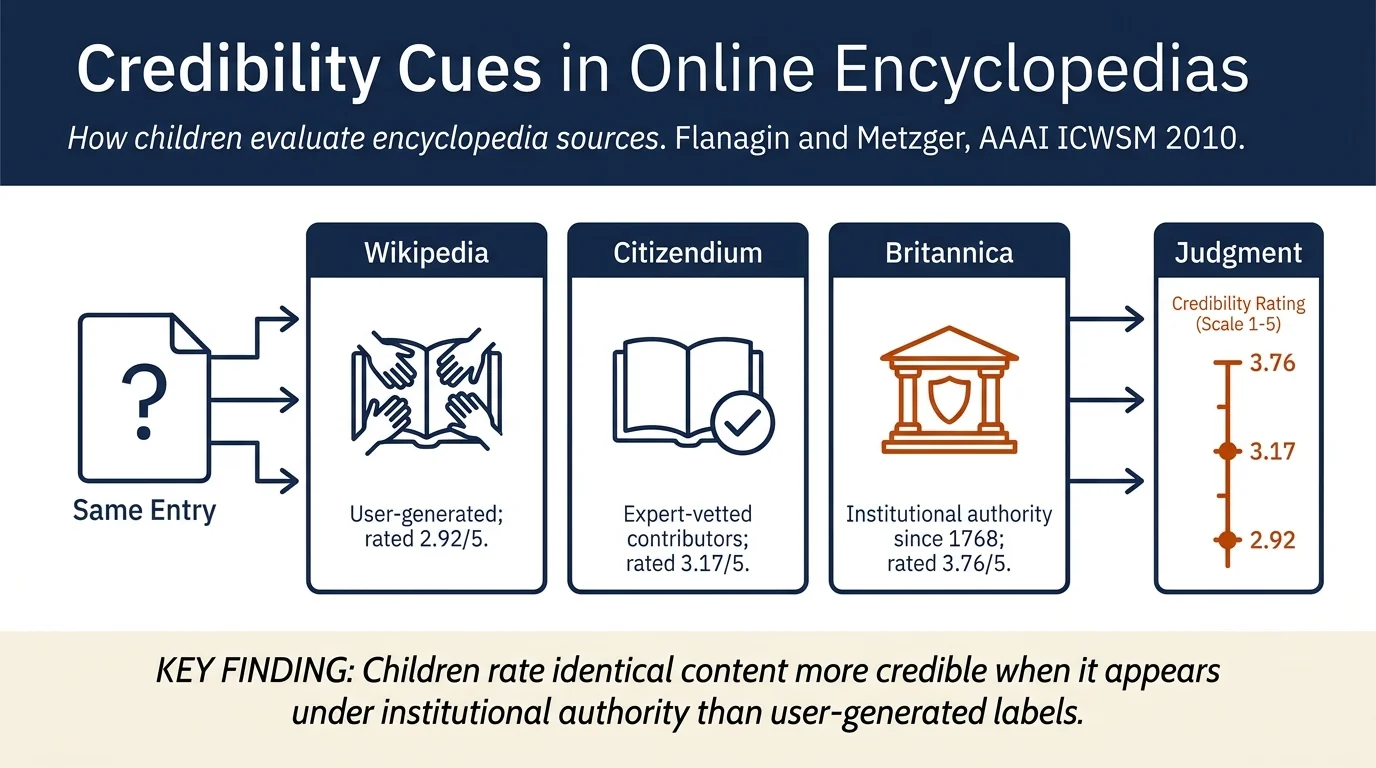
Contributions
- First systematic empirical examination of youth credibility assessments of user-generated versus expert-generated online encyclopedias.
- Large-scale, nationally representative survey with 2,747 children, using quasi-experimental embedded methods to test competing theories of credibility evaluation.
- Demonstration that children differentiate between Wikipedia, Citizendium (expert-vetted user contributions), and Encyclopedia Britannica, with significant perception gaps despite identical content.
- Evidence that children rely primarily on contextual credibility cues (source/site affiliation) over content cues when evaluating encyclopedia information.
- Finding that the actual source of an entry matters less than the perceived source or placement—same content deemed more credible under an expert-authority banner.
- Identification of an apparent paradox: children show awareness of risks in anonymous user-generated content, yet rate Wikipedia credible at nearly the same level as more-vetted alternatives.
Method
Survey design and participants:
- Web-based survey administered June–July 2009 through Knowledge Networks, a probability-based online panel
- Sample: 2,747 children ages 11–18 from across the U.S., with high demographic representativeness
- Response rate: 46.3%; qualified completion rate 91.7%
- Survey responses weighted to match U.S. Census demographics for Internet households
General survey measures:
- Familiarity with Wikipedia and understanding of how it operates (what Wikipedia is, 7-item identification task)
- Perceived credibility: 5-point scales asking how much children believe and how much they think people should believe information in Wikipedia
- Usage frequency and contribution history
- Age-stratified analysis across the 11–18 age range
Quasi-experimental methods: Two embedded experiments designed to isolate the effects of source/context cues versus content cues:
Experiment 1 (source/context cues):
- Participants viewed an identical encyclopedia entry (created from information pooled from all three encyclopedias to ensure content was equal)
- Entry was presented as originating from one of three sources:
- Wikipedia: "where anyone can add or change information at any time without giving their real names"
- Citizendium: "where anyone can contribute entries, as long as they are identified by their real names and where all contributions are reviewed by experts before being accepted"
- Encyclopedia Britannica: "whose entries have been contributed by respected experts worldwide since 1768"
- Participants evaluated credibility on 5-point scale
- Screening question confirmed participants understood the differences in editorial processes
Experiment 2 (content cues interact with context):
- Used actual encyclopedia entries on two topics (global warming, homeopathy) from each source, edited to roughly equal length
- 18 different page images created: 2 topics × 3 original sources × 3 placement sites
- Participants saw one entry presented as from one encyclopedia but actually originating from any of the three
- Measured how actual content source (independent variable) interacts with perceived source/placement (independent variable) to affect credibility judgments
- Screening question again confirmed understanding of editorial methods
Results
Survey findings
- Awareness: 99% of children had heard of Wikipedia; 84% had used it for information
- Contribution: Only 12% had written or changed information; those who did reported doing so rarely
- Understanding: Only 78% correctly identified what Wikipedia is from a 7-item list; 9% said they didn't know
- Perceived credibility: 28% believe Wikipedia information "a lot," 43% believe it "some"
- Norm beliefs: When asked what people should believe, children were more skeptical: 23% said "a little bit," 49% "some," 20% "a lot"—significantly lower than their own stated beliefs, indicating awareness of potential problems
Experiment 1 results (source cues dominate)
Children found entries more credible when attributed to sources with clearer expertise and vetting:
| Source | Mean credibility | Significance |
|---|---|---|
| Encyclopedia Britannica | 3.76 | — |
| Citizendium | 3.17 | n.s. vs. Wikipedia |
| Wikipedia | 2.92 | p < .001 vs. Britannica |
Key finding: Children did not distinguish between Wikipedia and Citizendium despite Citizendium's explicit expert vetting—both were significantly less credible than Britannica. This suggests children may not have fully internalized the difference in editorial processes between the two, or institutional authority (Britannica's centuries of history) outweighs moderate expertise signals.
Experiment 2 results (context overrides actual content)
When real encyclopedia entries were placed on different sites:
- Source of content alone did not predict credibility: Whether an entry actually came from Wikipedia, Citizendium, or Britannica was irrelevant ($F(2, 181) = .09, p = .92$).
- Placement was critical: Entries were judged less credible on Wikipedia ($M = 2.74$) than on Citizendium ($M = 3.24, p < .05$) or Britannica ($M = 3.55, p < .001$)—regardless of actual source.
- Content–context interaction: Wikipedia-origin entries were perceived as significantly more credible when children believed they came from Citizendium or Britannica ($F(4, 179) = 3.63, p < .01$). The same Wikipedia entry judged as less credible on Wikipedia's site became more credible under a Citizendium or Britannica label.
Interpretation: This demonstrates that children's credibility evaluation is context-driven, not content-driven. Institutional affiliation and perceived vetting processes matter far more than the actual quality of the information.
Notes
Strengths:
- Rigorous experimental design: Embedding quasi-experiments within a survey allows causal inference about what drives credibility—context versus content—in ways pure survey data cannot.
- Representative sample: Knowledge Networks panel reduces selection bias compared to convenience samples; results generalizable to U.S. Internet households.
- Large N and age range: 2,747 children spanning 11–18 years allows age-stratified analysis and captures critical developmental differences.
- Practical relevance: Directly informs educators and librarians about how children actually evaluate online reference sources, not how they should.
- Equal-content manipulation: By using identical entries across sources (Experiment 1) or the same real entries placed on different sites (Experiment 2), the design isolates contextual cues from content quality.
Limitations:
- Timing (2009): Data predate modern social media's algorithmic reach, TikTok, and AI-generated content. Wikipedia's design and public awareness of it have both evolved.
- Self-report plus static stimuli: Participants rate screenshots, not live browsing. Real-world credibility assessment may involve scrolling, verifying citations, checking edit histories—behaviors this design cannot capture.
- Short entries: The encyclopedia entries used are brief. Children's credibility judgments of longer, more complex content might differ.
- Limited analysis of age differences: While data span 11–18, the paper reports limited age-stratified results; most findings are collapsed across age.
- No behavioral validation: Study measures stated credibility beliefs, not actual reliance or verification behavior when encountering misinformation.
Implications:
- Context is destiny in youth credibility: Educators cannot assume children will verify content by reading carefully; institutional signals (URL, design, cited expertise) drive beliefs more than content itself.
- Wikipedia's reputation is robust: Despite its anonymous, user-generated nature, children find it reasonably credible—a testament to its design and public image, not necessarily its actual quality.
- Vetting signals are weak: Citizendium's explicit expert vetting did not substantially improve credibility over Wikipedia in Experiment 1, suggesting children either don't understand or don't value that signal.
- Expertise matters, but subtly: Britannica's centuries-old institutional authority outperformed other signals, but the effect size is modest—authority is a cue, not a guarantee.
- Metacognitive awareness: Children's lower ratings for what people should believe versus what they personally believe suggest some metacognitive awareness of risks, though it doesn't change their actual reliance.
Relationship to misinformation literature:
This work is foundational to understanding youth vulnerability to source confusion and "context collapse" in digital environments. If children attribute credibility based on placement rather than content verification, they are at risk from spoofed or framed misinformation (e.g., fake news site designed to look official). The finding that content credibility depends more on context than quality also explains why institutional impersonation is an effective deception tactic.