 Miriam Metzger
 Andrew J. Flanagin
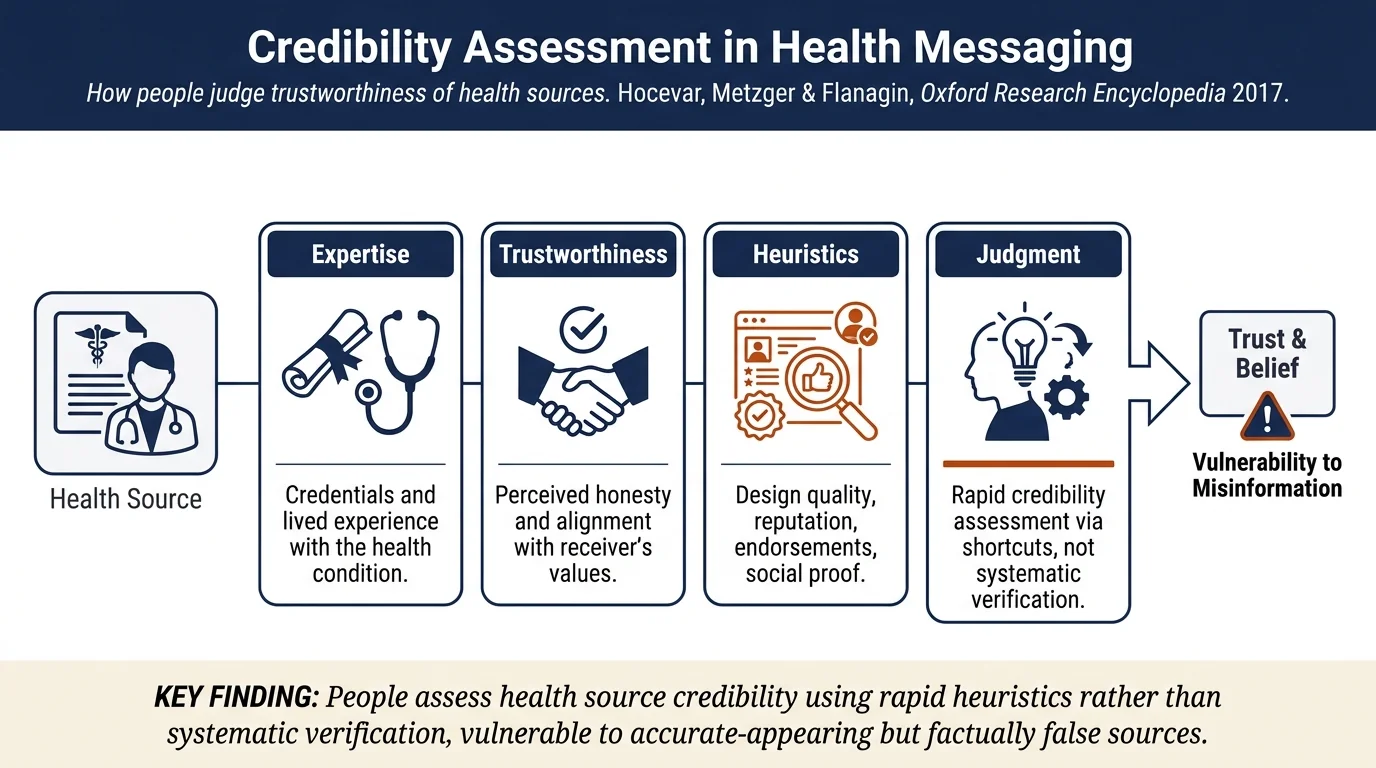
Contributions
- Synthesizes 50+ years of credibility research (Hovland, Janis & Kelley; McCroskey & Teven; Aristotle's ethos framework) across source, message, and media dimensions
- Documents how traditional credibility models (expertise + trustworthiness) apply to health messaging in classical persuasion and dual-processing theories (Heuristic-Systematic Model, Elaboration Likelihood Model)
- Reviews online credibility models specific to digital environments: MAIN model (Sundar, 2008), Warranting theory (Walther & Parks, 2002), cognitive authority theory (Flitch & Cromwell, 2008), and digital literacy frameworks
- Identifies shift in expertise definition: traditional models relied on formal credentials; contemporary models account for "experiential credibility" (credibility from personal lived experience with a health concern)
- Catalogs specific online heuristics people use when evaluating health information: reputation-based cues, endorsements from trusted others, consistency with existing beliefs, interface design quality, and social proof from recommendation volume
- Documents vulnerability of online health-information seeking: information moved online amplified credibility challenges because laypeople must discern expertise among vast, unvetted sources without institutional gatekeeping
Method
Systematic literature review examining credibility research across four decades and multiple subdisciplines (communication, psychology, education, marketing). The review:
- Traditional credibility frameworks — traces definitional history of expertise and trustworthiness as core components, documents dual-processing theories (HSM: Eagly & Chaiken; ELM: Petty & Cacioppo) showing how cognitive load/motivation affect whether people scrutinize sources systematically versus heuristically
- Online credibility models — reviews contemporary frameworks specific to digital media including site credibility assessment, source credibility online, warranting theory (how perceivers infer source authenticity from information leakage across modalities)
- Domain-specific health context — applies credibility theory to health and risk messaging, examining how source cues interact with message features and receiver characteristics (prior knowledge, self-efficacy, need for cognition)
- Identity and similarity effects — reviews social identity theory research showing perceived similarity between source and receiver affects credibility and persuasion
- Experiential credibility and social media — examines how user-generated health information (patient forums, social media health communities) complicates traditional expertise definitions; documents research showing laypeople with direct health experience can rival credentialed experts in persuasiveness despite lower formal authority
Results
Key empirical findings synthesized:
- Source expertise + trustworthiness are the two most robust credibility dimensions across decades of research (Hovland et al., 1953 onward)
- In online environments, people rely heavily on heuristic cues (design quality, source reputation, endorsement volume) rather than systematic verification; this heuristic reliance is especially pronounced for low-motivation or low-ability individuals (consistent with HSM/ELM predictions)
- Health credibility judgments involve systematic processing when personal relevance is high (direct health concern); lower for abstract/unfamiliar health topics — consistent with ELM's argument that issue involvement predicts processing mode
- Expertise definition has shifted: traditional credibility research centered on formal credentials and professional affiliation; contemporary work shows laypeople's experiential expertise (e.g., patient peers with the same condition) can rival or exceed credentialed sources in persuasive impact
- Digital media remove institutional gatekeeping cues (news organizations' editorial standards, university affiliations) that once signaled credibility; this creates "credibility vacuum" where laypeople must infer trustworthiness from surface-level site features, interface design, and social endorsements
- Perceived credibility and actual information accuracy are overlapping but distinct constructs — a source can be highly credible but inaccurate, and vice versa
- Trust in source trustworthiness often varies by source identity (government vs. citizen groups; physicians vs. patient peers) and receiver characteristics (socioeconomic status, ideology, prior knowledge)
- Similarity-based heuristic: people judge information more credible when it comes from sources perceived as similar to them (shared group identity, shared values, shared experience) — particularly relevant to social media health communities where homophily drives information diffusion
Notes
Strengths: This review is exceptionally comprehensive and traces the theoretical lineage of credibility research with precision. The synthesis of classical persuasion theory (Hovland, McCroskey) with contemporary digital-era challenges is rigorous and well-grounded. The specific attention to how expertise conceptualization has evolved—from purely credentialed (formal degrees, professional titles) to including experiential expertise (patient knowledge)—is prescient and directly relevant to understanding how misinformation gains traction via peer testimony and lived-experience narratives in social media. The dual-processing frameworks (HSM, ELM) provide mechanistic explanations for why people are vulnerable to incredible-but-persuasive sources.
Limitations and open questions: The review is primarily focused on psychological and behavioral mechanisms; it does not deeply engage with algorithmic amplification or platform design interventions (though it acknowledges these as domains of future research). The paper does not empirically test hypotheses; it synthesizes existing work and identifies research gaps. The empirical landscape around health misinformation specifically was evolving when this was published (2017)—more recent work (post-2020) has begun systematically studying how health misinformation spreads on social media platforms, which builds on credibility theory but adds network and algorithmic dimensions not covered here.
The paper would benefit from integration with subsequent work on: (1) how automated systems assess source credibility (e.g., BERT-based fact-checking systems that may encode source signals), (2) how misinformation exploits credibility heuristics at scale via bots and coordinated campaigns, (3) cross-cultural variation in what credibility cues (e.g., government sources) are trusted.
Relevance: Directly foundational to understanding both why people believe health misinformation and how detection systems should weight source credibility signals. Health misinformation is a major vector of real-world harm (vaccine hesitancy, dangerous treatments, trust erosion in public health); understanding credibility mechanisms is essential to both detection and intervention design.