 Miriam Metzger
 Andrew J. Flanagin
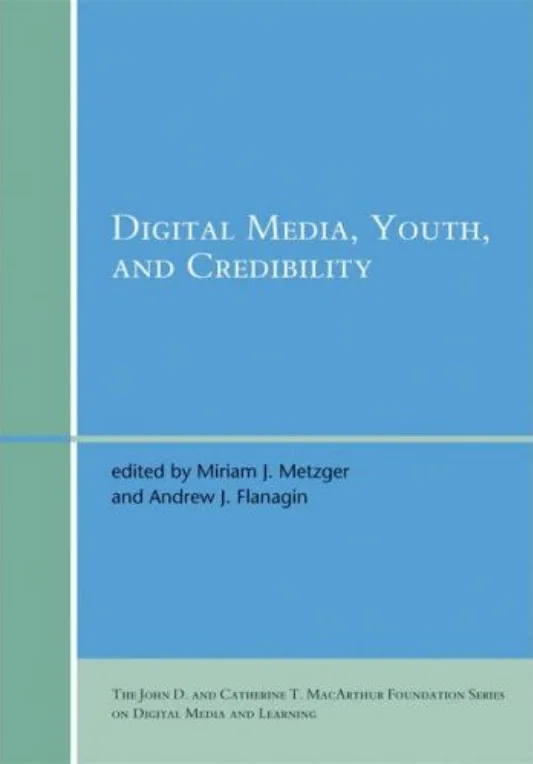
Overview
The volume addresses credibility assessment as a critical skill for young people navigating increasingly complex digital media environments. Rather than a fixed set of topics, the collection revolves around how youth evaluate the believability of sources and messages as they encounter them through digital media.
Structure: Nine substantive chapters organized around complementary perspectives:
- Foundational framework (Flanagin & Metzger): credibility as a multidimensional construct in digital contexts and its evolution from traditional media.
- Cognitive development (Eastin): how age and cognitive maturity influence credibility judgments and information evaluation strategies.
- Information-seeking behavior (Rieh & Hilligoss): credibility assessment during active search tasks among college students.
- Technology effects (Sundar): the MAIN model—a canonical framework explaining how media features (modularity, agency, interactivity, navigability) trigger heuristics that influence credibility perceptions.
- Authority and trust (Lankes): credibility tools and the role of information intermediaries in digital environments.
- Domain expertise (Eysenbach): credibility assessment for health information, with implications for apomediation and expert-user power dynamics.
- Education and pedagogy (Harris): challenges and strategies for teaching credibility assessment in schools, including the tension between librarian guidance and student autonomy.
- Policy context (Weingarten): how credibility concerns shape (and should shape) public policy on digital media, information access, and youth protection.
Approach: Integrating cognitive science, communication theory, information science, media literacy pedagogy, and policy perspectives. Authors draw on empirical research, theoretical frameworks, and practical case studies to move beyond simplistic checklists toward nuanced understanding of how credibility judgments are actually made.
Why it matters for GUIDE
This volume is a foundational methodological reference for misinformation and disinformation work. Source credibility assessment is the cognitive core of lie detection and media evaluation:
- Credibility frameworks underpin models used to evaluate fake news and false claims. Understanding how youth (and adults) form trust judgments is prerequisite to designing interventions.
- Heuristics and cognitive load (e.g., Sundar's MAIN model) explain why people rely on shallow cues (design, source signals) rather than content analysis—a critical insight for understanding why misinformation spreads.
- Authority and intermediaries (Lankes) connect to contemporary questions about algorithm-mediated trust and the role of fact-checkers as apomediation tools.
- Health information credibility (Eysenbach) is directly applicable to studying health misinformation (vaccine rumors, disease cures, etc.).
- Teaching media literacy (Harris) informs interventions aimed at building resilience to false information.
- Policy implications (Weingarten) frame the broader tension between open information access and quality/safety—central to platform moderation and regulatory debates.
The book's emphasis on the process of judgment (not just the accuracy of outcomes) aligns with GUIDE's focus on how people detect and reason about information integrity.
Notes
Strengths: Comprehensive, theoretically grounded coverage spanning cognitive development, empirical information-seeking studies, design effects, domain-specific applications, and pedagogy. The MAIN model (Sundar) has become a canonical reference in communication research on technology effects. Well-suited as a background text for researchers designing interventions or studying credibility in misinformation contexts.
Scope and audience: Written for researchers and educators, not journalists or the general public. Presupposes familiarity with communication theory and educational research.
Publication and access: Published 2008, now 16 years old. While foundational, the book predates social media platform algorithmic sophistication (algorithmic recommendation, generative AI), so some design discussions are dated. Health information and political polarization sections remain relevant; youth development and media literacy principles are enduring. Available through MIT Press under CC-BY-NC-ND 3.0 license.
Chapters
9 of 9 chapters have their own GUIDE page.