 Miriam Metzger
 Andrew J. Flanagin
Contributions
- First large-scale study of young people's credibility evaluation beliefs and practices, measuring both awareness and actual skill
- Identifies cognitive development (age), individual thinking styles (need for cognition, flexible thinking), and credibility training as key factors
- Demonstrates that exposure to credibility evaluation training can paradoxically increase susceptibility to hoax sites
- Extends dual-process models of adolescent decision-making to the digital information-literacy domain
- Provides evidence that generic training approaches may not equip youth with the metacognitive foundations for effective online information evaluation
Method
A nationally representative online survey administered via Knowledge Networks to 2,747 children and adolescents aged 11–18 with Internet access in the U.S. The study measured three dimensions of credibility evaluation: (1) awareness and use of analytical decision-making strategies, (2) credibility judgments toward online information, and (3) susceptibility to hoax websites (a behavioral measure using fabricated websites). Regression analyses tested predictors across five blocks: control variables (prior exposure to false information), credibility training, demographic variables (age, SES, parental education), cognitive style (need for cognition, flexible thinking, faith in intuition, trust in others), and academic performance.
Results
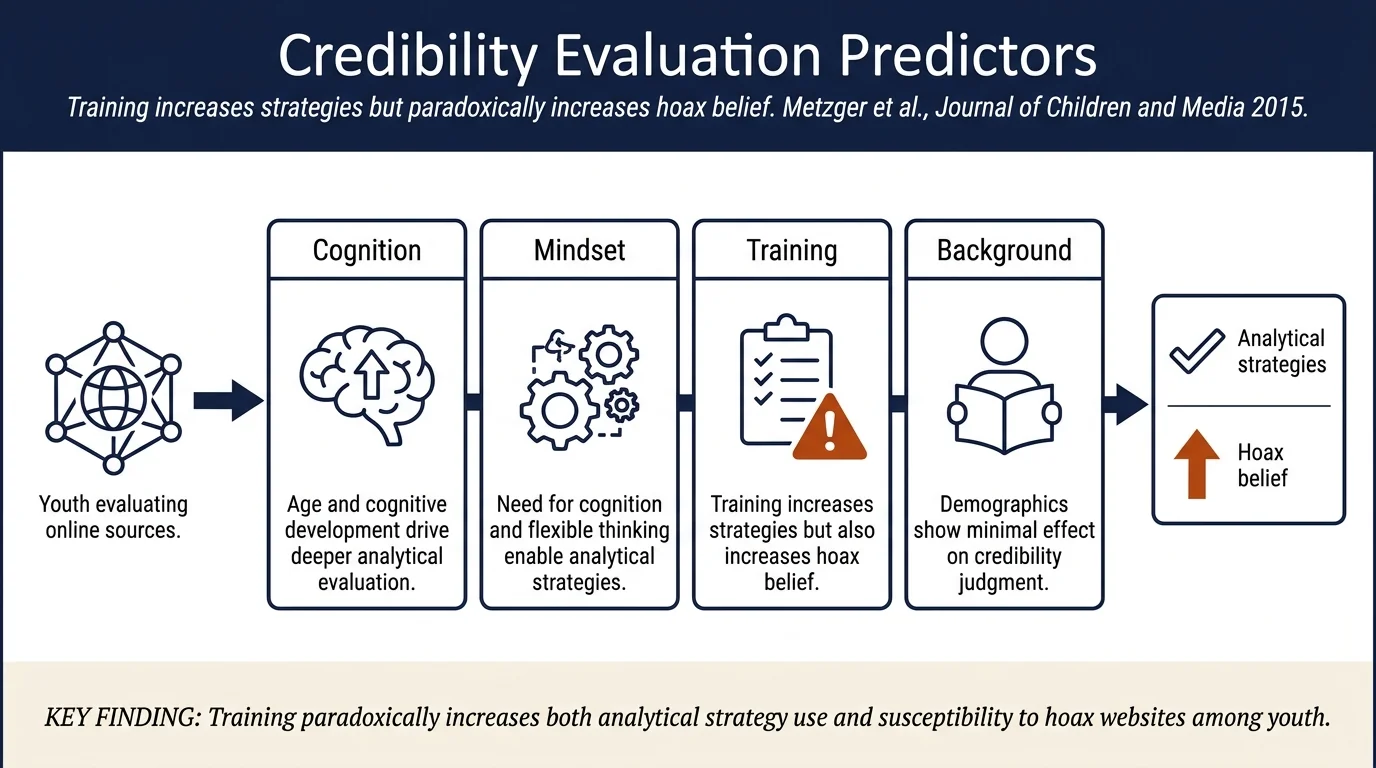
Age and cognitive development emerged as the strongest predictor: older children reported more sophisticated analytical evaluation strategies ($\beta = .070$, $p < .01$) and were significantly more aware of credibility as a potential problem.
Thinking styles showed mixed effects. Need for cognition and flexible thinking positively predicted use of analytical strategies ($\beta = .150$ and $\beta = .252$ respectively, both $p < .001$), consistent with dual-process theories. Surprisingly, faith in intuition also positively predicted analytical strategy use ($\beta = .168$, $p < .001$), suggesting that intuitive and analytical approaches are not strictly opposed among youth.
Credibility training yielded a troubling pattern: exposure to training significantly increased use of analytical strategies ($\beta = .104$, $p < .01$), but also significantly increased belief in hoax websites ($\beta = .257$, $p < .05$). This suggests youth may apply learned checklists mechanically without understanding their purpose or developing genuine skepticism.
Demographic variables (SES, parental education, household income) had negligible impact on credibility awareness or skill, contrary to prior adult-focused research. Academic performance positively predicted analytical strategy use ($\beta = .122$, $p < .001$) but showed no association with actual credibility judgments toward hoax sites.
Trust in others did not predict use of analytical strategies but positively predicted credibility toward online information ($\beta = .134$, $p < .001$)—a finding consistent with the authors' interpretation that social trust generalizes to information sources.
Notes
The most striking and consequential finding is the paradox that credibility evaluation training increases both correct strategies and susceptibility to hoaxes. The authors argue this reflects a gap between procedural knowledge ("what to do") and conceptual understanding ("why these strategies work and what they protect against"). They suggest future interventions should emphasize metacognitive development—teaching youth not just checklists but the underlying reasoning about how misinformation succeeds and what makes sources trustworthy.
The study's focus on actual hoax-site engagement (not just self-reported beliefs) is methodologically important and provides stronger evidence than typical survey-only designs. The absence of SES effects is notable and somewhat contradicts adult-focused research; the authors hypothesize this may reflect differences in the sample selection or the relatively high education levels of Knowledge Networks participants.
A limitation is reliance on self-report for training exposure and strategy use; future work should incorporate behavioral observations or think-aloud protocols to validate whether youth actually use the strategies they report using.