 Miriam Metzger
 Andrew J. Flanagin
Contributions
- Demonstrates empirically that both children and parents exhibit comparative optimism in evaluating online information credibility
- Shows that children display higher comparative optimism than parents when assessing their own credibility evaluation skills compared to both typical internet users and their parents
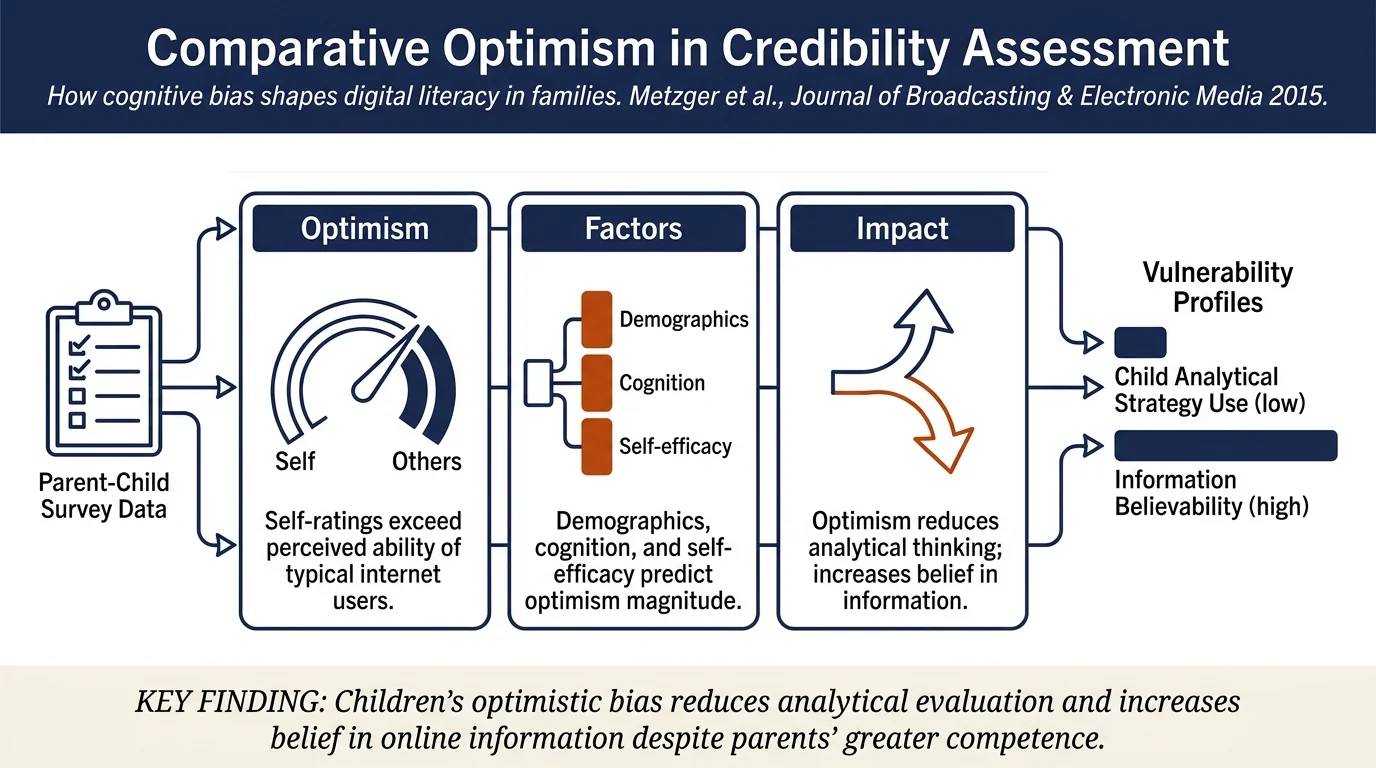
- Identifies demographic (age, education, income), dispositional (cognitive thinking style), and self-efficacy factors that predict the magnitude of comparative optimism
- Documents that parental comparative optimism relates to the type of mediation strategies parents employ to manage their children's internet use
- Shows that children's comparative optimism is associated with more positive beliefs about online information credibility but negatively related to analytical evaluation strategies
Method
National representative online survey conducted with the professional research firm Gfk (Knowledge Networks). Invitations sent to 5,936 adult parents with children ages 11–18; final sample of 2,747 parent-child dyads (91.7% completion rate after quality control). Survey operationalized comparative optimism using an adapted instrument by Weinstein (1980), where participants rated their own credibility evaluation abilities on a 7-point scale while also comparing themselves to "typical internet users." Cognitive thinking style measured via need-for-cognition scale; perceived self-efficacy measured via three items on internet skills and knowledge; parental mediation strategies assessed using Valkenburg et al. (1999) taxonomy covering passive, active, and restrictive mediation approaches. Online information credibility evaluation measured via factor analysis of four items on believability, information concern, and analytical strategies.
Results
Research Question 1: Comparative optimism exists in online credibility evaluation. T-tests confirmed significant differences from scale midpoint (indicating comparative optimism) across all comparison groups (2-tailed). Highest comparative optimism among parents comparing themselves to their child ($M=5.48$, $SD=1.18$); followed by parents comparing to typical users ($M=5.09$, $SD=1.10$); children comparing to typical users showed moderate optimism ($M=4.53$, $SD=1.11$). Children comparing themselves to parents showed slightly lower optimism ($M=3.29$, $SD=1.22$), suggesting realistic perception of parental competence.
Hypotheses 2–4: Age effects show children's comparative optimism increased with age ($H_3$ confirmed); parent and child optimism converged as child age increased ($H_4$ confirmed), suggesting developmental progression toward adult-like self-assessment.
Demographic factors: Parental education and income positively predicted comparative optimism in credibility evaluation ($H_{5a}$ confirmed); higher education and income associated with more optimistic self-assessments.
Cognitive processing: Children's disposition toward effortful thinking (need for cognition) negatively predicted comparative optimism ($H_7$ confirmed); children who engaged in more careful information processing showed lower comparative optimism.
Self-efficacy: Children's perceived self-efficacy in internet use positively related to comparative optimism ($H_8$ confirmed).
Parental mediation: Parental comparative optimism positively related to active mediation efforts ($H_9$ confirmed); parents with higher comparative optimism more likely to discuss online content with children. Parents' comparative optimism also inversely related to mediation effectiveness—greater optimism correlated with less restrictive mediation.
Children's beliefs and behaviors: Children's comparative optimism positively associated with tendency to find online information believable ($H_{10a}$ confirmed); negatively associated with analytical information evaluation strategies ($H_{11}$ confirmed), indicating that optimistically biased children rely less on careful evaluation.
Notes
Methodological strength: nationally representative sample with high completion rate and demographic weighting to U.S. Census data, strengthening generalizability. The finding that greater comparative optimism predicts less rather than more effective parental mediation has practical implications for digital literacy education and media literacy interventions targeting families. The age-related convergence between parent and child optimism suggests that cognitive development and accumulated online experience gradually attune self-assessment. The study reveals a potential vulnerability: children who are optimistically biased about their credibility evaluation skills may be precisely those least likely to employ analytical strategies that could protect them. Limitations include self-report measures of cognitive style and mediation behavior (no behavioral observation); causal direction between comparative optimism and mediation strategy type remains unclear and could be bidirectional (parents with optimistic children may adopt more active mediation to maintain monitoring, or active mediation may foster optimism by signaling that the child is capable).