 Andrew J. Flanagin
 Miriam Metzger
Contributions
- Credibility framework — defines credibility as believability comprising two primary dimensions (trustworthiness and expertise) with both objective and subjective components, situated within the traditions of Aristotle's ethos, 20th-century persuasion research, and contemporary multi-disciplinary approaches.
- Origins and evolution — traces credibility research from classical rhetoric through mid-century persuasion studies to the emergence of digital credibility research in the 1990s, showing how the field adapted from centralized authority models to decentralized information environments.
- Digital media challenges — articulates five core problems unique to digital contexts: information abundance (unprecedented quantity, reduced production barriers), source ambiguity (unclear origin, masked authorship, re-purposing), lack of gatekeepers and quality standards, blurred source-channel-message distinctions, and converged media types (sponsorship opacity, format similarity).
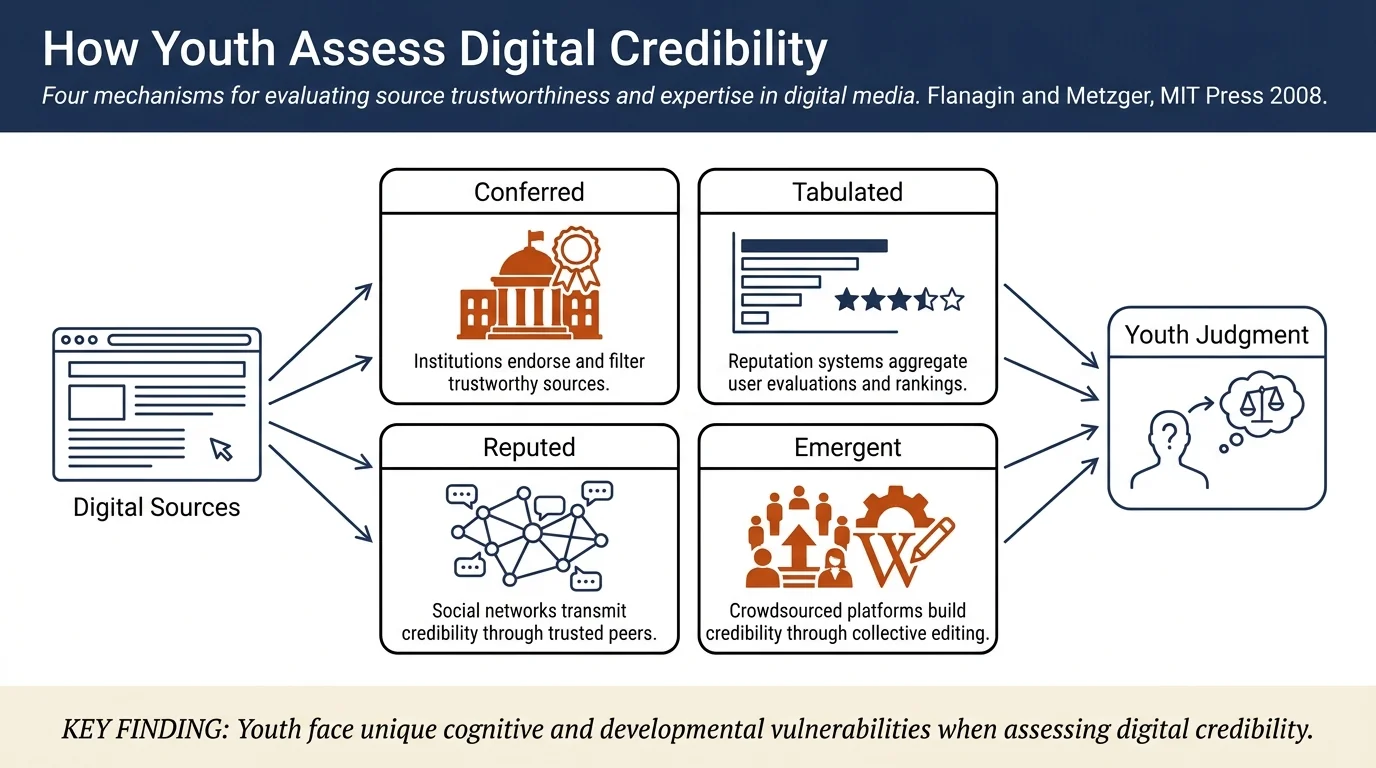
- Contemporary credibility forms — identifies and describes four mechanisms by which digital media users assess credibility: conferred (institutional endorsement), tabulated (reputation systems and ratings), reputed (personal/social networks), and emergent (collective/crowdsourced knowledge such as Wikipedia).
- Youth as a distinct population — argues that youth face special credibility challenges due to: limited life experience and accumulated knowledge, underdeveloped cognitive abilities to discriminate information types, immersion in digital media from birth, developmental susceptibility to peer influence, and special contextual risks (learning, identity, financial, physical safety) if credibility assessment fails.
Method
The chapter is not empirical research; rather, it is a conceptual and narrative synthesis drawing on:
- Credibility theory from rhetoric, social psychology, and communication research spanning Aristotle through contemporary work by Metzger, Flanagin, and others.
- Child development literature (Eastin and others in the volume) on cognitive maturation and information processing abilities across age ranges.
- Empirical findings from prior credibility studies examining web site evaluation, media credibility comparisons (traditional vs. online), and youth information-seeking behavior.
- Case studies and examples of digital media affordances (web design, social networks, search engines, e-mail) and how they interact with credibility judgment.
The authors synthesize these to construct a conceptual model and argue for youth-specific credibility research.
Results
Key findings and arguments:
-
Credibility is multidimensional and subjective. Credibility combines trustworthiness (receiver-based perception of integrity) and expertise (source's objective credentials and subjective capability judgments). Both have objective and subjective components; credibility is fundamentally a perception, not an intrinsic property.
-
Digital media disrupt traditional credibility signals. Unlike print or broadcast, digital media lack clear gatekeeper filtering, uniform quality standards, or stable source/channel relationships. Information can be posted anonymously, copied without attribution, embedded in ads, or aggregated across sources, obscuring the original source.
-
Four contemporary forms of credibility assessment operate in digital environments: - Conferred: institutions (libraries, educators, organizations) confer credibility on resources they endorse or index. - Tabulated: reputation systems and rating mechanisms (eBay ratings, Amazon reviews, search rankings) aggregate user evaluations. - Reputed: social networks transmit credibility judgments ("my friends trust this source"). - Emergent: crowdsourced platforms like Wikipedia create credibility through collective, decentralized editing.
-
Youth are uniquely vulnerable to credibility misjudgment due to developmental and contextual factors: - Cognitive development: Younger children struggle to distinguish commercial from editorial content, understand sponsorship opacity, or grasp complex source–message–channel relationships. - Experience: Limited life experience means fewer accumulated reference points for judging plausibility; youth often lack institutional knowledge (differences between media outlets, publisher reputations). - Immersion: Youth have grown up entirely in digital environments and may not recognize how credibility signals differ from those in traditional media. - Social influence: Peer-based credibility transmission (emergent and reputed forms) is especially powerful among youth but also vulnerable to misinformation spread. - Consequences: Credibility failures carry high stakes—learning (academic), identity (self-representation), health, and financial (shopping, banking decisions).
-
Scholars, educators, and youth hold diverging perspectives on digital media and credibility: - Scholars argue that digital media democratize credibility (decentralized authority, collective evaluation) versus centralized gating; this is liberating but also risky. - Educators emphasize the need to teach critical evaluation skills and credibility assessment, yet struggle to find time and frameworks within curricula; debate exists between protective (filtering, restricted access) and empowering (critical thinking training) approaches. - Youth themselves express less concern about credibility than adults; primary worries are accuracy of academic information and trustworthiness of people they meet online; youth report taking "it's up to each individual" approaches rather than seeking institutional help.
Notes
Strengths: The chapter provides a broad, accessible conceptual foundation for understanding how digital media have transformed credibility assessment. The historical trace (from Aristotle through early-2000s web research) contextualizes why youth face novel challenges. The taxonomy of credibility forms (conferred, tabulated, reputed, emergent) is useful for thinking about contemporary systems (ratings, social networks, Wikipedia) and was novel at the time of publication.
Scope and limits: This is a synthesis and framework chapter, not reporting new empirical data. The examples (Google sponsored links, e-mail spam, blog authorship) are dated (2008); contemporary challenges (algorithmic recommendation, generative AI, TikTok) are not addressed. The chapter presupposes familiarity with credibility research but is written accessibly for researchers and educators unfamiliar with youth development literature.
Relevance to GUIDE: This chapter is a canonical reference for understanding how credibility assessment works, why it matters, and why young people are especially vulnerable—essential context for misinformation research. The framework of credibility dimensions and mechanisms persists across later work in the volume and in contemporary fake-news research. It is frequently cited by researchers studying youth media literacy and information evaluation.
Age of work: Published in 2008 (now 18 years old). Foundational principles of credibility judgment remain relevant; specific platform examples and design discussions are dated.