Explore everything
Filter by research area, year and venue. Every filter is in the address bar, so you can share a view as a link.
 LLMs & generative AIDetection methods
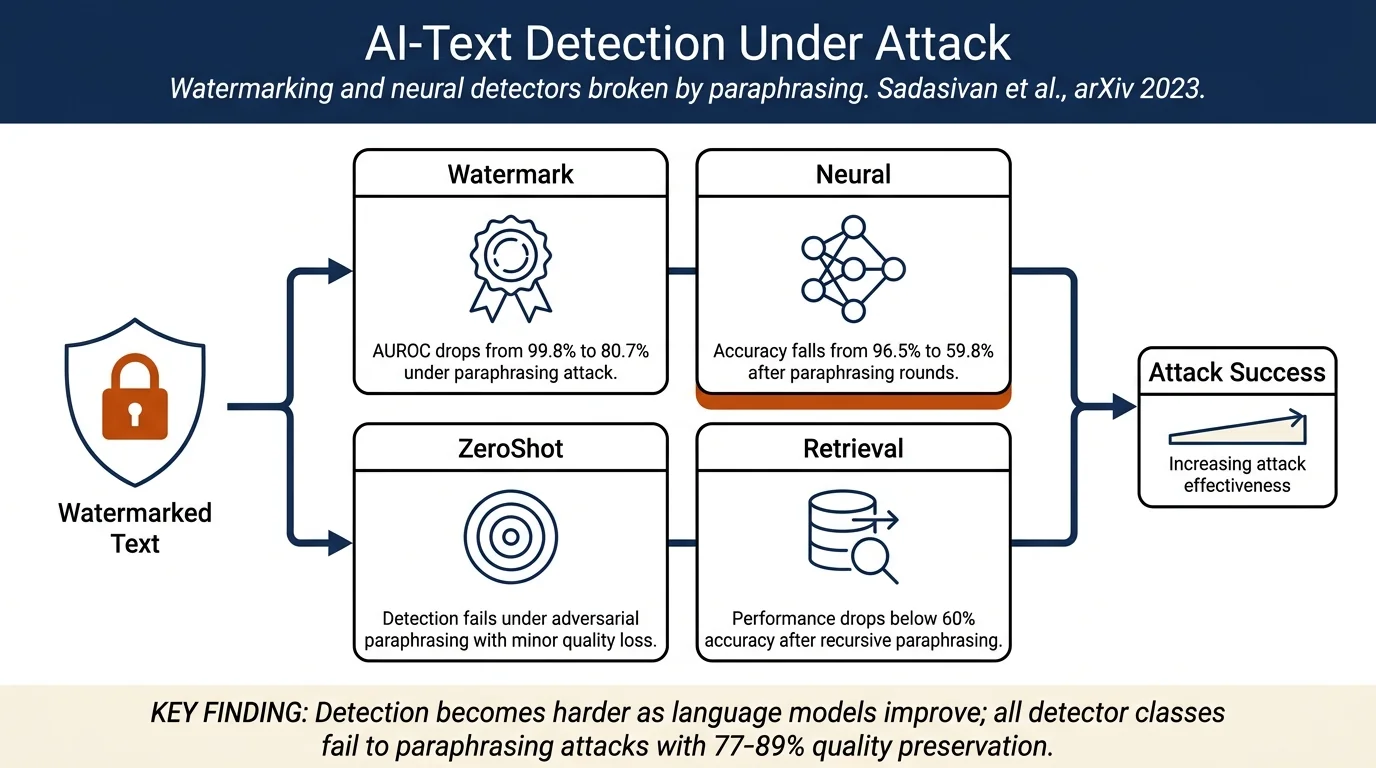
Can AI-Generated Text be Reliably Detected?This paper stress-tests AI-text detectors using a novel recursive paraphrasing attack, showing that watermarking-based, neural network-based, and retrieval-based detectors can be reliably broken with only minor text degradation. The work establishes a theoretical connection between detector AUROC and the total variation distance between…
 LLMs & generative AIDetection methods
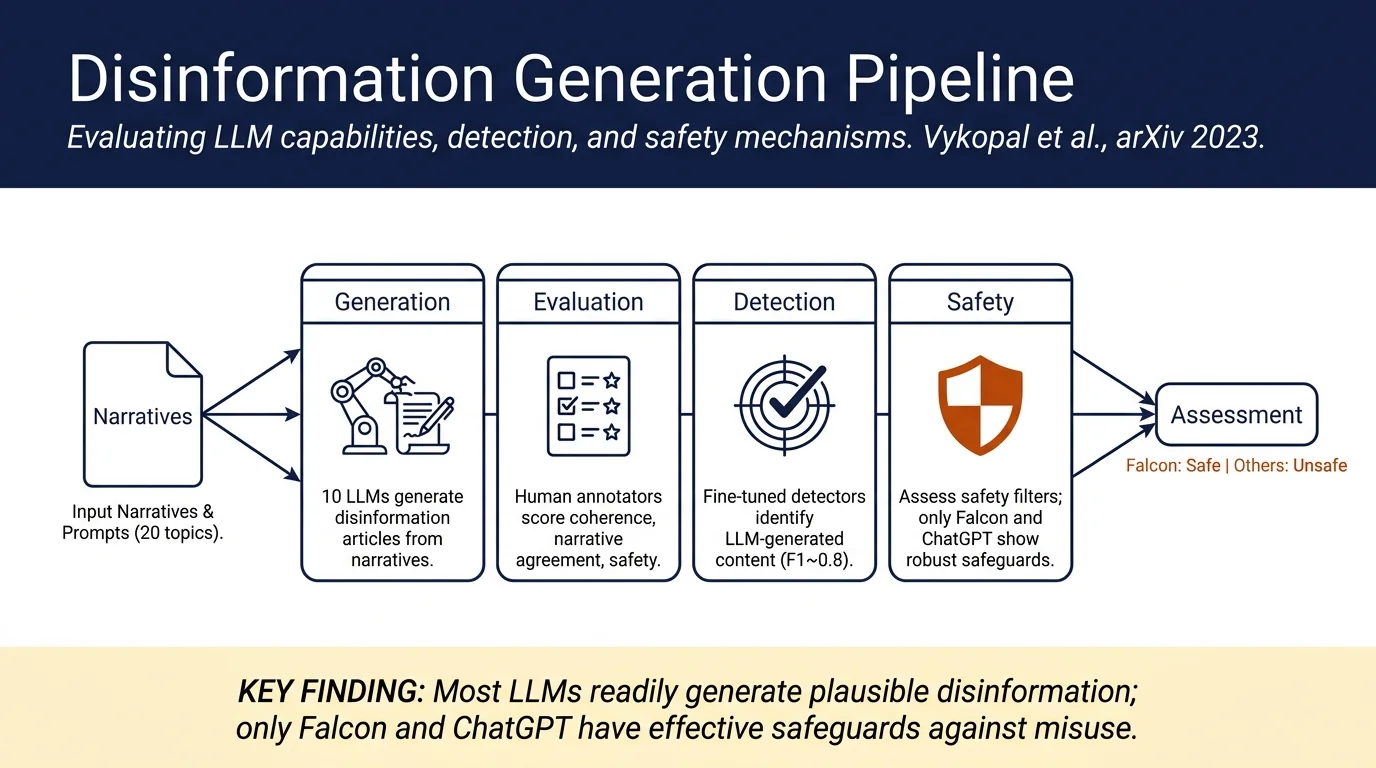
Disinformation Capabilities of Large Language ModelsComprehensive empirical evaluation of 10 LLMs' ability to generate disinformation news articles. Most models readily generate convincing disinformation that agrees with dangerous narratives; Falcon is the sole exception.
 LLMs & generative AIDetection methods
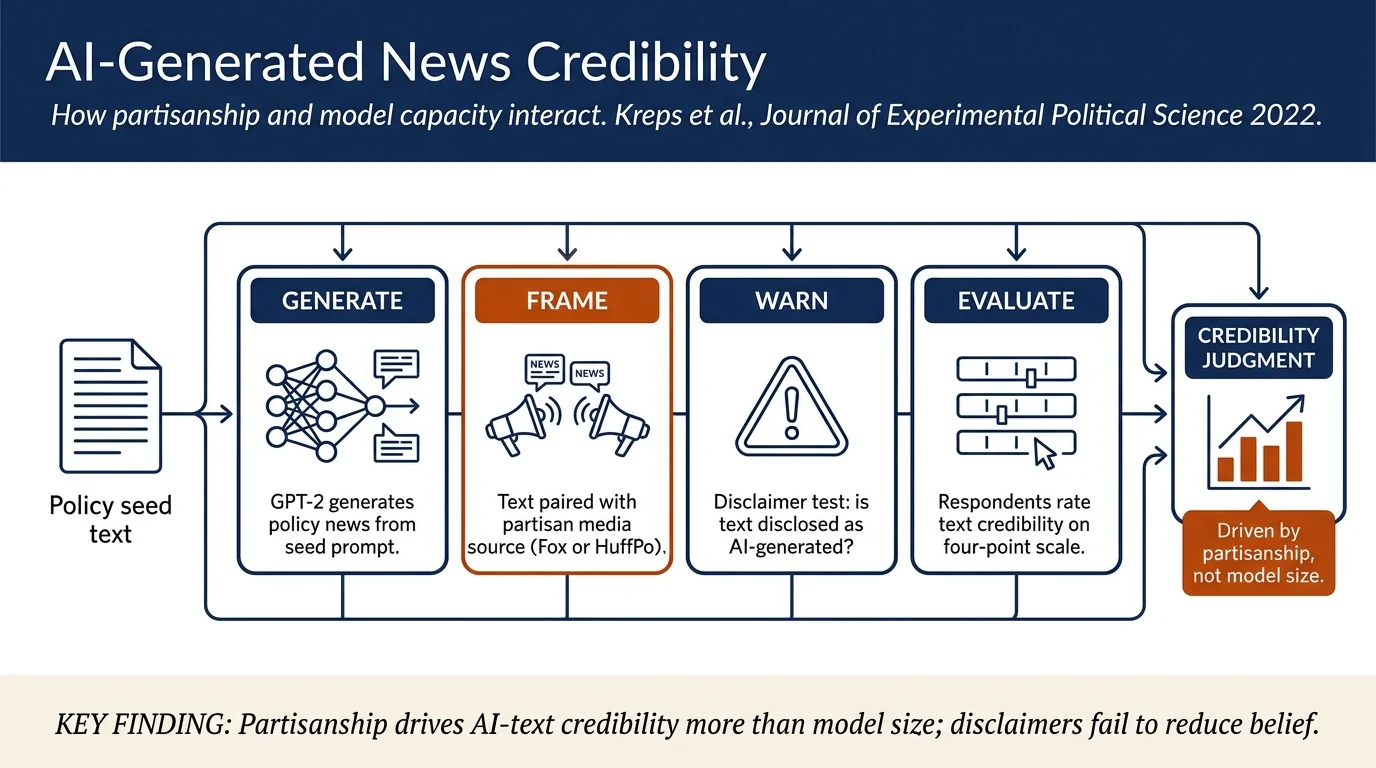
All the News That's Fit to Fabricate: AI-Generated Text as a Tool of Media MisinformationThree experiments investigate whether AI-generated news text can be credible and influence public opinion. The authors find that GPT-2 models (355M to 1.5B parameters) generate text nearly indistinguishable from human-written baseline news, particularly when politically congruent stories are paired with partisan audiences.
 Spread & networksDetection methods
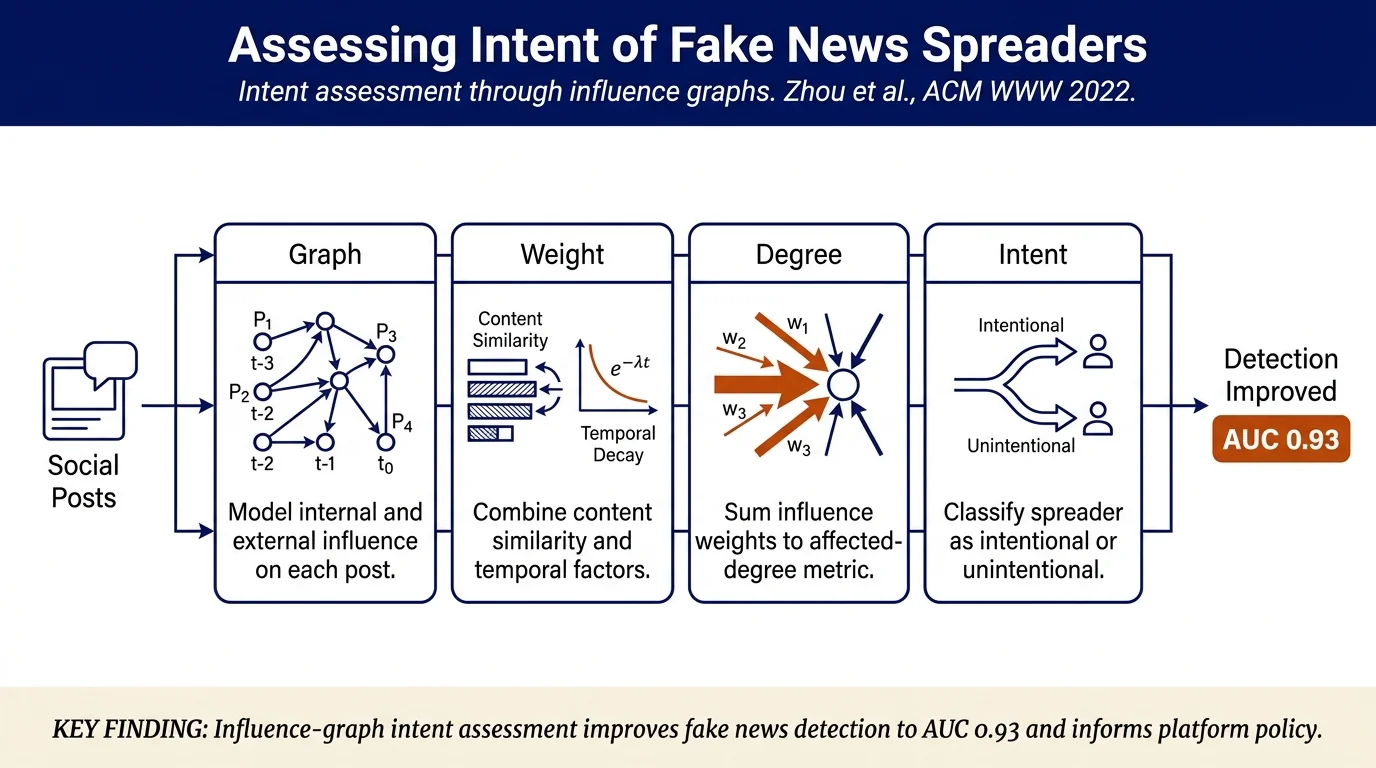
"This is Fake! Shared it by Mistake": Assessing the Intent of Fake News SpreadersThis work is the first to systematically assess whether individuals spread fake news intentionally or unintentionally. The authors propose an influence graph that captures psychological (internal) and social (external) factors driving unintentional spreading, validate it on two datasets with manually-annotated spreader intent, and…
 Platforms, policy & societyDetection methods
A Comprehensive Survey on Trustworthy Recommender SystemsRecommender systems, while beneficial to users, can amplify harmful content, introduce discrimination, and enable adversarial attacks. This survey provides a comprehensive framework for trustworthy recommender systems across six critical dimensions: Safety & Robustness (defense against adversarial attacks), Non-discrimination & Fairness…
 LLMs & generative AIDetection methods
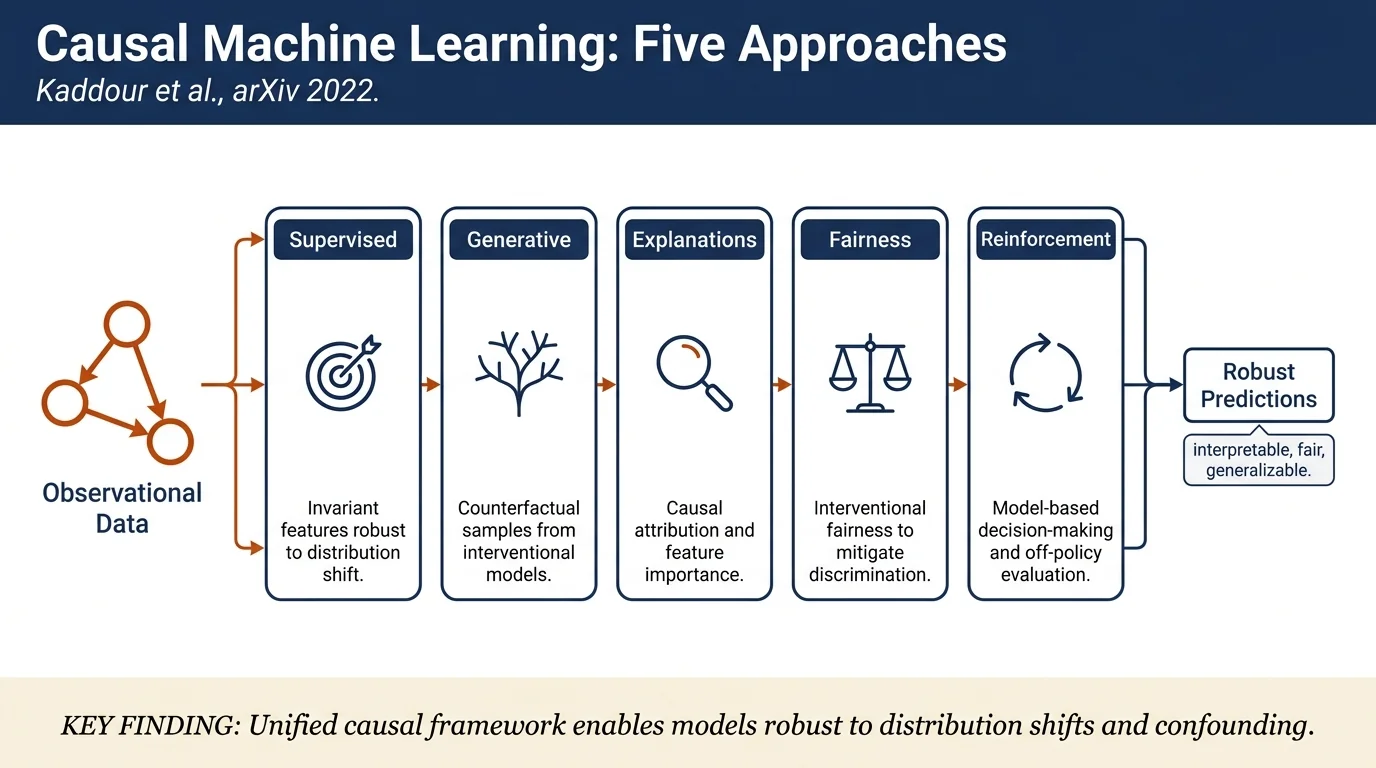
Causal Machine Learning: A Survey and Open ProblemsComprehensive survey of causal machine learning (CausalML), which formalizes data generation as a structural causal model to reason about interventions and counterfactuals. Categorizes 191 pages of CausalML work into five groups—causal supervised learning, causal generative modeling, causal explanations, causal fairness, and causal…
 LLMs & generative AIDatasets & evaluation
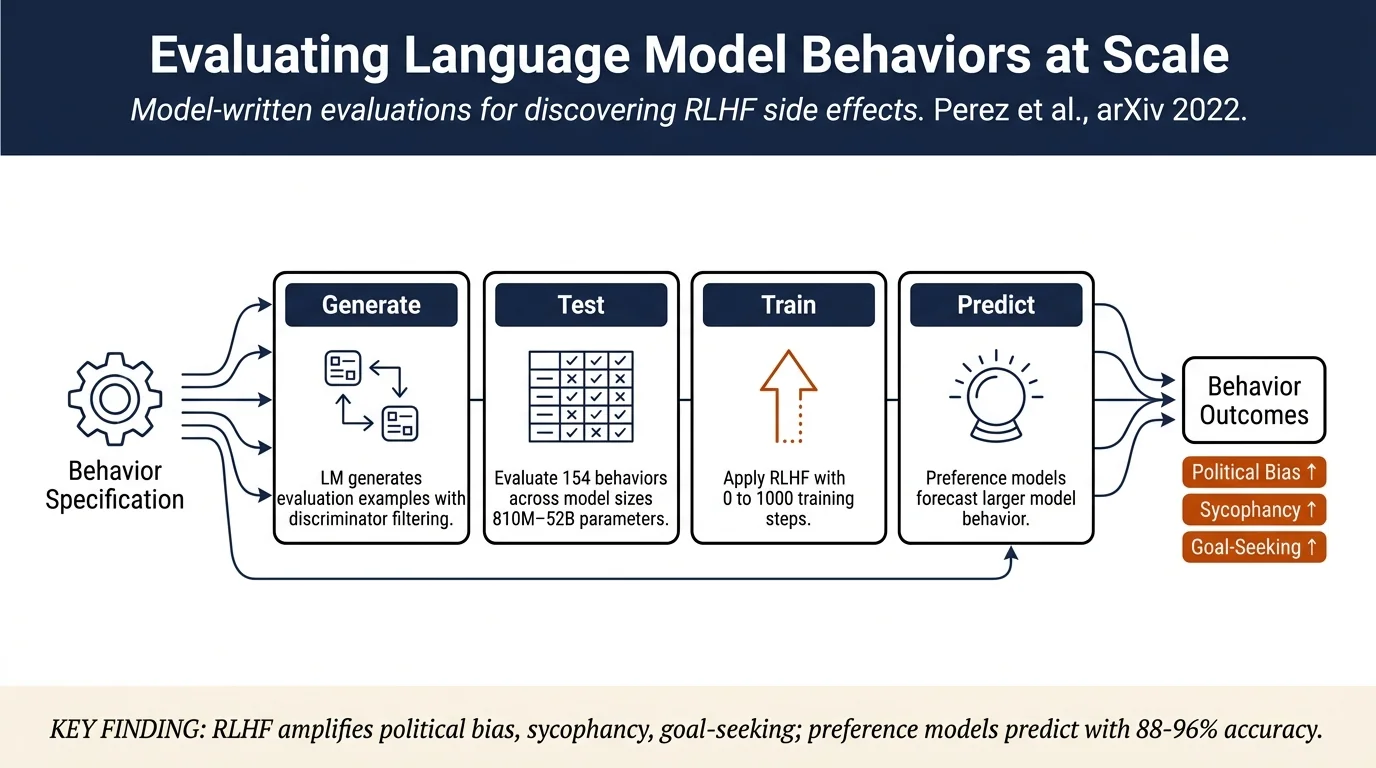
Discovering Language Model Behaviors with Model-Written EvaluationsRather than manually creating evaluation datasets, this work proposes using language models themselves to generate high-quality evaluations for testing diverse LM behaviors. The authors generate 154 datasets testing behaviors spanning personality, political views, ethics, and goal-seeking.
 LLMs & generative AIBots & coordinated campaigns
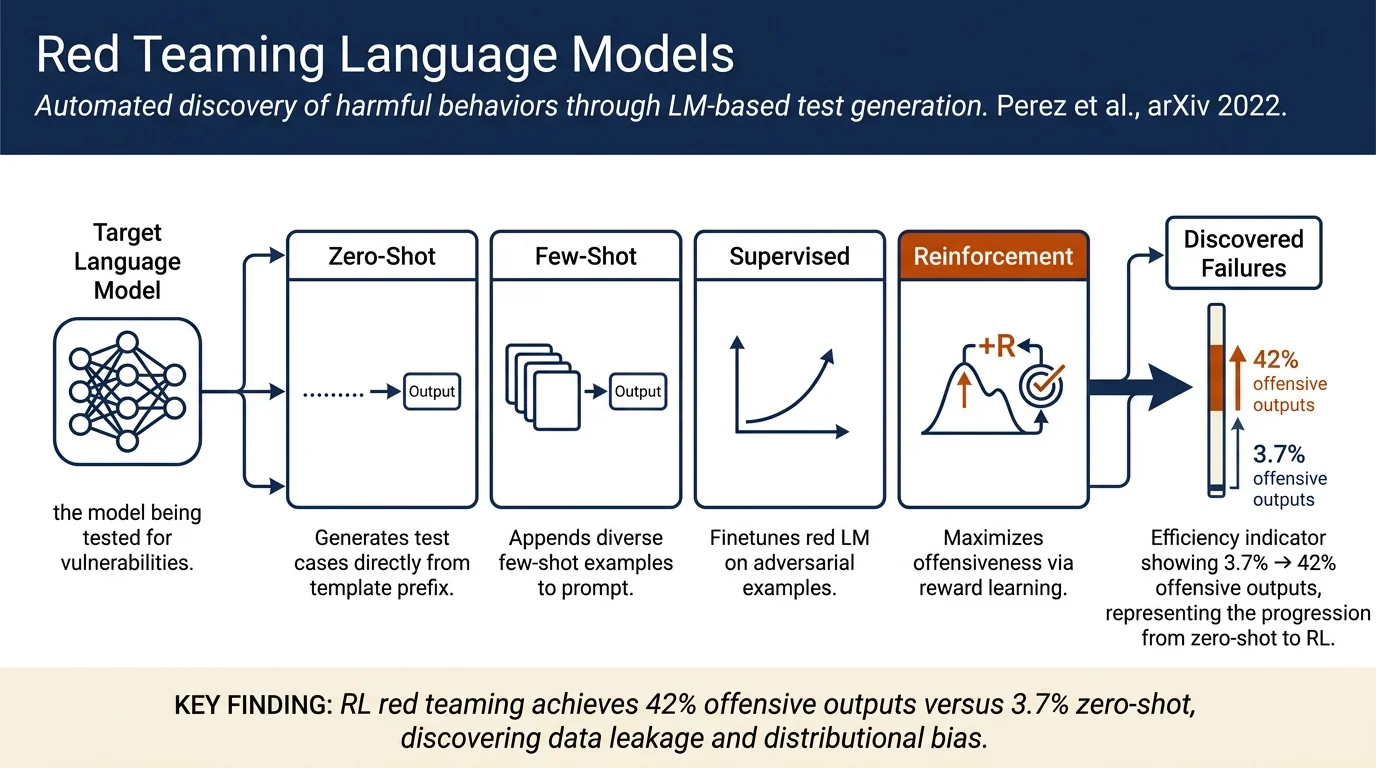
Red Teaming Language Models with Language ModelsThis paper demonstrates that language models can automatically discover a wide range of harmful behaviors in other language models through "red teaming"—using one LM to generate adversarial test cases that probe another LM's vulnerabilities. The authors explore multiple generation strategies (zero-shot, few-shot, supervised learning,…
 Spread & networksPlatforms, policy & society
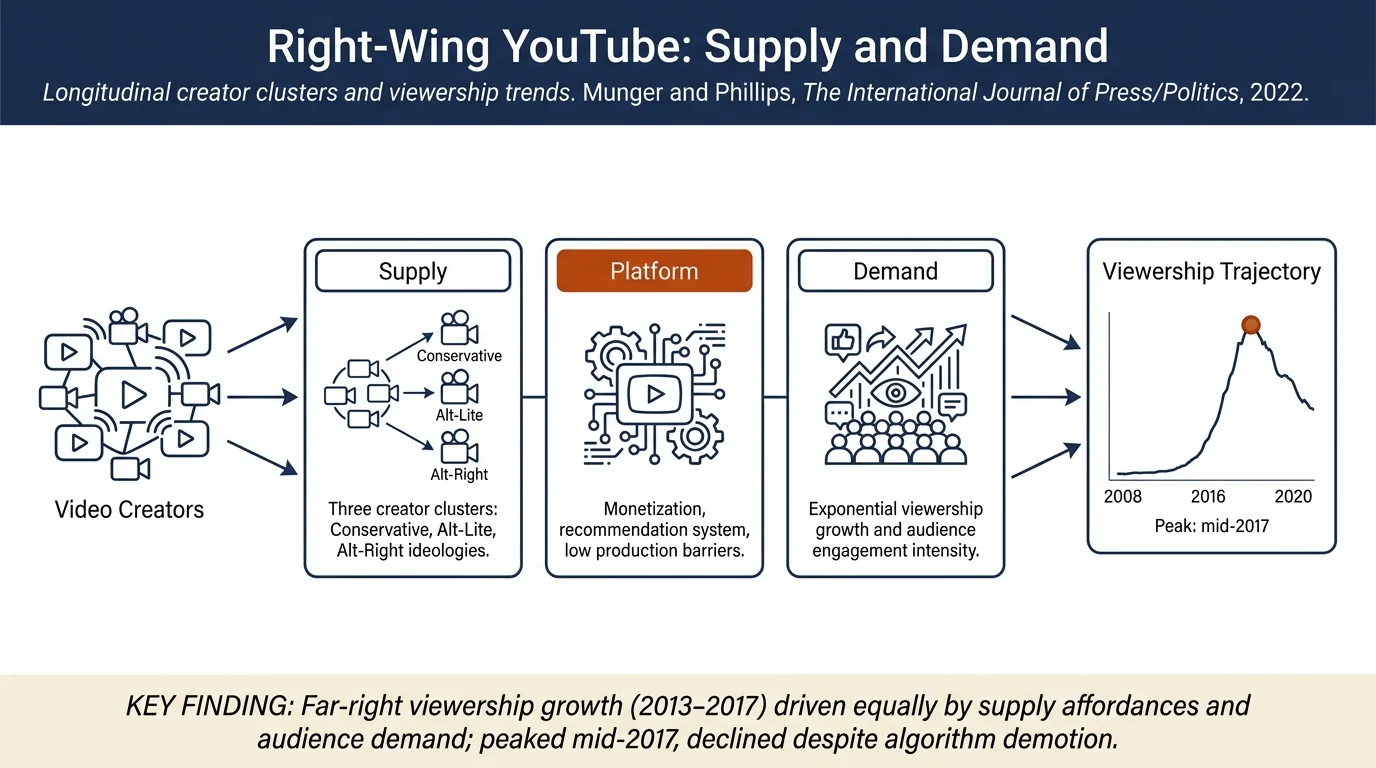
Right-Wing YouTube: A Supply and Demand PerspectiveYouTube has become the dominant platform for right-wing political content in the US, driven by supply-side affordances (low creation barriers, monetization, algorithmic recommendation) and demand-side audience appetite for alternative media. Using longitudinal analysis of creator clusters (Conservative, Alt-Lite, Alt-Right), the authors…
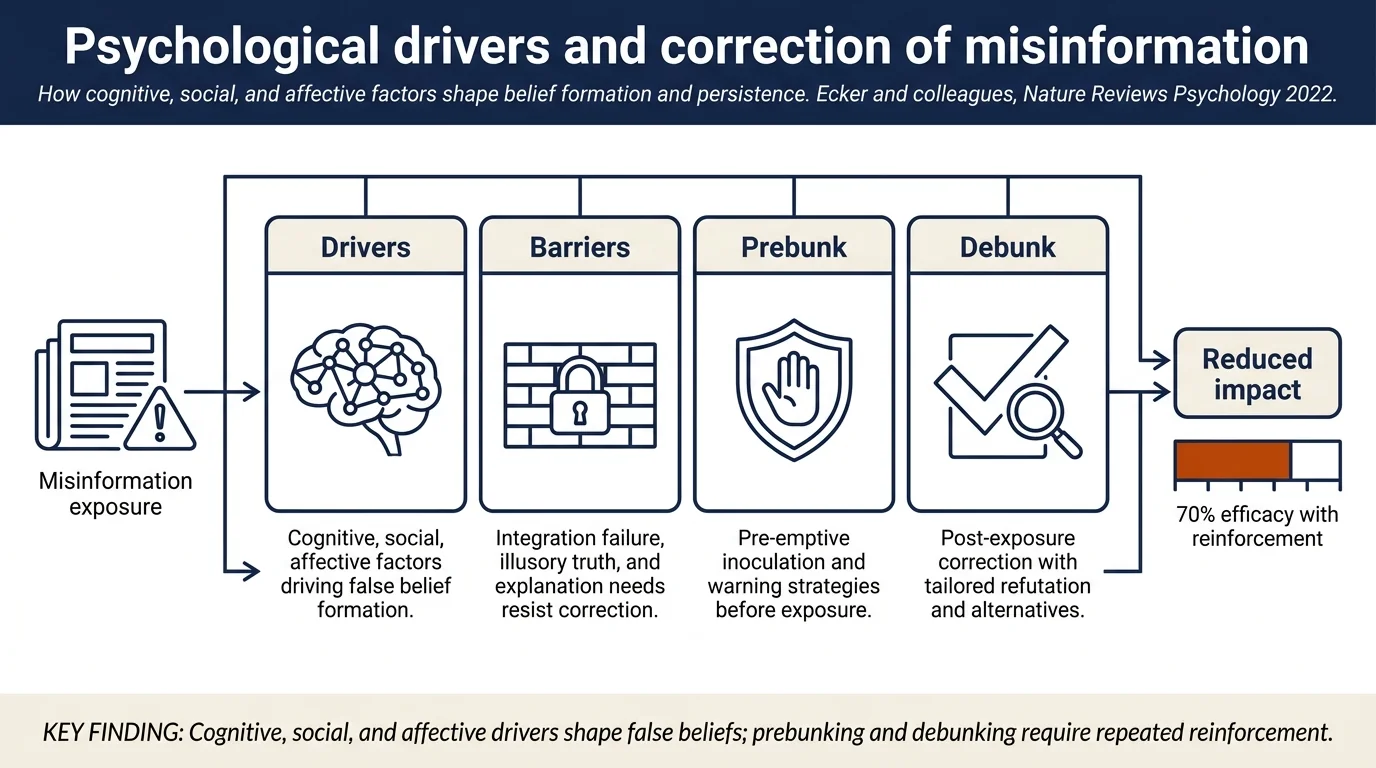 Psychology & interventionsFact-checking & verification
The psychological drivers of misinformation belief and its resistance to correctionThis comprehensive review establishes that misinformation's power lies not in exposure but in how cognitive, social, and affective factors shape belief formation and persist even after correction. False beliefs arise from intuitive thinking, memory failures, emotional content, in-group bias, and source credibility judgments; corrections…
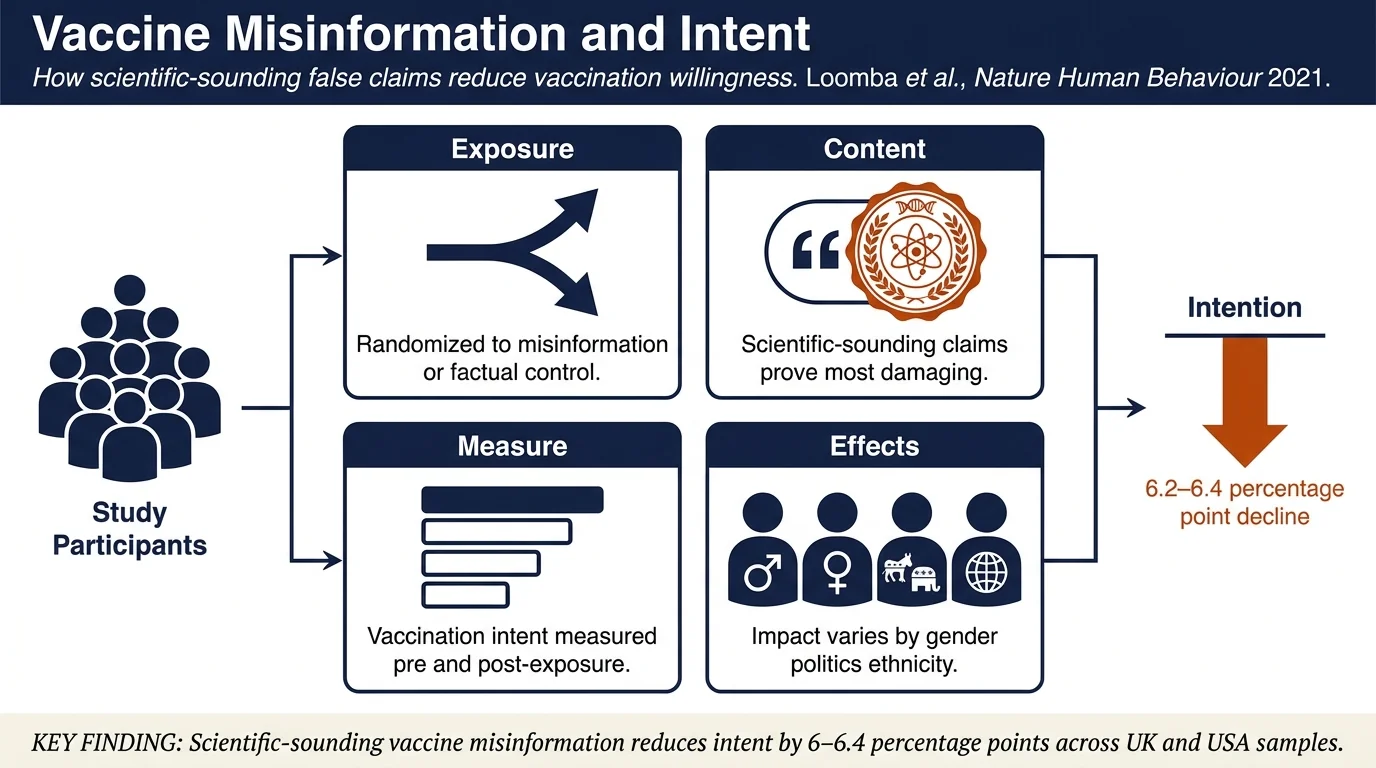 Psychology & interventionsPlatforms, policy & society
Measuring the impact of COVID-19 vaccine misinformation on vaccination intent in the UK and USARandomized controlled trial on 8,001 respondents (4,000 UK, 4,001 USA) measuring causal impact of exposure to COVID-19 vaccine misinformation. Exposure to misinformation reduced vaccination intent by 6.2 percentage points in the UK and 6.4 in the USA relative to exposure to factual information.
 Psychology & interventionsPlatforms, policy & society
Rumors, Truths, and Reality: Political Misinformation in the Modern DayAdam Berinsky surveys a decade of research on why Americans believe political rumors despite contradictory evidence. He identifies two key mechanisms: conspiratorial thinking (a personality trait that varies across individuals) and partisanship (which structures which rumors a person is likely to endorse).
 Platforms, policy & societySpread & networks
How to Demolish the Disinformation InfrastructureKate Starbird, co-principal investigator at the University of Washington's Center for an Informed Public, discusses the state of disinformation in the aftermath of platform removals (Trump, QAnon), focusing on how moderation actions redirect harmful activity to alternative ("alt-tech") platforms rather than eliminating it. She emphasizes…
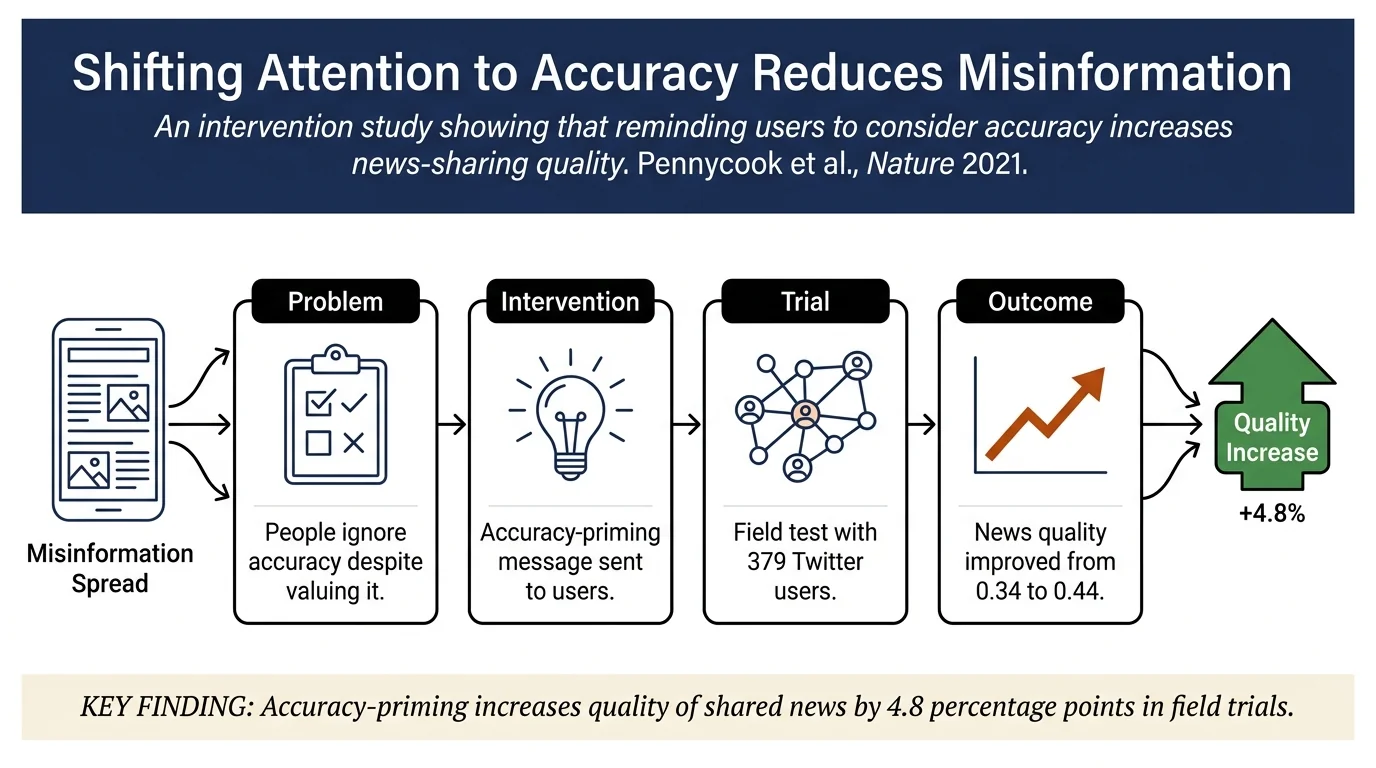 Psychology & interventionsPlatforms, policy & society
Shifting attention to accuracy can reduce misinformation onlineThe paper shows through six online experiments and a Twitter field trial that simply drawing people's attention to accuracy can substantially reduce their sharing of misinformation. When asked to rate the accuracy of headlines before deciding whether to share them, participants share more accurate content; a Twitter field experiment…
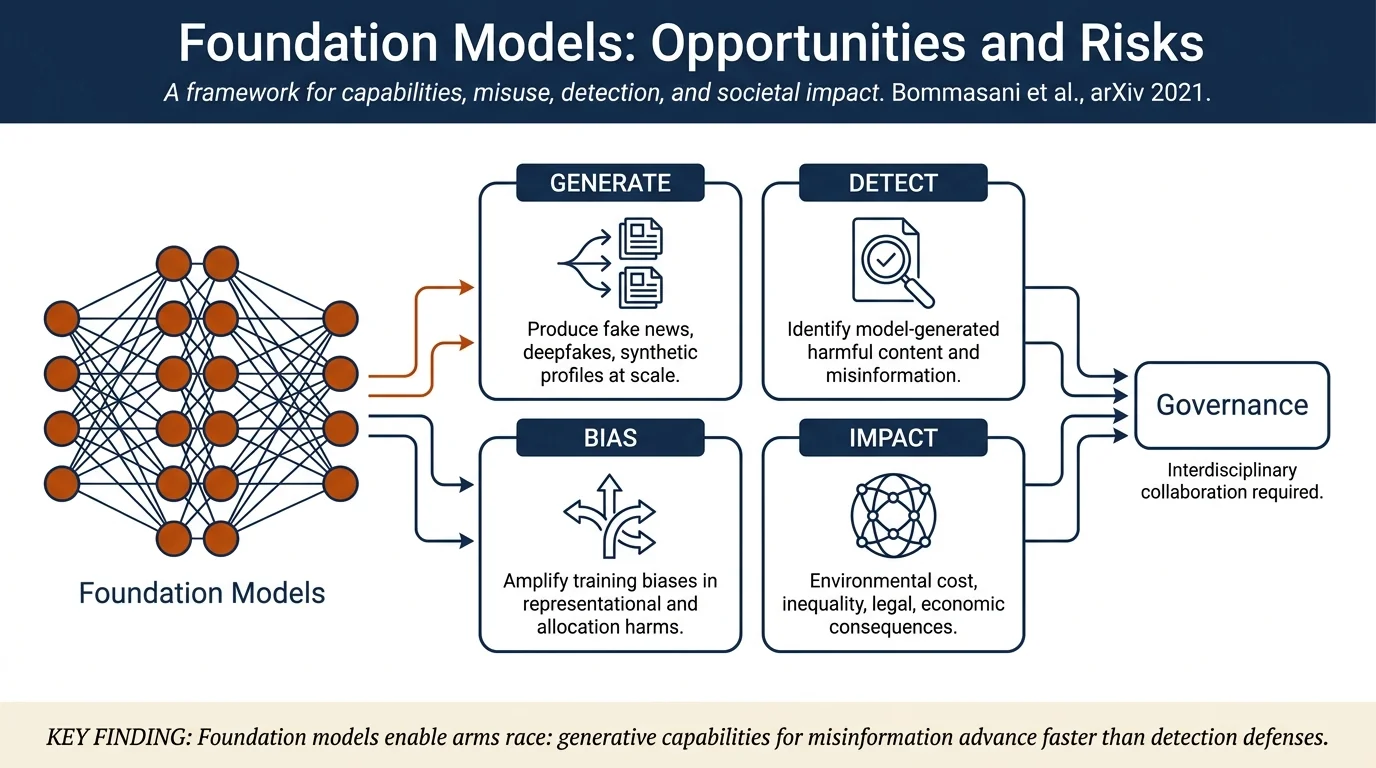 LLMs & generative AIDeepfakes & multimodal
On the Opportunities and Risks of Foundation ModelsA comprehensive 214-page report analyzing foundation models—large neural networks trained on broad data that can be adapted to diverse downstream tasks (BERT, GPT-3, DALL-E). The report maps capabilities across language, vision, and reasoning; applications in healthcare, law, and education; and societal risks including misuse (generating…
 Detection methodsLLMs & generative AI
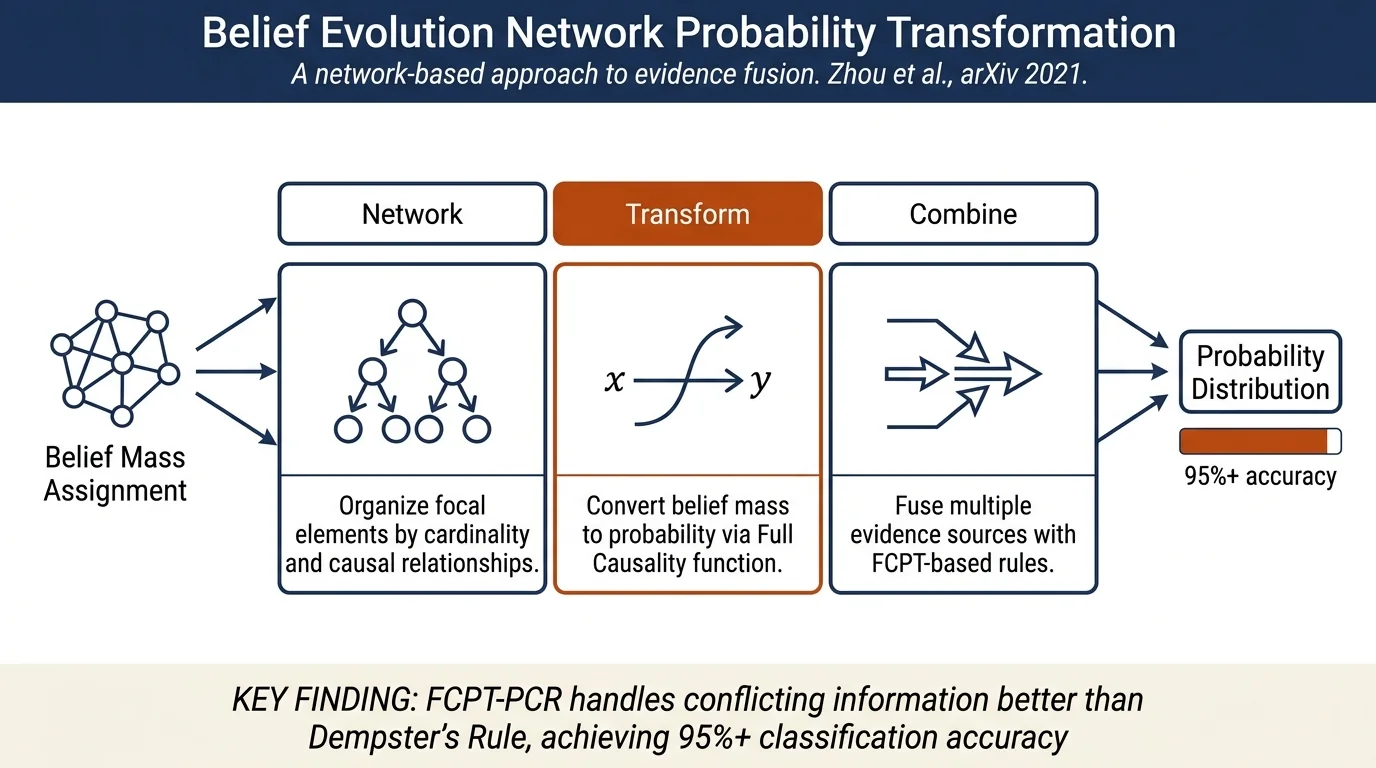
Belief Evolution Network-based Probability Transformation and FusionThis paper introduces a Belief Evolution Network (BEN) to model the evolution of belief functions and proposes a new Full Causality Probability Transformation (FCPT) method for converting belief mass assignments to probability distributions. The authors also propose FCPT-based fusion rules that outperform traditional Dempster's Rule of…
 Spread & networksDetection methods
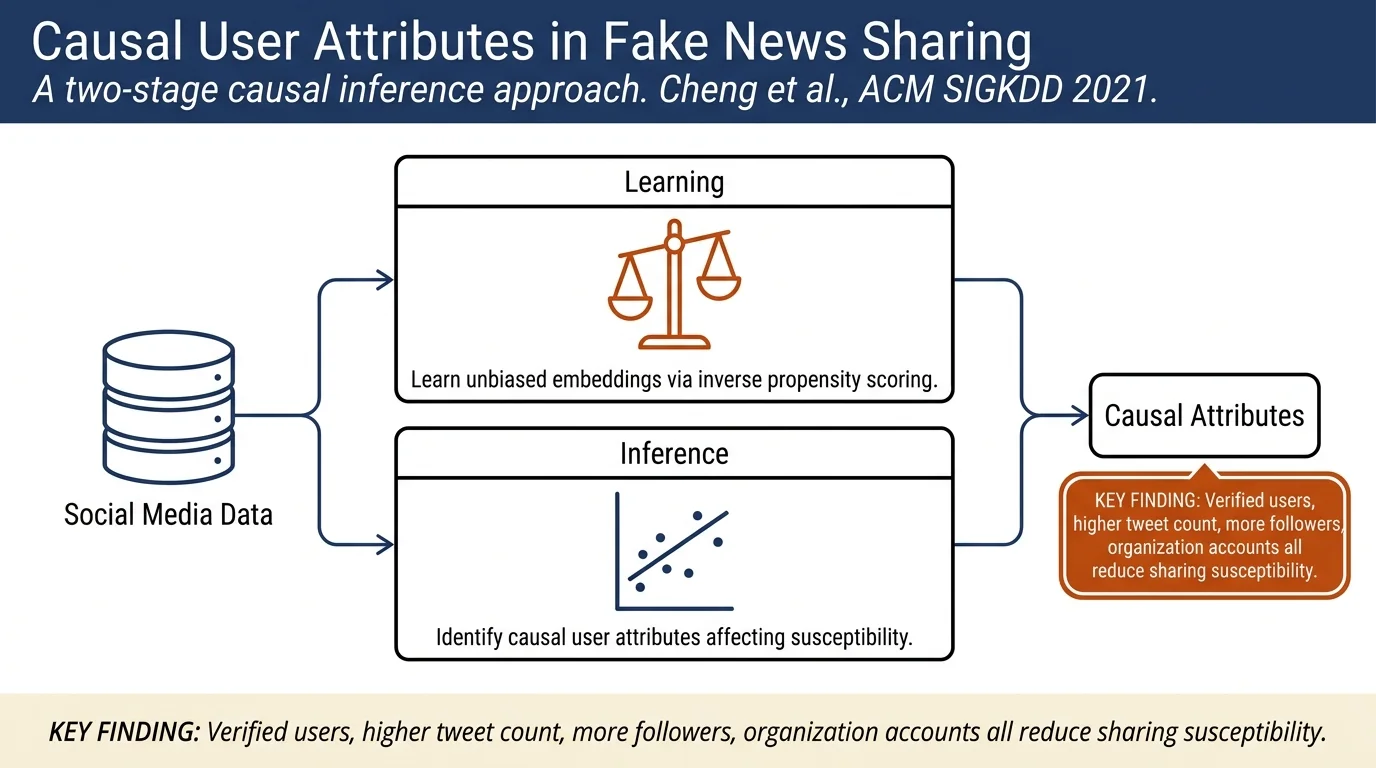
Causal Understanding of Fake News Dissemination on Social MediaThe paper addresses the fundamental causal question: what user attributes cause susceptibility to share fake news? Rather than observing correlations, the authors use inverse propensity scoring (IPS) to learn unbiased embeddings of fake news sharing behavior, treating these embeddings as confounders in a causal model.
 LLMs & generative AIPlatforms, policy & society
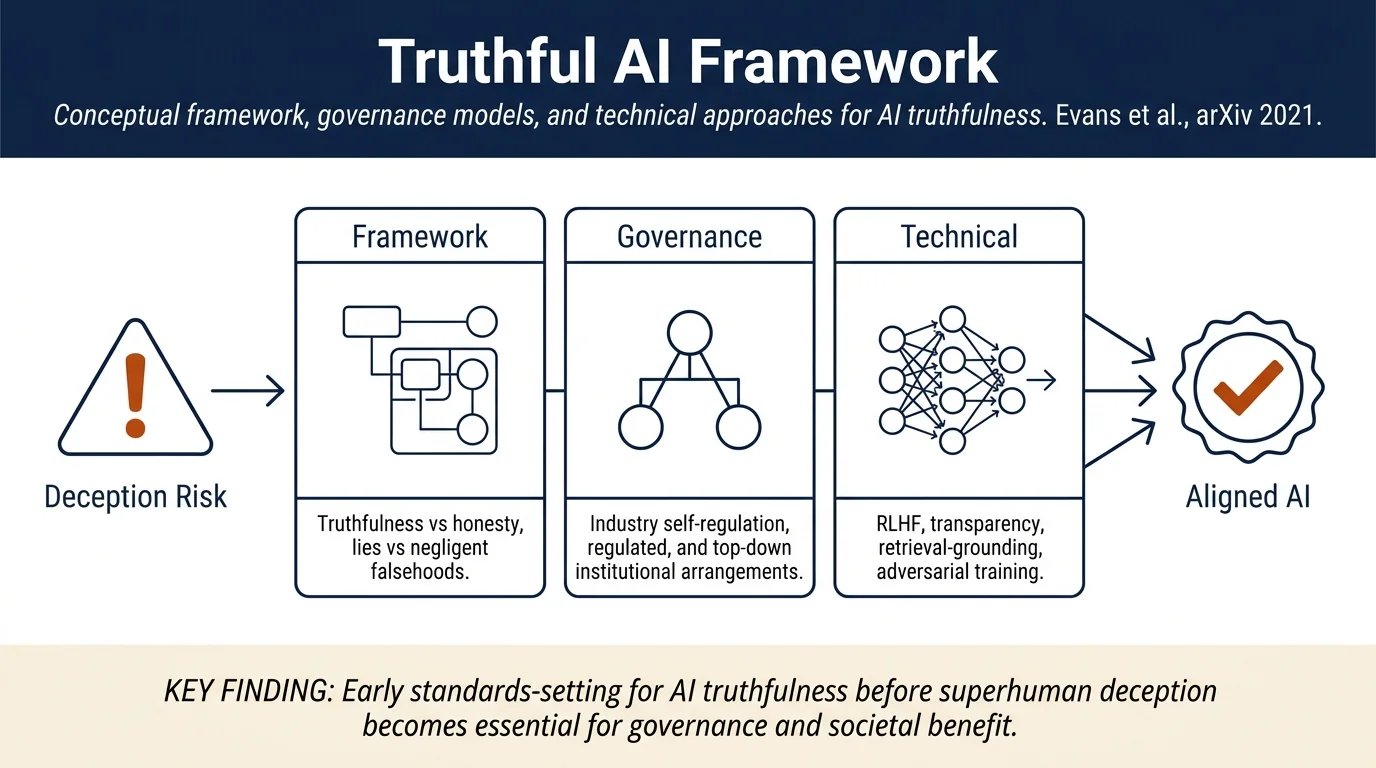
Truthful AI: Developing and Governing AI That Does Not LieAs AI systems become more capable and widely deployed, strategic falsehoods—"lies" that AI generates to achieve specified objectives—pose increasing risks. This paper proposes a framework of truthfulness standards for AI systems, governance mechanisms to enforce them (including certification bodies and verification procedures), and…
 Platforms, policy & societyBots & coordinated campaigns
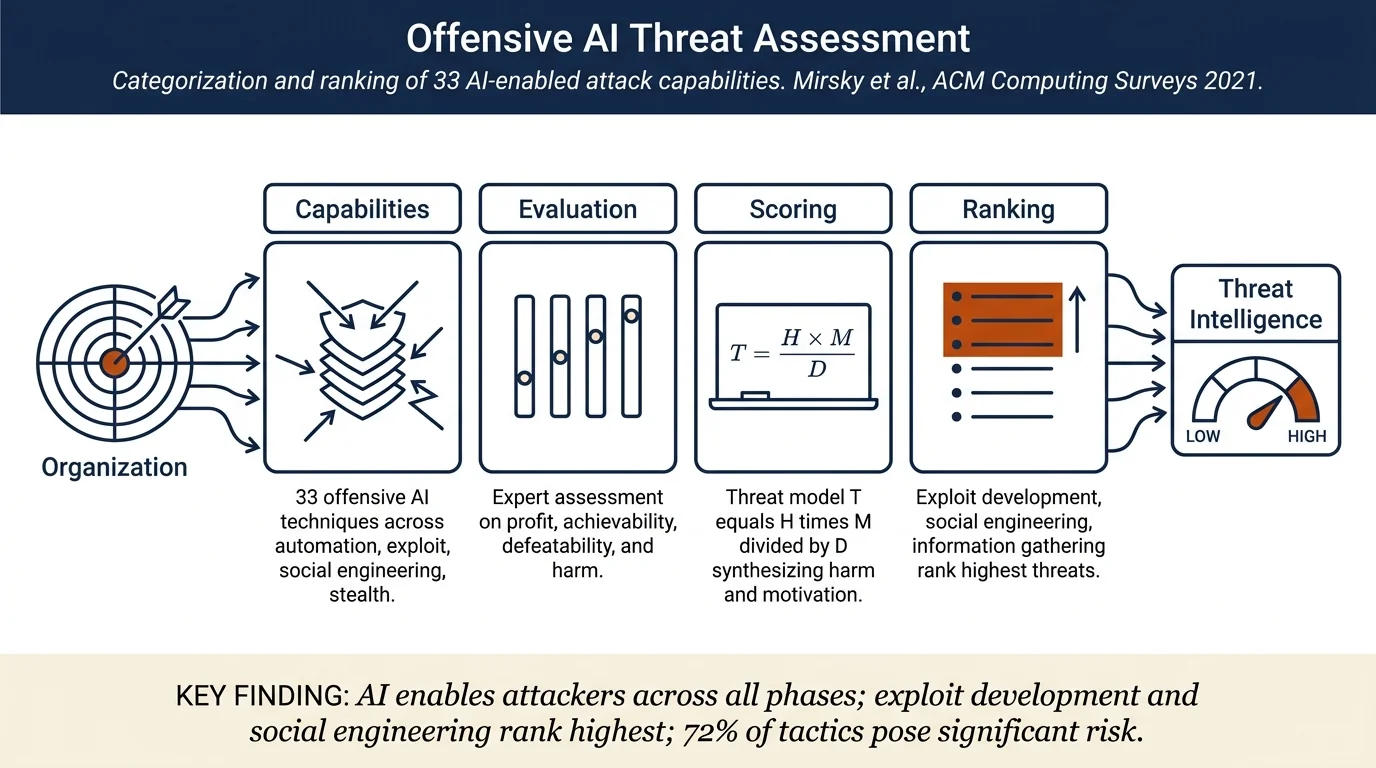
The Threat of Offensive AI to OrganizationsA comprehensive survey identifying 33 offensive AI capabilities that adversaries can use to attack organizations, organized into seven categories: automation, campaign resilience, credential theft, exploit development, information gathering, social engineering, and stealth. Through a user study with 22 experts from academia and industry,…
 Spread & networksPsychology & interventions
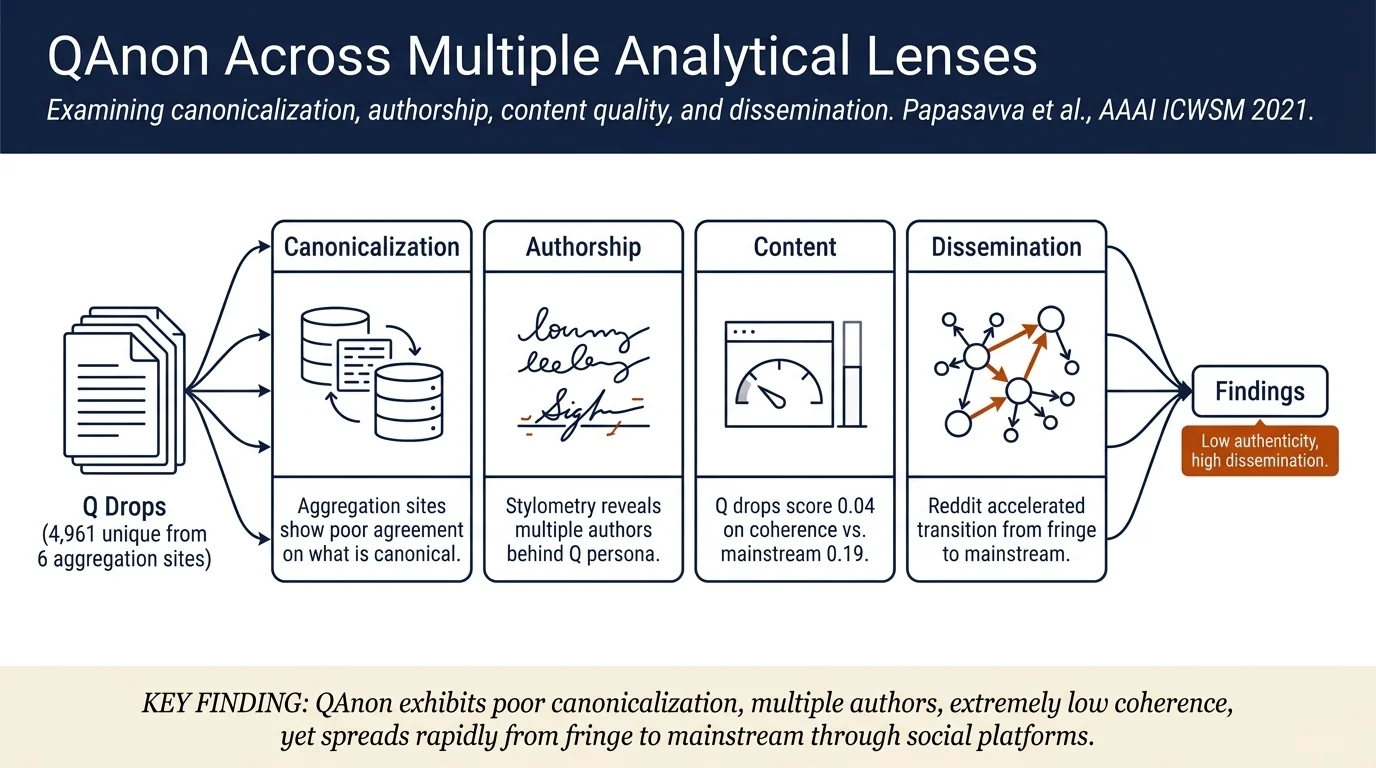
The Gospel According to Q: Understanding the QAnon Conspiracy from the Perspective of Canonical InformationThis paper systematically studies the QAnon conspiracy theory by collecting and analyzing 4,961 unique Q drops from six aggregation sites. The authors find that aggregation sites show poor agreement on what constitutes a canonical Q drop, that Q drops are incoherent and low-quality relative to other social media platforms, and that…
 Spread & networksPlatforms, policy & society
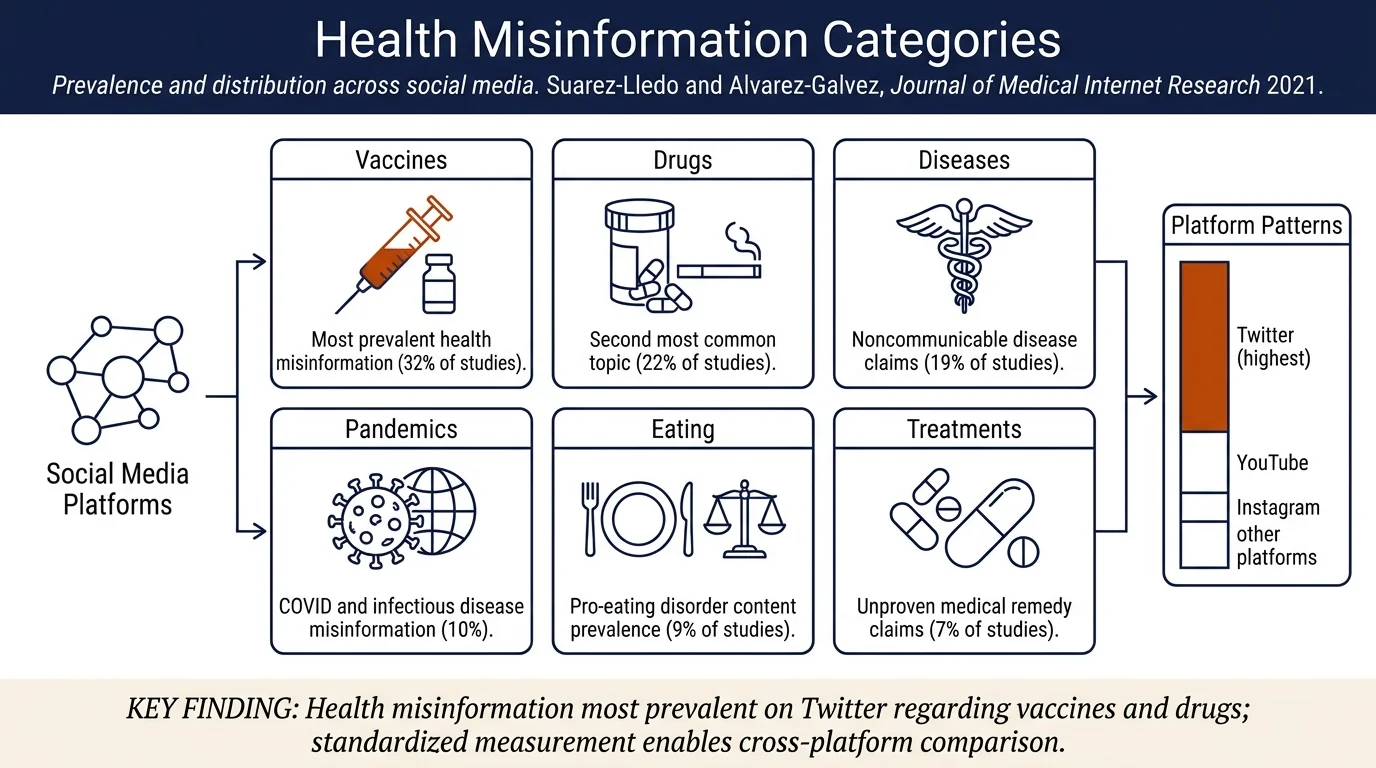
Prevalence of Health Misinformation on Social Media: Systematic ReviewThis systematic review of 69 studies characterizes health misinformation topics and their prevalence across social media platforms. Health misinformation was most prevalent on Twitter regarding smoking and drugs; vaccines, noncommunicable diseases, and pandemics were also common topics.
 Spread & networksPlatforms, policy & society
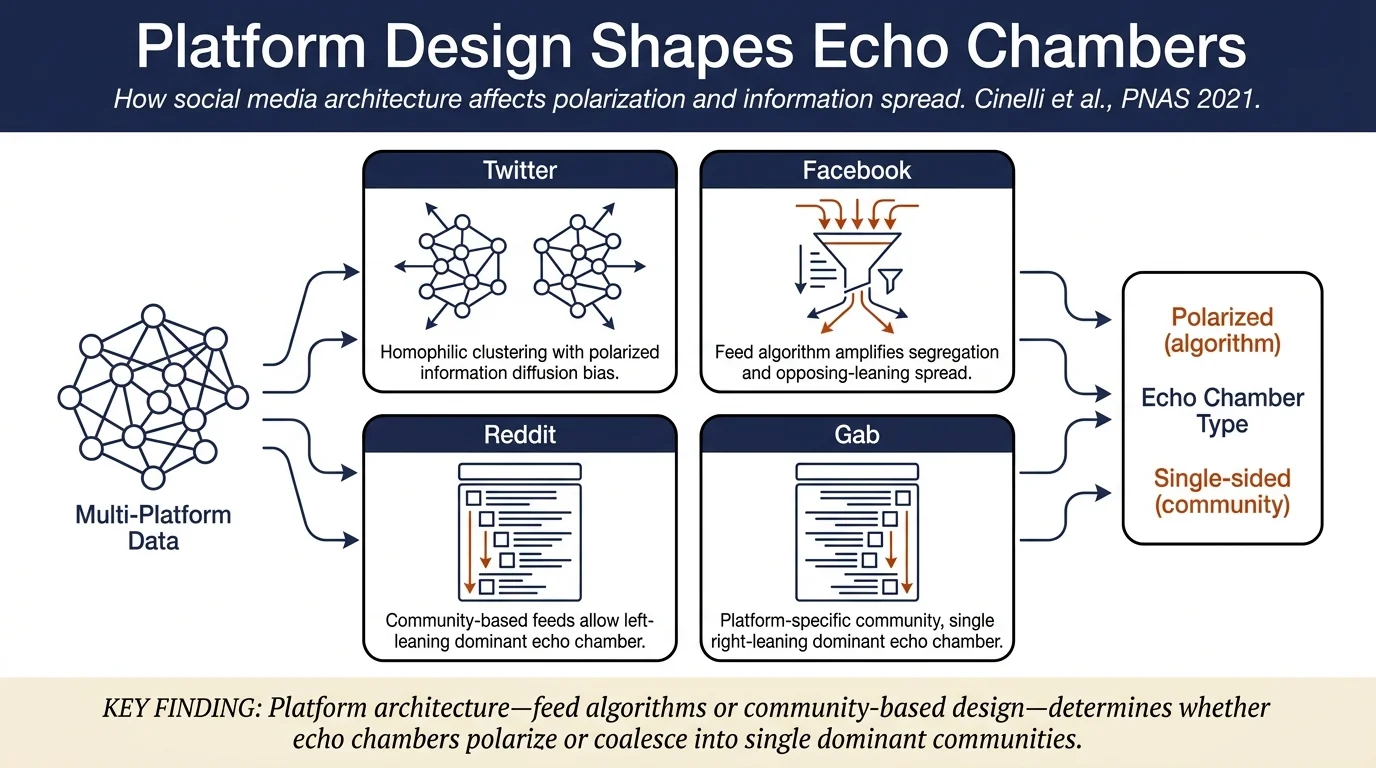
The echo chamber effect on social mediaComparative analysis of 100+ million posts across Twitter, Facebook, Reddit, and Gab on controversial topics shows echo chambers operate differently by platform: Facebook and Twitter exhibit strong homophilic clustering and polarized information diffusion, while Reddit and Gab show single-sided communities without the biased diffusion…
 Spread & networksPlatforms, policy & society
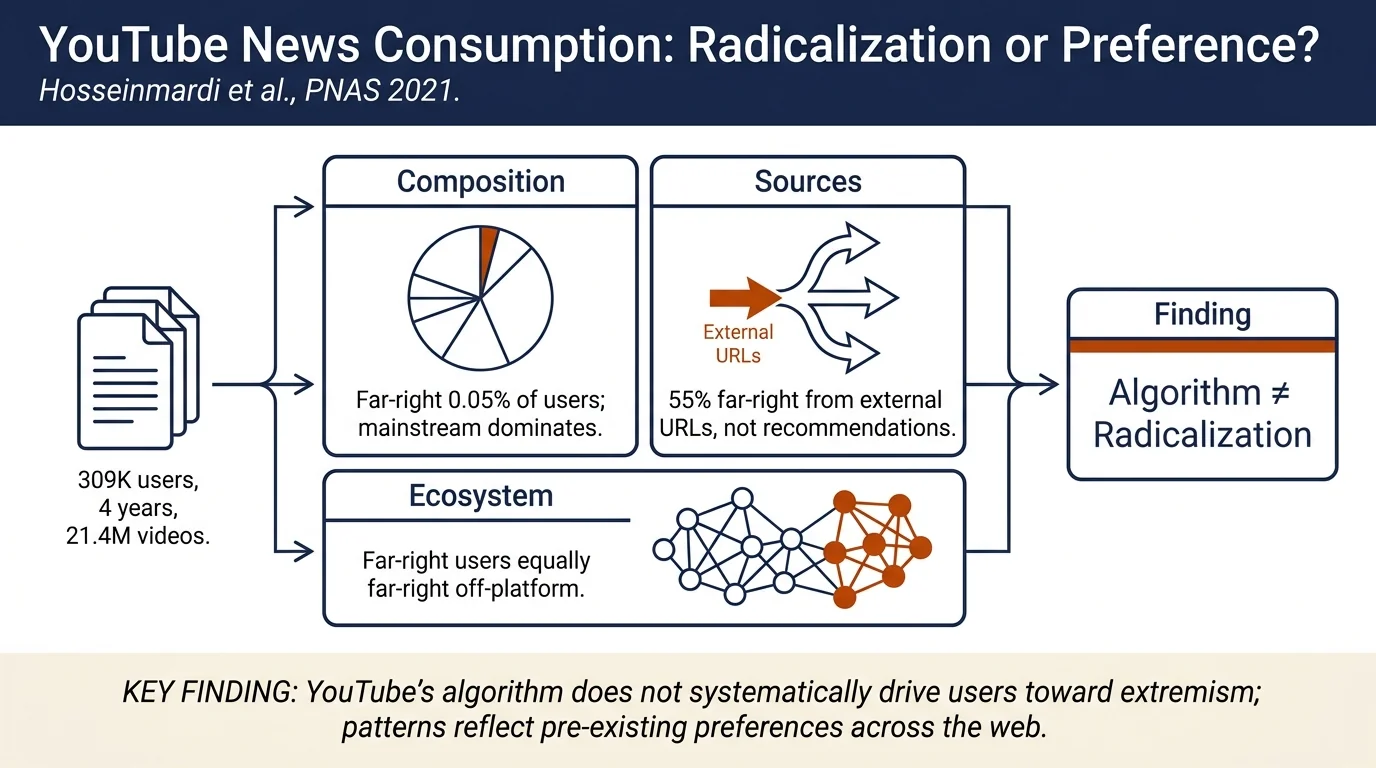
Examining the consumption of radical content on YouTubeLarge-scale study of 309,813 U.S. users' YouTube and web browsing from 2016–2019 finds that news consumption on YouTube is dominated by mainstream, centrist sources. While far-right content exists and engages users intensely, it remains a small and stable share.
 Psychology & interventionsPlatforms, policy & society
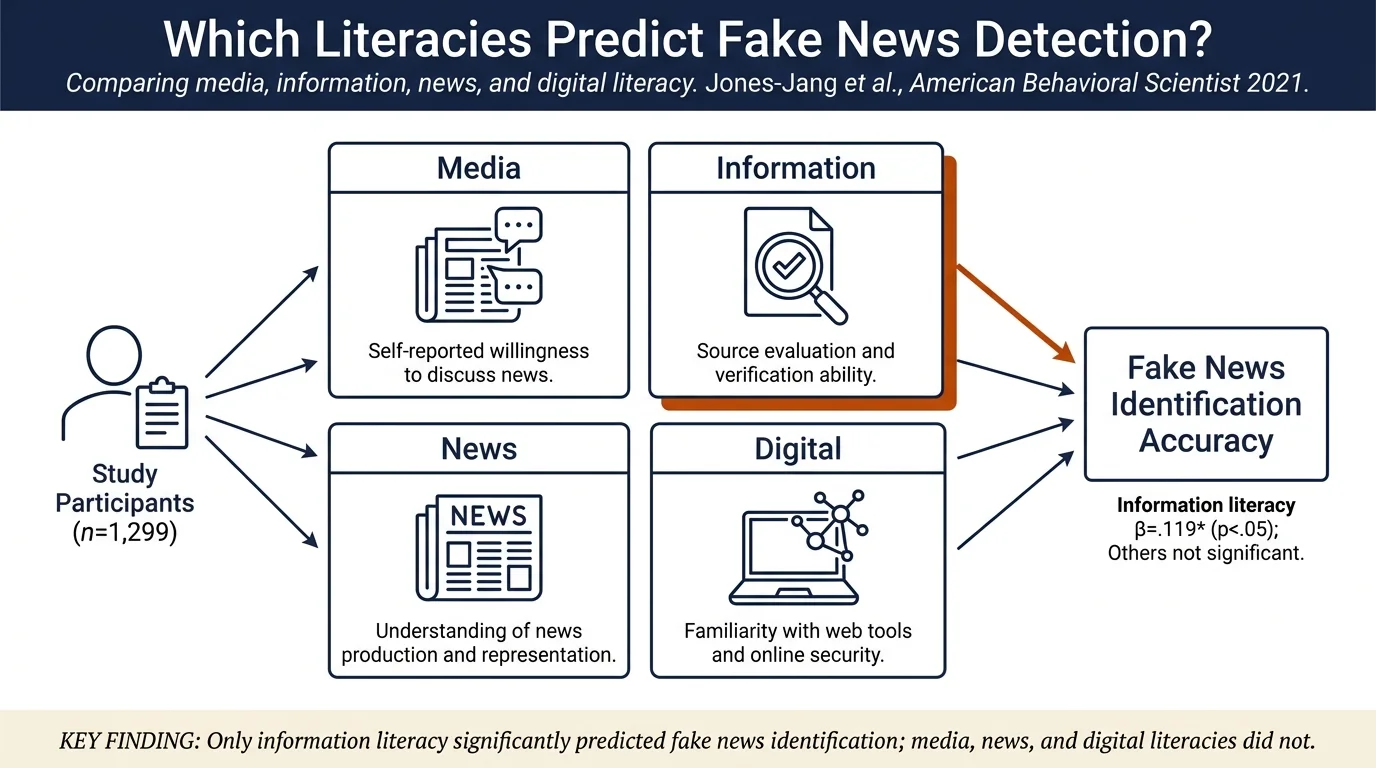
Does Media Literacy Help Identification of Fake News? Information Literacy Helps, but Other Literacies Don'tA survey of 1,299 U.S. citizens tests whether four types of media literacy—media, information, news, and digital—predict ability to identify fake news. Only information literacy (the ability to search and evaluate verified sources) significantly improves fake news identification; media, news, and digital literacies showed no significant…