Information Self-Sufficiency and Its Paradox
The chapter opens by documenting youth's increasing dependence on digital information for major life decisions: booking travel, medical information, education. This trend creates an "information self-sufficiency paradox": users are simultaneously more responsible for their own information decisions (without traditional intermediaries) and more dependent on the tools and information provided by others. Physical examination and trust in institutions are increasingly replaced by digital-only transactions, forcing users to assess credibility based entirely on information—with fewer physical or institutional cues to rely on.
From Authority to Reliability
A central theme is the shift from authority-based to reliability-based credibility assessment. Traditional authority approaches (trusting a single recognized expert or institution) are inadequate in digital environments where sources proliferate. The chapter proposes reliability as the organizing principle: users synthesize information from multiple sources, test for consistency, and assess dependability over time. This shift reflects a broader decentralization of authority on the Internet, where "anyone" can be an authority, requiring users to evaluate information rather than simply defer to institutions.
The Invisible Architecture of Credibility
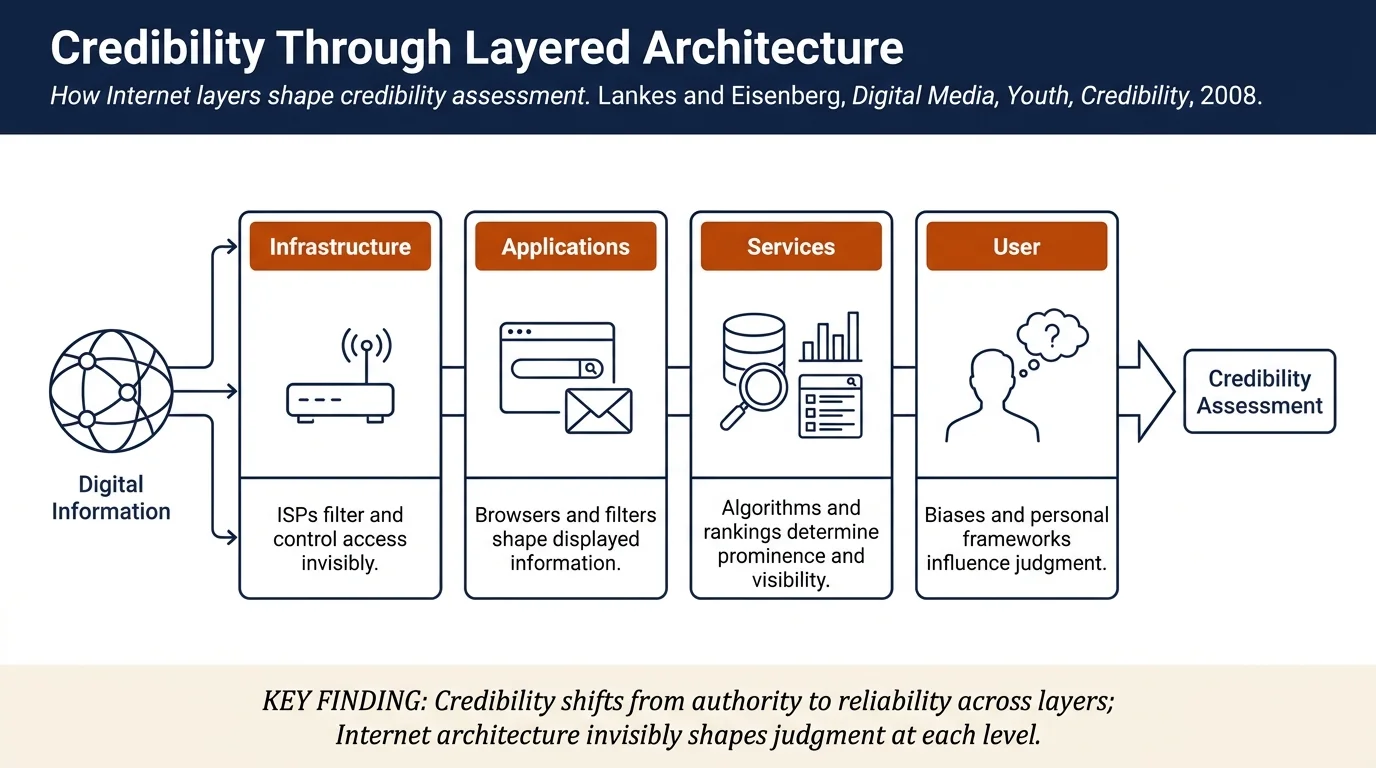
The chapter introduces the Lankes/Eisenberg Architecture—a layered model of the Internet showing how credibility is manipulated invisibly at each level:
- Infrastructure (routers, protocols): Internet Service Providers can block or filter access; users rarely know.
- Applications (browsers, email clients): Spam filters, page load times, and presentation choices silently shape what users see.
- Information services (Google, Wikipedia, social platforms): Search rankings, recommendation algorithms, and editorial choices determine prominence and visibility.
- User layer (individuals, biases, heuristics): Users bring their own cognitive biases and frameworks.
Each layer can affect credibility determinations without users' awareness. This framework explains why credibility assessment in digital environments is fundamentally different from physical-world evaluation: much of the manipulation is invisible.
Reliability, Open Systems, and Participation
The chapter discusses how open systems, transparency, and user participation can support reliability-based credibility assessment:
- Open source software: By making source code publicly available and testable, open source projects build credibility through transparency and community participation, not by claiming authority.
- Participation and conversation: Interactive tools that allow users to discuss, contribute, and scrutinize information (e.g., Wikipedia editing, collaborative documents) enable credibility assessment through ongoing dialogue rather than passive consumption.
- Digital literacy and infrastructure access: For youth to truly assess credibility, they must understand the technical layers that shape information flow. Schools that filter or restrict access to the underlying infrastructure paradoxically limit youth's ability to learn credibility assessment.
The "Credibility Conversation"
The chapter proposes that effective credibility assessment should frame the process as a conversation among peers, rather than a one-way authority pronouncement. Youth using digital media should:
- Seek out tools that enable participation and discussion
- Engage in collective knowledge-building (e.g., Wikipedia contributions)
- Learn to access information and tools alongside others in their networks
- Critically evaluate information in conversation with peers and mentors
This conversational approach aligns with learning theory (scaffolding, knowledge co-construction) and is well-suited to digital networks' affordances.
Implications for Education and Policy
The chapter concludes by identifying tensions for educators and policymakers:
- Digital literacy paradox: Teaching youth to identify and defend against misinformation by blocking access to that information (content filters) is counterproductive—youth need to engage with and scrutinize information to develop true credibility judgment skills.
- Information architecture transparency: For youth to assess credibility, they must understand (and be able to influence) the technical systems shaping information access.
- Participation and power: As youth take on more responsibility for credibility determinations, they need tools and environments that enable genuine participation, not just consumption.
Notes
Strengths: The chapter offers a distinctive layered model of how Internet architecture shapes credibility invisibly. The distinction between authority and reliability is conceptually clear and well-motivated. The emphasis on participation, transparency, and conversation as approaches to credibility assessment is prescient and aligns well with contemporary digital practices (open source, Wikipedia, social platforms).
Scope and audience: Addressed to educators, designers, and policymakers, not just researchers. Assumes familiarity with communication and education concepts but not technical depth.
Limitations and context: Written in 2008, before algorithmic recommendation systems, social media at scale, and generative AI. The chapter does not address algorithmic credibility manipulation, coordinated disinformation, or deepfakes—phenomena that have since become central to credibility concerns. The optimism about open systems, Wikipedia, and user participation reflects the pre-algorithm era. Nevertheless, the foundational argument—that credibility is determined by invisible architecture at multiple layers, and that transparency and participation are essential—remains relevant.
Relationship to other chapters: Complements Sundar's MAIN model (ch. 5) by grounding technology effects in a broader information-architecture framework. Anticipates Harris's (ch. 8) discussion of teaching credibility in schools, and Eysenbach's (ch. 7) attention to domain-specific credibility (health).