Contributions
- Categorizes three distinct government policy approaches to Internet credibility: restrictive (censor role), supportive (educator and trusted source roles), and identifies specific policy examples for each
- Analyzes the tension between multiple political and constitutional values in credibility policy debates (privacy vs. law enforcement access, free speech vs. harm prevention, intellectual property vs. information flow)
- Introduces concrete credibility policy scenarios (pharmaceutical fraud, doughnut-earth conspiracy, education, government agency information) to illustrate how the same credibility issue generates different policy responses depending on context, authority domain, and stakeholder interests
- Argues that government faces conflicting mandates from technology scale, unintended consequences, and tension between viewing the Internet as either an educational opportunity or a threatening environment for children
- Proposes that addressing Internet credibility effectively requires balanced democratic debate engaging multiple stakeholders, not simplistic good-versus-evil framings
Key Arguments
Three Government Roles in Credibility Policy:
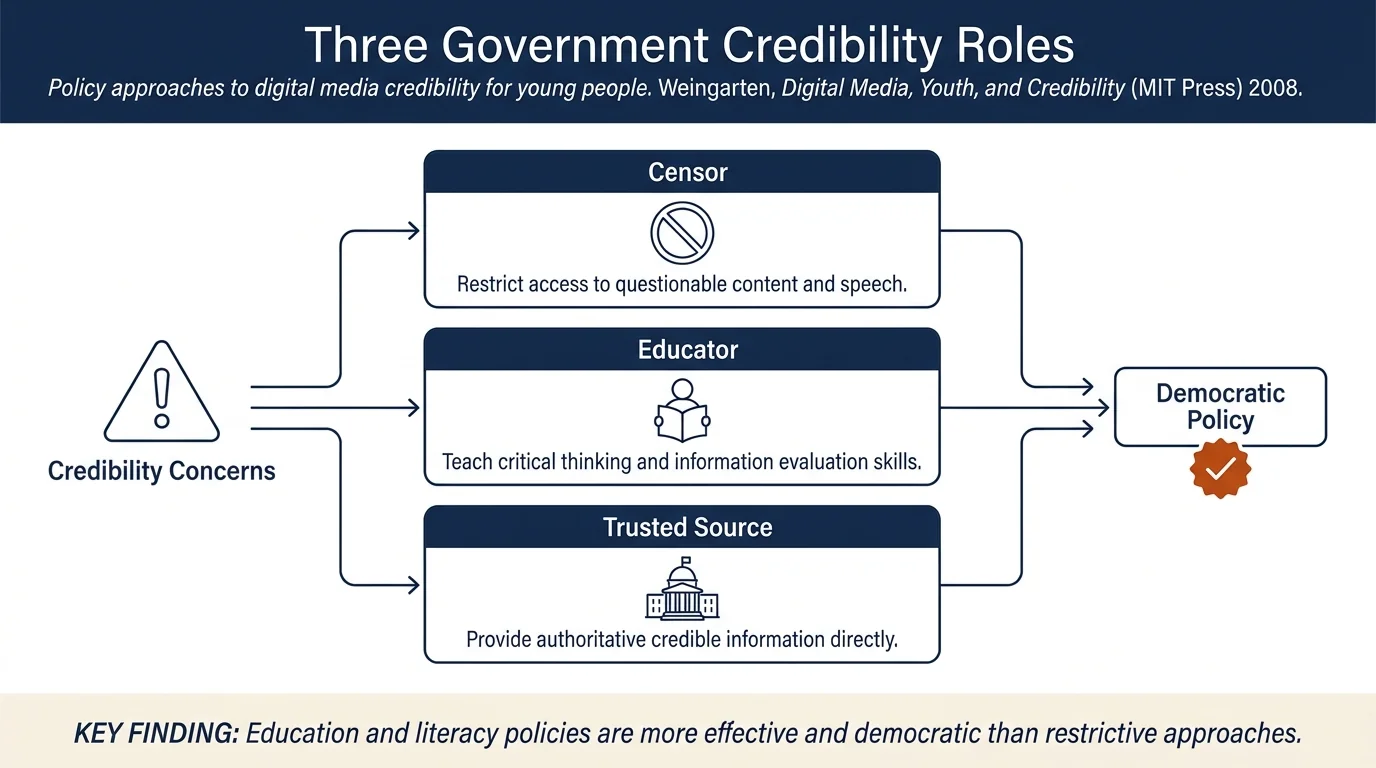
Government can intervene in Internet credibility in three fundamentally different ways. First, government as censor restricts speech and/or access to information the government deems questionable, typically focused on protecting children from harmful content. Second, government as educator directly instructs, develops curricula, and sets educational standards aimed at teaching people how to distinguish credible from non-credible information. Third, government as trusted source collects and disseminates information in ways that help people find credible information directly from government resources or indirectly through expertise and intermediaries.
Throughout the chapter, restrictive policies are referred to as "restrictive," while educator and trusted source policies are referred to as "supportive."
Scale and Unintended Consequences:
A major theme is the gap between technological factors and policy effectiveness. Government regulation struggles because (1) the Internet's scale makes content supervision nearly impossible — anyone can publish anything — and (2) technologies often have unintended consequences. The evolution of communication technologies (telephone, radio, television, Internet) shows that new technologies always generate initial moral panic and regulatory responses, yet the actual societal effects often differ from predictions. For example, the radio was thought to enable uncontrolled parental monitoring, cell phones to allow secret coordination, and the Internet to create anarchic information environments. Each prediction contained a grain of truth but missed the actual complexity of how technologies embed themselves in social practice.
Conflicting Information Values:
A fundamental source of credibility policy debates is tension among four core constitutional/democratic values: privacy (autonomy from government intrusion), freedom of speech (ability to express and hear diverse views), intellectual property (creators' rights to profit), and information access (ability to find and use information needed for participation and decision-making). Credibility policies often require balancing these values, and there is no formula. For instance:
- Privacy concerns conflict with government's need to verify and enforce information accuracy
- Free speech principles conflict with desire to suppress false or harmful speech
- Information access and use conflict with copyright protections
- Educational goals (teaching critical evaluation) conflict with both censorship (easy to implement but undemocratic) and laissez-faire approaches (do nothing)
Education as the Preferred Solution:
The chapter argues that education and information literacy — helping people develop the skills to assess credibility themselves — align better with democratic values and are more likely to be effective long-term than restriction. The government has centuries of responsibility for education and a track record of using education to support both individual capability and democratic participation. However, this approach is also the most difficult and least politically salient (it requires sustained investment and shows effects slowly), which is why restrictive policies and reactive regulation often dominate the policy debate even when they are less effective.
Government as Authoritative Information Source:
A key supportive policy role is for government to be a direct source of credible information. Government has institutional incentives to provide accurate information (legal mandates, public trust, agency reputation) and means to enforce consistency and accuracy through formal processes. Libraries and public schools have long served as intermediaries helping the public access credible government information. This role assumes government itself is trustworthy — a proposition that is itself contested in political debate.
Notes
Weingarten brings a policy and institutional perspective to what is largely a cognitive and educational literature. The chapter's value lies in clarifying that credibility debates are fundamentally about competing values and policy choices, not technical problems. The pharmaceutical, doughnut-earth, government website, and spam scenarios illustrate that identical credibility issues generate different policy imperatives depending on the domain, the harm at stake, and the authority relationships involved.
The tension between viewing the Internet as transformative educational opportunity versus threatening environment for children maps onto real political divides that have persisted for decades across communication technologies. The chapter implicitly argues that moving toward balanced policy requires explicit acknowledgment of these competing frames rather than assuming one narrative (opportunity or threat) is correct.
A limitation is that the chapter predates social media, algorithmic recommendation systems, and data-driven misinformation campaigns, which have shifted the scale and coordination dimensions of the credibility problem significantly. Nevertheless, the fundamental framework — government roles, constitutional value tensions, the case for supportive over restrictive policies — remains relevant.