Contributions
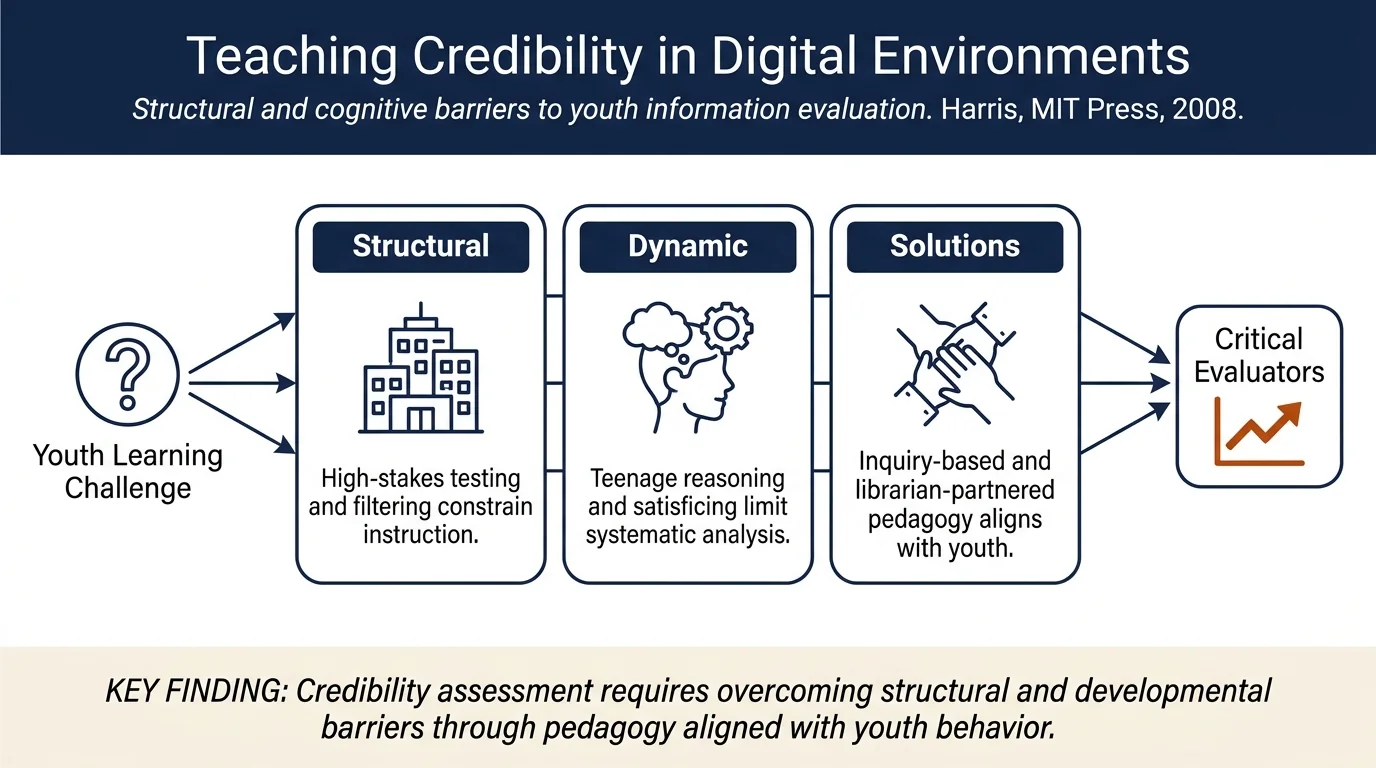
- Distinguishes structural challenges (institutional, policy-driven) from dynamic challenges (cognitive, developmental) to teaching credibility assessment in schools.
- Documents how US decentralized education governance, combined with high-stakes testing mandates, systematically crowds out credibility instruction despite consensus among educators about its importance.
- Shows how adolescent cognitive development and adolescent rebellion against authority intersect to complicate credibility instruction—teenagers question imposed rules but lack analytic strategies for genuine evidence evaluation.
- Demonstrates that young people's information-seeking behavior relies on satisficing (sufficiency-based heuristics) rather than systematic optimization, with time and motivation constraints driving pragmatic shortcuts rather than deep analysis.
- Proposes pedagogical reframing: teach credibility assessment by leveraging students' existing Web engagement, collaborating with school librarians, using inquiry-based projects, and capitalizing on digital media production as a credibility-transparent activity.
Structural Challenges
The US education system is locally controlled but nationally influenced. While no federal curriculum mandate exists, state graduation requirements and high-stakes testing (esp. NCLB) powerfully shape what teachers must prioritize. High-stakes accountability means school success depends on reading and math test scores—not on critical thinking or media literacy. Filtering software mandated by CIPA (Children's Internet Protection Act) restricts student access to digital media and reduces teaching opportunities, even when filters block legitimate resources for school-related research. Professional standards from organizations like ISTE (International Society for Technology in Education), AASL (American Association of School Librarians), and ACRL (Association of College and Research Libraries) promote credibility assessment, but adoption is voluntary and uneven. Many school districts lack resources to fund professional development or time for teachers to coordinate around this topic, leaving credibility instruction scattered across information literacy, critical thinking, and English language arts without unified framing.
Dynamic Challenges
Adolescence itself presents challenges. Teenagers are developmentally prone to questioning rules and authority—a healthy independence instinct—but this teenage rebellion can manifest as resistance to credibility guidelines, believing they are old enough to form reliable judgments. Adolescent cognitive development is still maturing; abstract logical reasoning and metacognitive awareness (ability to reflect on one's own thinking processes) continue through the late teens and into early adulthood. Young people's everyday information seeking is driven by satisficing: when motivated to find information quickly, they adopt heuristic shortcuts rather than systematic analysis. Time constraints, information overload, and social motivation (seeking answers from friends rather than libraries) mean young people often prioritize speed over verification. The Web environment compounds these challenges—conflicting cues (a site may look professional yet contain misleading content), context deficit (searching decontextualizes sources), and Wikipedia's collaborative authorship model (which students struggle to understand).
Solutions
The chapter proposes capitalizing on what young people are already doing: rather than imposing external checklists, educators can build credibility assessment into inquiry-based projects where students naturally evaluate information as they research. School librarian partnerships are essential; librarians can embed credibility guidance into research instruction. Using digital media production itself as a learning tool makes credibility transparent—when students create digital content, they become aware of how design choices, sourcing, and authority signals shape what others perceive as credible. Institutional culture change is necessary: schools can position credibility assessment as a core competency across subjects, not an isolated unit in English class.
Notes
Strengths: Pragmatic framing of institutional barriers that acknowledge the gap between educational ideals (teach critical thinking) and systemic constraints (high-stakes testing, filtering, lack of coordination). Useful taxonomy distinguishing structural obstacles (policy, governance) from cognitive/developmental ones. Concrete classroom examples (Martin Luther King Jr. web search deception, Wikipedia credibility confusion) illustrate challenges vividly. Proposes solutions aligned with existing youth behavior rather than imposing new frameworks.
Limitations: Written in 2008, before social media platforms became primary news sources for youth; predates algorithm curation, verification via social networks, and AI-generated content. Some institutional details (NCLB specifics, early-2000s filtering approaches) are dated. The chapter gestures toward solutions but doesn't empirically test their effectiveness.
Pedagogical contribution: This chapter speaks directly to educators designing credibility instruction. It reframes media literacy not as a subject to squeeze in but as a competency woven through inquiry-based learning, library partnerships, and digital production projects. The distinction between structural and dynamic challenges is conceptually useful: acknowledging structural barriers helps educators strategize within real constraints rather than blame student or teacher failure on individual shortcomings.
For GUIDE: Foundational reference on the tension between credibility assessment as an educational ideal and the systemic, developmental, and technological obstacles to implementation. Essential reading for anyone designing misinformation interventions targeting youth or developing educational curricula on information evaluation.